
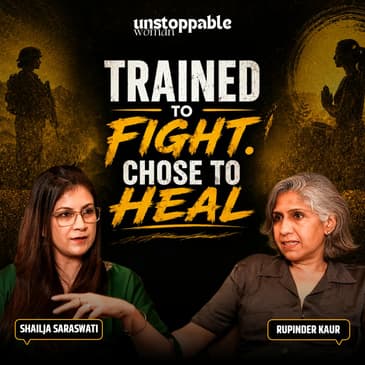

What happens when a life built on discipline takes an unexpected turn? In this episode of Unstoppable Woman, Shailja Saraswati sits down with Captain Rupinder Kaur (Retd), whose journey spans army life, leadership, adversity, healing, and reinvention.
Growing up in an army environment taught her resilience, adaptability, service, and the ability to keep moving forward no matter the circumstance. But some of life's most important lessons came not from structure and discipline, but from navigating uncertainty, illness, personal transformation, and the courage to begin again.
From the values of military life to the world of natural healing and holistic wellbeing, this conversation explores what it truly means to reinvent yourself without losing who you are.
Together, they discuss:
• Growing up in an army family and the lessons it leaves behind
• The hidden strengths that come from constant adaptation
• Leadership, resilience, and service
• Why discipline alone is not always enough
• Navigating adversity and personal transformation
• Healing, wellbeing, and finding a deeper sense of purpose
• Reinvention at different stages of life
• The support systems that help us grow and recover
This is a conversation about strength, identity, resilience, and the courage to create a second chapter when life asks you to evolve.
If you've ever faced change, uncertainty, loss, or the need to start again, this episode will resonate deeply.
Guest: Captain Rupinder Kaur (Retd)
Host: Shailja Saraswati
Chapters:
00:00 - Introduction: The Courage to Begin a Second Chapter
03:30 - Born to Serve: Growing Up in an Army Family
08:45 - The Hidden Strengths of Constant Adaptation
14:20 - Leadership and Resilience in Uniform
20:10 - The Turning Point: When Discipline Alone Isn't Enough
26:40 - Navigating Illness and Personal Transformation
32:15 - Discovering Naturopathy: The Story of Natural Healing
38:50 - The Mentor's Impact: Guidance Through the Shift
44:15 - The Art of Ageless Reinvention
51:30 - Final Reflections: Living with Deeper Purpose
About Unstoppable Woman
Unstoppable Woman is a leadership and transformation conversation platform that explores the inner journeys behind extraordinary lives. Through powerful conversations with leaders, founders, creators, changemakers, and experts, we uncover the deeper patterns of resilience, self-trust, reinvention, and inner authority.
Hosted by Shailja Saraswati, Founder of Unstoppable Network.
[00:00:00] It also meant me and my brother, I have an older brother, we grew up in empty houses. My mother was commanding hospitals, she was always at work. Because I don't think children understand achievement, children understand presence. And I was no different. You know, I'm still curious about the kid in you and when you were feeling what you were feeling. The cost your mother was paying was actually... Family life.
[00:00:29] If you don't want to hire an army person, why are you talking to me? If you don't like discipline, why are you wasting my time and your time? It triggered me, you know, because again, discipline is a fundamental of the army. While I was working with Google, that I got diagnosed with tuberculosis of the spine. One vertebra of my spine, put a titanium plate, supported it with some more bone from my body.
[00:00:57] And for 3-4 months, I lay flat on a bed recovering. My focus very quickly shifted was, I'm just 30. I have to get back on my feet. And again at that time came up this resolve of saying, I have to do all your own. Right? And allopathic medicine is not a system I can fully align myself with. So what do I do? Right?
[00:01:24] And hence I decided this time, full time, that I am going to get into this properly. So I went back to do a 3.5 year diploma in it. You are not a story of reinvention, you're a story of integration.
[00:01:36] So see, we are meeting absolutely after like almost three decades. Right? But today I just really want to focus on the parts which I've really missed and the audience would be really keen to know what's
[00:02:05] the part of becoming Rupi 2.0 version which is sitting in front of me today. Oh wow! A lot has happened, a lot has been absorbed in you. And I can see all the shades and changes which you've gone through in all these years. But before we start, before we start, we have a ritual in which we bring you into the unstoppable circle. So I'm going to just ask you the first key. Are you ready? Yes, I think so.
[00:02:33] So what is that one value you refuse to compromise on no matter what? Honesty. Okay, so that was your first key. Second is when pressure rises, what is that one inner practice that brings you back to yourself? This too shall pass. I mean, I think enough has happened over the last so many years to understand that situations change.
[00:03:02] And we all have a lot of resilience. So when things get very hard and things do get very hard, they also pass. In one sentence, what does being unstoppable mean to you at the beginning of the show? So when I think of the word unstoppable, especially because it's a word you use a lot,
[00:03:31] to me, I think it means movement. It means change. And it means evolving. So I think for me, what if I have learned something from my life is that stagnation is not an option. Stagnation rots, whether we apply it to our lives or to water.
[00:03:59] And as long as we are constantly evolving and moving and doing something about things, we are okay. So when I think of your word unstoppable, that's what comes to my mind. Okay. In fact, that's how it is, right? If you were to ask me what is the most constant thing I have experienced in my life? Movement. It's constant movement. And adaptation. Well, you have to. You have. You have. You have. Yes.
[00:04:26] I think I can't talk about my life without talking about my parents. So I'm third generation army. Both my grandfathers were in the British army. And then both my parents were in the army. My mother served for 33 years. My father served for about 34, 35 years. And in comparison, I served for only six. But in some ways, we have a lot of army.
[00:04:51] In fact, once, I think it was last year's Independence Day, when the society I stay in wanted me to say something. So they asked me for a little bio. And it was when I was writing that, that I realized that in these three generations, and I am not part of that bio, they have actually been for five wars. So from World War I to World War II to the Pakistan war and the China war, our family has seen it all. Amazing.
[00:05:20] And then, you know, there is the context of talking about the high achievement which was modeled very early for me with my parents, right? And I think I would definitely like to mention my mother here a little. Sure. Sure. Because, you know, for the longest time, we kept talking about my father as a general, which by itself sounds big.
[00:05:45] But we forgot sometimes, and I have been guilty of that, to look at my mother more closely. Hmm. And she is a pioneer. So Shalja, when I joined the army, I joined in 2000. Right. Right? My army number was 481, which meant that I was the 481st woman to join the Indian army outside of the medical services. Okay. Right? My mother joined in 1963.
[00:06:16] The China war had just happened and there was like a need for doctors and there was an emergency recruitment in the army. When my mother joined, she was two, three women in a batch of 120 male doctors. And they were just a handful of women even in the medical services at that time. Right? So her career is actually very significant. And she went on to become a full colonel and command these big hospitals.
[00:06:44] She commanded a 250 bedded multi-speciality hospital in Amritsar during the days when insigency in Punjab was still there. And in fact, the reason we ended up in Shimla was because she was commanding the military hospital, which was at that time called Walker Hospital. Right. Just hold on to this. Let's just go back and, you know, as a kid, from your eyes, when you're looking at your mom, and she's your mom. Yes. While she might be, you know, at a very high position.
[00:07:14] What was happening to Rupi the kid, Rupi the teenager at that time, absorbing her mom in command, in growth phase? What was happening in the back of your mind? So actually nothing was happening. You know, because like all kids who grow up with parents who can be anything, to me, my mother was my mother. Right.
[00:08:05] It was the bad end of their career. It also meant me and my brother. I have an older brother. We grew up in empty houses. Okay. Right. My mother was commanding hospitals. She was always at work. She was also constantly doing night duties because she was also a pediatrician and a very good one. Right. So she was on call. She would be in hospitals. So we grew up in very large, empty houses. Okay. Right.
[00:08:30] And when I look back, I spend also a lot of time disliking my mother for it because I don't think children understand achievement. Children understand presence. Right. And I was no different. I wanted parents who would be around. I was a regular child and so was my brother. Right.
[00:08:53] So the non-presence and the trade-off that I think women still make when they do high-profile jobs and what it cost them in their family life was also what I grew up with. And, you know, for my early years, I rebelled as a teenager. So I did all the rebellion that, you know, people do saying, I don't want to be like my mother. Okay.
[00:09:20] I think it was only later on, you know, especially when I turned 40. So I didn't need to reflect. Right. So I think when we will talk about what I ended up doing in my life, it came naturally to me. You know, my my desire to become a naturopathy doctor, my desire to go back to health and health systems. Right. And to actually comes from my mother.
[00:09:45] Because what I subconsciously imbibed, right, while also rebelling and holding that tension of I could not have asked for a better role model. They both existed in my house. I wanted to wear the uniform, which I did. I saw it in my parents, what it means to be a good, uniformed soldier. The joke is I have sometimes been very clear in life and sometimes been very confused in life.
[00:10:09] So when I joined the army, it's the most aligned I have felt with who I am. Okay. Okay. So there was no, what I'm trying to trigger. There was also its time had come. So I will also say, you see, certain things when societal change happens. It's never one thing in my mind. Sure. Right. Right. The competence of a woman, according to me, was a big factor.
[00:10:33] But along with that was also, I think, an Indian society in a lot of ways has evolved. Right. It has. Yeah. Was also more and more ready to see women in uniform. You know, when I was posted in Chirinagar and I was there for two and a half years, I joined the, what is called the Ordnance Corps. Okay. Right. Which is the ammunition side of the army. That is where you came and met me. I was posted in an ammunition depot in Ludhiana. Yes, I remember that. When you came. Right.
[00:11:02] But we were also made coffins in Chirinagar. Right. I had asked you at that time, you were doing it? Yeah. I remember. You told me, I'm the one who supplies the entire ammunition. Okay. I'm not the one. But yeah. Yeah. I mean, honestly. The setup I was in. We had an ammunition store and then we would get back to it. Right. When we were posted in Chirinagar and I was part of that post.
[00:11:27] We were made coffins on daily basis for all the casualties that happen in that area. So when you give a military funeral, the coffin was made from our unit. Right. Right. And you know what sometimes people used to say? Indian society is still not ready to see a woman in uniform come back in a coffin. Not that the women are not competent. But our society will not see it.
[00:11:57] And hence, we can't post women in border areas. Hence, we can't give them forward postings. Hence, we will not put them in infantry. There is no problem in their competence. Our society is a problem in certain things. In fact, when I had started the show and from where we started and what we are doing now, that's changed itself because we are also getting men on the show. We are also opening it up for all voices to come together and say, hey, transformation is not only gender agnostic, right?
[00:12:26] It can't be. Yes. You cannot move in isolation. And you can't have echo chambers just saying the same thing and there is no movement, real movement. And even if you see a lot started happening in terms of in metros, a lot of women empowerment narrative is out there, in organization it's there. But the enablement is not there. Sure. The focus on how to do it is not there. And that is, I think, where I'm holding the space, you know,
[00:12:55] through this platform and the kind of work I do at Unstoppable Network, is to give those enablement, those techniques to people. Sure. To build the operating system for transformation. I think that's wonderful. So coming back to you now, Rupi, you have lived a life of extreme regiment, extreme control, extreme, I'm using the word extreme because for us civilians, like you call us, or used to call us,
[00:13:25] it's unimaginable, right? We can't even imagine the kind of discipline you guys go through, the approach you guys have. How much of that has created your inner operating system now? How much of that was not aligned to who you are, which you had to let go? Sure. So for the longest time, I used to say I don't have a gender lens. I don't understand why people talk so much about gender roles.
[00:13:53] And it was a privilege I had, I didn't realize it. That we actually have this intermingling and equality of gender very well imbibed in our house. And I think more than me, my brother is a very good example of what it means to be a man, but be maternal. Understood. Right? And see it play out very well. So going back to what you were saying. How much of that operating system are you still holding on to and what you had to let go?
[00:14:22] No, what is that? What I'm saying, what you were saying about women empowerment, I'm saying women don't get empowered alone. Right? Absolutely. Women also need family units if you have a family. Yes. If you are single, it's different, but you get empowered in those units. Absolutely. And the men have an equal role to play there. Absolutely. Share the load. Share the load. Right? And somewhere, you know, work is a unit where there is equality.
[00:14:47] You know, I've seen like, just holding on to this thought, and I've seen two or three categories in which women sort of fall into. One is the rebels or the protestants in which they protest and they are like, It's the best for women empowerment. Because they don't get the system, the support. So they sort of feel that everything, they have to do it by themselves. Second is the one which are much more integrated, like where you come from, when your household comes from. Right?
[00:15:15] Where there is an ecosystem which reflects then in their lives, what they want to do and how they see the world. Right? What we are inside anyway is how we see the world outside. And those are the ones who are actually walking the talk. And most of these women also come on the show and they're walking the talk and they come and say, Shareja, we have not had difficulty. You know, we've had, we sort of rolled up our sleeves because the system supported and we moved ahead. Correct. Right? So these are the second category.
[00:15:44] And the third is, are there ones perhaps who are not even aware of their rights? Right? So a lot of people who are now connecting back with the show, maybe tier 2, tier 3 towns, they started writing in. Yeah. And they are saying that, Hame ye nahi pata tha. Hame ye nahi pata tha ki aisa bi ho sakta hai. Hame ye bhi kar sakte hai. Sure. So a lot of information is required and also examples of people who are walking the talk. Yes.
[00:16:13] Look, yare ek toh mujhe na ye ek din achanak hame utke aisa khyaal aya is not the story of my life. Yes. Right? I would imagine. Because mujhe hamesha lagta hai ki kuch chijjeh dhere dhere se aati hai. And it's also never one factor. And again, I'm speaking for my life. It's never the one factor. At least that's not how my life has been. Which has triggered me into making some very big shift and all. And these are big shifts.
[00:16:39] So like I was saying, in our time we used to be given just five year contracts in the army. Right? Mere paan saal khatam ho gaye tha. Aur mera extension aa gaya tha. So I was actually in my sixth year. Okay. Right? Lot of people sometimes leave because apka contract khatam hua hai, extension ni milta hai. Okay. I had got my extension. Okay. So I could have now served for ten years. Pir se extension aata ha. Because that's how the norms of service were in our times. But I'll tell you, Shalja, what had started happening. So jab hum equality ki baate kar rahe hai.
[00:17:11] Surprisingly na, senbeads mein mein hai padhai nahi ki. Lekin uske baad bokot padhai ki. It's almost as if you know, wo jo sari meinne masti maari na. Baad mein jaake, I discovered I like studying. I am not bad academically. And I should just enjoy it. So I did fairly well in my army courses. I wanted to specialize in ammunition, which were long-term 11-month courses. Hamei allowed nahi tha. Okay. Right? And that thought also entered my life.
[00:17:38] So when we talk about the real inequalities, I was like, I'm good. But the system will not give me a chance. Right? So that was, but that was not the only factor. Again, like I'm saying. That was one factor that came up. Right? I had discovered I could study. Okay. I wanted to study more. Meri education mujhe puri nahi lagi thi. Okay. And at that time, army had started as part of rehabilitation for short service officers, which were people like me, tying up with IIMs.
[00:18:09] And I could, I got the chance through the army to go to one of the IIM to do a six-month compressed MBA bol doa pasko. Because it was six months full-time residential. Do that. And because I got selected, I had to put in my papers. So I couldn't have both options. Got it. So just why I'm asking you to pause and just unpack a little bit is because I have met many people who come back from army.
[00:18:36] And the decision you took is not a decision they've taken. And they are feeling a little lost. And as fresh as I was speaking to someone maybe a couple of weeks ago who's a coach now, like myself. And they are trying to figure out this entire jump and shift from army to civil world. So it can be a little jarring. But your decision was obviously looks like very well thought through.
[00:19:00] You had passion for studies, great institute to go to, you know, understand more. So it was a good segue before you sort of came back. Of course. Yeah. Of course. So would you advise people to do something like this before they decide to exit army? Or is it a very personal journey everyone has?
[00:19:25] You know the thing is, I don't think I can advise someone else on their life unless I'm also fully understanding the context of their life. Right? In my context, this is something I could do. And can I also tell you, you are making it sound like it was very well thought of. It was not. It was a little impulsive. But I felt I had it in me to do a lot more. So you are impulsive? Of course I am.
[00:19:55] Of course I am. But I have, and I have borne the brunt of my impulsivity later also. Okay. I mean we will talk about what I did after I am right. You will realize. But then you have to have the ability to take accountability for your bad decision as well. And there is where I will say I think I have that little bit resilience. It's true. It's true. It's true. It's true. It's my life. What you decided to do. And the rebellion in you.
[00:20:24] Now when you are rebelling against your parents, you don't know how much blessing comes. For the longest time my father used to say you are just like a misguided missile. Missile is, but you don't know where you are going. And I was like, yes, this is okay. Okay. Serving in the army is, it does give you a lot of confidence. And it does give you some life skills. I was good with people. Right?
[00:20:49] So in that first job when they gave me a 40 people team, I didn't flinch. I was comfortable being with a lot of people. You know in the army when you join even as a lieutenant when we were doing. So you have 5,000 to 10,000 people who are doing something in your command. Right? So some of the fundamentals of your leadership, right? They come. And that is where the army training and military training is fantastic.
[00:21:19] Okay? It gives you the ability to deal with people. It also keeps you grounded and humble. So the first job when they gave me a team of 40 people at some point, I was okay. And then there was one round which I think at that time was taken by their head of HR and another person. And it was a normal interview. You know, all the questions which by then everybody had asked me.
[00:21:43] And suddenly he said something like, so if we hire you in Google, I hope we will not encounter Captain Rupinder Kaur. Right? And I was like, what do you mean? And he said, oh we hope we will not encounter some very disciplined, no-nonsense person in our work setting. And I got really annoyed. I got really annoyed. I still remember.
[00:22:13] And I forgot that it is my interview. It is my final stages. And I was like, what is this question? Okay? And then I remember my response also was, if you don't want to hire an army person, why are you talking to me? If you don't like discipline, why are you wasting my time and your time? Okay? And honestly I got out of that interview thinking, it happened. Why did it trigger you? It triggered me. You know, because again, discipline is a fundamental of the army. Right?
[00:22:43] And it is not all harsh. It is not all harsh. I agree sometimes we overdo it. Right? But it does fundamentally give you a strength. The resilience you talk about. The strength that comes through in life, in hard times. Where do you come from? Where do you come from? There is also the ability that you don't have to maintain your life. Where do you come from? Where do you come from? Where do you come from? Where do you come from? So just hold on to this.
[00:23:12] And so, you know, I just want to, I'm connecting with what you're saying is that life may jeb tough times aate hain, wo hume kabhi strong bana deata hain. Because koa choice in he hodhi, k ar us tough time mein we are tested. Then we figure out ways of dealing with it. And then that makes us little better skilled. That next time something similar happens, we'll be able to tackle better. But for an army person, that is... It's a given, right? It is a given. It's a given. It is a given.
[00:23:41] And it is also the system, operating system, which is being polished. Irrespective good times, hard times, tough times, aap ka system yehi hai. Toh kuch bhi life mein aajane ka, toh then you are obviously centered. If I can say, you know, use a word centered. Sure. So I'm still curious that why did it trigger you? I'll tell you. I'll tell you. So see, this is where I'll... I'll also respond to a few words you used. But I'll also tell you why it triggered me. Of course. At heart, I'm a forgy. Right?
[00:24:12] Three generations of people serving in the army for so long cannot not leave a fundamental impression inside you. Aap ka DNA wo hi hai. Mera DNA wo hai. Mera apna bhai jo forge mein kabhi nahi gaya. Woh forge ke videos dek dek ke abhi bhi itna khush hota hai. Right? He is so close to the army and he has so much respect even though he himself never went there. Okay? But humare DNA mein wo hai.
[00:24:42] Ab haam nahi nikal sate. Also, the DNA comes with respecting the uniform. Of course. Okay? Because I grew up seeing that. I grew up not because I was forced to respect. I grew up learning in my own way that this is respectable. Because of the quality of people who made it respectable. Right? And it was not a given just because kisi nahi uniform paen liya ya.
[00:25:10] It was not a given for me just because mera father general hai. That I have to respect him. But I grew seeing an honest man. I grew seeing what it means to be a soldier. And that is part of my DNA. So, and at the same time I am not blind to the extreme that one can go in saying it is all good. It is not all good. It comes with its problems also.
[00:25:38] But it's a fundamental institution that I have a lot of respect for. So, don't, unless you are making a very valid point. Like this interview example that I gave you. This is just a stereotypical thing. Ki aap fawji ho. To aap pata nahi kuch rigid se, ajeeb se, disciplinarian hoonge. Yeah. Context kuch nahi hai. Context kuch nahi hai. Ek ap ka opinion hai. Right? At the same time, aap mujhe hire kar rhe ho. Kyunki mere paas ek military background hai. I am to wahan pe koi uski, you know.
[00:26:08] Like I am in the Google office there was not relevant. Wahan toh log havert se aayun hai hai. And sari foreign degrees ke aayun hai. Right? It was my army background that made you want to interview me. Sure. Right? So, I think it was a flippant remark. Which I have enough respect to say. Whether you give me the job or not, I will also not tolerate it. And can I also tell you the end result of that? That interview got me hired. Right? So, it's not like they got put off.
[00:26:38] In fact, I think they whatever. They like the fact that someone stands up for something you respect. I did get hired. Going back to what you were saying. So, I think I will differ here a little. Okay. So, these words we don't use there. You have a day-to-day life. You have a life. Right? Hardships and tragedy are a part of the life you are living. So, when I was mentioning to you that we were built in Shrinagar.
[00:27:06] In the coffins, there is a body of someone. Right? So, when you are building in Shrinagar, what is going on? It's not so much. But when you are looking at a very young age, a life that is lost. You know, think about the difference mostly in normal life. And when I am saying normal, I am just saying people who are not exposed to those kind of work risks.
[00:27:35] You start seeing death a little later in life. People age. People die. There is illness. Unless, of course, there has been something which is untimely. Yeah. Right? In the normal course of life, that's how you encounter death. For people who join the army, they start encountering it very early on. Okay?
[00:28:18] Because if you are in the operational parts of the army, like Shrinagar was that time, you are also seeing that. Okay? And it gives you the perspective that death is death. You know, whether... Sure, there is a lot of pride when someone in uniform passes away. Yeah. Right? There is a sense of honor which, again, you don't have to think about. It comes naturally. But a death is a death. There are families that are getting broken.
[00:28:48] There are people who are losing their loved ones. You feel all that emotion. Okay? And does that shape you in some ways? I'm just saying it's one of the things that can shape you in saying that. But life still has to go on. Do you even get the time to process those emotions? Or is it that the system requires you to move on to the next, to the next, to the next?
[00:29:15] Because that's how it sounds, that it's so high in discipline, that discipline and system takes over the emotion sometimes. Yes, it does. Okay. Yes, it does. Right? So the system, like I said, again, both the good and the bad. Right? It becomes a way of life. And in that sense, I would say what we really called emotional processing sometimes doesn't happen. Does not happen. Right? Which is why there can also be a lot of pent up anger in a lot of uniformed people.
[00:29:46] You know, you have never really processed it to the extent what we call emotional processing. Okay? And you do move on. Because like I said, right, in the army, it will be like the show must go on. And the institution and the honor around it takes over that one loss of life sometimes. Right? So you are able to sometimes, I think what it also helps you do is you are able to place it in some meaningful way in your own psyche.
[00:30:15] Right? And give it a place which is then not so harmful. Because the institution lends itself to helping you. I'm not sure, Shalja. Like I keep saying that, you know, at some point I would say that there's too much of army in me. I don't know what I have dropped. But I have spent, I came out of the army in 2006. We are in 2026. So the last 20 years I have lived a civilian life. Right?
[00:30:45] I have adapted and adjusted to this life also. I don't know what I have dropped. But I feel I have, I'm no longer a person in uniform. I am no longer a 4G. It's still something I feel very proud of. It's still something at the core of my identity. But I have been able to blend also, you know, in civilian life.
[00:31:10] And going back to maybe what you were trying to ask me, not everybody blends very easily. Okay?
[00:31:46] And integrate into the life which you have chosen now, which is there for 20 years. Right. But that is very you. Yes. So you have not switched or flipped your operating system. It's there. No. But, and I can see that. I can still see that army person sitting in front of me, which is an honor, honestly. But you brought the best of all of that. And you're giving it to the world when you now entered the healing rooms, which you've created. I hope I am.
[00:32:15] I mean, I sincerely hope I am. But yes, I would say that I'm more consciously able to do it now. I can tone it up. And I have in my life in the social sector or sometimes, you know, in situations where my army persona is a lot more useful than my non-army persona. Also known how to dial it up. Right?
[00:32:41] And it is something more, I think you're right, more integrated and also more consciously evoked if need be. Yes. Right? And at some point, I think it cost me my health. So it was while I was working with Google that I got diagnosed with tuberculosis of the spine. And by the time we detected it, I think it had spread a lot in one of the vertebras.
[00:33:06] So I had to go through a surgery where they removed one vertebra of my spine, put a titanium plate, supported it with some more bone from my body. And for three, four months, I lay flat on a bed recovering. I mean, I can't even imagine how tough it would have been, both physically, mentally. It was painful. It was for sure painful.
[00:33:33] And it was for sure very worrisome. And my mother was, and also being a doctor, right, she also, I think, imagined the worst because, you know, sometimes knowledge makes you look at things that otherwise you don't know. Right? And sometimes ignorance can be bliss. She was very worried. I was not even 30 years old at that time that her daughter had had a surgery where fundamentally her spine has been messed with. Right? Right?
[00:34:02] And you don't know what the consequence of that surgery would be for the rest of your life. So there was, I think there was that tension more in her than me. My focus very quickly shifted was, Iye to life nahi ho sakti. I'm just 30. Okay. I have to get back on my feet. See, when my surgery happened and, you know, it was, it was a long drawn complicated surgery because they'd also taken a bone from my hip and put it there. They said three months bed rest. Right?
[00:34:31] So I went back to Chandigarh and, you know, I lay flat for three months. I couldn't move. I just had surgeries in two places. Right? And it was during that time that I started feeling that, so what do I do now? You know, aapne surgery karke mera so-called infected bone nikal diya. And aapne mujhe anti-tuberculosis medicine pe dal diya. But what can I do? Right? And there was excruciating pain in my body.
[00:35:00] So I used to have a lot of nerve pain on the left side of my shoulder, which is how my tuberculosis got detected. That pain didn't go away even after surgery. And, you know, I would go back to the doctors who had operated on me and say, ye to dard to abhi bhi ho ra hai. Right? And they kept just upping my pills. They said, painkiller le lo. After a while, they said, painkiller se nahi ho ra, you are just getting anxious, anxiety pills le lo. Okay. And at one point, I think they also said, aapne sleeping pill vi le lo. Aap jada hi chinta kar rahe ho.
[00:35:29] Ye pain bhi shayad real nahi hai. And I was like, no, that's not true. My body is physically in pain. And I am very incapacitated because of the surgery. There was a time when my brother came to make me lace because I couldn't bend. I couldn't move my neck. I couldn't sit up properly. So he had to come and lift me from the bed. You know, make me with my shoes and get me moving around a little.
[00:35:59] He used to help. So that chain is broken. What is the headache? So the chain is broken. And I do agree with you because, like I said, there were similar situations. It's exactly what I felt. The chain is broken. It is broken. You fix the body. You send the body back. And then it is your headache. I am not saying body back, the person back. But then the person is left high and dry with the family members to figure out what next. And then you are searching. Then you are evaluating options. Alternative therapy, naturopathy.
[00:36:26] And there are so many things out there to choose from. But you don't know what to choose. My dear brother, right? And like I keep going back to how caring and maternal he can be, took care of me, right? He is the one who stayed with me in the hospital. And when I came to Chandigarh, of course my parents were around. But you know, the heavy lifting of someone to take a seat or take a seat, my brother did. And this is where, you know, sometimes, and I listened to a few things that my father was telling me. So my father's first thing was, this is TB.
[00:36:57] TB needs fresh air. Because, you know, in the old times, TB was a disease. People were sending them to the mountains. Ventilation and mountain air was almost a cure. Okay? So my father's one thing to me was, You go to the house, there's a park in Chandigarh. You go. No, you don't have to go. You sit down below the tree and you feel like you. Okay? And I was like, absolutely, this makes sense to me. Anyway, I was at home doing nothing. Right? So I started doing that. So my brother will take me.
[00:37:26] I will go walk till that little park and sit there on a bench. And I would try to breathe. And while they breathe, I was like, this is possible. Right? And slowly, slowly, I was like, why am I not doing this? So I started doing half an hour of pranayama in the morning and in the afternoon. Right? So when the pain in the knees went, what was the feeling behind? What were you feeling? Okay, I'm sitting in the garden and breathing.
[00:37:55] And I'm feeling a little better. What happened then? I have to get back on my feet, Shalha. So that was your north star? It was very clear. Whatever it takes, I'm going to get out of this. Correct. And this is a phase? 100%. See, never in my life has anything felt like life has been done. It's not possible. Like I said, the only thing constant is change and movement. By the way, I was still in a job. So Google had been gracious enough to give me that medical leave for three months.
[00:38:23] But I needed to go back and join my job. Right? So I needed to get back on my own feet. Right? So slowly, slowly, slowly, slowly. And then, you know, as I felt better, I came back. I got my review done. I had a very close friend at that time whom I think my mother spoke to. And she very sweetly came and even lived with me for a month. Because I used to live alone in Gurgaon. Right?
[00:38:51] And I couldn't drive and things like that. So she helped me in that one month of settling back. But I went back to work. And to continue Shalja, once my medical reviews were over, which took about six months to nine months, it was then that for the first time I went and got myself admitted in a naturopathy hospital in Palampur. Achha, apne aap. Apne aap. But I'll also tell you why. But why? Yeah.
[00:39:19] Because jab aap itni tuberculosis ki medication khate ho, aapka liver pe asar aata hai. And even the surgeons who had operated on me and put me on those medications would say, every two months you need to get a liver function test done. Achha. It used to be part of my review. Okay. Right? Ta ki liver damage na ho jai, medication strong hoti. Okay? And somewhere I fundamentally understood ki medication ka long term side effect hota hai.
[00:39:48] So I think, look, since we spoke about my first health scare, which happened when I was 30. The next time when I encountered health, again in a painful way, was when I was turning 40. Okay. Right? And at that point, no, it was not anything as dramatic as haddi gal gaya hai and surgery ho gaya hai. But it was, you know, female bodies anyway, I think when we cross over from the 40th year onwards, does change. And mine was changing for the worst.
[00:40:18] Okay. Right? And again at that time came up this resolve of saying, mujhe apne aapko thik karna hai. Right? And allopathic medicine is not a system I can fully align myself with. So what do I do? Right? And hence I decided this time full time that I am going to get into this properly. So I went back to do a three and a half year diploma in it. Okay. Study it in a way that, you know, I feel like I understand the theory of it also.
[00:40:49] Trained under a few, some very good people. Took myself to naturopathy facilities. You know, because there is a big part of treatment in naturopathy also. Right? Jis ko hum hip baats bolte hai hai, ya cold baats bolte hai, ya spinal baats bolte hai, ya, you know, peet ke uper mitti lagana bolte hai. Ye sab actually naturopathy ke treatments hote hai. Right? And they have to be learned and studied and, you know, I did an internship in some facilities jahan sab sika fir me ne ja ka. Okay. So just, this is a good point. Yes.
[00:41:18] And I am again going back to your inner work in the inner, you know, operating system which you have developed all these years. Right? So let's say cut to, you get a patient. The patient is talking to you, interacting with you. And I see a lot of discipline also required to do naturopathy and to imbibe naturopathy in your life.
[00:41:38] So if an ex-army person is now a naturopath and talking to a patient, so how much of those learnings as rupee the whole person also coming in to heal your patient? Sure. You know, it's not only that you're telling them the medicine, but it's also your holistic being which is going into the recommendation. Right? Because ismeh discipline ke bina toh log nahi sustain kar sakte. I know.
[00:42:16] So I can tell you that the way, that's why the way I do naturopathy is slightly different from, how also a lot of other people might be doing it.
[00:42:41] And actually Shalja, ismeh na discipline ka word itna nahi aata mere damaag meh itna support ka aata hai. Right? That's very kind and a good switch. No, it's not a kind switch. This is also a good pivot to take, Rupi, because see, the life where you started made you very resilient and very strong and very even extreme, if I can use the word. 100%. But you have a good idea. But what do you say about that energy? What do you say about that energy? Support.
[00:43:11] Which is beautiful. Sure. So you think that why does everybody have to go through the same level of struggle to reach somewhere? You think that some people have done it. Right? They have helped me. Nobody does not do it alone. I also have helped me in my resilience. Right? Now I have done it. Now I have to struggle too much. I can also make it easier for me.
[00:43:38] If I am here with you, you should be able to lean on a little bit of my strength. Right? Because you have developed your strong strength so that you can convert that strength in support. Right? So the way I do my naturopathy is, Shalja, when I take on a client, by the way, I'll just tell you how also I start. Everybody is not a good person to get into naturopathy. Like I said. And naturopathy is also two ways. One is, we will go to a facility.
[00:44:09] Where we go for a week, 15 days, 20 days, whatever we want to go there, we will treat you there. Sure. And there will be a very conducive environment. You know? From the lifestyle change to the food, to the treatments. Naturopathy is full-fledged hospitals. Sure. Right? Like you have to do with your panchkarma treatments. Like you have to do with naturopathy. Naturopathy is also too. You have to get a whole regime on a day-to-day basis. Right. You have to do with your body. Right.
[00:44:37] That's a drawback, because I did this every time. Like I gave you that Palampur example. When my treatment of TB was finished, I went to Palampur. But I was a working person in a city like Gurgaon. I needed to come back to a job. Yeah. After three weeks, I came back. Of course, I had a liver detox. Of course, I had a body detox. I had a thing to do with my body. Yeah. But I came back to a lifestyle and not enough tools to sustain that practice. Okay.
[00:45:13] So you got a fix, but not sustainable. You know, so I don't know the word trigger, but I think there are some things that fast track and accelerate the things that you otherwise are doing slowly, slowly, slowly, slowly, half-heartedly. I went nuts trying to call up all the naturopaths I knew, who were studying, who were learning facilities from my father's time. There is a place in Ambala, there is a place in Gurgaon, there is something that you will cure cancer. Right.
[00:45:42] And a lot of them told me, cancer can't do cancer. Right. And I was like, no, this happens. Okay. Again, it's not a rational thought. But there's a belief that it happens, but who does it? And there's some part of me that is saying, no, this is a capability in this system. But who is that practitioner who can do real cases and examples? She is my best friend.
[00:46:12] Yeah. Right. I'm worried for her. Obviously. I'm not doing an intellectual exercise at this point. I'm genuinely with concern looking. And you also are? I called him. I told him my friend's case. He said, of course, unko bolo baat kare. We also found out that he was very much alive. He was 92, 93. His wife had passed away. Right. Which was the misinformation I had heard that somebody has passed away. He said, ha ha, hum kareenge. Unko bolo phone pe baat kare. Okay.
[00:46:42] Everything in my body told me he can do it. But now this is where my friend is. Her father is also a doctor, a medical doctor. Right. She is sitting in the US. She has an 11 year old child. Okay. And cancer is a very scary disease. Right. I could only give her the information. I can't force anyone to implement that information. Implement that information.
[00:47:10] Because also I think, and this is, you know, I don't know how you think about it. But I feel in the terminology of healing, faith and belief also play a part. A huge part. A huge part. They say placebo. Correct. Meaning, you have to have faith from placebo medicine. Yeah. That's what I think about it. But it's not a placebo. It's not a placebo. The belief system, our mental brain activates our life.
[00:47:39] And the same thing that you have to believe so fundamentally. That's not a truth. It's not a truth. It'll work. It'll work. So, it hasn't followed us. She spoke to the doctor? No, she didn't. She didn't. It was too out of the world as a solution for someone. But she went ahead with the surgery. She went ahead, got her surgery done. She continues to be my best friend. She's the closest friend.
[00:48:08] Now she slowly, slowly believes in naturopathy also because she's encountering me constantly. Okay. But I think her fundamental belief from where she comes is also in bimariyong ke le toh which is fine. Like I have always felt it's not about sabko ek chijh follow karna hai. But aapko pata to hona chahiye ki koi or choice bhi hai. Okay. So, so far you let your faith lead you.
[00:48:38] You allowed it to lead you and you found your mentor, your doctor from whom you gained the knowledge. I did an apprenticeship with him then almost for a year. No, he was my study course. He was my 3-year-old diploma. I did it above him. Right? This was more like I'm working with him on the cases he has. Honestly. So, people who are treated ho raha hai hai hai. So, ek unka case aur ek tumhara case. If you can tell us of how people have come and cured themselves.
[00:49:08] Sure. See, like I said he was like you know this this expanse of knowledge jab minne unse se seekhna shuru kiya I was like sir ya apne koi case study likhe hai kuch likhha hai because you know while I can lead myself with faith I'm not irrational. I'm also someone who has had enough education to use my critical thinking and say evidence vi to chahi hai. So, when he would tell me ha ha hamne uska IBS thik kar diya hai
[00:49:38] wo cancer wale bhi aake chale gai PGI se koi patient aya tha I used to say ye kaha hai ye lo. Ki pinch of salt ke saath you were soaking it in but you wanted to really seek ke sahih hai ke nahi I needed to validate my own faith Shalja. Yeah. So, you went and you did I used to go back and speak to some of his patients jo unse thik ho kai gai in fact I started documenting those case histories for him. Okay. So, Dekush Shalja jaisae mene naturopathy sikha hai jin se sikha hai hum thoda
[00:50:08] disease reversal pe jyada kama karte hai right. So, I don't work with and naturopathy me again na disease ko thoda sa alag tariqe se hum classify karte hai hum har ek symptom ko aur har ek organ ke disease ko alag-alag tariqe se nahi tođtai hum us ko broadly tien tariqe se classify karte hai one is what we call acute diseases bhoat jaldi se aati hai aur jaldi se body se nikkal bhi jati hai because unka purana ghar nini hota apki body me right apko bukhaar chad gaya
[00:50:38] apko stomach bug ho gaya apko ap ek city se delhi aya jahaan pollution jada of symptoms there are more symptoms actually than diseases right and us mein actually the real thing is ap kuch mat karo body apne aap bhaar phengne ki chronic diseases i work on
[00:51:07] right apke paas ek bimari hai jis ke liye ap dhwai khate ho mera kam hai dhere dhere apki body ka kaya kalp and kaya kalp is actually originally an ayurved word apke body ka and and and and and environment badalna fundamentally in a way ki disease nikal bhi jaye aur wapis gharna kare right disruptive diseases is where my guide was most competent with jase ham nhe thoda sa cancer ka mention kia and all kia right woh waha pe aati
[00:51:37] hai i have taken on a few patients right and this is where i would say i need to also do more work because jab ye diseases hoti hai to log bhi jada darte hai right jab ham ek system try karte hai jisse ham wot familiar nahi hai plus as a naturopath i also need a very long period of time if you come with a
[00:52:14] destructive style everything that goes in your mouth is going to change and not just ki ma a ko thode se tips ya totke de rehi to muje hapke saath atna time bhi chahi hai to work sure so okay i think and i think we spoke about this a little earlier also i think healing fundamentally needs support healing is not so much a product of discipline even though we have talked enough about discipline
[00:52:43] and army in this entire show that we have recorded because not everybody is made the same way right but everybody fundamentally can heal and everybody deserves the chance to transform and heal right support is more crucial than discipline is in the world of healing and i think that is where that is where maybe i would also like to leave this message
[00:53:14] everybody needs to be supported okay all right so we move on to our quick bites now oh okay okay discipline without self-awareness becomes what can be can be following the wrong north star so discipline without self-awareness can actually make you lose your path yes and can also sometimes be disruptive right even to your own well-being okay
[00:53:44] a regulated nervous system feels like calm and fun at the same time real health is less about control and more about flow an unstoppable woman is not the one who never falls she is the one who moves on and constantly evolves if your body could speak one sentence to most
[00:54:13] people today it would say if I can work with a body I have by the way I have many broken bones and like I said a surgery with a plate and everything if I can work with a body which is not fundamentally strong but make it strong even at a later age even you can lovely lovely so Rupi final question to you what does
[00:54:43] unstoppable spirit mean to you again it just means that the show must go on till we are alive we need to constantly move and evolve and get up and be resilient Rupi you have lived many lifetimes you completely transformed yourself every version of you is more resilient and more unstoppable and it was an honour to have you as part of the show
[00:55:12] you are not a story of reinvention you're a story of integration and we're so proud of you thank you so much I think when you say all these big words I mean I also feel a sense of pride but thank you for having me thank you okay okay