
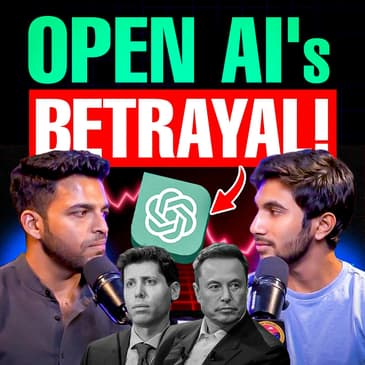

In this episode of The Startup Operator Roundup, Gunjan and Roshan break down the week's startup news and more!If you liked this episode, let us know by hitting the like button and share with your friends and family. Please also remember to subscribe to our channel and switch on the notifications to never miss an episode!
Topics:
00:00 Intro
07:21 Indus Valley Report
14:35 Krutim's false claims
18:25 Google play delists Indian apps
24:19 Elon: the most impactful human being
27:47 Elon takes OpenAI to court
30:43 AI Pin to soon launch in India
33:28 Disney and Reliance create media powerhouse
37:08 Fundraises of the week
-------------------------------------
Click here to get regular WhatsApp updates:
https://wa.me/message/ZUZQQGKCZTADL1
-------------------------------------
Connect with Us:
Linkedin: https://www.linkedin.com/company/startup-operator
Twitter: https://twitter.com/OperatorStartup
-------------------------------------
If you liked this episode, let us know by hitting the like button and share with your friends and family. Please also remember to subscribe to our channel and switch on the notifications to never miss an episode!
[00:00:00] Hello and welcome to another episode of the Startup Operator Roundup.
[00:00:04] I'm Roshan Karyapa.
[00:00:05] And I'm Gunjan Sahar and together we break down the biggest headlines from India's growing
[00:00:10] startup ecosystem.
[00:00:11] If this is the first time you're tuning into the channel then please consider subscribing
[00:00:14] because we talk everything startup.
[00:00:16] And if you're a regular listener then please consider liking and sharing this video with
[00:00:20] your friends.
[00:00:21] In this week's roundup we'll be talking about the recently launched in this valley report 2024. This is a highlight report by Bloom Ventures, where they present their
[00:00:30] views on how the India market is evolving. Last week, Ola also did the public release
[00:00:37] of Kruthrim's chatbot and that has had mixed reactions from the audience. So we'll try to
[00:00:42] get a hang of what's happening. The big Another big headline was Google de-listing multiple apps from its
[00:00:48] app store. That includes the Bharat Matrimony app suite, Kuku FM,
[00:00:52] Nokri.com and many others. That has caused a lot of stir in the ecosystem,
[00:00:56] causing the government to also step into this discussion. We'll be talking more
[00:00:59] about that. In other news, Elon Musk has decided to sue Sam Altman and open AI for apparent
[00:01:06] breach in contracts. They are saying open AI is now focusing more on profitability instead
[00:01:12] of building AI for general good. We'll take a look at what the arguments being made or
[00:01:17] and what basis does this case hold. Lastly, reliance and Disney have sealed a merger deal
[00:01:24] for the India media.
[00:01:26] To combine, they'll become of the largest media houses in the country.
[00:01:29] We'll discuss what implications does this have for the larger ecosystem.
[00:01:33] So a lot of exciting news coming up in this week's discussion.
[00:01:36] So stay tuned.
[00:01:38] Before we begin, last week had other headlines as well, a lot of the global dignitaries
[00:01:51] and the world's most influential people are in Jamnagar right now.
[00:01:55] For those you don't know, Jamnagar got her temporary international airport made just
[00:02:00] to fly these dignitaries in.
[00:02:02] And well, Rihanna is there along with other people, but what are you excited about?
[00:02:06] Yeah, I mean, so it's a pre-wedding celebration,
[00:02:10] be that, right?
[00:02:11] So there's a whole three months spectacle around this.
[00:02:14] And yeah, the world's richest, or perhaps the second
[00:02:17] or third richest man is getting his son married
[00:02:20] in grand fashion.
[00:02:22] And also makes the case for India as a wedding destination as well.
[00:02:25] So fantastic stuff. Happy to see Mark Zuckerberg, Rihanna, all of these folks here
[00:02:33] for Mukesh Baez' sons wedding.
[00:02:37] And have you heard Anantamani's peak? I mean, very sincere guy, man.
[00:02:43] I mean, so as having this conversation with
[00:02:45] some of my friends right the way Anandam Bani is speaking now is it really that's how billionaires
[00:02:52] sons of billionaires children are brought up or is that more of a media spectacle?
[00:02:56] Look I mean I would say that the guy is really authentic you know of course he's had some media
[00:03:01] training and of course there's a whole lot of PR and whatnot, but comes across as a genuine guy, right? And props to him, especially in the circumstances
[00:03:09] that he has grown up in and he's not had it easy, you know, he's had a host of health issues and so
[00:03:14] on. So yeah, it's good. I mean, there is some entertainment for the next couple of months on that front. But in other news, I would say the consumption data is out and
[00:03:30] India has eliminated extreme poverty. That's a massive, massive thing. Extreme poverty is
[00:03:35] defined as $2 a day or something to that effect around that. The data shows that growth is up.
[00:03:46] that, right? And the data shows that growth is up. And surprisingly, also inequality or the genico coefficient as they measure it has narrowed as well, both in rural and urban India. So this
[00:03:54] is a survey that's conducted where they ask people about their spending habits, right? I mean,
[00:03:59] how much have they spent on perishable, like fruits and vegetables, how much have they spent on durables, how much have they spent on other items of interest. And based on that, they analyze the wealth
[00:04:15] and poverty basically and growth in those kind of things. And I was really heartened
[00:04:21] to see that for sure.
[00:04:23] Another big news stemming out from there was the Q3 GDP growth.
[00:04:27] It was announced and it's 8.4.
[00:04:29] Experts had claimed that it'll be somewhere on the range of 6.6%
[00:04:33] quarter-on-quarter, but it's 8.4.
[00:04:37] And well, my stock sport fully looked really good on that day.
[00:04:40] Yeah, I think, look, I mean, I think people again will go back and forth about
[00:04:45] the numbers and say that, you know, maybe, you know, it's not really 8.4 and so on and
[00:04:51] so forth. But look, the momentum is surely there. Right. And I think it'll become quite
[00:04:57] apparent to the next quarter to quarters. And I've always said, right? I mean, India,
[00:05:02] it's, it's very difficult to like, you know, fudge at our scale, right? I mean, India, it's very difficult to like, you know,
[00:05:05] fudge at our scale, right?
[00:05:07] I mean, it's very apparent because the anecdotes will not,
[00:05:09] you know, will be so glaringly different that, you know,
[00:05:15] it's very difficult at our scale, I would say, right?
[00:05:17] So not to say that that's not a possibility,
[00:05:20] but in any case, I feel like, you know,
[00:05:22] when I compare the data with anecdotes,
[00:05:25] I think momentum is certainly back, right? And we're growing at a healthy pace as well.
[00:05:30] And this is open enough, you know, a bunch of folks who are way more smarter than I am.
[00:05:34] So, yeah. So that's what I think. Yeah. Okay. Well, apart from the money wedding and the
[00:05:39] GDP reports, I think India's last week, of the headlines were also saying that India is really strengthening its position to become a global leader for semiconductors and Tata and few other
[00:05:50] companies even TSMC and the Tata partnership. They announced big plans to set up fabricators
[00:05:58] around the country. That's amazing. So, three fabs have been approved by the government, two by Tata and one
[00:06:05] by this other company, I'm not sure. Two in Gujarat, one in Assam. This is fantastic news,
[00:06:12] because semiconductors are so integral. There are first line of defense, I would say, for everything.
[00:06:18] And given the whole geopolitical situation right now, where Taiwan is at a flashpoint and
[00:06:25] you know something God forbid may happen in the next few years so it definitely
[00:06:30] need to be at Minerva on that front for sure right so yeah this is a great start
[00:06:35] I would say people will still say that you know we are still dependent on China
[00:06:39] and all of those things but yeah it's a start takes time to take its apps absolutely
[00:06:43] takes time right if It absolutely takes time.
[00:06:45] If you look at software, for example,
[00:06:47] we didn't get to SAS just like that.
[00:06:49] I mean, it took 30 years to get to where SAS is right now.
[00:06:52] We're building world-class products and so on.
[00:06:56] So it's going to take time.
[00:06:57] But it's a very, very useful start, I would say.
[00:07:00] So a lot of good things have happened in the week or so.
[00:07:03] Yeah. So I think there's a good things have happened in the week or so. Yeah. Yeah.
[00:07:05] So I think there's a good point to talk about the Indus Valley report.
[00:07:09] Indus Valley report is an annual report that Bloom Ventures publishes, which kind of shares
[00:07:14] their perspectives on how India is evolving, how the Indus startup ecosystem is evolving.
[00:07:18] And I really like how they came up with the name Indus Valley report.
[00:07:22] Unlike Silicon Valley, Indus Valley is not limited to one geographical area. I talk about India as a whole, they talk about the startups in
[00:07:29] Bangalore and the satellite towns of Noida and Gurgaon, then Chennai, Hyderabad. And
[00:07:36] there are some really interesting insights as well. The report states that India's per
[00:07:41] capital GDP right now is $2,612, which is slightly lower than Bangladesh,
[00:07:46] and that ranks as 140th in the list.
[00:07:50] Consumption spends still hold the highest share when related to GDP, which is now 60% for
[00:07:56] India versus 38% for China.
[00:07:59] It also mentions the number of Indians that pay tax.
[00:08:03] The report says that only 0.3% of Indians
[00:08:06] contribute to 80% of the total tax collected. Now, this is direct tax. I'm not talking about
[00:08:11] the indirect business taxes. For consumption, I know we had discussed that discretionary spending
[00:08:18] in India is rising. And the report says that discretionary spending has increased from 13% to
[00:08:23] 21% from 2000 to
[00:08:25] 2000.
[00:08:26] So on all of the points that you mentioned, these are things that we've been saying as
[00:08:30] well, that hey, discretionary spending is rising because as your GD paper capital rises
[00:08:37] by some basis points, the discretionary spend goes up not linearly but exponentially.
[00:08:44] So excellent stuff. spends a spend goes up not linearly but exponentially. Yeah. Right.
[00:08:45] So yeah, excellent stuff.
[00:08:46] This is another demarcation that they make is by categorizing the income people into various
[00:08:52] level.
[00:08:53] There are three levels.
[00:08:54] India one, India two and India three.
[00:08:56] India one is has around 12 crore people in terms of population and their per capita income
[00:09:02] is around $15,000 or $12.45 lakhs.
[00:09:05] And this also forms the biggest market for startups to target to.
[00:09:09] India too is roughly 30 crores in terms of population
[00:09:12] and the per capita income is $3,000.
[00:09:14] And India 3 is around 100 crores in terms of population
[00:09:17] and per capita is around $1,000.
[00:09:19] That's also interesting because we have been talking about a growing middle class,
[00:09:23] but it's still at top 1% or 2% of the population that is really responsible for expanding.
[00:09:28] So the income disparity in India is huge right? I mean if you go to parts of UP and be heard the
[00:09:33] GDP per capita is almost like Sub-Saharan Africa types you know and whereas I mean what you mentioned
[00:09:40] like parts of Bangalore, parts of Bombay, parts of Hyderabad or whatever,
[00:09:46] are way, way up than that. So, I think the Zoom team has made the point earlier as well
[00:09:54] that you can't look at India as a whole, you have to kind of look at it as different parts.
[00:09:59] So another key aspect this report talks about is how funding levels in India ecosystem has now dropped to around
[00:10:05] pre-2017 levels.
[00:10:07] There is a sharp decline from the peak from the bull down we witnessed in 2019-2020.
[00:10:14] The report also highlights the slowdown in late-stage funding and what are the various
[00:10:18] options that emerges for start-up studies, other funds apart from VCs.
[00:10:23] One of the channels the report talks about
[00:10:25] is that if you're a profitable startup or
[00:10:28] you know have a decent growth rate,
[00:10:30] you should look for an IPO in the smaller market segments,
[00:10:33] not necessarily in terms of,
[00:10:35] not necessarily in the NSC and BSE.
[00:10:36] So what do you think of that?
[00:10:38] Yeah, for sure.
[00:10:39] And you know, I would have hoped that build is counting
[00:10:42] and debt would be a lot more popular in these markets as well.
[00:10:46] I mean, we should perhaps look at the numbers and check if that is indeed the case.
[00:10:51] But yeah, but all the I mean interest rates have risen.
[00:10:57] But basically, I mean, alternate sources of funding here because I think 2017 was this
[00:11:02] post-consumer internet wave in India,
[00:11:06] where things had quite in down,
[00:11:07] a bunch of these hyper-local startups had gone bust.
[00:11:13] I remember the types of local OA and stuff.
[00:11:17] And this was also pre-the SaaS optimism also.
[00:11:22] So yeah, it does feel like that kind of, I would say,
[00:11:28] also. So yeah, it does feel like that kind of, I would say, you know, and let's hope that time passes and all of these folks who've raised like tons of money to fund Indian startups,
[00:11:33] even Asian startups, I would say, start deploying capital. But the great thing is that, look,
[00:11:39] every founder we've had in the last three, four, five, six months, I would say, has a plan for profitability
[00:11:46] and a good number of them are already profitable.
[00:11:48] Yeah. I think the past two years, right? I mean, profitability and sustainability have
[00:11:54] become like buzz woods that in the ecosystem. But now, I mean, that is the one key factor
[00:11:59] apart from compliance that which we're seeing come in recently now. Sustainability and profitability
[00:12:04] is one of the key metrics
[00:12:05] that founders have to optimize for.
[00:12:07] It's not just showing the growth projections and stuff.
[00:12:11] Another but contrary to what you just mentioned,
[00:12:15] one segment has seen immense growth over this past few years
[00:12:19] is the rise of D2C brands.
[00:12:21] I think India is becoming a strong hub for what Bloom calls a digital
[00:12:26] native brands. They have been growing steadily and they are not just selling to India, they
[00:12:30] are selling to the world because online there is no borders. So I think this will give us
[00:12:35] a lot of creative and unique sales playbooks and GTM playbooks.
[00:12:40] Yeah, more than a few of these brands appeared on Shark Tank as well. I mean, most common product category I feel, right?
[00:12:47] And a lot of them are doing a few crores, a lot of them.
[00:12:51] Yeah, a lot of them.
[00:12:53] I mean, I was seeing this face yoga brand also, which is doing, you know, four, five crores
[00:12:57] in revenue.
[00:12:58] Pretty awesome, actually, you know, and all of these are profitable nettings, you know,
[00:13:03] fifteen, twenty percent, a bit, which is awesome, right?
[00:13:08] As a brand. So D2C is a massive shift for sure. At least, I think what is happening is there's
[00:13:14] a playbook that's emerging to go from zero to about a 10 crore revenue. And then that could be
[00:13:20] like pure native digital, digital Instagram on the website,
[00:13:25] marketplaces and so on.
[00:13:26] And then 10 to 100 crores via online and offline retail as well.
[00:13:31] And then beyond 100 crores, we've had mama earth,
[00:13:33] we've had nika, right?
[00:13:36] So there's all these playbooks emerging.
[00:13:39] So I feel like India's brand stopped.
[00:13:42] If you look at the number of brands that are more than
[00:13:46] 1000 crores in revenue, not in valuation, revenue, right? I think you will find very few of them.
[00:13:52] And especially the new ones, I would say. So yeah, that's open, very, very open for disruption,
[00:13:59] because also the demographic is changing, right? I mean, I still report indicates as well. So,
[00:14:03] yeah, let's see, we'll... The urban class is no more the largest consumer class. There's a lot of
[00:14:10] discussion is spending increase in the rural India as well. So I think there's a
[00:14:13] brand new market.
[00:14:14] Okay.
[00:14:14] Even post covered also the rural economy recovered faster than the
[00:14:18] urban economy. Right. So yeah.
[00:14:21] Awesome. A few months back, Sam Altman was in India and I think it was the editor of
[00:14:27] NDTV who asked the question that Ki, do you think India can never have its own chat
[00:14:31] GPT towards Sam Altman.
[00:14:34] really said that Ki, well, I don't think so, but you can definitely go try and building
[00:14:38] it. But it will be nothing as close. It's a futile effort. But last week, Bhabesh Agarwal
[00:14:42] introduced Crewthrim and described it as a major breakthrough
[00:14:45] in customer service.
[00:14:47] Quote unquote, he said, Kruthrim marks
[00:14:49] a dawn of a new era in the AI computing stack of a nation.
[00:14:53] We will aim to innovate alongside the world
[00:14:54] and define future paradigms.
[00:14:56] But does this really live up to the hype?
[00:14:59] We logged into the public beta release
[00:15:03] and tried to put in some queries.
[00:15:04] I gave in a translation
[00:15:05] while it did not score a 10 on 10. But a lot of other folks have been praising it for number
[00:15:13] one, the wide variety of languages that it's available in. It offers extensive user experience
[00:15:19] ranging from having in-depth information conversations and variety of topics. And I think one of
[00:15:23] the key differences between Crewthrim and chat GPT
[00:15:26] is that Crewthrim has available to the latest data.
[00:15:29] So it's very current affairs aware.
[00:15:32] But there are also a lot of reports
[00:15:34] that came up saying that when users prompted
[00:15:38] the bot in Asames that confused Asames with Bengali
[00:15:41] and any other Indo-Aryan language,
[00:15:43] because the scripts are kind of similar.
[00:15:45] So there could be some issues in the way the model was trained.
[00:15:48] Did you ask it what is the best electric scooter in India?
[00:15:52] Did you?
[00:15:54] So, you know, it had varying answers, right? Someone said that it said Ather, right?
[00:16:01] And someone else said no, it says Ola S100 or 150 or whatever that was
[00:16:06] but if it really answered Ola S1 then do you think that would be because of the bias?
[00:16:10] well we don't know see the first one that's pretty pretty big I mean think
[00:16:15] about it if that is actually true there will be biases I feel right and and look
[00:16:21] I mean people are dunking on the results and whatnot, right? I mean it is
[00:16:26] going to be rough around the edges, it's the first version of it, right? But look, I mean at least
[00:16:31] we have an Indian context to it, right? Because you know, chat JPT and Gemini and the others are
[00:16:37] like, hey, let's face it, I mean completely woke and driven from the West, right? I mean one of
[00:16:42] these folks, you know, tried asking about Prime Minister Modi and it said right? I mean one of these folks you know tried asking
[00:16:45] about Prime Minister Modi and it said you know one of the few results was that
[00:16:49] you know Prime Minister Modi is the fastest, right? And they asked about
[00:16:54] Xi Jinping who is literally like a dictator and it said no such thing, right?
[00:16:59] So let's not be you know under this impression that you that all this tech is completely neutral.
[00:17:07] If anything, the last two or three years should prove otherwise, especially post-tritofiles and
[00:17:12] so on. So I am actually happy that we have an indigenous platform. I'm in Yashore. It's not
[00:17:17] going to be perfect at this point of time. Give it a versions, and hopefully it will be priced reasonably also.
[00:17:25] Right. And look, this is from a man who is, you know, right now.
[00:17:31] Indian Elon Musk.
[00:17:32] Yeah, exactly. I mean, he's running a ride-hailing company. He is running an electric
[00:17:37] scooter company.
[00:17:38] He's riding a battery factory.
[00:17:40] Yeah. And he's doing this, right? So, yeah, let's give him a break. Yeah, and he's doing this, right? So yeah, let's give him a break. Yeah, but
[00:17:47] also a last week, Google came under heavy firing for the responses that Gemini generated
[00:17:53] right, including the response to Prime Minister Modi and showing some prominent historical
[00:17:59] icons in as people of color. But that was last week. This is a new week and Google is under fresh
[00:18:05] firing. Google had initiated a process of delisting multiple Indian applications from
[00:18:11] App Store. This included popular matrimony apps that are widely used across the country,
[00:18:16] Kukku fmknocky.com and even Caesar Vembu sir took to Twitter to express his concerns
[00:18:23] that what's happening in India and what Google is doing.
[00:18:26] This is a classic example of monopoly abuse.
[00:18:30] With the dominant position of Android in India,
[00:18:32] it is important that the regulators and courts
[00:18:34] get involved to level the playing field.
[00:18:36] And that's exactly what happened.
[00:18:38] Our union Mr. Ashwini Vashnav, in an interview
[00:18:41] said that India is very clear.
[00:18:43] Our policies very clear.
[00:18:44] Our startups will
[00:18:45] get the protection that they need and he has already spoken with Google. Few hours after
[00:18:50] this meeting, all the apps were back online, the play store. But what do you think is going
[00:18:57] to happen here? We have heard a lot of founders complain about the practices by Google, especially
[00:19:02] taking down apps without giving any appropriate reason.
[00:19:05] This really hampers their business.
[00:19:06] Yeah, it's really terrible.
[00:19:08] I mean, I have just been seeing B so, for example, of Ku Koe FM, Vina of Stage, and San
[00:19:16] Jiv Bikchandani of the Nakhri group, right?
[00:19:21] And Anupam of shadi.com and so on and so forth right I mean it's it's kind of affected so many of these apps a
[00:19:28] Few of these apps were back on the
[00:19:31] Store as pure consumption apps right which means that they weren't actually billing in app
[00:19:36] Right, but yeah, man. I mean I think
[00:19:38] it's reaching a breaking point because
[00:19:41] Google is definitely negotiating with developers right?
[00:19:44] I mean I'm damn sure Spotify is not paying them the 30% that they are
[00:19:48] existing for sure. And 30% is a lot. I mean, we're talking about a time when
[00:19:53] take rates are almost going on to near zero. And we have the kind of
[00:19:58] fantastic payment infrastructure in India. It's a bloody joke to pay 30%
[00:20:02] to someone on that. I really hope that Google
[00:20:08] and Apple do something about this because they're just inviting all of the competition,
[00:20:15] Council of India and so on and so forth to get involved. And these folks, well, in India,
[00:20:20] lobbying is not as sophisticated as the US.
[00:20:25] So they're going to lose out because India is famous for banning stuff.
[00:20:30] We banned TikTok.
[00:20:31] We banned a host of other things.
[00:20:33] One finder, you will just see an order that bans something else.
[00:20:36] And then people will be scrambling for stuff.
[00:20:40] So if I was Google, I'd really be like, quaking in the boots, right?
[00:20:45] And, you know, God knows I've had a ton of issues, right?
[00:20:49] You know, people have been calling for Sundar Pichai
[00:20:51] to leave as well, which would be kind of sad, right?
[00:20:54] Because, you know, look, when you think of Sundar Pichai,
[00:20:59] I mean, the guy really built Chrome, you know?
[00:21:03] And he made Google what it was in the, you know,
[00:21:09] what do they call Nautis or OOs, right?
[00:21:12] I mean, seriously, he literally built a huge size of Google's business, right?
[00:21:17] Fantastic product manager, leader and everything, but somehow, I mean, the last three, four,
[00:21:23] five years, I mean mean he seems to have like
[00:21:25] floundered right and it happens man. I mean you know when you're when you're managing a multi-hundred
[00:21:30] billion dollar company right, every misstep is magnified 10,000 times. I just hope you know people
[00:21:39] realize incidentally Sergei Brin was spotted in the Googleplex as well.
[00:21:45] He was at a Gemini hackathon or something of that sort.
[00:21:49] Yeah, there was some interesting people apologizing for the whole Gemini fiasco that went down.
[00:21:57] And that's kind of shocking.
[00:21:59] I'd imagine your co-founder of Google has to step in to fix things.
[00:22:05] Well, I mean, so that's what they say, right? You could be a CEO at one point of time, but
[00:22:11] you're always a founder, you know? Yeah, there were some interesting people addressing
[00:22:16] all of this work stuff, you know? So I won't say more. I mean, you guys can check out the
[00:22:21] videos of, you know, some of these folks. They were very interesting for sure.
[00:22:26] But yeah, and more than a couple of people
[00:22:28] have suggested, adventurinewas of publicity, AI
[00:22:31] to step in as a CEO right now.
[00:22:34] I don't know.
[00:22:35] Let's see what happens.
[00:22:37] But I really think that the government has
[00:22:42] been very proactive in the sense that.
[00:22:44] That's a good sign.
[00:22:45] Yeah, absolutely.
[00:22:46] They've stepped in and they've called an end to this nonsense.
[00:22:49] But I hope that they work with these big tech platforms
[00:22:53] to resolve these issues, because it's a recurring thing.
[00:22:55] It's an ongoing thing.
[00:22:57] And look, Google payment has one aspect of things.
[00:23:02] But just the arbitrary nature of things,
[00:23:04] the app economy
[00:23:05] is you know trillion dollar plus right now you know should two companies be at the helm
[00:23:11] of it should they be the gatekeepers I'm not very sure you know so there should be multiple
[00:23:16] things I mean there should be a democratization of that we should see many other app ecosystems
[00:23:22] like the Indus OS that we discussed and so on
[00:23:26] Yeah, all of this and more has to happen. I was okay. So who do you think right now is probably the best
[00:23:33] leader slash CEO slash founder
[00:23:36] No two ways about it, right?
[00:23:41] Well, then you're not the only one thinking seven Balaji Srinivasan took to Twitter and
[00:23:47] Went on to said Elon Musk is the greatest founder of all time
[00:23:51] He says that I would say I mean he's the greatest human being in the current era. I feel yeah
[00:23:57] Think about the okay. I mean you finish that. I mean I couldn't stop myself. Yeah, no no go on go on
[00:24:02] No, you you think about the impact that the person has had, right?
[00:24:08] I would say maybe electric vehicles would have been delayed by 10 or 15 years, but for Elon, right?
[00:24:16] Which is significant, right?
[00:24:17] You think about how much of, you know, whatever impact it's had on sustainability, climate change, and whatever, right?
[00:24:24] Then you think
[00:24:25] about the progress that we made on space tech. You think about what is
[00:24:32] that? Starlink, Neuralink and SolarCity and all of these man and Twitter.
[00:24:40] I mean people don't count Twitter among one of Elon's, maybe talk to
[00:24:46] top three things. I feel like that is the biggest impact that he's had over the last
[00:24:52] couple of years. Just simply buying Twitter and at $44 billion, I think Twitter was just
[00:24:56] a charity kiss. I don't think it makes any financial sense for him to have got it. And
[00:25:02] in fact, I mean, he's had even more scrutiny,
[00:25:05] right? You look at how the Biden government has screwed him, right, with all of the kind
[00:25:11] of litigation and so on and so forth, canceling contracts. And they've gone after him like
[00:25:16] personally, right? And even after all of that, the man takes time out to like troll people on Twitter, right? I mean, what a guy, man. What a guy.
[00:25:26] Seriously, like, I think by sure impact,
[00:25:30] I don't think any human being has had that kind of impact in our lifetime.
[00:25:34] So you're right, right? I mean, that guy has, I don't know, probably thought of things
[00:25:39] and just decided, hey, you know what, we should be building this, is thinking of...
[00:25:42] He's executing at the speed of thought.
[00:25:43] Yeah, yeah, I think, think of us uh an extra terrestrial human population is building in mars
[00:25:51] right you think of uh building underground tunnels to travel as it has the boarding company
[00:25:56] he's building the cyber truck he's now i think working on a car that does zero to hundred
[00:26:00] in less than a second wow right and that's and he says that's not even the most exciting part.
[00:26:06] Yeah.
[00:26:06] He built a flame thrower.
[00:26:09] Right.
[00:26:09] That guy, but in all seriousness, he has, I think what he
[00:26:13] learned is really well is like, well, everyone's building on the software
[00:26:15] space and stuff like that.
[00:26:17] He really went on to the hardware route.
[00:26:20] And that is what Balaji Sinevasa is actually talking about.
[00:26:23] He has built a space X.
[00:26:24] He has built Tesla. He's now co-founded Neuralink,
[00:26:28] the Boring Company and he's also part of OpenAI, right?
[00:26:32] So, yes.
[00:26:33] I'm a part of co-founded OpenAI.
[00:26:34] I mean, we'll talk about that, but yeah.
[00:26:37] Okay.
[00:26:37] So it's rightly right.
[00:26:39] Elon's accomplishments have earned him great respect within the tech industry.
[00:26:43] And where we are talking about him.
[00:26:45] So I guess that's a good thing.
[00:26:46] You only talk about good stuff.
[00:26:48] Yeah.
[00:26:49] Look, I mean, I will say that there are these tall words.
[00:26:54] I mean, you think of maybe Bob Noyce of Intel.
[00:26:59] You think of Steve Jobs and Larry Ellison, perhaps, the right, Mark Benioff maybe but then I mean Elon is
[00:27:10] just like heads and shoulders about all of these folks I would say right I think
[00:27:16] if all of these people were in a class Elon would be the backbencher
[00:27:24] Actually, the rancher of the car. Yeah.
[00:27:25] But talking about open air, Elon has filed a lawsuit against open air and Sam Altman
[00:27:31] claiming that the company is in breach of its mission, which is to build a general purpose
[00:27:37] AI for the benefit of mankind.
[00:27:39] He's saying that the company is now focusing more on making profits.
[00:27:42] Well, I don't know what the basis for this case is, but what do you think? How is this going to pan out?
[00:27:47] So Elon gave the first 100 million or so to open AI, right? Was part of the founding team
[00:27:54] along with Sam Altman and initially, open air was set up as a nonprofit organization.
[00:28:00] But sometime after it kind of made a pivot for reasons,
[00:28:05] they claim that for profits are more effective
[00:28:10] and so on and so forth.
[00:28:11] And obviously Microsoft came in
[00:28:14] with that multi-billion dollar investment.
[00:28:18] Look, I think Elon has a case, obviously, right?
[00:28:21] When you set up a non-profit, I mean it's a it's different right I mean you
[00:28:25] can't just come I don't think it's a it's a non-profit I think it was meant to be a not-for-profit yeah
[00:28:31] right and I had a trust established that kind of I think it's probably the same thing I don't know
[00:28:36] you guys can correct us but yeah it is not-for-profit and you can't just like halfway change that to a
[00:28:42] for-profit organization transfer all the IP from this,
[00:28:45] not for profit to this organization,
[00:28:48] start making billions.
[00:28:49] And I think that fundamental point holds.
[00:28:52] I think where philosophically Elon and Sam kind of differ
[00:28:57] is that Elon wants this stuff to be open sourced,
[00:29:01] whereas obviously, OpenAI has its own private, close source kind of a thing, right?
[00:29:08] But of course, Elon has Grok as well, which is private.
[00:29:13] So yeah, I mean, it's just the battle of these Stolwerts, I would say, right?
[00:29:19] You know, Vinod Kosla has gotten himself involved somehow.
[00:29:22] There's a full Twitter feud going on.
[00:29:26] Yeah, the exchange is really nasty.
[00:29:28] Yeah, spicy feud going on on Twitter between Elon and Vinod and Sam Altman and a bunch
[00:29:34] of others.
[00:29:35] Right.
[00:29:36] So Vinod Khosla tweeted that, you know, Elon should have gotten in early and then someone
[00:29:40] told him that, hey, look, Elon was literally the first guy who gave that funding and everything and then Winot has said that yeah he he got an early but he should have
[00:29:52] stayed or something to that effect right you guys should go check out that Twitter thread and
[00:29:56] the responses. Check out Winot's coasters Twitter time and it's interesting. I mean he anyway is
[00:30:01] like a very very entertaining, I would say.
[00:30:05] Mr. Kosla doesn't hold back.
[00:30:07] You know, obviously is a very strong personality as well.
[00:30:12] So it's just awesome that we get to see this in public.
[00:30:15] But now that Sam Altman has been really being caught up with this lawsuit,
[00:30:20] one of the startups that he's back in human,
[00:30:23] they are in talks with Indian telecom operators to launch AI pin in India. This AI pin is a device that attaches to clothing
[00:30:30] and facilitates communication with an AI chatbot using your voice and laser ink technology
[00:30:36] projects on your hands or wherever and you can interact with those.
[00:30:40] We all saw the demo. I mean, there was so much of lack for the demo. I thought
[00:30:46] it was okay, actually. I mean, but people said that it was like really pedantic and
[00:30:51] you know, boring and stuff like that. But yeah, the human AI pin, right? I mean, it
[00:30:58] seems like a fantastic product. What do you think about its use cases? How will it make
[00:31:03] its look? I feel like there's this eternal search for the next form factor. I mean, what is it?
[00:31:08] After laptops, we had mobiles and then what? Has there been a device that has taken over
[00:31:15] at that scale? I don't know. Now we have the Vision Pro, obviously, which is another experiment.
[00:31:21] But what else? The watch, of watch, of course it is successful,
[00:31:25] but to the extent that it's a computing device,
[00:31:27] I don't think so, right?
[00:31:28] I mean, it's more of a kind of a wearable,
[00:31:30] like a health indicator as such.
[00:31:32] So could it be something like the human AI pin?
[00:31:37] I don't know, right?
[00:31:38] But we'll have to fail forward.
[00:31:41] You know, a bunch of these folks are gonna develop staff.
[00:31:43] I mean, people are gonna dunk on them. And then at some point of time, it You know, a bunch of these folks are going to develop stuff. I mean, people are going to dunk on them.
[00:31:45] And then at some point of time, it's going to reach a scale of maturity.
[00:31:48] And, you know, we'll have a standard, right?
[00:31:50] And I'm sure that the first few laptops that were produced were absolute shit.
[00:31:56] I mean, I've still used a Toshiba laptop from 16 years ago, right?
[00:32:01] I mean, I mean, you could kill someone with that, basically, you know, it was one
[00:32:06] of those laptops that weighed I think maybe three and a half kilos or something or that
[00:32:09] sort, maybe more, I think, right? And if you answer it, it would be like, you don't
[00:32:15] need a heater in the room. Yeah, man, I mean, it was just a fume. So yeah.
[00:32:22] Yeah. But this has really interesting use cases, right?
[00:32:27] I mean, people are saying this will find big adoption in the field of medical applications.
[00:32:32] And this is a great way to complement the capabilities of your smartphone, right?
[00:32:37] It's just another way in which you can integrate tech into your day-to-day lives.
[00:32:42] And that's how you do.
[00:32:43] You don't have a brush anymore, you have any eye pin.
[00:32:46] Yeah.
[00:32:47] With all of this integrating,
[00:32:49] I don't know if the fundamental human experiences don't change.
[00:32:52] I mean, we talk about this neural link, the chip in the brain and stuff like that.
[00:32:57] I don't know.
[00:32:58] I just really hope and pray that in 100 years time, humans will still be humans,
[00:33:02] but I'm not very optimistic about that. We'll find out. Okay let's take a break from what's happening in the west and come back to India.
[00:33:10] In India Reliance and Disney have announced a joint venture of worth 8.5 billion dollars to
[00:33:15] create a media powerhouse in the country. Mukesh Ambani will be the senior partner of this newly
[00:33:22] formed entity. The partnership can hold significant market share in advertising and streaming, which
[00:33:27] is around 40-45%, and this could lead to better profitability and reduced content calls for
[00:33:32] the new entity.
[00:33:33] Disney will merge its India operations with Viacom 18 part of Reliance, and the new venture
[00:33:37] will be 63% owned by Reliance and Viacom 18 and 37% by Disney.
[00:33:44] Despite Disney's initial success in India,
[00:33:45] Reliance's acquisition of Indian Premier League cricket
[00:33:48] rights led to a loss of subscribers for Disney.
[00:33:51] The New Deal signifies Disney's continued commitment,
[00:33:54] at least to the Indian market.
[00:33:56] The most entity is expected to capture significant market
[00:33:59] share.
[00:33:59] This includes 35% of total TV viewership, 40% of the total
[00:34:04] revenue market for broadcasters,
[00:34:06] which includes ad sales and affiliate fees, and 45% of premium video on demand streaming
[00:34:12] market. If you were on Amazon or, you know, a Z for that matter, how would you react to
[00:34:20] this? Look, it's a very hard business to run for sure. And this consolidation is something
[00:34:27] that we've been talking about for a while as well. So I'm sure, I mean, they must have
[00:34:32] seen this coming. It's a massive win for Geo, I would say. I'm just excited about the opportunity
[00:34:40] Geo has to build everything full stack.
[00:34:45] If you look at how Reliance business has grown,
[00:34:48] they're famous for this backward integration.
[00:34:50] So don't be so sure.
[00:34:52] So surprised if Reliance starts owning some of Google
[00:34:56] and Amazon's business on the data center side also.
[00:34:58] That'll be.
[00:34:59] So everything from application to infrastructure
[00:35:02] to everything in between.
[00:35:09] I really don't know how they execute moves at this level, right? I mean, I'd love to be a flyer on the wall and like, you know, listen to some of the
[00:35:13] stuff that's being said, you know.
[00:35:14] Clearly you didn't get an invite to the money wedding.
[00:35:16] Yeah, well, I'm missing a few zeros in my bank account.
[00:35:21] But yeah, I mean, I would love to see some of this
[00:35:25] corporate shit talk go down in these boardrooms and whatnot.
[00:35:28] You know, so I read this tweet, OK?
[00:35:31] The shirt which marks the curve is wearing on day two.
[00:35:34] Yeah.
[00:35:34] The shirt that's apparently going for 1.6 lakhs.
[00:35:41] One shirt.
[00:35:41] Yeah, yeah.
[00:35:42] And I saw that video of Mark noticing on Earth.
[00:35:46] Watch.
[00:35:47] Watch as well, which is supposedly 15 crores or something.
[00:35:50] Yeah.
[00:35:50] Yeah.
[00:35:51] Man, it's a different world I tell you.
[00:35:53] This reminds me of some movies from way back
[00:35:57] where a family is landing in the airport, all the carvallers,
[00:36:00] are like white people, white people.
[00:36:02] Oh, yeah.
[00:36:03] That's not that as well.
[00:36:04] Yeah.
[00:36:04] Man. You think we're soon moving into...
[00:36:06] So, do switch.
[00:36:07] That, that's when, 2026.
[00:36:09] May happen, I think.
[00:36:11] Not in 2026, for sure.
[00:36:13] I mean, who knows, 50, 60 years from now, you know?
[00:36:17] One thing is, India is going to become a lot more prominent.
[00:36:19] For sure.
[00:36:20] It's already coming from...
[00:36:21] Yeah, for sure.
[00:36:22] I mean, I think we're just seeing the early signs of that.
[00:36:24] I think we grow at this level.
[00:36:26] And if we have a stable government at the center
[00:36:29] for another 10 years, yeah.
[00:36:32] Really, the Prime Minister often talks
[00:36:34] about this Amrit Karl, right?
[00:36:36] And it's not all rhetoric flourish, right?
[00:36:39] I mean, of course, there's some of that.
[00:36:40] But also, yeah, I mean mean some amazing times ahead you know
[00:36:46] that should hopefully. Awesome. Before we wrap up this episode here the notable
[00:36:51] fundraisers from the week Zeno Health which is a medicine delivery platform
[00:36:54] raised 25 million dollars from stick investment and lightbox. Capillary
[00:36:59] technologies which is you know one of the success more successful enterprise
[00:37:02] SaaS startups raised 95 million dollars as part of its series D fund raise.
[00:37:07] And this was led by a group of investors.
[00:37:10] Luggage brand, Mokobora raised $100 crore
[00:37:13] rupees or $12 million from peak 15 partners,
[00:37:15] Sos VC and Sama capital.
[00:37:18] I think the most interesting one is capital technology
[00:37:20] that is especially given the environment,
[00:37:22] the funding landscape we are in for them to raise $95 million as part of a CSD. That's really commendable.
[00:37:28] Significant for sure. And capillary was in shambles when COVID hit because they had such
[00:37:34] a huge exposure to the retail industry and obviously retail went to zero pretty much overnight.
[00:37:40] To come back from there to having this kind of money And hopefully listing at some point of time is a fabulous fabulous achievement like props to you know
[00:37:50] Anish who is the founder and the rest of the leadership team and board right so
[00:37:55] Absolutely stunning stuff. I would say right and mokabara is mokabara mokabara. Yeah interesting brand
[00:38:02] You know, I mean their backpacks have gone viral and after seeing it on Instagram,
[00:38:06] maybe like 20 times I still have registered getting one for myself, right?
[00:38:10] But they also have an interesting brand partnership with Indigo.
[00:38:15] Indigo and Hansel.
[00:38:16] So, right?
[00:38:17] Yeah, man.
[00:38:18] Awesome.
[00:38:19] I mean, I just love brands that punch way above their weight.
[00:38:21] Right?
[00:38:22] This is one of them.
[00:38:23] And I hope that, you know, they'll scale to become the next Samsung. Yeah, Samsung and American tourist or whatever,
[00:38:28] right? I mean, I really would love to see one Indian brand go completely global.
[00:38:33] Yeah. Tata? Tata is global. Of course, but Tata is like 100 plus years old. I'm
[00:38:40] talking about, you know, one new new age D2C brand that we can probably tell
[00:38:46] in 10 years time that we were around when we started D2C brand and let's take it global.
[00:38:51] How difficult can we?
[00:38:53] Let's crowdsource some ideas. You guys have some ideas.
[00:38:56] So look, that's Kartham Kartham.
[00:38:59] Alright folks, that's all for this fantastic conversation. I think this is one of the more fluid conversations.
[00:39:07] We're missing a producer today,
[00:39:09] so that may have something to do with it.
[00:39:13] Hi folks, so that's it from our side.
[00:39:16] Hope you have a fantastic weekend.
[00:39:17] Okay, and do all the good stuff,
[00:39:18] like, share, comment on this video.
[00:39:21] And if you really enjoyed this video,
[00:39:22] then please do leave us a review
[00:39:24] on your favorite podcast platform that really goes a long way for other people to discover
[00:39:28] our content.
[00:39:29] Yeah and a bunch of you have been commenting saying that we are such an underrated channel
[00:39:33] and that you know we definitely deserve more views and engagement and everything.
[00:39:37] Thank you so much I really feel it too right.
[00:39:41] Just like keep doing all of the good stuff like Gunjan mentioned and we'll get there.
[00:39:45] We'll get there with your support and you can say that you were one of the first few
[00:39:50] 10,000 subscribers.
[00:39:52] I mean, when we reach a million or whatever.
[00:39:54] Actually, if you're leaving us a review, drop us a message.
[00:39:57] We'll send you a t-shirt.
[00:39:59] We're having some new t-shirts under here.
[00:40:01] He's going to send you a t-shirt.
[00:40:02] Anyway, guys, thanks so much and we'll be back on another episode soon.
[00:40:07] Hopefully with our producer also.
[00:40:09] Bye.
[00:40:10] Bye bye.