

Follow me on Instagram: https://www.instagram.com/sumedhbilgi/
Subscribe to add happiness to your Lives, FINALLY: https://www.youtube.com/channel/UCsKCP4R4NB71NZIjOIx8IEQ?sub_confirmation=1
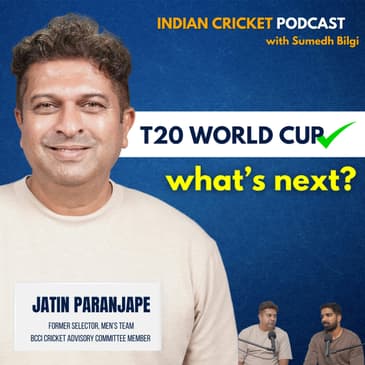
Team India's T20 World Cup celebrations are in swing and while every Indian continues to live that incredible India vs South Africa final in Barbados, we bring back the Indian Cricket Podcast and we're joined by former selector and current BCCI Cricket Advisory Committee member, Jatin Paranjape
On the show we chat about:
1) Jatin and his incredible career in cricket
2) The power of cricket in India's grassroots
3) Tennis ball cricket in India and the growth there
4) Team India's future captain and future head coach
5) Much much more! SUBSCRIBE and share!
#viratkohli #rohitsharma #teamindia #podcast #teamindiacoach
[00:00:00] What are the parameters? I asked him where he lives. He said, we are in Sangli. I used to have a Dhaba. But I have given that on rent. And now we are living in a house in Bombay, rented place in Bombay.
[00:00:29] Because you know my daughter is good and I want to support her. There are hundreds of these stories happening as we speak in India. And I said, where are you from? They were all from outside of Maharashtra.
[00:00:41] But they had come to Bombay so that they could get a trial or be able to bowl at the Mumbai Indians net practice. The way actors come from outside, sitting outside the producers offices just for a screen test. And multiply this by 20x.
[00:01:01] And that's the fervour around wanting to become a cricketer. There is such a lot of increased adjacency between tennis ball cricket and leatherball cricket now. So I saw so many bowlers and I was like, why is this guy not playing Ranji Trophy for some team?
[00:01:17] Because after Virat Kohli and Rohit Sharma retired, who is going to be the flag bearer of that culture? In the incredible after glory of one of Indian Cricket and India's finest hours, the Indian Cricket podcast is finally back.
[00:01:41] And back with a bang with Jatin Paranjpe debuting on the podcast. Jatin Bhai is somebody that I've admired for a very very long time because of the body of work that he's brought to Indian Cricket over the years.
[00:01:51] Jatin Bhai has obviously played for Mumbai Ranji at the highest level. Has played for India as well. And then gone on to pursue a fabulous career in the sports business space.
[00:02:02] Jatin Bhai has also held office for the BCCI in the form of the selector for the senior men's team. And now is part of the all-important cricket advisory committee that is set to appoint the head coach for Team India.
[00:02:14] So we obviously spoke on the day of the incredible final in Barbados. So we couldn't really encapsulate our emotions that we've experienced for Team India in the aftermath of this most fabulous event for all of us.
[00:02:29] But I think what we've beautifully done is encapsulated the power of Indian Cricket right from the grassroots till the very top which is the senior men's team.
[00:02:40] Now conversations like these are very important because we get to understand how Indian Cricket is positioned in such a powerful way for utter dominance in the time to come. And that's what Jatin Bhai speaks on the podcast.
[00:02:51] Now I know we've been away for a while and I know I've promised you consistency in the episodes for a very long time. But we're going to try and put that in place going forward.
[00:03:00] Of course with my IPL and now WPL commitments that takes a bit of a backseat in the first half of the year. But now we are here and we're going to bring you regular episodes in the time to come. So please hit subscribe and hit the bell icon.
[00:03:13] And without further ado, let me bring on Jatin Franspreet on the Indian Cricket Podcast. Enjoy! You've always been an enabler. That's how I've always seen you. You've always enabled, you know, even in our interaction the first time. This is not the first time.
[00:03:27] Our first time was a few months ago. I felt very enabled after speaking with you. I felt like I walked away from that conversation feeling like, huh, I can do something here. I can, I can. These are the avenues that I can go into.
[00:03:41] Your knowledge is something that I really, really cherish and I look forward to. And I'm very happy that you're here today, that you've taken the time to come on the show. Because you've got one of the most kick-ass portfolios in Indian cricket.
[00:03:54] Portfolio is such that what hasn't been done by the guy? I mean, you've, you've, you come from this incredible, you know, incredible background of cricket. Like my mentor Gaurav Kapoor says, the business of cricket runs in the family.
[00:04:10] And then on to play cricket at the highest level, to win five Ranji trophies in 10 years. Yeah. And then to move to, dare I say have the humility to move to cricket business back then when not a lot of people were thinking about it.
[00:04:24] Move to Nike, do sports marketing at Nike, go on the international level, do Khelo more, be part of the BCCI in multiple capacities. How do you do that? You know, I always had a, I always saw myself being involved in the business of sport.
[00:04:44] And it goes back to when I played in the Sahara Cup in 1998. Toronto? Yeah, that was an IMG-owned event. So it was IMG's IP essentially. And Ravi Krishnan was the guy. And Ravi is still a very dear friend of mine. He's a mentor in many ways to me.
[00:05:02] And I remember looking at Ravi and his team at IMG, you know, getting all the stuff organized. And I thought, when my career finishes, I will want to do something like this. So the seed was sown at that time, you know,
[00:05:15] and I don't know whether it's manifestation or whatever you call it, but something you like something and you kind of, you know, your footsteps are drawn in that direction. So that happened. But after I stopped playing cricket, actually my,
[00:05:29] so with this thought that I want to do something in the business of sport, I saw that after I came back from injury, you know, I played two, three seasons for Bombay. Yes. I was not enjoying the game because there was just too much,
[00:05:45] too much surrounding noise around Bombay cricket at that time, which I did not appreciate. And I said, OK, fine now, you know, I'll study. So I wrote to the MCA saying that I'm going to take a year off and I started studying for my CET, you know,
[00:06:03] and it's tough, right? Very tough. And then suddenly I get a call from from the MCA saying, you know, there's a I think it was Sachin actually who called me. And he said there is a Bombay versus Australia match.
[00:06:16] I am not playing because I have a nickel, but you have to play because we need somebody experienced at number three. And I said, Sachin, I knew what his number three was. Yeah, always a number three for him. Yeah.
[00:06:29] And and I said, look, I have I don't know where my kid is, you know, and the match is 10 days away. And so he said, no, no, you we've organized practice for you from tomorrow. You have to do two or three sessions a day, whatever.
[00:06:44] Yeah. Just kept the phone down and you know, when the boss tells you to do something, you just do it. So during that game, I'm during that game, I got talking to Steve War and a couple of the Australian players.
[00:06:57] And Steve War mentioned that he was part of a sports marketing company called Sporting Frontiers. And you know, there was Neil Maxwell, who was the co-founder of Sporting Frontiers along with Steve War. And they asked me whether I want to come and work for them.
[00:07:13] And then I said, if I'm getting an opportunity to work in sports marketing, then let's do MBA later. So they asked me, let me go on the street and find out from ground up. I've learned I've learned the sports business right from ground up. Yeah. Incredible journey.
[00:07:31] I think to probably just ground this conversation for us to sort of lay down the foundation. It's the core at the core of it is obviously the love for the game and the unending desire to keep bettering Indian cricket wherever we touch upon it.
[00:07:48] That's always been it. It was the same with your father. It's the same with you. And you know, like there are obviously a lot. I mean, you've been on podcasts, you've been on conversation.
[00:07:59] A lot of people ask you about what was your background like and how did cricket happen in your childhood? Was it a lot of cricket, etc.? And while I was watching that, I remembered what Arashwin said to me this IPL.
[00:08:13] We asked him about how he's always thinking about the game. He's always obsessed about it. And he said, if there's something that I truly love, something that sparks my soul, why should I stop myself from immersing myself from it?
[00:08:28] Yeah. Yeah. Just for the sake of work life balance. It doesn't matter. My soul sparks up by cricket. And therefore I, you know, do not need to do anything else. And that's the same energy I get from you. That your entire life is dedicated to cricket and sport.
[00:08:42] To sport actually, I'm really, really passionate about the human capital in India. You know, the young human capital in India. I'm super passionate about that. I would like to provide youngsters all across India an opportunity to be in cricket or be in sport,
[00:09:02] as a coach, as an umpire, as a curator, as a referee, as a scorer, as an analyst, or as a school sports operations teacher or a venue manager or a tournament organizer. There's so many avenues available. So Ujwal and I, when we started ideating,
[00:09:22] first two, three years what happened was we said, so even now I tell the full team that Khelo more is set. Khelo more's reason for existence is that we should make more money for the supply side.
[00:09:36] Be it a venue, be it a coach, be it a physio or a trainer or whatever. Whatever the supply of sports is, you know, we should be able to give them, we should be able to give them a bigger market, a wider market.
[00:09:48] So obviously they'll get more business and stuff like that. So that's always been the intention. Really, it's just that. Like Ashwin said, it's that one thing which makes me incredibly happy.
[00:10:02] Even now I've like come here because I've got two players I had to speak to and you know, all of that. I did a call in the Uber with a player who's in Germany training with a SNC guy in Germany.
[00:10:16] But you have to help. That's what I learned from my parents. You have to go out of your way and help and give. The incredible common theme that I see in your father, your mother and you is you're all teachers.
[00:10:33] You're all people that coach in a certain way. You spend time with young talent. That's something that you've done so extensively, which is scouting. As part of Nike and before that and now after that as well with your capacity in the BCCI.
[00:10:49] What is it about young talent in this country that really makes you happy? I think just the self-assuredness, just the self-confidence which you see across the board. Across the board. Be it cricket, be it badminton, be it athletics.
[00:11:08] I was in Bhopal a couple of weeks back. Ujwal and I were in Bhopal to meet some government people who were doing a fantastic job in MP for sports complexes or state-of-the-art sports complexes. They were showing us a boxing arena there.
[00:11:28] There were three girls there who were going about their routine and you should have just seen them. They were unbelievable. So focused, so confident going about all their drills. I got tired just looking at them. But energized at the same time.
[00:11:47] So the young India is very, very confident. You just have to be there, support them, guide them to avoid any pitfalls which you can recognize because of your experience. But I think the amount of potential in sport in India is crazy.
[00:12:06] You've always spoken about how your father was a master of figuring out the pathway for a young cricketer. That was his... he could see into the future and say, listen, play for this club, play at this position, move this way, move that way.
[00:12:21] The pathway for a young cricketer is probably the most important thing. You can obviously sit down and coach them and do a lot of things but to show them that this is the way is important.
[00:12:33] I've just felt that with the change in Indian cricket and the way it's expanded and grown, it becomes even more important now to show the right pathway for cricketers, for young male and women cricketers to go forward.
[00:12:48] So what's the difference you reckon back then for a young cricketer to make it through under 14, under 16, under 19 in India to what it is now and how can that be made better? So, made a big difference with the number of cricketers.
[00:13:07] The number of cricketers now has gone up by 10x probably because just the demand around cricket and now for women's cricket as well. So the number has shot up but there isn't still a proper pathway.
[00:13:22] The tournaments are expanding. So if you look at Mumbai, there are tons and tons of tournaments. But I think there can still be some directional guidance which local custodians of the game, whichever game have to provide. Parents need to be part of this entire exercise.
[00:13:42] So say if you have 200 under 12 kids in Mumbai playing cricket and that's what we do at Kailomore as well. We have joint meetings with the parents, with the children, with our coaches and say that literally on a whiteboard map out how the pathway is going to be.
[00:14:06] So the parents know, okay now after this it's this and that. So there needs to be some pathway which has to be drawn out in front of you. Lot of obviously cricket enthusiasts in the country.
[00:14:20] A lot of boys like me wake up in their childhood and say we play cricket but we're not good enough. The drop off rate when you're off of the kids that are trying to play cricket for India is there.
[00:14:34] It's a significant drop off rate. You play with your heart and you're not sometimes good enough. So the heart breaks. There are some other options. Now today what happens is that when you pass your 10th standard and go into 11th standard and say you're a gymnast,
[00:15:17] 11th or 12th there's nothing for you. Then automatically the sport drops off. So if you, there are two scenarios. One is you're interested but not so good to be amongst the elite. And then you drop off because there's no other option.
[00:15:32] But at that 11th standard stage if you could avail the opportunity of becoming a certified gymnastic trainer for example, or if you could become a referee or if you could be a tournament organizer or something like that, then you have options to keep you in sport.
[00:15:48] That's the drop off which is frightening for me because that's a huge chunk right? And unfortunately missed opportunities. And unfortunately, I don't mean to sound wrong on this but that group say or in Ambedkar College or Siddharth College in Bombay,
[00:16:09] lower middle class income, you've been a sprinter or a basketball player or a gymnast or a cricketer. That sport has disappeared from your life and there are no other options. You will become a worker in the gig economy. You will be delivering food or working for Amazon.
[00:16:27] And that's why some employability has to be built up in sport. And that's what drives me, that entire human capital. Not just the 0.1% who's going to be a Virat Kohli or somebody else. But what happens to the others? They have to be thriving contributors in the sports ecosystem.
[00:16:51] Absolutely. Like you said, having organized leadership is obviously incredibly important. At government levels, people coming up like yourselves, private folks coming up, building things together. But obviously having committees and having that sort of a setup is something that the BCCI has done incredibly well.
[00:17:19] Other sports are obviously catching up. So let's stick to cricket and then through cricket, through BCCI, provide that little bit of imprint, little bit of a guideline for other teams to go forward. How would you describe the way the BCCI goes about organizing cricket in this country?
[00:17:38] From the grassroots till right up? I think it's a very incredible back end. It's an incredible floor plate of participation. Because you have 30 plus associations right from under 14. Now BCCI have introduced under 14 also. So under 14 and then under 16, then 19s and 23s
[00:18:00] and then Ranji Trophy for boys and girls. So the amount of participation is huge. And hence the operational expertise is also huge. So I wouldn't, in the last 10 years, I don't think there's one Sumit, there's one talented player in India who has escaped from the net.
[00:18:20] Who's not been scouted. Not even one. The last guy I remember was actually Rohit Sharma. For a while he was an outlier in Bombay cricket. And then we thought, oh my God, I've seen him from the age of 14-15. It's just a tremendous amount of talent.
[00:18:42] And we used to feel that, let's hope he doesn't slip through the net. And it didn't happen. So that's the last kind of comparable example I can give. So this entire organization, this entire mosaic which the BCCI have put together
[00:18:58] of participation and then having the right people in associations and that's working really well. And I think Indians just embraced cricket after the 83 World Cup. And then the Champion of Champions happened. So there was a cadence to that celebration.
[00:19:20] And then the 87 World Cup happened in India, so that cadence continued. Then a certain Sachin Tendulkar came along in 89. So he captured everybody's hearts with the opening of the economy. Then the opening of the economy happened. But the BCCI have been an incredibly shrewd commercial machine.
[00:19:42] So they leveraged all these opportunities and they then built a moat around their entire business essentially. And that's what is incredible. So they turned this entire interest into participation. And they turned that participation into commerce basically. Fabulous.
[00:20:04] In the same vein, there's obviously been, there is from the rest of the world at times a fair bit of criticism around the BCCI for being powerful, for being influential in the geopolitics of global cricket.
[00:20:21] But it's for due reason. It's happened because of great work that's happened for multiple years. It's two words to describe. My answer is two words. Sour grapes. That's it. Nothing else. You do it. Who stopped you? Do it. You've not been commercially as savvy. You've not leveraged stuff.
[00:20:45] You've not come up with a behemoth like the IPL. And so, you know, it's the guys who have done it have got to get the credit for it. And I think the BCCI also does a fantastic job. Look at Afghanistan's rise.
[00:21:00] It's one of the most heartwarming, beautiful, it's like, it's sport. I love the guys. They're also a beautiful bunch of boys. It's sport. I wrote something yesterday saying that if you want to show your young daughter or young son a role model in sport, show them Rashid Khan.
[00:21:18] It's true. Show them Rashid Khan. So, look at Afghanistan. What did the BCCI do during pandemic? They made Noida and Lucknow as two home bases. Ekana. Yeah, they said, hey, you know what? Boom! We're going to bring you over. Everything's going to be laid out.
[00:21:39] They had a couple of BCCI ops guys stationed there to look after everything. And if that would have not happened, then Bangladesh Cricket's trajectory would not have continued. So wherever there is a support which is needed, the BCCI have been the first to put up their hand.
[00:21:55] First to put up their hand. There's no two ways about that. Emerged as a global leader, obviously. And long will it continue. Long will it continue. Absolutely. What do you make of the IPL and the way it's grown? It's a beast. It's an absolute beast.
[00:22:11] I mean, 17, 18 year old adolescent, which is raring to go. Yeah. And if you look behind the curtain a little bit, and so maybe you are well versed with this, but you see American private equity businesses now interested in buying stakes into IPL teams.
[00:22:33] Nothing kind of endorses the IPL as a global product more than this. Here are the guys who invested in NBA teams and NFL teams and NHL teams. And coming to India saying, hey, we need to look at cricket.
[00:22:50] So I was in Melbourne three or four weeks back for a sports tech conference. And the 2028 Olympics are going to be in Los Angeles. And there was from Wasserman Media Group, KC Wasserman is the CEO of the 2028 Olympics.
[00:23:13] And I know KC just a little bit through my Nike days. And he was talking via video conference from LA to this group of 200 sports tech entrepreneurs and stakeholders in the sports ecosystem. I counted he mentioned cricket 11 times and he said cricket doesn't need the Olympics,
[00:23:38] but the Olympics needs the Indian cricket fan. There you go. Because the Olympics are struggling with their fans not being young. Right. So if there is cricket and it's an experimental piece in LA with six or eight teams, I think. But he mentioned cricket so many times.
[00:23:58] And that's how Americans are looking at cricket. So the USA teams showing in the T20 World Cup has come at just the right time as well. So all the lines are, you know, all the line, all the stuff is falling into place.
[00:24:14] All the ducks are being lined up in a row for cricket to become a much bigger sport than just the 12, 15, 20 teams right now. It will become a much bigger sport because, you know, fingers crossed that the 2036 Olympics is in India.
[00:24:29] And if at that time you have 70 or 80 countries playing cricket at the Olympics, that's incredible. So then it goes there and that opens up the feeder system for the IPL. So, you know, guys from South America might be scouted by IPL teams. And that's the correlation.
[00:24:46] So the IPL is going to grow because global cricket is going to grow. What's beautiful is that the WPL, which has come up recently, is the rate of growth of the WPL is very interesting to me because I think they've had the we've obviously,
[00:25:04] I mean, with regards to the timing, it's a different conversation altogether. But there is a blueprint that's already ready with the IPL that the WPL can take a few things from and grow.
[00:25:16] And what's I think fantastic is that, you know, the talent on the pitch has spoken for itself. So how what's been your assessment? Yeah, I'm super excited about girls' cricket, women's cricket, because I am seeing on a daily basis, like even at our academy,
[00:25:33] like 30, 40 super talented girls, super talented, like crazy, crazy. And the kind of sacrifices their parents have put in. I'll give you an example. There's one girl who's a medium pacer. And I go there, I talk to the parents, you know, because they come with their parents.
[00:25:48] Our academy is in Bandra. They come from Kalyan, Dombivli on a daily basis. Palghar, daily basis, daily basis. So I was talking to the father and he, I'll use a little bit of Marathi here. And he said, so I asked him, So I asked him, So he said,
[00:26:08] We are in Sangli and I used to have a dhaba. But I've given that on rent. And now we are living in a house in Bombay, rented place in Bombay, because you know, my daughter is good. And I want to support.
[00:26:25] So there are hundreds of these stories happening as we speak in India. There will be thousands of these stories happening very soon. In the same vein, what's also been very interesting and I wanted to talk to you about is the growth of regional T20 leagues in India.
[00:26:41] Swarastra, Tamil Nadu, Karnataka is obviously... Punjab just finished yesterday. Punjab, Shere Punjab. What do you make of that? It was waiting to happen. It was waiting to happen. Whatever happens at the top end, at a macro level, will have a microcosm, you know, at the feeder level.
[00:26:58] So it was waiting to happen. And access is there, right? I mean, in the sense like, I think, like you said, the network is in place. The network is in place.
[00:27:06] So what's interesting is obviously the motivation for the young cricketer will continue to be the IPL and Team India. But also these leagues that are coming up all over. For the viewer A, obviously more cricket, more regional connect.
[00:27:20] But also for the cricketer, there's like another opportunity to make a living. You're in the shop window. You know, there and then. And I remember a few years back when I was with Nike, we were trying to build a new fast bowling shoe. You know, so we...
[00:27:35] And I was very keen that the product guys come and test the shoe on a cross mehdan or Azad mehdan. Because that's where the cricket is going to play there. Absolutely. Who plays on one-day? Absolutely.
[00:27:46] So it has to be sturdy enough to take that, you know, to take that surface. And I was talking to a few of the bowlers. I said, you know, there were like four or five bowlers had come and we wanted to test the shoes with them.
[00:28:02] And none of them spoke Marathi. And I said, we're all speaking Hindi. And I said, where are you from? They were all from outside of Maharashtra.
[00:28:12] But they had come to Bombay so that they could get a trial or be able to bowl at the Mumbai Indians net practice. So the way for Bollywood, the way actors come from outside, sitting outside the producers' offices just for a screen test.
[00:28:32] And this multiply this by 20x. And that's the fervour around wanting to become a cricketer in India. It's fabulous. The other early touch point that into playing cricket, the other category of cricketers are the tennis ball cricketers.
[00:28:52] And with your association with the street, that is something that proved to be very, very interesting. I mean, it also attracted a lot of viewership. A lot of people watched it because the skill level is there. It's a different beast altogether, isn't it? Tennis ball cricket.
[00:29:10] What do you make of it? It's a different beast. And there is such a lot of increased adjacency between tennis ball cricket and leather ball cricket now, Sumed. Because you are not allowed to chuck anymore in tennis ball cricket. You have to bowl with a straight arm.
[00:29:27] So earlier what was there? You were allowed to chuck. The other person bends his elbow and bowls. But now you're not allowed to do that. I saw so many bowlers and I was like, why is this guy not playing Ranji Trophy for some team?
[00:29:41] Or why is this guy not playing Time Shield? And then I would go and talk to them and they would say, we are cricketers. But we didn't get a chance. That's why we've come into this ecosystem of tennis ball cricket. Interesting.
[00:29:53] So these are all guys who played Air Division Club cricket. Then next year they didn't get a chance or they got injured and they could never come back. So there's a parallel universe of tennis ball cricket. All these guys are professionals.
[00:30:05] Their families run on them being professional tennis ball cricketers. You go to anywhere in Goa, Maharashtra. Suddenly along the road you'll see like 30-40 bikes parked and on the ground tennis ball cricketers. Incredibly competitive also. Huge competitive. So for me it was a very emotional experience.
[00:30:31] And it was a very emotional experience because these are the... This is their time in the sun to be picked in the auction and to play in front of millions of viewers. That's what they wanted to achieve with a red ball in their hand.
[00:30:47] But they are doing it with a tennis ball in their hand. If we look across the board and if you look across grassroots and we look across age category cricket, the motivation will always be Team India. It will always continue to be.
[00:31:00] It is and it will always continue to be. I think just to set things up, where do you see the health of the men's team right now? And how are we placed and how are we going? That's a great question.
[00:31:15] I think we are at the start of an incredible opportunity. Which will see India being a top, top T20 side in the future. And we are talking on the day of the finals. And I feel there is a huge opportunity.
[00:31:38] There's a big, big highway being thrown open in front of us. Wherein it becomes the responsibility of the BCCI in a way to make sure that this opportunity is leveraged. We have the raw materials from a skill perspective to become the best T20 team by a margin.
[00:32:01] And we also have the raw material to become the best test team by a distance. So if you look at the surrounding competition, so to speak, India, Australia later this year will be a fantastic series. We were just talking about it.
[00:32:18] But next year we will have Australia without three or four of their top players. So there's a churn which will happen there. There's a churn which will happen in South Africa.
[00:32:30] And we know that there isn't a huge amount of talent in South Africa at a 19, 20, 21 year old level. The way it is in India. Now you look at the Indian team to Zimbabwe, look at the talent in that team. We are blessed with that.
[00:32:47] So we need to be very mindful. We've got a mine which is full of all the treasured minerals, so to speak. And how do we kind of have our flying formation across Test Match Cricket, ODI Cricket and T20 Cricket?
[00:33:10] Who are the guys who are going to be leading those teams? Is the same coach going to be looking after all those teams? I for one feel that there should be two captains across the three formats.
[00:33:21] That captain across the other two formats should be the vice captain in the Test Match team. So that the alignment in the group, the culture, the vision is something which is adopted because he is the vice captain.
[00:33:35] And that he will take into the other two teams as well. So there's a lot of planning, a lot of visioning work which remains to be seen. At the same time there is a new National Cricket Academy which is being built on 65 acres of land.
[00:33:48] How can that become the supply chain of all the dreams that you want to achieve as a country in cricket? All of these pieces need to come together. Go a little further. How do we manage this incredible crop of 30-35 boys that we have?
[00:34:08] What do you think is the way to manage these guys in the best possible way? So that none of them are A. demotivated or B. that we don't miss out on the potential that each one has to offer?
[00:34:21] You know it's a tough one. It's not going to be an easy journey. But you need to plan very well for it. And every sports ecosystem goes through some evolution. Let's look at the US Basketball for example.
[00:34:39] I just saw an incredible documentary called the Redeem Team which is about the 2008 Beijing Olympics USA Basketball team. In 2004 they lost in Athens and they were called the Dream Team. So the media gave them the sobriquet of Redeem Team.
[00:34:57] And you saw all these big guys come together but all playing under, as coach asks them, Coach K asks them that I want you to bring all your egos and put it under one big Team USA Basketball ego.
[00:35:15] So a lot of our work in the future will be around culture. Very very important that the right culture is dominant. Like the cadence of culture remains the same. Let's go back 15 years when Sachin became captain of India. And all your newer players started coming in.
[00:35:37] You had the UVs and the Zaheers and the Viru's and the Bhajis. And how they were all, you know, how that culture rapper was kind of, you know,
[00:35:50] Introduced to them, adopted by them, passed on by them to the Dhonis, to the Virat Kolis, passed on by the Virat Kolis and the Dhonis. So that entire cadence has to continue. So that's not going to be an easy journey.
[00:36:04] But what will happen is that the right players with the right culture will form those 40 or 45 players playing for India regularly. So that your culture needs to remain intact. Because after Virat Koli and Rohit Sharma retired, who is going to be the flag bearer of that culture?
[00:36:31] So that's the first flag that we had under Rohit's captaincy and earlier under Virat's captaincy. It was the objective for the Indian team was to be the best test team in the world. Because that's the respect they have for test cricket.
[00:36:47] So it's very important that, you know, that flag remains flying. And I can see Jaspeet Bumrah being a big kind of flag bearer of that.
[00:36:59] So that the team, the team that is going to be the best for the purest form of the game, the most traditional form of the game has to keep going. It's going to be a tough one. It's going to be a tough one.
[00:37:08] But I think we should be able to manage it. So, I mean, I know that I've often heard you speak about the character of a player. Yeah. Even when you're scouting, you know, you would say you'd rather look at a player who's a captain.
[00:37:23] He gets just a little bit of preference here. Another look from you. In the same vein, you know, from what you've seen from Jaspeet, you think he's the one who stands out? Honestly, I feel Rishabh Pant is a guy who should lead in going forward. Super, super culture.
[00:37:42] Just an all-around great guy. And I think Rishabh Pant, Shreyas Iyer, Jaspeet Bumrah, these are the three or four names which come to mind. You know, wherein the mantle of leadership can be placed on. And, you know, they just have to keep growing from there on, I think.
[00:38:02] But an immediate thought would be Rishabh Pant should be made captain as and when, you know, whatever transition happens. Character, right? That's the big word. And all of these guys have had their share of, you know, they've seen their share of life.
[00:38:18] And to just, I think that when you see your share, your character evolves and you become this leader. You become this person. I think that rubs off on leadership as well. I think so.
[00:38:28] I mean, if you look at Rishabh in the last three games, he's got out badly. But you've seen his expression and he knows it. You know, so he's now wanting to get better there. But you rewind a little bit and he's been through a near-death experience. Exactly.
[00:38:42] From what my friends at the National Cricket Academy tell me that Jatin, he's not been late for one session in two years. He's not been a minute late for any sessions. So he wanted it.
[00:38:54] And I think that, you know, when you go through the hottest fire, that's when your diamond kind of emerges after that. So I think, you know, here are three or four guys. I also feel Jaiswal will be an all format player.
[00:39:08] I think Ruturaj Gaikwad will be an all format player. Shubhman is a fantastic player as well. So from a batting perspective, I'm not too worried. It's just the spin department which worries me because after Ash, you know, whom do you have? But now you're seeing Kuldeep Yadav, right?
[00:39:23] I was just thinking yesterday that every great team of the past has had at least two great bowlers. Absolutely. If you look at the Australian team of the West Indies, so I had three or four of them in the 80s and the 90s also.
[00:39:38] And the Aussies in the 90s and the 2000s had Maghra and won. You know, and then they had a Gillespie and, you know, surrounding. But today India have that. You have Bumrah and now Kuldeep Yadav is going to become that guy.
[00:39:52] So in the white ball format, you have Bumrah and Kuldeep Yadav. And in the red ball, guess what? Bumrah, Kuldeep Yadav and now Ashwin. And then Mohammed Shami. Exactly. So that's why he is in his best shape. Yeah, Siraj is a great trier.
[00:40:08] He doesn't have the quality of a Shami. And he will be the first to admit that. Shami is a Rolls Royce. You know, they're keeping him for the Australian series. Correct. The five test matches. Ankle theek kar ki aaja ho Shami bhai. Five test matches.
[00:40:24] Lala is going to steal him completely. Yeah, yeah. It's fabulous. Sticking to the same vein, are you open to speaking about the new head coach? Yeah, so I'm part of the cricket advisory committee. We've had our meetings and we've had our discussions.
[00:40:39] I think the new coach has because of all these pieces I've mentioned, there's a huge responsibility on the new coach. That person needs to hold the respect of the younger players. You know, so that's extremely important because in a dressing room,
[00:40:56] if the coach, you know, today you have Rahul and then Ravi earlier on. The guys who command respect, right? So it's very important that especially with mostly a younger team, you need to have a coach who will have that respect and who has that experience as well.
[00:41:14] Because what lies ahead is a lot of strategy work as well for Indian cricket. Where do you see yourself in the next five years? We are here, Australia is going to go through this journey. England's where they are right now. You know, South Africa is here.
[00:41:31] Afghanistan is playing. Where do we see ourselves? Where do we see ourselves and work backwards from there? And the coach like in a cricket team, the coach is like a supplier to the captain. In a football team, the manager is the boss,
[00:41:46] but here the captain is the boss. So you need a coach who will have a great relationship with the next captain and the next captain after that because if a coach is going to be around for four or five years,
[00:41:56] he might see a couple of captains in those four or five years. With the parameters, right? I mean obviously with your capacity, with the advisory committee. It is the top job, right? The role of the head coach. It is as big as it gets.
[00:42:11] High pressure, the hot seat. What are the parameters? You know, what are some of the things that the committee wishes to see or the BCI wishes to tick off with this person that will eventually be the head coach of team India.
[00:42:23] So one thing amidst all of this which is really helpful is that the ICC has a future tours program, the FTP. It's chalked out to 2027, I think 2028 if I'm not mistaken. So you know what my calendar is. And then you work backward from that calendar.
[00:42:41] And then your pool of players emerges. And then which teams are the teams you can take a chance against. So Zimbabwe send a young team. Because they are playing for India. When you're playing for India, that pressure is still there. You could be playing Simbak too.
[00:42:56] But when you're wearing the India cap, you're not an IPL player or an India player. So it's different. So that is, so my thoughts were around how are you going to approach, you know, how are you going to manage your talent base given this calendar. Right. Most important.
[00:43:15] Yes. Yeah, I mean mindful of the time. But sorry, I think I spoke too much. Not at all. I mean mindful of your time. We will sit here. We were just talking before you came. They were asking how much will be enough? You can keep talking.
[00:43:32] It never ends. But I mean, I think there are a lot of things that the Indian cricket fan does not know fully. And would like to know fully. One of the things I think is just what does the cricket advisory committee do? What is your responsibility?
[00:43:48] You're part of the three member committee that is called the cricket advisory committee. So what does the committee actually do? So the cricket advisory committee interviews and appoints the senior men's selection committee
[00:44:02] and the head coach and also has a role to play for similar positions for the women's cricket part of it as well. So the selection committees and the head coaches are the applications are reviewed and processed and then recommendations are made and appointments are made by this committee.
[00:44:26] So the head coach for the men's team, the head coach for the women's team, the selection committees for the men's team, the selection committees for the women's team as well. It's a job and a role that requires a lot.
[00:44:40] What does it take out of you to be a member of this advisory committee knowing that these decisions are paramount? Just for a joke, I keep telling my friends, my non-cricketing friends that this role is reducing the number of my cricketing friends.
[00:44:58] Because all the applicants are people whom I've played with and you can pick only one person. So the other guys are like, Jax, you know me for 20 years, you don't think I'm good enough to do this? I'm like, okay, or like those guys. It's incredible though.
[00:45:14] It's incredible. I mean, these decisions lay out everything going forward. It's a matter of honor, honestly. It's a BCCI to be part of the BCCI is a big thing. So I'm super lucky.
[00:45:27] Just to wrap up, I think we've spoken in depth about so many facets of the game right from the grass root up to all the way up. But I think you've been witness to the cricket economy growing, to the cricket ecosystem in India growing right from the beginning.
[00:45:50] What is the one thing that sticks with you about the growth of Indian cricket for everybody? Not just for the players but for consumers, for participants, for everybody. What is the one thing that stands out for you?
[00:46:04] I think the future because after you've had a history of about 20-30 years where cricket's been growing, you rarely have an asset which sees phenomenal growth year after year, decade after decade. And that's happened for the last, say, 83, now it's four decades.
[00:46:27] So four decades that asset has kept, you know, the market cap has kept appreciating. And now we're saying, oh my God, there's something called the US of A which might be interested in cricket. So it's going to grow. So the longevity of that asset is remarkable.
[00:46:45] The asset called Indian cricket is remarkable. Absolutely. What was remarkable was also this chat. So thank you. It was very, very nice to have you. My pleasure. I'm sorry. How did you feel? It's been a long time coming.
[00:46:59] I love talking cricket and I would love to be on any future shows as well. Not a problem. See, this is on record. Yeah, it's on record. Later don't say you're busy. No, no, no. You're always busy. I've brought Uber and all. I'm busy here. Very grounded person.
[00:47:16] Thank you. Thank you. My pleasure. Entirely. Thank you. If you're more of an audio person and you like listening to your content while you're doing other things in the house
[00:47:26] or you're traveling or you're working, make sure you hit the buttons below to get access to my podcast on all major audio platforms. You won't regret it.