
We would like to start by thanking the International Institute for Asian Studies (Leiden, Netherlands) and Mr. Benjamin Linder for helping us with the recording of this podcast episode.
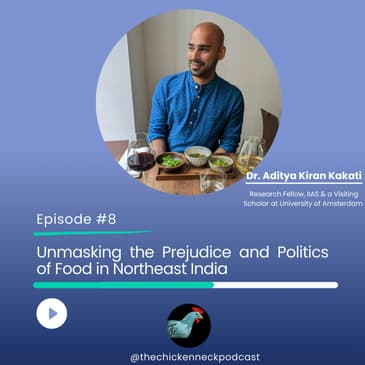
In this 8th episode, we are joined by Dr. Aditya Kiran Kakati, who is a Visiting Scholar, at the University of Amsterdam (UvA) and an Affiliate Research Fellow, at the International Institute for Asian Studies (IIAS) and at The Highland Institute, Kohima, Nagaland. Aditya works as an Associate Editor for The Highlander Journal, which seeks to promote conversations on global highlands to push the boundaries of traditional area studies. Aditya’s MA thesis was an ethnographic project titled "Eating Ethnic Enclaves: Cultural Encounters in Liminal Spaces of Eating in the Context of Migrations from the Eastern Himalayan Region". The research was on the emergence of ethnic cuisine, restaurant and labour cultures, identity politics, and socio-cultural relations arising from minority community migration from borderland conflict zones within India. He keenly maintains his culinary pursuits, mostly in the home kitchen and occasionally in public forums.
In this episode, we delve deep into the intricate and diverse food cultures of Northeast India, exposing the stigma and politics that often overshadow this rich culinary heritage. Join us as we uncover how ignorance about this region gives rise to racism and prejudice, leading to the downplaying of vital issues.
We explore the unsettling disgust directed at the food consumed by Northeastern communities, revealing the intricate web of caste authority, privilege, and politics of purity that underlie these sentiments. Discover how everyday food choices in India intersect with complex issues such as caste violence, ultra-nationalism, and the quest for purity.
Our episode also spotlights the recent ban on dog meat in Nagaland and the passionate debate it has ignited. We examine this issue from multiple angles, including the clash between indigenous practices and animal rights concerns. Join us on a journey that uncovers the flavors, emotions, and politics that are an integral part of Northeast India's eclectic food culture.
You can read more about his work : http://journals.ed.ac.uk/himalaya/article/view/8044
Disclaimer: The views and opinions expressed in the podcast are those of the individual podcasters. Listener Discretion is advised.
Follow us on Twitter, Facebook, Instagram, and LinkedIn. You can listen to our show on all streaming platforms by clicking on the link:- https://bingepods.com/podcast/the-chicken-neck-podcast
Learn more about your ad choices. Visit megaphone.fm/adchoices
[00:00:00] Hello and welcome to the ChickenNet Podcast.
[00:00:02] Supported by the IdeaBruze Network, we are a bunch of curious individuals based out of
[00:00:07] the North East.
[00:00:08] And we strive to bring you the best of policy discussions through the intersection with
[00:00:12] things that affect your and our daily lives.
[00:00:15] If you like what we do, show your support by sharing our work.
[00:00:18] Don't forget to leave your comments on this episode in our social media handbooks.
[00:00:24] Hello everyone, welcome to another all of this factors shape into our culinary skills right and which you would of course delve into in a more specific research-oriented phenomena ended up making the tribal cuisine or cuisines from northeast India. They're not interchangeable but in the way it was presented and making it made these cuisines
[00:03:02] more mainstream and broke casteboos and the cast Hindu youth, who could not eat this meat at home otherwise. I think the popularity of Naga food for instance, which offered unique pork dishes, filled this demand for new tastes. And I continue to write about these issues related to food, identity and ethnicity alongside my work on conflict and development. So it's an interesting match of how you try to you know 12 into your different passions and then make a research out of it. So I mean of course we are quite aware of what Professor
[00:05:44] Tolleke Kohn also writes on food and her interesting very interesting takes on it history of our identity, of violence, of ultra nationalism, some of purity, right? Because you say that these are part of things that you have looked into. So how does food have anything to do with all of this? Could you tell us a little bit about that? So food, although, is very personal, and I think because it is personal, it has various meanings for every individual has a different meaning
[00:07:04] for what it, as you said, for you frictions can emerge. So food inherently is actually political because it is also personal. And this politics happens at different levels, right? So it is at an individual level. One can get discriminated against for eating certain kinds of food.
[00:08:22] One can be made fun of, one we stick to a country for instance, the food habits in North East would be very different from let's say the food habits in northern part of the country or let's say the central part of the country. Right? Traditionally, we are also looked at, I mean people from North East consume a lot of
[00:09:40] meat for instance, right? Of different varieties which might not be the same in the central part the caste order like tribal populations in particular have been subject to such prejudice and discrimination across the country. However, in recent decades, the greater and distinct racialization of such discriminative practices has emerged, which was partly enabled by the fact that people from northeast India and the Himalayan region have distinct physical features.
[00:11:03] In experiencing discrimination in places like Delhi, you'll find that pork is publicly considered an integral part of what is Assamese cuisine, in a way that was not possible, even a generation or two earlier. Here, arguably, there is a broadening of the notion of Assamese society that disrupts the caste order,
[00:12:22] even if it is in a limited manner.
[00:12:25] But there is still relative unfamiliarity within mainstreaming in a very kind of mediated festival space where partly it's been showcased, partly exoticised and but at the same time also made part of the mainstream eating culture. Again, that's an interesting point to bring out, right? How there has been a practice, you know, there has been now a practice of all of this article or this book chapter was called For the Love of Pork, where I tried to map this phenomena as to understanding how pork became recognized as a mainstream sort of asymies delicacy. It has existed for a long time among especially among tribal populations, even
[00:15:01] Hindu tribals, right? Because the normal Himalayan region, but also in places like Shillong. Pork eating was very common. So people who grew up there or had ties to places like in Shillong and so on used to eat pork. But for a larger mass of the population, I think
[00:16:24] mOMOs became a way, one of the ways, of course, not the only how, what transform was the demand, first of all, and then also the availability of spaces where you could actually access this sort of meat. So I think along with acceptance, it is also the presentability of something and also the fact that it is more easily available.
[00:17:40] So and the fact that acceptability comes from availability of something.
[00:17:43] Like for instance, when you talk about MOM, Assamese, it's things like pork that are foundational parts of a cuisine, and Paneer is kind of encroaching into that, right? Which in the realm of ethnic cuisine. And I think over time, this sort of hard boundary is probably collapsing because of the demand, because of acceptance and general sort of, yes, like developed taste for things like pork.
[00:21:24] dog meat and Nagaland, right? I mean, because I stay currently in the northern part of the country, it's actually intriguing
[00:21:30] if I say dog meat, there would be so many different opinions because dog is looked at
[00:21:35] such like a animal that you pet at home.
[00:21:39] So to have just the idea that the people bring in with dog meat. So, before coming to the specifics of this particular case in Nagaland and that is the article that we wrote in response to this particular phenomenon that happened and the meaning the dog meat pan and the way in which people have come with it historically. So when it comes to especially Asian countries, any station countries where dog meat is consumed. This is different when you compare with, for example Nordic countries consumption of whale, because there are different rights issues or different kinds of environmental animal rights issues at play there, but it is not
[00:24:20] racialized in the same way that dog meat consumption of the Naga dog meat controversy when this ban happened in July, 2020. At the outset, I would like to say that this particular article was actually co-authored initially
[00:25:42] and this was meant to respond to debates
[00:25:45] sparked by the dog meat ban in July, 2020.
[00:26:46] to feeling this sort of us versus them narrative. As it happened in the case of the dog meat ban,
[00:26:53] several public commentators and intellectuals saw the ban as an attack on other cultural rights, which is not unfounded given the history of difficulties faced by Naga's.
[00:26:58] Our response was prompted by the fact of funds from that particular constituency. Moreover we compared dog meat consumption to rampant illegal hunting and eating of endangered
[00:28:22] animals which comes with its own set of problems. objection to the commercial dog meat treat in Nagaland, which is a relatively recent development, was its scale and cruelty. Moreover, the fact that dog meat was and is still eaten by many in Nagaland should not become the basis for stereotyping either, which using cultural arguments can only exacerbate. Unfortunately, my co-authors and other collaborators
[00:29:43] also chose to remain anonymous in the writing of primarily at least for a lot of the Northeastern states, this idea of what you consume and how that reflects on the society is a larger concern.
[00:31:00] And I think it has, I mean, to this potentially you can argue it's the same thing as what
[00:31:03] is happening with the example of what is political or what can be regulated also coming within our
[00:32:21] homes right which I mean it can happen when I let's say, which does not, the society is not accepting of it, then it's just, then is it a conflict of different bundle of rights and obligations that the society versus individual has. How do you look at that particular issue? Right. So this is actually a question that you guys as lawyers are better pleased to answer and
[00:33:40] engage perhaps.
[00:33:42] But it is also interesting to have this conversation with you for the same reason. thing. But aside from that, there are health risks, illegal trade involved and cruelty, which are more tangible, let's say, factors that can help determine how to approach the question of restrictions on food. I would also add that protecting the right to eat certain foods in an unregulated manner can be dangerous. So, for example, if you give particular rights
[00:36:03] And then also alongside that, what foods should qualify as legitimate recipients of legal protection
[00:36:08] within this kind of an indigenous discourse, right?
[00:36:11] But all of this will not shift the discourse
[00:36:15] towards the real issues actually at hand.
[00:36:17] Moreover, the practical experiences
[00:36:19] and the intellectual critiques of doctrines
[00:36:21] like multiculturalism, when you talk about rights
[00:36:24] in places like Canada, these sort of rights were meant are farming and have livestock. I think there's a growing set of literature as well that looks at this relationship of intimacy between different communities and the animals that they keep, but that rights. I think I also had a question as to whether this entire, you know, ban with the Nagalan ban that we had discussed, how the element of, you know, the food that we eat and its impact on
[00:39:04] diseases, the zoonotic diseases, how does let us say. And ultimately, it is the body that we need to help with the maximum number of different
[00:40:20] fibers and proteins.
[00:40:21] So, I think that as well.
[00:40:22] And it is interesting to understand how all of this comes we form because I mean just to again lay it more simply what I would like to understand is because I have a particular food habit right because I come from a particular community. Now because somebody is telling me what I should it or should not it, does it impact my greater identity as an individual from that particular community?
[00:41:43] If I am asked to eat or not as an individual, not necessarily as a community, how can, how is that compatible? And I think that here you can see the, the difference between what we think the ban on something, like you said, I mean, for instance, the fact that one example could be alcohol ban, right? Just because certain states have banned alcohol,
[00:44:21] it doesn't mean that you do not actually find alcohol.
[00:44:24] It's just that it's done in black.
[00:44:26] I think when, a conversation we have wanted to have for a very long time to talk about food and its impact on all of these different facets in our life including politics. And I know there's been a lot of 2N fro for us to get the dates done but I'm so glad that this happened. And on that note, thank you so much for coming to the Chicken Network. It's been an absolute privilege speaking to you about such an interesting aspect.
[00:45:42] I'm interested in understanding