
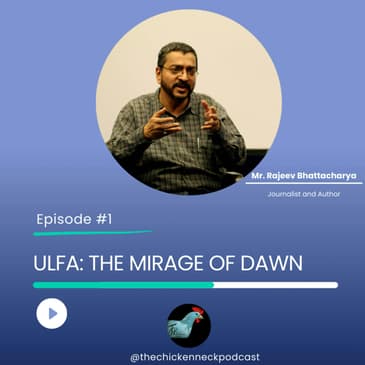

Welcome to the highly-anticipated Season 4 of The Chicken-Neck Podcast, where we kick off with a riveting exploration into the covert history of one of India's most influential separatist organizations – the United Liberation Front of Asom (ULFA). In our first episode, we are joined by senior journalist and Chevening Fellow, Mr. Rajeev Bhattacharya.
Rajeev Bhattacharya, a veteran journalist with an extensive background working for reputable publications such as The Telegraph, The Indian Express, The Times of India, and Times Now, brings his wealth of experience to our podcast. As the managing editor of Seven Sisters Post, Bhattacharya has delved deep into the heart of India's northeast, reporting on the intricate dynamics of the region's borderlands with Myanmar, Bhutan, China, and Bangladesh.
In his latest groundbreaking work, "ULFA: The Mirage of Dawn" (2023), Bhattacharya unravels the clandestine history of ULFA, a separatist force that has left an indelible mark on India's Northeast since the early 1980s. Join us on this compelling journey as our host engages in an exclusive conversation with Bhattacharya, shedding light on his investigative journalism process, the challenges faced, and the extraordinary encounters he experienced while peeling back the layers of ULFA's stronghold. Through this captivating podcast episode, we seek to delve into the intricate web of ULFA's influence, discovering the untold stories that have shaped the region's history.
Don't miss out on this thought-provoking episode that promises to leave you with a deeper understanding of ULFA's complexities and the mirage that has veiled its dawn for decades.
Find the book at amazon: - https://www.amazon.in/ULFA-Mirage-Dawn-Rajeev-Bhattacharyya/dp/
Disclaimer: The views and opinions expressed in the podcast are those of the individual podcasters. Listener discretion is advised.
Follow us on Twitter, Facebook, Instagram, and LinkedIn. You can listen to our show on all streaming platforms by clicking on the link:- https://bingepods.com/podcast/the-chicken-neck-podcast
Learn more about your ad choices. Visit megaphone.fm/adchoices
[00:00:00] Hello and welcome to the Chicken-Neck Podcast. Supported by the IDA Dude's Network, we are a bunch of curious individuals based out of the North East. And we strive to bring you the best of policy discussions through the intersection with things that affect your and our daily lives. If you like what we do, show your support by sharing our work. Don't forget to leave your comments on this episode in our social media handbooks. Hello and welcome to another episode of the Chicken-Neck Podcast. As we begin a new season, we have with us one of us,
[00:00:29] Sam's most respected and senior journalist Rajiv Bhattacharya, Rajiv Dha, obviously forces us to call him Rajiv Dha enough since our first call.
[00:00:39] And he has been one of, as I said, he has been one of the most senior journalists. He has worked with some of India's biggest media houses,
[00:00:45] including the Telegraph, Indian Express, Times of India, Times 9 was also the managing editor of Seven Sisters post.
[00:00:52] So as you see, he has worked with almost all the big houses, media houses in India.
[00:00:56] Apart from his obviously journalistic side, he is also academic by heart. At least that is what I would like to believe.
[00:01:02] He is a Shevning Fellow and has written numerous books which is added to the academic literature of insurgency and of alpha in Assam and throughout India.
[00:01:13] Now, our discussion today will of course revolve around a number of books that he has written over the course of his lifetime of work,
[00:01:23] and some of which of course include Ronda Gu with Rebel's Journey to Meet India's Most Wanted Man,
[00:01:28] where he talks about Boris Bora, which we will talk about in detail. He has also written another book called Lenses and the Gorilla insurgency in India's Northeast,
[00:01:37] another book called Boris Bora Humbhanot, which is I think an Assamese book that he has translated as well.
[00:01:43] But he has also come up with a new book called Ulfar the Mirage of Dawn, which will be a focal point of our discussion today.
[00:01:50] So Rajiv Dha, welcome to the podcast.
[00:01:52] Thank you so much.
[00:01:53] I am grateful to all of you for giving me this wonderful opportunity to say a few words about my book, about alpha, about whatever questions you might ask me.
[00:02:02] Thank you so much.
[00:02:03] So Rajiv, to start this on a more informal note, at a time when you started your journalistic career,
[00:02:12] as we even hear about stories today, so many journalists were at the focal point of what was happening in Assam at that point,
[00:02:19] when Ulfar's rise and the fact that they were attacked whenever something was reported wrong or let's say reported for them or against them.
[00:02:27] So tell us a bit about your journey as a journalist and how did you come about reporting on Ulfar?
[00:02:36] Will you tell us a bit about that?
[00:02:38] What do you say?
[00:02:39] In life, I believe you automatically get drawn and attracted towards certain topics.
[00:02:45] And I believe in destiny, some people get drawn towards sports, some towards business, culture, etc.
[00:02:52] And I have always been attracted by everything that is underground, that is secret.
[00:02:57] That goes to underground arm movements that extends to spiritual secrecy, everything.
[00:03:03] I want to dig out and I have realized that in certain areas, which I would like to elaborate in certain areas,
[00:03:10] it's better not to dig out, you need to experience certain things.
[00:03:14] So after beginning my career as a journalist, I was interested to know more about Ulfar and other inserted outfits operating in the notice.
[00:03:24] As a whole, I was interested in the notice.
[00:03:28] My God's grace, I am a very focused person.
[00:03:31] So I decided when I was working in Delhi, in Delhi, Grapdato's way back in 2005, after I came back from London,
[00:03:39] I decided that I will no longer be staying in Delhi.
[00:03:43] I should go back to the notice.
[00:03:45] The notice has a huge scope for not only journalists, also for two other categories of people, for social scientists and also for the intelligence agencies.
[00:03:56] I realized it was a region waiting to be discovered.
[00:04:01] It's a region in which you can dig out many, many, much detailed information on numerous topics.
[00:04:09] Because I have myself seen, in the last so many years, wherever I go to the notice in any region, the ground narrative is very different from the narratives that we have been reading for so many years.
[00:04:21] So looking back, I realized that with God's grace, my decision to return to the notice in 2007 as the bureau chief of notice with times now was not wrong.
[00:04:32] It was correct decision.
[00:04:34] So I am grateful to the universe, I am grateful to everybody who has helped me.
[00:04:37] So why I got drawn towards these arm movements?
[00:04:40] I don't really know.
[00:04:41] It was a very natural tendency.
[00:04:42] So I began pursuing this, my interest with great dedication.
[00:04:48] It was an in the journey, I must admit, as I was drawn towards more focused towards alpha, I ended up writing two wrong stories also.
[00:04:58] Every journalist, every journalist on the ground, in his or her career, there, it's bound to have wrong stories.
[00:05:06] The challenge is not to have too many wrong stories.
[00:05:08] In my career, I ended up writing two wrong stories on alpha, which in fact motivated me all the more to delve deeper into alpha.
[00:05:17] Now, the idea of writing a book, this current book, the latest book that I have, Alpha the Mirage of Dawn published by Harper Collins.
[00:05:25] The idea of writing this book began to take shape only in 2010.
[00:05:29] And I realized, the first thing I realized was that I will have to interview and meet Chief of Staff Parej Borwa because he was an extremely elusive person.
[00:05:40] Oh, oh, journalist of Great Refuge, an eminent journalist called Bertie Lintoner, who I regard as my guru in journalism.
[00:05:48] His stage in Thailand is originally from Sweden.
[00:05:50] He was the, he was among the first journalist, a product of the first journalist to have entered with Parej Borwa.
[00:05:55] He met Parej Borwa and the other leaders first in Myanmar and then again in a Southeast Asian country.
[00:06:01] So I realized I had to meet Parej Borwa.
[00:06:04] I began, I got out the roadmap.
[00:06:07] I began on pursuing, at last, I met with success.
[00:06:11] Finally, Mr. Parej Borwa, Dangoriya, he gave me the green signal sometime very early in 2011, and I started with that.
[00:06:20] So it was a very, it was a very tough journey, but I enjoyed everything.
[00:06:27] Even all the dangers, all the risks that I had to go through, all the challenges that I had to overcome, I enjoyed everything.
[00:06:34] I must be grateful to the universe.
[00:06:37] You know, we'll talk about, you know, a little bit about your journey of going and meeting the Ulfar Chief and, you know, how secret that was or whatever you had mentioned in your previous writings.
[00:06:48] But, you know, through our podcast, we also want to kind of let our listeners know because Ulfar is a huge thing in the Northeast because of all our insurgency groups and what has happened historically.
[00:07:00] But many of our listeners might not know what Ulfar is, so even if we start from that point.
[00:07:05] So, you know, could you tell us a bit about, as somebody who has looked into this organization, what are some of the integral points for the formation of Ulfar?
[00:07:14] And why is it that they still sustained to survive as an organization?
[00:07:19] You see, if you have a look at the history of Ulfar, in the post-Defendants period, the state has witnessed continuous agitations after 1947.
[00:07:30] Some of the policies pursued by the colonial British regime were continued by the Indian government.
[00:07:37] I'll just give you one example, the crude oil from Assam was pumped out to create a two-established refinery in Baraoi.
[00:07:46] But it was something, I mean, not only obnoxious, it is also a very, I would say, very short-sighted policy.
[00:07:52] This is a landlocked region.
[00:07:54] You need avenues of employment here.
[00:07:56] It's one of the most backwards regions in the country.
[00:07:59] So, the situation had been building up after 1947.
[00:08:03] After the independence, there was a perception among a large section of people that took a long story short, that these agitations have not produced any result.
[00:08:15] There ought to be an alternate path to compel New Delhi to redress the decades-old grievances, and some people decided to pick up weapons.
[00:08:25] Now, if you, the major episodes in history, right, during the time of independence, whatever Prime Minister Nehru,
[00:08:32] he spat with Gopinod former chief ministers, Gopinod Botaloy, that even next, that was even before independence.
[00:08:40] And if not being Gopinod Botaloy, Assam and Nautis would have been, was collapsed in Group C of the Cabinet Mission Plan,
[00:08:47] Assam and Nautis would have been in East Pakistan, too.
[00:08:50] It was because of Gopinod Botaloy, some senior congress leaders in Assam, and Mahatma Gandhi,
[00:08:54] mother of the nation, that Assam and Nautis had been saved.
[00:08:57] This is a reality.
[00:08:58] Nobody can, it's recorded.
[00:09:00] After that, even Prime Minister Nehru even went to the extent of threatening the Assam government,
[00:09:06] that if you do not accommodate the refugees from East Pakistan,
[00:09:10] we'll stop the financial grants to you.
[00:09:12] Is that with Gopinod Botaloy and Nautis, it's too early.
[00:09:18] Next came the 1971 war.
[00:09:21] You, again, have a huge number of refugees coming and staying.
[00:09:25] Most of them have gone back, but the huge number of governments have stayed back in Assam.
[00:09:29] The central was unmuting to listen to the grievances of the indigenous communities in Assam.
[00:09:37] It was a bulldozing policy.
[00:09:39] You will have to accept since you are part of India.
[00:09:42] So, at one point of time, it's bound to create a situation where people, some radical sections will think,
[00:09:49] and okay, fine, these policies, we will have to think differently.
[00:09:53] Assam should not be part of the Indian Union.
[00:09:55] We need to pick up weapons.
[00:09:57] We need to fight it out.
[00:09:58] So, I do late 70s, the situation had taken such a turn.
[00:10:03] On the one hand, you had a situation building up the Assam vegetation, but even before that,
[00:10:07] a group of people had already started thinking along different lines.
[00:10:10] And already in Margherita, as I've said in the book,
[00:10:15] there were only the Kerala classes going on Margherita.
[00:10:18] Then subsequently, the Aumjatiya da Vadijuva Satropurika was formed.
[00:10:21] Some people got together, formed a committee.
[00:10:24] At that point of time, in the early 80s, not only alpha,
[00:10:27] there were many armed groups, but it was only alpha that sustained.
[00:10:31] Many members from the other armed groups, these armed groups were fizzled out.
[00:10:36] They joined alpha, and the linkages to Myanmar got established.
[00:10:40] The people went there, received training, then subsequently to Kachin, Pakistan, Bangladesh,
[00:10:45] and everybody.
[00:10:46] So, even if there had been no alpha, there would have been some other organization.
[00:10:49] Such happening, such episodes is not only peculiar to Assam.
[00:10:53] If you have a look at the history of other regions in the country,
[00:10:56] in the country, other regions.
[00:10:58] across the world. You have many similar examples. You have the case of the Mavis movement in Central India. Nobody wants to pick up a gun and become an insurgent by choice. It's the last choice of many people. That the government, nobody is listening to us. We have our grievances. So, very picking up a weapon will resolve, will put an end to our problems. So, that is in a nutshell, that is the beginning of all function.
[00:11:28] It became active in the early 80s. It went on for a variety of reasons. It was able to sustain.
[00:11:35] It ended up as an organization with the maximum network in the world second only to the LTT in South Asia,
[00:11:43] which I have dealt with in the laboratory in my book.
[00:11:46] Interestingly, because just picking up from your last point and the fact that you said that
[00:11:53] nobody would actually resort to picking up guns by choice until and unless they forced
[00:11:58] when that was, I think, an integral point in Assam's history. Your last point on networking,
[00:12:03] you talk about networking and that is the time when Ulfa came in in Assam, that was also the time
[00:12:10] when other states in the region also had a lot of insurgency going on. You mentioned Myanmar
[00:12:16] and we keep hearing about the inferences of other countries, specifically China and Pakistan.
[00:12:22] And with the kind of networking that you mentioned, do you, through your research or through your
[00:12:28] interactions, have you seen that there have been some kind of networking or some kind of relation
[00:12:32] with all of these countries as an organization for Ulfa throughout history, even if not condemned
[00:12:37] really at this point? So, what I meant is that because you talked about the aspect of networking
[00:12:41] and throughout history, because there has been a lot of talk about countries like China and
[00:12:48] because of the alpha having a setup in Myanmar and because of the fact that North East had
[00:12:52] other insurgent groups as well. So, could you, through your experience or through your research,
[00:12:58] could you tell us a bit about if there have been instances of correlation with countries
[00:13:02] like China and Pakistan, which have had certain influences on Ulfa and its functioning,
[00:13:06] not just in providing materials but also on the ideologies and not the ideology,
[00:13:12] but in their functioning, training them and everything else with regards.
[00:13:16] Well, of course, everything is documented. See, China, the first country to have
[00:13:20] offered assistance to rebel outfits in the North East was Pakistan. It, it started assisting
[00:13:28] the Nagan National Council and other groups. There was a breakaway faction of UNLF, then
[00:13:34] there was UN, then there was MNF that a country is to Bangladesh establish linkages with Pakistan.
[00:13:41] Pakistan, even China also, from the late 60s, from 1966, if I'm not wrong,
[00:13:49] 66 or 67, the first batch of NNC had gone to China, then by MNF, then the PLU. These were the
[00:13:55] three groups trained by China in its territory. PLU was trained in a different region, a very
[00:14:02] small square of PLA, in Tibet. MNF, two batches and NNC, four batches, I think,
[00:14:10] they were trained in UNN problems. You see, after the point of time, especially after the 1975
[00:14:17] shillong record, China started gradually distancing itself.
[00:14:21] Bertie Littner has written in the book Red Game List that sometime in 1985 or '86,
[00:14:29] one group of PLA have taken was receiving training in Kachin provided by the Kachin
[00:14:35] Independence Army at the behest of China. There are indications. Now, when Atalbari
[00:14:41] watched by a gone to China in the late 70s, he requested the Chinese government, "Okay, please
[00:14:46] don't help, don't give training and weapons to the separatist groups from the North East."
[00:14:52] China seemed to have agreed. "Okay, fine, we'll put an end to it."
[00:14:56] But coinciding with the development was coming to power of Deng Xiaoping. Now, Deng Xiaoping
[00:15:03] had a very different approach. He was not very supportive of exporting Chinese communism to other
[00:15:08] countries, which was very different from the policies followed by Mao Zedong. So, all these
[00:15:13] factors combined, from Chinese territory, all the training facilities were dismantled.
[00:15:18] But China now has evidence as involved. China was training a square of PLA, a group of PLA,
[00:15:24] in Kachin, through the Kachin Independence Army. Then there was a long gap. After that,
[00:15:29] there are no instances of notice rebels being trained in China, but there are instances
[00:15:36] of notice rebel leaders staying in China at the moment. Also, for many years,
[00:15:41] these rebel outfits had been receiving weapons from produced by Norinko, the state-owned
[00:15:48] weapons manufacturing unit in China. Now, many people have been asking me,
[00:15:52] is this a deliberate policy of China to arm the notice rebels? You see, sometime in the mid-90s,
[00:15:59] which has been reported also, the Norinko and the Chinese government decided to
[00:16:04] modernize all its arsenal and dispose of all the old weapons, obsolete weapons.
[00:16:09] Now, I am given to understand that in the late 90s or maybe in 2000, before 2010,
[00:16:15] if you had gone to Yunnan with proper contacts and with the right amount of money, maybe one
[00:16:21] billion dollars, even we would have received the weapons. There were some agencies in Yunnan
[00:16:26] comprising retired servicemen of PLA, People's Liberation Army of China. They had formed some
[00:16:33] agencies which used to broker deals between rebel outfits and the Norinko. As a result of which,
[00:16:40] if you see the Maoist movement in Nepal, even the Taliban movement in Afghanistan, you have
[00:16:44] Chinese weapons available. So, Chinese weapons were not only confined to the notice. They were
[00:16:49] everywhere in the region. They were disposing of the old weapons. At the same time, there was
[00:16:54] an episode which also raises a question mark, the Chitago Arms Hall in 2004 in Bangladesh.
[00:17:00] The Chitago Arms Hall, if you have a look at the photographs which are available on the date,
[00:17:07] not these weapons came in green boxes. They were new weapons. They were not second-end weapons.
[00:17:13] It was an ISI operation and not an alpha operation. All the while we have been writing,
[00:17:19] we have been thinking that it was an alpha operation. Basically, it was an ISI operation.
[00:17:23] Ten truckloads of weapons were confiscated. For some reason, the entire consignment
[00:17:30] could not be brought to Chitago. If the entire consignment had come,
[00:17:35] there would have been 26 truckloads of weapons. Now, alpha will never have the money to pay so
[00:17:41] much of for so much of weapons. It was an ISI operation. The plan was to actually dump these
[00:17:47] weapons at convenient locations and distribute them all over India. The plan never took shape.
[00:17:55] Now, this is one episode which actually China has a very, you see, it's very different from
[00:18:02] that of Pakistan. It is harboring the naughty tribal leaders, some rebel leaders, very selective,
[00:18:09] not with the intention of creating disturbances in the notice. It's an old policy of China.
[00:18:15] It had also given asylum to the leaders of Communist Party of Burma, CPP, like Thakkenbach
[00:18:20] Intel. After the CPP collapsed in 1989, all the leaders were taken to China. They were given houses.
[00:18:26] Chinese government told them by intelligence told them, "Okay, fine.
[00:18:30] You now stay here for the rest of your lives." This is an old policy of China of cultivating
[00:18:36] the search into office. Now, so far as the notice, rebel outfits are concerned. His leaders
[00:18:40] staying in China is concerned. I get the feeling that China, these leaders have been allowed to
[00:18:46] stay here, not with the intention. China doesn't have the intention of breaking up disturbances
[00:18:51] in the notice, unlike Pakistan. This is a big difference between China, Chinese, and Pakistan.
[00:18:55] China would be more interested in capturing the market of India. China would be more interested
[00:19:01] in diverting the waters from the reverse of distant event, which could be far more dangerous than
[00:19:08] having blue skies with some rebel outfits, the leaders of some rebel outfits.
[00:19:12] So, China dictating everything to the rebel outfit, this is out of question. I don't think
[00:19:18] this is quite true. Now, so far as Pakistan is concerned, Pakistan has tried to use some outfits
[00:19:26] to trigger a blast. This is what the information that I have gathered suggests. At one point of
[00:19:32] time, Pakistan had come to influence in great amount of, had a great influence over alpha,
[00:19:37] which was a cause for the split also. Many leaders started detesting that.
[00:19:41] Why should we always listen to Pakistan? Alpha was a revolutionary organization and not a
[00:19:47] terrorist outfit. What is the logic? So, that was a point of conflict because
[00:19:53] Polish board, what chief of stop, Polish board, had drawn very close to Pakistan.
[00:19:58] Whereas the other leaders were not. At one point of time, it led to a friction.
[00:20:02] There were other factors also. It finally led to a split. Pakistan's policy is always to dictate
[00:20:07] the rebel outfits. You will have to do as per our direction. You will have to trigger a blast.
[00:20:13] You will have to kill people. Pakistan also sought to cultivate some MFOs, mostly fundamentalist
[00:20:21] organizations in Assam, but it did not take off. We know we have instances of some groups like
[00:20:26] the Malta. There was one called Malfa. One book has given a list of 37 Islamist outfits in Assam,
[00:20:34] which is absolutely false. I don't want to name the author. He stays in God. He relies on
[00:20:40] basically cut and paste information doesn't go to the ground. Some intelligence officer
[00:20:44] tends in gives him a fake report. He writes everything on that. If there were 37 Islamist
[00:20:49] outfits in Assam, Assam should have been an Afghanistan by now. Nothing has happened so far.
[00:20:54] So basically, this is the basic difference between the influence and the role of
[00:21:00] China and Pakistan with naughty separatist office. Now, if you come and ask me,
[00:21:04] what was the role of Bangladesh's intelligence agencies? It was not continuous. There were some
[00:21:10] officers included in the pro-Pakistan lobby, who were close to the B&E Jamaat, Islam,
[00:21:15] that had helped Alfa with weapons, transparent of weapons, with hideouts. These officers had
[00:21:22] close ties, but to say that the entire agency's intelligence agencies, whether it's the DCFI or
[00:21:28] NSI in Bangladesh, had been very close to all these outfits. It's not true. The policies of
[00:21:33] these agencies keep on changing with each government. If the army becomes the policy change,
[00:21:38] if the B&E become the policy change. So this is what is the difference between Bangladesh,
[00:21:44] China and Pakistan? You know, one very rather naive question because you're talking about
[00:21:50] different countries' roles. I was just thinking about arms and everything else related to Alfa.
[00:21:57] Now, I know for sure that there is one separate outfit from Monipur that has huge investments in Myanmar. You see, Monipur,
[00:22:27] what is the population compared to Assan is very less. Business establishments are less, there are low-key gardens, low PSUs.
[00:22:33] So, they have to sustain true alternate sources of income. Now, there is one outfit that has made huge investments in Myanmar, even in Bangladesh also.
[00:22:41] So, it has alternate sources of income. Now, so far as alpha is concerned, alpha relied mainly on what some people would say taxes, some people would say extortials.
[00:22:52] It was never food. It was occasional. Sorry, it was irregular. There were many phases in the alpha camps. Also, in Bangladesh, people had to go without food.
[00:23:03] All these rumors of alpha having billions and millions of dollar is absolutely nonsense. Some leaders might have made some money, some leaders might have invested in small businesses in Bangladesh.
[00:23:15] Even when the first people from Guwahati went to Bangladesh to establish a base moon in Noviz and one another person.
[00:23:22] They have themselves told me, "We are the motor driving school. We have established with open-up restaurants."
[00:23:27] But some other leaders have invested a slightly large amount of money. I have mentioned in my book that alpha-chifor-star Parishpur had invested in crude oil also.
[00:23:37] Certainly, maybe he might have admitted some amount of money, but not the millions and billions that we have been reading all about.
[00:23:43] So far as the intelligence agency's funding is concerned, so far we don't have any evidence of Chinese intelligence agencies giving money to not its outfits.
[00:23:54] But yes, there are instances we have confirmed from multiple sources. There are instances of the ISI providing funds to some to alpha and perhaps to one or two more outfits.
[00:24:09] It's true. Apart from that, I have not come across any other agency giving funds to alpha.
[00:24:16] Yes, in counterinsurgency operations, what happens? Some other agencies may give money to some people inside the organizations with the hope that you keep on passing information or maybe we'll give you more money if you can gather 100 people, work out of the cap.
[00:24:33] Such things have happened. Now, let me not go into details about all these things. This is part of counterinsurgency engaged mainly by the intelligence, Indian intelligence agencies.
[00:24:42] At many occasions, people have been caught in the camps. They have been given their sentences. We have heard many cases.
[00:24:49] Very recently, there was a case in Myanmar. This is the transaction between intelligence agencies and health authorities office.
[00:24:58] This is the definite pattern. It depends upon the circumstances of counterinsurgency.
[00:25:03] Pakistan, yes, we have a population of Pakistan giving funds. ISI is just trying to understand how this entire ecosystem works.
[00:25:13] Moving from, because in a very brief amount of time, we have actually explained it very well, what the role and the factors were.
[00:25:23] Coming from that too, more of a personal instance, because in one of your earlier books, you mentioned the entire journey of how you went on to meet one of India's most wanted men.
[00:25:34] Could you tell us very briefly your journey and how was Polish Bora as a man, as a person? Because for a lot of us, even for us growing up or generations before, Polish Bora is just a name.
[00:25:47] Not too many people have had the time to actually or had the privilege of spending time with him and understanding how the entire outfit works or what is the brain behind the man and what is he thinking about.
[00:25:59] So, could you tell us a bit about your experience of going there and speaking to him?
[00:26:03] It was a covert assignment to Myanmar's Sargain region to a place called Thaka in Hukong-guen.
[00:26:10] Hukong-guen was also the scene of action during Second World War.
[00:26:13] While passing through the villages, we still came across villages where they had hung, large artillery shells. We have seen all those things.
[00:26:23] Now, the entire assignment took me 110 days to accomplish, but I had to prepare for the assignment for about 9 months.
[00:26:31] After I received the green signal from Alpha Chifokstav, Polish Bora, he warned me that he asked me many times, "Will you be able to make it? It's going to be tough and risky?"
[00:26:42] I said, "Don't worry about me. If I die, I die. I'm going to make it."
[00:26:46] Then he said, "Okay, if you have to make it start working for, start walking and running, running is impossible."
[00:26:53] He said, "Start walking for 8, 9 kilometers every day."
[00:26:56] I started in depth. I did that for 7, 8 months. Every day walking for 7, 8 kilometers.
[00:27:02] But then I realized as I started walking in the hills, walking in the plains is so very different from walking in the hills.
[00:27:09] There was a point, at one point, in the Potkai Range, I thought I'd not be able to accomplish the journey and I'd have to return. I'd have to come back very soon.
[00:27:19] But finally, we did it. So, putting it very briefly, it was tough and fascinating for me.
[00:27:26] Now, if you ask me to do it now, impossible.
[00:27:29] I stayed there for almost 4 months. Bertil Littner, which is wife and young daughter who was born in Kohima, stayed for 18 months in Myanmar.
[00:27:43] So, when I came back, the first thing I did was to send the mill to Bertil. The Bertil, I stayed for 4 months. I could have ended up for maximum 2 months more, not beyond that.
[00:27:52] Because only somebody who has seen the terrain who has gone to Myanmar will understand what I'm talking about.
[00:27:58] Now, I was there in that region. I saw and learned a lot about the Nagai Navika region in Myanmar, which happens to be among the least known regions in the world.
[00:28:08] Very few people, very few journalists have been there. Although, there are some people from the informal valley have gone there, through the Chinwin River.
[00:28:18] The first journalist who went there was in 1962, James Garin. So, it was a law. It was an end of learning a law.
[00:28:27] In addition, I also understood, I learned how rebel camps sustain the nitty-gritty of everyday life and a great deal about other outfits such as the NSCM Kaplan, PLA, UNLF.
[00:28:42] There were all camps in the region. In the radius of maybe 8 to 9 kilometers, we visited 2 more camps, 3 more camps, NSCM and DFB and one group of them from informal, which had not liked to name. They asked me what to name it.
[00:28:57] So, it was a great learning experience. I just understood the nitty-gritty, the daily life in the camp, how the food was procured, how the money came, and if there was a method, what would they do?
[00:29:10] That was the first thing. In fact, in the camp, generally, the first thing that one should do, that I used to do, the drinking water, but you have to ensure the drinking water.
[00:29:20] Because at some places, in the Naga region, I have seen people drinking without boiling. That could be dangerous at times, because people who have been to Kachian Alpha, there is a one-way before I embark upon this assignment.
[00:29:31] They'd be very careful about the drinking water. The second point is the exit route. If suddenly there is an attack, where do you scale?
[00:29:38] On the very first day, I served everything. I and my colleague, Paddy Gugwe, from the liaison, and later on, I realized that there was no possibility of attack.
[00:29:47] Why? I mentioned everything. There was a fact between NSCM, Kaklang and Nwara, and we say in 2001, there was no possibility of any attack, which I came back, which I reported in Seven Sisters Sports, and which I have also written in the Ranthi Guitras.
[00:30:01] So, it was a great learning experience for me. Probably, my book, this book, that book, actually, Ranthi Guitras,
[00:30:07] actually, Ranthi Guitras was a wife of this book, Viraj of Doh.
[00:30:11] I never had in mind that I would write a book after completing when I embarked upon the journey.
[00:30:17] Now, when I came back, I knew I had a lot of information for my book on Alpha, but I could also write a catalog focusing on the Naga region, which I did.
[00:30:26] And I also, Harper Condens came forward to publish the book, and overall, the reception had been quite good for the book. It has been translated into SMB, Tamil, Bengali, Hindi, so far, four languages.
[00:30:38] The reception had been quite good. So, it was a very fascinating experience for me.
[00:30:42] And how I was meeting Polish-Boro in all this while, how did you understand of the applications?
[00:30:49] When we reached the camp, it was November 22, 2011.
[00:30:54] As expected, we expected Polish-Boro, Chief of Stop, Polish-Boro, not to be in the camp. He was not there. We waited, we settled now.
[00:31:04] To a very beautiful, very, very, twice-two meals a day, walking, roaming around in the region.
[00:31:12] On 4th of December, there was a story in the Newslife Channel in Guwahati, that Raji Bhattacharya and Sitya Ralfa function as Gebon Modan had been,
[00:31:23] well, they had been captured by the Apprehended by the Myanmar army.
[00:31:31] The journey senior journey is now from that news, the national media flashed it.
[00:31:35] If it's there on the net, even now, I got wild. I immediately told Gebon Modan, "Okay, he passed away at last year, last year, last year."
[00:31:44] I told him, "Please give me the satellite phone. My folks, my parents, everybody would be very worried."
[00:31:52] He told me, "Remain come, we will tell somebody to inform your father that you are safe and so on. Don't speak. Don't take that.
[00:32:01] We'll not give you the satellite phone now. The reason being, do you remember the case in Afghanistan, when Osama bin Laden was speaking on the satellite phone?
[00:32:09] His position was trapped and a cruise missile was fired by the U.S. I briefly remembered something.
[00:32:15] I said, "Okay, please do it. Even do it today itself." He said, "Don't worry. We give you our word.
[00:32:21] Your father, your parents, your everybody in your home will get the message that you are safe and so on.
[00:32:28] There are TV discussions in God. What has happened? I made a mistake.
[00:32:33] Now I realized there was an attempt to bump me or kill me by somebody in my office, seven sisters post.
[00:32:41] If you read the book, you can come to me. It's very unfortunate that you work with somebody. You are trying to kill that colleague.
[00:32:49] That person deliberately leaked it out. I mean, that's a different topic.
[00:32:55] knew that he could not wherever he was staying, I believe he was in China, he could not come
[00:33:01] back and come to the camp very soon. The method had to subside, then only he will start the
[00:33:06] journey once he knew a functionality told me. He told me, now you relax, you do whatever
[00:33:12] you want, but don't go out of the camp without our permission, apart from that you do whatever
[00:33:16] you want. We kept on waiting, he came on, he came on, I think if I remember the date correctly,
[00:33:23] December 22nd, he came to the camp from Danon, we started interjectivity. He is a very good host,
[00:33:30] he is witty, very lively and with a good sense of humour also. Overall I would say as a
[00:33:38] urban leader, he is a tactician part excellence, but I doubt if he can be a strategist to the
[00:33:45] long term vision. He is a good tactician, which is why he has escaped a minimum of four assassination
[00:33:51] attempts on his life. His tars are good or whatever you say, he has escaped assassination attempts.
[00:33:59] So, summing up that man, I think another last point is that he is a very good manager,
[00:34:06] a drawback with him is that he doesn't like this criticism. If somebody questions him or
[00:34:12] somebody, he decides him, he starts casting down on that guy, which basically means, suppose
[00:34:20] you or me, we are not open to criticism, which means that whatever drawbacks we have will
[00:34:26] continue with that indefinitely. That also means that we are reluctant to change. Now
[00:34:33] if you talk to all the pro-box leaders who have come back from Bangladesh, many say the
[00:34:38] same things about it. He likes to control everything. He doesn't like criticism. He doesn't like
[00:34:43] being asked questions. So, that is a very great drawback with him, I suppose. Otherwise,
[00:34:48] this is how I found those days that we interacted with him. It was really, really enjoyable.
[00:34:53] We learnt that law. Even after that, after coming back home from my discussions with
[00:34:58] him on phone, there were many unanswered questions. I kept on asking him, he kept on
[00:35:03] explaining me. In fact, without him, without his cooperation, my present book would not
[00:35:07] have been posted. So, I am grateful to him also.
[00:35:10] Again, changing this from an aspect of what was happening around in alpha to what the
[00:35:17] government was trying to do at that time, just trying to also understand the administrative
[00:35:23] perspective of it from the government. Because you have covered all of this so much, there
[00:35:29] are two instances. First is, of course, the number of military operations that had taken
[00:35:33] place in around that region, in Assam and Nothis. Operations like, especially operation, Bajran,
[00:35:41] Rino and all clear. So, could you tell us a bit about what was the thinking behind that
[00:35:46] was, why did the government resort to that and not of a more conciliatory approaches
[00:35:51] like they are doing now? What was the approach? Why did that phase come for the government?
[00:35:56] See, why the late 90s, beginning a process that had begun, I would say, from 1988. Alpha
[00:36:03] has almost established a parallel government in Assam, Sopran Khutropaid. Some very senior
[00:36:09] government officials were assassinated, including a very senior influential Swaraj's pulse brother,
[00:36:18] I forget his name, in Deep Ruger district, he was shot dead. So, a point had come and
[00:36:24] alpha was, there was no point of negotiation. Alpha had just begun. The impact of Kachil
[00:36:29] was so much on the minds of the leaders, that on top of it, there was no planning, there
[00:36:35] was no roadmap. Alpha thought that it would not be very difficult, maybe it could be not
[00:36:42] very difficult to campaign for Assam's independence. So, when there was no question of alpha leaders
[00:36:49] making efforts to reach out to the government, when the movement had just begun. For the government,
[00:36:55] the AGP government was no longer there. The Congress government led by, the Congress leaders led by
[00:37:01] Etishwar Circuit, their intention was, they knew if elections were held, they would come back to power.
[00:37:06] That was a very important factor. All these factors combined, government caught at one point,
[00:37:14] it would not be very difficult to finish up alpha. Operation Buzz drone was launched without much
[00:37:20] planning. It was an operation that ended in absolute failure. Just amassing some, they
[00:37:29] confiscated some weapons, apprehended some leaders, but none of the top leaders.
[00:37:34] So, the ban on alpha in 1990 was followed by Operation Buzz drone and Rhino, which were
[00:37:40] actually in the logical scheme of things. You challenge the authority of the government.
[00:37:45] Beyond a certain point, the government will not properly tell it. This has happened,
[00:37:49] not only in Assam, but everywhere in India, where there have been insurgents.
[00:37:53] Now, between Operation and Buzz drone and Rhino, it is a vast difference. Buzz drone was a failure,
[00:38:00] because the army was not prepared. And above all, the police was not taken into confidence.
[00:38:05] It lasted for, I think, about five months till about April, from November 1990 till April
[00:38:13] 1991. The army was much better prepared for Operation Rhino with a different set of tactics.
[00:38:20] The army knew, "Okay, we have been asked to go back to the barracks, but again,
[00:38:24] the operation will have to be launched, because alpha is still at large. They realize that later on."
[00:38:29] So, the biggest problem with Operation Buzz drone was lack of intelligence.
[00:38:33] Between Operation Buzz drone and Rhino, Army Star had created its own intelligence. Army also
[00:38:40] farmed out alternative tactics. The police were stroking, intelligence network was created,
[00:38:47] and even the media was made use of as a tool in counterinsurgency operation.
[00:38:53] Now, we, as I go back, start digging. I have come across the names of two journalists who were
[00:38:59] who used to be paid regularly for what we call a "sign off psychological operations."
[00:39:06] So, it was a different set of tactics. The results were different. But again,
[00:39:10] because of favorable conditions in Assam and also in neighboring countries especially in
[00:39:16] Myanmar and Bangladesh, the 1990s was a very, was a alpha could sustain, alpha could retaliate.
[00:39:24] But at the same time, as I always been saying, alpha never had the proper road map. It gives
[00:39:29] the impression of a very confused organization. So, this is about Operation Buzz drone and Rhino.
[00:39:34] Of course, only obviously we had input. That was input on.
[00:39:37] And in addition to all of this, you know, government operations, in Assam, there's always this talk
[00:39:45] about something called, you know, the secret killings, the mysterious and secrecy surrounding
[00:39:49] killings and disappearance is in Assam. I know there's a very sensitive topic to anybody who has,
[00:39:56] you know, or, you know, there's a lot of secrecy around anybody who has covered this.
[00:40:00] But could you tell us in whatever limited capacity, you know, you'd like to share
[00:40:04] about the secret killings and, you know, what all happened during the secret killings?
[00:40:09] You see, I have written quite a lot on this episode called "secret killings" in the book.
[00:40:13] Now, if secret killings has to be distinguished for fake encounters, secret killings have happened
[00:40:18] only in Assam and Punjab. Secret killings had the approval of the government.
[00:40:23] Now, this is based evidence from what former Chief Minister of Assam, Tobin Minkwe remarked,
[00:40:27] some, just some years before his death, Tobin Minkwe reportedly asked to continue with the
[00:40:37] policy of secret killings, which he refused. Now, these stories available on the neck,
[00:40:41] you just have to search on them, it is available, okay? So, this is enough evidence.
[00:40:45] And I have also mentioned this story in my notes and references of my book.
[00:40:50] In giving shape to the secret killings policy, government approval was one factor,
[00:40:56] and there were other reasons that contributed towards shaping the policy.
[00:40:59] There was a gang of triggered happy police officers who loved to kill people,
[00:41:04] and they joined hands with the gang of Black Thirsty Salfa Square.
[00:41:08] The philosophy behind secret killings was that an eye for an eye,
[00:41:13] you kill and we kill, will no longer remain silent. It's not always easy to kill or target
[00:41:20] the rebels and shoot them. So, what the secret killings policy did,
[00:41:26] they would target the family members and also the close associates in Dinkman of Alpha,
[00:41:31] on mere suspicion. Many innocent people were killed.
[00:41:36] I know at least two shopkeepers in Guwahati were picked up and killed.
[00:41:40] I have what I mentioned in the book, I have come across two cases of contract killings.
[00:41:46] One police officer was given money to pump off two people,
[00:41:50] two persons, and those two persons were killed. We have all the details.
[00:41:53] And also, what happens is that when the secret killings policy was won,
[00:42:00] all these police officers involved in that skin, in that project, then grabbed land,
[00:42:08] left right and center. It's a local secret. I mean, everybody knows this and they are free.
[00:42:13] Nobody prosecuted them. Because the government did not want prosecution.
[00:42:16] So, this policy was envisaged as a counterinsurgency tool to liberalize the Alpha.
[00:42:22] Overall, if you see the number of people killed in Punjab and Assam,
[00:42:27] in Assam it was much less, much less. I think I have mentioned some figures in the book also,
[00:42:31] I think it's 150 or 200 only. In Punjab, it was much more. But overall, looking back,
[00:42:38] the policy did have a huge negative impact on Alpha. Alpha was on the bad foot.
[00:42:43] The link man, the links were snapped. And this aspect coincided with some other problems,
[00:42:51] internal problems in Alpha. And they combined to create a larger crisis in the late 90s,
[00:42:56] which I have mentioned in the book, all these factors combined actually.
[00:43:05] Definitely. And it's very interesting, Sir, that when you take us through the different
[00:43:10] episodes or different instances of how the entire movement progressed over the years.
[00:43:16] And at different stages, how they had to face different challenges and there were different
[00:43:21] responses from the different governments in power. So, currently, as we can see that
[00:43:27] this entire movement has come to a stage where there are peace talks and there have been
[00:43:33] conversations recently. So, what do you think are the in your experiences,
[00:43:37] the current differences in the current approach and how the key events that has led to the peace
[00:43:43] process that has culminated today? This is the fourth initiative. The first happened in '92,
[00:43:49] the second in 2005 to 2007, the third in 2008.
[00:43:54] In 1992, the entire rank and file of the organization, Parigal, very small, small fraction
[00:44:02] call which came to be known as the Salfa. The rank and file of the outfit was where against
[00:44:08] starting peace talks with the government. It collapsed. In 2005 and 2007, the government
[00:44:14] started having doubts on Alfa's intentions. Later on, as we came to know, as we have come
[00:44:21] to know, there were some intelligence reports specifying that Chief of Stop Parigal will
[00:44:28] not come for talks. He will keep on dealing the whole process. He will keep on sending
[00:44:32] his people some delegates to talks to negotiating table, but he will himself not come. Also,
[00:44:39] there was a trust deficit, as I mentioned in the book with figures. The Alfa also, although
[00:44:45] there was a 40-day ceasefire after that or even before that, the killings were wrong.
[00:44:51] The Alfa also retaliated the secret security forces also retaliated. One very unfortunate
[00:44:57] incident was that happened in Kakopotar when Ojit Mohanto was killed and subsequently
[00:45:02] more people were killed. So there was a trust deficit. All the leaders were at one place
[00:45:08] in Bangladesh. Parigal, Chief of Stop Parigal, he was able to convince the people to get
[00:45:15] fined. This is not the right time for peace talks. Later on, when Ayavat Parigal, he told
[00:45:20] me, I asked him, did you really intend to sit for talks? He said, our objective was
[00:45:26] to see how far the government would go in the negotiation. Perhaps that was in plain sight
[00:45:32] for us, I feel that was a mistake by Alfa, the government had said, we are willing to
[00:45:37] discuss all core issues under courts. This has not happened with any insurgent outfit
[00:45:42] in the country. Alfa should have grabbed the opportunity. This peace initiative had happened.
[00:45:48] Only this has gone so far, only because of one man, Prime Minister Manvans, former Prime
[00:45:52] Minister Manvans. He was the righteous of a member from Assam. He was genuinely interested
[00:45:57] to dissolve the issue, which is why otherwise the bureaucracy, the army, the official dumb,
[00:46:03] it will never go to the extent of issuing a letter to Alfa saying that we are willing
[00:46:07] to discuss all core issues. This is unprecedented. That was the second attempt. The third attempt
[00:46:11] when the two companies of 28 battalion revolted, they came over ground. They had a few round
[00:46:19] of talks with some, I think, home ministry officials. The home ministry officials were
[00:46:23] reluctant because they said to speak in the peace process, at least you must have some
[00:46:28] senior functionalist with you. If you are able to bring some senior functionalist from
[00:46:32] Dhaka, you go on, it will help you. That did not happen. It was a day then in 2008. 2009
[00:46:39] everything changed. With the awami coming to power in Bangladesh, the crackdown began.
[00:46:43] Chief of Staff Parish Burwar was prepared. His bags were packed. He knew the crackdown
[00:46:50] would begin sooner or later. One finder, he found two officials of, I think, that was
[00:46:58] a bad reaction with Darian or something, trailing him. He came back to his house, picked up
[00:47:03] his suitcase, dashed to the airport. From the airport, after props crossing, after going
[00:47:09] to the immigration, he called up Chairman Arupinder Raskbar and said, "Sir, this is
[00:47:15] to say bye. Goodbye. I am off." I think that was on 12th, 12th or 11th of April, 2009.
[00:47:24] Already the tension had been building up between Chief of Staff Parish Burwar on one side.
[00:47:28] The rest of the senior functionalist on the other side. When he went away from the country,
[00:47:33] it was a signal to all of them to look at the split is final. That was the time when the
[00:47:40] entire senior front proof of perfection did by Chairman Raskbar, they started exploring
[00:47:46] all options to revive the peace process with the Indian group. Subsequently, they were
[00:47:50] apprehended and they were over to India and the whole peace process started. The peace
[00:47:56] process had the sanction of, I think, more than 120 civil society organizations, which
[00:48:02] was evidenced from the Jagdio Avi Borton held in Guwahati in mid 2010. So, whatever alpha
[00:48:09] represented with a views and opinions also of all the civil society organizations from
[00:48:15] a processor. So, all these factors made this four peace initiative very different from
[00:48:19] the previous three peace initiatives. On that note, after such a long run process
[00:48:27] and attempts where for different reasons, the entire process involves so many stakeholders.
[00:48:34] Because ultimately, when we're talking about the culmination of peace talks in the after
[00:48:40] such a long run process, the peace talk obviously have to cater to the long term challenges.
[00:48:45] On that note, Adivta, how do you see the current agreement that has been formulated between
[00:48:50] the alpha faction, the Assam government and the union government? And can you take us
[00:48:55] through the fundamental aspects of the agreement and what it's to establish?
[00:49:00] See, the 37-page charter of demands that had been combined by the committee established
[00:49:09] by the Jagdio Avi Borton, the entire focus of the charter of demands had been on securing
[00:49:16] same cards for the indigenous communities in Assam. Apart from the divide, other like
[00:49:23] granting away the status to the six communities, reservation for the indigenous communities
[00:49:29] in all the elected bodies. Now, if you have a look at the accord that was
[00:49:34] aimed, that was concluded on 29th of December. Now, for that, for a moment that I am a resident
[00:49:40] of Assam. I am myself not very satisfied with the accord. Even the alpha products alpha
[00:49:46] functionaries are also not satisfied with the accord. But so many people have asked
[00:49:53] questions such as, was the accord meant for only development projects? What about the
[00:49:59] safeguards? What about, why if you were at all, well, I have seen those TV discussions
[00:50:05] in the newspapers, editorials and all. Many have questioned. If you really had to, if
[00:50:10] you want, if you wanted development projects, why did you, why did you wage the move? Why
[00:50:15] did you, why did you get engaged in the campaign? All these violent campaign, 10,000 people
[00:50:20] were killed. Very right questions. Now, if you have a look at the accord, what's there
[00:50:25] in the accord? First, granting of ST status, a bill was
[00:50:31] stable by the government in righteous over in 2019. The government has said, we will expedite
[00:50:37] the matter. Now, we know that the government has a very notorious as a very bad track record
[00:50:45] in implementing all these agreements with not his groups. We'd have the best example
[00:50:49] is the semaphore. So, that remains to be seen whether the ST status is given to those
[00:50:56] and to these six communities, which is actually as a resident of Assam, I feel that is necessary.
[00:51:03] The government's argument was that initially I'm private to some certain things that have
[00:51:07] happened in the negotiation. The government's interlocutors said that if we grant the status
[00:51:13] to these six commentings, there will be many demands from other parts of the country. The
[00:51:17] quad question is, why are you equating Assam with other parts of the country? Assam situation
[00:51:22] is serious. That is about ST status. On the NRC, the government has said, subject after
[00:51:30] the Supreme Court's judgment, the government will initiate all the initial extra measures
[00:51:37] under courts if necessary. But that is, I think there's no no no, we can't criticize
[00:51:43] on that because the whole matter is subject is NRC. And the BJP government, civil society
[00:51:49] groups in Assam have been saying that the NRC needs a division. It is as a resident of
[00:51:56] Assam as a journalist in Assam. I find it very difficult to believe that there are only
[00:52:01] 19 lakhs of illegal immigrants in Assam. Why the errors took place in the NRC? That's
[00:52:06] a long chapter. I've written everything. You'll get it in first party. I've written it in
[00:52:10] informed review, informed free repression first post. I've written four or five factors.
[00:52:17] So, comment could not go beyond that. It's a subject is matter. It remains to be seen
[00:52:22] what the Supreme Court says. Every division have been submitted, even by former NRC court
[00:52:26] intermediaries, Devo Sharma, underscoring all the annual values, which is very, very serious.
[00:52:31] If it is not rectified, these people will become genuine citizens. Next point is, which
[00:52:37] is again related to the citizenship issue and also safeguards, that clause six issue
[00:52:42] of Assam Court Court. The head military, John Nogusti, that concluded the 25 groups in Assam
[00:52:48] State already challenged the cut-off year for Assam, citizens, which is 1971. The hearing
[00:52:55] is complete. It has been completed in December. The Supreme Court has reserved the judgement.
[00:53:00] Now the NRC was compiled in 1971 as the cut-off year. Now, it remains to be seen what the
[00:53:05] Supreme Court says. If the Supreme Court decides on a different cut-off date, then the whole
[00:53:09] NRC becomes redundant. The whole NRC will have to be started anew. Apart from that,
[00:53:16] the government, so far as reservation in elected bodies is concerned, the government has rejected
[00:53:21] that. Totally rejected. I am not very sure on what grounds has been rejected because
[00:53:28] probably because there is still no definition of who is an Assam is in Assam. That is a
[00:53:33] crucial region, who is an Assam is. That could be one reason for the reason why or that prompted
[00:53:39] the government to reject this. This is the one, totally. So far as voters list is concerned,
[00:53:47] it says, the court says, necessary measures will be taken to ensure that illegal migrants
[00:53:53] do not get enrolled in the voters list. But here I have an observation. The government
[00:53:58] so far has failed to erect a stringent regime of preventive measures. NRC is not preventive
[00:54:04] measure. So far now we have, after so many years of independence, after so many efforts,
[00:54:10] PIP scheme during the late 60s, the government has not been able to erect a preventive measures
[00:54:18] if some people come from Bangladesh. What do you do? So again, here is a question mark.
[00:54:25] In short, I would say that a court also is very tentative in nature. Let's see how it
[00:54:30] pans out. Its name is too early to give full comments now. Now, so far as the development
[00:54:35] our projects are concerned. If these development projects are implemented, are executed in
[00:54:42] a definite times span of say 15 years, it will have a huge amount of positive impact
[00:54:47] on the sir. Many people have been saying, do you really need an alpha accord for this
[00:54:52] if there was no alpha, this development project should not have come. You have to understand. Okay, fine. I also don't support. Why could not the government should have given it also? Why should some people take up weapons, go to Bangladesh, Pakistan or Myanmar, then come back, initiate a peace process, conclude a peace deal, and then you give all these development projects. Isn't that very funny? Next thing. People of Assam should understand one thing. Agitations have made up of this process, and they should not have done that.
[00:55:22] Applications have not borne results. This example is the Citizens of the M&M Act. I think 4 or 5 persons have died also. But the government has said we are going to implement it. What has happened?
[00:55:33] Could people of Assam stop the Citizens of the M&M Act? The damage has been done. Now, if the BNP comes to power in Bangladesh, you can imagine what will happen. Damage has been done.
[00:55:45] So, instead of agitating more industries, blocking the highways, should you not grab whatever New Delhi is given and giving us? Given to Assam?
[00:55:53] No indigenous organization or organizations from Assam can go to New Delhi and compel the central government to consider anything. Those days are gone.
[00:56:04] My question, the mantra should be you grab whatever is given to you, implement it fast, take rear guard action.
[00:56:12] Society in Brahmaputra, as I have been repeating, has failed.
[00:56:17] Society has not been able to come up with answers to many questions, many issues that have been lingering on the horizon for many decades.
[00:56:27] You accept the reality. Agitations have not borne results.
[00:56:32] Accept the reality, grab whatever has been given to you, implement it fast.
[00:56:38] Engage in rear guard action, whatever can be said, save it. Otherwise, it will be even more dangerous.
[00:56:45] That's a very interesting take because come to think of it, the entire hope for the next 10-15 years is that whatever good that can come out of this and the implementation of this accord and what it will definitely set the tone for a long-term future of Assam.
[00:57:03] On that note, you really emphasize on the fact that there needs to be the inadequacy of preventive measures or where we failed in this regard.
[00:57:13] So can you take us through some preventive measures or can you take us through some aspects where things can be improved so that they can barely continue to happen along with the aspects of the accord that you just discussed?
[00:57:29] See, the entire process involves three stages, detection, the judicial process of producing the foreign national before the tribunal and then deportation.
[00:57:41] Now, all these processes are very tough and time-taking.
[00:57:45] Now, in detection, it doesn't only mean catching somebody who has immediately crossed the border, but somebody who might have settled in some remote locations years ago.
[00:57:56] Now, this brings to my mind a very interesting case, the case of Kamaluddin.
[00:58:01] Now, this fellow, he got the passport made through fraudulent means and even contrasted the assembly polls in Assam from Jomunamu constituency in 1996.
[00:58:12] He was apprehended by the police two years later and then deported to Bangladesh.
[00:58:18] He crossed the border again to file the case in Guwati High Court,
[00:58:23] challenging the deportation on the ground that he was a citizen of a village.
[00:58:28] I've forgotten the name of the village with landed property.
[00:58:33] The government contested his claims by producing an irrefutable evidence that he had held from Bangladesh and he was deported again.
[00:58:43] Now, you see, this cannot be a single case.
[00:58:46] There are many more instances.
[00:58:48] People who have settled down completely, they've mixed up with the population, but there are certain pockets.
[00:58:54] So, these people must be identified.
[00:58:57] So, the police has to gear up and here the special branch will have a very important role.
[00:59:04] You need a network of informers.
[00:59:06] You have to take the people into confidence, the genuine citizens.
[00:59:10] Secondly, the judicial process, the tribunals have to be streamlined and strengthened.
[00:59:16] There should not be wrong judgments.
[00:59:19] Now, in the past few years, there have been cases when citizens have been declared as illegal immigrants.
[00:59:28] This should not be done.
[00:59:30] Some days ago, if I remember correctly, the chief minister said that something about streamlining the foreign tribunals.
[00:59:38] This must be done immediately and there must be made permanent.
[00:59:43] Even if it means a huge amount of money could be involved.
[00:59:50] This must be done. There's no alternative.
[00:59:52] Next is, what happens to the people who are declared as illegal immigrants?
[00:59:58] They'll have to be put in jail before they're deported because after all, they have committed the crime.
[01:00:04] No country in the world welcomes an illegal immigrant without a visa.
[01:00:08] This must be accepted.
[01:00:10] When somebody has committed the crime, he has to face the punishment.
[01:00:14] Now, third is the deportation process, which takes a very long time.
[01:00:19] It could take several months and even years because the details are given to the Bangladesh authorities by India who didn't get them verified.
[01:00:28] And only after everything is completed, can the illegal immigrant be deported.
[01:00:33] So, in such circumstances, a faster-rused route of deportation of sending them back must be explored,
[01:00:42] including the option if they can be pushed back without this long process.
[01:00:47] Now, why I'm saying pushing back?
[01:00:49] There have been many instances when illegal immigrants were apprehended by the BSF and pushed back without this long process.
[01:00:57] One case happened just about a week ago.
[01:01:00] I think if I'm not wrong, it was in Tripura.
[01:01:03] And Bangladesh has also done the same when Indian nationals had been apprehended in the country.
[01:01:09] So, the bottom line is, a SAM cannot be allowed to become a state with a majority of illegal immigrants from Bangladesh.
[01:01:16] Full stop.
[01:01:18] No compromise on that.
[01:01:20] And not everything can be justified in the name of humanity.
[01:01:25] Finally the NRC must be revised completely because it is difficult to accept that there are only 19 lakhs of illegal immigrants in the SAM.
[01:01:35] It's difficult to accept.
[01:01:37] It was an application-based process which was the first mistake.
[01:01:41] It should have been clubbed with the census.
[01:01:44] Now, NRC must be revised even if it means spending a lot of money again.
[01:01:49] It should be clubbed with the census. The message has to go across the border that SAM and the NRC are not safe anymore for illegal immigrants.
[01:02:01] Thank you so much for taking us through the entire question of how parallel and comprehensive measures are in need of the R because we definitely hope that the people of the SAM get the due protection and their interest.
[01:02:17] You've got it adequately as you pointed out.
[01:02:20] On that note, as you've got to finish out the episode and what has been a really intriguing and interesting episode for us, we have been wanting to host you for a very long time and we finally got the opportunity.
[01:02:32] So, please tell us and our listeners a bit about your book and the idea behind it because you've already covered most of the aspects in the entire discussion.
[01:02:41] So, can you just take us and our audience to the same?
[01:02:45] Well, initially, I envisaged that this book, Alpha the Mirage of Dog would be a very easy journey for me.
[01:02:51] And I'd be able to finish the research in three, four years, maybe.
[01:02:55] My target was to get this book published by 2016.
[01:02:59] But never did I realize that it would take me 11 years to complete the research.
[01:03:03] It was a very tough topic because everything is secret.
[01:03:07] And I must admit that my family background helped me a lot in gathering information on the subject from both the sites.
[01:03:14] From the government and also from the insurgent outfit.
[01:03:17] And yet, many questions remain unanswered.
[01:03:20] Such as, let me give you an example, the Chitangong Arms Hall of 2014 Bangladesh.
[01:03:25] What actually triggered the confiscation of the weapons nobody knows, nobody has a precise answer.
[01:03:30] Although, I feel that theory given by Alpha Chief of Stop Parrish Barois True, I would not prefer to give details on this for certain reasons.
[01:03:39] At times, I had to pass through very tricky situations when gathering information.
[01:03:43] On this subject.
[01:03:45] And sometimes, I met with a dead end in my endeavor to interview some people.
[01:03:50] And this has happened in Bhutan and Bangladesh.
[01:03:53] Finally, I realized that what I gathered through field research, this is a book on entirely field research, could be enough.
[01:04:00] There can be converted into a book.
[01:04:02] I had to deliberately avoid writing about maybe 10% of the information I gathered on this topic.
[01:04:09] Because I knew I would go, I might land in trouble if I write all these things.
[01:04:15] So, I'm deleted 10%.
[01:04:17] Still, in the book, I would say that approximately 50% are probably more than 50% of the entire content in the book are exclusive legal publishers.
[01:04:29] I think from whatever research and whatever writings we have read about you from your site for so long, I'm sure the book is going to be very interesting.
[01:04:40] I hope our listeners also, to this episode, understand the amount of research that has gone through of so many years of following this organization.
[01:04:49] And it is such a crucial time, even for the generations for the future, with whatever is happening with the government.
[01:04:55] It's such an interesting time to actually read the book. The timing is also absolutely crucial.
[01:05:01] So, on that note, we wish you the best for your book.
[01:05:04] We will all try to read as much of your work in the future as well.
[01:05:09] And we hope you keep giving us with more literature because it adds so much value to the academic literature of Assam and its history.
[01:05:16] But on that note, also, thank you for coming to our podcast and letting us know so many crucial aspects of Assam's past, present and for the future as well.
[01:05:24] Thank you. Your time is very valuable, and thank you for making time for us.
[01:05:27] Thank you so much. Thank you so much. I've been forgiving very spiritually. Good luck to you.
[01:05:31] Thank you. Thank you.
[01:05:32] If you enjoyed listening to this episode of the Chicken Neck Podcast, check out our other episodes available across all major streaming platforms and help us grow by spreading the word.
[01:05:42] And for more updates, do follow us on our social media handles.
[01:05:45] [MUSIC]