
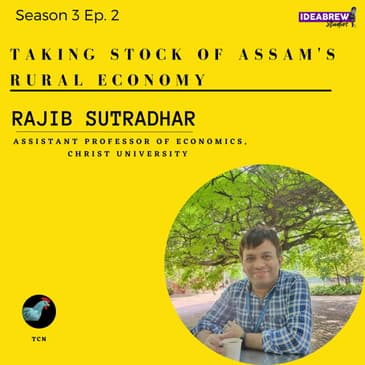
This episode features Team Chicken Neck in conversation with Dr. Rajib Sutradhar, who currently works as an Assistant Professor of Economics at the School of Social Sciences, Christ University Bangalore.
Dr. Sutradhar has written extensively on several economic aspects relating to Assam over the years, especially on cold storages, food prices, supply chains, supermarkets, and rural inequality. In this episode, we discuss several aspects of his work and questions relating to economic development in Assam and the Northeast and discussed policy issues in several sectors keeping in mind the impact of the pandemic.
Disclaimer: The views and opinions expressed in the podcast are those of the individual podcasters. Listener Discretion is advised.
Follow us on Twitter, Facebook, Instagram, and LinkedIn. You can listen to our show on all streaming platforms by clicking on the link:- https://bingepods.com/podcast/the-chicken-neck-podcast
Learn more about your ad choices. Visit megaphone.fm/adchoices
[00:00:00] I'm pretty conservative. Many of us are here to rule American. We believe and I believe that we have a responsibility to care for not only for our families, but our communities. And this wind project is a great opportunity. It's roads, bridges, schools, things that we need around here.
[00:00:20] For people who are skeptical, come and see it. It is creating opportunities that we never had before. Fuel for Thought, presented by the American Clean Power Association Our guest today is Dr. Rajib Sutradhar, who is an assistant professor at Christ University School of Social Sciences.
[00:01:04] Mr. Sutradhar is a well-known economist from the region and must I say that has had the privilege of working in some of the more interesting research projects in the region.
[00:01:13] Relating to particularly northeast is what I mean to say. He's also a regular columnist in some of the reputed national and regional dailies in the northeast. Dr. Sutradhar, it's a pleasure to have you. Welcome to The Chicken-Neck Podcast.
[00:01:26] Thank you, Chicken-Neck podcast team and thank you for having me here. It's nice to be able to discuss about such issues which really concern the developmental challenge of northeast. It's really good to be here meeting you guys. Thank you so much. It's a pleasure hosting you today.
[00:01:47] I would like to begin this conversation by talking briefly about what we found from your writings, particularly in the region. You're somebody who has written extensively on the food sector, must I say, or interrelated food sector.
[00:02:04] You've written on coal storages, food prices, supply chains, supermarkets and how all of this together sometimes leads to rural inequality.
[00:02:13] Now, could you as somebody who does not understand the economic angles of all of this, could you tell us a little bit about how these different aspects are interconnected and how they're related to farmers' well-being? Yeah, yeah. So this is very interesting question.
[00:02:29] So to begin with, I must say this coal storage and supermarket, all these are actually vital part of agri-food supply chain.
[00:02:38] And if you know that this agri-food supply chain, which basically connect the rural area with the urban sectors has changed a lot over the last couple of decades.
[00:02:47] Right? And so now earlier it was basically the food being produced in the village area and then it was sold in the nearby area. It's consumed in the nearby areas. But now with the growing urbanization, the food supply chain has become longer.
[00:03:00] Okay. And to just to put, given analogy, this food supply chain can be amazing in something like say it's just stream basically. We have in the upstream, there are a lot of farmers in the midstream. We have all these wholesalers, processing sectors and then coal storage.
[00:03:18] And in the downstream we have these retailers, all these food cart, then retail markets. So all this now in the last couple of decades, we have a lot of changes in the post reform period, especially.
[00:03:30] We have now the reforms coming in with government basically withdrawing from these sectors and a lot of private sectors have started entering. Okay. So what we have is now more organized, basically.
[00:03:43] And how these three different segments operate in coordination with the others are actually very important for farmers well-being. So just to give an example, like say if I'm a farmer, I produce potatoes and if I cannot store it long for long enough, then potatoes get wasted.
[00:04:00] So probably then in that case, I may want to sell the produce right after the harvest for which basically since everybody will try to sell the potatoes in the same time, those price will come down and farmers won't get the right prices.
[00:04:13] So but if I access to cold storage, cold storage, so then probably you can store it for longer time and sometime the cold storage will issue you how sir, which you can then use as a mortgage to access credit.
[00:04:26] So then you won't be under compulsion to sell this potato was immediately.
[00:04:30] So but then that is not enough. I mean says sometime because I was working in behind for quite some time, I saw that in the like when the cold storage session gets over to then put the prices actually coming down to such a level that it is even back not covering the
[00:04:45] the payment charges that you have to make for using cold storage to put farmers leave the cold storage there and then so farmers incurred loss and so is the case with cold storage they are also suffering loss they store that potatoes for like three one four months.
[00:04:59] And they are not able to get the money for the cost and not forget about them making profit. So basically what we need is that we need a good coordination across different segment of the supply chain.
[00:05:11] So just imagine that there is some kind of a processing facilities there. So probably we could have process and then farmers would not have to have to sell the produce at such low prices or probably throw away the potatoes.
[00:05:22] So this way basically we need to have a need to this whole discussion about the value saying governance comes you need to have a like coordination across all segment of the supply chains and someone has to leave this coordination.
[00:05:36] Okay, it might be say you have a lead actor basically and lead actor might be someone likes a government procurement center or might be the supermarket which is now coming in a big way or might be farmer producer organization they can be the biggest player and they will dictate
[00:05:51] the terms of the conditions of selling the produce but so basically when we have a value saying you have more values being created and supply chain become more efficient.
[00:06:01] But that doesn't guarantee that the values created will go to the farmers basically this is where basically governance of values in comes into question and so say let us assume that supermarket comes and they become like
[00:06:13] say other name your company comes they started investing all the supply chains but then doesn't really guarantee that farmers will get a higher prices.
[00:06:21] So this is a question that actually I just become such a controversial issue when this farm proposed because what we have now seen is what the last three decades is withdrawal of the government so government public sector is now withdrawing its investment in all these food supply
[00:06:37] chains to many cases it might be the case that farmers have no option but to sell to only one player. So then it become a monopsony so then you may not get the prices that you should have got.
[00:06:48] So because if we look at now in US there's all supermarkets and there's no other actors but then in US the farming prices are falling like anything and almost 50% of the farmers are now incurring losses and in last 10 years more than one lack farmers quick farming.
[00:07:06] So basically we need to have the proper governance along with some other options that farmers would have I mean in terms of public procurement and all.
[00:07:17] So this is how basically you know pollution governance is extremely important right we need to have an investment happening in all these segments and some of them must of course come from the private sector government cannot take care of all the food supply chain but at the same time governance of the
[00:07:30] values in very important this might be true basically like and you need to promote the farmer bodies organization which is happening now but then and you have to give a bigger role to FPO something like the Monday or something like whenever it comes to regulation it
[00:07:45] should be part of the decision making process all these are basically not happening now much.
[00:07:51] And I think what you just said right the system of Monday and everything with respect to the farmers protest as well again to just understand the basics of what you've been trying to say one claim that was heard around northeast and I'll correlate this with the
[00:08:09] the storage issue as well for instance now I think this is a time where in specially in our cities cities considering let's say in Goa and some of the cities in a Sam not I haven't seen personally too much may even if they have in the other north eastern
[00:08:22] states but the idea of supermarket is now picking up slowly yeah yeah and now that is one question as to how does that impact the north eastern economy from a agricultural or farmer point of view because we are also heavily agriculture dependent region
[00:08:42] and the second sub question to this is the farmer protest because even for the farmer protest we saw that they were protesting one part of the country why do you think and again it's from an economic angle from your understanding why do you think the protest did not happen in other parts of the country for instance in the northeast your views on
[00:09:01] Yeah, yeah see if you look at this why protest was only concentrated in the say not western part of India something like the panza Hariana Western that is also because see most of this rise procurement happens in this build panza Hariana and western
[00:09:21] western UP so and this procurement happens through basically you can say this a PMC market but now what this farmer X proposed is basically is basically there will be no tax outside for transaction outside the PMC market and status quo will maintain in the market so that means if you are a trader and if you want to buy produce from the Mondays you have to pay tax but if you procure it from the farmers directly you don't have to pay any taxes so then you will be fooled to basically go to Monday and buy produced
[00:09:51] to pay the money right so that means there will be dusting tunnel declining turnover of the Mondays and since all these MSP procurement happens in the Mondays this farmers think that now that will be withdrawn basically so they won't have this MSP cushions that they're enjoying for quite some time.
[00:10:07] Okay, okay, but then in northeastern state that is so of course now much of this rise procurement for the entire country happens from these areas.
[00:10:17] And what happens is that price procure to be from these reasons actually are shipped over through this all this this this food food supplies and this fci network and it leads are not just an reasons.
[00:10:31] So now imagine the data farmer in Assam wants to sell their produce, but now my a bulk of this requirement in Assam is actually made through this fci procurement that happens from this nor this panza failure knowledge road.
[00:10:44] So what happens is that that depletes the prices in Assam. Okay, so that means if I am a farmers, I am not only I am not getting the benefit of public procurement and even open market also I do not get the benefits of this.
[00:10:56] So basically, so I am facing the loss. But now the question is this correction in the situation that let us say like, but then at the same time there is not much of a public procurement in Assam and there's no infrastructure happening in that front.
[00:11:10] Okay, so, so many people are saying that if now this MSP resume all these are withdrawn, then probably northeastern reasons are going to get the benefit.
[00:11:20] So this is unlikely to happen because there is not much of a public investment in food procurement in and their northeastern reasons. And because if we remember this MS summit commission, they recommended that food procurement network be set up in every state or in fact at the every block.
[00:11:35] But somehow this is not happening till now. And what we see is a panza failure and these are its farmers already. They're the one who benefited from this green revolution.
[00:11:45] And if political economy in the sense that now they control the decision making in terms of where these guys will be procured. So and so this all these marginal reasons are now getting bypassed, even though state like Assam is more suitable for growing rise compared to panza,
[00:12:01] and now coming to the supermarkets in Assam, they are still very small players. They're not the big reliance phrase and all these procurement doesn't not happening in northeast. And one reason you must one thing that you need to look at is there's two kind of exclusion happening in the
[00:12:19] supermarkets, even supplicing one is basically they are bypassing the reasons where there is not enough infrastructure. Okay, a lot of this infrastructure is in the liquid supply chain are like something of a like public good characters.
[00:12:33] There's a lot of like externalities which you cannot appropriate. So that means private investment is not coming in those areas. Okay, so then second point.
[00:12:42] So that means they are only going to bring procuring from those reasons, which already have a lot of infrastructure something like the panza, Harina, or probably on the produce where basically that cost of procurement is much less.
[00:12:54] Okay, and then they will procure from those reasons and they supply to entire India. So probably what is happening in the rise so it may happen in the other product.
[00:13:01] So then they are bypassing the reason so as fast as possible happening at the regional level and second level like so once this choose a reason, so then they will concentrate only on those farmers who can meet their standard.
[00:13:14] Okay, so basically they don't want to basically incur the investment that is required for building capacity among the resource for farmers. Okay, so basically that what will happen is we have a growing concentration of procurement at the
[00:13:26] at the affiliates level. So probably there will be only few are farmers who can meet the standard, they will basically leave them land from the small farmers and as a whole what we will have is a deep presentation happening and at the end increasing real inequality.
[00:13:40] And it's a fair argument to make and it's really interesting to understand how you know this entire argument because I asked this because there was this entire argument as to how this is going to affect other states including states that are not really related too much with let's say high levels of production but now that you break down I think it's it would be very helpful to our listeners as well.
[00:14:05] So from the cold storage issue to the another thing on which you have written it's the hand loom industry, right and I think something that is very close to all of our hearts which is although very famous from Assam is also an unorganized sector.
[00:14:21] And the Hualkusi weaving cluster is a large hand loom cluster in the state and which has however been affected very badly during the COVID-19 pandemic that happened, and also because of the lockdown.
[00:14:36] Now, it is almost fighting a lonely battle for survival. So what do you think as an economist that can be done from a policy level to reintegrate this particular industry in the state?
[00:14:50] Yeah, so thanks for the very interesting question. So first let us start with this point that the hand loom sector has been under crisis for quite some time.
[00:15:00] So it is not something that has gone bad during this COVID time. This only COVID has exposed the facilities of the sector.
[00:15:08] But at the same time, this sector is extremely important. I mean, if you look at the next two agriculture in Assam, it is a hand loom that is the biggest source of employment and in fact, and it's very unorganized and many of them are basically living a subsistence livelihood.
[00:15:21] In fact, if you look at across country in Assam has the biggest importance in terms of like a headroom sector out of all the people who are engaged in hand looms sector across countries put the person of them belong to Assam.
[00:15:34] So that is extremely in no matter whichever way you look at it's extremely important as per livelihood is concerned. But now and this sector has been facing a lot of crisis.
[00:15:44] First is, of course, it's now battling with a lot of products which are produced in power loom and they're flooding the market.
[00:15:51] Right. And many people are not able to differentiate which one is actually hand loom product and which is power loom and power loom products are much cheaper.
[00:15:58] Okay. So the so the same time but there's also a lot of demands I mean because now the globalized on this as a miss community has become more more dispersed and we always have some loneliness to identify with the as a miss culture.
[00:16:12] So there's a big premium market, but somehow despite those these roses stories I mean that is emerging. But we have this sector which is really struggling a lot.
[00:16:22] And one of the reasons of course this entire input and output sector is controlled by this margin capital. I mean that's from the outside this maraudy traders, they basically control both supply chain and demand side.
[00:16:34] So in case of select because these sectors, the cost supply of this year is not so easily available and the price is very high. Okay. And which many small hand loom waivers cannot afford right and this is a let us not forget that this is a it has a very seasonal demands.
[00:16:52] So you need to have a certain time period in a year with the way there is a huge demand for these products. Okay, so you need certainly a bulk produce I mean and you need to produce in huge quantities and which for that you need a storage of raw materials and which many small holders small waivers with limited amount of funding they cannot basically
[00:17:10] afford to store for a long time. So basically this hand loom sector if we go to the wall to see you'll find the lot of household based enterprises actually household based enterprises, but only few households can actually afford to basically store these raw materials and then wait for the right time to basically produce and sell.
[00:17:28] Okay, so then what we have seen is basically this maraudy traders they basically supplied the silk raw materials silk yarn to these all the households once they produce and then they process the same produce they provide the design and everything.
[00:17:42] So basically what we see is both the in terms of this input market and also output market, there's a control of maraudy traders I mean so that so basically what we have is now the huge prices of this finance finished product but hardly some of that actually goes to these the waivers.
[00:18:00] I have looked at many of these household enterprises what they earn monthly and then you divide by the family members and also this is kind of a putting out system like you do not have any control over the ownership right.
[00:18:12] And so yeah and there's no no fix hours I mean you are cooking rice at the same time we're basically preparing all this seal today is no fix hours and if we estimate the park a bit a month monthly ironing which is actually our daily ironing which is less than the minimum wage legislated by the government of awesome.
[00:18:29] So this is a very difficult condition that they are going through. So this is about the household enterprises and many of them also engage engage some of them were relatively better off. They do not engage family members, they basically engage higher higher or migrant workers and they are also their condition is equally bad I mean and they do not have any public entertainment facilities like say recent cards and all so their condition is also equally bad and many of them are
[00:18:54] basically given by the lack of livelihood option in this in the area from where they have come from. I mean, so I mean it's the situation that I mean, and if you look at like what what is it that governments would do probably they can mean one thing they need to ensure is to the issue with supply of the silk yarn because this is where basically they face a lot of hardships.
[00:19:16] So probably they can, there is some they can promote some kind of a collective organization basically some kind of a silk bank, okay, silk yarn bank so that they can have access to this, this silk supply raw silk supply whenever it is required to government has set up some silk, silver and bank, but that is not properly working I mean, and also the government policy at the macro level is also not very consistent.
[00:19:41] They are kind of at one level, reserving this sector this sector I mean but at the same time they have deregulated the yarn to a lot of yarn that is produced in the countries are now exported I mean.
[00:19:54] So at the same time our weverse are basically paying a lot of huge prices to obtain the same year. So probably those policies need to be reconsidered I mean to make this sector more viable.
[00:20:04] No, I think that's a fair point that you made with respect to the, you know, the silk yarn bank and how this being an unorganized sector creates trouble with respect to, you know, the payments and problems with respect to what they end up getting inspired of all the hardware because the entire skill is in the yarn and in making the handloom products at the end of the day.
[00:20:27] But I just have a follow up question to what you just said and it is, do you think that making this unorganized sector an organized one attempts and do you think that's a potential solution to an issue like this or do you think it's not possible because for years now and like you rightly mentioned it's not just the
[00:20:47] COVID pandemic was kind of the final nail in the coffin the industry we know I think me growing up have I have always heard about issues in the industry and how the people you know who are concerned with the industry have been suffering.
[00:21:02] So what is your take on this? I think we cannot bring it entirely under the organized level. It's not like something like textile machines and all somehow it is not going to work like that because somehow this whole handloom is basically it's a very niche product.
[00:21:20] Okay, I mean it and different people need to different kind of designs varieties. Okay, so you cannot produce it at a large scale. So you need to get that to a different kind of more flexible production approach.
[00:21:33] And also the large industries they know that I mean there's a lot of supervision cost I mean there's a lot of very nimble handwork. Okay, so which somewhat very difficult to supervise I mean.
[00:21:46] So basically probably what we see has seen over the years now is there's organized segment in the supply chain, but that is more at the retail level. And I don't see this is expanding to the other the downstream upstream levels to the handloom waivers.
[00:22:02] So probably what we can do is at least make this this cooperative work but what we know is there's a cooperative there and some of the government scheme actually are rooted through this cooperative.
[00:22:13] But then these are basically mostly run or capsized by certain relatively better of households, and most other households are basically not aware of what is happening.
[00:22:23] So probably we need to give more trust to this at this some kind of collective organizations or when a few scan also come a few scan be also promoted in this kind of handloom products, where then you have the collective bargain.
[00:22:38] And then you can basically bring a lot of policy actions, where the cost of delivering these policies are much less if we have a certain scale level to end and in some other parts that is happening so probably going and some can also think along that line.
[00:22:51] No, I guess we both agree what you just said and I believe government was some recognizes the hardest faced by the handloom industry and maybe takes up your recommendation and do something to reignite this industry.
[00:23:08] So my next question is in relation to so we have seen that development of the Nordistan region has remained high on the agenda of both the central and respective state governments.
[00:23:18] And we have seen this by frequent visits of the Prime Minister as well as the cabinet ministers to the region to flag off various infrastructural projects.
[00:23:26] So in line with the priority given to this region per capita levels of central assistance to state plans in the Nordistan region are among the highest in the country.
[00:23:36] So the government of India has also been providing special assistance in respect of some of the states in the Nordistan region for providing, you know, a special area programs such as the Heal area development program as well as the border area development program.
[00:23:50] So do you reason at which such an approach for an all round development in North is or more particularly a sum and adding on to that, do you think that there's a need to adopt a new approach to fast forward to economic development in the region.
[00:24:05] So what constructive role can the region and planning bodies like North system council as well as the department for the North system region can take for the enhancement of the economic development of the region.
[00:24:19] Yeah, yeah. So like you said, thanks for this very interesting question. Like you said, I mean of course there's a lot of central government spending in these reasons.
[00:24:28] But I think my answer this reason, these spending are also driven by probably some kind of a security concerns right you need to develop this infrastructure and all.
[00:24:38] But when you look at this livelihood issues like how much of that actually goes into addressing the livelihood is addressing the livelihood issues.
[00:24:45] So that is still a lot of gap that needs to be made I mean, so this is something that is really like concerning me at this moment.
[00:24:53] So even like when I see and also when I see this the way that they're spending is a lot of lack of transparency. Okay, and what we see is actually this kind of findings are creating a new local elite basically I mean and there's no not much of a community
[00:25:10] rights between the types of citizens. Okay, something like Sam, and there is also there is a class deficit. I mean how they basically what kind of capacity or building among them.
[00:25:19] Okay And so if you look at the IOS looking at us going through this Northeast Council spending almost like 50% spendings happening in this infrastructure level at this building capacity in terms of like say agro processing and some kind of
[00:25:33] ah ah value addition that may bring or make agriculture more emunerative there's hardly any experience it's like almost less than nine or eight percent even though 70 percent of the people are dependent on agriculture for the livelihood
[00:25:46] okay so these are the things that I think they need to take care of so much of these spending are actually given by some nexus between the politician contractor local elite and and there is not
[00:26:00] also that the way they are spent there's not much transparency I mean so this is something that they need they need to address and regarding this north east country so guys if you guys recall there is still 2017 probably
[00:26:12] there is something called non-lapsable central pool research so the central pool funding so almost like every department they have to allow 10 percent of the funding to the north eastern regions okay and and then now this is not this discontinued in favor of certain
[00:26:28] infrastructure building fund that they created so even those time till 2017 what we have seen is there's a lot of spending that is happening there but then fun allotted to bodies like
[00:26:38] north east council is very less it is declining all the time and there are a lot of accumulated funding that goes from this ministry and they remain unspanned I mean so there is basically north east council they could have probably made more bigger interventions had those funding
[00:26:53] been spent I mean so there are a lot of accumulation and over a period of time that that allocations to north east council has also declined I mean so probably we need to address these issues
[00:27:04] but at the same time on not just through this central funding you cannot address the laser developmental challenges we need to also look at something like why private investment is not coming and how to engage this private investment in those sectors
[00:27:18] I just I was just looking at something like say credit deposit ratio so the how much money is spent out of say out of credit that deposit that is mobilized from a region how much is spent back
[00:27:28] in this region okay and for Assam you can't believe that it's around 38 percent that means every hundred rupees that is mobilized as a credit only 38 rupees is spent in the region and if you look
[00:27:40] at this state like southern state like say Tamil Nadu they have 142 that means every hundred rupees that is spent mobilized from the region 142 rupees is spent so why is this happening and in 2012
[00:27:53] someone like Ockel Gogo has raised these issues but somehow actually that was not taken up by any political party leaders also so probably we need to address this larger gap I mean some are probably we do not have enough investment happening at the private sector levels and also
[00:28:09] probably there are a lot of produce that is happening in other regions these are funding those reasons and which make basically the investment to say something like say we import a lot of chicken
[00:28:22] eggs, peas and all so probably a lot of investment could have happened there I mean so but then we are not creating enough something like say Venkat Yashrath harm in enterprise they supply a huge bulk of produce to Assam and this they crowd out the private investment
[00:28:35] in other sectors so those are the larger issues then probably we need to create other than making the reason entirely different than on central funding in fact if you look at a lot of
[00:28:43] Siddi minister begging about we got this much funding this time but that is actually not the way to approach a sustainable development yeah. That's an interesting point and the point that you ended up saying that you know the central government funds because I think one of
[00:29:04] the very interesting fact that was conveyed to me by a journalist friend was from the northeast and he mentioned that during COVID some of the states that were the least affected were certain states in the northeast not with respect I mean I'm not talking about
[00:29:21] the numbers but economically least affected and I was very curious and I asked him why he said you know what because they don't have their own the government over the years have made
[00:29:30] them so dependent that they have no income of their own so even if there is COVID they're still getting funds from the government so there's no economic influence on them so it's one of
[00:29:40] saying that you know our state is not affected but the other way like you said it's not about breaking further funds but yeah yeah not affected it's not because they're strong but they're so
[00:29:48] poor that there is nothing left to be destroyed basically you can read it the other way around yeah that's true yeah I think that also makes me wonder as to why such a policy because I know
[00:29:58] traditionally this area has been a very disturbed area so whether the dependency on resources you know which again from resources versus the protest kind of a situation but I think that's that's a debate not for us to understand but more from a political aspect but from that
[00:30:15] to another very interesting part of the research because I know we have to accumulate a lot of your work within a short span of time and my question is with respect to your research
[00:30:23] in Karbi Anglong right you you you did a research on Karbi Anglong where you basically talk about something called gene fact which was once much advertised as a model of collective effort to
[00:30:37] engage farmers from region with global value chain so now what is what has happened to it and could you tell us a bit at the beginning as to what your research with respect to Karbi Anglong
[00:30:49] was yeah actually see Karbi Anglong is a region actually it's a it's a like in a big center of ethnic classes different communities like cookies, carbies, demasas all fighting over over like
[00:31:02] one is to other others okay but then suddenly it has also like got itself in the news for a probably quote unquote right reasons that it's it's a largest producer of organic ginger and and
[00:31:14] ginger that is produced in the region is high in demand because of this high content of kuru kumina I mean which is which has a very good medicinal properties okay so but then again so there's
[00:31:24] a lot of expansion of ginger production in that region but also that that is also this has also become the reason for ethnic classes I mean because their carbies the majority community in that area but it's the cookies which produce maximum amount of ginger so it's
[00:31:39] a question of dominance and a lot of other things so then it led to a lot of ethnic classes I mean part of them is even right this and then a lot of extras on of traders so then at the time
[00:31:50] that district commissioner of Karbi Anglong was Angamathu and he then spent some two corolls out of some government scheme to this set up the zinfaith and and then like he was thinking of like giving organic certification and linking up with the exporters
[00:32:07] so suddenly it got a lot of coverages like if you look at at the time some prominent journalists like say uh some uh who was the guy this uh to look at susan taluk dar and all they wrote extensively
[00:32:19] in hindu front line and all so then and and district commissioner Angamathu got a lot of international award so I was really like oh this is something that I need to study so then
[00:32:29] 10 years down the line when I went to Assam join okd so I saw the fasting agendas I why not apply for a project to study zinfaith so I got the money and to study the model and when I went there
[00:32:40] so there is nothing there in the paper I mean you see a building there and then and some ghost farmers dotting the registry and and they are basically zinfaith is now buying
[00:32:49] ginger from the jedas that they're supposed to replace I mean so then I saw like what went wrong I mean I mean because zinfaith is the let us not forget the first organization to introduce
[00:32:59] a commodity come debit card so common debit card which basically the commodity link okay so that means if you're growing ginger you get a get a card through which you can access getting from
[00:33:09] the banks so you are no longer dependent on the the so-called traders who exploit them like anything but then after one year those programs are discontinued right so now you see again
[00:33:20] lot of this appears coming into pixel so I was thinking like what lessons this appears can learn from what went wrong with zinfaith so what I found is that actually this credit card program also
[00:33:31] didn't work with the farmers because they are they do not have enough options of livelihood okay so they are apparently always running cash shortage and they just took advantage of that they give them credit they provide the response everything through the local agents they were
[00:33:47] used network of local agents and then once you take all these creations and all you are basically forced to basically I mean do whatever they ask them to do so let us know that they are basically
[00:33:58] the ginger has a high demand so then why not grow ginger I will give you advance money and then once the is grown then they they procure the prices like say 8 rupees 5 rupees
[00:34:07] and same ginger is sold for 80 rupees in gohate I mean okay so now the question is it is also about the livelihood issues I mean if they do not have any access to enough livelihood
[00:34:17] so then just 5,000 rupees credit card is not going to work that out I mean so so the next question is why is this livelihood option declining for this a vast majority of the card B demas or all these
[00:34:28] farmers one is of course the way the stick autonomous council has intervened in the reasons I mean and there is no basically all these communities used to do all the shifting cultivations they moved from the one place to the others and land was allocated by this
[00:34:42] village council I mean the beginning of the season even now they still do and then depending on the requirement if you have a more familiar members they will basically give you more land but now what we have is witness over the years is district autonomous council now
[00:34:56] did recognizing the role of this village council they kind of issue the private land partners which then you can basically and so basically they appoint their own village head which is one of the largest jurisdictions and now these these village heads are appointed by
[00:35:11] district council so they're answerable to district council not to the village people so then they will basically issue the private land partners so basically people who have connections who are locally they can actually amass a huge amount of land so this land that is
[00:35:24] now available for this as a common property for the people's indisputable livelihood is declining it's hardly I mean so that means now you do not have enough livelihood options and if you look at the kind education be it percentage of pass out in class 10
[00:35:39] everything is much less in the reason compared to any others even there are some evidence so basically you are not promoting a alternative livelihood at the same time now you are basically privatizing the land which now is reducing its excess for the vast majority of the local people
[00:35:52] so then you are basically done no option but to basically accept money from the debtors whenever they come and the status control the supply sense in the boat and so basically what though they to avoid this situation what the interest would have
[00:36:05] done is basically undo the damage that is done I mean they basically need to recognize the village council and make them the center of the collective actions but what they did actually this gene fit they did more of what other development intervention did basically you kind of give
[00:36:18] credit but you can get credit only if you have some kind of a defect to land in your name and if you do not have land in your name you cannot get the credit so basically again
[00:36:27] it's kind of doing the more damage than actually undo the damage as it is what we see finally could not at least a livelihood options and now the input is buying basically
[00:36:36] the produce the produce from the debtors and now what we see is this now a lot of fps are being promoted by North this net fee and other developmental agencies and one of the fpo now
[00:36:47] it's called the jeez song gof a farmer producer company that is housed in the gene fit and they run by the same person so basically now I don't know I mean how this they're going to
[00:36:58] overcome the problem that happened with the gene fit I mean I mean so this is basically is it the whole line in the new but I don't know probably you can wait and see how these fpo's which many of
[00:37:08] which are targeting this organic produce in the reasons are going to address this larger issue basically the message is clear you need to engage with the local community and without that there cannot be any collective action that's a story in itself right how you saw one news
[00:37:25] and a success of an organization then you go to study the organization and you see a ghost building so it's a and that's the kind of developmental interventions in much of the
[00:37:34] reasons I mean it's just one example I think yeah I think but but then again I think as a as a lay person who does not have uh doesn't understand the economics of everything concerned
[00:37:46] I I I think we discussed today two issues one was the hand-to-hand issue and now the gene fit issue is and to look at it from a outsider perspective it's it's very interesting that most
[00:37:57] of the bottlenecks in both the industries appear to be the same except for of course the credit system the credit system like you said I think and again I think this is the gray area where
[00:38:07] we see today tech companies come in a play a very active role where they are basically basically giving credit not necessarily based on what you have but in different ways I think yeah
[00:38:17] a gap or intervention like you said by companies which could have probably been done years earlier in a system that was very interesting so but but just a short follow-up on this how do you see the
[00:38:30] role of organizations like net fee and as fact to integrate farmers with the global value chains specifically focusing on organic products given your experience with gene fed and all these organizations see like because I have been also talking to someone like say monos does who is the
[00:38:49] the manager of net fee so what they understood is that most of these these interventions are basically supply driven I mean it's not demand driven central government suddenly comes and
[00:39:00] decided no we need to set up 10 000 fps I mean so let us push them I mean so they have a target they have to basically set up this all these fps within a year so they basically look for the
[00:39:11] people who can just give the money but first you need to look at like like you need in this all this demand or not if not demand that design and everything has to come from the bottom of airflow
[00:39:20] like basically what is your incentive or what kind of commodity product that you grow I mean and then what is the organizational setup but there's hardly any discussion it is they are just
[00:39:31] like pushing it from the top without looking at how it is going to work I mean so I mean this is certainly not the right way to go I mean of course this very intention of sitting
[00:39:40] I feel like bringing farmer in there in terms of some certain form of aggregation is step in the right direction but the implementation is something that I do not agree with okay and
[00:39:50] also what they do trying to do is they promote one one product one district I mean so this is kind of you know promoting the the the monoculture I mean this this it can bring its own
[00:40:00] challenges in terms of biodiversity and soil fertility so because I have been also engaged in this organic farming to FPO in Sikkim now I have got one ICMOD project so this is the same kind
[00:40:13] of challenges that we are witnessing so probably yeah of course we need organic certification and much of Nortis is actually uses much less patelage and chemical pesticide but I think we need to be more careful in what kind of approach actually serve the interest of the local
[00:40:30] community and at the same time cash in on the global demand for this. Now I guess you have to definitely explain all the specs to our listeners and the line of the same by next question to you is that as an economist how do you see the
[00:40:43] talk around the idea of making a sum one of the fastest growing states in the country or if we put it in the words of the honorable Chief Minister Himantavisa Sarama to make a
[00:40:54] sum the top five states of the country and in a conversation like this where so where does the sum stand in the cross domestic product and how important an indicator is the aggregate state
[00:41:07] expenditure. Yeah that's a very interesting about this and the very difficult question I must say even so I was looking at the state figure so in terms of Parkabita NSDP right next state
[00:41:22] domestic product a sum was at part of the national level is till 91 92 okay and now when I look at I mean over the last couple of years I saw that as a means legging in the bottom five states bottom
[00:41:36] five major states and that is for quite some time okay in fact and now recently and it is not just about the income I mean if you look at the latest index this is reported by Niti Ayub
[00:41:50] to document the multi-dimensional poverty index as a may has the poverty ratio is 33 point something I mean which is in fact more than that I just said to be in fact basically as some has joined the new
[00:42:01] Bimaru states I mean new club of Bimaru states and this is I think it's really frightening I mean so no matter what are the indicators that we see even if something like say the infant
[00:42:10] mortality rate or maternal mortality rate as some is doing was in Bangladesh is that say there I we are really like no this is something we really undermine I mean so this is something
[00:42:21] so I of course we have a very low base I mean I mean so probably we may have a higher growth but then because it's always easier to start with a faster rate from a low base I mean but if you look at
[00:42:32] for the last 10 years or seven years or even from which was in 16 onwards team now in fact I was just looking at today morning there is this some care there things which again shows
[00:42:43] silent composite index which is reported I think yesterday and even there also are some score is something like 17.2 I mean compared to the average score of 40 45 at the national level
[00:42:53] so so this is really I mean I mean what or is some for the states I mean now the question is so what went wrong I mean suddenly we till 1991 we are like at the national level is
[00:43:04] and then we lag behind so much so if you look at actually the first reform we have we draw of the state state public intervention is much less and then we have the private capital actually
[00:43:14] taking the lead in terms of triggering development taking up projects so obviously private capital will come to those reasons where they get more ratio to return we have return we have insurgency problems then infrastructure issues so suddenly like there is now they are flocking
[00:43:28] to reasons where they are like getting more stable environment so and they are producing so there's something called an economy is called agglomeration effect so if something happens
[00:43:38] at the scale level so then it's easier to set up in a farm or industry they are at a much lesser cost and you're assured of the market okay so then so it works in a ripple effect I mean
[00:43:48] and then what went wrong is that we so those farms they produce a balcony produce and they actually come and they spread over all other all the reason including the backward reason so then it's very difficult to promote a new kind of investment there basically something like
[00:44:02] say that really basic there in essence this like chicken and all we probably produce only 40 or 50% of what we need I mean and all these things come from somewhere else even now even the pig supplies
[00:44:14] and they are knocking I mean this someone in Zaland or they are possibly producing all these pigs and then they're looking for the market because pig is not getting consumed there okay so
[00:44:22] basically what we need to do is I mean somehow we need to reverse this trend and this is very consistent with basically something like a deposit ratio so we not only have a
[00:44:32] low part of the income but limited amount of saving that we generate with that low part of the income that is not getting absorbed in the region they actually are now are getting diverted to other
[00:44:42] reasons something like Tamil Nadu they already have a higher income but then more investment than saving generated is happening there so it's a vicious cycle I mean how to correct that I mean
[00:44:51] so this is something that and now the post-gST now we have a basically GST goods and service tax which is the uniform tax so now here basically central government has the state government
[00:45:02] has lost their autonomy to basically the fiscal space to give the incentives like if some funds come we'll give the incentive so then you please come to us now that space is also getting swing because
[00:45:13] now you have a uniform tax structure okay so basically as a result we I mean the state have a very limited amount of space to attract the private investment and reverse the trend and this has to happen you know in with active cooperation with the central government
[00:45:28] and this is what I am arguing about like in the last point no we just don't need some central fundings I mean to take up development project you have to basically reverse this policy decision
[00:45:38] and now let us assume we look at this whatever be it the automobile or any supply chain now we have some kind of a post we are now in a post-gST regime post-gST means you are not you are
[00:45:52] producing very diverse products not a mass product of the same type so you can basically fragment this fellow saying and you can look at some of the fellow saints if hello saints in
[00:46:00] northeast okay because if you look at now just one product is like say produce some part in Vietnam some in China some in India some in Bangladesh and getting getting like Mars in some other
[00:46:12] other countries so if that product can move across countries why not across state and some part relocate to northeast okay so these kind of initiatives are much more sustainable and and and mass it should be work out I mean and there is no reason because we have now
[00:46:28] high tech and like logistic lot of like advancement happening why not we set up some segment of the velocity in northeast so that because finally we need to question what what is happening with the employment level along with the development interventions and we already
[00:46:44] at India all at all India level we have a unemployment rate which is like highest in past four five decades and some even higher unemployment than the national level and all
[00:46:53] through in all the years if you look at this period level four survey so this is something that I mean we need to think through I mean. No I think that's a very interesting take on how the economics
[00:47:05] of the state can be better arranged to have investment and this is important because for a very long time although we have been hearing or there have been talks about Assam growing economically but at the end of the day like you said some part of the global supply
[00:47:19] chain has to be put here to increase employment because I think there can be like like you mentioned that there can be development even without employment now is that development so in a
[00:47:31] development like that will the local people you know benefit out of it is a question that only time can answer I think this is a debate we can I forgot one point here I just forgot
[00:47:42] the next point this is basically about the state explanation that is also a very important part so since there's not much development happening and now finally state has to also retain its legitimacy I mean so what state will do basically they every year who elects on you'll create
[00:47:56] certain government jobs and get out to be more basically not voices sections that whoever voices you kind of create some jobs I mean government jobs but then it's I think it's if we're not making any productive intervention I mean in terms of like
[00:48:12] to reverse this trend that we have been noticing over the past three decades just creating certain job for the election may be help you win the elections but that is not going to basically because if you look at our revenue expenditure as a share of total public expenditure
[00:48:25] is much high much high and and if the private investment is not coming and state expenditure is also kind of more towards revenue expenditure then that's a point to be really wide
[00:48:36] and just to add on to what Animes just asked so you just mentioned about the employment rate so Assam has a low employment rate in comparison to the national average but however in a recent
[00:48:48] study conducted by the India today Assam has been ranked as number one as the most improved big state among all the states in India and it has also improved in its ranking in terms of infrastructure and agriculture so how do you see this as an economist and
[00:49:03] it isn't a step towards being the yeah yeah that's what I'm saying that that's why I'm saying that that base is very important the base effect okay so if we are scoring 10 marks in the exam out of
[00:49:13] 100 you can easily like score 20 and I say oh I have made a hundred percent progress but if you score say like 80 so then it's very difficult to move from 80 to 90 I mean so so of course
[00:49:23] but then everything we need to judge in terms of how much employment is generated I mean so if so basically the employment should be the central focus of the any development interventions okay we may be growing past somewhere down the line but finally what about the livelihood
[00:49:39] I mean I was just looking at this because if you look at till sometime back when when I first came to JNU I mean Delhi so then most of the students is like people from North East to
[00:49:49] migrate for education reasons but now we see a lot of this migration happened due to livelihood the life outside the states right to unincome and that is not a bad thing to be clear but what is now
[00:50:01] really worrying is that Assam is slowly emerging as a half of this seasonal out migration this seasonal out migration is basically something like no you're a footloose labor you move from the one
[00:50:11] place to the others without settling down anywhere right and you can imagine that there's a direct buzz from Assam to Kerala I mean okay and they are all killing this labor labor class I mean
[00:50:23] so and even I stay in Bangalore and sometime I come across in supermarket some ladies like middle age 45 50 year old living behind their children in temazhi and all and somehow some
[00:50:34] interior areas so this is something that I mean I really feel very sad about I mean so I really don't want my state to become a outmakers on half something like ZBHAR or other state already
[00:50:44] have become okay so this is something that we really need to do something in terms of development and what jobs it has created so basically I want to judge any development intervention in terms of
[00:50:55] how much job that it created I think there's a very fair point you just made I think the like I was saying that the developmental intervention at the end of the day needs to be a very important
[00:51:07] you know point that needs to be added to the entire debate because like you mentioned for instance I think the case in point here is the state of Bihar because for years now
[00:51:17] and this is not trying to demean anything but I think Bihar I personally feel that without people from Bihar the country will not work because you have people moving out of Bihar and working in
[00:51:27] almost all parts of the country but at the same time is that unorganized sector the people are moving to helping the state develop so that I think like you said now that we have those
[00:51:38] labor you know we have people who are working in almost same sort of jobs will that really be the signaling of how much developed a state like Assam is I think yes because if we are not able to
[00:51:51] intervene correctly throughout development means that means that is why people are moving out of Assam that's a very I think fair point to me yes and I think we are I mean I mean as bad as
[00:52:03] it sounds I think traditionally we have been a very proud society and I think while this is of course while I think one argument is whether like we say often that in the west there is dignity
[00:52:16] of labor which I completely am in you know consonance with yes but then the challenge in India is then that when somebody moves to become let's say to a job like you just mentioned let's say a
[00:52:27] security guard or in a mall or anywhere else their standard of living is not the same as the west so that argument of dignity of labor does not come because the kind of protection that they
[00:52:38] that they get cannot really be ascertained directly some of them might get good protection some of them might not get good protection and of course there is the angle of racism that is
[00:52:48] involved mostly from yes yes true and I think coming from that to something I think that's all more on the positive side in the region is the the rise of startups and entrepreneurs
[00:53:00] in the region right a lot we see today a lot of people move out of cities like Bangalore and Chennai to the reverse migration or Hyderabad for that matter and come back to India and to
[00:53:11] sorry come back to Assam and do their own startups on tech tech or even agriculture and tech now for that matter so and we have seen that there the government has also taken certain initiatives to increase the you know intervention with respect to startups but
[00:53:28] how do you are you satisfied with the kind of policies that are being created on and what do you think should be some of the key policy considerations that keep needs to be kept in
[00:53:37] mind especially in terms of the challenges that the startups face and how can the government here play a very convenient or very important role to in a way smoothly transition this startups into bigger companies so that they generate more employment yeah so there's a thanks and
[00:53:53] there's a very interesting question I mean so if you look at I mean basically the startup policies and all but we need to first understand what is the startup what do you mean by
[00:54:01] start okay and start up is something basically it's a firm which has no like previous existence it's a basically s0 or infant firm that is what this quote unquote startup means I mean so of
[00:54:12] course it cannot be basically died with any large established firm okay or it cannot be acquired by some firms who are already in existence it's all very new in every every
[00:54:23] sense of the world okay but then is it the first time that we have a startup so if you look at going if you go by this definition then we actually we have a we are in the third phase of
[00:54:31] startup the first it started with you can say all these like household based enterprises like say handloom works all these are also some kind of enterprises okay that started initially I mean along with agriculture if agriculture is not sufficient enough you you also do a lot of
[00:54:47] other things and then we have a second phase of startup which actually have started with this small scale industry right so these are basically again like started by people with different degree of scientific from primary education to a lot of like more education
[00:55:04] intensive people okay but the third space is slightly differently sense that it is somewhat more like tech oriented you have a lot of technology coming into place okay and some people who are returning from technology or probably engineering background and now they
[00:55:18] want to set up on their own things okay so it is somewhat more highly educated people like that has started this startup but now the thing is see what do this startup do I mean
[00:55:31] they kind of provide some support services they build up some kind of linkage between the large organized firms and the consumers okay so they kind of provide these services to these
[00:55:41] supplies and linkages okay but now question is that if we do not have and if you look at now the short history of this startup it is not very encouraging not many startups have
[00:55:52] been successful till now but we are still in the implementation in the initial stage probably we'll learn better over the period of time and we will have more startup being successful
[00:56:01] over a period of time but now the question is but since we do not have if you look at the AASAM AASAM is not known for having a presence of big firms big organized firms
[00:56:11] like I said that is the whole trajectory of this post reform growth in the AASAM so probably then if those firms are not there so then this this startup cannot survive on their own it's just like other previous entrepreneurial history we need to have the local environment
[00:56:26] which is conducive for this success of the startup okay so this is another hurdle that they start up from the region because almost like 600 odd startup that has been promoted in the region 80% of them are in AASAM okay so they they many that phase this they start startup
[00:56:42] anywhere phases lot of hurdles but startup in north is probably will face bigger hurdle than the others because these large firms which they can cater to their side is are missing yeah okay but then then we need to also look at the
[00:56:54] given the limited situation what kind of solution that we look for I mean so then like you said probably in organic farming then some kind of agro-processing limited scale so then probably handloom products where probably some kind of
[00:57:08] marketing support is required I mean so say probably this is let us say there's a pure coming up and then probably then in startup can link them up with say that in better market services I mean so so in those those are the areas basically
[00:57:21] which probably this startup can focus on especially on this this agro-processing I mean if I go to AASAM I see lots of this Zeus produce in say putan arming are coming to AASAM I mean if they can separate to AASAM definitely we have
[00:57:36] the enough resources to produce probably on our own I mean at the bring that to scale level so probably this is where this startup can simply play a role so basically they need to know what is our needs here where basically we have a
[00:57:49] more scope of successful and probably this is where government can also some kind of do some kind of handholding I mean till the time when we have some hallucin being fragmented and relocated to north eastern regions
[00:58:01] yeah that is how I see I think again this is a very interesting observation and I see I think a lot of such startups for instance I think very recently I was made aware of somebody you know leaving behind a very lucrative bank job to start
[00:58:18] peak breeding in AASAM which is again because when I went talked about you know he said it mentioned that starting it because there's so much demand in the south asian region region for peak that it it's not just limited to AASAM so I think like you mentioned this
[00:58:34] industries which are which can create value in terms of employment and also where but at the same time I think the government intervention has to start by giving them different incentives so
[00:58:43] that more and more people pick up for things like that yeah that's so yeah but I think that's a very interesting point you said and overall I think and I enjoyed the economic perspective to
[00:58:53] issues that that involve in our day to realize I personally feel that another angle that can that the government should look into in northeast is the big sports market with I think
[00:59:06] because there's such a huge potential for us to so get into that arena but that's a very non-economist argument to make so I really don't know yeah I completely agree probably sports then then
[00:59:18] rock music all this we have a we have a different kind of interest I mean and probably I think I mean that act is policy if it is successful can play a huge role I mean probably somehow
[00:59:28] it is not happening much I mean and also I think we also need to link up much better with Bangladesh I mean because Bangladesh if you remember is one the fastest growing economy now and but we have
[00:59:40] a lot of deficit trust deficit I mean somehow so and we're looking more towards east but then Bangladesh is a bigger market I think so this is somewhere probably we also need to look at and
[00:59:50] then if we can work those out probably startup will have even bigger futures I mean of course I think completely agreed and given that how you know how close it is I think those
[01:00:01] partnerships can definitely you know traditionally it's always been a very close partner so I think it definitely helps the cause as well but on that note thank you so much Dr. Rajiv it's an honor
[01:00:11] hosting you in the podcast we hope to have you here again to have more perspectives on economics I know you're working on a lot of projects we will keep a close check on your
[01:00:20] projects and hopefully we'll be able to discuss on those projects in the future so thank you for making time yeah I really enjoyed also talking to you guys I mean I look forward to having more
[01:00:28] conversation like this thank you yeah thank you so much if you enjoyed listening to this episode of the chicken neck podcast check out our other episodes available across all major streaming
[01:00:38] platforms and help us grow by spreading the word and for more updates do follow us on our social media handles