
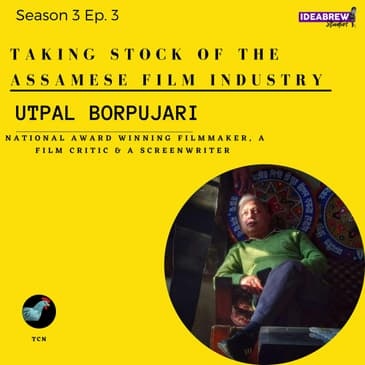
Welcome to the 3rd episode of Season 3 of The Chicken-Neck Podcast. Today we're joined by Mr. Utpal Borpujari, who is an National award winning filmmaker and critic having been awarded the National Film Award twice in both roles.
In this episode, we talk to him about his journey from being a journalist to donning the hat of filmmaking. He has been instrumental in depicting the diverse culture of Assam through his filmmaking which includes many prominent documentaries such as "Ishu", "Memories of a Forgotten War", "Songs of the Blue Hills", "Mayong: Myth/Reality" as well as his latest movie on Majuli's mask making culture titled "Mask Art of Majuli", & also short fiction films such as "Xogun", among many others.
The episode also covers aspects of documentary filmmaking and it's importance in showcasing the real life stories, the problems and prospects, as well as the various initiatives taken by him.
- (00:00- 07:06):- Journey of Mr. Utpal Borpujari
- (07:07- 12:45):- The documentary on Mask Making culture of Majuli titled "Mask Art of Majuli"
- (12:46- 25:35):- Documentary Filmmaking
- (25:36- 34:28):- The importance of documentaries in showcasing real life stories
- (34:29- 42:25):- Problems & Prospects
- (42:26- 52:30):- Relatability of Content
- (52:30- 54:25):- The contribution of Late Nipon Goswami
- (54:26- 56:34):- The documentary titled "Baruar Xongxar"
- (56:35- 1:03:34):- Mongeet
- (1:03:35- 1:06:42):- Upcoming projects and the Conclusion
Disclaimer: The views and opinions expressed in the podcast are those of the individual podcasters. Listener Discretion is advised.
Follow us on Twitter, Facebook, Instagram, and LinkedIn. You can listen to our show on all streaming platforms by clicking on the link:- https://bingepods.com/podcast/the-chicken-neck-podcast
Learn more about your ad choices. Visit megaphone.fm/adchoices
[00:00:00] Hello and welcome to the Chicken-Neck Podcast. Supported by the IDW's network, we are a bunch
[00:00:05] of curious individuals based out of the North East. And we strive to bring you the best of
[00:00:09] policy discussions through their intersection with things that affect your and our daily
[00:00:14] lives. If you like what we do, show your support by sharing our work. Don't forget
[00:00:19] to leave your comments on this episode in our social media handbooks.
[00:00:23] Hello and welcome to another episode of the Chicken-Neck Podcast. Our guest today
[00:00:27] is Mr. Utpal Bhavapujari who is an award-winning filmmaker and critic, having been awarded
[00:00:32] the National Film Award twice in both roles. Mr. Bhavapujari also features regularly in
[00:00:37] the columns of prestigious national and regional newspapers and writes about a wide
[00:00:41] area of topics such as politics, movies, culture and other interesting areas. In this episode
[00:00:47] we talk to him about his journey from being a journalist to donning the hat of filmmaking
[00:00:51] and also cover a lot of aspects from films, documentaries as well as media and journalism.
[00:00:58] Thank you. Thank you. I'm really happy to be on Chicken-Neck's podcast because I've been going
[00:01:06] through its content and it's really interesting and it's really a good thing that you are trying
[00:01:11] to bring voices from the Northeast out to the rest of the world.
[00:01:17] Thank you so much, sir. One of the reasons we started was to bring the voices of the
[00:01:21] Northeast to the rest of the world. So thank you so much for appreciating that. But, sir,
[00:01:25] to start off the podcast and to start off from your journey, in the short introduction that I
[00:01:31] just gave, we see you as a journalist, as a filmmaker, screenwriter as well as a film critic.
[00:01:38] It's very rare that a person has so many diverse hats to himself. So could you tell us a little bit
[00:01:45] about your journey, how you started your career as a journalist and how you have then for it
[00:01:49] into the other parts and that too successfully? So could you please take us a bit through
[00:01:54] your own journey? Yeah, I actually started writing in newspaper first in the children's column
[00:02:00] while I was a school student in Guwahati. I was a student of cotton college here at Hazard
[00:02:04] Kendery School and when we were young, that was the period when the Assam vegetation was going on
[00:02:11] and during that time I used to contribute once in a while with, you know, sometimes with
[00:02:18] quizzes and sometimes with one or two sketches to the children section of the very popular weekly
[00:02:26] newspaper called Aukham Badi. So I think that is how that the whole germ was planted in my,
[00:02:34] you know, in my brain about journalism. And then while I was in college, in cotton college,
[00:02:41] while I was in the second year of my BAC, that time this weekly, actually fortnightly
[00:02:50] New Jersey called the North East Sun started from Delhi. And it gave a lot of space to freelance
[00:02:56] writers from all over Northeast to write on various topics. So that is where actually I started
[00:03:02] my, you can say actual journalism, though I was, I had no knowledge about how professional
[00:03:10] journalism is practice and how what is the life of journalists. I used to write on topics that
[00:03:16] would interest me from, you know, culture cinema about various events in Guwahati,
[00:03:22] also about sports and all that. So in Northeast Sun, and that was during 1988-89.
[00:03:29] So after that, I went to IIT Rootkey for my MTech in applied geology. And during those three
[00:03:37] years also, though the IIT curriculum is very tough and very time consuming, I used to contribute
[00:03:43] about the happenings in the campus to there were in those days, there were a couple of
[00:03:50] newspapers which used to have campus columns, you know. So I used to contribute there. And
[00:03:57] I also used to write on popular science and say travel logs in newspapers in even during that time,
[00:04:05] my articles were carried in the Hindustan Times Indian Express. And also in the very popular
[00:04:10] as a means magazine called Pranti. So that is how I mean, I continued writing and towards
[00:04:18] once I finished my master's degree, though I might have profession qualified me to go into
[00:04:25] in the field of geology, maybe to oil company or something. But I got more interested to a journalism
[00:04:33] and I went back to Guwahati and joined the Sentinel newspaper as a reporter. And that's how my
[00:04:40] professional career started after working there for slightly more than a year, I got an opportunity
[00:04:47] to join Press Trust of India in Delhi. And that is when I shifted to Delhi and I joined PTI in
[00:04:55] 1990 1995, April. And since then I have, I was I see, I've been staying in Delhi.
[00:05:02] After five years in PTI, I joined Deccan Herald, the very popular newspaper from Bangor.
[00:05:08] I joined its political bureau in Delhi. And I worked there for nearly 10 years
[00:05:16] with it is fall break in between during which I joined the newspaper called Sakaal Times,
[00:05:22] which was brought out by a very famous Sakaal group of newspapers from Maharashtra.
[00:05:27] So I joined their bureau, their office in Delhi, but that was a short lived
[00:05:31] affair on the newspaper closed down very soon after a few months. So I went back to Deccan
[00:05:36] Herald. And that is how I continued in my journalism profession till the end of 2010.
[00:05:42] And while I was, I had been writing on cinema extensively, especially
[00:05:48] I after I shifted to Delhi, I got exposure to a lot of cinema, you know, a lot of cinema events
[00:05:54] and cinema in Delhi, because you have in Delhi places like India International Center, India
[00:05:59] Habitat Center, then the various embassy cultural centers, which all organize a lot
[00:06:07] of film screenings and a lot of people who come to Delhi, I mean, even now they do. And
[00:06:12] I had the chance to interact with them. And also I had the chance of, you know,
[00:06:18] covering the International Film Festival of India and then the Cinefan Festival,
[00:06:26] Ocean Cinefan, which became Ocean Cinefan later on. And we
[00:06:30] got to meet a lot of great filmmakers in these festivals. And that's how slowly by
[00:06:36] you know, I got interested in cinema more and more. And then towards the end of 2010,
[00:06:42] I thought, okay, I have written the, you know, for a long time, almost two decades about
[00:06:46] other people. But now it's time to venture to the visual media maybe and try telling
[00:06:52] those stories which are not possible to tell, you know, through the medium of journalism.
[00:06:58] So that's how I shifted to filmmaking into the, from 2011 onwards.
[00:07:06] I think that's a very interesting journey because especially,
[00:07:11] I mean, I was just listening to your journey and I just kind of think that while it is so,
[00:07:15] you know, popular now to take a pivot from your career in today's time.
[00:07:20] But you had done it when it was before any of the social media, you know,
[00:07:25] had basically infiltrated in our lives. So to shift from one profession to another is I think
[00:07:30] a challenging act in itself and then to be successful is another story altogether.
[00:07:36] So I think you will obviously, you know, your diverse interest in converting those
[00:07:41] interests into career opportunities, something that needs to be an inspiration to the
[00:07:45] generation of us and the ones younger than us of course. But sir, talking a bit about your
[00:07:52] work and getting straight to it, you recently directed a documentary which was titled as the
[00:07:58] Mask Art of Majuli, which depicted the mask making culture of Majuli in a Sam.
[00:08:05] Would you like to tell us a bit about the film, the culture of mask making and how the idea
[00:08:10] came about? I understand this is a little related to how you got into filmmaking in the first
[00:08:15] place as you just mentioned. So could you tell us what made you work on that?
[00:08:19] Yeah, right. I mean, I will come to your last comment and it's related to how you,
[00:08:26] how I came to filmmaking. Actually, you know, when I was a journalist, I extensively
[00:08:34] travelled the interiors of India to cover elections, to cover political rallies and also
[00:08:39] went quite a bit to the interiors of North East India also to cover various events.
[00:08:44] I mean, they can help though it's based in Bangalore. It had a very good focus on North East India.
[00:08:52] And quite often I would be sent to cover events in North East India. And then I saw that there
[00:08:58] are so many stories that need to be told, you know, which are in the interiors of India and
[00:09:05] especially in North East because I coming from North East, I strongly believe that
[00:09:11] lot of this information and lot of wrong information about North East comes from the
[00:09:18] fact that there is hardly any information available on the region in mainstream media or
[00:09:24] visual media. So that was one idea of my coming to filmmaking so that I can take
[00:09:34] take up stories which are not possible to tell through usual day-to-day journalism
[00:09:39] and then tell them in the audiovisual media through a cinematic style. And that's how if you
[00:09:48] look at all my films, especially my documentary films, you'll see that I have tried to bring
[00:09:53] out stories that I feel need to be strongly projected to rest of the country and also
[00:09:59] outside the country. So, Mask Art of Majuli which is my latest documentary film, it is also part of
[00:10:05] that effort only and it was produced by the Indira Gandhi National Centre for the Arts and
[00:10:11] North East Regional Centre which is based in Guwahati. It's an organization under the Ministry
[00:10:18] of Culture and they try to preserve and document various cultural aspects of India.
[00:10:26] They have been doing it since many years and they also make films as part of this effort.
[00:10:32] So, I got the opportunity to make this film on Mask Art of Majuli. So, Infatite proposed the idea
[00:10:41] to agency and they commissioned the film to me. The idea is that you know as Asamese people
[00:10:48] we know about the Mask Art which was initiated by Srimanta Sankar Dev and how it is
[00:10:55] used in Bhavnara, Jyotiyanath and all. We all Asamese people know about that.
[00:10:59] And also Mask Art is not something that is only found in Assam. It's found all over the world
[00:11:05] but Mask Art of Assam which is though it is practiced in some other parts of Assam also,
[00:11:15] it's the core of it is practiced in Majuli in the Chavaguri Khotra. The Khotras as you
[00:11:23] know are the West-White monasteries and why I got interested in the subject is that it is
[00:11:31] almost a dying art in Assam. It's only two families which practice the art in Majuli
[00:11:35] and there are a couple of families which practice in other parts of Assam.
[00:11:40] And in Majuli because Majuli is the heart of the Satriya culture in Assam
[00:11:48] and I thought that if I tell the story from the perspective of mask makers and mask making
[00:11:56] in Majuli, I could also showcase a little bit about the life and you know life of Majuli,
[00:12:03] the society, the culture, the nature everything visually. So that's how I kind of took it up
[00:12:09] and also another very important aspect of Mask in Assam is that they are
[00:12:14] totally traditionally totally organic you know they are made with bamboo, cloth and
[00:12:21] you know mud mixture of mud and cow dung and then painted with natural colors.
[00:12:27] Of course now these days natural colors are very hard to find so they have started using
[00:12:31] artificial colors but that is a traditional way. So that's how I got interested in the subject
[00:12:36] and made the film and till now it has been screened in a couple of festivals and people
[00:12:41] have liked it. That's the biggest satisfaction one can get as a filmmaker.
[00:12:45] No I'm sure, I mean this is such an integral part of our culture and the fact that the story goes
[00:12:50] on around the world. It's such a strong medium to you know tell the story to the rest of the
[00:12:55] world so many congratulations on that. You know sir to move from this because again for us
[00:13:01] to cover so much of your work especially with respect to documentary making and we wanted to
[00:13:06] have an insight into some of the work that you have done. So apart from this particular documentary
[00:13:12] you have also made you know short fiction film called Hogan and other documentaries like Memories
[00:13:17] of a Forgotten Wall, Memories Songs of Blue Hills and Mayong. Could you tell us a bit about
[00:13:25] the thought process again behind all of this work and what are this work primarily about?
[00:13:33] Yeah I mean if you look at all the documentary films that you have mentioned they are
[00:13:39] they're part of the stories that need to be told from the artist. I mean that is
[00:13:44] I primarily get affected by the subjects which are not known much not only outside the region but
[00:13:52] even within the region it's not much known sometimes. So all this documentary and Mayong was my
[00:14:00] Mayong meets last reality was my first documentary film immediately after I left
[00:14:06] journalism in 2010. I completed the film in 2012 so it is a story of Mayong the place which we all
[00:14:14] know for its practice of magic. Many people say it's black magic but the tradition was not only
[00:14:20] about black magic but also about magic practice of magic and of course there are a lot of you
[00:14:25] know manuscripts which are in old Asami's language and many of them are yet to be deciphered
[00:14:33] but people who are in Mayong, people who are studying the whole tradition they say that
[00:14:40] they contain a lot of you know information about the magical practices also a lot of you know mantras.
[00:14:46] So I thought this place which is so near Guwahati I mean people don't even know about
[00:14:51] this place even in Guwahati when everybody knows the name Mayong but many people don't
[00:14:55] know where it is how to go there and people were quite afraid even now some people tell
[00:15:03] me that they're afraid to go to the place because they a lot of believe that there will be people
[00:15:08] who do magic on you and all that so that's why I just thought that I would like to you know capture
[00:15:16] the whole cultural story behind the meets and also about the meets. So that is how that
[00:15:26] film was made. Okay so that was about the film on Mayong and then Memories of a Forgotten War was
[00:15:35] again I initially started off by thinking that when we were in school and college we used to
[00:15:43] watch you know a lot of programs on Durgaur'san about folk music from northeast and all that
[00:15:49] occasionally those programs would be telecast and they would show a group of dancers or group
[00:15:55] of singers standing in a beautiful location and then to sing the song without any information about
[00:16:03] what why this song is sung what is the meaning and what belongs to which tribe and all that.
[00:16:10] So I was also always intrigued about you know the musical practices in Nagaland and
[00:16:18] as well as rest of the northeast so I thought that you know Nagaland being such a diverse
[00:16:26] state you know ethnically I mean one tribe doesn't understand the language of another tribe and all
[00:16:32] that so I thought how musically the society is because we know the Naga folk music is very rich
[00:16:41] and that's how initially I started off by trying to explore that aspect but when I went into Nagaland
[00:16:47] I found that the kind of musical practices that society is having currently is amazing and
[00:16:54] we all know about the Hornbyn festival and how it has become an international you know
[00:16:59] internationally blockbuster kind of music festival but the ground work that the Nagas have been doing
[00:17:08] is amazing and that's how my whole idea whole focus of the story changed I kind of went into a
[00:17:16] journey of exploring contemporary practices of Naga folk music and also I tried to bring in the
[00:17:23] debate between the traditional folk musicians and the younger musicians some of whom are also trying to
[00:17:29] experiment with folk music to take it to the larger world some are say trying to make it a bit
[00:17:38] blues kind of bit foxy blue kind of thing some people are trying to combine it with western
[00:17:44] classical music a lot of experimentation is going on so that's how the whole story emerged in my
[00:17:49] film if you watch the film which is it is available on youtube songs of the blue hills you will find that
[00:17:57] the whole debate is there but the Nagas immensely respect their traditions and they are very proud
[00:18:03] of their culture and they are trying to take it to the next level to the rest of the world and I think
[00:18:09] they have succeeded in a huge way through the Hornbyn festival and my film is kind of
[00:18:16] documenting that journey then coming to memories of a forgotten war it's I was always intrigued about
[00:18:24] you know the battles of second world war which were fought in Nagaland and Manipur intrigue was
[00:18:31] in two counts one is that people from two you know disparate continents you know disparate countries
[00:18:38] two island nations one is England and the one is Japan and they came all the way to fight in the
[00:18:45] hills where they have those stakes I mean they were fighting in a place where nobody knew their
[00:18:53] language their culture anything and and the local people were caught in the crossfire I mean that
[00:18:58] was not their battle but they suffered like anything I mean their villages were razed people got
[00:19:04] killed and a lot of I mean even now is repercussions have felt you know sometimes people find unexploded
[00:19:12] mortars or grenades from the second world war and without knowing what they are they try to
[00:19:18] tinker with them and they explode and people lose their limbs or even lives I mean incidents
[00:19:23] like that keep happening even even today so I thought that that story needed to be told
[00:19:30] and also I'm told from the point of view of of the you know of someone who is from North East
[00:19:38] you know there have been films documentary films made by BBC and other western organizations
[00:19:46] you know there is a documentary made by the American army on the construction of the Lido
[00:19:54] that Steelwell wrote so in those films it's always about Victor and the vanquist you know who won the
[00:20:01] battles and who lost so it's all about if you if you if the filmmaker is from you know UK it
[00:20:09] would talk about the allied armies victly and how brave the allied army were and how they defeated
[00:20:14] the Japanese and all that and Japan hardly talks about these battles because they lost there
[00:20:19] when who would like to talk about the battle where they lost you know so in Japan it's hardly spoken
[00:20:25] about and there have been of course books on them and the books some of the books are very well
[00:20:31] written and they dispassionately have looked into it but I found it in a documentary space
[00:20:36] hardly there are any films which you know look at it from a point of view of humanity
[00:20:42] so I thought that if I try to explore the idea from the point of view of the local people
[00:20:48] and how they suffered and that's how I got into making this film and it was produced by
[00:20:55] my dear friend Subhimal Bhattacharji who was my junior in cotton college and he is a very well
[00:21:02] known cyber security expert and defense consultant based in Delhi he's from Hafflon
[00:21:08] so when he heard that I had this idea to make the film and he said okay I'll fund it I said
[00:21:14] no it will be a costly affair because it's not only about shooting in Manipura and Nagaland but
[00:21:20] we have to if possible get hold of catch hold of some of the war veterans who are still alive
[00:21:26] who are in their 90s and they are they will be in UK and Japan we have to travel there
[00:21:31] so Subhimal said no let's start it and let's keep going and we'll see how it can be done
[00:21:38] and that's how bit by bit we did the film we shot extensively in Mizoram we interviewed some of the
[00:21:45] veterans who had fought in Nagaland Manipur from Mizoram and they also fought in the Burma front
[00:21:50] which is in the Burma Burma site now Myanmar site and then I went to Manipur and Nagaland
[00:21:57] shot extensively in the villages and made a lot of you know people old people who either
[00:22:04] participated in the war as soldiers that is mostly Nagas and all or people who witnessed the
[00:22:11] battles or also suffered in the battles I mean made a lot of people in Nagaland and Manipur
[00:22:16] in that category then we went to UK actually we shot the film in 2014
[00:22:23] mostly we shot in 2014 which was the 78th anniversary of the battle of Kohima in April
[00:22:28] so there were ceremonies which were held in UK and Japan to commemorate those battles
[00:22:34] and interestingly the British always talks about battle of Kohima because they won there
[00:22:39] and Japanese never talks talks about battle of Kohima they only talk about battle of infall
[00:22:44] because they won there I mean that is how the whole psychology of war you know works but
[00:22:51] when we shot in Japan in UK we found that people are trying to
[00:22:56] there are there are organizations we are trying to
[00:22:58] have a reconciliation process and people are meeting each other and I was very fortunate that
[00:23:06] I made I could film two veterans one from the light army the British army and one from the
[00:23:13] Japanese army sitting together in Tokyo and reminiscing about the war I mean it was one of
[00:23:18] the most moving moments in the film and ultimately my film was about humanity and how nobody
[00:23:26] wins in you know wars ultimately it's humanity which loses the common people they suffer
[00:23:31] and also I think it is part of the history of Northeast India which is hardly known outside
[00:23:36] so I thought it was very important to document it I saw it widely in the various battle spots
[00:23:43] in both Manipur and Nagaland and even now people discover you know water shells, drainage,
[00:23:51] sharp nails you know those things are even now found in the hills and the valleys of Manipur
[00:23:56] and Nagaland so it was a very exciting film and it's it's streaming in a on a on a platform
[00:24:04] right now but we are trying to now make it widely available by making it available on YouTube
[00:24:11] movies or Google play or things like that hopefully it will come there soon and you
[00:24:15] were asking me about the short film Hogan as you know in English is Vulture and it was a very
[00:24:23] you know famous short story by Monod Kumar Goswami with a very senior journalist and also
[00:24:31] a prominent writer he won the Sahita Academy Award this year so it is one of his most
[00:24:37] celebrated story and it kind of explores the it kind of explores the state journalism is in
[00:24:45] so I have seen the evolution of journalism since 1993 onwards directly as a as a professional
[00:24:53] and I have seen how the whole the morality the ethical part and that whole debate going on
[00:25:01] in the in the profession how things have changed in the last few years so I felt that this story
[00:25:07] could be one which could you know reflect a lot of things about the state of journalism in our
[00:25:13] country so so I made this film which was made in 2020 and it just traveled to a lot of festivals
[00:25:25] and it will hopefully come on a on it will be released online in the in the next couple of months
[00:25:35] I think it goes on to show as to what we started the conversation on that you started
[00:25:40] you know this entire process of filmmaking to tell stories that may not be you know as
[00:25:46] effectively said through you know through words so I think that that is reflected
[00:25:52] through your work and through your stories continuously I think what we would do as as the
[00:25:58] as a podcast and as much as we can is that we'll try to link your you know all this all
[00:26:03] these films all these short films to our show notes so that people can click and go to
[00:26:09] the source through which they can access this I think some of them as you mentioned are
[00:26:13] also available on YouTube but I'm particularly touched by how how you went on to search
[00:26:20] you know war veterans to look into the story of the Second World War that has fought with
[00:26:25] the hills of this region I think we as a podcast have also tried to look into these issues
[00:26:31] you know rather than these stories and and I can understand how difficult of a task it might
[00:26:36] have been for you to find the people who fit into that bracket because I think for us also
[00:26:42] you know we wanted to have an episode on partition and it was very difficult for us
[00:26:46] to find people who would be accessible to all those aspects I think I was particularly touched by
[00:26:54] the story of the war veteran and as I was saying that you know we also found a lot of
[00:27:01] issues while trying to get a story about partition because the stories are not so well
[00:27:06] discussed in this part of the region but coming from this to the element that you
[00:27:12] as you mentioned that your focus is primarily on making documentaries and short films
[00:27:17] I think a major concern of the SMAs film industry has been first the audience responses
[00:27:24] the secondly at the larger picture not just SMAs film industry but also the hindi film industry
[00:27:30] or the Indian film industry there are a lot of movies that you know do not necessarily
[00:27:35] connect to the common individual having said that of course now OTT has been doing a great
[00:27:41] job in bringing stories that are more realistic but at the same time you know the while I can
[00:27:47] understand that the idea of a big screen big picture is your larger than life kind of a scenario
[00:27:53] but do you think that documentaries are the way to go in filling that gap where they show real
[00:28:00] life stories or real stories which influence people like you me and the people around us
[00:28:05] do you think documentaries are the future of real storytelling no I think there is
[00:28:13] always a difference between documentaries and fiction films and I have also made a fiction
[00:28:18] feature film called issue and which is produced by Children from Society India but it is yet to
[00:28:26] be released though it went to a lot of film festivals and won the national award so I
[00:28:34] think having practiced both forms of filmmaking the documentary and fiction I think
[00:28:39] both are different words actually and both have different purposes like there are a lot of stories
[00:28:44] which need to be documented as they are in as in real life so and they cannot be told through
[00:28:53] a fiction story so they are eating documentaries become very important and and also you know
[00:29:02] documentaries capture life as it is so there is there is a rawness to it of course it is edited
[00:29:10] the version of of real life and it is it is what the director wants the audience to see but it's
[00:29:17] not not the actual real life but it's the edited version of real life but at the same time it is
[00:29:22] as close to real life as it is possible unlike fiction where it where it's a totally fictional
[00:29:29] story it might be based on a true incident or true story but ultimately it's a scripted completely
[00:29:35] scripted storytelling where you know the audience is completely emotionally manipulated by the
[00:29:43] director and and taken into the world of the you know world of the story
[00:29:49] but I think both types of story storytelling are important as far as you know cinema goes and
[00:29:59] and of course fiction films will have had you know larger as I was saying that
[00:30:06] documentary films and fiction both have different purposes and I as we all know
[00:30:14] fiction films always have a larger audience you know because because we all love listening to or
[00:30:20] reading or watching stories and that's why fiction stories are always very popular all over the
[00:30:29] world and that's how and that's why I think the fiction films are also much more popular
[00:30:34] than documentary films but documentary films are a very important purpose of documenting
[00:30:42] things which are from real life as close to the reality as possible it's it's a kind of edited
[00:30:50] edited reality because again you cannot show real life as it is even in a documentary film
[00:30:57] because of various technological and time constraints you have to maybe you show
[00:31:03] a subject an incident that has occurred over a period of time in just half an hour or
[00:31:09] one hour or you might might show a story that is that takes place in many places but you combine it
[00:31:18] into one one one one within a limited period so that is again a kind of edited storytelling
[00:31:27] that is again a kind of storytelling but totally reflecting real life so documentary films
[00:31:35] kind of make it very it serves a very important purpose for viewers by you know taking them into
[00:31:46] real situations and real incidents and that's how they are actually very hard hitting if you look at
[00:31:52] it I mean they they can they can reflect the real life as it is and they can make you think
[00:32:01] and also you know go into the situations as they are so and and what have they are I mean documentary
[00:32:08] films have a limited audience as compared to you know fiction films feature films but
[00:32:16] I think they have a very strong and significant audience very committed audience the world over
[00:32:22] and but compared to rest of the world especially the west western countries or within Asia Korea
[00:32:29] or Japan we in India have very limited opportunity to screen documentary films you know we hardly have
[00:32:36] any I mean there have been just a handful of you know examples of documentary films getting
[00:32:43] released theatrically in India and they are shown mostly in festivals or special screenings to
[00:32:52] you know specific interest groups to screenings in you know educational institutions
[00:32:58] or and now of course because of the on various online platforms its documentaries are traveling
[00:33:06] much more widely than before I mean but again when it comes to the OTT sector of India
[00:33:13] their documentary intake is very very limited I mean they may have a big number of documentaries
[00:33:22] if you go into each of the platforms but very only a small percentage of them will be from India
[00:33:29] and again they will they will be very kind of you know it's not as democratic as one would
[00:33:37] like to believe you know in choosing the subjects or giving representation to all kinds
[00:33:43] of documentaries but these days because of YouTube which is a free platform lot of people
[00:33:48] upload their films there so a lot of good documentaries are also available on YouTube
[00:33:54] but yes that challenge is always there but India has got a very strong documentary movement it has
[00:34:00] had a strong movement from before and now it's getting stronger this year I mean in Oscar one film
[00:34:06] on the Oscar and the other film all that which didn't win the Oscar it was a very very
[00:34:12] significant film of our times and thus in one of the very recent previous editions
[00:34:19] writing with fire had got an Oscar nomination so it shows that Indian documentary filmmaking is now
[00:34:26] really at par with the rest of the world of course I think the recent Oscar is also a testament
[00:34:32] to this you know to this fact but you know while we're at filmmaking another issue that I
[00:34:40] wanted to have your sort of word on was the continuous debate in as I'm with respect to
[00:34:48] people losing interest in as mis movies I I know it's a debatable issue because the recent movie
[00:34:56] Dr. Besburu did pretty well but at the same time there are a lot of movies that come in every year
[00:35:01] which you know not necessarily do so well and I think as somebody growing up me myself was
[00:35:09] it was my parents would make it a point to take me to movie halls to watch as mis movies but I do
[00:35:14] not necessarily see the same kind of interest one of them is of course the number of screenings have
[00:35:19] drastically you know have decreased but how do you see this issue as somebody who is associated
[00:35:26] with the industry in some way or the other do you think it's a problem with the content or
[00:35:30] do you think there are other issues do you think it is the movie halls declined the
[00:35:35] domestic movie halls declined how do you see this issue
[00:35:40] yeah actually you know it's a multi layered issue you know earlier the challenge was the
[00:35:48] number of cinema halls and all that at one point in time I some had over 150 cinema
[00:35:53] houses that was during the 80s I'm talking about and that time lot of films did very well
[00:35:59] but after that because of the whole political situation lot of cinema halls closed down and
[00:36:04] the number of halls reduced and I still feel that you know there is a huge audience for
[00:36:11] as a mid-cinema if cinema can reach the audiences you know earlier when we were in school we had
[00:36:18] seen that people would hire buses to come to the nearest town to watch films you know
[00:36:24] people from places which didn't have cinema halls but now people won't do that because they have
[00:36:31] so much of modem entertainment sitting on at their home on their mobile phones they can watch
[00:36:36] films from the world over I'm not saying that everybody is watching you know Insta reels or
[00:36:41] TikTok video kind of stuff I mean of course that is a huge waste of time that is
[00:36:47] that is happening the world over I mean so along with the creative work lot of
[00:36:51] you know waste of time also happens when you keep watching all these deals and all that
[00:36:57] but at the same time there is there are people who can access you know content from the world over
[00:37:03] sitting anywhere in the world you know in the most interior place of Assam so they won't travel to
[00:37:08] the town hiring a bus or anything to watch watch a film you know like before unless
[00:37:15] that is a very high kind of film through publicity or it has a big award winning film like Venus
[00:37:21] Rockstars so the whole thing is that if we in Assam can have more and more cinema halls in
[00:37:29] the interior places you know places which are beyond the cities and towns there is a big
[00:37:36] audience for Assam students waiting there because why I can say with say with confidence is that
[00:37:42] one is that our traveling theater groups the Bangalman Theater they are huge heat wherever
[00:37:49] they are stayed I mean people buy tickets worth 250 rupees even in the villages and they watch
[00:37:56] and why they watch because the biggest stars of Assam cinema act in those place and they are
[00:38:02] right in your in your front of your eyes and they are in your village so and it's
[00:38:07] entertainment right next door similarly if you look in recent years I would like to give the
[00:38:14] example of Hibang Suprasad Das who is a graduate from NSD in Assam School of Drama and he's an actor
[00:38:20] and director he has made a couple of films which he has you know he lives directly in
[00:38:28] in community halls theater halls like that he has not gone through the typical you know cinema
[00:38:34] release kind of mode I mean he has not really been normal cinema halls there's a film called Gauru
[00:38:42] which came during the between I think this first and second waves of covid for I'm a bit confused
[00:38:52] about timing but I think it was it came between the first and second waves of covid so he released
[00:38:57] with only in small small halls which he hired himself he took his own projector and
[00:39:03] data pairs projection system and showed the film by selling tickets and it was a it was a big hit
[00:39:09] even in Guwahati he screened in a theater hall called Kumar Haskell Nightmare on this for seven
[00:39:15] days every show was household so and in the interiors it was even more so so I think if if
[00:39:22] there is enough publicity which is another problem with a lot of Assamese films that the
[00:39:26] publicity campaigns are not very well planned and and some films actually people don't even know when
[00:39:33] they come in when they go because they lack of publicity I think there is a audience for all
[00:39:38] kinds of Assamese cinema of course every film won't run that we all know nowhere in the world
[00:39:42] everything runs but I mean well publicized good films would have a good audience that's
[00:39:49] my strong belief provided there are enough cinema halls in the in all parts of the state
[00:39:54] and not only in the Assamese speaking Brambutra valley I think even Assamese films can run even
[00:40:00] in Nagaland or Arunachal because they understand you know Assamese even but actually hardly any
[00:40:06] Assamese films are released I think these are big markets to so to say for Assamese cinema
[00:40:13] and of course I would as a filmmaker I would be very happy you know content which good quality
[00:40:19] Assamese films run more than the more than the films which copy the great you know telegram
[00:40:26] films or you know the great films from outside and try to replicate that model in Assam
[00:40:31] but yes like we have examples of films like Missing China then Khan Sanjonga then Rathnakar
[00:40:39] and now Dr. Bajburvar too which have shown that Assamese films can really do well
[00:40:43] commercially and even I mean even more than these films I think one very recent
[00:40:48] example is Monjolpur was Olu which was which is a very serious subject about old age loneliness and all
[00:40:55] and it is a subject which would take which anyone can say we'd have a very limited audience
[00:41:03] but that film also ran for six weeks in Guwahati in Assamese cinema halls that means
[00:41:08] for six weeks there was audience for that kind of content also that means there is you know
[00:41:15] audience for any kind of good content provided it's made visible in the in front of the
[00:41:22] prospective audience to publicity and PR and also you know it's available to people and
[00:41:31] people I mean even around Guwahati if I can give you another example of why I believe
[00:41:37] there's a strong market for Assamese films even in the whole city of the greater Guwahati
[00:41:42] I mean people there are places where from where people won't come to the multiplexes to watch films
[00:41:47] because they live in a towards Pamohi to the outskirts of the city towards
[00:41:52] Sandrakore towards Mayang or towards beyond the Guwahati University area so these are all
[00:41:57] Assamese speaking areas where there are no cinema halls so if cinema goes there people
[00:42:03] will definitely watch I am very confident of that and of course our competition will of course
[00:42:08] always will be with Hindi cinema and the availability of screens when a big project in
[00:42:14] this number really just that that is going to be there but if the number of screens increase and
[00:42:19] proportionately if the response of the people towards Assamese cinema increases that
[00:42:24] challenge can be overcome. I think it's a very valid point and I think as somebody just an
[00:42:31] outsider my I kind of you know echo with your points as well just I think additional to it what
[00:42:38] I have seen around while I agree that there's a market I also think that there's a question of
[00:42:44] relatability to the content as well I mean it is a little ironical that as a community
[00:42:50] the Assamese community who take great pride in being Assamese we do not watch our own movies
[00:42:56] but at the same time I think it's a question of relatability like you said you know that
[00:43:02] movies that are copied necessarily from let's say some other part of the region may not necessarily
[00:43:09] be relatable to the Assamese crowd but some of the examples that you said have also been
[00:43:15] successful because they are relatable so I think one question is a question of
[00:43:19] relatability the movie should also you know like most documentaries that you mentioned
[00:43:23] today that documentaries which are talking about issues which are necessarily let's say
[00:43:27] Assamese like the issue of mass making in Marjulia I think as somebody who for me like for me for
[00:43:35] example because I know of it now I'll definitely go back and watch it so I think the question
[00:43:39] of relatability and also I think as a new generation would also I think we have to
[00:43:47] be a little disruptive with the use of technology you said the question of reaching
[00:43:52] to this movies because I said mobile theaters are important so can movie halls be built in every part
[00:43:59] of the of the state that is again somewhere where the government has to interfere but I think a more
[00:44:06] disruptive idea is an example I've seen recently in the state of Haryana where
[00:44:11] these individuals came up with an app called stage where you basically pay I think some 30
[00:44:17] or 50 rupees every year or every month to watch Haryana content movies that are basically very
[00:44:24] Haryan being their style movies or you know series so I think I know of a few startups that
[00:44:28] have come up in Assamese as well maybe they haven't picked up as much as stage has in Haryana
[00:44:34] because because stage I think has somewhere around 10 million you know users so I think that is
[00:44:40] I think for me personally from what I could gather from what you said the idea of the
[00:44:45] you know relatability reaching out to the people and also being disruptive are some of the elements
[00:44:51] which we need to you know really pick up to make as much more accessible right I agree with that and
[00:44:58] I think that there are a couple of Assamese apps also which are you know promoting Assamese
[00:45:04] web series as well as Assamese films but they are I think you have to pick up as much as
[00:45:09] the apps you mentioned the stage and some other apps I mean every region because they
[00:45:14] imagine or other big OTT scan only or will not will or will not take you know content from
[00:45:22] certain languages so every region has got their own regional app now regional OTT now
[00:45:28] even in Malayalam which is so big I mean their films are all over so very good content
[00:45:34] in the story wise treatment wise and their films are all over Netflix, Amazon, Hotstar
[00:45:40] but even then there are their own Malayalam specific apps more than one because they the big OTTs won't
[00:45:49] take all kinds of films so there are OTTs which only take films which are not catered to by the
[00:45:55] bigger OTTs so in Haryana also there are a couple of series one Choppa is one and everywhere
[00:46:01] you go in Telugu there is AHA in Bengali there is Gojso in Assamese we have Vildrama
[00:46:07] and Clock and Dale which are now promoting but there I hope they will pick up slowly but more
[00:46:13] than that I think watching a film I mean as far as OTT and web series or other small short films
[00:46:22] are concerned it's okay to watch on the smaller screen but cinema is always a big screen
[00:46:28] and you know experience I mean if it is possible one should have the cinema screen
[00:46:36] big screen and that is where I think the number of halls should increase and government I believe
[00:46:43] that government can only play a facilitator it cannot run the business because it's a private
[00:46:47] business ultimately so government can facilitate definitely in construction of smaller halls in
[00:46:53] interiors of Assam I think the Assam feel finance corporation is also working in the direction
[00:47:00] but that's a very good model is that there are a lot of you know this temporary cinema halls which
[00:47:07] can be erected you know inflatable cinema halls which are run by several companies in India and
[00:47:13] there are these are running very successfully in places like Haryana, Isgur in even in
[00:47:18] our natural space and these are all the latest projection systems you know Dolby 5.1 and then
[00:47:25] how kind of cities you see everything is there so I think that is another model which
[00:47:32] if some entrepreneur takes such halls to Assam in a commercial business and you know
[00:47:37] starts a business that will be very good for our local cinema it's not only about you know
[00:47:42] Assam is cinema but it's all cinema in all the ethnic languages of Assam so because if you look
[00:47:48] at the ethnic say a missing language film it won't run widely in a place like Guwahati or Chorhat
[00:47:55] or you know Tehspur because only a limited number of people will watch that film but if it is shown
[00:48:04] in Majuli or Luckinpur areas where there are ethnic speakers of the language are located
[00:48:12] I mean I think there is a big scope for such films to do well commercially similarly for
[00:48:16] Bodo films if they are released widely in Bodo speaking areas they will have a big audience
[00:48:21] I mean the filmmaker Rajni Basumotary tried that by organizing her own screenings in the
[00:48:27] Bodo speaking areas for her last film Jalai and it got good response from people so that is
[00:48:33] one aspect and another thing is I think that relatability factor which you say
[00:48:39] ultimately I mean whatever genre we make films in we I strongly believe that our films should reflect
[00:48:48] you know our our soil and our society you know and if we blindly copy films that are
[00:48:56] successful outside without you know any any reflection of our culture your society or our
[00:49:05] you know for various dynamics of our society then people finally would reject them I mean one or
[00:49:13] two films can be a success but in the long run if you look at it Marathi cinema Balayalam cinema
[00:49:19] even Telugu cinema they're I mean they reflect their own society very well even a film like
[00:49:24] Pushpa if you see I mean it's a totally commercial mainstream if you define if you
[00:49:30] have to define mainstream cinema Pushpa is one one very good definition you know it has all
[00:49:35] ingredients of so-called mainstream cinema but it is so rooted in its culture to the rural
[00:49:43] you know and other ways if you if you see the cost costumes if you see their
[00:49:50] you know the way they leave the houses they are in art direction everything is very very
[00:49:57] you know Telugu so people came out to watch that film in huge numbers and of course it also
[00:50:03] connected to audiences beyond Andhra because somehow it clicked with the after the post pandemic
[00:50:09] thing people wanted something which is very escapeeist and maybe that way it connected even
[00:50:15] seems like RRR which has very fantasy driven films I mean they also kind of because
[00:50:21] it's originally a Telugu film if you look at it it gets us to a lot of reflect a lot of
[00:50:25] their own you know cultural elements you know so finally in Nazami cinema also we have to think
[00:50:32] in along those lines I mean not just blindly if you know things from outside and of course all
[00:50:39] kinds of things will always be there I mean good the good the bad and the active will always
[00:50:43] exist everywhere so and and also there is a responsibility of the audiences also to you
[00:50:51] know accept and the good ones more than the bad ones I mean if you support the bad content more
[00:51:00] obviously the more bad content output will be there. No I think that's a very valid point
[00:51:06] to add on actually that the audience also plays a very important role on the kind of
[00:51:10] content that filmmakers tend to create because at the end of the day it's a market
[00:51:15] only the demand will create more supply so it's a valid point. But at the same time
[00:51:21] if you look at it I mean filmmaker like Kenny Basumathari he created this very
[00:51:28] local kung fu series he created this I mean he created a very good model for you know
[00:51:39] what can be indigenous commercial cinema you know absolutely he didn't copy anything from
[00:51:46] anywhere he created his own genre and it's so hugely successful I mean I mean he had this very
[00:51:53] typical Guwahati humor which nobody had used before that and now he is replicating and he is going
[00:51:59] bigger and bigger and look at all the subsequent films local part and another one is coming now
[00:52:06] so I think that is the way one should be an original thinker basically. Yeah and I think
[00:52:12] his stories are also very unique I think we never thought that there would be an
[00:52:17] Esme's film talking about kung fu so the humor and you know the fights are his and the amount of
[00:52:23] hardship that he has had to go to produce this movie with Andhrae I think he has been
[00:52:27] an absolute inspiration to the new generation as well. But you know talking about a little
[00:52:33] bit about star power as well for Esme's movies we also recently lost Mr. Nipon Goswami
[00:52:41] and I think yeah while our generation saw him more in the fatherly roles I think the generation
[00:52:48] above us saw him as the real superstar so what are your thoughts on it and how do you use how much
[00:52:55] of a loss do you think it is for the Esme's film industry at the moment. I think Nipon Goswami
[00:53:01] and Biju Phukun were the real superstars of Asami cinema I mean I mean the kind of
[00:53:07] popularity they have had it is not yet replicated I mean there have been many popular actors in
[00:53:16] Asami cinema but the the stature they achieved in their lifetime is really a good quality films and
[00:53:25] if you look at their whole the way they carried on with their life and it was very
[00:53:32] dignified and very respectable and so people kind of love them very much and of course they passing
[00:53:41] away both of them Nipon Goswami very recently and helping big lovers yeah but they are very good
[00:53:48] examples of how cultural personalities should be you know people who I mean they set examples
[00:53:56] about how they should be a public life for cultural personalities unlike some of our very popular
[00:54:03] you know cultural personalities who who sometimes set you know very undesirable
[00:54:11] examples of of social behavior. I think they've been I mean they've lived a life worth
[00:54:18] being an example also I think I completely am one with am with you on that
[00:54:26] but you know coming to the last bit because I know we have covered a bit of ground about a lot of
[00:54:31] things but tell us a bit about again coming to your work for say could you tell us a bit about
[00:54:37] your upcoming documentary on Boruwa Khonkar House of Boruwa so what is it about I mean
[00:54:43] it sounds very interesting yeah it is Boruwa Khonkar the house of Boruwa is actually about a
[00:54:48] house in Guwahati which is completing 100 years this year 2023 and that house is on the eastern
[00:54:55] side of Laka Hill field in the in the heart of the city and that house has given us so many
[00:55:05] so much of happiness to Asami's cultural and social and sporting arenas I mean it's
[00:55:13] it's a story that is I think what telling I mean it has given us 30 films and there have been four
[00:55:18] film directors from that family there have been two music directors there have been one very famous
[00:55:26] singer there have been two longevity players there have been like there have been actresses
[00:55:35] from the family there have been you know businessmen and so many different aspects and they've
[00:55:43] contributed hugely to the Asami's society so I thought if I can make a documentary you know
[00:55:53] kind of capturing that contribution uh attribute to that family and that house that's how that
[00:55:59] whole idea came about and and and the few individuals have joined hands to finance the film
[00:56:08] which includes Narayan Prasad, Sanjeev, Deepchut, Sohwariya and they
[00:56:14] so it will be our tribute to that family and the house on its 100th
[00:56:18] it's a it's a very noble and a very interesting point I look forward to it when when does it
[00:56:22] release sir it's now in post-production now it's sound design and sound editing is going on so
[00:56:29] we'll be ready to screen the film maybe in another too much time I'm looking forward to it uh so one
[00:56:36] of the other initiatives that I cannot let you go without discussing is uh an initiative by you
[00:56:41] called Mungit which you started with the famous actor Adil Hussain and Kaushik Nal. Mungit really
[00:56:46] I think over the years have picked up especially from what I could observe over the last year
[00:56:51] and two I think it has become very famous within the local crowd as well so could you
[00:56:56] tell us a bit about what the initiative was about how did you conceive of this idea and how are you
[00:57:01] taking it forward? Mungit actually started off with Adil and Kaushik discussing about
[00:57:10] how to harness the positive energies of our young people you know the cultural young
[00:57:15] cultural activists so then they also we all three we discussed the idea and expanded it
[00:57:24] and the other idea is that you know in Assam there are a lot of musically inclined young boys and girls
[00:57:31] from interiors of Assam who because of lack of guidance and they got lack of orientation sometimes
[00:57:37] you know don't go the right way I mean they they they are in a hurry to release a music video
[00:57:46] and get the likes on on social media and then maybe perform in the local functions and that's it
[00:57:54] but there is a lot of very good talents Vanny after a few years because of this lack of
[00:58:01] guidance we thought we should just do something to kind of create a platform to harness the
[00:58:10] talents that's the that's how the whole idea behind Mungit came about and Mungit is basically a
[00:58:18] residential workshop for young talented musicians and they are selected to call for entries given
[00:58:26] then in a highly qualified jury they shortlist the candidates and because we can take on the
[00:58:34] limited number of people in the workshop every year it is held in Majuli in in in the place called
[00:58:41] Dekasang which is owned by Ko Siknat and it's a completely residential workshop where a lot of
[00:58:47] big names from the music world of music come and give guidance to the youngsters I mean people
[00:58:54] like Dhruvajit Pukon who is one of India's foremost music producers then perform Konura
[00:59:02] Khaykyanilipalbara, Joy Bhurva, Torali Harma, Saraswati Phukon all these people and also people who are
[00:59:11] not from us unlike this year we have Parvati Baal which is an internationally acclaimed Baal singer
[00:59:17] and it's so inspiring to listen to her own journey so that is a whole idea of you know
[00:59:23] in getting the young talent together and kind of giving them a platform it's not possible to
[00:59:31] of course give the platform to a huge number of people because of our limited resources but
[00:59:40] we have tried to kind of support every year at least 25 to 30 young kids to practice their craft and
[00:59:50] also interact because in those three days you are within a campus with some of the
[00:59:56] most creative people in Assam and you no individual can get that opportunity anywhere else
[01:00:05] so the idea is to that like I said to harness the talent and allow it one kid under the same
[01:00:11] initiative which is run under a trust called Raul Ko Siknat Foundation in which was created
[01:00:17] memory of Raul the son of Ko Siknat and Krishna Bholuannath who passed away in a constant accident
[01:00:25] 2019 so we have started Montulika which is a similar workshop on painting and Montritika
[01:00:34] which we started this year on sculpture because painting and sculpture are limited then we have
[01:00:39] another one day one afternoon celebration of poetry which is called Mon Kovita which we started three
[01:00:48] years ago the first year we had the poetry of Vizhen Kottasarjo and Ramakanta Bolva
[01:00:55] and Nilamondi Phukon then last year we celebrated obviously Nilamondi Phukon because he had
[01:01:01] won the Gyan Peter word and this year we celebrated Ganesh Gogo one of Assam's most
[01:01:07] brilliant poets so that is again an effective to you know create more interest about the rich
[01:01:15] tradition of poetry in Assam and it's not like a normal you know what you can say normal Koby
[01:01:22] Khan villain it's not like it's not like a Koby Khan villain so it's beyond that we try to do
[01:01:28] a lot of creative interpretation of poetry like like Adi Hussain read one of the English translation
[01:01:37] of the poems Santana Bordeloy, Dr. Santana Bordeloy read Nilamondi Phukon's poetry
[01:01:44] then Joy Bolva and Sankula's Kumar Moitri Pathar they have musically interpreted two of
[01:01:49] Nilamondi Phukon's poetry and Joy Bolva's song would be released very soon based on one of
[01:01:54] the most famous poems Tuponitri Thamukh, Hedipu Yusil. So that is the whole idea basically to
[01:02:03] positively harness the talent because we see in Assam there are so much of distraction
[01:02:09] to often negative sense you know for the young generation and if we can at least
[01:02:15] somehow create a space for positive cultural thinking it will be our little contribution
[01:02:21] to the state and that is the whole idea behind this whole initiative which is under the thumb
[01:02:26] of Nilamondi. No I think it's not a small contribution sir I think it's a big contribution
[01:02:32] because I was going through a few articles which because we I mean it's a like you said that
[01:02:38] it's only it's only a few people who get the opportunity so I was going through a few
[01:02:42] articles you talked about your initiative and I think you and like some of it like you mentioned
[01:02:48] it's not just music it's a lot of host of other things as well including food so I think it's
[01:02:53] everything quintessentially Assamese and I think it also gives the young people an objective to what
[01:03:00] how an Assamese identity should be represented so I think it obviously in addition to your
[01:03:06] objective it is a playing it is also playing a much larger you know role in defining or
[01:03:13] putting across what and how diverse the Assamese idea of an Assamese community is so I think
[01:03:20] kudos to that to all three of you and I think it's doing pretty well it's hitting all the right boxes
[01:03:26] but sir on a parting note what are your filmmaking plans for the future tell us a
[01:03:31] bit about that. Yeah one is of course this bold work which is coming up and then I have
[01:03:37] one of my scripts was in the NFDC screenwriters lab in 2021 it's called an unreal story
[01:03:46] again based on a short story it's not exactly a story one recounting of a real incident in
[01:03:52] the fictional way so by Monos Goswami so that story that I'll be making in Hindi
[01:04:00] so we and my me and my producer we are currently looking to get the right finances
[01:04:08] so it will be shot in Assam then there is another Assamese film Assamese feature film which will be
[01:04:15] hopefully happening soon and so these are the two projects which I currently have in mind
[01:04:21] and of course there are many ideas which we keep working on and there are ideas for websites
[01:04:26] also which we are developing me and my team so but all of this can happen only one at a time
[01:04:33] so let's see what which happens first then also depends on I mean the finances you know
[01:04:41] you know the biggest challenge for an independent filmmaker is to
[01:04:45] get the getting the finances so let's see which one happened first I'll keep you informed.
[01:04:52] No I think we are very hopeful sir I think everything will work out because
[01:04:56] there's already been so much evidence of your wonderful work so we always always will look forward
[01:05:01] to more work from you and I hope all of this projects come into light as soon as possible
[01:05:06] but on that note sir thank you so much for making the time I know you have a very busy
[01:05:10] schedule so thank you so much for making the time to come into this podcast it's an
[01:05:14] absolute pleasure you'd love to have you again I know we have only been able to
[01:05:18] you know very briefly talk about your projects but I think just while listening to it
[01:05:23] I was hoping that we could get you to talk about your project individually at some point of time
[01:05:28] every documentary with some other cast members from those documentaries but we'll plan that in
[01:05:33] the future but for today at least thank you so much for making the time it's an absolute pleasure
[01:05:37] and I'm hopeful that you have inspired a lot of young people from the northeastern region
[01:05:41] and beyond who will be listening to this podcast hope you like being in our podcast thank you so
[01:05:47] much sir thank you and thank you for having me and like I said at the very beginning that
[01:05:53] second next podcast is you are doing a very important job of taking the voices of
[01:06:00] from northeastern India to the rest of the world and also within the region because we need more
[01:06:06] conversations happening you know we we hardly have that and even within the northeastern
[01:06:11] states state-to-state conversation is very less so we need more platforms like this and
[01:06:19] and I hope I'll be part of it in the future again sometime in the future and I look forward to
[01:06:26] also listening to your other forthcoming you know episodes with other persons and yeah thank you
[01:06:34] so much if you enjoyed listening to this episode of the chicken neck podcast check out our
[01:06:39] other episodes available across all major streaming platforms and help us grow by spreading the word
[01:06:44] and for more updates do follow us on our social media handles