
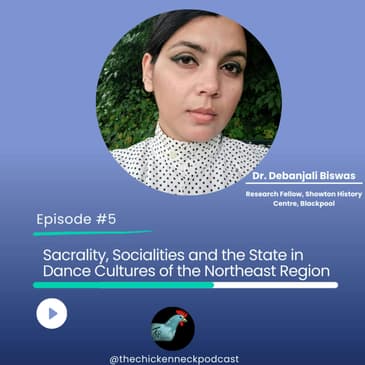
In our 5th episode of Season 3, we explore the rich and diverse dance cultures of the Northeast region of India, and how they intersect with concepts of sacrality, sociality, and the State. We are joined by Dr. Debanjali Biswas, who is an early career researcher in Performance Studies and Social Anthropology. She writes to critically engage with social, political, affective dimensions of dance in everyday life in contemporary South Asia. She is currently a Research Fellow with Showtown History Centre, Blackpool.
The Northeast region of India is home to a plethora of dance forms, each with its unique history, cultural significance, and social context. From the high-energy Bihu dance of Assam to the graceful Naga dances, these dance forms have evolved over centuries, reflecting the complex cultural and social dynamics of the region.
One of the key themes we delve into in this podcast is the role of sacrality in Northeastern dance cultures. For many communities in the region, dance is not just a form of entertainment, but a sacred ritual performed in honor of deities and ancestors. We explore how these sacred dimensions of dance intersect with sociality and community-building, shaping the way people relate to each other and their surroundings.
We also examine the role of the state in Northeastern dance cultures, and how government policies and initiatives have impacted these dance forms. While some argue that state support has helped preserve and promote Northeastern dance cultures, others point out that it has also led to a homogenization of these diverse traditions. Dr. Biswas has offered a nuanced and insightful exploration of the complex interplay between sacrality, sociality, and the state in Northeastern dance cultures. Whether you're a dance enthusiast, a cultural explorer, or simply curious about the rich and diverse cultural landscape of India, this episode is sure to offer a fascinating and thought-provoking perspective on the region's dance traditions.
Disclaimer: The views and opinions expressed in the podcast are those of the individual podcasters. Listener Discretion is advised.
Follow us on Twitter, Facebook, Instagram, and LinkedIn. You can listen to our show on all streaming platforms by clicking on the link:- https://bingepods.com/podcast/the-chicken-neck-podcast
Learn more about your ad choices. Visit megaphone.fm/adchoices
[00:00:00] Hello and welcome to the Chicken Nick Podcast.
[00:00:03] Supported by the IdeaBrives Network, we are a bunch of curious individuals based out of
[00:00:07] the Northeast, and we strive to bring you the best of policy discussions through the
[00:00:11] intersection with things that affect your and our daily lives.
[00:00:15] If you like what we do, show your support by sharing our work.
[00:00:18] Don't forget to leave your comments on this episode in our social media handbooks.
[00:00:22] Hello and welcome to another episode. Very, very honored to have you. was sent to art classes and I started attending dance classes from when I was a child. Incidentally, I started learning Manipuri dance from 1992 and I was learning from someone who had extensive training from Guruji's who came from Manipur and who had settled in Calcutta.
[00:04:04] and create different kinds of thematic productions. So that was one inspiration.
[00:04:05] The second was we also gave
[00:04:10] practical and theoretical examinations in dance.
[00:04:14] And of course, a lot of it are facts and history.
[00:04:18] But in my mind, there were questions
[00:04:21] that weren't being answered by just rote learning
[00:04:25] and repeating what was there in the books. this was also my responsibility to find answers. And by attending dances, dancers, sessions, day and night, you would start getting those questions and answers. The frictions, you learn that there are different ways of looking at dance, that everyone has a very different way of
[00:05:42] speaking about what dance means to them. And of course, then you start looking see what dance means to you. What what how do you feel being a part of being an artist in ever evolving community is where Conflict has been a part of our communities life for the past 50 60 years. How do you feel that? many pre dance
[00:07:01] Features in the Indian classical panorama. How what do you think about your heritage through?
[00:08:04] a very integral part of you getting into this research, right? So would you then say that it's a necessary step for you to take that leap of faith to
[00:08:11] understand how dance impacts a society or an individual?
[00:08:15] Is it a prerequisite in that case?
[00:08:19] From what I have seen from, it has been a prerequisite for me personally, because when as they had other disciplinary groundings. They just chanced upon dance and they started writing on it. Some of them wrote very well. Some of them wrote pertinent stuff. Some of them wrote things that can be countered with a that can happen around the area, right? Even if I take the example of law, for instance, if there can be, let's say somebody who's writing a theoretical paper on law, saying that, you know, these are the changes that should happen in law, because this is superficially what I think the structure is. But then there is somebody who let's say has faced a problem first and then have a very
[00:11:03] different approach to what changes needs to take place within the structure.
[00:11:07] So there are two different, I'm and dance and ritual, they are interconnected. Young people grow up observing it almost on a regular basis.
[00:12:21] Whether it's almost every social religious setting has movement as a part of it, whether it's the
[00:13:25] complicated for the audience to say and they'll be like, oh wow, they have done such a brilliant thing. When the community needs to move together, things has to be very simple four beat or eight beat rhythm cycle.
[00:13:31] So then you learn how the entire community is dancing together.
[00:13:36] You are not an individual in that situation. You have to be able to do something which everyone else is doing.
[00:13:41] But then again movements are drawn from there as well. So there is a process of the food is wafting in, you like someone, you're looking at them, the dance does all these things. It makes different form of socialities more sort of, it brings certain harmonious elements together while you're watching it in a more intimate
[00:15:02] setting. Such things can't be said for when you, is there a well-defined role of dance or is it, you know,
[00:16:20] it's used for all of the different ways or messages? Lots of different, lots of different purposes.
[00:17:24] into dance. So even when you see dance on stage, you know, someone's describing a season through dance, let's say a rainy season, Malhar Ragh is playing and you're, you know,
[00:17:30] you're walking with your harvest, there is a rain coming, you're picking flowers, someone's
[00:17:36] enacting a fishing scene. There are so many things that are happening while you are trying to
[00:17:41] describe the beauty of rain, something like that. And in some understanding, the modern or experimental can also be called contemporary. So contemporary movements actually heed to the call of the now, current perspective. So there was a very interesting dancer practitioner called Chandralekha in the IPTA. They were using dance for a completely different purpose. They were responding to a situation that was not being explored. How to say this? It was, dance sort of became this way
[00:20:23] of expressing these injustices that was happening
[00:21:26] husking grains, some can be erotic themed, some can be danced in a funeral. You know amongst the Hamaar community who resides in the Northeast India, there is a
[00:21:31] funeral dance called the garlam, when the chief person dies in the village.
[00:21:37] So it has a, it's a mix of melancholy, sadness, but there are, that's also a way of recognizing
[00:21:45] a life well lived and it's a morning made on the music. It's not a dance per se. And then we start making covers of it, and there's something called a hook step that you know, the step step becomes a repetitive thing. That's what becomes a Bollywood dance. Otherwise, there is no particular genre of Bollywood dance per se.
[00:23:01] Which necessarily would also be just an imagination
[00:23:03] of the choreographer that he has over the years, you know,
[00:23:06] seen through different forms of dances. I think we are all able to figure out who that is. But he's a good dancer, is it? Has he not been a good dancer in the past? He has been, but it's just that Bollywood is very trendy, right? They try to do whatever it's telling. So it's a mixture of the director's vision and the choreographer.
[00:24:20] Maybe they just had an hour to do the filming and they said,
[00:24:23] okay, this is going to be, they want to go away. So you have to make it like in the 30 minutes and that requires the choreographer or the dance gurus to sort of adapt the more important sequences from a ritual to a stage. And that hasn't happened to meet Ram. So this was the gesture which brought them together. There are so many ways, I have seen like two, three different kinds of classical dance chore you said that a longer form of dance needs to be wrapped up within 30 minutes is also an indication how history must continue with the change of time. I think that is adaptation. The fact that you said the 30 minutes, they need to wrap it up so that people also, the audience also appreciates that while at the same time, maybe not at the purest form that it tried to exist.
[00:28:21] So I think that that has a lot to do with the fact that a heart also at the same time has to adapt to the needs of time. know now, A, you have a more democratic way of learning and sharing dance, you can learn online, you can share online, whether or not you have an audience who is dedicated to you or whether it is like a general audience who wants to watch it, whether you are doing classical, whether you are doing film, music, you will always find an audience or you will share
[00:29:42] within friends and we have all done that. happening. Some people manage to get together with musicians, create new music during the pandemic. So if they're presenting it in a platform, they're like, this is something I came from, I thought during the pandemic. Yes. Some people are using music that's readily available on YouTube. They're just choreographing to it. Some people just want to move because they're tired of staying in
[00:31:00] the house. So you'd see the change that happens within people. Some people who have never danced,
[00:32:07] being given to you in a 30 second dream. So that again is a product of the time. I think I completely agree. First, I think the point about how social media has throughout
[00:32:12] the pandemic democratized dance because now anybody we can phone with a phone has danced
[00:32:16] and actually they are not just traditional dances. I think there are people who have
[00:32:19] made careers out of just dancing for 30 seconds. And I was feeling very upset because you have people from all over South Asian diaspora from India. So I was discussing it with a friend, a scholar who lives in Emphol and he said, eventually
[00:33:45] we don't have proper internet. to come to them and to translate for them and to have that discussion online. That was difficult. But towards the middle of the pandemic when organizations like Sanghi Natak Academy, Minister of Culture, they were sort of giving endowments. They made it possible.
[00:35:00] They gave the space for workshop.
[00:35:02] They said, okay, we are going to host a five-day workshop in an empty auditorium areas which often remain unexplored. But also, tell us a bit about how and why is dance as a form or as a study. What is it talking about the society that, let's say, anything else cannot? Because I know we have deluded a lot into the importance of it. But as a discipline, what is it that all other disciplines cannot say which dance as a discipline can?
[00:36:23] Yeah, it's a great question.
[00:36:26] It goes back to the thing that I'm dancing together, we are trying to put together different forms of ideas that creative collaboration takes a lot of time. Again, there are different forms of ideas. Before you see the final,
[00:37:41] whatever you are seeing, it has gone through movements. And I'm not, this can again relate back to that exercise sports, the physical activity part of it. But there is a psychosomatic change that, there is a little bit of creative consultation and hence a form became completely historicized. Over the years, Rasslila has emerged then as the foundation of the Manipuri classical dance.
[00:40:22] So it speaks to a certain kind of history, but it's also talking about distinct ways of living. So now, if you... now actually is the season he is looking at his and ancestors past and bringing something to the present just with dance. So he is saying that I am going to construct something called a PR ral, which is a new folk dance as a community exercise to remember the Mizor folk tales and myths that have now
[00:43:00] gradually been forgotten because there was a massive conversion to Christianity in the
[00:43:06] 20th century. which are now completely erased. I think that's also a very significant point. I was just thinking while you were speaking about the importance of dance in a new form, when you're talking about the form of dance that's been now used to get back a lot of lost history, if one could put it that way.
[00:44:22] Just a question as to how easy or difficult is it to corrupt dance?
[00:45:28] over and over. Let us say from a very simple, we all know Radha Krishna stories, right? A feminist might identify it in very different way because she can say that Krishna is maybe
[00:45:38] a supreme being but he is constantly delirailing people will get offended. But if you say, oh, in the Bhakti movement, this has already happened, they say, okay,
[00:47:00] we have a heritage of asking these questions to these norms.
[00:47:05] So then they will say, okay, you would say that's criminal. Yeah. So dance then becomes a safe space of exploring that, which are unable to do in a real life situation. No, I think for lack of better word, I think Kaurappa was the worst word to use, but I
[00:48:20] was also trying to think of it in context of, let's say Shiva, you have all kinds.
[00:49:46] When you are saying that you can perform only one kind and not the other changes, which is why also some dancers and choreographers are very guarded about their heritage. They use the word preservation or conservation to say that, that you know, we have to preserve the dance. They want to make an. You are taking notes in your mind or later on you are sort of writing whatever you have seen. You have a pen or a camera, you have interlocutors, you are engaging with the people who are in front of you as artists, as movement practitioners and then you are also cross-checking whether
[00:52:26] or not you know, if you are watching a long-danced ritual, you would see, okay, I have been present through six hours, there has been no electric interruption, which means, which also means that we have been well-funded, which also means that there was an the question to one of the artists, how do you feel that there is no audience? And they were like, we are playing for the board. People don't need to watch us.
[00:55:00] But the atmosphere changed a week later when the curfew was lifted
[00:55:05] and people could come and watch. The archivist came and said, Devanjali, you're working on Manipur, right? I have a bunch of films, do you want to see it? And I said, yes. It turned out to be a dance film that was filmed in 1945 at the end of the Second World War outside Imphal. I had then recollected that in 2008,
[00:56:21] when I was living with Oja Thiamsore Mokidevi,
[00:56:25] she used to mention that, but also it speaks to certain events which may not have been written in history at all. So, then it becomes something that you need to connect with the other aspects of historical writing.
[00:57:41] And Second World War has been such an you know throughout the podcast you have realized that there are so many stories that haven't really been touched upon from the northeast and this is just another addition to it you know just that you said
[00:59:00] with the dance aspect to it and I mean I seen the film, I sort of analyzed what they were dancing. Some of it is some vocabulary which I understand because it is a part of what became a Manipuri
[01:00:20] dance tradition.
[01:00:21] But some of it wasn't and it seemed like a very modern contemporary take probably made archive of dance, starting from Manipur but also gradually looking at different colonial archives because I have the privilege of sitting here, I can just go and ask, request access and see. I am trying to see what are the old dance performance or theatre even photographs that
[01:01:42] these colonial archives have and see if there is a way of visually mapping performance from the Northeast past. But I've started with Manipur because that's the area I'm more familiar with and some of the dances I'm more familiar with. So that some of the work is going there. As a part of my research project with Showtown History Center,
[01:03:03] it's again an archival fellowship. It's basically an entire collection
[01:03:04] of theater performance dance.
[01:03:07] They're coming up with a museum next year. performed there as well, but sometimes they just didn't perform. They were there as, they were exhibited as, you know, or dances say about ecology, cosmology of their, and how they are bringing all that aspect an important dimension to that, you know, rhetoric of unity and diversity we keep saying. We don't say that there is this homogeneous way of living. We say that through these dances, you can also say these distinct ways of being. However, in dances also continue to be a rubric of criticism and
[01:08:02] His name is Bon, Bon Bon. So he has done a series of productions.
[01:08:04] One of them is called NURBS,
[01:08:07] which was remarkable in the way the dancers drew
[01:08:09] on Manipuri martial art,
[01:08:11] but also traditional and contemporary movement styles.
[01:08:14] But he took, with NURBS,
[01:08:16] he basically, he was talking about militarization.
[01:08:20] So he was looking at militarization in Manipur
[01:08:22] and exploring a concept,
[01:08:25] which is where he's, with choreography, different struggles of the people who live there, but also asking questions about hydroelectric projects and people-river interactions. And she's also taken music from our home community, the ORE mission community, and then expressing it all through dance. So that's what basically that article was.
[01:09:40] It's looking at various different ways
[01:09:44] artists from Northeast India speak through dance. in a way impacts our society, how it forms, how it evolves in a way. But does it benefit anything in everyday life or simply, you know, let's say conceptually or on a day-to-day basis, how does that get influenced by dance? What do you feel when you see a dance? Me, I think I get happiness at times.
[01:11:01] If let's say it's relating to culture, in a whole year you say, okay, the designated
[01:12:24] day to celebrate dance. and as an academic to do with, for there are fewer numbers of people who do that on a daily basis. Yeah, and that again relates to the question of livelihood, of what it means to sort of live and obscene things, it is not a reliable mode of storytelling. There are other emotions which comes out by doing, watching, dancing as well, that also happens.
[01:15:01] And in many cases it does take on very scary proportions. very evocative way of telling whether or whether or not the adi basi cannot dance in their own ancestral grounds and they cannot dance because dance. So he is basically the dance and also not dancing also becomes a part of resistance. Yeah, I think dance has just so many elements that keeps unfolding. But the last question that I have with respect because now you just mentioned
[01:17:40] about this particular book and how and who dances or does not dance is also in a way So something like, to go back to the film question, that is made for public. Everyone watches the dance, that's why there is a different hook to those kind of dances. Sometimes it's more titillating so that it garners more views.
[01:19:00] Sometimes it's more thoughtfully crafted.
[01:19:04] Sometimes people take more liberty with it, by wearing less clothes or by titillating movements, someone has found something offensive. We are in the middle of so many of them on a daily basis. But that audience, but these are people who have, let's say, chastre, kar, Sanskritic knowledge base. So they view one dance performance, one music performance, one after the other. They understand all of it. They are being able to enjoy it.
[01:21:40] But there is again a lot of controversies
[01:21:42] which happened around that as well. If you are viewing dance on a daily basis, there are certain, there are every kind of debate where you can pitch the dance in, right? Because before I read Hans Dasobhan Darshikhar's book, I asked not to perform certain ghazals or maybe a misremembering. But something that was not a part of the majoritarian audience, she was asked to leave, you are creating an audience who is only going to think and work in one way and who is never
[01:24:23] going to criticise or critically ask questions possible so that people can go back and access it. But at the same time, I think as in along at least the four projects that you mentioned from Northeast India, I think once we, you have a conclusion to it,
[01:25:44] we'd be happy to have an episode each maybe on one of them, because there's so
[01:25:47] many interesting aspect of dancing. There's a lot of hard-hitting work that also can be made through different forms of movements and stuff.