
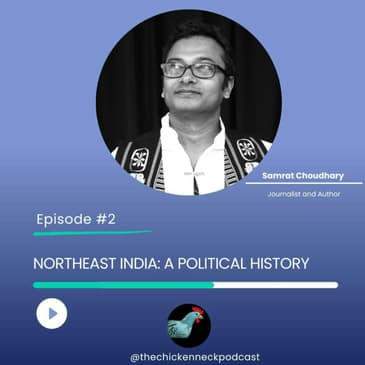
In the second episode of Season 4, we had the pleasure of hosting Mr. Samrat Choudhary, a prominent journalist and author from Shillong, India. Samrat is known for his insightful work, including editing the anthology "Insider Outsider" on the divide in India’s Northeast, which received positive reviews. His literary accomplishments also include his novel "The Urban Jungle," nominated for the Man Asian Literary Prize, and various short stories, essays, and a graphic novella turned play.
During our conversation, Samrat shared insights from his latest book, "Northeast India: A Political History," which offers an accessible introduction to the political history of the region. We delved into the historical journeys of Northeast Indian states into modern India, including the shaping of their boundaries, often influenced by neighboring countries. Identity politics, particularly based on language and religion, remain central to the region's political landscape, making the emergence of print vernaculars and the introduction of major religions significant aspects of its history.
As we navigate questions of nationalism and identity globally, this episode provides a deep dive into Northeast India's history, exploring its unique journey into nationhood since 1947. Samrat Choudhary's narrative weaves together the stories of diverse tribes and peoples, from remote hill-tribes to those inhabiting the valley of the Brahmaputra River, illustrating how they became integral parts of India's diverse fabric. Join us as we unravel the captivating history of one of the world’s most intriguing regions, Northeast India.
Find the book at amazon: - Buy Northeast India: A Political History Book Online at Low Prices in India | Northeast India: A Political History Reviews & Ratings - Amazon.in
Disclaimer: The views and opinions expressed in the podcast are those of the individual podcasters. Listener discretion is advised.
Follow us on Twitter, Facebook, Instagram, and LinkedIn. You can listen to our show on all streaming platforms by clicking on the link:- https://bingepods.com/podcast/the-chicken-neck-podcast
Learn more about your ad choices. Visit megaphone.fm/adchoices
[00:00:00] Hello and welcome to the Chicken-Neck Podcast. Supported by the IDF News Network, we are a bunch of curious individuals based out of the North East.
[00:00:08] And we strive to bring you the best of policy discussions through their intersection with things that affect your and our daily lives.
[00:00:15] If you like what we do, show your support by sharing our work. Don't forget to leave your comments on this episode in our social media handbooks.
[00:00:23] Hello and welcome to another episode of the Chicken-Neck Podcast. It's been quite a while since we released our last episode and we are actually glad to be back.
[00:00:33] Our guest today is Samrat Chaudhary who is a journalist and author from Shillong. Samrat and I go a little back where we first met at a conference which spoke about issues around the Northeast.
[00:00:47] Samrat has been an editor of broadsheet newspapers in Delhi, Mumbai and Bangalore. And as an author and a journalist has had his very diverse experience of working in very different areas.
[00:01:01] Some of which of course includes a lot of literary experience. He has been the editor of several books.
[00:01:11] He has in fact written a travelogue following the course of the Brahma Bhutra called The Greated River.
[00:01:17] He has also written a novel called The Urban Jungle which was published by the very renowned Penguin Books in 2011 and was nominated for the Manitian Literary Prize.
[00:01:26] Apart from this, Samrat is also a columnist and writes often in some of the leading newspapers around the country.
[00:01:35] But our discussion today with Samrat is about his most recent work, The Northeast India Political History.
[00:01:44] A book that he came up with last year if I'm not wrong Samrat.
[00:01:48] Which has actually stirred up quite an interest because when I was looking into different websites which showed some of the most relevant books about Northeast, your book was up there in the top two in every website that I looked at.
[00:02:00] Oh wow! So on that note, welcome to the Chicken Neck Podcast Samrat.
[00:02:06] Thank you. Thanks so much for having me on your show.
[00:02:11] You know it's to start off since we just, Animesh also brought up your book and we were really curious when we were going through it.
[00:02:22] And we were very lucky to receive a copy from you itself before the episode. So it was really nice getting to go through the book.
[00:02:28] Could you tell us a bit about your book, the idea behind it and the entire process because to write articles and columns and to write something of a book,
[00:02:39] especially on Northeast India and to cover such a wide range of stories and topics is a really interesting process.
[00:02:47] So could you just take us through the process and what went around in writing the book?
[00:02:53] Yeah, well I mean journalism is a whole other kettle of fish and writing books is completely different.
[00:03:01] And actually I kind of stumbled into it you can say. I mean I meandered into it.
[00:03:08] It was my work on my previous book, the Brahmaputra book which led basically to this.
[00:03:15] And I had stumbled into that one as well. I met Preeti Gill who is a former publisher and had just become literary agent at a conference in Jamiya
[00:03:28] where I was not even presenting a paper and we ended up having a tea break discussion where it turned out that she was looking for somebody to write a book on the Brahmaputra
[00:03:39] and at that time I was living in Bombay. And you know so I was very excited at the thought of being able to do such a book but I didn't know if I could actually do it.
[00:03:50] So I thought about it for a few days and then eventually I was tempted to say yes and I took the task on and I started going back to the Northeast.
[00:04:00] I had left after my 12th standard exams and studied outside and worked outside for many years.
[00:04:06] So I had in some sense lost my touch with the issues.
[00:04:12] I had written journalistically from time to time but my deeper engagement with the region actually happened because of the research and the travelling that I did as I started researching my Brahmaputra book.
[00:04:26] And that's when it sort of actually came together and the material that I gathered you know some of that sparked some ideas, some of that remained with me.
[00:04:35] I put together a small library of my own and that eventually fed into this book.
[00:04:42] And this book also happened in some sense by chance because after I finished my Brahmaputra manuscript what had happened was that
[00:04:52] the publisher who was originally interested in the project had by then somehow lost interest in the project.
[00:04:59] So I had a whole manuscript and had travelled thousands of kilometres, well I mean not thousands but several, I've been there several times so I suppose I could say that.
[00:05:08] And here I was with the manuscript and years of work and more publishers.
[00:05:14] But at that time I by chance ended up getting a Chevening Fellowship and so I was in London and I got in touch with Hearst publishers and even though they didn't take the Brahmaputra book at that point in time,
[00:05:28] eventually the conversations and connections led to this book, the Northeast India Political History being sort of written.
[00:05:39] So it was a series of coincidences and chance encounters that led to this book and published.
[00:05:47] Just to follow up on that and this is question more out of curiosity I'm sure somebody who wants to write or wants to work around that area might have that question so I wanted to ask.
[00:06:00] Because I saw your work, one of your work for instance the first novel was, first you wrote a novel then you wrote a travelogue and then of course now you're coming up with a literature which is in many ways a history of the region.
[00:06:13] Both, I mean history in the traditional sense and also contemporary events which, I mean contemporary events as well.
[00:06:22] So as somebody who writes in different areas, because normally we see if somebody is writing about history they tend to write about history.
[00:06:30] How challenging is it and how do you get into that process of writing from, you know shifting from writing a novel to a travelogue to something of a historical piece?
[00:06:40] How do you do that?
[00:06:41] Well, I mean I am not a specialist and I don't consider myself an expert on anything except perhaps to some extent journalism.
[00:06:51] But the thing about journalism is that when we do journalism we are forced to engage with different subjects on different days it's just part of the job.
[00:07:00] And so a large part of my journalism experience actually was doing special features for the Hindustan times where I spent several years.
[00:07:10] And it could be you know one that one week I was writing about, one week you know I might be following the election trail in some state.
[00:07:21] I've been on the election trail in the tribulation, Bihar and elsewhere.
[00:07:27] Another week you might be in the northeast or in Kashmir.
[00:07:30] Another week you might be writing about food and then some other time you might be writing about something like I remember covering a hockey match, India-Pakistan hockey match.
[00:07:44] So if you could end up doing just about anything, whatever it was that fell to you that week you did.
[00:07:51] And the intimidation that one feels about not knowing is something that you're forced to overcome because that's the nature of the job.
[00:08:00] So you go in saying that I don't know but at the same time you know that you have to do it and you know that it has to come out in the paper in two days.
[00:08:10] And so I would go in with the feeling that I don't know but also with the feeling that well I mean I have to do it and so I will do it.
[00:08:19] One last follow up with respect to that because when I was reading your book another very interesting facet of the book was
[00:08:27] you know understanding that while you had written so much and especially with respect to some states for instance the chapter on Nagaland which we will speak about on Tripura as well.
[00:08:38] There were events which were connected to what is happening in the current time as well.
[00:08:44] And one very interesting thing was that I felt was that you stuck to the facts and it was very rarely where I would see that you know given an opinion on what is happening.
[00:08:55] So how challenging is it to write a book where you are not really giving your opinion in spite of you being from that region having lived there,
[00:09:04] having researched there for this book as well.
[00:09:07] So how do you delineate that process of putting in opinions and consciously not putting in opinions?
[00:09:15] It was my journalistic training. In journalism the basic training is that you don't report, you know you don't report opinions.
[00:09:24] The space for opinion is separate from the space for narrating facts as far as we are able to discern them.
[00:09:31] We may fail in that effort but at least the effort should be to honestly and accurately report the facts.
[00:09:38] So what I was trying over here was basically to just lay out a simple chronology in a certain geography and to look at how that the present political boundaries came to be formed,
[00:09:50] present political identities came to be formed.
[00:09:52] So I was not looking at you know at reporting, at expressing my own opinions. In fact I was very consciously trying to keep my opinion out of it and to use standard sources as far as possible.
[00:10:05] Just put the bare bones facts out there as far as one can discern them.
[00:10:11] There may be disagreements between different groups or different writers on different facts.
[00:10:18] In such cases I have tried to represent as far as possible those differences as well so that there are different views on that I have tried to represent in a very way possible.
[00:10:30] You know while going through your book one thing that really caught my attention as well was the way you title the chapters very interestingly.
[00:10:38] Each chapter has a very interesting and unique title and that actually makes the reader very curious regarding what it is about.
[00:10:46] The first chapter for example is called the Christianity and modernity in entering India in the modern world.
[00:10:53] On that note, Northeast India has a major Christian concentration in India and especially with regards to if we see the way the Christian population is divided in India.
[00:11:05] Part of it is in the coastal areas and the rest is majorly based in the northeast.
[00:11:11] So however in one thing that is unique to our region when it comes to Northeast India when it comes to the Christian population is that it is a modern phenomenon which has happened in mostly in the 20th century.
[00:11:26] So could you tell us about what were the changes that went through and how this thing came to be and how this population grew in the last 150 years and the major developments that took place in this regard?
[00:11:37] Well I mean the advent of the missionaries was very important in the formation of present political identities throughout the Northeast.
[00:11:48] I mean starting with Assam itself and the Baptist Mission Press which had a sizable impact.
[00:11:56] Not in the religious sense but in the linguistic sense it had a role.
[00:12:03] If you look at the basic theory of how languages are sort of standardized, the standardization of languages and so they had been impactful not just in one state and several states.
[00:12:19] It was similar in the case of Meghalaya also and in other states as well.
[00:12:23] So that was one part of the impact.
[00:12:25] Coming to the question of religion itself, the growth of Christianity.
[00:12:29] In the Northeast if you speak about the Christian population basically you are talking about Nagaland, Mizoram and Meghalaya which are the three Christian majority states and overwhelmingly so in the case of Nagaland and Mizoram.
[00:12:47] And then you are looking at the hill areas of Manipur and you are looking at Arunachal Pradesh also, parts of Arunachal Pradesh.
[00:12:57] So it's not all the states, it's the hills and interestingly I mean not again not uniformly in every case but say for example in the case of Nagaland and also in the case of Mizoram.
[00:13:13] Now those areas were places where British administration entered only in the late years of the 1800s.
[00:13:23] So it's only towards the end of the 1800s that we find British administration extending up into the Nagahills and into the Lushai Hills and so on.
[00:13:34] And before that you still have the period of expeditions and raids and counter raids and so on.
[00:13:41] So it's after 1890 or late 1890s that an administration is established which makes it possible for the missionaries to extend their activities in those areas.
[00:14:02] The process, I think in the case of Mizoram at least the process is very clear.
[00:14:08] It's basically that you see the numbers and the numbers go up very sharply from approximately 1900 to 1941.
[00:14:20] In the case of Mizoram the number of Christians in 1901 was 45 people only and it rose to almost a lack which was at that time more than 60% of the population by 1941.
[00:14:32] So basically you have a major growth in the first four decades of the 20th century.
[00:14:41] So it's basically, I would say that the growth of the Christian population is something which happened with the extension of British administration.
[00:14:55] And even though the British administrators and the missionaries were often at longer heads with each other but it was somehow a process that they went hand in hand.
[00:15:06] And because the extension of British administration into some of those hills happened quite late in the day.
[00:15:12] So therefore it was towards the end of British rule that we saw that period of explosive growth in the number of Christians.
[00:15:20] I think and when you talk about tea, so this idea of Christianity, rising Christianity and tea and the Britishers coming into
[00:15:30] and sort of in trying to push, was there a certain push?
[00:15:36] I mean a lot of literature that we tend to read also talks about this push for Christianity because of the spread of commercialization around this area.
[00:15:46] Is there a relation between that as well?
[00:15:49] What I remember coming across is basically accounts of British administrators where they are somehow not so happy with the missionaries.
[00:16:05] And of course, there would be individual British officers who were very religious and might have therefore been very keen on extending the work of the missions.
[00:16:15] But there were also a lot of British administrators who were not happy with the missions.
[00:16:25] And again going back to Mizoram that is something that we find in the accounts of the British administrators.
[00:16:33] Basically you see that they're saying that the mission is sort of taking on the most powerful role in a certain sense.
[00:16:47] That our administration does not extend so far into the interiors but they have a lot of influence in the villages and so on and so forth.
[00:16:57] And so it is not a process which would have been uniformly encouraged by the British.
[00:17:07] In fact right from the beginning of British rule initially the East India Company had decided to not allow missionary activity.
[00:17:16] Which is why the missionaries were based out of Sriramput which was not a British settlement because they were not allowed to operate in British areas.
[00:17:28] And of course that policy changed subsequently and then they started coming in but I think it's a complicated picture where at some points during the British rule
[00:17:42] some administrators encouraged the missionaries in some places they encouraged the missionaries but sometimes they fought with each other.
[00:17:49] In the case of Assam the American British mission and the British administrators were often at loggerheads.
[00:17:56] So it was not a uniform process.
[00:17:59] I mean that also reminds me as to how even during the expansion of this earlier the Brahmaputra valley in Assam how they were at loggerheads with how to go about.
[00:18:10] I think it was also a very evolving thought process for them politically and maybe later religiously as to whether push for these things on which also on a large scale dependent on the person who was in charge of this entire idea.
[00:18:23] So maybe that is how this has played in.
[00:18:26] But one of the things that your book also reflected was the you know the once the the northeastern part was in a way incorporated into the modern idea of India.
[00:18:40] There were a lot of states in the northeastern part which was initially of course part of Assam.
[00:18:45] However, even the socio-political setup that had developed post throughout the British era the different inferences they had with respect to putting people in a particular geography and the different commercial aspects to their colonization.
[00:19:02] There was a lot of you know spread of independent, independent minded hill people around this area which led to of course partition of a different sort within the structure of you know breakdown of Assam into different states.
[00:19:18] But within those states that were formed as well one of its which is contemporary very relevant which is Manipur.
[00:19:25] The aspect of low and high lying individuals you know communities the meeting and cookies you know led to has led of course led to a lot of conflict.
[00:19:35] So could you take us through because you have a very nice chapter where you talk about Manipur's princes and rebels and how there was a whole attempt at assimilating it through the ages.
[00:19:47] Because I also asked this in context to the fact that I remember leading a portion of the British says initial attempt to colonize this part of the world where you know once they had actually taken the Brahmaputra valley where essentially the Ahum kingdoms.
[00:20:07] While they were exploiting the Ahum kingdoms because it was weak they had actually given a lot of power to the Manipuri kings because the Manipuri king was strategically very important.
[00:20:17] So could you take us through and you have also I think mentioned it initially in your book so could you take us through a bit of that and how the you know all of these colonial aspects have actually played a larger role in how the conflict lies in Manipur today.
[00:20:33] Okay, so well I mean it is you know what you mentioned which is the existence of state like structures in the lowlands and of independent, independent minded hill people in the highlands.
[00:20:47] And in the case of Manipur there is a very ancient history of state formation of the process of state formation which dates back to about 33 AD.
[00:20:57] And I mainly drew my references of that early very early history of Manipur from the English translation of the royal chronicles the Chaitral Kumbapa, Saroj Nalini Arambam Parath and the works of another Manipuri historian Rajkumar Jhalajit Singh who also used the Chaitral Kumbapa as his source.
[00:21:18] And so for that part I will read from the book itself because I don't want to misquote the authors, the original authors.
[00:21:32] And so what Jhalajit Singh says is that the story starts with a battle between Pakangba who was the first king and the Shah invader from Burma who had established himself in what is now Intha.
[00:21:47] For some reason not yet known the throne of the principality which came to be known as Ninhthauja Principality from 33 AD onwards well we can't in the spring of that year.
[00:21:58] A man named Pakangba had distinguished himself as a warrior. Pakangba fought for the throne with Poraiton and thoroughly defeated him in a decisive battle.
[00:22:06] He seized all his weapons and the women who came in his home. So after he ascends the throne of the Ninhthauja Principality which was then one of seven in the plains of Manipur, Pakangba sets about consolidating his rule.
[00:22:21] And he marries the vanquished Poraiton's sister, Plisna and the first territorial expansion of the Ninhthauja Principality begins from there on.
[00:22:32] Continues in the reign of his grandson, Tauting Mang who conquered a few villages in the valley but it takes a long time.
[00:22:41] It's a process which takes about 500 years before the Ninhthauja are finally able to defeat the neighboring principality of the Angams and really realize tributes from them.
[00:22:51] So basically there is a process which goes through centuries of internal consolidation and state formation where the different Mithai clans are eventually united into one Mithai kingdom, the valley.
[00:23:10] And there are records in the Chetharal Kumbapa of conflicts with others which start to pop up and from fairly early in the day.
[00:23:22] So they record conflict with people in the hills. There are subsequent records of conflicts with people who were referred to as Mayans and which would basically imply people from the plains probably of nearby Cilland or Kumbapa.
[00:23:40] And so we find those records of conflicts. It's only basically the arrival of modern ideas of state and territory which you have periods where the relations are good,
[00:24:05] periods where the relations are not so good between different groups.
[00:24:10] We must not forget the Burmese influence as well because the kingdom becomes very powerful, the Manipur kingdom becomes very powerful in the reign of King Garib Nawaz and who attacks Burma several times, successfully attacks Burma several times.
[00:24:28] But then he also ironically for someone who bears that name becomes a very devout and conservative Hindu and also ends up offending followers of the Sanamahi, traditional Sanamahi faith.
[00:24:49] And so there is a religious tension within Manipur towards the end of Israel. The king himself is killed by his own son and the period of instability follows in Manipur.
[00:25:04] And at that time in well Burma has become very powerful and the Burmese then start to attack. And eventually it's basically Burmese rule of both the Manipur and the Aham kingdoms and subsequent intervention by the British, the Anglo-Burmese war and after that colonial rule.
[00:25:24] So that's the basic timeline. Now it's after the coming of colonial rule and essentially of modernity that we start to have these current ideas of notions of identity and territory that we have now.
[00:25:39] And coming to the present conflict which you mentioned, my view of it is that it is born out of those modern notions of identity and territory.
[00:25:52] Because basically the way I see the conflict is I see it as a conflict of clashing nationalisms. And so you have certain Manipuri nationalism, you have a Naga nationalism pre-existing and that is something which is something which the government of India for example has been having peace talks for some decades now.
[00:26:22] With the groups and you also have a sort of you had in the past as a larger idea of a Mizo nationalism. And so there is a sort of a Mizo nationalism also.
[00:26:43] There have been insurgent groups which have fought on behalf of these nationalisms for many years now. And the government of India has had arrangements with several of these groups over the years, peace making arrangements.
[00:27:02] And so you've gotten a situation where there are conflicting ideas of territory overlapping maps and these, you know, identities with their armed groups behind them. So it is in a sense a very difficult conflict to resolve.
[00:27:21] Right. And I think what is also interesting is that towards the end of that chapter on Manipur and I think I can guess that you had sort of completed this manuscript before the tensions in Manipur had started.
[00:27:35] So you essentially there talk about the problems that it might cause as a result of the tensions that already exist. Which is also another very interesting take on how history can, you know, and all, you know, in a way and the settlements can in a way create problems with how they exist or coexist at a particular point of time.
[00:27:56] So that I also found very interesting with your book. But yeah, I think that that point is very interesting when you say as to how traditionally although they were a community, a very old community in fact but through migration and through different aspects historical migration there has been a lot of issues that have developed even with the role of the neighboring states as well.
[00:28:20] But from that to I'd like to jump from that to the aspect of, you know, Nagaland because you mentioned Mizoram as well. And while we'll not ask you to every time explain, you know, the larger context because I know it's also very difficult for you to remember all the context of what we are trying to say.
[00:28:38] But you also talk about Nagaland and the Nagar rebellion in great detail when it comes to, you know, when it comes to Nagaland in your book. And while you know we'd like to give you a very, I mean we'd like for you to give us a very brief outline of what this rebellion was.
[00:28:57] My question largely also revolves around the aspect towards the end of your chapter on Nagaland, where you talk about how the BJP actually played, you know, came to power in Nagaland and then because you very interestingly say that the BJP threw its power in the center end through the deep pockets they come to power in the state.
[00:29:21] And however, you know, do you think that the Nagar Peace Accord had a large role when it came to bringing BJP in the state and how do you think that in a state like Nagaland BJP could essentially establish some sort of a voter base.
[00:29:39] Because traditionally these parties were not really very successful in the states in my case.
[00:29:47] I don't think, well, I mean they're not really in power but they are definitely a part of the power structure and.
[00:29:53] Sorry, I mean you mentioned that we have seats where they won.
[00:29:58] Yeah, yeah, yeah. And I think in the hills of northeast India at least the expansion of the BJP may have less to do with ideological reasons and more to do with practical reasons.
[00:30:12] And for some of these places, apart from very practical concerns such as the issue of which, you know, where the money comes from who disburses the funds at the center.
[00:30:31] So apart from that, it's basically a question of dealing with whichever is the central authority, whoever is the central authority in Delhi.
[00:30:41] And so you'd find the pattern which has been repeated over the years of some of these states having very strong sort of alignment with whichever parties in power in the center.
[00:30:58] So for example, say in the case of Arunachal, as long as the Congress was in power in the center, the state was solidly a Congress state and subsequently almost the entire Congress became the BJP.
[00:31:16] So, so I think we can't see that in ideological terms. I think that should just be seen in very practical terms as as necessities of political survival for for the practitioners of that profession.
[00:31:36] And could you, I mean in a very brief manner talk talk us through the Nagar rebellion as to what is the importance of that rebellion when it comes to the state because you I mean your your chapter sort of traces it right from independence and how the idea of statehood and how they wanted to be a different independent place all together.
[00:31:58] So could you take us very briefly through that?
[00:32:01] Well, I mean the Nagar argument from the beginning was that they were never a part of any Indian kingdom or empire that in a sense that they had always been independent.
[00:32:16] And so the initial representations also to for example, the Simon commission which is often referred to brought up the fact that they were also culturally distinct and they had their unique culture and identity and it was distinct from that of the
[00:32:39] in religious terms of the you know the Hindus on one side and the Muslims and the other which was relevant in those times because
[00:32:47] after all you were heading towards a partition and religious life.
[00:32:50] And so that sense of a distinct identity and the different distinct culture and the distinct territory which was linked to that distinct identity was always there for from the beginnings of the modern political consciousness where it can be traced.
[00:33:11] And I think even at the time of before independence there was strong voices saying that we don't really want to be a part of the future Indian or Pakistani state you know that we should be able to decide our own future essentially.
[00:33:33] So, FISO was active before independence as well.
[00:33:38] And I have started my chapter by mentioning the telegram which never reached which was sent one day before the independence of India saying that they wanted to remain independent.
[00:33:54] So, that idea was always there for quite a long time and while it did not it probably did not have universal support but it did at some points enjoy quite widespread support.
[00:34:10] That sense changed over the years and probably initially there the real fighting happened in the early days in the late 1950s and 60s before the formation of Nagaland state which was the first state to be carved out of Assam.
[00:34:32] It was basically a political way to appease and integrate within the Indian Union you know that struggle for independence.
[00:34:49] And I think it has been largely successful. It has been to a great extent successful because the kind of conflict that existed then gradually petered out and while the issue is not finally laid to rest because we have a framework agreement which has been signed but not the final agreement between the contending parties.
[00:35:16] But nonetheless there has been substantial progress over the years since the time when there was open warfare for a free Nagaland.
[00:35:32] I mean again that's a very interesting insight into how you know all of this led to what it is currently.
[00:35:39] But moving from that to also because there are so many different aspects to your book it's actually very difficult to jump from one point one point to another but other interesting aspect is where you bring up the aspect of Sikkim and what I found very interesting was that you see your chapter is named Sikkim and the completion of region making.
[00:35:58] So my first question of course would be why do you call it the completion of region making. I mean also from the aspect of was it regards to the modern Nazis as we know that and know it.
[00:36:10] And of course also with that I would like to know of your views on why initially do you think Sikkim was not pushed as a because it was part of the British protected it and could you tell us as to why it later became a part in 1975 and not and why also do you call it.
[00:36:27] The completion of region.
[00:36:29] Well precisely because it was not a part of the country until 1975 so it was also not really geographically it is separated from the other states of the region.
[00:36:39] It doesn't have geographical contiguity with the region normally you think of a region you think of places which are together.
[00:36:46] Contiguous to one another but Sikkim is not and historically also it was it was you know it had a different trajectory to its history all through.
[00:36:59] Culturally also it was fairly distinct from several of the others areas and states in the Northeast so it has always been a bit different from the other states of the Northeast even now I think it's the eighth sister in more ways than one of the seven sister states all.
[00:37:16] Have a you know a certain closeness which Sikkim does not seem to share with the rest.
[00:37:22] So it's inclusion eventually you know as an official part of the region in the Northeast Council, a belated inclusion was what was what in some sense made it you know completed the region making in my idea because I see the Northeast as an official region.
[00:37:42] Not so much a historical with all these eight states and so Sikkim is the outlier definitely which sort of makes it you know that that part of that official region and the completion of region making happens with its with its inclusion.
[00:38:03] What was your other question about the historical process by which it became a part of India.
[00:38:08] Yeah, I mean also the fact that they were a protectorate initially right why the I mean of course there was a long political battle but I just wanted you to speak a little bit on based on your research or so.
[00:38:21] So, so the you know the status of Sikkim as a princely state was similar before 1975 to other princely states before 1947 in some way because it remained a princely state until then.
[00:38:38] And it was not the only princely state in that part of the world.
[00:38:43] You also have it, it's neighbor Bhutan to think about which with which Kingdom Sikkim had old ties their royal families were related to each other and perhaps naturally the you know the royal families in both places had similar aspirations,
[00:39:03] which was clearly stated which were clearly stated by the rulers at different times, which was essentially that they wanted to remain in independent in terms of their internal affairs and to remain under protection of first of the British Indian Empire and then of its successor Indian state.
[00:39:22] And Bhutan was able to successfully achieve this goal but Sikkim eventually could not retain that level of independence and became a part of India.
[00:39:32] I think I would argue that it was not 1975 but 1971 when the die was cast because that was the year when the Bangladesh war happened as a result of which Pakistan split into and East Pakistan.
[00:39:51] And as the victory in a war in which India had prevailed despite opposition from despite well I mean despite yes open to some extent from the Americans.
[00:40:06] So it was for a while it was in a position where it could redraw maps, which is what happened right then.
[00:40:16] So the map of the entire region got redrawn and it was a region which geographically the bounds of that region at the Himalayas in the north and the Bay of Bengal in the south.
[00:40:28] And so within that region the you know a lot of maps got redrawn.
[00:40:33] So the entire map of North-East India also got redrawn at that time.
[00:40:37] And so the reorganization of North-East India happened Bangladesh emerges on the map.
[00:40:43] Bhutan, sorry Bhutan becomes it's a crucial year for Bhutan also Bhutan becomes a UN member probably with support from western backing and so its independence becomes secure.
[00:41:02] And Sikkim however is not able to achieve that because Sikkim started not immediately but soon after to you know have problems.
[00:41:18] The king of Sikkim wanted to get what the king of Bhutan had got and so the king of Sikkim wants a renegotiation of the Indo-Sikkim is friendship,
[00:41:30] friendship treaty but what happens instead is that Indira Gandhi fresh from victory in war tasks Ramnath Kao the celebrated spy master of India with doing something in the matter.
[00:41:45] And so two years later elections happened in Sikkim, internal elections in Sikkim.
[00:41:52] Sikkim had a state council at the time and in the internal in the Sikkim elections the Sikkim's Kings party basically the national party wins nine out of the 18 seats and is the single largest party.
[00:42:09] But protests break out against alleged rigging unfairness in the electoral processes and the protests become very intense and eventually the king finds himself besieged and unable to control the situation and has to appeal to India for help.
[00:42:29] And then Indian help arrives and fresh elections are held organized by the Indian Election Commission which the opposition to the Sikkim King wins handsomely.
[00:42:45] And then subsequently a referendum happens which is a referendum to join India and which votes overwhelmingly in favor of joining India.
[00:42:57] And so by very democratic and largely peaceful methods Sikkim is integrated into India.
[00:43:07] Right. I mean as unique as that story with respect to Sikkim is and the fact that it was one of those princely states which came in later like you mentioned another very interesting story is that of Tripura and I think I was mentioning the other colleagues at the podcast as well that the trip to our chapter personally was an eye opener.
[00:43:31] And the reason for this was that and it has also a bit of contemporary relevance as well because now we see that the government is focusing a lot on Tripura with respect to infrastructure because it's sort of the last place when it comes to its connectivity with Bangladesh.
[00:43:46] But before the partition I could sense that there is a route they used to be a route for trade and I think that in a way might have influenced which I know from you of course more on the history and impact of history and politics in the state.
[00:44:01] Now, would you then say that the kind of political history or the economic history or the problems whatever has existed in the state has to do with the fact that it had greater connectivity and somehow that connectivity was hampered over the years due to partition.
[00:44:20] And also just to add on to that maybe the fact of my immigration and migration and issue that has existed in Assam or in some other states over time in northeast.
[00:44:35] Is this somewhere do you feel that this issue is more visible with regards to Tripura or over the years Tripura has been shown as this as a political example not necessarily let's say as what has existed but as a political example by the political class of different states.
[00:44:53] This is what has happened and this might happen to you so that fear factor.
[00:44:57] Do you think that is an example that has been there that has been used over the years. Could you tell us about that?
[00:45:03] Sure. So, so basically I think we have to think about it in you know in terms of a slightly longer span of history and what I said a little while ago that the geography the geographical boundaries the natural boundaries if you think about them are the Himalayas in the north and the
[00:45:28] Bengalis in the south. Now within this region people have been moving back and forth for you know throughout history there has been there has been movement of human populations large small throughout.
[00:45:43] In fact, the Brahmaputra is was the ancient highway of that entire region and the rivers were the main highways by which people move and so movement of people is something which has been happening for centuries and it has happened
[00:45:56] from other directions as well for example the Ahom scheme from the other direction from from from from across the Patkai hills.
[00:46:08] So, so movement is something which has been going on for centuries and where there were not any major geographical barriers to their movement.
[00:46:19] The the scale of movement would naturally have been greater. So, coming back to Tripura and the question of Tripura we find for example that the both the royal chronicles of Tripura and you know accounts of historians
[00:46:40] talk about arguably the first historical as opposed to mythical figure of first first historical ruler of the Manikya dynasty as Ratnafa that is something which is often be said he was he was definitely the first to bear the title of Manikya by which the kings are known to this day.
[00:47:00] And that was a title which according to Alexander Mackenzie was given to him by by the Nawab of Gaur. So, so basically what we find this as I just read from what Alexander Mackenzie wrote.
[00:47:23] He mentions that Ratnafa was a younger son of the Tripura king and therefore not in direct line of succession who obtained the throne with the help of 4000 Muhammadan troops lent to him by the King of Gaur.
[00:47:37] And this is happening around 1270 980.
[00:47:40] And then after securing the throne Ratnafa according to the royal chronicles of Tripura gifted the King of Gaur elephants and sought in exchange people from the nine essential castes.
[00:47:53] So, basically what is happening in 750 years ago is is that the the king of Tripura is now the new king of Tripura is asking for labor essentially he's asking for skilled the migration or migration of skilled labor.
[00:48:09] And he's asking for the labor from Bengal into the Kingdom of Tripura. So, it is something which which which happens at the very inception of the of the modern state of the state structure there.
[00:48:23] It's not something which which is new in that sense.
[00:48:27] In subsequent years the Kingdom of Tripura sometimes it's it's larger sometimes it's smaller with territorial boundaries extend or contract depending on the power of the ruling rulers at that time and the power of its neighbors.
[00:48:46] At some point early early 1700s the Mughals come to capture the areas of Tripura which are in the plains, which are the fertile areas where there's a lot of the agriculture happens.
[00:49:02] And those areas come to be known as Chaklaroshnabhad and the King of Tripura remains the zamindar of those areas but no more the king.
[00:49:12] So, he's king in the hills but in the adjoining plains he is now a zamindar and he's paying tribute to the whoever the ruler is and that is where the British find it.
[00:49:26] So, then we find that in the British accounts the British are saying that this is how we found it and this is how we kept it.
[00:49:31] So, so Chaklaroshnabhad continues as a sort of part of Tripura in the British maps it's mentioned as Tipera T I double P E R A or T I double P E R A H right and the hill state is hill Tipera.
[00:49:49] So, so the name is same and there is a distinction of topography and this continues until 1947 essentially even though the names have changed before that but what has happened what happens then is that now you have a situation where you are going to draw international boundaries
[00:50:09] where no international boundaries previously existed and of course after that there is a huge migration of people not actually not immediately in 1947 it actually happens in subsequent years because of riot after riot and there is a mass migration that happens and the demographic balance changes.
[00:50:31] Now demographic balance changing is something which when you did not have democracy was not so important but by then you have electoral democracy and everybody is counting numbers and having a majority means being powerful whereas that was not the case when the kings were ruling because
[00:50:50] it didn't matter who was a majority or a minority what mattered was whether you were a noble or a royal family or a commoner and so now you have this situation where you have a democratic politics coming in and the numbers have become important
[00:51:07] and the censuses have come so numbers are being counted and everybody is getting to see what those numbers are and the anxieties about politics and representation competitive politics all begin.
[00:51:20] So what we then see is the modern politics of you know anxieties about immigration anxieties about majorities and minorities and of course about representation which which continue and it has definitely a very distinct sort of difference between the politics in the tribal areas and in the non-tribal areas.
[00:51:49] Right I mean it's very unique how all of this because we also had a you know we had a few episodes which talked about partition in general in sorry particular and it also in a way on very similar lines to what you had mentioned of course we I mean although we did not look too much into the historical aspect of it starting from
[00:52:09] but from post the British era it was very interesting and it resonated almost the same thoughts as you as to how you know this so called the Zamin Dari system and later the drawing of partition lines suddenly caused a lot of problems around that region in Tripura and which
[00:52:28] you know again coming back to the aspect of this entire you know the problem that exists with regards to language even in Tripura with respect to the Bengali speaking and of late the whole Tripura movement that had started in Tripura so that also has a lot of you know significance with what has happened to what you just mentioned.
[00:52:51] And if anything you'd like to add to that along with my question with regards to Assam as well because of all the chapters you know your chapter on Assam has the most unique title where you say the politics of representation and I correlate this to the question on Tripura because like I said that Tripura is almost sometimes used as this example of a threat where they say that this might happen.
[00:53:18] So why do you think of I mean I understand the idea behind using the representation what representation when it comes to Assam but how do you look at this aspect of representation and of migration in Assam because I think that the reasons for migration in Assam were almost similar it was pretty sure so what a lot of people to work here and also the fact that a lot of Bengali speaking people had migrated
[00:53:48] of problems that they faced after migration or after partition so how do you correlate both these examples and would you like to through your experience of this research and writing this book would you like to share your inputs on this particular issue.
[00:54:05] Yeah so as far as the name of the chapter is concerned actually what I was thinking of at that time was the chronology.
[00:54:11] So the name you know the politics of representation in the case of that chapter which happens to be the chapter on Assam is because the first assembly in the whole of northeast was the Shiloh Assembly and what was then the capital of Assam.
[00:54:25] And that was the time when you were seeing the emergence of the politics of representation nationally not just there but because I focused on that region so I spoke about that part of the world.
[00:54:38] But so I was actually thinking about representative politics as a whole making an entry the first elections and you know the first assembly being formed and the first governments being formed which happened before 1947 and talking about 1937 and so on.
[00:55:01] So it's that in that aspect that I meant the politics of representation. As far as migration is concerned issue of migration is concerned it cannot be disentangled from the question of the drawing of borders as you know as you also said.
[00:55:21] So the drawing of those borders has been momentous for for the region and I think we are still working. I mean we are obviously still working our way through through all of that because you did have you did have a lot of people who were displaced in the case of Assam you have the loss of
[00:55:44] Sillat which was still then a part of Assam and so the Sillati Hindu population became homeless they were not welcome on one side for their religion and on the other side they had you know they were not so welcome because of their language.
[00:56:00] And so that is something I think that began and continued to sort of play on anxieties for a long time. And in the case of Tripura as well definitely I mean what I said earlier the measuring and counting the censuses and the anxieties of the
[00:56:30] population is about about representation majorities and minorities. I think what I would also add is that you also basically you had the coming of the modern economy you had the coming of modern education which is a precursor to playing
[00:56:47] jobs basically to have to having a good position in the modern economy. So the change of economic systems is also something which has to be taken into account which is happening at the same time as all the rest of this is happening.
[00:57:00] And so the relative educational advantage of non tribal populations in large cases over tribal populations and probably of the Bengalis over the tribal populations is something which happened because of historical factors the British were there first in the plains and in Bengal.
[00:57:27] And but it was something which which also would definitely have have given rise to concerns because basically you had a situation now where people would see that you know that a lot of Bengalis are coming in and they're going to dominate the jobs in the
[00:57:51] in the
[00:57:53] whichever state it is and that is something that was definitely a concern for all the local populations. I think now over the years as educational advancements have happened everywhere those differences don't exist in the first mover advantage that the Bengali population had is no longer there.
[00:58:17] And you'll see it very simply look at a look every year at the merit list of every state and you'll see that it's the locals now were usually at the top of the merit list or dominating the merit list in every state.
[00:58:30] So so so that anxiety I think has largely dissipated. It's it's not that way anymore.
[00:58:40] In in terms of jobs also I think you've got reservations at least for example in my home state of Meghalaya very heavy reservation very high reservations and so those anxieties have I think largely been addressed and
[00:58:59] hopefully those issues are largely addressed.
[00:59:03] Those are actually very interesting observations including the merit the argument on merit which I think shows as to how access to education has sort of in a way ease out a lot of these tensions that existed initially.
[00:59:18] But because you mentioned Meghalaya and because it's a homestead I mean I had to ask this question.
[00:59:26] You know with all of these political events that have happened in the Northeast over the years one very unique one although you know as I was broken into many pieces over the years the most unique one was probably the shifting of capital from Shillong to Goharthi.
[00:59:42] And Shillong has always been looked into as this very cosmopolitan city historically for this region is where and so so far as that even Ruben Azari had his songs written on it.
[00:59:56] But my question is more on the side of language because we know that one of the contributing factors to the the state of Meghalaya one at least the final nail in the coffin was the push for as much language and language.
[01:00:12] I'd like to know your views on this as well that language in this region in spite of the variety and the diversity in different languages that different communities speak has always been a factor for instance let's say the pushing of Bengali in as an official language by the Britishers where the Bengalis actually had nothing to do but it was just an official language or the pushing of asemies in this case as an official language in in the
[01:00:39] asem which also included Meghalaya. So how do you think this different factors which are becoming trigger points have contributed to how this region looks today? What is your point of views on this?
[01:00:53] Yeah so I think I can start somewhere else completely. So basically you know if you look at the old world, the world before the coming of nation states you see language is not a factor at all in terms of identity.
[01:01:13] So for example you'll find that the Russian court is using French. You'll find that the British royal family is actually German and that the Queen Victoria and her husband whatever King Albert or whatever his name was they're talking to each other in German.
[01:01:33] The name of the British royal family is actually the house of Saxe Cobra Guthard. They're basically of Germanic ancestry and it is only at the coming of the first world war that they decide that okay now we are at war with Germany we can't be Germans anymore basically.
[01:01:53] So what I'm saying is that the issues of identity of linguistic identity or similar identities did not matter in a world where the identity of the king or queen was what mattered.
[01:02:08] And the king or queen could in England could be German that was not also a factor. People were loyal to the king or the queen or the royal house and it was the identity, it was the persona of the king or the queen around which power congregated.
[01:02:24] So it's a different world whereas you gradually see a shift to two things. You get the idea of the nation state which is basically what is the nation. The nation is a group of people who share a certain identity and that identity may be a linguistic identity or an ethnic identity
[01:02:44] or even a religious identity. But the idea that such a group constitutes a nation that they have a territory that they more than anybody else own, right? That they are the authentic people of that land and the others don't belong or belong but as second plus citizens.
[01:03:03] Those are ideas which start coming in only late after the first world war in many cases. So you start seeing that sort of identity politics and it proliferates and it spreads and you have the sort of the creation of the emergence of that kind of state.
[01:03:33] In many cases after the fall of colonial empires which again happens post first world war and post second world war. So it's a process by which the Indian state emerges, Pakistan emerges, Bangladesh emerges.
[01:03:49] So, Northeast India also the idea that you know that a particular linguistic identity belongs in a particular place and owns a particular territory more than others speaking different languages. You have to link it to the standardization of languages.
[01:04:09] Now whether it is the Bengali language or the Asani language or any modern language, they are modern languages. Modern language people may claim you know project back into history that yeah it's ancient but actually how far back can you push it?
[01:04:25] You probably find that in the form that we would understand the language as it is spoken today, the standard language. The standardization has happened maybe 300 400 years ago.
[01:04:37] The first dictionaries in the first dramas definitely happen in the colonial period. You don't see the standard language you can't have it before the coming of the printing press. So the printing press has to come first.
[01:04:51] So these are all processes which have happened in the last 300 400 years or less and the emergence of the identities and the politics around those identities is something which has happened subsequent to that.
[01:05:07] And this is something which is there in both in the theory and in the observation that yeah this is how it happens.
[01:05:15] And so I think in the case of the northeast and state after state you see the missionaries going in and standardizing languages. It happened in Bengal also. It was very similar here also.
[01:05:29] And it's happened you know it's a process by which the linguistic, modern linguistic, modern languages emerge, modern linguistic identities emerge and then territorial notions of those identities are formed.
[01:05:46] You have the proliferation of the map, the printed map which again cannot exist cannot predate the existence of the printing press. So, so territory and identity and of course after that, the notion of who a particular state belongs to and it is something
[01:06:05] which is recognized even by the United Nations subsequently that people have a right to self determination you say it even now. So groups that see themselves as as as peoples naturally they you know they think that they should have their own, they have their own identity and therefore they should have their own territory.
[01:06:25] So it is a I think it is a process which has been ongoing for quite quite a while. But but it has in some sense it has reached, it has it has hit its problems for example in places like Manipur where you have these overlapping claims of different groups.
[01:06:45] You know, one of the most interesting and fascinating things throughout our conversation today has been that much like your book. We've heard you describe and talk in detail about how each state or each state within and the communities within have had different experiences and together they have come together to form the union today.
[01:07:06] I'll be it in for different reasons for for different reasons their movements were fueled by different aspirations and different communities had different historical ties had different and the way they interacted with each other also has caused the entire northeastern region to be formed the way it is.
[01:07:25] As you said it's very interesting that you know my next question is something that you talked about just now the fact that the idea of territory and community although very different are linked to each other because of the fact that
[01:07:39] territory is something that gives that community that sense of identity that okay we belong to this particular region and that drives them forward. You know you have brought on this very interesting idea of by saying that they are two ideas of India, Bharat and Hindustan which remain in daily competition.
[01:08:00] So if you could take a listeners through what exactly your thought behind saying this or what exactly do you think this daily competition between the idea of Bharat and Hindustan the two ideas of India are.
[01:08:15] So I think actually that I would say it's not two but three Bharat Hindustan and India and and each of these has its own roots. So Bharat of course is from the Sanskrit root and it has definite Hindu tone to it history to it.
[01:08:45] Hindustan is a word which comes from Persian and Arabic roots and it was the name by which the territory was known the country was known during Mughal rule.
[01:09:00] It is the name by which it is recognized even now for example I want to visit to Turkey several years ago I was asked if I was from Hindustan. So so it is the name which is in use as far west as Turkey maybe even now.
[01:09:16] India of course is a word which comes from Greek roots and so therefore it has a western western connotation right from the beginning and by the beginning I mean the time of Alexander the Great.
[01:09:32] So so so basically right from inception these are three ideas which have been around and often in contention because each of them has a distinct tone and sort of texture to the identity that comes with it.
[01:09:55] And so I think everybody would agree that that the term Bharat has a more Hindu connotation to it and is therefore also the name which is preferred by those who favor Hindu nationalism.
[01:10:19] The name Hindustan is something which historically was associated with the Mughals and and it has that sort of you know that that sort of sort of perso-Rabic roots so it has a different connotation and India remains the western idea of the country in some sense.
[01:10:42] It is also the idea of a territory which which has sort of the strongest resonance with the western educated and with those who you know would favor the you know the tracing of the history in a direct line from British India.
[01:11:11] Rather than from ancient scriptures for example or ethics. So I guess they are they are very different and they are in contention even now we see these debates even now about what the country is really and what it should be.
[01:11:34] And from 1947 to so few years ago it was definitely the idea of India which which was prevalent and now it seems that the times have changed.
[01:11:49] But those three ideas all remain they remain and they they are still around and because each of them you know has probably a few hundred million people who are invested in each of these ideas so they will probably remain around.
[01:12:07] You can't do anything that will remove one idea completely from contention it will probably remain in some form or another.
[01:12:14] And it's especially very interesting because you've traced the idea of Bharat and the way the terminology was used and the various connotations that it has had over the years in your book in great detail.
[01:12:26] So it is a very detailed way of exploring the idea of Bharat and also eventually how India and Hindustan as terms came to be.
[01:12:36] On that note staying on the lines of identity to you know this is something that especially since we are a podcast from Northeast we'd like to touch upon it a bit.
[01:12:48] Since we've talked about the uniqueness of the region and how the different communities in this region have experienced something that think their experiences have been quite unique in terms of their integration to the with the Indian Union and their way kingdoms existed.
[01:13:06] Historically and how administration was done in this region.
[01:13:11] The question that comes with the Citizenship Amendment Act often is that why is the idea so different in the way it is being discussed or being you know the way it's affecting states like the northeastern states like a Sam.
[01:13:29] And how the question of Citizenship Amendment Act effects or is being dealt with in the larger Indian context.
[01:13:37] So just could you just take us briefly through that a bit so that you know our listeners also get an idea of that.
[01:13:45] Well, I mean it was evident right from the beginning that for the rest of India the issue was one about the exclusion of Muslims whereas for the northeast the issue was actually the inclusion of Bangladesh is suspected Bangladesh is a people of Bangladesh origin.
[01:14:12] So, so the issues were completely different in the northeast and in the rest of the country and that was something which so many, you know, protests in the northeast demonstrated protesters held up banners explaining you know what saying what they were worried about.
[01:14:34] And so, so basically that issue of migration has always been a hot potato in the northeast and the fear of being overwhelmed by a large numbers of people coming across from Bangladesh whether they're Hindu or Muslim is something which has always been around.
[01:14:57] So religion is not really the determinant as far as northeast India is concerned.
[01:15:04] And to some extent I'm sympathetic with those concerns.
[01:15:09] I usually have avoided expressing my own opinions, both in my book and while speaking, but I think on this I have written extensively right from the beginning.
[01:15:21] I have always been concerned that even before it passed into law and the first time I heard about it I was concerned about the Citizenship Amendment Act, and about the NRC as well.
[01:15:36] Now, I don't think one can be looked at without the other.
[01:15:40] In fact, our home minister famously said after on a lot of these years.
[01:15:44] So, so, so we have to understand that there is in people's minds a connection between the two and by people I mean not just ordinary people but even people in power there was a connection between the two.
[01:15:59] And NRC happened and what happened after the NRC everybody rejected it.
[01:16:08] I can't think of any group which actually said yes, we love it.
[01:16:13] This is it.
[01:16:14] Including the chief minister now.
[01:16:19] So, so, so it's very interesting that it satisfied nobody so many thousands of course was you know were spent on the exercise.
[01:16:29] So many people poor people were further over this than many people need running a pillar to post trying to get their names in the list.
[01:16:38] And at the end they're just going to put it in the dustbin that is like putting 1600 crores and I don't know how many people died putting them all in the dustbin and then saying let's do it again.
[01:16:48] So that was NRC.
[01:16:51] See a who needs to see according to India's existing citizenship laws, anybody can become a citizen by naturalization in 12 years.
[01:17:01] The major migrations which happened you know the refugee migrations which happened happened in 1947 and 1971 by 1980, 380 for those people were already eligible for naturalization.
[01:17:14] So now I don't know you know who is coming and how many people are coming.
[01:17:19] I have actually because of my work on the B. I have traveled on both sides of the border.
[01:17:24] And I've met people from the border security forces as well.
[01:17:28] And there usually people from the states of North India who are posted there and I've asked that do you see a lot of migration happening and they've always been very clear that
[01:17:42] Haa Pahale Hota Hoga Abhi Nahi Hota.
[01:17:44] So, and I was not talking to them on record so they were not compelled to say anything.
[01:17:51] These were informal conversations.
[01:17:53] So I don't know.
[01:17:55] I really don't know what is being achieved by doing all of this.
[01:18:01] I see, I see no practical applicability or very little practical applicability given the cost of both the NRC and the C.
[01:18:13] So it creates tensions between communities.
[01:18:18] There is a human cost.
[01:18:20] There is a financial cost that the government is supposed to bear.
[01:18:24] And at the end of it, I'm not sure what has been achieved.
[01:18:29] Another very significant point with the C.A. is that anybody who wants to take the benefit of the C.A.
[01:18:37] has to essentially first establish that they came from Bangladesh.
[01:18:40] Yes.
[01:18:41] So which is also very contrary to what the NRC wanted to establish.
[01:18:46] Of course given the cut of it because like you said that most of the migration took place during a certain period.
[01:18:54] So I think that is the connection where I think they need to resolve what they are trying to argue.
[01:19:01] So I think that is legally a very difficult point to challenge.
[01:19:07] On that note, it was really nice having you on our podcast and we've started recording again.
[01:19:13] It was really great that we could have such an interesting episode to start off things again for us as well.
[01:19:19] And congratulations on the book.
[01:19:21] We hope that more and more people get to go through it because it covers everything so interestingly.
[01:19:27] And I think I'm pretty sure if anyone just looks at the names, the way the chapters are named,
[01:19:32] they should be curious enough and end up reading the entire book.
[01:19:35] Thank you so much Samrat.
[01:19:37] It was a really nice hosting you.
[01:19:39] And we hope to have you on future episodes of our podcast as well.
[01:19:42] Thank you very much.
[01:19:44] Thanks.