
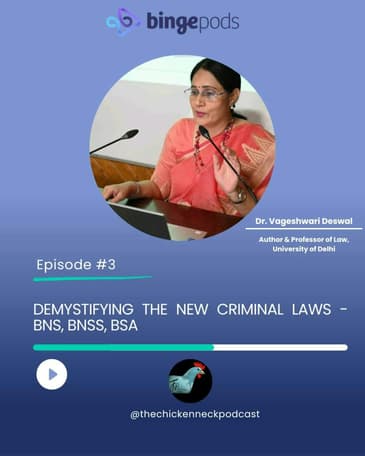

In the 3rd episode of Season 4 on The Chicken-Neck Podcast, we had the honor of hosting Prof. (Dr.) Vageshwari Deswal, a distinguished law professor at the University of Delhi. This episode, titled "Decluttering the New Criminal Laws - BNS, BNSS, BSA," dives deep into the transformative changes in India's criminal justice system brought about by three pivotal legislations: the Bharatiya Nyaya Sanhita, 2023 (BNS), Bharatiya Nagarik Suraksha Sanhita, 2023 (BNSS), and Bharatiya Sakshya Adhiniyam, 2023 (BSA).
Prof. Deswal expertly navigates the shift from the existing laws—IPC, CrPC, and the Indian Evidence Act—to these new statutes, which aim to modernize and simplify legal procedures in India. The discussion sheds light on key aspects such as the enhanced scope of FIRs through electronic communication, the role of forensic evidence in major crimes, and new provisions for the protection of women and vulnerable groups during investigations. Her insights unravel how these reforms are set to redefine criminal jurisprudence and enhance citizens' rights and police accountability in India’s evolving legal landscape.
Tune in to this thought-provoking conversation to gain a clearer understanding of what these new laws mean for India’s justice system and how they aim to address the complexities of crime and investigation in the 21st century.
Disclaimer: The views and opinions expressed in the podcast are those of the individual podcasters. Listener discretion is advised.
Follow us on Twitter, Facebook, Instagram, and LinkedIn. You can listen to our show on all streaming platforms by clicking on the link:- The Chicken-Neck Podcast | Bingepods - Best Indian podcasts
Learn more about your ad choices. Visit megaphone.fm/adchoices
[00:00:00] Hello and welcome to the Chicken-Neck Podcast. Supported by the IDW's network, we are a bunch
[00:00:05] of curious individuals based out of the North East. And we strive to bring you the best of
[00:00:09] policy discussions through their intersection with things that affect your and our daily
[00:00:14] lives. If you like what we do, show your support by sharing our work. Don't forget to leave
[00:00:19] your comments on this episode in our social media handbooks.
[00:00:22] Hello and welcome to another episode of the Chicken-Neck Podcast. Our guest today
[00:00:27] is Professor Dr. Vageshwari Deswal, who is a professor at the Faculty of Law at the University
[00:00:32] of Delhi, where she teaches law with the focus on criminal law and gender justice. Beyond
[00:00:37] the classroom, Professor Deswal is an accomplished author and activist known for her sharp insights
[00:00:42] and dedication to making the world a more just and equal place. Whether it's through
[00:00:47] an academic work, newspaper columns or activism, Dr. Deswal's passion for justice shines
[00:00:52] through in everything she does. She's an established author and her recent publications
[00:00:57] include the in-depth analysis of three major new criminal laws, the Bharatiya Nagarik
[00:01:02] Suraksha Sanhita, the Bharatiya Sakshya Adhanyam as well as the Bharatiya Nyaya Sanhita.
[00:01:07] So as we sought to discuss in an episode the new criminal laws and what they entail
[00:01:12] for the Indian criminal justice system, we thought that it would be really a great
[00:01:16] episode to have ma'am on our podcast and we were really hoping to have this episode and
[00:01:23] welcome to the podcast ma'am. Thank you. So, you know, we have seen your work and we've seen
[00:01:31] that you regularly written on the new criminal laws. So with the advent of the new criminal
[00:01:36] laws, there's been a lot of discussion since even before they came into effect and even
[00:01:40] after they've come into effect, there's a lot of discussion that has been going on
[00:01:44] with regards to the laws. With respect to the new laws, do you think that it'll essentially bring
[00:01:51] about a new comprehensive change in the criminal justice system? And what do you think was the
[00:01:57] idea behind bringing in the new laws and replacing the major criminal laws of the Indian
[00:02:02] criminal justice system? See, the laws that we had gave our own. The IBC was enacted way back
[00:02:10] in the year 1860. Then we got the Indian Evidence Act in the year 1872. The CRPC, which we had
[00:02:19] filed to the Sathya Nandretsu Laksha Centre was a revised version which we had enacted in the
[00:02:26] year 1973 before that the Britishers had given us three versions of CRPC. One was in 1861, then
[00:02:34] 1862 and then there was a uniform, a regular procedure code that they gave us in 1898.
[00:02:41] So you see these three laws, they had outlived their utility. We needed laws that were more
[00:02:48] contentured, more in tune with the times which could deal with the contemporary changing needs
[00:02:55] of the society. And yes, the changes are comprehensive in nature and culture. In Bharatiya Naya Sahita,
[00:03:05] 20 new offenses have been introduced. J-term or fine it has been increased in 168 cases.
[00:03:14] Mandatory minimum punishment has been prescribed in 23 cases and community service has been
[00:03:21] introduced as a new kind of punishment in six kinds of crimes. Coming to Bharatiya Nandretsu
[00:03:27] Laksha Centre, the new section, sub sections or clauses that have been added are 92 enough.
[00:03:35] 17 provisions have been modified, 14 sections have been denoted, audio, video, electronic
[00:03:42] needs are now required and 35 provisions and time lines have been specified at 35 places.
[00:03:50] Coming to Bharatiya Sahitya Abhinayan, there have been 15 insertions in the four sections,
[00:03:57] sub sections, explanations and provisors. They are having 24 body provisions and 10 deletions of
[00:04:04] sections and explanations. So you see the changes were long overdue. See in life,
[00:04:12] as in society in laws, the only constant is change. Laws, they also need to change
[00:04:19] to meet the changing requirements of society. We gained independence in the year 1947 but it
[00:04:27] is took us so long to hire our own bone-grown criminal law to our students. On the basis of
[00:04:34] 41st report of 50th law commission, CRPC was passed in 1973. The 42nd report of law commission
[00:04:44] had recommended overhaul of our criminal laws in 1971 itself but despite that,
[00:04:52] IPC continuance was gone. So although we attempted to constitutionalise our criminal
[00:04:59] procedural law, the substantive law IPC continuance won't form. De-organising our criminal laws
[00:05:08] should have been prioritised immediately after gaining independence but see it took us 76 years
[00:05:16] to do so. It's no time we get amending the laws. IPC was amended 75 times yet there was the need
[00:05:25] to make our laws indigenous, contemporary, progressive and futuristic. So now when we have
[00:05:34] overhauled our criminal justice system and enacted three new criminal laws, it's a welcome.
[00:05:42] Better late than never. So in this regard you've pointed out how the thought process of bringing
[00:05:51] these laws and why the need for these laws were felt and how they've tried to make sure that
[00:05:56] the contemporary issues and contemporary issues that a criminal justice system faces are
[00:06:01] incorporated into the text of the law itself. So can you take us through the process of how
[00:06:06] the government machinery or how the legislative machineries went into finding how to make these
[00:06:13] changes to figure out what needs to be essentially incorporated, what are the things that need to
[00:06:19] be reformed or the entire process behind making these laws because it's interesting that these
[00:06:24] laws have tried to reform the entire system but there has been a long drawn process because
[00:06:30] it's quite a significant change and even for lawyers I think they've been trying to grasp how the
[00:06:36] sections have changed and most books thankfully have a comparative feel of how the new sections are.
[00:06:42] So you know and obviously definitely they'll get more and more refined as they come into
[00:06:47] practice because that's how the law always takes its course. So can you take us through
[00:06:51] the process that went in behind bringing in these reforms?
[00:06:55] Yeah, as I said the reforms were long overdue. So what we did, Criminal Reforms Committee was set up
[00:07:04] that was handed by Professor Ranbir Singh who was the then Vice Chancellor of NLUK.
[00:07:11] It was important to involve legal precarmonitions also although the Department of Legal Affairs
[00:07:17] Ministry of Law and Justice was working full-time in this but there was a committee
[00:07:22] and they were inviting responses from various stakeholders and it took them almost
[00:07:29] four years to finalize the draft of these three legislations and the meantime Vice
[00:07:35] Chancellor has also changed its way and the Ministry also had a couple of changes
[00:07:40] but eventually it was after long deliberations and discussions that a bill was finally introduced
[00:07:48] in August 2023 but then it was seen that there was still a myth that needed to be changed
[00:07:56] so the bill was reintroduced in its revised form in December 2023 and finally passed in December
[00:08:04] itself. So now what we have is the revised and amended version of those bills also in the
[00:08:11] form of Bharati Anya and Surakshya Saintha and Bharati Asad.
[00:08:19] Essentially since it's taken for almost you know on paper it's taken four years but the thought
[00:08:25] process had started quite a few years back and there were several steps that had to be taken
[00:08:29] before bringing in these new laws in terms of implementation because it deals with a system
[00:08:34] or these laws deal with something that is being implemented to realize situations with
[00:08:39] societal developments essentially because the way the criminal justice system functions is
[00:08:45] in connect with society and how the crimes come up or how it deals with them. So you know in terms
[00:08:51] of implementation what are the challenges that might come up with regards to these laws and
[00:08:57] how do you think the new laws are equipped to navigate these challenges and how do you
[00:09:02] think the people the stakeholders who are involved in implementing these laws be it the
[00:09:09] clear idea of how these laws function and as well as the implementing authorities like the
[00:09:14] judicial officers how do you think they'll face challenges and what does the law have to
[00:09:20] encounter these challenges? See Neel we all know that crimes they keep changing
[00:09:26] and we needed these amendments in order to deal with the changing contours of crime.
[00:09:34] I'll give you a small example earlier we did not have instances of data theft so
[00:09:41] that under the Indian Indian code it dealt with only corporeal movable property but over the years
[00:09:49] we had to enact special laws to deal with cases of incorporeal or intangible movable property
[00:09:56] such as electricity intellectual property now Harathya Niyal Saheela it defines movable property
[00:10:05] as property of every description. So you see a simple change in the definitions
[00:10:11] brings about a sea change in the way it is implemented now with a simple change in the
[00:10:16] definition of movable property now what happens all kinds of tangible intangible
[00:10:21] corporeal and incorporeal property that are movable in nature so instances of data theft
[00:10:28] identity theft all these things now they can be covered under a main law we did not necessarily
[00:10:33] refer to the information technology at. Similarly when they talk about definition of the term
[00:10:41] child now the law defines a child as any person below 18 years of age so whether it is a boy
[00:10:48] whether it is a girl whether it is a trans child now everybody is protected earlier IPC did not define
[00:10:55] child we had used the term minor and that was different for boys the age of majority was 18
[00:11:02] for girls it was 16 in life fines then coming to ill-adfine rights in digital age why should the
[00:11:10] waiter or informant have to physically visit the police station to register in alfaya so what
[00:11:17] i'm happy and i'll get surajshasenita which has replaced the CRPC does is it introduces the
[00:11:23] concepts of zero FI on that is ineffective about jurisdiction we can register the FI on at the
[00:11:28] nearest police station similarly registration of the FI are so when there are no physical barriers
[00:11:35] to crime we needed concepts such as the FI are zero FI are so it's not only this there were
[00:11:42] many more reasons to update annuals come on to the implementation it is going to be tough
[00:11:49] no doubt training our police personnel training our prosecutors judges all this is being done
[00:11:57] on a board for the more large field this has been this is already under process we need updated
[00:12:03] technology we have to use for instance all this is an uphill task there are challenges
[00:12:12] galore but let us proceed with a positive mindset and deal with challenges as and when the situation
[00:12:21] demands one important concern is regarding adhering to specified timelines which is extremely tough
[00:12:30] see now we have prescribed timelines for investigations there are prescribed timelines
[00:12:35] for trials as well as pronouncement of judgments and we all know it's just easier said than done
[00:12:42] this is all going to be extremely challenging but at least when we have specified goals let us
[00:12:50] try our best but definitely ma'am as you pointed out there will be challenges but as and when as
[00:12:55] the law evolves and as and when we get more jurisprudence and the higher courts and but they also
[00:13:00] elaborate on these aspects then I think the judiciary will be better equipped to deal with
[00:13:07] these issues and at the same time the other stakeholders the people who are actually
[00:13:11] involved in implementing these laws will also have to be trained and then it will help us
[00:13:17] resolve those challenges coming to the next point of our discussion with regards to
[00:13:23] offenses such as you know terrorism lynching and as you already pointed out the aspect of
[00:13:27] cyber crime how when the previous laws were implemented or when they were brought about
[00:13:32] the entire concept of the entire possibility of a cyber crime never existed it's a modern
[00:13:37] phenomenon that we've had to deal with extensively in recent years so you've already
[00:13:42] pointed out about the cyber crime aspect with but with regards to other major aspects such
[00:13:47] as you know terrorism lynching which has also been a social problem in our country sadly in the last
[00:13:53] few years how does the new criminal law navigate these aspects and how does the new satshi adhanyam
[00:13:59] as well as the nia sanjita and the suraksha sanjita deal with these things procedurally
[00:14:04] as well as in terms of how they approach these crimes or deal with these crimes
[00:14:10] see now we have specific provisions relating to terrorist acts earlier terrorism was no
[00:14:16] defined under the IPC we had a UAPA which is the unlawful activities prevention
[00:14:23] prevention act which dealt with activities of terrorism similarly coming to organized crime
[00:14:29] it was nowhere defined under the IPC we had special state laws so while UAP is a central
[00:14:36] legislation for organized crime we had different state administrations so what about those states
[00:14:42] such as west wind wall which did not have a law to deal with organized crime and then we
[00:14:48] know so many cycles frauds and all these things that are back in a from many such states where
[00:14:54] they did not have a specific law to deal with organized crime so now with a central law in
[00:15:00] place definitely all that with the curve coming to terrorist acts despite having a UAPA
[00:15:06] what was the need to introduce terrorist act as a specific crime under the IPC
[00:15:12] the answer is simple UAP does not have provisions for bail bail is not initially to be granted
[00:15:22] and see what happens it is known as a draconian piece of criticism so although terrorist act is
[00:15:29] also something which provides for a very strict punishment under the VAS but then there is a
[00:15:35] discretion with the senior police officer to decide whether the case would be registered under the
[00:15:40] provisions of PNS or whether the case would be registered under the UA depending upon the gravity
[00:15:47] of the crime as well as the conditions of the criminal ultimately after the investigations
[00:15:54] the senior police officer not below the rank of a supreme manager police could map to eventually
[00:15:59] did the call whether they accused us to be booked under PNS if that is done then maybe he would be
[00:16:05] open to the grant of bail also subject to other conditions and also the general exceptions which
[00:16:12] are available under the BAS they are available in cases of what we call as special statutes
[00:16:18] in a very truncated form so that is one of the logics why we have introduced terrorist
[00:16:24] stat as a specific prime under the BNS then there is organized crime and then coming to more
[00:16:29] approaches silly already had guidelines that were issued in Tahseen Punevala's case although those
[00:16:36] guidelines the context was cow vigilantism but now what we've done we've introduced the concept
[00:16:43] of joint the identity earlier what we would have to do we will have to read such offenses
[00:16:49] along with section 34 or 149 which provided for common intention or common object in the
[00:16:56] terms of child liability but now what we've done if there is if it can be proven that there was a
[00:17:03] group of minimum five so now in order to constitute joint liability cases of more
[00:17:09] of lynchings, honour, killings, hate crimes what is required is minimum five people who
[00:17:15] should be acting as a group in favour of the common object they should be acting in concert
[00:17:20] so when they are all acting together so irrespective of the actual part that is paid by either one
[00:17:26] of them the liability would be the same and each one of them would be equally liable so now this
[00:17:33] saves the prosecution the burden of apportioning the exact gain to each one of the parties when
[00:17:41] there are more than one people involved in execution of a crime so that is the objective
[00:17:47] of introducing always new kinds of crime. Yeah ma'am so as we know that these clarifications
[00:17:52] were really important I would like to proceed by asking you that as we know there are a large
[00:17:58] number of pending cases in India so how do you think the new laws are going to address
[00:18:03] this issue and ensure the speedy delivery of justice do you think there is going to be
[00:18:07] any effect on this issue when it comes to the pendency that is already there the procedural
[00:18:14] laws will definitely be very very useful in trying to ensure that there is no pendency henceforth
[00:18:23] because we have specified timelines for everything all going to be difficult initially but I'm
[00:18:29] sure that slowly we are going to streamline all the processes but come into the pendency which
[00:18:34] is already there the backlog which is already pending so as it is substantive law does not apply
[00:18:40] retrospectively but procedurally law can be applied even to those cases which were already pending
[00:18:47] so it all now depends see that is something again which only the laws cannot correct
[00:18:54] what is required is we need to update our infrastructure we need to bring in more judges
[00:19:00] there is so much of vacancy huge number of vacancies in judicial appointments even our
[00:19:06] full list that is under staff that is under so all this would have to be done in order to
[00:19:12] tackle this large issue or this huge issue of pendency so I think it's more of a
[00:19:19] comprehensive effort of everything not just the not just the legislature or the laws but
[00:19:25] all the three all pins of the society so now my next question is very specific to bnss so since in
[00:19:32] the new bnss the police custody period from the time of arrest which was initially the first 15 days
[00:19:39] has been changed to any 15 days of the detention period so do you think this is going to affect
[00:19:44] the rights of the persons who are detained and also will it give like excessive powers to the
[00:19:50] police what you are talking about is section 187 of the Bharati and Averit Surakshya Senita which was
[00:19:57] the old 167 in the see the provision which relates to Raman so when investigation cannot be
[00:20:05] completed within 24 hours of arrest then the magistrate may authorize detention in such custody
[00:20:12] as magistrate think straight for maximum period of 15 days now this could be done in parts or
[00:20:18] it would be continuous at any time during the initial period of detention now what the law says is
[00:20:27] if the total detention is for a period of 60 days then that 15 days it could be within the
[00:20:33] initial four pages and where the detention could be up to 90 days then that 15 days has to be
[00:20:41] within the initial 60 days so the magistrate may authorize detention beyond 15 days if there are
[00:20:50] adequate grounds for doing so but under section 187 subsection 4 the magistrate shall not authorize
[00:20:59] detention in police custody unless the accused is physically produced before him see not merely
[00:21:06] by video conferencing when it comes to grant in judicial custody the accused may be produced even via
[00:21:13] video conferencing but when it comes to seeking police custody the accused has to be produced
[00:21:20] every time before the magistrate physically so he has to be produced physically every time the
[00:21:27] police seeks extension of detention in custody after 60 days accused is eligible for default
[00:21:33] bail provided he is ready to furnish that bail out in cases where offense is punishable with 10
[00:21:40] years or with life on the deck and default bail eligibility arises only after 90 days as I told
[00:21:49] you in police custody there is this trip of physically production judicial custody even
[00:21:53] where accused is produced through video conferencing that is okay see there were a couple
[00:21:58] of judicial pronouncements regarding this in 1992 there was this case of cdi versus Anupam Kulgarni
[00:22:06] in which it was her head fullest reminders to be planted only in the first 15 days there after in
[00:22:12] 2023 we had a decision cbi versus Vikas Mishra in which supreme court observed that Anupam Kulgarni
[00:22:20] needs to be revisited and in august 2023 in central Balaji's case the supreme court agreed
[00:22:27] with the gas Mishra and referred the question to a large wage but however after an act of
[00:22:33] bns the reference has now been rendered very fractious so you see it is not that the person
[00:22:41] with the apt in custody indefinitely the time is only 15 days I suppose the police is not able to
[00:22:48] complete its investigation for which they use might be required in custody within the initial 15
[00:22:54] days within the initial 40 days or 60 days depending on case to be depending on the gravity of the
[00:23:00] crime with which is an accused is uh uh which an accused is likely to be charged so they
[00:23:08] will seek extension of the detention but then when we are ensuring that he is physically
[00:23:13] reduced before the match is played you see we can rule out the possibility of any kind of
[00:23:18] abuse or torturing us today well mom it's very insightful that you have laid down the
[00:23:24] entire jurisprudence of this with case laws and have addressed the issue but I would still like
[00:23:30] to ask you do you think there is still a chance of the accused being treated unfairly because
[00:23:36] it is not the first 15 days and it could be any of the 15 days see I mean when they talk about
[00:23:44] fairness that is something which is very very subjective the person is accused he is charged
[00:23:51] of a serious offense and he has to be investigated thoroughly see what we can do is we can just
[00:23:58] ensure certain checks are there in place so that the accused is not abused but see accused people
[00:24:05] we don't they've not given any pass to the police the police is not authorized even to
[00:24:10] touch the accused person they can just resort to interrogation and sometimes heart and criminals
[00:24:16] they don't break down they don't reveal the truth and sometimes there are newer facts coming before
[00:24:22] the police went in the force of their investigations so if we were to put such a strict tongue
[00:24:28] line they'll see this is the accused he has been arrested and within the first 15 years you
[00:24:33] have to just somehow complete your investigation this would be extremely difficult the police
[00:24:39] is not dealing with only one case within a jurisdiction there might be multiple cases
[00:24:44] so at the most what we can do is we can ensure that rights of our arrested persons which are
[00:24:49] already there in place which were earlier there in the form of traditional pronouncements
[00:24:54] later on they were introduced piece me in a piece more manner in the CRPC now we have an entire
[00:25:01] jurisprudence dedicated towards crimes of arrested persons we have sufficient checks
[00:25:06] and cases so I don't think that we can violate the constitutional rights of an accused person
[00:25:12] but somehow a balance has to be struck the police also has to be given certain powers
[00:25:18] certain liberties so that they can crack the case ma'am do you also think that the police
[00:25:24] needs to be trained as well and also are there any programs as such which are conducted on
[00:25:30] a regular basis for the police? yes, fortunately the police is undergoing a lot of training now
[00:25:35] I know every day every state every union territory isn't the process of training its
[00:25:41] police people then there are a scope these which have been laid down by the vprd how to train
[00:25:47] them and what is to be followed how are the risks are to be conducted how preliminary inquiries to
[00:25:52] be conducted how are the files to be registered so there are so many checks in places now
[00:25:58] which can have to be adhered to we see the living then information age you can easily
[00:26:03] reward if anything wrong is happening against a person see now that is see we are progressing a lot
[00:26:10] we have made provisions for recording the site of crimes all the investigating procedures they have
[00:26:17] to be recorded they have to be uploaded directly from the scene of the crime so now we are trying
[00:26:24] to usher in a lot of transparency although it will take some time but we are proceeding we
[00:26:29] are taking daily steps at a time but definitely in the third direction thank you so much mom for
[00:26:35] clarifying this and I hope a balance can be maintained further coming to my next question
[00:26:41] as we know that the new laws lack a provision similar to the old section 377 of the IPC
[00:26:47] and how there are changes with regard to adultery laws and the and the age of marital rape
[00:26:53] has been raised to 18 and also the fact that attempting suicide is not a crime for common
[00:27:00] people do you think these changes have a large impact on the society in general especially to
[00:27:06] the vulnerable groups maybe the person is suffering from some sort of a mental distress and such a
[00:27:11] person needs treatment instead of permission now what we've done so this prevention which was
[00:27:17] there earlier in the IPC which was impliedly reviewed by the mental health care act 2017
[00:27:22] it has been reintroduced in a revised form and now attempt to commit suicide is a crime if only
[00:27:30] it is done to obstruct a public servant in the performance office duties so as it is you cannot
[00:27:37] allow people to hold the stage to ransom by threatening suicide in case the state does not
[00:27:43] proceed to their demands now you've raised one very important matter and that is regarding section
[00:27:50] 377 in updates in johar what the supreme court had done it had nearly worked out down the
[00:27:56] provisions relating to homosexuality in the sense that it was only consensual homosexuality
[00:28:01] that was not a crime non-consensual homosexuality continued to be a crime
[00:28:07] now let us talk about the related laws we have poxel which protects our minor children whether
[00:28:15] they are boys girls trans children from any kind of an assault whether that is rape whether that
[00:28:20] is so don't any any kind of a sexual assault coming to girls they are all protected now even again
[00:28:26] so don't me because the definition of rape is so expanded as to include all sorts of
[00:28:31] violations offered in a now the only segment that has been left outside the ambit of protection is
[00:28:39] adult men boys you know the age of 18 years are protected girls irrespective of their age are
[00:28:45] protected but what about men non-consensual homosexuality with 377 totally it's based
[00:28:53] from the statute now what we have to do is we have to look at other related provision
[00:28:57] such as we can refer to provision regarding sexual harassment sexual harassment of men is also
[00:29:03] a crime see under our kharati a nice adita the perpetrator of sexual harassment can only be
[00:29:10] a man the victim could be both a man as well as a woman so where a man harasses another man
[00:29:15] that is a crime compared with that provisions regarding birth simple birth degree or third
[00:29:22] criminal force assault all that could be clubbed in to deal with cases of
[00:29:28] coming to the issue of marital rape now although we have not criminalized marital rape
[00:29:33] but what we've done we've amended the law to align it with the judgment delivered by the supreme
[00:29:39] foreman independent thought forces using of india where in the courts at hill there any
[00:29:44] sort of a distinction between married and unmarried women when it comes to age of
[00:29:48] consent is arbitrary so what we've done we've raised the age of consent to a uniform
[00:29:53] meeting for whether the girl is married or whether she's unmarried but beyond that
[00:29:58] for a girl who's married and who's above 18 years of age then there is no prediction
[00:30:03] against how to and there was another part about the adultery okay now coming to adultery
[00:30:12] adultery was decriminalized and why was it decriminalized because as per section 497
[00:30:20] see the language itself was very problematic because it said when a woman except in with
[00:30:27] the consent or con nivance of her husband so what this means is she conniving itself
[00:30:31] as a very negative term and with the consent of the husband what does that mean see the
[00:30:36] sexuality of the woman has been absolutely monopolized by her husband and if the husband
[00:30:42] agrees she can go around she can have physical intimacy with any other man and it is a problem
[00:30:48] only when she does that without the consent of her husband what about her own consent and her
[00:30:54] own agency when she is above 18 years of age okay the woman does not have the right to
[00:31:00] consent but the husband can do whatever he wants because see what would happen the husband
[00:31:06] would prosecute the other man he could not prosecute his wife not even for not even as a nebeter
[00:31:12] but he would prosecute the adultery well the other man because he had violated his property rights
[00:31:19] in a way because the wife and her sexuality was like the property of the husband now what if
[00:31:25] the adulterer was also method his wife could not prosecute either her husband or the other
[00:31:32] woman with whom her husband was in a consensual relationship okay so now this was something
[00:31:38] which was by native of article 40 more overwhelmingly are talking about adults I mean when there is
[00:31:45] a consent it cannot be a criminal activity and if it is a criminal activity it should be criminal
[00:31:51] for both even adultery is a ground for divorce if you don't want to stay within adulterous
[00:31:56] you can anyway see for divorce there is an exit point provided in such a relationship
[00:32:02] what was the need to criminalize such an so that is why 497 which was already strong now
[00:32:08] where is the thing about it was a shines now what's the term we replaced it from the statute
[00:32:15] so ma'am there's a lot of debate going around the adultery provision people saying that even
[00:32:21] though divorce is an option what about women who are not physically you know independent
[00:32:27] or strong enough to get a divorce see now see what the provision we had was it was about a woman who's
[00:32:35] in an adulterous relationship she chooses to be with another man but she is not economically
[00:32:43] independent and she wants to latch on to her husband to get money from him but she wants to
[00:32:49] be in a relationship with another I mean how do you even defend this kind of a provision
[00:32:54] no what I'm trying to say is the man whose wife does not have a recourse here the women who is in
[00:33:00] a relate suppose a woman is committing adultery with another marriage obviously
[00:33:04] claim maintenance from her husband she needs to divorce him and then claim for maintenance from
[00:33:09] because it is the husband who's at fault in such cases what would be the use of staying in such a
[00:33:15] man but there is also a lot of argument going around that there are a lot of women who do
[00:33:21] not have the agency or do not even or are not even educated enough to go for a divorce I mean
[00:33:27] there are instances where women are so like so uneducated or are unaware of the realities that
[00:33:33] they are in today's age and time you simply cannot justify that just because a woman is not
[00:33:40] independent so she needs to continue in an abusive or an adulterous relationship
[00:33:47] in fact what I would say is we need to provide easier examples in such cases
[00:33:53] and then there has to be the concept of matrimonial property and rather there should
[00:33:57] be more emphasis on educating and empowering our girls children so that they don't have to
[00:34:02] put up with these kind of things so ma'am do you think are there enough programs to educate
[00:34:09] women to let them know that they have this recourse available when their husbands are cheating
[00:34:15] so awareness is something that needs to be spread they have to be told and actually as a
[00:34:20] ground of divorce was already there which was always there you don't think it is any time
[00:34:25] before rocket science it is something which everybody knows that when you are in a committed
[00:34:29] relationship it is wrong to have a relationship out of the body when you are in a regular
[00:34:36] so it is something which everybody has to know how can anybody be so naive in today's day and
[00:34:41] time as to not know that it's not an ambulance to continue with such a stance there is a provision
[00:34:48] accessibility of law is definitely there are several impediments when a woman wants to approach
[00:34:55] the courts so that is something which can be addressed and should be addressed
[00:35:02] just to jump on the whole discussion because of you know because you ended the
[00:35:07] issue with accessibility of law and we see that there are a lot of there's a lot of effort
[00:35:13] through different legislations to the government where they're trying to look into providing legal
[00:35:18] aid of late so where do you put in the whole debate of legal aid especially of let's say
[00:35:24] in situations where it is less accessible can be women in certain cases it can also be
[00:35:29] under trial prisoners in a lot of cases so where do you put in the new law with respect
[00:35:33] to this aspect how well have they been able to address you know gaps that existed in the old
[00:35:39] legislation with respect to legal aid this there and the old law also legal aid is the right of
[00:35:46] the accused person it is the duty of the police officer to inform them about their rights to
[00:35:51] engage your council where they are not able to engage your council a council has to be provided
[00:35:56] at state expense then there is Nalsa there is district state legal services authorities who
[00:36:02] are all working and legal aid is accessible it is the prison authorities also who are now duty bound
[00:36:08] to tell the accused persons the under trials that he has legally you see in law school though so we
[00:36:13] are all running legal aid and we all take our students to these prisons and where they interact
[00:36:19] with under choice and then inform them of their rights and also I mean just to add on to that
[00:36:27] also the constitutional aspect of it which already exists but I just want to quickly move on to from
[00:36:33] that to another very significant part of it which has been quite debatable over the last few months
[00:36:39] that's that's the forensic evidence aspect in which the acts bring in and have essentially given
[00:36:45] more importance to and the argument contrary to it is regarding the fact as to what whether
[00:36:51] the country has enough infrastructure with respect to forensic forensics given the
[00:36:56] importance that it has given and although you know there have been instances in the budget where
[00:37:00] they have talked about forensics but as a somebody who's involved in the criminal you know
[00:37:06] who has taken extensively and has done a lot of work in criminal laws how do you think
[00:37:10] what what do you think or what is your take on how the government is looking at foreign
[00:37:14] six for criminal cases and what is the step forward to other than investment of course to
[00:37:19] include or increase the importance of forensics in a criminal in a criminal
[00:37:25] on k or a lot of importance has been given to inclusion of forensics and criminal justice
[00:37:31] investigations and it is extremely important also if we have to adhere to timelines that we have
[00:37:37] to crack cases within the specified timelines we cannot leave forensics out now the thing is
[00:37:44] despite so much of budget being allocated to these what we are saying in setting up of new
[00:37:50] NFSUs which is national forensic science universities and all that are to be set up in many states now
[00:37:56] across the country and despite there being guidelines that in case there is no forensic
[00:38:02] laughter or no forensic facility in the state we have to notify what would be the concern
[00:38:08] but we have to definitely leverage technology we have to utilize forensics no matter
[00:38:15] again see what is written on paper and what the reality is that is quite different it will
[00:38:22] take time before we make these forensic facilities accessible to all our police also
[00:38:27] it is very easy when it is easier said when we look at these web series and all
[00:38:33] and we see these police officers having these body cameras and having access to all sorts of
[00:38:39] latest technology here it is see our police officers not all of them have smartphones also
[00:38:46] and when we are talking about recording of the of the crying scene they don't even know how to
[00:38:51] record it properly their hands are not stable it would be sometimes vertical sometimes horizontal
[00:38:57] then it did so quality of evidence all that is lost so a lot of training has to go in we need to pump
[00:39:06] in a lot of money so that we can make all the infrastructure accessible to them only then well
[00:39:12] what has been provided in the statutory books transcount to reality it is a long way right I
[00:39:19] mean that's a completely you know because this is in a way I think we are somewhere
[00:39:23] barred between the idea of transforming the legal system but also the necessary infrastructure that
[00:39:28] is necessary for you know to take that next step from that to another aspect is that you know again
[00:39:34] a lot has been discussed considering that this is a completely new no set of set of laws that
[00:39:41] are governing a very serious aspect of our day-to-day lives consider the another acquisition
[00:39:47] that the ones criticizing the new laws make is with respect to the fact that the new laws
[00:39:52] especially gives a lot of power to the police um and especially with respect to F.I.I. and
[00:39:59] cognisable offenses so do you believe that this new law somewhere shifts that power and gives
[00:40:05] excessive you know in our control to the police with respect to that or do you think
[00:40:09] contrary to this idea at all F.I.L has to be mandatorily registered in all possible offenses
[00:40:17] see what the new law talks about is preliminary inquiry which was earlier also there we have
[00:40:24] Anita Kumari guidelines now what the law says is under section 173 of the BNSS or section 3
[00:40:31] it says now preliminary inquiry may be conducted in cases that are punishable with imprisonment
[00:40:37] between 3 to 7 weeks again for that we have SOPs in place the VP Argyl has laid down SOPs it says
[00:40:45] that if the police officer decides to conduct the preliminary inquiry he has to see prior
[00:40:52] approving from a police officer who is not below the rank of DSP within whose jurisdiction the
[00:40:58] crime has taken place and preliminary inquiry is to be conducted only after evaluated the
[00:41:05] nature and gravity of the offense to determine the necessity for such preliminary inquiry further
[00:41:12] preliminary inquiry is also time bomb it has to be conducted and completed within 14 days
[00:41:18] during those 14 days also the police officers they have to document all findings and
[00:41:24] all the evidence that they gather during such preliminary inquiry if a prime of
[00:41:29] a case exists then they proceed with investigation otherwise they close the inquiry to the report
[00:41:35] will be approved by authority and they are also supposed to communicate the findings to date
[00:41:40] of late see where preliminary inquiry does not control within 14 days then they have to
[00:41:46] mandate a really registered an FIA every officer in charge of police station is
[00:41:51] duty bound to maintain a register of preliminary inquiries in the format prescribed by the
[00:41:57] direct the general of police if DSP does not grant permission within 24 hours on receiving a
[00:42:04] request from the officer in charge or even if the DSP denies permission for it for the
[00:42:10] standard of preliminary inquiry then FIA has to be registered immediately where police officer
[00:42:15] does not conclude preliminary inquiry within 14 days then DSP shall show cause the inquiry
[00:42:22] officer and if reply is not satisfactory then departmental actually would be initiated against
[00:42:28] the inquiry officer in every jurisdiction the superintendent of the Mrs. Drekwai to review
[00:42:34] the preliminary inquiry is in this jurisdiction during monthly crime review meetings and take
[00:42:40] corrective measures wherever required now why we need them to bring in this concept of
[00:42:45] preliminary inquiry is see anyone can go and register an FIR it does not necessarily
[00:42:50] need to be the victim anyone can be an informant who's are comes to know about the crime
[00:42:55] and seldom our FIRs based on boss said too many times people they might not be
[00:43:03] exactly sure and it is not necessary that every FIR is a truthful version you register
[00:43:09] an FIR against a person once an FIR has been registered the inquiry has to be taken
[00:43:15] through its logical conclusion you have to conduct the investigation then either FIA
[00:43:20] will report or you have to I mean register a case you have to file a police report in such cases
[00:43:27] so the problem that a person faces when a fake FIA has been registered against such a person
[00:43:33] in order to do away with that preliminary inquiry is a good check in place then at
[00:43:39] the same time there are certain provisions which have been excluded from the ambit of
[00:43:43] preliminary inquiry in which cases there is absolutely no discretion to the police officers
[00:43:48] and they will have to mandatorily register the FIR that is in cases of rape, sexual assault,
[00:43:54] molestation, acid attack in cases of crimes against the SCST community in all these cases
[00:44:00] the police cannot exercise a sterile stitching of registered FIR only after conduct in the
[00:44:08] so it is only in those crimes for which punishment is between three to seven years if it is below
[00:44:14] three years again there is no discretion if it is over three years again you see there is no
[00:44:19] discretion when the facts that disclose the commission of a commissive office for which punishment
[00:44:25] is more than seven years it's a serious crime but it's a situation absolutely without
[00:44:29] its officers they would have to register an FIR so preliminary inquiry is just in the form
[00:44:35] of a check so that unnecessarily people are not harassed you've given a very detailed
[00:44:46] perspective on how the concerns and how the idea for a preliminary inquiry and the modalities with
[00:44:52] respect to the enforcement authorities essentially the police who are dealing with the law and who
[00:44:56] are essentially bringing the law into action you know staying on the lines of your response
[00:45:02] and how you pointed out the fact that the law tries to balance these aspects you know the
[00:45:08] modern trend as we've seen is that the world is moving towards the idea of a very reformative
[00:45:13] concept of justice especially the way people are dealt with crimes are dealt with and so it
[00:45:20] essentially seeks to incorporate more and more humane provisions and you know in a in a bit to
[00:45:25] secure the rights of the innocent and make sure that no innocent person is wrongly punished
[00:45:31] or wrongly bought under the law so and these also tie in with the fact that
[00:45:38] and the discussion that we've had today itself regarding the time period in custody
[00:45:44] as well as a preliminary inquiry these are all layers of that very conversation
[00:45:48] of trying to get into a whole reformative aspect of how justice is administered
[00:45:54] so you know you've already pointed out some very key aspects of that on that note
[00:45:59] with regards to you know time frame for investigations as well as ensuring that the
[00:46:04] bail the way bail is granted or the modalities of how bail is given under these acts and as well
[00:46:11] as the judicial custody or as well as the custody or the time period of custody for the under trials
[00:46:17] how do these laws try to enshrine these principles and you know strike a balance between
[00:46:23] the interests of the criminal justice system or those trying to enforce the system
[00:46:27] as well as the people who are facing the system
[00:46:31] see first let us talk about the reformative aspect of punishment or restorative justice principles
[00:46:39] that have been brought into our criminal justice system by way of introducing community service
[00:46:45] as a kind of punishment see community services are non custodian kind of punishment in which
[00:46:52] you don't put the convict with the hardened criminals so you don't put the convict behind bars
[00:47:00] this is an attempt at re-socializing the convict by making him do some community service
[00:47:07] which helps the community for which he is not being made for which he is not going to be paid
[00:47:13] any money because it's a kind of punishment now this has been prescribed only in very
[00:47:18] guilty offenses and that's only for first time offenders when there is a possibility of
[00:47:24] reform of such person say I'll give you an example suppose there is a woman
[00:47:29] who has children to feed and she has no resources to feed her children so she steals a loaf of
[00:47:35] as per the law she's guilty of theft so would any person have the heart to send this person
[00:47:43] to prison for three years just because she's done that which he was compelled to do because of party
[00:47:50] in such cases what does the law say for head if a person steals and he's a first time thief
[00:47:58] and the value of the property that has been stolen is below 5000 rupees and the accused is
[00:48:04] willing to either restore the property or pay back the loss that was caused due to his active
[00:48:10] stealing then in such cases the accused can be sentenced to community service similarly if a person
[00:48:17] causes misconduct in public after the person is drunk such a person can be asked to do community
[00:48:24] service instead of being put behind bars see there is this lady judge of Delhi airport Justice
[00:48:30] Swain Akanta Shobha who was once I heard her and she was telling that she had gone to the
[00:48:37] school or while this group of our Kanya Sahab you must have seen in Konath place in Delhi
[00:48:41] and she said that there was some boys who were just creating a lot of ruckus outside the Guru
[00:48:47] Dua they were driving their motorcycles at great speed she said my first response was to ask the
[00:48:53] police officers on duty there to arrest them and bring them to color but then she said
[00:48:59] I realized that these are just misguided youth it is not that these boys are out there to
[00:49:06] commit a crime they are there just for the thrill of it because they don't know that what they are
[00:49:11] doing is wrong it could be harmful for them it could be harmful for others also so in such cases
[00:49:18] that the boys they can be asked to perform some community service as a measure of punishment
[00:49:23] for disturbing the peace of society and for indulging in such dangerous act then that
[00:49:28] could convey a better message instead of putting them behind the bars where they could come
[00:49:34] in contact with other ardent criminals and in fact learn a trick or two about how to commit a crime
[00:49:39] so in such cases community services to be introduced so this is an excellent measure
[00:49:45] that has been introduced in our laws so what was the other part of your question me
[00:49:52] it was regarding how you know it ensuring that the innocent people in terms of obviously
[00:49:58] in terms of the procedure the enforcement authorities have to follow certain measures
[00:50:03] and take certain because obviously the entire process of investigating a crime coming to a
[00:50:08] conclusion making sure that the process works in a very efficient way it's a big challenge
[00:50:14] even for those implementing it because again we are dealing with real life problems here
[00:50:19] which are which cannot be just limited to change in the text or change in the wordings of
[00:50:25] love real life challenges are often situations which come up suddenly abruptly and police
[00:50:30] officers have to be equipped to deal with that so you've already dealt with how the idea of
[00:50:35] a reformative justice and these aspects are very important and the example of the Guru Dwarah
[00:50:40] is very interesting because it comes from someone who is a judicial officer at the
[00:50:45] one of the highest levels at the high court especially of a city like state like Delhi
[00:50:51] so the other aspect is that you know how do the interests of the innocent people who might be
[00:50:58] involved in such investigations or who are subject to these processes can be ensured and
[00:51:04] and how can a balance be struck between their interests as well as the efficiency of the
[00:51:10] process and how are aspects like bail you know the timing has to be dealt with in under the
[00:51:15] new laws see the provisions should that I will earlier see our issue did not defend the concept
[00:51:22] of pay now there is a clear definition of the term they know the law also says that there is
[00:51:27] a provision for release on personal okay see there was the sword judging if you've read
[00:51:33] Modi Nam versus state in which Justice Krishna had remarked that when you compel a person to
[00:51:39] pay a huge amount of surety and when you compel a poor person to do that it is a virtual
[00:51:46] genital of pay moreover this was a case which dealt with the case of a migrant labor he did not know
[00:51:54] any person in that particular state so if you're insisting on that person to get a surety from
[00:51:59] that particular state whereas he belonged to some other state then you're insisting on huge
[00:52:04] sums of money to be deposited as a purity now this is all a virtual deny of a grand justice
[00:52:10] Krishna here had remarked that effluents don't be afraid in DJs right so now there is a provision
[00:52:19] for release on personal bonds also because what we need to understand is how we can ensure
[00:52:25] that the person does not commit it is not possible if only we have deterrent punishments
[00:52:33] prescribing a higher punishment for a crime is no guarantee that the kind will not be committed
[00:52:39] what we guarantee non-commission of a crime is the certainty of the punishment it is only
[00:52:45] when the accused knows that you will not be able to evade the long arms of the law and the law
[00:52:50] is going to eventually catch up with you and you will be punished and the punishment would
[00:52:55] be executed in a very fast manner it is that which is going to have a deterrent effect and when we
[00:53:02] talk about those people who are wrongfully part of the net of the crime we have provision of bail
[00:53:08] or jail the rule is they are not jail and the provisions such as personal bonds and all
[00:53:14] now we can ensure that people they are not unnecessarily incarcerated you know thank you
[00:53:21] so much ma'am for pointing out the intricacies of these aspects because again as we started this
[00:53:27] discussion on the same note of how these laws will function in society so various social factors
[00:53:32] and social realities especially in our country need to be taken into account and you really
[00:53:37] dealt with those aspects in throughout the episode we are very well aware that you've written a
[00:53:42] book extensive book on the GEE's new laws and where you also laid down a comparison with
[00:53:47] previous provisions and the evolution of the law can you take us a bit through
[00:53:52] analysis as well through the new book and how it came to be and how you got down to writing it
[00:53:58] see when the bills were introduced in august at that very time i thought we should contact him
[00:54:04] but ma'am we need to do something in this area because i've already written a book for tax
[00:54:09] fund that was in 2013 that was a small book deal with general principles of criminal
[00:54:14] openity so we were thinking of writing a book on criminal laws but when the new criminal laws
[00:54:19] were introduced so now this was the opportunity so we waited for him here let the new criminal laws
[00:54:25] be formally introduced in the parliament then we started the talk so we were already halfway
[00:54:30] through the book where the law was introduced in an amended form so we immediately set on to
[00:54:38] work because the section numbering had changed some new provisions had been introduced and
[00:54:43] there were a couple of changes so we were already halfway through and this is a law which is a
[00:54:48] which is a this is a three book fed on the three new laws and it's a law and practice series
[00:54:54] primarily which came just to practicing law because as it is we have to unlearn the old
[00:55:01] laws the old numbers of the provisions especially and to relearn the new so this is going to
[00:55:09] be a very difficult process and that has by a comparative table actually right so what we've
[00:55:14] done is they analyzed the new provisions the town comparisons with the old provisions what
[00:55:20] are the changes if any leave have been highlighted and what are the judgments if any the old ones
[00:55:25] which can be applicable for the new judgments will happen because they have to see as of now
[00:55:32] there will be judgments from the trial codes and before we get conclusive judgments from
[00:55:36] the I quotes of Supreme Court it would be sometime it would be maybe a year or two before we get some
[00:55:41] new judicial pronouncements to be inserted in the new clause so as it is this is a law these are books
[00:55:48] which deal with the new laws and a comprehensive analysis of the provisions along with comparisons
[00:55:53] with the old laws I think that's very helpful especially because all of us are some in
[00:56:00] somewhere you know other dealing with the law in our daily lives as well as with our background
[00:56:04] in the legal field and on that note thank you so much man for joining us it was a really insightful
[00:56:10] episode we really wanted to discuss the new laws and how you know the way the because a lot of
[00:56:16] conversations have been happening around these laws but the fact that we could get you on more
[00:56:21] of a personal extent extensively on these last two BLR sorry it was really glad we're really
[00:56:28] glad and we hope that we can host you in future episodes as well it has been a pleasure thank you
[00:56:33] god bless if you enjoyed listening to this episode of the chicken neck podcast check out our other
[00:56:38] episodes available across all major streaming platforms and help us grow by spreading the
[00:56:43] word and for more updates do follow us on our social media handles