
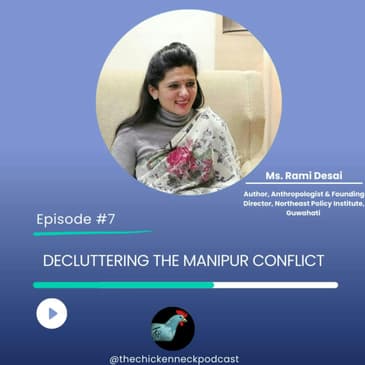
In this thought-provoking episode, we dive deep into the complex socio-political landscape that impacts Manipur - an Indian State, with the renowned scholar, author, and anthropologist, Ms. Rami Desai. With her expertise in ethnic identity, tribal issues, and insurgency, Ms. Desai offers invaluable insights into the recent and ongoing Manipur violence.
Throughout the episode, we explore the historical context that has contributed to the present state of unrest, shedding light on the fault lines that divide the Meiteis and Kukis communities. Ms. Desai through her on-ground experiences expertly navigates the intricacies of tensions, highlighting the apprehensions and grievances of both sides. We examine how these long-standing grievances have fueled violence and perpetuated a cycle of conflict.
Beyond simply analyzing the situation, we also delve into potential measures that can be taken to address the conflict and foster a peaceful resolution. Ms. Desai's scholarly perspective allows us to consider both immediate solutions and long-term approaches that may help heal wounds and build bridges between communities.
Disclaimer: The views and opinions expressed in the podcast are those of the individual podcasters. Listener Discretion is advised.
Follow us on Twitter, Facebook, Instagram, and LinkedIn. You can listen to our show on all streaming platforms by clicking on the link:- https://bingepods.com/podcast/the-chicken-neck-podcast
Learn more about your ad choices. Visit megaphone.fm/adchoices
[00:00:00] Hello and welcome to the Chicken Nuke Podcast.
[00:00:03] Supported by the Idea of Dreams Network, we are a bunch of curious individuals based out
[00:00:07] of the North East.
[00:00:08] And we strive to bring you the best of policy discussions through the intersection with
[00:00:12] things that affect your and our daily lives.
[00:00:15] If you like what we do, show your support by sharing our work.
[00:00:18] Don't forget to leave your comments on this episode in our social media handles.
[00:00:23] Hello and welcome to another episode of the Northeast region and how you got to work and what kind of work you are currently doing in Northeast? Of course. So I was always very, very interested in different civilizations, cultures, history, but also
[00:01:42] conflicts.
[00:01:44] And one of the things that drew me to the North East and here, you know, everybody says, Oh, it's so different. It's a, I mean, how has this happened to us? Because I'm a Gujarati. I was born and brought up in Delhi, you know,
[00:03:05] I had friends from all different communities and it never struck me that anybody was any You know, a lot of the aspects were adjusted to that. I then ended up doing anthropology of religion and that's when I started using those frameworks to study the North East. So when I came back to India, I realized that I didn't want to be an out-of-the-art anthropologist. I didn't want to be an academia, but I wanted to be on the field. And that's where my journey started
[00:04:22] with the North East region 15 years ago.
[00:04:24] I started traveling it, I leaders started understanding, I still won't say I know everything, but it has been 15 years. You know it's very interesting how you point out how you studied these things and this fascination about the Northeast, the very reason that I think all of us started this podcast itself is the one thing that brought you here and how you analyze these things.
[00:05:43] And you know in the build up to this episode just in tribal communities, but in other You know states as well you have different communities who live together and may have certain rivalries. So the same is the case in money poor, but money poor is In my opinion a far more complex state than some of the other states because it has multiple tribes
[00:07:05] So cookies like the Nagas is an umbrella term
[00:08:05] now everybody knows which is amazing about mainstream media is once they pick it up the amount of knowledge that you know to seven eight so it used to never happen when I started
[00:08:09] happening to the North East it never covered the North East now mainstream media is covering
[00:08:13] it and so you know the land issue has always been a bit of a you know bottleneck because
[00:08:22] obviously as we know now that the cookies have rights, we have now been limited to an area that is no longer sufficient for us because populations are growing and if we were to look at it for the next 20 years,
[00:09:40] where are we going to live?
[00:09:42] You know, the population is, you know,
[00:09:44] it's going to become a get-or-like situation. that the government of India has made. So the British segregated the hills and the plains on the basis of the tribes that lived there. So the plains were obviously easily accessible, more urbanized, you know, had more development. A lot of the hills were dominated by tribes that were very, very aggressive, were not
[00:11:00] happy with this sort of British interference. you know, a mainstream consciousness. Also, then they were excluded from what I would consider a sense of nationalism as well. That also affected them. So, we saw a lot of separatist movements come up. We saw a lot of insurgencies come up because there was no contact with these types. Of course, over a period post-independence, over a period of time, that all has subsided.
[00:12:23] You know, maybe not entirely, suggesting to the State Government that the Mates be included in the scheduled trial list. Now let me explain to you what that means. So the High Court or the State Government cannot by themselves
[00:13:41] decide which community should be in a scheduled trial list also. So there is a case of the Lamadas, which are the Bajaras from down south, who by the Indira Gandhi government were deemed a schedule try.
[00:15:01] And people objected to that.
[00:15:04] That case for 20 years has been in the courts. You know, so for me to be able to answer you in terms of exactly what is this conflict about, it's not that simple. It's about historical legacy of rules and regulations. It's about historical rivalry between ethnic communities. It's about land rights.
[00:16:22] And yes, from the Kukhi community end, Manipur hasn't had any registration, but there is settlement of infiltrators. This
[00:17:40] we know not just because of the locals telling us this or knowing this, but also because papers or through people who have published and discussions in news channels. It's very interesting as to how you break down all of these elements. Starting for the fact that of course there's a lot to do with how the geography was divided initially into various and hills and how the lack of resources have a part to play right from the British era to how things are today.
[00:19:01] It only draws me, if I may take the in a research article which said that there's often this idea of the hills
[00:20:22] versus the valleys within the state as well. we want to come to this country, we want to come to the North East region and we want to govern it. No, one of the things was that we see these tribal people and their way of life to us is akin to savages. We need to civilise them and in order to civilise them we have to tame them.
[00:21:45] How do we tame them? tell you this as well, they used to actually take expositions which were like cages across European cities which would be filled with colored people, tribal people and they would ask the public to come and see them. I would uh I would not stop at saying that it was like zoos
[00:23:03] you know where people would come and see animals is something that we have to do until we govern and we control every single community there. This was Mackenzie's like vision, right? But also because they saw that China lay across the border. So for them strategically also it became very important that China is across the border.
[00:24:21] China and you know China and Britain also had their own rivalry in terms of the trade wars, demand for a separate homeland and the slogan of that separate homeland was Nagalim for Christ. Right. So these kind of layers of divisions kept piling over and now I just believe that these kind of identities have become so cemented psychologically that somehow logic doesn't prevail.
[00:26:46] looking at money poor from the lens of conflict. You know, so I think maybe we've taken these divisions too far. I think like you said it's an interesting point both the historical
[00:26:55] aspect and how at the end of the day it is the money poories or it's money poor that gets hurt
[00:27:01] at that and because I think regardless of what right. How does it affect the other community and why has the other community started feeling threatened by this entire process of being you know one other
[00:28:21] community given an S3 status? they decided that they didn't need it. But now they feel that they do actually meet that status because they didn't realize the kind of benefits that were that they were getting from being a part of a scheduled drive and because they have historical foundations as forest drives before, they have the right to claim it.
[00:29:41] Now the cookies say this never happened,
[00:29:44] but, and you know, many, many references.
[00:31:01] One of the important ones is by a famous report
[00:31:05] by Sir Athalstain Baines, So there's also this sense of we are losing our identity as well or we are going to lose the demographic war because infiltration coming in from Myanmar is adding to the population of the cookie community.
[00:32:20] So there's this demographic sort of grievance as well, so I would say for the welfare of the state and the general feeling of equality, the land must be shared by everybody. And of course, you know, we have made him a as a state which is completely scheduled, tried. So, it, you know, it's not as if it hasn't happened before. Money for can be an entirely scheduled right state as well. But of course,
[00:33:43] the cookies feel that that is their land and, you know, the maybes are too advanced and
[00:34:45] That's a very interesting last point you made. I just want to think of it.
[00:34:48] I often hear a lot of news revolving around a lot of communities, even from Assam who
[00:34:54] are recommended by the government to be included with the SC or the ST status.
[00:35:01] If this is a question of, like you said, it's a question of merit.
[00:35:03] I'm not saying that they can be terms of if the way you were working them. But post that, yes, the divisions of seats, the Maitis have more the value at one, but the tribal community is also had. And there also, there's an up and down of, you know, how many seats is, you know, to the cookies have, how many
[00:36:24] seats do the nagas have. So if there and it's natural for people living in close quarters and ancient communities living side by side that there might be some competitiveness. Also ways of life council decides. Now no hill council is jail equal to decide, you know, to mass distribute land to people who want to live in the valley. The other problem is, till there is conflict or insurgent droves or militancy in the valley,
[00:40:06] notice a certain age group of youth missing because after school they'd leave majority of them could leave and if not after school after be it 100% daily and nobody was coming
[00:40:12] back and setting up industry because who would want to come back where you have no life,
[00:40:17] you have no social life, it's written by conflict. A young person would want to come back in
[00:40:22] the last five years, seven years, eight years. I saw that there were restaurants coming up Naga's are not objecting to this inclusion. You know one of the interesting things that he pointed out is that how in a state of peace you know these communities were finally trying to live in harmony but the idea of how the competition for resources for access to more opportunities which has always been a question
[00:41:43] of consideration for Northeastern states has again brought about a conflict which might We all know that they started from an objection to schedule tribe inclusion. Now it has turned the world post to autonomous district councils. Now this doesn't mean that they don't have autonomy. They already have their Hill Autonomous District councils, you know, which are made up bested powers that Hill Councils have because you see, again, like I said, a lot of the tribes have sub-tribes. Kookies also have sub-tribes. It's unnecessary that everybody is on the same page, everybody
[00:44:21] gets along with everybody. This might cause, and this is to Southeast Asia, it is what our active policy hinges on. Also, these are areas that are generally really important in terms of national security, border control, infiltration. You know, all of this has an impact on these areas.
[00:45:42] So, and also the maybes will now and it might take a lot of time but that is the problem.
[00:47:00] If communities don't begin a dialogue, if they don't collectively ask for peace and of the measures that can be taken because there are contentions that even the cookies have when it comes to the administration although they have been rested with certain powers. The ability to maximize those maybe have not been, has not been, you know, has, have not been adequate policy measures to maximize their, the powers that have been rested in
[00:48:20] them.
[00:48:21] So is there a way of sorting this so that future generations can deal with this conflict and
[00:48:26] find a middle path? Look, I don't know, this looks really illegal to me. So, it obviously hasn't gone. These weapons haven't gone in the hands of the law-abiding citizen. It's gone in the hands of the miscreants. So, how do you get these weapons back?
[00:49:40] Of course, we have a great security, maybe a great security spectrum that are working
[00:49:47] in these house. You know, it can be simple, simple things like this and all it requires you to do is take a stat being an alarmist. So why should we not think that this can happen again? So I think civil society will play a great role. Number two, I think it's important for a state that I am not here to demand for the most ideal thing that I can imagine can happen to me. I am here to be able completely isolated. You know, so that is in my opinion not the greatest move because if you come down really happy-handedly as the government, as a defence force, you know, people are already emotional,
[00:55:00] there's already someone of trust deficit, you know, there will be a complete break in They have guns and how the civil society can play a role in identifying the person who is let's say moving with a gun and how any normal person, a law abiding person would the first instinct would be that I wouldn't need a gun at my house, right. Also ponders may are very curiously kind of thought at that point as to how did they get hold of that gun in the first place.
[00:56:21] Because if let's say if it's not a licensed gun somebody has to provide it to them.
[00:56:24] They have been obviously news news about arms and ammunition being looted but that's also And this is from a very neutral perspective that the government isn't really showing any interest in what is happening in Manipur. But I just kind of pondered upon the idea of whether this is something that even there, because is there an idea of trying to deal with this separately?
[00:57:41] Because like you said, one government move might actually be seen as against one community or the other. weaponry that is being carried around. This is obviously not weaponry that average citizen will have access to. So of course some of it has been looted. This is well known. But my point as I made earlier that even when we were dealing with the NSCN crisis or other
[00:59:01] insurgent groups, we saw a lot of the weapons ever put that aside. We have an unstable neighbourhood. In terms of, you know, we have Pakistan on one side, we have China on the other side.
[01:00:20] Bangladesh has its own radical groups to deal with.
[01:00:24] Nannmar has its own radical groups to deal with. have a role in this because Myanmar took out a notice, the Myanmar government took out a notice saying that the government is in a way, there are citizens who are living in India saying that please ensure that it has a lot of repercussions as well. We are a federal structure. We have Supreme Court rulings that have said that you cannot have, government cannot misuse its powers by randomly putting
[01:03:01] President's rule
[01:03:04] in their favor. You know, so it's not that easy.
[01:03:06] One has to reach that point now. from both the communities has about 30,000 people, 20,000 people from both the communities have been given safe passage back to their homes. You know, so things are happening on ground. We might calculate in terms of the violence that we see on a day to day basis, but you know, somehow even media houses don't like to cover the piece that is coming in or
[01:04:23] the work that is being done for rehabilitation. So we tend to see it only with this, populations, sensitive situations, then strategy has to take precedence. And you have to bring normalcy back, you have to let tempers cool down, and you have to allow people some breathing space to even start thinking properly, right? Everybody is thinking from their emotions. You know, so yes, my approach would be a more soft handed approach.
[01:06:48] but also to ensure that everybody who has been displaced feels safe enough to go back to their homes. Nobody should remain, you know, as internally displaced people, that's the saddest thing, you know.
[01:06:55] And I think that would be a really momentous time when communities can with regards to what would be the policy could be the policy framework. I only hope and pray that you know the ones at the helm of affairs also think of that way. But on that note, you know thank you so much for coming to the podcast. I hope our listeners get to learn as much as we did personally from this
[01:08:21] episode. If this has totally been a refresher on understanding the conflict that is taking place