
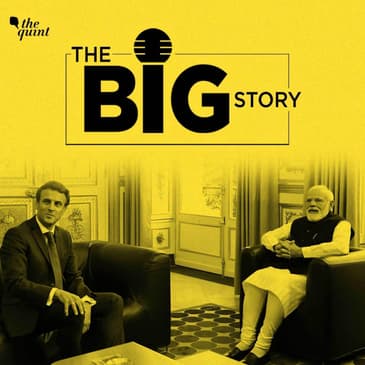
PM Modi’s first port of call was Berlin, where he met the new German Chancellor Olaf Scholz, whose government has decided to make economic sacrifices by reducing its energy dependence on Russia and even changing its decades-old stance on defence spending.
PM Modi then travelled to Copenhagen, where he held the second India-Nordic summit with Denmark, Sweden, Finland, Iceland, and Norway to explore new areas of cooperation. This summit was special because India is the only country other than the US that the Nordic Five engages on such a level.
And on his way back to New Delhi, PM Modi made a stopover in Paris, France, where President Emmanuel Macron was re-elected just 10 days ago. India and France have been strategic partners since 1998 and the talks here focused on the importance of a "free, open and rules-based" Indo-Pacific.
A common texture across the trip was the joint statements in each country, where differences over Ukraine were apparent. In Germany, Modi’s statement said no one will be the "victorious party in this war" and the only way out was through talks.
While India has been in an uncomfortable position since the Russia-Ukraine war began and has continued to not condemn Russia for any of its actions so far, there seems to be a level of comprehension by European countries on India’s stance.
And the flurry of European leaders and delegations to India in the past few weeks, especially the visit of EU President Ursula von der Leyen suggests a changing world order.
In today’s episode, we discuss the main takeaways from PM Modi’s EU trip with our guest Manoj Joshi, a distinguished Fellow at The Observer Research Foundation.
Host and Producer: Himmat Shaligram Editor: Saundarya Talwar
Music: Big Bang Fuzz
Listen to The Big Story podcast on:
Apple: https://apple.co/2AYdLIl Saavn: http://bit.ly/2oix78C Google Podcasts: http://bit.ly/2ntMV7S Spotify: https://spoti.fi/2IyLAUQ Deezer: http://bit.ly/2Vrf5Ng Castbox: http://bit.ly/2VqZ9ur
Learn more about your ad choices. Visit megaphone.fm/adchoices
[00:00:00] In the backdrop of the ongoing Russia-Ukraine conflict, Primus and Narendra Modi wrapped up its first foreign visit of the year to Europe on 5th May with visits to Germany, Denmark and France. PM Modi's first port of call was Berlin, where he met the new German Chancellor Olaf
[00:00:28] Scholz, whose government has decided to make economic sacrifices by reducing its energy dependence on Russia and even changing its decades old stance on defence spending. PM Modi then travelled to Copenhagen, where he held the second India Nordic Summit with
[00:00:40] Denmark, Sweden, Finland, Iceland and Norway to explore new areas of cooperation. This summit was special because India is the only country other than the US that the Nordic Five engage on such a level.
[00:00:51] And on its way back to New Delhi, PM Modi met a stopover in Paris where President Emmanuel Macron was re-elected just 10 days ago. India and France have been strategic partners since 1998 and the talks here focused on the importance of a free, open and rules-based Indo-Pacific.
[00:01:05] A common texture across this trip was seen during the joint statements in each country where differences over Ukraine were apparent. In Germany, PM Modi's statement said that no one would be victorious in this war and the only way out was through talks.
[00:01:18] Though India has been in an uncomfortable position since the start of the Yashya-Ukrain War and has continued to not condemn Russia for any of its actions so far, there seems to be a level of comprehension by European countries on India's stance.
[00:01:30] And the flurry of European leaders and delegations to India in the past few weeks, especially the visit of EU President Ursula von der Leyen, suggests a changing gold order. In today's episode, we discuss the main takeaways from PM Modi's EU trip with our guest Manoj
[00:01:43] Joshi, a distinguished fellow at the Observer Research Foundation. You're tuned in to the Big Story, the podcast where we dissect the headline-making news for you and I'm your host, Imat. As Russia gets more isolated by Western and EU sanctions, Europe has started to
[00:02:07] loom larger than ever before in India's diplomatic strategy. Although India was one of the first countries to establish relations with the EU way back in 1962, the relationship expanded beyond trade and economic relations only in recent decades.
[00:02:20] But over the past few weeks, Europe's intensity of engagement has increased in the wake of the war in Ukraine, where delegations from UK, Poland, Portugal, Luxembourg, Netherlands, Norway, among others, and EU President Ursula von der Leyen visiting India.
[00:02:34] And an important outcome of a visit was the launch of the EU-India Trade and Technology Council, which according to a press release will quote and quote, provide the political steer and necessary structure to operationalize political decisions, coordinate technical work, and report to political level
[00:02:47] to ensure implementation and follow-up in areas that are important. End quote. Manoj Joshi, a distinguished fellow at the Observer Research Foundation, explains that with Europe moving away from Russia and China, India has become a natural partner for EU in the Indo-Pacific.
[00:03:01] Well, you know, one of the important things is that the Ukraine war has upset all the calculations. And initially, the Russians saw the Russians and the Chinese had seen Europe as a major partner, an economic partner after all, you know, Russia supplied
[00:03:23] a vast amount of energy to Europe and has a lot of trade with Europe. Likewise, the Chinese had very ambitious programs. The entire Belt and Road Initiative actually is directed towards Europe. But now with this Ukrainian conflict, what has happened is there's
[00:03:42] a sharp break. And the Russian-European relations are not going to return to normal for a long time already. And we don't know when, you know, if you look at the range of sanctions that are already there, when they would, what time they'll be there. We have no idea.
[00:04:00] Now along with that has come a kind of an estrangement with China. Now that had independent causes also, meaning China and Europe were having problems in 2020-2021 with regard to Xinjiang and the human rights issue. And both sides had sanctioned each other's
[00:04:18] issues, sanctions against each other's officials. And so there were already problems between Europe and China. And now that China is standing four square with Russia on this Ukraine thing, it has deepened the divide between, you know, Europe and China and Russia as a combined.
[00:04:40] So therefore for Europe looking for partners, I think it has become much more important to see India as a potential partner in all this. Of course, the United States remains Europe's principal military and economic partner. Now coming to PM Modi's Euro visits starting
[00:04:59] first with Germany to attend the Sixth Indo-German Intergovernmental Consultations or IGC. Now India and Germany don't have a traditional strategic partnership. The relationship so far is based on trade, investment, technology, functional collaboration, skill development and sustainability. However, the war has changed the dynamics of this relationship. Germany,
[00:05:18] which over the past few years has invested a lot in Russia, has made significant breaks in this relationship with the former Soviet Union from tough sanctions to terminating the Nord Stream 2 gas pipeline and even contemplating banning Russian oil. And PM Modi's visit becomes
[00:05:31] an opportunity for both the countries to deepen their trade relations more. With one of the biggest gains coming from the IGC was in the form of a joint intent to establish a green and sustainable development partnership where Germany is going to finance 10 billion euros
[00:05:44] to fund green projects in India. Moving now to PM Modi's visit to Copenhagen, where he participated in the second India Nordic Summit and held bilateral paintings with all the attending Prime Minister of Finland, Iceland, Denmark, Sweden and Norway. And like Germany,
[00:05:58] India's partnership with Nordic countries is on the same lines of green partnership and investment. However, the undertone of this summit was Russia. While India joined the Nordics and expressing quote unquote, serious concern over the ongoing united crisis in Ukraine,
[00:06:12] India's silence on the issue may have been uncomfortable for Sweden and Finland, who are contemplating joining NATO in the wake of war on their borders. Now trade between Denmark and India has increased over the years from 2.8 billion dollars in
[00:06:23] 2016 to 5 billion dollars in 2021. However, Manojoshi weighs in that though the two sides have signed over nine packs, real action will ground to be difficult to translate given India's bureaucratic threat. The problem with the Europeans is that the problem is that the Europeans
[00:06:42] are well known for their engineering and their high quality products and digital innovation, these Swedes and the Danes and others. The problem is that Indian official culture is that you try to get the thing that the cheapest. So when governments issue tenders etc, they
[00:07:06] encourage what is called L1 meaning the lowest bid and this is where many European companies have a problem because they end up, they are quite straightforward, they put up their products are often high priced but they are quality product. So but the point is you
[00:07:23] have a cheaper competitor from somewhere in Asia, South Korea or Malaysia or somewhere else Vietnam or China then that competitor gains the advantage. So the Europeans find this a bit of a problem and plus of course as I said the bureaucratic red tape in India
[00:07:44] legendary no matter what the government says that red tape is there and it does, it is very frustrating. Many of the European countries are very small, they don't have kind of huge populations, they work with their companies are pretty small also they can't afford
[00:08:03] kind of huge staff etc to deal with all this. Coming to Pm Modi's last leg of the trip, France which stands out from all the other countries which Pm Modi visited given the close decades
[00:08:17] bilateral ties between the two countries. As a joint statement noted their partnership is based on a quote unquote abiding faith in strategic autonomy and a belief in multi-polar world that goes back decades. France has also been a good friend to India over the years standing by India
[00:08:30] since 1998 when India conducted nuclear tests against the criticism of the rest of the international community and given this friendship it is also important to note here that France currently holds the rotating presidency of the EU till the end of June 2022. This is significant for
[00:08:46] India given that free trade agreement talks with the EU have been stalled for more than a decade now. So with France by its side can we expect to see a shift in India-EU relations in the coming months? Manojoshi Wazan
[00:08:58] They can play a role but the point is that the EU bureaucracy in Brussels is the key part. They laid out France and Germany since they are bilaterally much more familiar with India, their companies work here, they are aware of the shortcomings, they're aware of the challenges
[00:09:20] and they definitely can contribute to the whole process in Brussels. But at the end of the day we have to be very clear that it is the European Union bureaucracy which deals with this and the
[00:09:36] European Union functions in a kind of a conventional basis. They try to take everyone along with them when they are formulating various rules on tariffs. As far as they're concerned it's not just tariff only, India would like issues of tariff only but they have other issues
[00:09:58] you know labour conditions, various other kind of conditionalities, climate related technology and all kinds of conditionalities are also there in their trade agreements. But when it comes to defence and security etc they often bilateral processes and there of course we have
[00:10:19] much more depth with France, we have just bought the Raphael aircraft from them, we have had the Scorpion submarine deal with them and France has a sophisticated defence industry
[00:10:35] and they are willing to work with us in a whole range of areas. The Germans are not too much into the defence side and they are also very reluctant to export some of their defence materials. There are other countries also Sweden is there which has a very
[00:10:56] sophisticated defence industry also but as I said with all of them the same issue often comes up is that their products are extremely good but they're also expensive you know and so often dealing with
[00:11:11] them is an issue but that is from the defence trade point of view. From the strategic point of view definitely our closest relationship after the French and the British for example with the French in the Indo-Pacific we have a lot of coordination particularly if you look at the
[00:11:30] southwestern part of the Indian Ocean or the western Indian Ocean where we don't do much with the US but we definitely do more coordination with the French because the French actually have island territories in southwest Indian Ocean you see and the French Navy is very much present
[00:11:49] there so we do more coordination with them and I think if you look at the outcome of the visit you will see that there has been a big discussion on the Indo-Pacific issue. Manoj Yoshi wrote a
[00:12:01] three-part analysis on the significance of PM Modi's three-day visit to Europe and you can find these articles on the Quinn's website. If you like listening to this episode please subscribe to The Big Story for episodic updates. We're available on Apple, Google Podcasts,
[00:12:16] Spotify, Geo7 and most of the other popular podcast streaming platforms. For other podcasts please log on to the Quinn's website and for any feedback please shoot an email to podcastatthequinn.com. Thanks for listening. Log on to the Quinn's website and check out our other podcasts.