
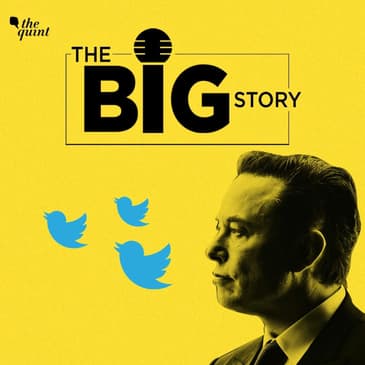
In his statement on Tuesday, 26 April Musk said he wants to "make Twitter better than ever by enhancing the product with new features, making the algorithms open source to increase trust, defeating the spam bots, and authenticating all humans."
The announcement also confirmed many of the details that had already been reported — or tweeted — about the transaction. However, it has also left many unanswered questions, most pertinently— how will a privately held Twitter operate? And is Elon Musk’s idea of “free speech” right for a platform like Twitter ?
Joining us today to discuss all this is Apar Gupta, the Executive Director of the Internet Freedom Foundation.
Host and Producer: Himmat Shaligram Editor: Shorbori Purkayastha
Music: Big Bang Fuzz
Listen to The Big Story podcast on:
Apple: https://apple.co/2AYdLIl Saavn: http://bit.ly/2oix78C Google Podcasts: http://bit.ly/2ntMV7S Spotify: https://spoti.fi/2IyLAUQ Deezer: http://bit.ly/2Vrf5Ng Castbox: http://bit.ly/2VqZ9ur
Learn more about your ad choices. Visit megaphone.fm/adchoices
[00:00:00] Hello and welcome to a live Big Story podcast and I am your host, Himad. In today's live episode, we discussed the biggest headline of the day which is Elon Musk acquiring Twitter. And yes, I am aware of the irony of discussing Twitter on Twitter.
[00:00:31] But only some days ago, Musk was bid to buy Twitter was thought to be a long shot but his offer has now been accepted by the social media platform. The billionaire will now pay a cool $44 billion to take the company private.
[00:00:44] In a statement on Monday, Musk said that he wants to quote-unquote make Twitter better than ever by enhancing the product with new features, making the algorithms open source to increase trust, defeating the spam pods and authenticating all humans.
[00:00:58] The announcement also confirmed many of the details that had already been reported or tweeted about the transaction. But however, it has also left many unanswered questions most pertinently on how will a privately held Twitter operate and is Elon Musk's idea of quote-unquote free speech right for a platform
[00:01:16] like Twitter. Joining us today to discuss all this is Abad Gupta, the Executive Director of the Internet Freedom Foundation. Abad, welcome back to the Big Story podcast. It's always a pleasure speaking with you. Hi, I thank you so much for having me here.
[00:01:29] I put myself on mute earlier. It's okay. So, first I want to get your views on Musk's idea of freedom of speech. He has said that, and I quote, free speech is the bedrock of a functioning democracy
[00:01:43] and Twitter is the judicial town square where matters vital to the future of humanity are debated. So, what do you have to say about this idea of free speech on Twitter? And is this the right thing also for the platform?
[00:01:56] I wouldn't be the best person to comment on whether this is the right step for the platform, but the statement you just read out by itself, it's a little bit incoherent because the understanding of what Musk has about free speech firstly, it's not very well developed.
[00:02:16] He's essentially a business or a product person, he's an engineer. So I don't think so. He understands the full conception of the democratic doctrine of free speech. And I'll just say why. Firstly, he says that taking it private is one of the measures through which he can make
[00:02:33] sure and ensure that free speech remains free in a sense, right? Beyond the precious convolves fleet of our investment. But by itself, it does not change the fundamental character of the entity being a business.
[00:02:48] It basically be lists from a stock exchange and ownership then goes to a single individual. And we have seen in the past that newspapers or outlets which have been owned by individuals
[00:03:00] as opposed to being listed on the fair markets by itself do not promise any higher value of free speech when it's a solution from political. But I want to know what are the ramifications of having such an open no holds bound type of digital town square?
[00:03:18] What there are now big questions also of Trump being invited back or being given back his account as well. So what can one expect of such a platform to be where there is now such a safe space?
[00:03:31] What can be the ramifications of having such an open space now? The ramifications it's done through will be essentially driven by the business model which we need to focus on. Now Mr. Musk is what he is saying whether he will change the fundamental character of
[00:03:45] Twitter, which is at present an ad company, essentially, where it makes sure that people can stay on for longer periods of time and it gathers their preferences how they interact on the platform. And on the basis of which it serves the personality traits or the identification markers or
[00:04:08] the profile of a person to a marketer and that marketer then sends you out. So essentially, that's the core of the business model. Now if you shift away from that business model, there will be certain engineering choices which will be changing.
[00:04:20] So there is a huge difference in the experience of the platform changes by itself and that also then has impacts on pre-speech and expression. For instance, the large degree of misinformation or fake news which is out there quite often
[00:04:36] is also because there is a high degree of emphasis on platforms to ad users. So they may not be organic or real people by itself. They may be just spurring a greater degree of authentic activity or growth or etc.
[00:04:54] And thereby padding up the numbers for advertisers and Francis Jungel's complaints have shown it how this is happening in the Meta platform. Real engagement is substantially lower than actual artificial engagement to bots etc. Now, how is Musk going to approach that issue?
[00:05:10] We have some insight but is that free speech consistent? When he says that he wants to bring a real world identity, etc. which has terrible consequences actually for a larger free speech. Given that certain identity situation will disadvantage vulnerable groups, minorities
[00:05:28] or women who want to speak up on need to. Now I also want to know is it now more worrying that a company like Twitter which has a significant data set of private and public communications and has both companies and governments on the platform
[00:05:46] will now be owned by a private entity of all these data sets going to private hands? I really don't know because essentially you are tying so much to the personality of one individual and what they want to do.
[00:06:01] And they essentially through their public displays have inspired no levels of confidence in a very stable theoretical approach towards free expression. And they seem to be through the public statements approaching this much more from an ideological and mission driven perspective as I was hearing somebody else
[00:06:24] also say this in a recent data interaction rather than a business perspective. So we don't know what will be the platform changes, what will be the business model? What is this free speech? But we do know that changes will be coming.
[00:06:39] The ownership has passed now one thing which can possibly also happen. Things can improve that possibility is there. For instance, Elon Musk has said he wants to publicly release the algorithm which prioritizes speech on Twitter.
[00:07:00] So what you see, why you see it will be open to a greater degree of technical audit, public scrutiny, this is being supported by Jack Dorsey, the former CEO. And this is all good. But at the same point in time, there are some things which are very
[00:07:18] concerning about the founders track record their companies. For instance, they have Tesla has fired an engineer in the past who was doing reviews of the autopilot teachers of the cars. They have a large plant which is in China.
[00:07:38] And you don't know how those business relationships may impact work on Twitter also. You also know that there is a large degree of of commercial development of SpaceX, which is happening all the time. And SpaceX has been a company which has come to define Elon Musk in which
[00:07:58] there have been a large number of failures and experiments which have led to the success of today. Can we afford that same iterative cycle of failure given that the number of people who are on the platform or who rely on it? These are questions.
[00:08:16] And I would say that we will not have clear answers and we will need to come back after a year. I would not like to give any clear answers right now. And I would say what we can have possibly to some extent is
[00:08:32] some sense of change, some sense of some sense of things being contrary to our expectations. And let's see what happens. I would be surprised by anybody saying that A will happen or B will happen and that actually happening after a year.
[00:08:49] I want to know about your thoughts on Elon Musk's track record in terms of promises to his customers as well. He spoke a bit about Tesla as well. But when it comes to those kind of companies like Tesla or even Neuralink,
[00:09:02] which he is an executive at, we have seen some enormous number of delays in the liberties of the technology itself. So does this kind of track record also inspire confidence about his intentions with Twitter of making it open source? And as he says, quote unquote digital towns where
[00:09:19] I don't know what he means by this because a public townscare would require a very different form of an entity to be there for it to be a public townscare. By its very nature, it will be owned by a community rather than owned by an individual.
[00:09:37] So in fact, it being listed at least in theory on the share markets is a much more accountable method given that a company which is listed on the share market does need to follow certain regulatory requirements, which are in terms of investor
[00:09:57] discloses the shareholder accurate information and discloses to shareholders not only with respect to a business, but also to active shareholders who are seeking a board seat for a human's rights expert as has happened in Twitter. And Twitter has refused it. So there's greater degree of control.
[00:10:12] So in a sense, it's not a public townscare. It's basically a billionaire who's saying that you can come and you can play in my amusement park. And I'm not going to charge you for the ticket. Speaking of like the lessons or the failures also, do you think
[00:10:28] Musk is also missing some of the fundamental lessons, lessons which meta or even Twitter went through to become like the safe for the code and go safe in open platform yesterday? Like there are some fundamental lessons or like signals that
[00:10:40] he's missing to see I like there are multiple ways how we can approach this. It can be with a sense of optimism. It can be with a sense of concern, cynicism. My basic sense about all of this is we are investing a lot
[00:10:57] in terms of our hopes, hinging it on the personality, hinging it on the tweets, hinging it on the press interactions of a single person. Are we are we really relying too much on and so individual? And doesn't that put a larger question mark that these platforms,
[00:11:24] whether they may be listed on the share markets, whether they may be owned by a private individual, we are investing too much control of our public media into the power of individuals either for profit or for their ideology. And that's the larger question.
[00:11:39] It shows a larger vacuum, which is there in global public broadcast systems, which are required and could have been built through digital technologies. And I would say that yes, there's a large segment of people who admire and on mass for all the achievements he has
[00:11:57] made, and there's much to admire. But by itself, that should not lead to a degree of hero worship or kind of a reality distortion field in which we do not, we are not able to objectively analyze that Twitter
[00:12:10] is not only a product, Twitter is not only a company, which is actually what Musk is saying, serving a larger wider public function for children such functions by itself originate from much more democratic institutions rather than individuals or purely through profit seeking corporations.
[00:12:29] Well, thank you for the end of my questions also. But thank you so much for coming on the podcast. And for our listeners, that's the end of the show. And if you like listening to this episode, please subscribe to
[00:12:40] the Big Story Home Episodic Updates and also tune in to the Queen's other podcast series as well like It Me Stari Baate, Kise Kahania, Land of a Billion and Urdu Nama. You'll find them on the Queen's website or Apple Podcasts, Google Podcasts, Spotify, GeoSavhan or
[00:12:55] Barabayu List of the Podcasts. If you like listening to this episode, please subscribe to the Big Story for Episodic Updates. We're available on Apple, Google Podcasts, Spotify, GeoSavhan and most of the other popular podcast streaming platforms. For other podcasts, please log on to the
[00:13:11] Queen's website and for any feedback, please shoot an email to podcastatthequinn.com. Thanks for listening. Log on to the Queen's website and check out our other podcasts.