
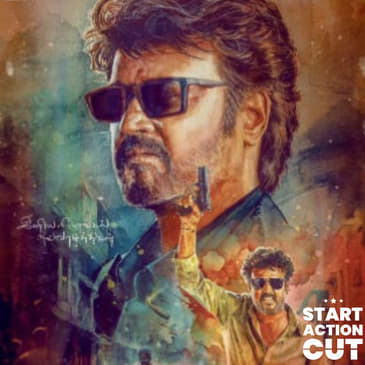

In this episode of Start Action Cut, Swathi and Padmakumar are decoding the Tamil film Vettaiyan directed by TJ Gnanavel and starring Rajinikanth and Amitabh Bachchan in lead roles.
See omnystudio.com/listener for privacy information.
[00:00:12] Hi, today's movie is Vettaiyan starring Rejni Khan and Swati is here so we'll know what she meant in the review. So welcome to Onmanorama Movie Podcast, Start, Action, Cut. Swati could you please explain to us what you actually meant in the review? Whether you liked it or whether you disliked it, what was that?
[00:00:35] Okay, first of all, hi Patma Kumar, thanks for having me. First of all, for me, the movie was slightly confusing as an audience because I was told between whether to enjoy it as the Rejni Khanh star or to the societal aspects that movie talks about. Because for me at least what I felt was that, so this movie is coming from TJ Janavail who did movies like Jaipir. So I thought maybe in this setting he's going to talk about a really important, he is talking about two different
[00:01:05] social issues. But when Rejni Khanh came into the picture, I thought somewhere that his star power weighed the movie down because I think Janavail was probably confused as to whether he should give more focus to Rejni Khanh's star power or to give more importance to the social causes. We've discussed before and you told me that you kind of thought that it was going well together. But for me, I felt like the social causes took a backseat here because somewhere they had to,
[00:01:31] the makers had to strike a balance for what the audience wants. And I guess in that aspect, like I said, it was a bit confusing because there were many scenes where it required a lot of attention. But when the star power and the swag and the mask scenes came into the whole picture, I thought that those scenes, the kind of scenes that the important scenes were sort of weighed down by it. So that is what I sort of felt, Patma Kumar.
[00:01:55] I'm pretty confused by your opinion, because how can viewers say that a mass entertainer cannot have social issues in that film?
[00:02:04] I'm not saying that it should not have a social cause, but I'm saying the star power weighed the movie's social cause down.
[00:02:10] Because you see, this is an entertainer. Since an entertainer movie appeals to masses, more people than a serious movie. So I think the message gets to, I mean, the message spreads over a large mass of people.
[00:02:24] So in that sense, I think it's okay. Since it's Rejni Khan, we can expect swag. Actually, personally, I like the film. I wouldn't say that it's a deep, nerve-wracking film or mind-numbing emotions are there.
[00:02:39] But the thing is, it appeals to so many people, because there are people who would like to get involved in the social causes, who are the social issues which are close to them, which affects their own life, which is connected to their own lives.
[00:02:54] So this film is, the director has tried to make correct mix of the mass appeal, the Rejni factor, a little bit of what I think is the comical elements, which was deftly executed by Fahad Fasil.
[00:03:08] And then the social issues. The film talks about two main social problems. One is encounter killings, which is a social menace.
[00:03:15] There are people who actually demand encounter killings because they find the delayed justice actually making the people, I mean, the people involved, get away with the crime they have committed.
[00:03:28] So that's actually not right. That's what we are shown. In the film itself, the character played by Amitabh Bachchan says that justice delayed is justice denied and also justice hurried is justice buried.
[00:03:42] So that's right. So all these elements are put together in the right mix and you enjoy it and it's engaging throughout the film.
[00:03:49] But I don't know where you and where and why you find this social issue disturbing you in this film.
[00:03:55] You had earlier said that since it's a Rejni movie, these social issues shouldn't have been there.
[00:04:01] So please suggest a topic or a subject or a theme for a film for Rejni Kam.
[00:04:05] I never said these social causes should not have been there. I think you're confusing my point.
[00:04:11] I said like because he was there, either it should happen in a full-fledged movie which should have talked about the social causes a load.
[00:04:18] And why is there a need for a mass scene for this hero? Because he is in the gray area.
[00:04:23] He's not somebody who's in black and white. He's not shown as somebody who's right or wrong.
[00:04:27] Eventually, he does not get punished also.
[00:04:29] So I somehow felt like the movie is going along the lines of the movie Zainagana Mana where the encounter killing part at least was going like that.
[00:04:37] But here, I don't think the Tamil audience, this movie is dominantly made for Tamil audience.
[00:04:41] And I have watched many movies with my Tamil friends. I studied in MCC.
[00:04:45] And when we were watching, this is not what they want out of a Vijayaj Lee Khan movie or a Vijay movie.
[00:04:51] They go into the theatres expecting something really in a mass masala style.
[00:04:55] But that is not the movie's offering.
[00:04:57] But that being said, I never said that he should not have been there in this movie.
[00:05:01] If he was placed in this movie, the mass and the dialogues or something like that should have been extremely cut down.
[00:05:07] It is cut down. It is toned down in this movie to a great extent.
[00:05:10] But even then, it would have been better if the mass element and the swag and all those would have been less.
[00:05:17] And they could have focused more on the social cause because it does talk about two very important social causes like encounter killings.
[00:05:23] How can somebody take somebody else's life without the law getting involved?
[00:05:26] And the dark side of the educational system that drives people, students to their own deaths.
[00:05:31] That is what the movie talks about.
[00:05:32] So when the swag and the other elements come in, don't you think the whole point gets somewhere lost along the lines?
[00:05:38] Yeah, sure. So could you please, you mean to say that these two important issues in society shouldn't have been there in this movie.
[00:05:46] And a person who is going to watch a Rajnikanth film should not expect such social issues in that film.
[00:05:52] Do you want to say that?
[00:05:53] And if so, then again, you missed my point that I had told you earlier that please suggest a theme.
[00:05:59] Yeah, but still, I don't think you are getting my point.
[00:06:02] As you said, maybe if they could have mellowed the swag a bit down, it would have worked well.
[00:06:07] I never said that the social causes should not have been there.
[00:06:09] It should have been there.
[00:06:11] They should have scaled the social issues higher a bit and Rajnikanth's flag down a bit.
[00:06:16] A little bit down.
[00:06:17] Yeah.
[00:06:18] I think in future, makers of Rajnikanth film will take note of that.
[00:06:21] For me, it was the right mix because it kept me hooked, kept me engaged throughout.
[00:06:27] So, in the outset itself, when I see that Nisalaya song in which you see even Anirut, the music director, coming in.
[00:06:34] And you see Manjuwarir and Rajnikanth shaking a leg.
[00:06:37] So, first I wondered why this song at this moment.
[00:06:41] So, then after watching the film, where else they could have placed it?
[00:06:44] Yeah, they could not have placed it any time else or anywhere else.
[00:06:47] Yeah, that is right.
[00:06:49] So, that's how the makers have it.
[00:06:51] They had a hard time, I think, to keep picks, all those things.
[00:06:55] And in between the smatterings of comical gags by Fahad Fahs' character, Patrick.
[00:07:01] So, I also liked it.
[00:07:02] And it moves from the beginning to end in a very interesting and captivating manner.
[00:07:09] And one point I felt why they did so was, you see, the teacher was being targeted.
[00:07:15] I mean, she did something bad for the narcotic contrabands.
[00:07:19] You see, the teacher was being targeted by the drug mafia for informing the police about the drug being horded in the school classrooms.
[00:07:29] And then it deviates from there.
[00:07:31] There is no connection between this incident and the violence that she had to undergo later.
[00:07:38] So, that's one thing.
[00:07:39] But otherwise, it's going smoothly.
[00:07:41] Even that too, actually, that's a good deviation.
[00:07:44] You get a fresh turn in the movie.
[00:07:48] So, in that manner, even the anorhythm musical,
[00:07:50] Hunder Vandar, song that gives you goosebumps.
[00:07:53] Because the first time watchers of Rajni movie will be having a very great time experiencing this film.
[00:08:01] So, that's what I say, Swadi.
[00:08:04] The whole thing was a great Rajni entertainer.
[00:08:07] So, why don't you understand that?
[00:08:09] I do understand that, Madhav.
[00:08:10] What I'm saying is, like I said before, because it talks about these important issues.
[00:08:16] And there's also a predictability factor here.
[00:08:18] Because Rajni is here.
[00:08:20] You know that this is going to happen like this.
[00:08:22] So, in Jan Agarman, if you look at it, Rajni Khan plays a character similar to Suraj Van Jarmur's character.
[00:08:28] But ultimately, he realizes, he repents and he is punished for it.
[00:08:31] But if you look at this movie, is he punished?
[00:08:33] He is going on and taking classes for junior police officers about what is right and what is wrong.
[00:08:38] How does he have the right to talk about such things when he has committed a crime?
[00:08:42] He's killed an innocent person.
[00:08:43] And then he's in charge of taking classes.
[00:08:45] How does that logic work?
[00:08:46] He should have been punished? No.
[00:08:48] So, even in real situation, in society, there are people, activists and politicians,
[00:08:57] who voice about the emancipation of people, society, rules, law and order.
[00:09:06] But things happen in a gradual manner.
[00:09:09] So, even in films, earlier there was a discussion on a film that why a particular actress was being cast in a movie.
[00:09:16] Because the reason they pointed out was it spoke about an issue in society.
[00:09:21] So, at least they are speaking an issue in society.
[00:09:25] This film too, the film is pointing out or highlighting an issue in society.
[00:09:29] Now you are saying that why the swag of Rajni has been blended to that.
[00:09:35] Yeah, that is there.
[00:09:36] But did Jai Bheem not reach that for it?
[00:09:38] Why you are expecting Jai Bheem by the same director, Kharavail?
[00:09:43] No, I'm not saying that he should have done the same thing.
[00:09:46] I'm asking you.
[00:09:47] Jai Bheem did not reach that level.
[00:09:49] It did really well.
[00:09:51] Yes.
[00:09:51] But there could be some minor slight changes or the degree of, I mean,
[00:09:57] how you play up the issues and the mass appeal entertainment factor.
[00:10:02] So, there could be some discrepancies.
[00:10:05] There could be some changes.
[00:10:07] But I don't think you should be punishing a director for being...
[00:10:12] I'm not punishing him at all.
[00:10:13] I'm not punishing him at all.
[00:10:14] I understand his dilemma.
[00:10:16] I understand his dilemma.
[00:10:18] And one thing I had was, you had earlier pointed out that the character of Dushara Vijayan,
[00:10:24] the teacher, the sexual violence she had to undergo,
[00:10:27] that was being often repeated in the movie.
[00:10:30] And you said that...
[00:10:33] It was extremely repeated.
[00:10:33] Yeah.
[00:10:34] So, I agree to that point.
[00:10:35] Because once it's part of a movie,
[00:10:38] you need not repeatedly show the same thing to talk about the issue.
[00:10:43] But in no way highlighted the mass appeal or the entertainment factor of the star power of this character.
[00:10:52] No, I completely disagree with that one moment.
[00:10:55] I completely disagree.
[00:10:56] Because I'll tell you why.
[00:10:58] But first, I think let me bring a woman's perspective into this.
[00:11:01] First of all, that scene was extremely difficult for me to watch on screen.
[00:11:05] It was so...
[00:11:06] It's extremely difficult for anybody to watch that scene.
[00:11:09] Okay.
[00:11:10] Yeah.
[00:11:10] That is there.
[00:11:11] But for me, it was firstly very traumatizing.
[00:11:15] And then again, they're playing it again and again and again to create a sense of that dread in us that this should not have happened.
[00:11:22] So, what does the hero do?
[00:11:25] He catches the culprit.
[00:11:26] He kills them.
[00:11:26] And then we'll be like clapping our hands.
[00:11:28] But what is the need for him to go there and put on his sunglasses and say some mass dialogue?
[00:11:33] Was that the purpose behind the whole rape scene?
[00:11:35] So that the hero can go and say some mass dialogue?
[00:11:37] No.
[00:11:38] A woman was completely violated.
[00:11:39] The most inhuman thing happened to her.
[00:11:42] And then this hero is like...
[00:11:44] He's saying some mass dialogue and putting on that dark sunglasses there.
[00:11:49] I don't know what that scene meant.
[00:11:50] For me, that was extremely insensitive.
[00:11:53] Okay.
[00:11:53] So, I know that point.
[00:11:55] So, I agree with you.
[00:11:57] If I don't remember the scene where he went there and putting on the sunglasses and then saying the mass dialogues.
[00:12:05] But whether he's actually...
[00:12:07] I mean, maybe he was trying to use his power to quell all, I mean, such criminal intentions.
[00:12:16] Maybe.
[00:12:16] I don't know.
[00:12:17] Yeah, that is there.
[00:12:18] But somebody actually close to him has died.
[00:12:21] This horrible thing happened to somebody he knew.
[00:12:23] And then still he's acting like, you know, acting like that means...
[00:12:26] I think it defeats the purpose.
[00:12:28] Okay.
[00:12:29] You won the point there.
[00:12:30] Okay, fine.
[00:12:31] Thank you.
[00:12:32] Then another thing that...
[00:12:34] One more aspect that I found.
[00:12:36] It's not a flaw, but actually maybe their cinematic element there.
[00:12:41] Like the character of Gunnar played by Asal Kolar.
[00:12:45] And he did a very great joke.
[00:12:46] But the thing is that never once we were shown him denying the crime that was being imposed on him.
[00:12:57] So, was it to make us hook to the whole investigation?
[00:13:02] I don't know.
[00:13:03] So, whether it's a flaw or whatever it is, that I found it's a cinematic flaw.
[00:13:09] Maybe it's a directorial miss or maybe they were intentionally making it so.
[00:13:15] That's one thing.
[00:13:15] Otherwise, it's a great watch.
[00:13:18] I mean, it's an engaging watch.
[00:13:19] Not a great...
[00:13:20] I wouldn't call it a great movie.
[00:13:21] I know.
[00:13:21] Engaging watch.
[00:13:22] Yeah.
[00:13:23] Yeah.
[00:13:24] So, you agree to that?
[00:13:25] Engaging watch.
[00:13:26] That part, I agree.
[00:13:27] Like, you'll actually finish the whole movie.
[00:13:29] I wouldn't say you'd run away before that.
[00:13:31] Okay.
[00:13:32] Fine.
[00:13:32] Now, I know the whole movie, you didn't like it thoroughly.
[00:13:36] There are elements which you like too.
[00:13:38] Would you please explain them?
[00:13:40] Yes.
[00:13:40] So, first of all, I like the fact that there were so many A-listers in the movie.
[00:13:45] I think to watch them all together on screen, like Amitabh Bachchan, there is Fasil, Lachnikan, Manjuwari, there is Rana Dagwati.
[00:13:53] So many people coming together.
[00:13:54] And I think all of them had a chance to do something different.
[00:13:56] I don't think we've seen Manjuwari do a dance number like that.
[00:14:00] I don't think we've seen Fahad in such a...
[00:14:03] We've seen him doing quirky roles, but this was something completely, a little bit more lighter and a fun version of him.
[00:14:11] And Rajni doing...
[00:14:12] This Paulist character was unlike the character that he's played before.
[00:14:15] But Amitabh's character, I think we've seen him play similar roles before, like in the movie Pink.
[00:14:19] But his presence was actually needed here.
[00:14:22] Yeah, because he's the covering force and in all the senses possible, because here you're shown a policeman who's taking law into his own hands.
[00:14:31] You'd actually cheer for him.
[00:14:32] You would want him to do that because you actually want the culprits to get punished.
[00:14:36] That is how us as normal citizens of the country would function.
[00:14:41] But he's there to question those.
[00:14:43] He's there to ask questions as to how can you do that?
[00:14:46] How can you take law into your own hands?
[00:14:48] Are there no moral or moral values behind this?
[00:14:52] Or how can you do that?
[00:14:53] So he's the representation of that.
[00:14:55] And that he played really nicely.
[00:14:57] That I liked about the movie.
[00:14:59] And also the music and the background score also really worked with the whole Rajni Kanswak.
[00:15:05] So I think Anirudh really did great work with the song Manasalaya.
[00:15:09] Because even before it was released, it was such a great hit.
[00:15:11] And like you mentioned before, there was no other space that you could actually put this song.
[00:15:16] The only lighter parts came in the beginning.
[00:15:18] So they placed the song there.
[00:15:20] So yeah, that was really engaging and fun.
[00:15:22] You can actually vibe to it.
[00:15:23] Even now, I still have that from my playlist.
[00:15:26] Yes.
[00:15:27] One thing you had mentioned earlier about Fahad Fasil playing the role.
[00:15:30] You said that.
[00:15:31] In that sense, I would actually give kudos to Fahad Fasil accepting such a role which was playing.
[00:15:40] And anybody else could have done.
[00:15:41] So that's a great thing about Fahad Fasil.
[00:15:44] And another aspect that I found a bit as a flow, not actually a flow, is the fact that aging of Rajni Khan seemed to creep in.
[00:15:55] Because we hang on to the mass appeal of Rajni or the Rajni factor.
[00:16:01] Just because of the legacy he had established.
[00:16:04] It were anyone else you've seen in which he was dragging a person like a powering figure like Rana the Gubati from his office.
[00:16:13] You see that?
[00:16:14] You feel that he was clinging and hanging on to his collar.
[00:16:17] Yeah.
[00:16:18] Yeah, and I thought so.
[00:16:20] Yes.
[00:16:20] So I think next time onwards, as you said, Rajni would be taking care of, I mean, trimming down that mass, I mean, superpower or superhero sort of vibe around him.
[00:16:34] Vettayan, I think overall he's an engaging entertainer with bits of messages, philosophies, social issues, and a few gags executed by Fahad Fasil playing the character of Patrick.
[00:16:48] And we see a lot of Malayalam actors in this movie like Sabu Moon, Manju Varrier, other than Fahad Fasil.
[00:16:57] So that brings us to the end of this episode.
[00:17:00] Thanks for listening to Start Action Cut, produced and hosted by me, Pat Mogumar.
[00:17:05] Follow www.onmanorama.com for more podcasts on movies.
[00:17:09] And be sure to come back for the next episode of Start Action Cut out on Mondays.
[00:17:13] Thank you.
[00:17:18] Thank you.
[00:17:18] Thank you.
[00:17:19] Thank you.