
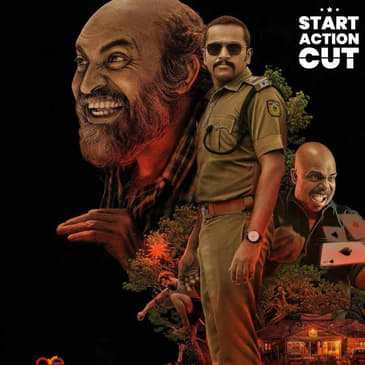

In this episode of Start Action Cut, Swathi, Aswin and Padmakumar are decoding Malayalam film Praavinkoodu Shappu written and directed by Sreeraj Sreenivasan and starring Basil Joseph, Chemban Vinod Jose, Soubin Shahir, Chandini Sreedharan in lead roles.
See omnystudio.com/listener for privacy information.
[00:00:11] Hello and welcome to Onmanorama Movie Podcast, Start, Action, Cut. Today we are decoding the film Praavinkoodu Shappu written and directed by Shri Raj Srinivasan and starring Basil Joseph, Chamban Vinod Joss, Saubin Shah, Chandni Shritaran in lead roles. Today we have Swati and Ashwin to discuss the film.
[00:00:32] In fact, I find this an engaging watch giving you no room to feel any lag. It's a crime thriller centered around a death or murder that happens in a toady shop. But there are things that stand in the way to enjoy it completely. I agree. But I think it's a great storyline, a fantastic and promising lineup of actors. But something has gone amiss.
[00:01:01] What I feel is the trivialization of areas which should have been treated with certain seriousness, some cringy comical interludes and dialogues are the reasons for it. What do you think, Ashwin? Yeah, Patmukumar, for me the title was really intriguing. And then the opening scene. So what we hear is some gentle cooing of dhavs, a classic Malayalam song being played out.
[00:01:28] And then what we see is really shocking. Two human legs slowly rising upward, starts flailing like the fluttering wings, and then it turns still. So I think that set the tone of the film. That kind of sets the objective the director wants in his narrative. Because he wants to append all those lovely tenderness associated with characters in a village, or for that matter, in a place called toddy shop.
[00:01:56] Because outside the toddy shop, we see vast expanse of barren landscape, devoid of any greenery. I thought it meant devoid of any sign of warmth, affection or companionship. Because these characters are twisted. These characters are dorky. They have absolutely nothing for each other, standing around a corpse or a dead body.
[00:02:19] They would still feel like finishing that last bottle of toddy, or joke about why this person is not wearing his undergarment, things like that. So the way with which he completely went around the narrative, trying to establish a new way of storytelling, that struck me. The introduction of scenes and situations are, I think, spectacular. It gives, for me, it gives a hint of what is about to play out.
[00:02:47] But ultimately, it reaches nowhere near our imagination about the rest of the trail. Brilliance, in terms of making a movie, is when it soars above your imagination, soars above what you imagine. So, but here, I think, it's way below it. How was it for you? Well, for me, Patma Kumar, it was definitely an enjoyable watch. There were many parts of the film that I genuinely enjoyed, though there were also moments, like you said, that didn't work for me.
[00:03:15] What I liked about the movie was how the makers managed to bring a proper detective-style protagonist, much like Sherlock Holmes, to the story. Baseless introduces a very quirky police inspector who's sharp and analytical, dissecting crime scenes like a detective. But he is far from being the great Holmes. He is little pompous, constantly seeking praise, and undeniably full of himself.
[00:03:40] Whereas Saubin's character, Kannan, he plays a crippled man who seems weighed down by how unfair the world is to people like him. He keeps voicing his frustration, saying how everyone treats people like him in the most unjust way. And when this murder happens, it's not in a grand fancy, it's not like the other murder mystery that I've seen, maybe in Hollywood movies. It doesn't happen in a fancy house or a mansion. It happens inside a toddy shop.
[00:04:06] And the makers, everything, have beautifully crafted the setting, building a row, an intriguing premise that draws you in. And in that aspect, movie, I think it really drew me in. But like you said, there were many points that quite did not match for me also. Because we've seen Basil play this quirky person again and again so many times that I think he might just get typecast as one. Because there's nothing new for him to play. We've seen him play roles with a little bit of a grey shade.
[00:04:35] And that's always been the case, I think, in the last, in the recent past. So I think that was another off-putting element. And I think they could have done so much more with this content or the script that they had. But nevertheless, it was quite enjoyable for me. I agree with what you said about Basil Joseph. But before going there, I would like to point out Sobin Shahir as Kannan. He shines above all in terms of performance.
[00:05:02] I think he's a stunner in this film. And his physical transformation part, he produces some brilliant moments which are really mesmerizing for me. Now, talking about Basil Joseph, he's actually a study material, I think. Because he defies all the criteria which defines the conventional hero. Yet he is very popular among Malayali audience and is considered as a safe bet by producers.
[00:05:31] And I think it's because he represents the common, ordinary people. Or is it because he successfully balances tomfoolery and subtlety or blends comedy and the profundity of life, the way Dilip once did in a series of movies during his prime? I think he's trying to fill the gap. I mean, the Malayali film audience is trying to accept him as a replacement of Dilip.
[00:05:59] You can see that the towering figures of Chamban Vinod and Shivajit, who played Kamban Babu or Shabarish Verma in the film, they are actually dwarfed by the diminutive Basil Joseph. So, what do you think about the actor? I mean, in general and about Basil in particular, the lead actor in this film?
[00:06:22] See, Patmama, before I get to the actor part, I would like to share my views about why these characters actually didn't work for me. For me, there were major character inconsistencies with regard to Kannan played by Saubin Shahir. For me, we can't get into details because we may be spoiling the narrative, but still, within the restraint, I will try to explain why I felt so. Here, there are a lot of women characters here. There are two women characters here.
[00:06:51] But these women characters, the sole purpose, I felt, was to carry the baggage, the insecurities, the inferiorities of the men, their male partners. That's the sole purpose. And even when one of the characters, one of the male characters feels wronged, although the cause, the grief resulting from the cause is as much shared by the woman as by Saubin Shahir's character, she is still being used as a ploy.
[00:07:18] The revenge happens at the cost of her honour, her dignity, and this is not explained properly. I mean, this didn't work for me. For a man of masterly intelligence, a brilliance as he's shown in this film, he lacks the tenderness. That's what I said. This film is mostly about twisted characters, just like the barren landscape. All those minute traits of tenderness warmth have been dried up, have been sucked out of them.
[00:07:45] So, when they feel wronged, when they feel that they are treated badly, they will go to any extent. Betraying their best friend, betraying, I wouldn't use the word betrayal, but using your loved partner to avenge your cause, no matter how grave it was, the path he chose to do so didn't work for me at all. Because by the end, we as audience, we would know what happened.
[00:08:14] But imagining the narrative, all those people around would still blemish her, would still treat her with contempt. So, what kind of a man would do that to a woman whom he loves? So, once I felt so, I never fell for the character, I never fell for the cause he was propagating. The same happens with another woman. She herself says in one scene, I fell for the emotional tragedy that happened in my male partner's life.
[00:08:41] And having done so, the male partner, what does he do? He has no qualms complaining about her or spreading lies about his friend's wife or even about his friend. So, this is what, there is a relentlessly downbeat worldview which kind of bogs down the narrative of this film. Yeah, I agree. I don't say that the film, the storyline is flawless. But the part, the revenge part, what you said was, I think they both together went about committing the crime.
[00:09:11] The plan was they're both. So, I don't think it was just the Cunnan characters. Yeah, that's what I said. The film brings in the magic element and that's where the art of deception. Art of deception is all about manipulation, misdirection and he was even manipulating the wife, the woman he loves the most or he claims to love the most in his life. So, the true magician is actually the Cunnan played by Saabian Shahir, but he's also cunningly deceptive. He is the evil in this film for me.
[00:09:41] So, one thing the director chose to do in this film is that mostly in these films when a murder happens in a closed space, we have so many characters, there are so many suspects. We go about unearthing who the person got killed was, what was his past, what happened to him earlier, how he was with others.
[00:10:01] But here, he takes the other way around. It's about the people who may have committed the crime, the man who may have committed the crime, even about the investigator who arrives at the village with his motive. So, all those things worked well, but for me, to empathize with this character, his slyness was a real barrier. As to the plot, I think what just Ashwin said about the scheming, the chief schemer of things here is Cunnan.
[00:10:28] We find that they both were avenging a crime which was meted out to them. So, in terms of enjoying the narrative, I think these things are actually shown in most of the movies. There is no distinction, clear distinction between a hero, I mean benevolent lead, a protagonist in the film or a spiteful avenger or criminal. So, what do you say about the characters and the whole narrative?
[00:10:57] Well, I think, Patma Kumar, I don't think, at least this is my opinion, I don't think there is one lead or one main protagonist in this movie. Because like Ashwin said, all of them are twisted people with their own flaws and I think that is the essence. We are all flawed as humans and I don't think you need to empathize with Cunnan because, like he said, he is not a perfect man. He might be deceptive, he might be manipulative, but he has his reason to do what he did.
[00:11:22] So, how he does it, how he uses the one thing that is in his power, that is magic, to go about with the crime, I think that shows how much a person can push something or push somebody when he is cornered by something. And I don't think we need to empathize him on that matter because towards the end, how things unfold, you see another murder happening, which is in a totally different light. The circumstances are different, but that is how it is, right?
[00:11:48] Sometimes when certain things happen, even though you might be responsible for it, the factors or the way it happens, it is not just in your control. So, maybe it can happen to any one of us, but that doesn't put us in a right or wrong category, right? Because we are people who will always stay in grey area. Like if you take Cunnan or Basil, Santosh and even Chandni's character, Merinda, all of them have their own struggles, their own stories.
[00:12:17] And I don't think we need to see them as, you know, good or bad people because each of them have their own agenda. Like Basil has his own motive to come to this village. Kanan has a motive to do what he did. And even Semban, we know what he contributes. He needs to find what went down or how things unfolded. And I think in that way, if you look at it, I personally did not feel like I need to empathize with anybody because you're just watching this movie behind a curtain and you're just taking a sneak peek at them,
[00:12:46] understanding what they're going through. That is it. And in that way, I think the movie was convincing enough. But like also one of the point that you mentioned before, like Basil, you know, defying all the conventional standards, you know, ways of being a proper hero. I think that is why that is because he looks like us. He looks like a very ordinary person. But that being said, like I mentioned before, he's been doing it for a while now.
[00:13:12] And I think we know what he can do. But the comparison with Dilip, anything in one of his interviews, he said he does not want to be compared to Dilip because he wants to create his own identity. But I've never found a similarity between him and Dilip because at least in my opinion, if he's put in a completely different role, a completely different character, we don't know how he'll play that out. In this particular mold of a character, he fits in well. So I think in the future, maybe when he does different roles, then we can tell if he's a really versatile actor or not.
[00:13:41] Yes. Asriyad's, Kannan's character, why I liked Kannan is because, don't you think he was playing different shades of, I mean, he was actually showing different traits inside him. Is it not real? I mean, the person. See, Pat Mahumar, I agree to what you are saying, like he was showing different shades, but I really never go to understand the depth of this character. For a man as ingenious as he claims to be in this film, we would have been gratified had we been told
[00:14:07] how he ended up serving liquor, I mean serving Toddy in a Ramchapel kind of shop. Yeah. How we ended up with such a pathetic, bitious life in a rural hamlet. And also one point of disagreement I had with the story was that we are told that this investigator who comes to this village is extremely brilliant. He has an eye for detail. He catches the minutest of hints and he just builds on them.
[00:14:33] So how on earth could he miss out evident hints being given by the other character played by Saw bin Shahid during that investigation? He was letting it slip. It wasn't over-confidence. I mean, at one point, yes, this character really plays out like a true vulnerable human being falling prey to the lure of a woman, falling prey to the frustration, the inability to rise to the expectations being piled up on him. All that is agreed. But he wasn't paying attention to what he was trying to say, the other man.
[00:15:02] He was reading him like a book. But how could he miss that? How could he let him go? And then finally you come up with a past, a story in which his sense of manipulation is trying to be amassed in some kind of a true cause of revenge or something. That never worked for me. I agree with you Ashwin. But I feel, I didn't say that this is a very great movie, thrilling, I mean flawless movie. What I find is everything, the introduction of everything has been
[00:15:31] very perfect. I mean the storyline, what they intended was perfect, but they couldn't execute, I mean to the fullest, with the artistic brilliance which they could have shown very brilliantly, the, I mean vengeance or the depths to which, I mean actually the characters were underdeveloped, most of them. So that is the thing. But if you can read the story and the underlying, I mean the undercurrent of the main plot.
[00:16:00] And as regards, I also agree that Basil Joseph's character, Sandosh, he couldn't read what, who the, I mean the hints that were being given out by the culprits. And actually coming to Basil Joseph, I think he was not becoming the character. Actually the character was becoming Basil Joseph. But there were some subtle humour in this film in which
[00:16:26] actually drowned by the, by the cringy elements that was, I mean littered all over the place. So, some things like Chandni Sridharan's character, Merinda, spelling her name, Merinda, May Merinda. So, those tiny things were there, but you have to identify the conversation in the toddy shop. A few of them were good, but by the time you start enjoying those tiny little humorous elements,
[00:16:55] you hit upon sore thumbs in the, in the episodes. So, some of the flaws that stood out, glaring for me, that one thing is that the schemer of things, Kannan, he should have never disclosed that he was a magician. That's a great, big hint to the police. So, being a, I mean such a wise person, he would have never given out that.
[00:17:20] Another scene which I found confusing was why Kannan was being trashed in his house by Babu. What was the reason? Do you have any idea what, what was the reason? Again, to get into those details would be like giving away too much. Okay. But I didn't... Yeah, I thought that reason was convincingly told. Really? Yeah. Because he was privy to a very close secret, very deeply guarded secret of that toddy shop owner. But...
[00:17:49] Toddy shop owner must have felt that he would actually... But he had let him go at that moment. You mean that he was a witness to something that... Yeah, he was witness to something. But at that point he was... But he had seen... Yeah, but then there was the scene where he was almost to confide. Babu sees that. Okay. That was the reason. Yeah. But still, to that level, that point, I don't know. And that particular scene was shown at least twice.
[00:18:16] Okay. Now, some contradictory scenes like... If she was faking a victim, the female character in the film, why she fainted at one point when she was there? I mean, there is a scene in which she faints for no reason. See, that's where I always felt the director became the magician in this film. A magician who actually overdid his tricks. Because there were many scenes and inserts which were totally unnecessary to actually telling the story. But he still did so.
[00:18:45] At the end of the story, we were kind of dumbfounded. Yeah. And also some unnecessary comical gags or conversation like... Merinda asking whether the revolver can actually fire. And also many of the crude one-liners were actually lost on us. Yes. And also there was some dark humor which were actually unwarnt. I thought there was this overriding keenness to be nonchalant, to be deliberately irreverent, which kind of affected the storytelling.
[00:19:13] I think dark humor is a genre which should be treated very carefully because here, I think that is where the movie falters. They tried to mix dark humor with an investigation and that sort of did not go together. And I think dark humor is one of the main themes of this movie. And they used it too much. That I agree. But the thing is, the placement of the lines or where they use it, that is when... You know, it felt kind of odd.
[00:19:43] Because there is this one particular scene where Kanan is getting thrashed in the police station. And Basil sorts of jumps into the scene. And there, he kind of tells a very random thing. It's supposed to come off as comical, but you'd be like... Okay, they're trying to... As if they're trying to, you know, downplay the situation. And that happens during many scenes. And another thing... See, there are two or three very big stars in this movie.
[00:20:09] So, you know that by the posters or the trailer that one of them has to do with something. And that is already established. Now, you know that these are the actors. If the movie would have, you know, done something else with the climax, then it would have been interesting. But since you know that this is going to happen, that sort of takes away the curious element or the suspense element of the movie. Because it's just that... Now, for example, this main character is there. It's just...
[00:20:39] The movie is just showing how you're reaching to that character. Because I think if they've done... Like I said, if they've done... Would have done something else with the plot or... Or even a much more convincing reason, it would have had that impact they intended. I think that's where it sort of falls apart. And what about the... The new dialogue at the end that Miranda utters? Actually, I would have found it very interesting. But there are so many cringey dialogues.
[00:21:07] And this also go along with that. So, how do you find? I mean, like I said, it's another scene where they use this sort of dark comedy in a serious scene. Because you're supposed to laugh at it. But everything that unfolded until that moment was not comical at all. It was kind of very serious. But this one thing seems... Kind of takes away the whole seriousness of everything that happened. And you'd be like, okay, maybe it's not that serious. So, what are they going to do with it?
[00:21:36] Even the climax, the very last line that Basil, you know, sorts of tells. And we'd be like, okay, what next? It doesn't feel like movie has a proper full stop. It's like a semicolon. Right. And also, one character that I found which had a great potential but didn't work was the character of that senior police officer of Basil Joseph. He was actually doing something... We were shown glimpses of a traumatic childhood. We were shown occasional glimpses of his past. No, no, no. Senior police officer.
[00:22:05] Senior, the police officer senior to Basil Joseph. That circle inspector. The circle inspector. Yeah, yeah. He could have pulled off a good performance but he was going wild. I mean, he looked an old character in the film. For me, many of these characters were actually undercooked. Yes. I think it's an engagingly narrated movie if you are ready to forgive a number of flaws in the film. So, that brings us to the end of this episode.
[00:22:31] Thanks for listening to the podcast produced and hosted by me, Pat Mukumar. Follow www.onmanurama.com for more podcasts on movies. And be sure to come back for the next episode of Start Action Cut out on Mondays. Thank you. Thank you. Thank you. Thank you. Thank you.