
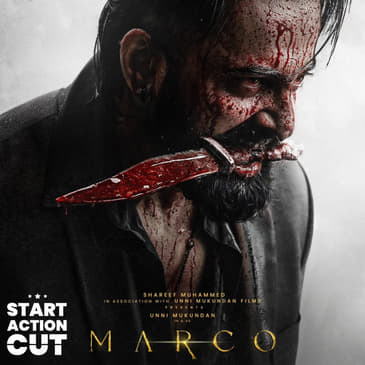

In this episode of Start Action Cut, Swathi, Aakash and Padmakumar are decoding Malayalam movie 'Marco' directed by Haneef Adeni and starring in Unni Mukundan in the lead along with an ensemble cast that includes Siddique, Jagadeesh, Abhimanyu S Thilakan, Kabir Duhan Singh, Anson Paul, Yukti Tareja, Durva Thaker among others.
See omnystudio.com/listener for privacy information.
[00:00:12] Hi, welcome to Onmanorama Movie Podcast, Start, Action, Cut. Today we are decoding the Malayalam movie, Marco directed by Hani Fadeni and starring Unni Mukundan in the lead along with an ensemble cast that includes Siddiqu, Jagdish, Abhimanyu, Tilagan, Kabir Duhan Singh, Hanson Paul, Yuktareja, Durva Thakar, among others.
[00:00:34] So, people in general dislike violence but they like it very much on movies. That's what is evident from the genre of movies which are catching up with the audience in recent times.
[00:00:46] And the intensity of horror factor of such movies is getting deeper.
[00:00:51] The movie Marco, which is perhaps showcasing violence through most heinous crimes Malayalam films has ever portrayed, is gaining audience not just in Kerala but beyond the borders of the state.
[00:01:04] The movie is now being readied in other languages too. Today we have Swati and Akash to discuss the film. Swati, what's your opinion about the film?
[00:01:15] Well, Patma Umar, what I felt about the movie is that it's undeniably an extremely violent film with comparisons being drawn to Bollywood movies like Kill an Animal.
[00:01:25] But unlike those films, Marco seems to prioritise violence over storytelling, leaving the narrative feeling thin and overwhelming.
[00:01:33] It's hard to ignore the trend of glorifying violent aesthetics in cinema today. It's simply beyond me, I would say.
[00:01:40] Violence, when used effectively, can serve as a powerful storytelling tool. But here it felt excessive and it lacked any meaningful purpose or emotional depth is what I felt.
[00:01:52] So with that said, if your primary focus is on the visceral, unrelenting nature of the action sequences, then the film certainly delivers in that department.
[00:02:01] However, the sheer excessiveness of violence was not my cup of tea. I couldn't really sit through the entire process. For me, a balance between story and style is very crucial and this film failed to strike that balance.
[00:02:15] And I was feeling more exhausted when I finished watching the movie.
[00:02:20] Akash, you watch films with a great involvement in the story and the whole lot of aspects of movies.
[00:02:27] How was it for you?
[00:02:30] Well, watching Marco, I wouldn't agree to this conversation that's been going around that says that it's a violent movie.
[00:02:35] I would say it's more of a brutal movie in terms of the lengths that it is willing to go.
[00:02:40] Because in terms of violence, I didn't find it innovative or experimental as such.
[00:02:45] I thought the violence that was portrayed in the movie, the way it was portrayed was picked up from films that we have seen already, like Old Boy, Animal, Kill, etc.
[00:02:54] But in terms of the brutality, in terms of the crimes or like the violence that was being committed on screen, in terms of the brutality, I think it was unprecedented.
[00:03:05] I haven't seen anything like that before.
[00:03:07] So for me, I would say it's the most brutal movie I have ever seen.
[00:03:11] Yeah, that's true.
[00:03:12] As you said, the movie is not showing anything new to us.
[00:03:18] Things that are shown in the film are actually we have already seen in movies before.
[00:03:22] And this film shows us the length, the extent to which it can go in terms of brutality.
[00:03:30] But for me, the highlight of the movie, which is revolving around a family dealing with gold business and the feud involving its business partners is stylish.
[00:03:41] The style of making and the no-it treatment.
[00:03:43] So I like that aspect of the movie because we have never seen this kind of movie.
[00:03:48] It has got kind of a yash film kgf, that sort of ambience, that in the dark frames and the violent nature and all those things.
[00:03:59] What do you say about the style and the treatment?
[00:04:03] Well, Pat Mumar write that it's an extremely stylish movie if you look at it because the main hero, Marco,
[00:04:08] he's shown as somebody who's extremely stylish even when he's doing all these stunts.
[00:04:13] He's shown as somebody who dresses up, who is present and presents himself in a very stylish manner.
[00:04:20] So that is definitely there.
[00:04:22] And Marco's characterization is like a breath of fresh air in the genre, often dominated by invincible larger than life heroes.
[00:04:29] Because he's obsessed as someone who can't be defeated.
[00:04:34] He's human, he's flawed and he's even introduced to us as somebody who is flawed and who has these negative traits.
[00:04:43] So he's not shown as a protector.
[00:04:45] He makes mistakes, break promises and bears the weight of his own reckless choices.
[00:04:49] Because there's a vulnerability to him that sets him apart from the typical Indian action hero,
[00:04:54] who rarely falters, never apologize and always comes out on top.
[00:04:59] Marco's journey is less about saving the day and more about navigating the messy consequences of his actions.
[00:05:04] And that's what makes him really authentic.
[00:05:09] But the thing is, while Marco as a character feels authentic,
[00:05:12] the film as a whole doesn't live up to that potential because there are very minimal dialogues, the story.
[00:05:18] It's a very simple and thin plotline.
[00:05:20] So basically a revenge sequence that is going on.
[00:05:22] But, you know, the kind of violence that is shown, the cause and all of that seems over the top.
[00:05:28] In many of the scenes, I was like, there was this particular scene where his friend is injured and he goes on this rampage.
[00:05:34] He kills everybody or just he takes this chainsaw and go on this rampage and kills everybody.
[00:05:40] Sheer bloodshed, blood spilling all over the place.
[00:05:42] And it's too brutal.
[00:05:43] And I was asking myself, why is this violence needed?
[00:05:46] I mean, when I was, I did one article where I talked about the violence in cinema.
[00:05:51] And one point that a psychologist pointed out was that it is only when such violent scenes are shown on screen that people actually focus on it.
[00:06:00] Because otherwise their attention span is very less.
[00:06:03] But I was like, at what cost?
[00:06:05] Because there are extremely violent scenes like killing a child and hanging a child.
[00:06:08] All of that meant nothing for me.
[00:06:11] It was too difficult to watch.
[00:06:13] So, the aesthetics, definitely you should commend on the aesthetics because I think they did a very great job there.
[00:06:19] But the violence was too much.
[00:06:21] I mean, it was very over the top.
[00:06:23] Yeah, I think the style and swag of Unni Mugundani is unmissable.
[00:06:27] Because, but we don't count it.
[00:06:29] I heard that the movie is getting popular in other states.
[00:06:33] And it appeals to us less.
[00:06:35] Because, except a few, all the actors are household names.
[00:06:39] Whether it's Jagdish or Siddiquh or even Unni Mugundan.
[00:06:42] So, when they appear in outfits which we have never seen them in, we might feel them to be odd and projecting odd mannerisms.
[00:06:51] Like when we see a brooding Unni Mugundan taking slow strides puffing away a cigar.
[00:06:57] Or Jagdish delivering power-packed cut dialogues in brilliant English.
[00:07:03] We look at them with indifference rather than admiration.
[00:07:07] So, I think if we watch the film as if we don't know any of them, I think we would enjoy it more.
[00:07:15] But it's not possible.
[00:07:16] Right, Agash?
[00:07:17] What do you say about the characterization, characters, the style, the treatment?
[00:07:21] I think for a Hani Fadini movie, I didn't find anything exceptional in terms of style.
[00:07:26] I think from his first film, Great Father, I think Hani Fadini has maintained a consistent style which is pretty dark, pretty brooding.
[00:07:34] With thumping background score as such.
[00:07:37] So, for me, this movie is highly stylized and I can see why audiences outside of Kerala would like this movie or would enjoy this movie.
[00:07:46] I think it would be the same reason how audiences in Kerala embraced KGF or embraced Salah for that matter.
[00:07:53] So, when I talk about stylization, I think the movie did pretty well.
[00:07:56] I think Hani Fadini did a good job in terms of presenting a movie.
[00:07:59] I guess you could say on par with KGF as such.
[00:08:03] But again, I don't see anything more beyond it.
[00:08:08] As an audience in Kerala, I can't deny the fact that this is nothing new to me.
[00:08:12] Seeing Jagadish or seeing Siddiq and the other household names in these roles, I have to agree with you here.
[00:08:18] Like, it was pretty much indifferent for me.
[00:08:20] One thing I would like to point out is the action choreography.
[00:08:25] It's meticulous.
[00:08:26] That is what I feel.
[00:08:27] And those actions actually drive the adrenaline rush which was indented.
[00:08:33] And then the high-octane stunts are quite thrilling.
[00:08:36] Like, what made the movie different was the collective contribution of villain characters played by Abhimanyu Tilagan, Kabir Duhan Singh, apart from Jagadish and Siddiq.
[00:08:46] So, the villain characters who exhibit the villainy in the movie, how far that was successful?
[00:08:53] What do you say?
[00:08:54] Well, Pat Mumar, in that way, I think Abhimanyu Tilagan did really full of a very commendable role.
[00:08:59] Is it his first movie?
[00:09:00] Have you ever seen?
[00:09:01] I think this is…
[00:09:02] Debut.
[00:09:03] As a debut film, but he did well, I think.
[00:09:05] Yeah, he did well.
[00:09:06] But, again, coming to the action part of it, because this is considered as a violent movie, we saw the movie together, Kill.
[00:09:12] I would say the choreography for Kill, in Kill, was much better because they were using everything possible on screen.
[00:09:19] Like, everything possible there.
[00:09:21] Like, all the action sequences were going inside, was inside the train, the moving train.
[00:09:26] And they completely used everything inside the train, the compartments, the seats, everything.
[00:09:32] Everything was more innovative.
[00:09:33] But in Marco, that is not the case.
[00:09:36] He just takes a gun or a chainsaw or a knife.
[00:09:39] That is how the stunt sequences go.
[00:09:41] So, if you look at the villain in Kill, that is, Rakav Jewel, he was much more dominating, not with his physical presence, but the way he goes on with the character.
[00:09:51] Here, in Marco, Apimanyu Tilakhan is a very towering force, even though there are many villains.
[00:09:56] He's a very towering force and he is villainous.
[00:09:58] But I would say I'd still go for Rakav Jewel's character because that character really scared me.
[00:10:04] Here, ultimately, you know that this guy is going to get killed.
[00:10:08] Apimanyu Tilakhan's character is going to get killed.
[00:10:10] And in Kill, I was not sure what was going to happen.
[00:10:13] So, that sort of curiosity or that intriguing factor for me was missing in Marco because maybe the storyline was flawed or it was very thin.
[00:10:21] You could actually see what is coming.
[00:10:23] You actually can't predict this is how it is going to be.
[00:10:26] That all of these people are going to get somehow brutally murdered or massacred.
[00:10:31] I don't know the word, but you can actually predict it.
[00:10:35] And I think that sort of takes away the fun from it.
[00:10:37] Yeah, I'm glad that you brought up the comparison with Kill.
[00:10:40] What I feel is Kill was trying to be more with a realistic movie.
[00:10:46] But here, this is a cinematic exploration.
[00:10:49] This is everything is cinematic.
[00:10:51] So, you can see we never see such kind of families.
[00:10:54] I mean, in real life.
[00:10:56] But in Kill, that situation can happen.
[00:10:59] But they went to an extreme level of violence in that movie.
[00:11:03] I'm also not quite sure about the science related to the procedures in this movie and found the actions quite convincing.
[00:11:10] But at the same time, what was unbelievable was how an army of men gathered around a lone man was inactive.
[00:11:19] It was just like the Vijay's movie.
[00:11:22] I think the best comparison would be Pushpa 2.
[00:11:24] Pushpa 2.
[00:11:25] Even in Pushpa 2.
[00:11:26] There was one more movie, that Vijay movie, where hundreds and thousands of people are fighting.
[00:11:31] It was Leo, I think.
[00:11:34] The recent Vijay movies.
[00:11:36] So, that was, I found it very odd.
[00:11:39] And the cumbersome violence and the efforts to generate horror at its best or worst with torn body parts and so on strewn all over the place.
[00:11:51] I think those were factors which were used to induce that, as you mentioned earlier, the aesthetic aspect of the movie.
[00:12:02] What do you say about that, Akash?
[00:12:05] No, Padma.
[00:12:05] So, coming on to that, I just wanted to add a couple more points, agreeing to what both of you said.
[00:12:10] In terms of the villainy, I would say, besides Abhimanyu and besides the other character whose name I do not remember, I think the real villain or the real villainy was shown by Marco's character.
[00:12:22] I think, because Marco is the spin-off or like a character that was from Mikhail, which was Hanifadani's last movie.
[00:12:30] The way Marco was presented in that movie was pretty much, you could call it clownery or buffoonish for that matter.
[00:12:37] So, for me to see how Hanifadani changed Marco's whole character storyline from something like a clown to something more villainous or like more brutal in nature.
[00:12:50] He's not a hero, he's an anti-hero.
[00:12:52] You can't even call him an anti-hero also, I guess.
[00:12:55] He's more like a villain.
[00:12:56] So, I think the resurrection of Marco as a villainous character compared to his role in Mikhail is why I would call him the real villain of the story.
[00:13:04] And apart from that, I think the movie, for me, the movie was all about the two fight sequences that were shown in the trailer.
[00:13:11] In the trailer, there are two sequences that are shown, which is one that happens in a forest and one that happens in a house.
[00:13:16] And for me, watching the whole movie, these two particular sequences, the fight sequence happening in the forest and the fight sequence happening in the house were really entertaining in terms of the brutality.
[00:13:27] Again, I would say not in terms of violence, which I did not find innovative or experimental as such.
[00:13:33] But in terms of brutality, sheer brutality, they were entertaining to watch.
[00:13:37] So, for me, when it comes to style, when it comes to villainy, the things that are being shown, it's these fight sequences, irrespective of their innovativeness, I guess.
[00:13:47] They were still entertaining to watch just for the brutality.
[00:13:50] And I would like to add this on.
[00:13:52] This comes from a personal fetish towards, for me, towards revenge-based action films, where the action is based on going eye for an eye.
[00:14:00] Which is something I saw in Tullumala, which I think is something that I haven't seen kill, but watching the trailer of kill, which I think happens in kill as well.
[00:14:08] So, for me, that revenge-based eye for an eye action was something I received in this movie.
[00:14:15] So, yeah.
[00:14:16] And I would also like to appreciate the technical team, including Ravi Basur with the BGM and the cinematography by Chandru Salvaraj.
[00:14:24] And the editing by Shamir Mohamed, they all kept the movie and movie's tone and tenor intact from the beginning till end.
[00:14:34] Ravi Basur knew what he was doing.
[00:14:35] I am pretty sure he got the idea that this Hanifadini is going for something that's on par with KJF.
[00:14:43] And Ravi Basur did deliver on that part.
[00:14:46] But one thing I really want to point out is how concerning it is.
[00:14:49] The fact that it's doing so well in Kerala.
[00:14:52] And now it's doing well in Bollywood as well.
[00:14:54] And going to do good in other languages.
[00:14:57] But the kind of violence that it shows and it's being celebrated, the fact that it is being celebrated is a very concerning thing for me.
[00:15:03] Because what is the message that it is putting across?
[00:15:06] That violence should not be celebrated because if style and violence are going together,
[00:15:13] there's a big chance that people, at least younger audience,
[00:15:17] because when I went in to watch the movie,
[00:15:20] most of the people there were very young kids and maybe teenagers and maybe college-going students,
[00:15:25] they might get inspired from it.
[00:15:26] So I don't think the rising trend that you are celebrating these violent films like
[00:15:32] Marco and Mura from Malayalam or even Kill or Animalism,
[00:15:35] it's a good trend.
[00:15:36] I feel like it's something to think about and talk about because for me,
[00:15:40] at least maybe it's a personal choice because violence on this scale is something to be shown on screen
[00:15:46] is something that people really need to think about.
[00:15:49] And we should keep aside the aesthetics behind it,
[00:15:51] just think about the moral and the psychological part of it.
[00:15:56] Yes. Do you think as a youngster,
[00:15:58] do you think the movies influence young people with the violence?
[00:16:05] In earlier days, I used to watch that after watching a film,
[00:16:09] they come out and they try to emulate whether it's a villain or the hero.
[00:16:13] Those actions are repeated or imitated.
[00:16:17] So does it happen now?
[00:16:19] Do they get influenced by the actions?
[00:16:21] No, I don't believe.
[00:16:22] While I do agree with what Swati has to say that there has been a growing trend of these hyper-masculine action-based revenge dramas,
[00:16:30] I don't think our audience is at a level where they do get influenced by such kind of films or such kind of actions.
[00:16:37] Because even for an audience that's dumb, if you can call it that,
[00:16:42] I don't think brutality of this nature can be considered normal or sane by any audience.
[00:16:47] Any audience all across India.
[00:16:49] That might hold true for Malayali audience.
[00:16:51] But when it comes to North, they celebrate anything.
[00:16:53] They celebrate animals.
[00:16:54] They celebrate films.
[00:16:56] They celebrate film.
[00:16:57] I believe, no, I don't believe filmmakers have any obligation to cater to that audience.
[00:17:02] What I see right now in terms of these movies being blown up is basically a counter product of a lack of hyper-masculine films in the last decade.
[00:17:11] From very last decade, we saw a lot of intimate portrayals of men in films.
[00:17:17] And the lack of hyper-masculine films, this was bound to happen where we would see a resurgence of hyper-masculine films.
[00:17:25] And there were good films like Kill, for example, which was very beautifully done.
[00:17:29] So, again, we have seen very critically acclaimed films like Kill, which was discussed for its innovative and experimental nature in terms of violence.
[00:17:37] So, movies like Marco, while it may not be as good as Kill or other critically acclaimed movies like, for example, John Wick from Hollywood.
[00:17:46] Again, it shows this is just a counter product for what happened in the last decade.
[00:17:51] And I don't think filmmakers still have any obligation.
[00:17:53] I don't think the audience will get enamored or influenced by such kind of action.
[00:18:00] Because if that was bound to happen, it would have happened a long time ago.
[00:18:04] So, while I do agree with the rising trend of films, I don't think it's a concerning matter of fact.
[00:18:12] I think, Astri Artha style, the costumes is noteworthy.
[00:18:17] I think how the costumes make all the characters stylish, even the villains.
[00:18:25] So, I think it has the influence of the Western movies.
[00:18:29] The costumes, whereby Dhania Balakrishnan added flamboyance to the whole tale.
[00:18:38] That's what I feel.
[00:18:39] Anything else you would like to add, Akash?
[00:18:41] Well, Patmohar, before delivering the final verdict on this movie, I would just like to comment Unni Mughudan for doing this movie.
[00:18:49] And that's primarily because right after releasing Maloo Singh, Unni Mughudan had said in an interview that he wouldn't act in new generation films.
[00:18:57] And his reasoning for the same was, the new generation films at that time, he felt contained excessive profanity, violence and explicit content.
[00:19:06] And seeing him act in a film like, or willing to do and even producing a film like Marco shows growth for me personally.
[00:19:15] And I guess I have to comment him for taking the opportunity and taking the risk to do this film.
[00:19:23] But still, I think Marco could have been a much better film.
[00:19:27] It could have been a much innovative and experimental film.
[00:19:31] Right now, I just think it was just trying to shock its audience.
[00:19:35] Well, I think like Akash said, this movie might be just a starting point to many other movies of this genre.
[00:19:42] Obviously, it is totally start coming up, like I said, through movies like Mura, which is again a violent movie.
[00:19:47] But let's see what to what extent this violence would go and what kind of violence would the filmmakers be willing to be willing to be willing to show on screen.
[00:19:56] Yeah, Marco is actually a thrillingly toxic movie.
[00:20:00] And I agree to both of you.
[00:20:02] I would have loved it more if they had cut down the violence by half and kept the goriness to a lower level.
[00:20:10] I think that would have left the movie more realistic and impactful.
[00:20:15] So that brings us to the end of this episode.
[00:20:18] Thanks for listening to the podcast produced and hosted by me, Pat Mugmar.
[00:20:23] Follow www.onmanorama.com for more podcasts and movies.
[00:20:28] And be sure to come back for the next episode of Start Action Cut out on Mondays.
[00:20:33] Thank you.