
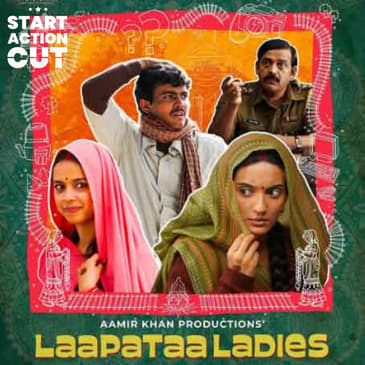

In this episode of Start Action Cut, Aswin, Sajesh and Padmakumar are discussing the Hindi movie 'Laapataa Ladies' written by Biplab Goswami, Divyanidhi Sharma and Sneha Desai and directed by Kiran Rao. The movie stars Nitanshi Goel, Sparsh Srivastav and Pratibha Ranta in the lead.
See omnystudio.com/listener for privacy information.
[00:00:00] Hi, welcome to Onmanorama Movie Podcast, Start, Action, Cut. Today we are decoding the Hindi movie, Laapataa Ladies, directed by Kiran Rao. The movie is a carefully written humor drama, mirroring certain social realities. The story revolves around two young brides who get lost from the same train.
[00:00:36] Today, Ashwin and Sagesh are joining the discussion. The writers of the movie are Peeplup Goswami, Divya Nithi Sharma and Sneha Deshai. Sagesh, there are three writers for the movie and it seems that they paid much attention to the script. So what was that fascinated you the most?
[00:00:57] Is it the scripting, the myriad nuances, the detailing or what is that interested you the most in this film? Patmuma, what fascinated me is not the detailing, which is definitely one major factor of the screenplay.
[00:01:15] But it was women writing for women, which brings a fresh perspective, which we have not seen or which we are not used to on big screen. So that is something that Sneha Deshai's screenplay brought to Laapataa Ladies and I loved it.
[00:01:34] That's the most fascinating factor about the screenplay. Ashwin, you also talk a lot about this film, the movie that stars Nitanshi Goyal, Pradipa Ranta and Parash Srivastava. What's your take on the film? Hi Patmuma, hi Sagesh.
[00:01:53] Sagesh rightly pointed out and he has said it so well when a woman screenplay writer writes a film about women, it makes so much difference. For me, starting from the title to character sketches and of course the script and
[00:02:07] choice of actors, there were so many elements likable about this film. It is not just that Laapataa Ladies is a film that bonds our attention towards a very relevant issue. It starts off as a typical comedy of the others.
[00:02:21] We are even curious as to how they are going to pull it off convincingly. But inside a heavily packed compartment we see more than one bright with wails, all draped in red and the confusion is somewhere around the corner.
[00:02:35] The scenes in the train are crafted to give glimpses of characters and we know what is to expect of them later on. As for the title, The Missing Ladies, it is not just catchy but it is also a glowing metaphor.
[00:02:49] They just don't get lost and separated from their husbands. It is also about how one woman doesn't even know that she has lost her identity long back while the other one is well aware of hers and goes to any extent to regain it.
[00:03:04] Also, I found a lovely charm about the way the story is told. The way the script introduces certain motives which assume profound meanings later on with the transformation of characters. Through the blurred vision of the veil bright we see an emotional woman handing over a
[00:03:21] tiny bundle of rice turmeric and stuff saying that this will protect your husband and your marriage. At one point this woman who doesn't even know where her husband is, who doesn't even know if her marriage is still intact, holds on to the same bundle.
[00:03:36] The irony can't be most stinging. There is a warm scene so beautifully done where a woman taught to adapt to any kitchen receives a reward for her labor perhaps for the first time in her life.
[00:03:48] She's doing this and that, she revues us it because she doesn't know she deserves to be appreciated and acknowledged. And the money she gets it is tied into a small bundle exactly the way her mother gave it at the time of her marriage.
[00:04:02] The symbol of that marriage becomes a symbol of her identity, self-respect and sustainability. Sometimes this film can't help being too direct and only a face but these little moments of genuine warmth and self-discovery make Lapata ladies stand apart.
[00:04:18] Yes Ashwin I get what you said but the movie reveals an relevant topic and the way you said it shows the patriarchal power and the subdued existence of women in Indian households. But don't you think that this is a two-dimensional treatment as in it exhibits the same team
[00:04:41] of like men are either monsters or fools and women are always the victims. So these vices still exist in our society but this is not that universal as the film What do you say?
[00:04:57] Patma Kumar when you're dealing with a story of this kind it's highly probable that there is only one way to tell the story but I think that's where the film makes a difference. As I said in the beginning it could have come out as a run-of-the-mill satirical comedy
[00:05:14] but it tries to achieve something greater more earnest attempt to tell a story of two young women with a lot of heart and I would say this film has the heart in the right place. I beg to differ regarding your observation on this two-dimensional pattern because from
[00:05:32] what I saw the male characters are sketched with layers and shades. The script holds a torch to their inner workings. For instance, I'll give an example. The first time we see the police inspector Manohar played by Devi Kishan he's listening to a song.
[00:05:48] The song is being sung by a woman seated right in front of her. She's made to sing because her son has been arrested for bad behavior. It is evident that this police inspector holds respect for women.
[00:06:00] He treats her as his equal, makes her sit in front of him and it kind of shows that he's corrupt but not evil. He even introduces his woman subordinate as coming from sports quarter inadvertently acknowledging her for who she is.
[00:06:16] So we know that this guy is very well capable of doing the right thing at the right time although he may be into wrong doings in a harmless manner. And also Deepak played beautifully by Sparsh. There is genuine care and affection he feels for his wife Poole.
[00:06:32] In the beginning there is a scene where he inches close to Poole when they're in a boat, his shoulder rubbing hers in a fleeting moment. Through the veil we see Poole smiling as though she accepts his expression of closeness.
[00:06:45] It even slips through the veil of strangeness between the newly married couple. When she goes missing he's devastated, he sings, his arms over his head has his squads in disbelief and despair as they're asking himself how can I lose her because Deepin
[00:07:00] said he knows that he's fallen in love with her. But I would say these are some of the shades which the characters are given which take the film to a different level rather than playing out as a direct conflict between the good and the bad.
[00:07:14] So I think it's not exactly the man versus woman or male versus female. It unnerves some social evils that is present still in our society or maybe we need to change the mindset. What do you say, Sajesh? What's your take?
[00:07:28] Back what Ashwin said, so to add on to this if you look at Deepak's character, see his innocence and his care is not restricted to his wife alone. So when you see Pushpa Rani or Jaya, so Deepak is not showing that male savior character
[00:07:46] alone but it's a genuine care that is coming out of for a fellow being who's in a similar situation like him. Like you know or in a similar situation like what his wife is in. So it's a genuine care that is coming out.
[00:08:02] So the male and female characters are written in a way like Ashwin said they are all laid. So problems are not with the men alone or the mother in law character of Jaya's mother
[00:08:15] in law if you look at the character is a woman going against women, which is again a direct reflection of the society. So it's not just about two genders but it's about people against people and that's the great thing. About being two dimension, I'm even okay with that.
[00:08:38] When we had this opportunity to make films, men had this, when I say we, I'm talking to my gender. So when men had this opportunity to make movies, women were either damsels in distress or they were objectified or they were all cry babies on the screen for melodrama.
[00:09:00] We never went and gave them any equality on screen. So why do we expect when women make movies, it has to be like that when the pendulum has swung to that side, let it be there, let them enjoy this, let them have this if it is two
[00:09:16] dimensional, let it be like that. Let men be the oppressor, men be the violators, men be displayed as you know evils and fools for we have been that. So I have no issues even if it is two dimensional.
[00:09:32] But Maumar to add to what Sajesh said, he kind of nailed it when he said that. I also felt that this is the advantage with a woman scriptwriter and a director because they bring in a new level of sensitivity and understanding to women characters.
[00:09:46] It's so different from how we have seen them being portrayed on screen. So they have supported the entire idea of chivalry and infused it with true sense of care, understanding and sense of being there for them.
[00:10:00] As he said, even though Pushpa is a total stranger to him, he still respects her. He still promises her that I will make sure that you reach your home, whether I find his own wife that's full or not.
[00:10:11] So that kind of sensitivity is evident throughout the script and the film. Yes Ashwin, I think it's the mindset or the thinking or the thought process that male director needs to infuse such things into films. They can do it.
[00:10:29] What I think is more thinking or a deliberate attempt is what we need. Yeah, Pakumar just want to add one point there. We have been watching movies for long. So have you seen men writing both these characters, men and women in the same sensitive way?
[00:10:49] But most of these movies written by women, there are all kinds of shades of men and women in their stories. That kind of writing, it's very rare when a man writes it. It's very rare.
[00:11:04] Like we can take handful of writers and movies which has both kind of characters written in the same sensitive and in that way. Yes, I agree. But they can write. What I said is we need some more effort.
[00:11:18] I mean, the writer should put more effort whether it's male or female. That doesn't matter. What we need is to exactly portray the women and men equally because it is not that men is always overpowering the women's existence.
[00:11:34] So as Sagesh said earlier, he said that the movie is a reflection of the society. If I ask you if there is anything that the movie advocates, if it giving some advice or some propounding some principles that the society should have
[00:11:50] these kind of aspects or instincts or the qualities, what does it put forward? Patmuma, see more than advocating anything, I believe that Kiran Rao is stating certain facts, certain realities or how it should be. She's not trying to teach us but she's just showing it to us.
[00:12:11] She's just bringing all those elements onto the table and it's up to us whether we want to take it or not. And she's not telling us you should be this, you should be that. No, that's the beauty of the script. That's the beauty of the making.
[00:12:26] It's left to us whether we want to take it or not. And I must say that, you know, inadvertently we will adapt the things that she brings onto the table. Yeah, that's what I felt. Ashwin, what's your opinion? Patmuma, just to add to our earlier discussion.
[00:12:41] Let's not forget the fact that the genesis of the entire film happened in a screenwriting competition and it was actually an original story written by a male which Amir Khan picked up and then Sneha Deshai worked on with Kiran Rao.
[00:12:57] So when we are saying that the script written by a woman adds more sensitivity to the entire thing, the original idea came from a male. And what I found so interesting about this film is the fact that it has shown us taking place in 2001 in a fictional village.
[00:13:14] But there are certain scenes which we can relate to even now. For example, there is a scene, a close-up show shows that Jaya is finishing her dinner and she's having the last morsel of roti and we can see that her fingers have run
[00:13:29] all over the plate as she has enjoyed that dish. She appreciates Deepak's mother for the dish. Just in a matter-of-fact manner, the mother responds who complements each other for cooking. When was the last time we actually told our mother or wife or even a woman friend?
[00:13:49] Like we are talking about this film and there are certain things which the film shows it kind of reminds us to be more understanding, to be more sensitive and let's not take the women in our life for granted. So that was an important takeaway apart from the performances.
[00:14:05] Okay, when it comes to performance, Ashwin, who do you think has made the most of the screen in this movie? I think the film is about two women and a man mostly. But for me, Ravikishanar's The Corp was exceptional.
[00:14:21] He lends that character the correct measure of quickness and brilliance. Even his voice rendition is so calculated that even when he tears into a character, he doesn't even amp up his pitch because he's so sure of it.
[00:14:36] And as for the character Manjumai played by Chhaya Khadam, she was also brilliant. There is a perennial scorn, indifference and coldness on her tired, unadorned face like moss on a tree because she has seen so much of her life.
[00:14:54] She has suffered so much and she doesn't even make sweets to sell in her shop because she feels that there is nothing to be happy about in her life. So the way the characters core being hardened by suffering, Chhaya Khadam plays it with the piercing anger and agony.
[00:15:10] I loved it. And as for the two lead female characters, both of them were really hard touching because when you're talking about Bhul's character, she's so fragile and Nitha and she even in her voice, the way she looks, that fragility is reflected.
[00:15:27] And also Pratipa lends great solidity to the character of Chhaya. Even while facing the most uncomfortable situations, there is an assurance about her, a confidence that springs naturally from her innocence. And Deepak played by Sparsh, he has a radiant charm and an irresistible sense of innocence about him.
[00:15:49] His longing for Bhul is painful and sweet at the same time. There's a beautiful scene when he tells Bhul, I love you in English. And before that, he says the sentence saying that in his family, he's the only one he can speak as much English.
[00:16:06] That was really innocent and it was beautifully done. So we get a feeling that this guy can do no wrong even in the worst possible circumstances. Patmumar, I totally agree with Ashwin. The characters he mentioned, the actors he mentioned, they have done a superb job on screen.
[00:16:26] And you won't find even one character, one actor, one person on the screen, unnatural or unwanted. They're all there and they're all living this cinema. And that's the beauty of it. And for me, the best character or best performance was Sparsh Srivastava who played Deepak.
[00:16:45] Certain close-ups in you should see those, the way he... There was no drop of overacting, not a drop of overreacting. Nothing was there. It was all calculated. It was all perfect. I really envied, I wish that I could get some role like that
[00:17:04] and I could portray it in that kind of an honesty. I totally agree with Ashwin when he commented about all the other actors. But this one person rang the chord. What about the technical aspects and the music and BGM in this movie?
[00:17:20] The first point is about Vikash Nauhlaka's cinematography. I just fell in love with... Yeah, I'm using this fell in love too many times but that's what happened. You can't blame me for that. But yeah, his handled camera work coupled with his motivated lighting,
[00:17:40] it creates a magic on screen. It's a fresh take in a way because you are so much used to all the flat lighting of these commercial movies and all of a sudden, you have a fresh theme, you have a fresh faces,
[00:17:56] you have fresh faces on screen and it is taken in a ultra realistic... When you say ultra realistic, it is not purely about putting your characters in shadows but here it is completely on motivated lights. And the frames, he has given a grammar to the picturization
[00:18:18] by using close-up shots for most part of it keeping us inside the entire confusion that is going on. So we become a part of it and his handle camera makes us believe that we are inside the coupe with the characters when they are.
[00:18:35] And you feel like telling Deepak that, Bagger, you're taking the wrong lady out and then if he could hear you, the movie would have stopped there but you are inside there, you are part of the entire confusion. And that is something that Vikash created with his camera work
[00:18:53] and it goes to wide lenses only when it is needed. So that is one part of it and then the background score, the sound and the songs, they never stand apart. In unlike other movies, they're not crowding the storytelling.
[00:19:10] So in that way it's beautiful work by all other departments as well. Yes, Sagesh, I remember your review and in that you mentioned that the close focal length chosen for the movie that intensifies the sense of intimacy. So that was a nice observation.
[00:19:27] Now Ashwin, what do you say, what interested you most as regards the technical area? As for editing, I have read somewhere that they took almost a year to put together all these scenes. There is hardly anything in this film which kind of sticks out
[00:19:42] but there is one scene which I wish they had taken it out because there is a scene involving a politician. I think it looked clumsy and it kind of impeded the flow of the narrative. Otherwise talking about the music,
[00:19:55] it was so evocative and it was rendered with a poignant touch and Sagesh said it is placed at the right time because earlier I heard Kiran Drao speak in an interview saying that there was a lengthy opening scene being played out to this Sajini raid, their wedding scene
[00:20:14] and then they kind of did a rejig and placed it towards the later end and it came out so beautifully that we could instantly connect with the characters and the emotions they go through. So that's pretty much about the music and BGM.
[00:20:28] Yeah, would you two people agree if I say that there are too many coincidences and like two brides getting lost in the same train? So does that rob the charm or the realistic aspect a bit in this movie? Well, this is what I said in the beginning.
[00:20:46] That's the beauty of this film. Even we were curious as to how they are going to show this or pull this out but the crowded compartment and also there is a random character saying something about an auspicious date
[00:20:58] which kind of suggests that so many marriages could have happened at this time. So there is a high probability that all these people could end up being in the same compartment and I think that part was convincing for me
[00:21:10] and I remember a similar storyline but not discussing all these issues but similar storyline once aired by Durga Srin under the tagline director's cut in which two newly married couples get lost right in the railway station because of this kongat veil.
[00:21:27] I thought it was convincingly done and apart from that Kiran Rao made sure that it didn't progress as a mere comedy of hers but it took a whole different dimension from then on. Satish, would you like to add something?
[00:21:40] So I totally agree with Ashwin and I believe there was this one part that added convincingly there where Pushparani's character she had a purpose when she got a chance she had to pounce onto it. So that is later conveyed when the police officer interrogated her
[00:21:59] and asked her like you know didn't she know that you know she was getting out with another person not her husband. So even when she blames her veil for obstructed view she also adds that you know it was my chance.
[00:22:13] She had to take it at that moment she was very selfish and that maybe that's why she wanted to help Deepak find a fool. So it was because of her this selfish move that Deepak and Fool got separated.
[00:22:27] So the story was convincing to me and there were reasons for characters as well. So it was fine with me. So to conclude I would like to borrow a sentence from Satish's review that is, Lapata Ladies exemplifies the potential of socially conscious cinema
[00:22:47] urging production houses like American Productions to support more such endeavors. So that brings us to the end of this episode. Thanks for listening to Start Action Cut produced and hosted by me Patmohmar with technical production by Idea Brew Studios. Follow www.onmanorama.com for more podcasts on movies
[00:23:08] and be sure to come back for the next episode of Start Action Cut that will be out on Monday. Thank you.