
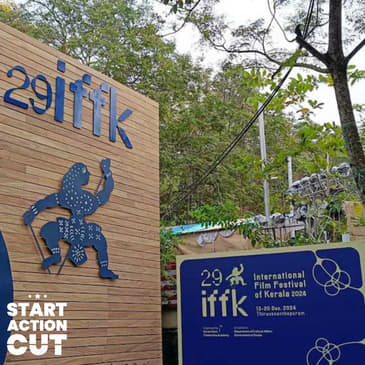
In this special episode of Start Action Cut, Vishnupriya, Swathi and Padmakumar are discussing in brief the general atmosphere and the nature of films screened at the International Film Festival (IFFK) this year.
See omnystudio.com/listener for privacy information.
[00:00:11] Hello and welcome to Onmanorama Movie Podcast, Start, Action, Cut.
[00:00:16] This is a special episode on International Film Festival of Kerala IFFK.
[00:00:21] A strong contingent of Onmanorama team had covered the festival and I am taking this opportunity to share that we had won the award for the best online media coverage of the festival.
[00:00:40] The Jury Members were Ayyappan, Ashwina and Swati. Our video titled Critics' Choice where they analyse top 5 movies of their choice and picking the best out of them is their Onmanorama YouTube channel.
[00:00:57] Here Vishnupriya who mostly watch movies outside the competition section and Swati who was also one of the Onmanorama Jury Members giving us an overview of the festival.
[00:01:11] So, Swati how was the festival for you? You were one of the Jury Members. How was it?
[00:01:17] Well, Patmohumar, this year like you said I had the opportunity to watch all the 14 films in the International Competition section along with my colleagues Ayyappan and Ashwin.
[00:01:26] It was truly an overwhelming experience in many ways as it allowed me to explore world cinema, different languages, cultures, acting styles and much more.
[00:01:36] So, out of the 14 films we watched my personal favourite was of course our topic for the Onmanorama Critics' Choice which I was also a part of like you said is the Iranian movie Me, Mariam, the children and 26 others directed by Farshat Hashmi.
[00:01:49] So, the experience as such was so overwhelming for me because last year when I went there it was to cover the event but this time I was a part of the jury and we had to watch all these 14 films in 7 days and there were days where we did not get the reservations for the films and then there were days we got the reservations but the queue was so long that we had to wait for like 2-3 hours to watch the movie.
[00:02:13] And I think I have to credit Ashwin and Ayyappan who were working with me.
[00:02:19] They showed absolutely great resilience and perseverance to Ayyappan especially because you know there were days where he had to wait for like more than 5 hours to watch a movie and to see them talk about movies, all of us talk about movies, debate about it and share our thoughts and what worked for us and what did not work for us to debate that amongst ourselves and to come to a final
[00:02:43] where it was truly a very engaging and it gave me a very fresh perspective about world cinema.
[00:02:51] I am so glad that we won the award for the best coverage in online media as well and I guess for all of us here it was truly a very eye-opening and very engaging experience as such.
[00:03:05] Vishnupriya, you used to be a regular presence at IFFK. How was it for you this time?
[00:03:10] So, Patma Kumar, this is my 9th time attending the film festival.
[00:03:16] I started with a student pass when I was 18 and I mean there was like 1 or 2 years that I missed attending the fest.
[00:03:28] But this year it was completely different from the usual time.
[00:03:34] I was doing reporting for Onorama, I was going for movie reviews, events, discussions and also finding other stories.
[00:03:42] So, it was a very different experience I had.
[00:03:45] I mean the number of movies I watched like you know when you compare with the previous years, it was less.
[00:03:52] I could only watch around 8 movies.
[00:03:55] My usual count like go around 20-25.
[00:03:59] But talking about the general like an impression.
[00:04:03] So, usually the fest like among my friends we have a very common opinion like it's either bad or good.
[00:04:12] So, this year it was like a mixed opinion actually.
[00:04:15] Because some said it was really good talking about the organization movie selection.
[00:04:20] But some actually said it was not that great.
[00:04:23] I mean I'm in an opinion that comparing to last year's movie selection, this year they had better movies.
[00:04:32] But a few of my friends actually said that like last year they watched better movies when you compare to this year's.
[00:04:39] But personally like again I watched less number of movies.
[00:04:44] But the movies that I watched worked for me and I liked it.
[00:04:47] And even about like talking about the theme, celebrating the works of women in cinema.
[00:04:55] I guess they tried to give like of course emphasis to the theme.
[00:05:02] Like I guess out of the 177 movies screened, 52 are directed by women.
[00:05:10] And also the awards like the Lifetime Achievement and Spirit of Cinema Award were awarded to Anne Hui and Payal Kapadia respectively.
[00:05:20] Like both are.
[00:05:21] Anne Hui is a Hong Kong director, filmmaker and Payal Kapadia the director of All We Imagine Us Like.
[00:05:28] But my personal experience is that I mean it is great people are talking about the female gaze, like women in cinema and all.
[00:05:38] But I guess it was a little late or this was not the time.
[00:05:43] This theme should have been the theme of IFFK way earlier.
[00:05:49] I mean that's my personal opinion.
[00:05:50] It's late because a stage like IFFK should address all this or should bring such like female directors way like before.
[00:06:02] So that was one thing I thought about the theme of this year.
[00:06:07] You watched films mostly outside the competition sections and there were talks about films like Misery Kodia and Crossing which actually won ICFT award.
[00:06:20] I mean UNESCO ICFT award at the IFFI.
[00:06:25] Actually what were the films that you noticed worth mentioning?
[00:06:30] Yeah.
[00:06:31] Yeah.
[00:06:31] So one more thing that I have to add is that this year they tried to include mainstream cinemas as well.
[00:06:41] I mean last year also they do that but this year the number of mainstream movies were a little higher than the usual.
[00:06:47] So out of the eight movies I watched my topic is Memories of a Burning Body and then I watched this movie Kneecap.
[00:06:53] And there was no room next door and then I watched Emilia Paris.
[00:06:59] And under the category Malayalam cinema today I watched Krishnan's latest Sangrusha Ghadana or The Art of Warfare.
[00:07:09] And then I watched Kill the Jockey and Humans in the Loop as well.
[00:07:14] Apart from these movies I also watched this short film which was directed and produced by the students of Kerala Institute.
[00:07:23] That actually was screened in the Kerala Film Market area of the IFFK.
[00:07:28] That was actually I guess the first time such a thing has introduced.
[00:07:32] But a makeshift theatre set up.
[00:07:35] They screen such short films or lesser known independent filmmakers movies.
[00:07:44] I guess you have to pay for that anyway.
[00:07:46] But I watched that short film also which was also actually interesting.
[00:07:50] I guess it's available on YouTube.
[00:07:53] Yes Swati, you watched 14 films in the competition section.
[00:07:59] And I heard that it was a painstaking job watching all the films.
[00:08:04] Because missing one film would have spoiled the whole, I mean the program.
[00:08:09] So how was it?
[00:08:10] How tiresome and how acidous was that task?
[00:08:14] It was extremely strenuous because every single day we, I think all of us, we got up around 7.30 and we just log into the website.
[00:08:25] And just wait for the reservation to begin, the portal to open so that we could book the movies.
[00:08:33] So the first, I think two days went okay.
[00:08:35] We got the reservations and we had an easy watch.
[00:08:38] But from the third day onwards it was extremely difficult because both me and IFFN Jettin did not get the reservations.
[00:08:44] And only Ashwin got two reservations.
[00:08:46] And we were like, oh my god, what is going to happen?
[00:08:49] Because we saw the queue, we saw the other queues for the other movies and it was extremely long.
[00:08:55] And I was very tense and Ashwin was like, we'll do something about it.
[00:08:59] We'll make some arrangements.
[00:09:01] We'll figure it out.
[00:09:02] So the next day, I remember, we got up at around 6 o'clock.
[00:09:05] Went to the, I think we went to Kalapha in around 7.
[00:09:09] Waited for 2 and a half, 3 hours, almost 3 hours there to watch the movie.
[00:09:13] We were among the first 10 people to reach Kalapha.
[00:09:16] And then we went around like 3 hours.
[00:09:19] And to see Ayipan, he was so tired.
[00:09:23] He actually sat there for some time.
[00:09:27] Because other people also, they showed the same kind of dedication.
[00:09:30] All of them were waiting.
[00:09:31] And we did not want to miss, we couldn't afford to miss any of the movies.
[00:09:35] Because in order to reach the final verdict, we had to watch, all three of us had to watch all the movies.
[00:09:40] And I think more than watching the movie, I think it was the process of watching the movie that was extremely strenuous.
[00:09:46] But it all, you know, sort of fell into place once we watched all the 14 films.
[00:09:50] I think that was on the 19th.
[00:09:52] Our last film was An Oscillating Shadow.
[00:09:54] And after watching that movie, I think that was when I finally told myself,
[00:09:58] Okay, you've accomplished this.
[00:10:00] You've watched all the 14 films.
[00:10:01] Now you can go about it.
[00:10:02] The shooting part, whatever we were going to say, the discussions, all of it came afterwards.
[00:10:08] But for me, the process of watching all those 14 films was, you know, it was greater than anything.
[00:10:14] Because, you know, I also, because Ayipan and Ashwin both are senior journalists as compared to me.
[00:10:18] And I think to be part of the panel, part of the jury was extremely an honorable experience for me.
[00:10:25] Because I got to learn a lot from these people.
[00:10:27] Because after watching every single movie, I'd ask Ayipan, what did you feel about the movie?
[00:10:32] And he'd tell me his perspectives.
[00:10:33] And I would be like, okay, I did not think of that.
[00:10:35] But this is what I thought about the movie.
[00:10:37] So we'd debate about it.
[00:10:38] We'll come to a conclusion.
[00:10:40] And yeah, so the whole experience for me was a very, it was a learning experience for me more than anything else.
[00:10:46] Yes, I would like to ask you both.
[00:10:49] Because you had to stand in queues for hours on end.
[00:10:54] And this means for more than two to three hours.
[00:10:58] And you had mentioned, I heard that Ayipan had to stand in queue from 11 o'clock to watch a film at three.
[00:11:05] So one aspect is that people, there are so, the crowd was so huge.
[00:11:11] And people are being more attracted to IFFK.
[00:11:15] I mean, film festivals.
[00:11:16] They are in need of good films, good stories.
[00:11:20] So how would you analyze that aspect?
[00:11:23] Both your, I mean, strain and the people coming there, how they are willing to watch good movies?
[00:11:33] Swati, you can.
[00:11:34] Yes, so I think one thing that really fascinated me is that the people who are coming there to watch the movies,
[00:11:41] they're very much aware of the movies and, you know, the reviews about it.
[00:11:45] And they know the kind of movies that they're coming to watch.
[00:11:48] And another thing that surprised me was the fact that there is this queue for senior citizens.
[00:11:54] And that queue is as long as the reserved or unreserved queue.
[00:11:57] And I was so shocked that people above 50, 60 are coming to watch these movies.
[00:12:02] And they are also waiting for all these three, four hours.
[00:12:05] That means that they have an interest in cinema and the craft behind it.
[00:12:09] And some of the movies for me, like there was this movie, The Hyperboreans.
[00:12:12] It was a Chilean movie.
[00:12:14] The crowd was so big and huge.
[00:12:17] And there's so many people crowding near the theater and even older people.
[00:12:20] And for me, that movie just went above my head because it was technically it was it was marvelous.
[00:12:25] But as a simple story, couldn't quite get a grasp of it initially.
[00:12:29] I had to go and read and understand about it.
[00:12:32] But the crowd was there were old people, there were youngsters,
[00:12:35] there were people from all age groups to watch that movie.
[00:12:38] And I heard people talking about the creative process that goes behind making the movie.
[00:12:42] And I was so surprised that people are so much aware of that,
[00:12:45] aware of filmmaking as a process, the craft behind it.
[00:12:48] And for a simple viewer, they might not look into all those aspects.
[00:12:52] Like for me, if I do a lot of reviews for On Manorama.
[00:12:56] So when I go watch a movie, I must look at the story, the acting.
[00:12:59] But at least in the international competition section, there were so many experimental movies.
[00:13:04] And I could understand that people want to learn about these movies.
[00:13:07] They're aware about these movies.
[00:13:09] And they discuss these movies amongst themselves.
[00:13:11] And for me, that was really an eye opening experience
[00:13:14] because I was not anticipating the fact that
[00:13:16] so many people would be aware of these kind of movies.
[00:13:18] And I think our young audience are very much aware of world cinema.
[00:13:23] And they were so interested in it.
[00:13:25] And they raise questions and ask these filmmakers who come there,
[00:13:28] talk about the movies with them.
[00:13:30] And I think in the future,
[00:13:32] we can expect a lot of great movies from these youngsters.
[00:13:36] Vishnu Priya, you can just add the theme.
[00:13:40] Along with this, the theme of the movie,
[00:13:42] how far the movie creation,
[00:13:45] how advanced is it from the previous years?
[00:13:50] So one thing I would like to add about the crowd,
[00:13:55] I mean, it's also something similar a few people mentioned to me,
[00:13:59] is the change in the crowd who are attending the fest.
[00:14:04] So especially, like, last year,
[00:14:08] there are people, like, big crowd,
[00:14:11] who are only there to watch movies for the fest,
[00:14:14] like in Trivandrum.
[00:14:15] Like how Swati mentioned,
[00:14:17] people are, like, you know,
[00:14:19] dedicated to watch movies and, like,
[00:14:21] as much as they can.
[00:14:23] And, like, you know, stand in queues for hours.
[00:14:24] And people are willing to watch the movie,
[00:14:27] like, if they are not able to get a seat,
[00:14:30] they'll stand and watch movies,
[00:14:31] which are, like, you know, two hours long.
[00:14:33] Like, they don't,
[00:14:34] they don't mind watching movies standing.
[00:14:37] But then there are also people
[00:14:39] who are just for their vibe.
[00:14:41] Like, you know,
[00:14:41] they just come to Tagore or to Nishagandhi
[00:14:44] and to this, like, you know, Spencer.
[00:14:46] Just to experience the vibe.
[00:14:47] Yeah, and they just leave.
[00:14:48] But this year,
[00:14:50] that crowd was less.
[00:14:52] You know,
[00:14:52] there were much people
[00:14:54] who are just there to get the vibe.
[00:14:56] Almost all of them were serious movie watchers.
[00:14:59] Yes, yes.
[00:14:59] And also,
[00:15:00] again, talking about crowd and long queues,
[00:15:03] we actually talked to a few people
[00:15:06] because the movie,
[00:15:07] all we imagine as light,
[00:15:08] the movie only had one screening
[00:15:10] and there was this massive crowd
[00:15:12] and long clash and fights
[00:15:14] and everything during that screening.
[00:15:16] So we talked to a few people.
[00:15:18] Like, even though there was
[00:15:19] a theatrical release,
[00:15:21] why you're still choosing
[00:15:23] to watch the movie on IFFK.
[00:15:25] But then, like, people,
[00:15:27] there went, like, you know,
[00:15:28] different responses,
[00:15:29] but people were,
[00:15:30] most of them were saying
[00:15:31] that they are actually,
[00:15:33] like, you know,
[00:15:33] want to watch the film
[00:15:34] during IFFK
[00:15:35] because the crowd
[00:15:36] is entirely different.
[00:15:37] So they chose to watch it
[00:15:38] on IFFK
[00:15:39] rather than going to
[00:15:40] a commercial,
[00:15:41] like, you know,
[00:15:42] normal theater
[00:15:44] because they're saying
[00:15:45] that affects the experience.
[00:15:46] experience.
[00:15:47] I would like to know
[00:15:48] what the theme was
[00:15:50] mainly
[00:15:51] and
[00:15:51] how the films were
[00:15:55] made
[00:15:55] along those
[00:15:57] themes.
[00:15:58] So, yeah,
[00:15:59] this year's three theme
[00:16:00] was
[00:16:00] celebrating
[00:16:01] the works of women
[00:16:03] in cinema
[00:16:03] and
[00:16:04] most movies
[00:16:06] that I watched
[00:16:07] had that aspect.
[00:16:08] I mean,
[00:16:09] not every,
[00:16:10] but most of
[00:16:11] the movies
[00:16:12] that I watched.
[00:16:13] So to particularly
[00:16:13] talk about one movie,
[00:16:15] I would say
[00:16:16] Memories of a Burning Body.
[00:16:18] So,
[00:16:19] Memories of a Burning Body
[00:16:21] talks about
[00:16:22] the
[00:16:23] understanding
[00:16:24] womanhood
[00:16:25] through unspoken,
[00:16:27] like,
[00:16:27] about the unspoken rules
[00:16:28] or
[00:16:29] the expectations
[00:16:30] that
[00:16:31] the
[00:16:32] society
[00:16:32] has.
[00:16:33] And
[00:16:34] one big thing
[00:16:35] that I really loved
[00:16:36] about the movie
[00:16:37] is that
[00:16:38] how they blended
[00:16:39] the movie
[00:16:40] short
[00:16:41] footages
[00:16:42] with
[00:16:42] real voices
[00:16:43] of women,
[00:16:45] like,
[00:16:45] you know,
[00:16:47] especially women
[00:16:48] of a certain age,
[00:16:49] like,
[00:16:49] that is
[00:16:49] over
[00:16:50] 50,
[00:16:51] I guess.
[00:16:52] Which was that movie?
[00:16:53] Memories of a Burning Body.
[00:16:55] So that,
[00:16:56] I mean,
[00:16:56] I was actually
[00:16:58] in,
[00:16:58] oh,
[00:16:58] how well
[00:17:00] that was made
[00:17:00] and,
[00:17:01] like,
[00:17:01] how they connected
[00:17:02] both these
[00:17:03] two different things
[00:17:04] and,
[00:17:05] like,
[00:17:05] you know,
[00:17:05] that craft was,
[00:17:07] like,
[00:17:07] something that
[00:17:08] surprised me
[00:17:09] and I was loving that.
[00:17:11] I mean,
[00:17:11] the narrative,
[00:17:12] that was
[00:17:12] a little simple
[00:17:14] or something that
[00:17:15] is,
[00:17:15] like,
[00:17:16] you know,
[00:17:16] talk over
[00:17:17] the times,
[00:17:18] I guess.
[00:17:19] But this one
[00:17:21] technical aspect,
[00:17:22] I was,
[00:17:22] like,
[00:17:23] totally in love
[00:17:24] with the movie.
[00:17:24] So,
[00:17:25] one movie that
[00:17:26] I want to really
[00:17:27] mention here is
[00:17:28] Feminist Fatima
[00:17:29] or Feminist Fatima.
[00:17:30] So why I want to
[00:17:32] talk about this movie
[00:17:33] is because
[00:17:33] it very subtly
[00:17:35] and satirically
[00:17:35] touches upon
[00:17:37] the patriarchy
[00:17:37] that exists
[00:17:38] in the society
[00:17:38] and I guess
[00:17:39] the main actress,
[00:17:41] even all the actors
[00:17:42] in the movie
[00:17:42] gave out excellent
[00:17:44] performances
[00:17:45] and a very similar
[00:17:47] movie like
[00:17:47] Feminist Fatima
[00:17:48] is The Great Indian
[00:17:50] Kitchen
[00:17:51] directed by
[00:17:51] Jio Baby.
[00:17:52] But how this
[00:17:53] movie stands
[00:17:53] apart is
[00:17:54] because
[00:17:55] it is not
[00:17:56] as intense.
[00:17:57] It is very
[00:17:57] light-hearted.
[00:17:58] You'd love
[00:17:59] some of the
[00:17:59] scenes,
[00:18:00] the way the
[00:18:01] main actress
[00:18:02] talks,
[00:18:02] the way she
[00:18:03] talks back
[00:18:04] sometimes,
[00:18:04] the things that
[00:18:05] she talks to
[00:18:06] herself,
[00:18:06] all that.
[00:18:07] You know,
[00:18:08] we can relate
[00:18:08] to it so much
[00:18:09] as women
[00:18:09] and I think
[00:18:11] movies like
[00:18:12] Feminist Fatima
[00:18:13] bring in a lot
[00:18:14] of conversations
[00:18:15] about women,
[00:18:16] their life
[00:18:17] in households,
[00:18:18] households,
[00:18:19] how they
[00:18:19] bring up
[00:18:19] children,
[00:18:21] financial
[00:18:21] independence,
[00:18:22] all of that
[00:18:23] and in a very
[00:18:24] subtle manner,
[00:18:25] the movie
[00:18:26] touched upon
[00:18:27] a lot of
[00:18:27] important issues
[00:18:28] that women
[00:18:28] should think
[00:18:30] about and
[00:18:30] society as
[00:18:31] such should
[00:18:31] think about
[00:18:32] and yeah,
[00:18:32] that's what
[00:18:33] I wanted to
[00:18:33] add to.
[00:18:34] So,
[00:18:34] compared to
[00:18:35] the previous
[00:18:36] IFFK
[00:18:37] editions,
[00:18:38] this year I
[00:18:38] think there
[00:18:39] was less
[00:18:40] number of
[00:18:42] controversies
[00:18:42] or news
[00:18:44] not related
[00:18:45] to the films
[00:18:45] so that's a
[00:18:46] good thing.
[00:18:47] People are
[00:18:47] more interested
[00:18:48] in movies
[00:18:49] alone.
[00:18:49] So,
[00:18:50] we have
[00:18:50] come to a
[00:18:50] close of
[00:18:51] this episode
[00:18:51] of Start
[00:18:52] Action Cut.
[00:18:52] Keep listening
[00:18:53] to the
[00:18:54] program.
[00:18:55] Thank you.