
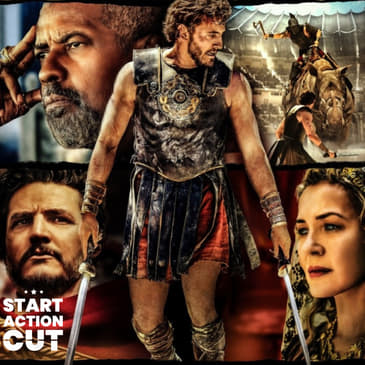
In this episode of Start Action Cut, Aswin and Padmakumar are decoding the historical epic film Gladiator II directed by Ridley Scott. The movie stars Paul Mescal, Pedro Pascal, Denzel Washington, and Connie Nielsen in lead roles.
See omnystudio.com/listener for privacy information.
[00:00:07] Hello and welcome to the 100th episode of Onmanorama Movie Podcast, Start, Action, Cut. Thanks to all our listeners. Today we are decoding the English film Gladiator II and we have Ashwin here to discuss the film. So when we talk about Gladiator II, a revisit to the old one, the prequel is inevitable and in that we travel through the story of Gladiator II and the old one.
[00:00:35] Maximus played by Russell Crove and his turmoil and betrayal at the hands of Commodos who murdered his father. And that was an awesome and inspiring story. And compared to that, this falls short of becoming a nerve-wracking or soul-stirring movie. What do you think Ashwin?
[00:01:03] First of all, Patma Kumar, a big congratulations on this milestone.
[00:01:07] Thank you.
[00:01:07] And a thank you to all our listeners also.
[00:01:10] So, okay. Talking about this film, my first glimpse of this film, I actually started watching this film in bits and pieces like back then when it was released.
[00:01:20] So, we used to have this film screenings on star movies at around 9pm.
[00:01:25] So, I remember watching a scene from this movie like a huge colossal set piece, decapitation, lot of bloodshed.
[00:01:34] And that was first kind of mind-blowing for me.
[00:01:37] And it was then that I decided that I should actually start watching this film in its entirety.
[00:01:42] And then it went on to win Oscars and it was a raving hit.
[00:01:46] So, it actually puzzles me how the idea of such a film of such a magnitude actually started off.
[00:01:55] It all began with a painting.
[00:01:58] Because I read somewhere, one of the film's studio producers, studio owners and its producer, Douglas Wick, actually started off with a painting.
[00:02:12] A painting of two gladiators.
[00:02:14] One has fallen and one is standing above him.
[00:02:16] So, they took this painting to Ridley Scott.
[00:02:20] They showed him this painting.
[00:02:21] They had a rough draft of the script also.
[00:02:24] But Ridley Scott and of course he is also an art school product.
[00:02:28] He didn't even, you know, ask for the script.
[00:02:31] All he was engrossed about was this image made by a French painter.
[00:02:38] So, they asked him like, shouldn't you be going through the script?
[00:02:42] So, that was one thing he said like, we will work it out.
[00:02:45] Like, we will figure out about the script.
[00:02:47] So, what happened was history.
[00:02:50] It was a real masterpiece because as film lovers, we have read about movies.
[00:02:57] We have watched movies like Spartacus, Cleopatra, Ben-Hur, all those historic epic period movies in 50s and 60s.
[00:03:04] And then there was a huge gap.
[00:03:06] There was a huge gap in the 90s and in early 2000, this film happened.
[00:03:11] It wasn't, what struck me about Gladiator 1 was, it wasn't just an action hero film.
[00:03:19] It wasn't just a war film.
[00:03:20] It wasn't just a periodic film or something.
[00:03:22] But it had romance.
[00:03:24] It had emotions.
[00:03:25] It had those lavish sets.
[00:03:28] It had those groundbreaking visual effects, which was unheard of at that time.
[00:03:34] So, all that made it into an extremely engaging, stupefying experience, like watching experience for me back then.
[00:03:43] So, talking about Gladiator 2, as you said, you can't help comparing it with the prequel.
[00:03:52] But again, as you said, it's difficult given the scale and magnitude and the popularity the original has achieved.
[00:03:59] But it's very hard for any film, although the director remains the same, the writer remains the same.
[00:04:06] But I didn't find the emotional scenes in this sequel as moving as I was moved by the first film.
[00:04:15] Yeah, yeah.
[00:04:15] You said it right, Ajwan.
[00:04:17] And you talked about the painting.
[00:04:21] Yeah.
[00:04:21] And that paint-like quality we can see in this film, The Gladiator 2.
[00:04:26] Correct.
[00:04:26] But other than that, when we talk about the protagonist, Delucius, in this film, whether his charisma or whether his dialogues in the previous film, you see the dialogues were soul-stirring.
[00:04:44] Yeah.
[00:04:45] And they were poignant.
[00:04:46] I mean, in this film, the quality of the film, the first film, the first Gladiator part one, what is the quality about that film is the poignance.
[00:04:59] The script was coherent and how it moves you, connects you emotionally.
[00:05:06] But in this film, I don't find the emotion translating to the audience.
[00:05:11] That's what I feel.
[00:05:13] And even the characters, the characters were clearly written.
[00:05:17] And in this film, what I found was the characters were a bit like comical.
[00:05:24] They turned out to be caricatures.
[00:05:27] And when you talk about even other than this character of Lucius, played by Paul Metzcal and Lucilia, played by the actress, I mean, Connie Nielsen.
[00:05:44] Nielsen.
[00:05:45] Okay.
[00:05:46] All the rest of the characters were not, I mean, they didn't have any depth.
[00:05:51] The whole story didn't have any depth.
[00:05:53] That's what I feel.
[00:05:54] The character played by Denzel Washington.
[00:05:57] Macroness.
[00:05:58] Macroness.
[00:05:59] And he just falls short of being grotesque.
[00:06:02] That is what I feel.
[00:06:03] Okay.
[00:06:04] So, how do you read the characters in this film?
[00:06:06] See, I like the word you use, the poetic quality of the first film.
[00:06:11] Like, today morning I was talking to one of our reporters, a pronounced movie buff.
[00:06:16] And we were actually discussing about the poetic quality of dialogues in that film.
[00:06:21] In fact, there are so many dialogues in the first version of Gladiator which actually move us so deeply.
[00:06:28] For example, the first time we see Marcus Aurelius, he's stepping into the tent.
[00:06:34] He catches a glimpse of his daughter.
[00:06:36] And the first thing he tells her is like, if only you were born a man, what a Caesar you would have made.
[00:06:42] I mean, it has a theatrical quality.
[00:06:44] It's more like a Shakespearean tinge to it.
[00:06:47] It has got a, as I said, a theatrical quality to the entire purpose of that dialogue.
[00:06:53] Yes.
[00:06:54] And also, there is a very emotional scene in which Marcus Aurelius actually tells Maximus that he should take over.
[00:07:02] Like, his son would not be the next hire, but he should be the one who should take over.
[00:07:06] And then he asks Maximus about his home.
[00:07:10] Tell me about your home.
[00:07:11] And he describes his home like, there is a kitchen garden which smells of herbs in the morning and jasmine in the evening.
[00:07:19] There is a tall poplar at the gate.
[00:07:21] Then he talks about grapes on the south, olives on the north, apple, figs, pears.
[00:07:26] I mean, such beautiful descriptions.
[00:07:29] There is a flowy, fluid quality to the dialogues that were written for that film.
[00:07:35] But when you come to this Gladiator 2, we find it hard to connect with what these characters talk to each other.
[00:07:43] There are deeply emotional moments between the mother and the son whom she had abandoned long time back.
[00:07:51] But we hardly feel that emotion swaying us.
[00:07:54] There is no soul-stirring quality about the dialogues which were written for this film.
[00:07:59] That is one aspect which kind of drew me away from Gladiator 2.
[00:08:04] Having said that, the scale of this film, the quality of imagery that unfolded on screen was again magnificent.
[00:08:15] It was spectacular.
[00:08:17] It was, of course, spectacular filmmaking.
[00:08:20] And to quote a word from Variety Film Review, they used the term neoclassic popcorn film.
[00:08:27] I mean, it has got everything for an action movie.
[00:08:30] I mean, that's where it stood out.
[00:08:31] As I said, when the producer and the studio maker were actually having the discussion with Ridley Scott about how they should make this film.
[00:08:40] There was this one line about a gladiator wanting to avenge an emperor.
[00:08:44] He wants to kill him.
[00:08:47] So, Ridley Scott kind of asks them, like, will it work?
[00:08:50] Will it work for the audience?
[00:08:51] Will it make money for us?
[00:08:52] So, that's where they bring in all those emotional elements.
[00:08:55] Like, there should be a compelling quality, compelling reason for his revenge.
[00:08:59] I mean, it is entirely devised as a revenge drama.
[00:09:02] And then they build on this beautifully, brilliantly short action set pieces.
[00:09:08] But just because they have a very strong reason for Maximus to unleash his revenge.
[00:09:13] And he does it with kind of an idealism.
[00:09:17] He's a war-weary idealism.
[00:09:19] He does it with a sense of nobility.
[00:09:21] He believes in afterlife.
[00:09:23] And that's where when the makers were initially discussing it, okay, we will make an action film.
[00:09:29] Even if the film falls flat, at least there would be some boys who would watch the film just for the sake of action scenes.
[00:09:36] But it was then that they inserted his belief in the afterlife.
[00:09:41] Like, his wife and his son were slaughtered in the most brutal manner.
[00:09:45] And then he believes that after his death, he would reunite with them.
[00:09:51] And then he can live with them.
[00:09:53] I mean, such strong belief in the afterlife elevates his quality as a character.
[00:09:57] And that's where we could relate to him more.
[00:09:59] And that's why Maximus continues to inspire us.
[00:10:01] That quality was, I think, missing in Gladiator 2.
[00:10:04] Yeah. And even the war scenes.
[00:10:06] I mean, the combat and the sword fights and the firing burning arrows.
[00:10:10] And all those scenes, sequences were, I think, in the previous film, the prequel, they were realistic.
[00:10:19] And here, they were, I mean, way down in terms of being realistic and spectacular.
[00:10:30] That is what I feel.
[00:10:31] But to add to it, we still kind of wonder at what Ridley Scott could achieve at that time.
[00:10:39] Because it was during the shoot of this film, Oliver Reed died.
[00:10:43] Oliver Reed plays the role of Proximus.
[00:10:47] I don't remember the name of that character.
[00:10:49] But Oliver Reed plays the character who actually brings in the slaves.
[00:10:52] Who actually takes the slaves for these gladiator games.
[00:10:56] So, Proximus' role was played by Oliver Reed.
[00:10:59] And during the show, it was mandatory that they end the shoot by 5pm so that he can have his own time.
[00:11:06] His own time. So, he died while drinking in a bar.
[00:11:09] And the entire unit was kind of stuck because they still had some scenes to be shot with Oliver Reed.
[00:11:16] But that was where Ridley Scott improvised.
[00:11:20] I mean, he had such a strong grasp over his subject that he could rearrange the shots.
[00:11:26] He could rearrange the scenes he had already shot with Oliver Reed.
[00:11:30] And then at that time, they thought of using a digital mask for Oliver Reed.
[00:11:34] So that, I mean, these all things were revealed to us as viewers later on.
[00:11:39] At that time, when we watched this film, we felt no difference.
[00:11:43] Because there is an interesting scene where we actually feel that there is no need for Oliver Reed's character anymore.
[00:11:49] But they had still shots left for Oliver Reed.
[00:11:54] Because I think they had written a scene for Oliver Reed.
[00:11:58] After Maximus' death, he enters the arena.
[00:12:01] He picks up flicks of dust and then he tosses it.
[00:12:05] You know, like a man who has seen it all.
[00:12:09] Like a man who has...
[00:12:10] It's like a show of rumors of a man who has sent so many men to death.
[00:12:14] It was in that arena.
[00:12:16] He had brought men and he had seen them die.
[00:12:19] So that one scene was written off.
[00:12:21] But even then, we kind of remember his character.
[00:12:24] So that was the brilliance.
[00:12:26] You spoke about technology.
[00:12:27] At that time, using a digital mask to kind of revive a character.
[00:12:33] Because initial discussion was to reshoot the entire thing.
[00:12:36] Which was like budget-wise, they had already escalated their estimate.
[00:12:40] And even then, they came up with this idea of digital mask.
[00:12:43] They rearranged the scenes and they pulled it off.
[00:12:46] But coming to this thing, we are far more advanced in terms of CGI.
[00:12:50] In terms of visual effects and all.
[00:12:52] But again, I love that aquatic scene.
[00:12:57] That the arena is converted into a kind of sea of swords.
[00:13:00] We have that marauding fishes moving around.
[00:13:05] And the entire battle being played around.
[00:13:07] I love that scene.
[00:13:09] Yeah.
[00:13:09] Yeah.
[00:13:10] And even the CGI, I think it was the monkey.
[00:13:15] What kind of a breed of...
[00:13:18] I don't know.
[00:13:18] I couldn't get it.
[00:13:20] In the initial scene.
[00:13:21] In the initial scene.
[00:13:22] It was tiger, I think.
[00:13:23] Animals.
[00:13:24] Animals.
[00:13:24] But here, I think a different variety of...
[00:13:27] I mean, what breed of...
[00:13:28] It was kind of more animated creatures.
[00:13:30] More animated creatures.
[00:13:30] So...
[00:13:31] And that was...
[00:13:33] I found a bit not convincing.
[00:13:36] Okay.
[00:13:37] And...
[00:13:40] So...
[00:13:41] Anyway, but the paint-like quality and as you said earlier, the scale, the magnitude...
[00:13:47] How...
[00:13:47] I also wondered how they recreated the whole Colosseum and the arena as real as it was before.
[00:13:55] So...
[00:13:56] Anyway, I think the movie is watchable.
[00:14:00] It is of course watchable.
[00:14:01] We have that poetic quality to the frames also.
[00:14:04] I mean, it looks like a painting also.
[00:14:06] Like stand-alone paintings.
[00:14:08] Yeah.
[00:14:08] All that works for that film.
[00:14:10] But in the first film, even if it was criticized for historical inaccuracies.
[00:14:14] For example, historically speaking, Commodus was not killed by a gladiator.
[00:14:19] Of course, he was killed by a gladiator, but he was strangulated by a gladiator while he was taking a bath.
[00:14:24] That's how it was believed to be.
[00:14:26] That was the original history.
[00:14:27] But Ridley Scott was so confident that he didn't even bother going through the script.
[00:14:30] Because he believed in this art of filmmaking, making use of whatever technology that was at his disposal.
[00:14:36] And he came up with a masterpiece.
[00:14:38] So...
[00:14:40] Given the limitations at that time, it was really a wonder, that film.
[00:14:45] But coming to this thing, as I said, even as our reporter Swati actually said, as a stand-alone...
[00:14:53] I was talking to her the other day.
[00:14:55] She said, as a stand-alone film, it may work, but I don't know.
[00:15:01] Yeah.
[00:15:01] If...
[00:15:02] I too, I think if you give me a choice to watch the film once more, I would only go for the first one.
[00:15:09] So, there was...
[00:15:10] There is nothing that much inspiring the second part.
[00:15:13] Right, right, right.
[00:15:13] So, anyway, we can watch it for this...
[00:15:17] For this pictorial quality.
[00:15:20] That brings us to the end of this episode of Start Action Cut, produced and hosted by me, Pat Nurumar.
[00:15:27] And thanks for listening to the episode.
[00:15:31] And please come...
[00:15:33] Do listen to Start Action Cut out on every Monday.
[00:15:36] Thank you.
[00:15:37] And thanks for listening to the episode.
[00:15:39] And if you're listening to the episode of Start Action Cut, you can see the end of this episode.
[00:15:41] And we'll see you next time.