
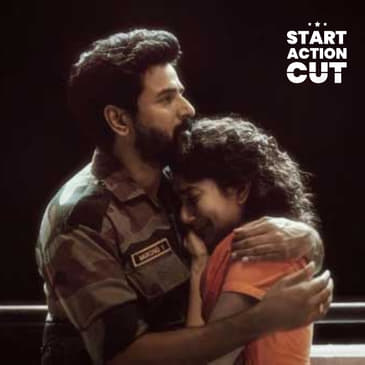

In this episode of Start Action Cut, Swathi and Padmakumar are decoding the biopic of Major Mukund Varadharajan. The action war film is directed by Rajkumar Periasamy. Sivakarthikeyan plays the lead role as Major Mukund Varadarajan, while Sai Pallavi plays Indhu Rebecca Varghese Major Mukund's wife.
See omnystudio.com/listener for privacy information.
[00:00:11] Welcome to Onmanorama Movie Podcast, Start, Action, Cut. This week we bring you a discussion on the Tamil biopic of Major Mukundh Varadarajan, an army major whose exceptional courage and heroics led to several breakthroughs in neutralizing some dreaded terrorists in the Kashmir Valley and making the extreme sacrifice in the country's honour.
[00:00:38] So Swathi is here to discuss the film. The action war film is directed by Rajkumar Periaswamy and Shivakarthi again plays a lead role as Major Mukundh Varadarajan, while Sai Pallavi plays Hindu Rebecca Varkis, Major Mukundh's Malayali wife.
[00:00:58] The narrative has been adapted from a segment in the book series, India's Most Fearless, True Stories of Modern Military Heroes by Shiv, Harur and Rahul Singh.
[00:01:12] Swathi, I like the movie very much and there are lots of aspects which make the movie a delightful watch.
[00:01:21] First and foremost is the exceptional blend of the cinematic and the realistic action and army scenarios. Then there is the emotional connect it establishes.
[00:01:35] The romance, the pain, the adrenaline rush strike us point blank. The ambush, war scenes and the military activities have been captured with the exact rawness without losing even a bit of its essence. What do you think?
[00:01:52] Well, Pat Mukundhwar, first of all, what stood out for me the most was how the movie brought back a flood of fond memories from my college days at Madras Christian College.
[00:02:02] So before getting into the movie, I just want to say that the scenes where Mukundh and Hindu meet and wander about the campus felt so familiar.
[00:02:10] It was like reliving those moments all over again. So a big thank you to the team behind Amaran for capturing those memories so beautifully.
[00:02:17] I'm sure my fellow MCCians will feel the same way. And about the movie.
[00:02:22] So when I was watching Amaran, it was honestly, it was super engaging.
[00:02:26] I think Shivakarth again, as Meetan Mukundhwar, he gave out a totally grounded and calm performance, which was so different from the roles we usually see him in.
[00:02:36] So he I think he really nailed the army vibe. And I think he could feel because he was looking like an army person.
[00:02:41] He was behaving like it, his whole physique. I think he did a physical transformation for this role.
[00:02:46] So the whole look of the movie and the strong performances were the huge standout for me.
[00:02:50] And it did slip into some of the usual army movie cliches, but it still kept me hooked.
[00:02:57] I think Shivakarth again, he just drove the movie forward and Sai Pallavi, who plays his wife, Indu Rebekah Vargis, just complimented his character really well.
[00:03:07] Usually in these movies, the hero is the main focus and the hero just gets a few emotional scenes on the side.
[00:03:13] But here, Sai Pallavi's role felt so much more real and balanced.
[00:03:18] And sure, there are those tear-jerker moments, but I think Shivakarth pulled off those moments really well.
[00:03:24] So I think Amaran overall was a really engaging watch, which talks about army people, their lives.
[00:03:31] I think the makers really tried to put in that effort to make us understand what it's like to be the family of an army person as well.
[00:03:39] Because usually in these movies, you get to see the version of the army man.
[00:03:44] But here, you get to see his mother's version, his wife's version.
[00:03:48] She's a single parent, bring their daughter, bring up their daughter, all that.
[00:03:52] So you could connect with multiple characters in the movie and it was a really well-made army movie, I would say.
[00:03:57] Even if the family version is shown, I think the makers have kept the charm, the adventurous, I mean, the urge for adventure in the army, the urge to join the army, that they have kept it intact.
[00:04:12] And both Shiva Cartaghan and Sai Pallavi showcase a volley of magical moments.
[00:04:18] Shiva Cartaghan falters not a bit in absorbing us entirely and carry us all through the saga.
[00:04:25] However, it's Sai Pallavi's brilliant nuances that gratify and mesmerize us.
[00:04:32] Whether it's the young, shy girl in the college, scared of walking the ramp on the stage,
[00:04:38] or the excited damsel smitten with her senior Mukund,
[00:04:44] or the lover in revolt against her family members who oppose her relationship,
[00:04:50] or the army officer's proud wife who is desperate for her husband's return from the restive land.
[00:04:59] She does them all with a matchless perfection.
[00:05:03] And then I like the moment when she receives the news, the saddening news,
[00:05:09] and how she is trying to cover up her emotions, but still she's helpless.
[00:05:16] So those moments were really emotional and real tearjerkers.
[00:05:21] And the music elevates the cinematic experience to a great measure.
[00:05:26] But the only problem was that she couldn't actually speak like a Malayali.
[00:05:30] So that dropped the charm of the realistic aura that the film was trying to put forward.
[00:05:38] What do you say?
[00:05:39] I completely agree, Patmogumar, because I felt like they could have cast it.
[00:05:43] Obviously, there is no question when it comes to Sai Pallavi's performance.
[00:05:47] She did a tremendous job as Indu Rebecca work.
[00:05:50] But I thought they could have cast a Malayali actor itself to play the role.
[00:05:55] Because there were many scenes where she had to speak Malayalam,
[00:05:59] but it felt like a Tamil person is speaking Malayalam.
[00:06:02] So that was a little off-putting.
[00:06:04] Then again, when it comes to the romance from the college days,
[00:06:08] that felt a bit cliché.
[00:06:10] The romance story with everything from like the meet-cute convincing their families
[00:06:15] and entering into that vet log.
[00:06:16] It was fun to watch, but it felt a bit overly dramatic for me.
[00:06:22] But after Mukund goes to the army and all those sequences were really realistic.
[00:06:28] But the initial few scenes where, like I said, they meet and how they get married
[00:06:35] and those scenes, I kind of felt like they were made to be a little more dramatic than needed.
[00:06:41] So the initial stages of their romance, that looked a bit cringy.
[00:06:47] So that's all but after a while, the story picks up momentum and then it goes forward smoothly.
[00:06:55] Another notable aspect was the depiction of Kashmiri people.
[00:07:00] Their ways, their life, turmoil, as well as the insurgence and their approach were convincingly picturized.
[00:07:08] Even the stone-belting scenes looked quite natural.
[00:07:12] I think the exactness was maintained even in the army-related activities,
[00:07:18] including the passing out parade and the training and all.
[00:07:21] How was it for you?
[00:07:22] So in a way, it is like a tribute to the family members of the army people
[00:07:27] and what they're going through and how they're sending these people to the army
[00:07:31] because everything is uncertain when somebody goes into the army.
[00:07:35] That dynamics beautifully explode in the movie.
[00:07:39] And there's a sequence, I think we can discuss the details of the movie now that it's been two weeks since the movie's release.
[00:07:47] There is this scene where Shivakarthi and Anisban travel in this vehicle and they suddenly get ambushed.
[00:07:53] And Sai Pallavi is on call with Shivakarthi again.
[00:07:56] And she hears all these bombs going off and shootings and people getting killed and all that.
[00:08:02] And the kind of emotions that she's going through was so relatable.
[00:08:07] Like you could actually understand it.
[00:08:09] Like if somebody is so close to us or so dear to us,
[00:08:13] we feel like something were to happen to them and we are actually on the phone
[00:08:17] and we don't know what is happening there.
[00:08:19] I cannot imagine if something like that happened in real life, how would we even react?
[00:08:25] And I think kudos to Sai Pallavi for pulling that scene off with such brilliance.
[00:08:29] It was so emotional.
[00:08:30] I think that was the most emotional scene in the movie for me.
[00:08:34] Even, you know, it affected me more than the climax sequence
[00:08:37] because this was so engaging and gut-rensing.
[00:08:41] I felt like, I don't know what kind of emotions Sai Pallavi as an actor went through to actually act that scene.
[00:08:48] I was actually thinking, okay, she might have really internalized that scene to understand the real Indus version.
[00:08:56] And then she might have acted this part because otherwise it would not seem really convincing.
[00:09:02] And if the role were to be given to somebody else, I don't know how they would have handled it.
[00:09:06] I think somebody with a great acting prowess, they need an actor like Sai Pallavi to execute that role.
[00:09:12] So there are many instances like that as well, not just this scene,
[00:09:16] but this was the most touching scene for me from that movie.
[00:09:19] Very true, Swati.
[00:09:21] But seeing some of the characters of the army men, there was a doubt how they could keep long hair and beard.
[00:09:28] And I have read somewhere and I heard that there is an explanation in the movie, but that's not quite established.
[00:09:34] So I wondered how it could be.
[00:09:36] So I just wanted to know the reason.
[00:09:39] So what do you say?
[00:09:40] I think even that reason wasn't really clear to me,
[00:09:43] but I thought maybe they were allowed to grow the beard or like something like that because they were maybe to just camouflage with the normal civilians so that they would seem normal and not like army people.
[00:09:58] Yeah, but it's not right to do the nitpicking when many of the other aspects, many of the other things have gone astoundingly well.
[00:10:05] But one thing that did not quite work with me was I don't know if others felt the same way, but I was not extremely invested in Major Mukund as the character because, you know,
[00:10:17] before even watching the movie, you know what is going to happen to this person because there were many provostal amends and you read about this story.
[00:10:24] So, but when that was happening, I was not crying because I maybe because I was already anticipating this, but somewhere I felt like the emotional connect that you should feel with the main character that was sort of missing in the movie.
[00:10:39] Because externally, when you look from a little bit far away, everything seems perfect in this movie.
[00:10:44] But do you have that emotional connect to this character? I don't think so.
[00:10:49] But maybe with Sai Pallavi's character, I could relate to her character more.
[00:10:53] But with Mukund's character, I don't think the makers were able to establish the intense feelings that one should feel for that character.
[00:11:01] Yeah, but I don't quite agree to that because I feel Shiv Kartikeyan did a commendable job and he was actually following the trail of the army major's life.
[00:11:15] So that's what I said. He was not actually emotionally expressive as an army man, but all those feelings were there subdued inside him.
[00:11:24] So we felt that it was inside him, but he was not actually expressing them. So that's how I felt.
[00:11:31] So the movie is thoroughly engaging, entertaining and at the same time, it shows the true picture of a soldier's life, how dangerously they live in war-dorn areas.
[00:11:43] So that brings us to the end of this episode. Thanks for listening to Start Action Cut, produced and hosted by me, Pat Mogumar.
[00:11:49] Follow www.onmanorama.com for more podcasts and movies and be sure to come back for the next episode of Start Action Cut out on Mondays. Thank you.