
Which stream is best after Class 10? Science, Commerce, or Humanities?
It is one of the most common questions parents and students ask after Class 10.
But what if the question itself is wrong?
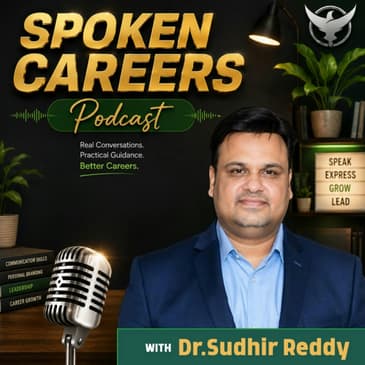
In this episode of Spoken Careers — Home of Career Decision Intelligence, Dr. Sudhir Reddy examines one of the most important education decisions Indian families face: choosing a stream after Class 10.
Science is often treated as the most prestigious option. Commerce can sometimes be viewed as a second choice. Humanities is sometimes unfairly described as having limited career opportunities.
But these assumptions can turn an academic decision into a social ranking exercise.
A stream is not a status symbol.
It is an academic pathway.
PCM, PCB, Commerce and Humanities can lead toward different combinations of subjects, degrees, skills and career possibilities. Choosing one does not automatically determine a student's final profession.
A student choosing PCM is not automatically choosing engineering. A student choosing PCB is not automatically choosing medicine. Commerce can lead toward areas such as finance, accounting, economics, management and business. Humanities can support pathways involving psychology, law, social sciences, communication, public policy, design and other fields.
The more important question is whether the chosen pathway makes sense for the individual student.
That requires looking beyond marks.
Parents and students should consider academic interests, demonstrated capabilities, learning preferences, the kinds of problems the student enjoys thinking about, realistic future pathways, motivation and practical family considerations.
The episode also explores an important parent–student tension.
Parents often recommend a particular stream because they want to protect future options. Students may have a different view of what they want to study and how they want to learn.
Neither perspective should automatically win.
A better conversation asks:
What future are we trying to protect?
What does the student genuinely want to explore?
What evidence supports the decision?
And as AI changes the nature of many professions, the discussion should go beyond which stream appears safest. Analytical thinking, communication, creativity, problem-solving, adaptability and the ability to work effectively with technology are increasingly important across many fields.
The goal of stream selection is therefore not to find the universally “best” stream.
It is to find a well-informed academic pathway for this particular student.
The question to carry with you is:
If nobody had told us which stream was prestigious, what would we discover about this student's genuine academic direction?
A stream should serve the student's future.
The student should not have to serve the stream's reputation.
- which stream is best after Class 10
- best stream after Class 10
- Science Commerce or Humanities after Class 10
- which stream to choose after 10th
- stream selection after Class 10
- career guidance after Class 10
- career guidance for Class 10 students
- choosing a stream after Class 10
- Science vs Commerce vs Humanities
- career options after Class 10
best stream after Class 10 + Science Commerce Humanities + stream selection + career guidance
- stream selection after 10th
- choosing stream after 10th
- best stream for students
- Science after Class 10
- Commerce after Class 10
- Humanities after Class 10
- Arts vs Commerce vs Science
- PCM after Class 10
- PCB after Class 10
- subject selection after Class 10
- Class 10 career planning
- career planning after Class 10
- career options after 10th
- career guidance for parents
- career guidance for students
- parent career guidance
- choosing subjects after Class 10
- how to choose stream after 10th
- how parents should choose stream
- student career confusion
- career clarity after Class 10
- future career options
- career pathways after 10th
- Science stream career options
- Commerce stream career options
- Humanities stream career options
- AI and future careers
- future-ready careers
- academic pathway
- choosing academic stream
- Class 10 stream selection mistakes
best stream after Class 10, which stream is best after 10th, stream selection after Class 10, Science Commerce Humanities, Science vs Commerce, Commerce vs Humanities, Science vs Humanities, choosing stream after 10th, career guidance after Class 10, career guidance for students, career guidance for parents, Class 10 career planning, career options after 10th, PCM after 10th, PCB after 10th, Commerce after 10th, Humanities after 10th, choosing subjects after Class 10, parent student career decisions, career clarity, academic pathway, future careers, AI era careers, future-ready careers, Spoken Careers, Career Decision Intelligence, Dr Sudhir Reddy
[00:00:19] Welcome to Spoken Careers, home of Career Decision Intelligence. I'm Dr. Sudhir Reddy. A Class 10 result arrives, and almost immediately the questions begin. So, Science, PCM or PCB, maybe Commerce, Humanities, and somewhere in the conversation one question usually appears, which stream is best? But I think that's the wrong question, because a stream is not a prize,
[00:00:46] science. It is a pathway, and the pathway has to make sense for the student who is going to walk it. Consider what happens in many families. A student has good marks in science. Someone says, then obviously take science. But good marks and good fit are not necessarily the same thing. Another student enjoys economics, business, and numbers. But Commerce is presented as though it
[00:01:10] is somehow a second choice. Another loves history, psychology, languages, or social sciences. And someone says, there won't be any scope. These statements can sound like guidance. But sometimes, they are simply old assumptions wearing the clothes of advice. And that brings us to today's career myth. The myth is, the best students should choose the most prestigious stream. But here's the career truth.
[00:01:35] There is no universally best stream. There is a better informed pathway for a particular student. Science is not a career. Commerce is not a career. Humanities is not a career. They are academic pathways that can lead toward many different possibilities. A student choosing PCM is not automatically choosing engineering. A student choosing PCB is not automatically choosing medicine. Commerce can lead toward finance, business, economics, accounting, management,
[00:02:04] and many other directions. Humanities can lead toward psychology, law, social sciences, communication, public policy, design, and much more. The important question is not, which stream has the highest status? It is, which pathway fits the student's interests, capabilities, learning preferences, and future possibilities. And parents have an important role here. Most parents aren't trying to
[00:02:30] make a bad decision for their child. They are trying to protect the future. Sometimes, they choose science because they believe it keeps more doors open. That concern is understandable. But keeping doors open has a cost if the student spends two years behind a door they never wanted to enter. So, let's use the next minute to make this practical. Before choosing a stream, don't ask only,
[00:02:53] what are the marks? Ask, which subjects does the student genuinely engage with? Then, what kind of problems do they enjoy thinking about? And finally, which future pathways does this combination realistically support? Now, let the parent answer those questions separately. Let the student answer them separately. Then compare. You may discover agreement. Or, you may discover a difference that needs a conversation. That conversation is valuable.
[00:03:20] Because the goal isn't for the parent to win. And it isn't for the student to simply get their way. The goal is to make the decision with enough understanding that both sides can explain why the pathway was chosen. And one more thing matters in today's world. AI is changing how many careers work. That makes the quality of a student's capabilities increasingly important analytical thinking, communication,
[00:03:45] creativity, problem solving, adaptability, and the ability to work intelligently with technology. So, the question is not simply, which stream has the safest future? The better question is, which pathway gives this student a strong foundation for developing the capabilities they will need? Before we finish, here's one question I'd like you to carry with you. If nobody had told us which stream was prestigious, what would we discover about this student's genuine academic direction?
[00:04:14] Because class 10 is an important transition. But, it is not a ceremony where a teenager has to declare their entire future. Choose a pathway. Understand what it opens. Understand what it requires. And remember, a stream should serve the student's future. The student should not have to serve the stream's reputation. If you're navigating this decision with a student or family, you'll find more resources at SpokenCareers.com