

Is getting into a prestigious college enough to build a successful career?
A famous college can provide excellent opportunities, strong networks, experienced faculty and valuable exposure. But opportunities only create potential. Students still have to use them.
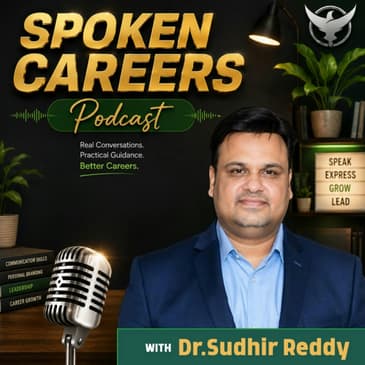
In Episode 42 of Spoken Careers, Dr. Sudhir Reddy explores the difference between college reputation and career capability through the contrasting journeys of two students.
One has the stronger college brand.
The other spends four years building projects, gaining experience, experimenting, networking and developing practical skills.
The episode explores an important question for students and parents:
What should a student actually build during college?
You'll discover five questions to ask before choosing a college:
- What will I actually learn?
- What will I be able to build?
- Who will I learn alongside?
- What opportunities will I have?
- And most importantly, will I actually use them?
Career Myth: If I get into a great college, my career will automatically become great.
Career Truth: A college can create opportunities. It cannot use them for you.
Signature Idea: Your college can open the door. Your capabilities determine what happens after you enter.
Spoken Careers — Home of Career Decision Intelligence.
[00:00:15] What if you spent four years trying to get into the right college, only to discover that you never asked what you were going to do once you got there? A famous college, a beautiful campus, a strong ranking, a powerful alumni network. All of these things can matter. But here's the uncomfortable question. What happens if the college gives you the opportunity and you don't use it?
[00:00:36] Welcome to Spoken Careers, home of Career Decision Intelligence. I am Dr. Sudhir Reddy. Imagine two students. Let's call them Arjun and Kabir. Both want to study computer science. Arjun gets into a highly prestigious college. Kabir gets into a less famous college. Arjun's family celebrates. Relatives call. Everyone says, wonderful. His future is secure. Kabir's family is happy too, but they keep hearing the same question.
[00:01:06] Why didn't he get into the bigger college? So Arjun arrives on campus feeling confident. Kabir arrives feeling that he has something to prove. Four years pass. Arjun attends classes, completes assignments, writes examinations and gets reasonable marks. He graduates with a prestigious college name on his resume. Kabir takes a different route. He builds small applications, participates in competitions, joins a robotics club, works with two classmates on a startup idea, does an internship,
[00:01:36] fails at a project, fails at a project, fails at a project, starts again, learns a technology that wasn't part of his syllabus, and builds something again. He doesn't have the same college brand, but he has something else. Evidence. Evidence of what he can do.
[00:01:50] Now imagine both students sitting in the same interview. The interviewer looks at Arjun's resume. Good college, good marks. Then asks, what have you built? Arjun pauses. Then the interviewer looks at Kabir. What have you built? Kabir opens his laptop and starts showing the work. Suddenly, the conversation changes.
[00:02:11] This isn't an argument against prestigious colleges. Not at all. A strong institution can provide extraordinary opportunities. Better infrastructure, better peers, better professors, better networks, and sometimes better access to internships and companies. Those advantages are real. But opportunity is not the same thing as outcome. And that's the distinction we often miss.
[00:02:35] Now let me ask you to explore today's career myth. The myth is, if I get into a great college, my career will automatically become great. Here's the career truth. A college can create opportunities. It cannot use them for you. Think about being given a gym membership at one of the best gyms in the city. You have excellent equipment, great trainers, beautiful facilities, everything is available. But if you never exercise, the membership doesn't make you fit.
[00:03:03] Education works in much the same way. A great college can give you access. But you still have to learn, experiment, build, communicate, network, ask questions, take risks, and sometimes fail. This is particularly important for parents. Because parents understandably want the best college for their child. And college rankings feel measurable. Marks are measurable. Cut-offs are measurable. Placements are measurable.
[00:03:29] But some of the most important outcomes of education are much harder to measure. Can your child think independently? Can they solve an unfamiliar problem? Can they communicate clearly? Can they work with people? Can they learn without someone constantly telling them what to do? Can they build something from an idea? Can they recover when something doesn't work? Can they make decisions? These capabilities may not appear on a college brochure. But they will eventually appear in the student's life.
[00:03:55] So here's a simple exercise. Before choosing a college, don't ask only, how good is this college? Ask five more questions. First, what will I actually learn here? Not what the brochure promises. What does the curriculum really look like? Second, what will I be able to build here? Projects, research, clubs, competitions, internships, real world work.
[00:04:18] Third, who will I become friends with? Because your peer group can influence your ambition, your thinking, and your opportunities. Fourth, what opportunities will I actually have access to? And fifth, perhaps the most important question, will I use them? Because a college can give you a hundred opportunities. If you use none of them, the number is irrelevant. There's another trap here. Sometimes, students spend their entire class 11 and class 12 years trying to enter a particular college.
[00:04:48] They prepare, they compete, they worry, they sacrifice. And finally, they get in. Then something strange happens. The goal was so focused on admission that nobody thought about what happens after admission. It's almost like spending years trying to get onto a football field and then forgetting to play the match. Getting into college is not the destination. It's the beginning of another phase. And this is where career decision intelligence becomes important.
[00:05:15] Don't ask only, which college will accept me? Ask, which environment will help me become more capable? That's a much better question. Before we close, here's today's golden minute. Your college name will open some doors. Your degree may help you enter the room. But eventually, someone will ask, what can you do? That's when your projects matter, your skills matter, your thinking matters, your communication matters, your experience matters, and your character matters. So choose a college carefully. Absolutely.
[00:05:45] Compare the curriculum. Look at the faculty. Study the opportunities. Understand the costs. Examine placements. Talk to students. And visit the campus if possible. Do your homework. But once you enter, stop worrying about whether the college is impressive enough. Start becoming impressive enough. Because the real return on education isn't the name printed on your degree. It's the person who walks out carrying it. Here's one question to carry with you. Imagine your college name disappeared from your resume tomorrow.
[00:06:14] No ranking. No brand. No famous alumni. Nothing. What would you still be able to show someone that proves what you can do? Your answer may reveal exactly what you need to build during the next four years. To explore more insights and future-ready resources, visit www.spokencareers.com. I'm Dr. Sudhir Reddy. This is Spoken Careers, home of Career Decision Intelligence. Choose the college carefully. Then make yourself worth remembering.
[00:06:44] Keep learning. Keep growing. Walk your path with courage. Live it with purpose. And always lead with love.