
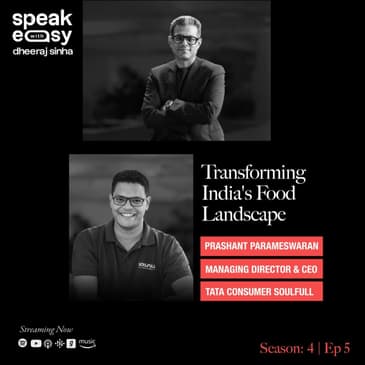
In this episode, our host, Dheeraj Sinha delves into the intriguing world of millets and their resurgence in India. He engages in a conversation with Prashant Parameswaran, the MD & CEO of Tata Consumer Soulfull Pvt. Ltd., who brings invaluable insights to the table with his extensive experience in the food industry. Prashant's discussion touches on the challenges of popularizing millets, bridging generational gaps, and making them relevant to contemporary dietary preferences.
The episode also explores the art of building a brand in the diverse landscape of Bharat. Prashant emphasizes the significance of understanding regional differences and cultural nuances in marketing. Overall, this episode provides a concise yet informative glimpse into the transformation of India's food industry and the strategies behind it.
[00:00:00] Can there really be a new proposition in the over-cluttered food category?
[00:00:13] We've all heard of Millets, but what explains its rising popularity in India?
[00:00:20] Is it a metro train or does it go down to tier 2 and tier 3 as well?
[00:00:26] Also, what's the key to building a brag for Bharat?
[00:00:30] Welcome to Speakeasy with Dheeraj Sinha, today we are talking to Prashad Pandit Shweraj.
[00:00:35] He is the MD and CEO of Tata Consumer Soulful.
[00:00:39] Prior to this Prashad was a co-founder of Kotaram Agro Foods which was acquired by the Tata.
[00:00:46] Prashad, welcome to Speakeasy with Dheeraj Sinha.
[00:00:50] Hey, Dheeraj likewise looking forward to this conversation.
[00:00:54] Amazing, amazing.
[00:00:56] So listen Prashad, I was going through the whole story and what peaked my interest first
[00:01:01] is that how does it feel right from being outside a large network building your own
[00:01:08] brand, soulful etc.
[00:01:10] And now coming and becoming part of a large conglomerate like Tata.
[00:01:15] So I will first start with how does that transition feel?
[00:01:20] The good bad and the ugly of it.
[00:01:21] No, I think I will just summarize it very, very simply.
[00:01:25] Great for, right?
[00:01:27] And when I say great for, grateful for very many things.
[00:01:32] One is I think it's a big validation and there is entrepreneurs you make large risky
[00:01:37] bets if you will.
[00:01:40] We have always been a very purpose driven brand.
[00:01:43] We believe that brands have to have purpose.
[00:01:47] And like I say, you know, I believe brands are immortal human beings.
[00:01:51] Right?
[00:01:52] So if brands have to be immortal human beings, it needs to go on beyond just let's say
[00:01:59] the founders, the co-founders and the original team.
[00:02:03] And to me, to be with the Tata's right and the brand now being Tata soulful, I'm grateful
[00:02:11] for the simple fact that this is the path of the immortal human being of the brand to
[00:02:17] stay.
[00:02:18] And to me, I think from there it's just a brilliant, brilliant piece.
[00:02:22] I think it's a marriage that's really made, I don't want to jinx it but in heaven because
[00:02:29] we are getting the entrepreneurial nature of the brand, the value system of, you know,
[00:02:36] all of us across India and even outside of India now cherish the Tata brand.
[00:02:43] And how do we actually then take this and get the brands into what I always call the
[00:02:49] value of India and more out of not just the top four, five, you know, six cities where
[00:02:56] you are seated, where I am seated but really into the value of India.
[00:03:00] And I think to me, just grateful for that.
[00:03:02] And as an entrepreneur, I'm committed to ensure that this becomes a success.
[00:03:07] And I think that's what is key for us.
[00:03:10] Amazing.
[00:03:11] Amazing.
[00:03:12] Amazing.
[00:03:13] And so moving on to the business and the space that you are into shant, right?
[00:03:17] I mean, health is kind of heating up in a big way in India, right?
[00:03:23] Post pandemic and so on and so forth.
[00:03:25] And all of us are relooking at our behaviors, our food that we eat, everything, all of
[00:03:32] that.
[00:03:33] I don't understand from you how widespread or how deep is that?
[00:03:36] Do you see this as a surface?
[00:03:39] You know, I watched a few recent.
[00:03:40] I made a few changes now have turmeric in milk.
[00:03:44] Is that the level it is at?
[00:03:46] Or is it going deeper?
[00:03:48] Is it going deeper in terms of town class, middle Indian, so on and so forth?
[00:03:53] You know, what's really going on from your perspective?
[00:03:56] That's a great question.
[00:03:58] There is a great question.
[00:03:59] I think.
[00:04:00] So first, let me, I'm known to buzz myths.
[00:04:03] So I'm going to start busting some myths.
[00:04:05] Amazing.
[00:04:06] Right from yeah.
[00:04:07] Right.
[00:04:08] I think we all think of health and you know, health and wellness and we think about
[00:04:14] all of it.
[00:04:15] It's right.
[00:04:16] Don't get me wrong.
[00:04:17] Yeah.
[00:04:18] Right.
[00:04:19] But but let me first address the health and wellness part.
[00:04:21] Right.
[00:04:22] I think the whole piece right on health and wellness definitely COVID has been jumped has
[00:04:28] made us all take a second and pause.
[00:04:32] But like all realities of catastrophic events, those memories paid right?
[00:04:38] Those memories paid very quickly.
[00:04:40] Absolutely.
[00:04:41] I mean, there was a time in the office or right from work from work from home.
[00:04:45] There's that suddenly it looks like COVID me.
[00:04:48] It suddenly feels like was a decade ago.
[00:04:51] Right.
[00:04:52] What was merely fewer months ago.
[00:04:54] Yeah.
[00:04:55] So the path that I want to really so definitely that is.
[00:04:58] It's had its health and wellness.
[00:05:00] It's had all of that we've realized that you know vaccines can only take care of us for
[00:05:03] so much.
[00:05:04] You know, we need to take care of the food.
[00:05:07] One part that COVID is done and I will relate this to telecom and industry have always
[00:05:12] watched with lot of closeness right?
[00:05:16] Telecom also we had the jump right?
[00:05:17] We didn't do the classic landline.
[00:05:20] We went straight into early from and we leap from and I think what that has done is it
[00:05:25] is it has definitely done a leap frog from my health and wellness perspective.
[00:05:30] However, the path that I want to bust is food is genuinely supposed to be about nourishment.
[00:05:37] Yeah.
[00:05:38] That is what your grandmother told you, your mom or told you.
[00:05:41] Absolutely.
[00:05:42] I told you right?
[00:05:43] That's what my grandparents told me right?
[00:05:45] I call them party.
[00:05:46] Tata whatever right whatever you may call them food was about nourishment which is why
[00:05:52] we ate dal ki chiri, we ate sambar right?
[00:05:55] We ate all of that.
[00:05:56] It was always about nourishment and I think India has the ability to not have to follow
[00:06:04] the Western world in what has happened on packaged foods.
[00:06:09] I believe if we stay rooted to course of purpose of what you know food really means and
[00:06:15] we can stay forward to nourishment as being one of the major and more important pieces
[00:06:21] that is there.
[00:06:22] And that is why for us I think that becomes a difference and hence I said I want to bust
[00:06:26] that myth because for that person and I go back to the core and if I have to say of the
[00:06:32] belly of India, he or she has worked so hard to get 1500 rupees of disposable income on
[00:06:38] a monthly basis.
[00:06:41] Brands such as us have to work four times harder to ensure that we don't provide junk back
[00:06:49] for his or her hard earned 50 rupees but provide strong nourishment options because he or
[00:06:55] she has got a very limited food right and how do we then ensure that because he is not
[00:07:01] really thinking about health and wellness, he is not thinking about all of that.
[00:07:06] I am hungry.
[00:07:07] I am genuinely hungry.
[00:07:08] My kid at home is genuinely hungry.
[00:07:10] My wife is genuinely needing those food items back home and I think that becomes very
[00:07:15] very core and important.
[00:07:16] So I would not look at health and wellness from that particular piece if you will.
[00:07:22] Very interesting.
[00:07:23] I mean just going a bit deeper into because it is a topic of fascination for me as well.
[00:07:29] So I have done a lot of work in this space as well.
[00:07:33] I helped ITC launch the juice category.
[00:07:37] I also before that I worked on Ashivath.
[00:07:40] Ashivath was in fact the name in the brief itself and that became the brand.
[00:07:46] So I have keen interest in food and I feel that food in India is cultural right.
[00:07:51] It has character.
[00:07:52] It is tamseks, satvik right?
[00:07:54] It is auspicious.
[00:07:55] It is a whole joy and celebration around food so you cannot understand the idea of food
[00:08:01] in India in an objective way minus the cultural connections that it comes with but help me
[00:08:08] understand a bit more.
[00:08:09] For example, I see my own plate now and we are going back to Raggi and we are going back
[00:08:17] to Mundaal Chila and we are cutting down on carbs.
[00:08:22] It is almost like going back to what my parents always said but I defied right?
[00:08:27] So are you looking at India from a usage nourishment?
[00:08:32] Are you looking at India from a nutrition point of view in terms of how do we at a large
[00:08:37] scale make sure that we move the country to a more nutritious, more healthier eating
[00:08:44] behaviors and habits and what are the insights or what are the strategies that is emanating
[00:08:50] from that thinking.
[00:08:53] So I am very glad that Raggi and Jovar and all of that is popping back on your plate which
[00:08:58] I think is great right?
[00:09:00] I think there are two important parts not just so I think what you said right?
[00:09:06] The India like and you have been there, you have seen brands across forget food even in
[00:09:12] personal care I think we are a country of many India's right?
[00:09:16] And I think it is very important for us to understand what works in each zone, state,
[00:09:21] town even if you will and how do you really do it?
[00:09:26] The minute we start saying it is one size fits all I think that is where failure starts.
[00:09:35] So let's take some things very, very simplistically and I mean before we get into why melads
[00:09:41] and all of that but I will just use the simple example again of melads right?
[00:09:46] What Raggi means to a person in Karnataka and what Raggi means to somebody in Tamil Nadu
[00:09:53] very different.
[00:09:55] What nots me which is the same as Raggi in the astra has a very different connotation.
[00:10:03] You move further west towards the north, Bajara Roti and a Jowar Roti start having a different
[00:10:10] feel and different things.
[00:10:13] How do you bring this back in?
[00:10:15] And you move to the east, you move to Orissa and they start calling Raggi or Nadsni Mandaya
[00:10:22] right?
[00:10:23] If somebody had to name the same thing in different ways then he or she has a different
[00:10:29] connection.
[00:10:30] And I think it's very important for us to peel those connections and be able to say what
[00:10:36] is it that you are offering to the consumer back in his or her own area because this is
[00:10:42] not Karnataka Karagi.
[00:10:44] It is Orissa Karmandaya, it is Maharashtra Karnaj and how do you then actually start looking
[00:10:50] at that?
[00:10:51] And the minute you start changing that I think then it starts moving right?
[00:10:55] Obviously there are pieces in terms of communication there are all of that but I think that's where
[00:11:00] the real connection really starts coming out.
[00:11:03] Yeah, amazing.
[00:11:04] I want to probe this a bit more because this is very interesting because food is about
[00:11:11] core in India, it's center of plate and core doesn't change so easily.
[00:11:15] In fact, I did a study where I understood that most of the changes have happened at the
[00:11:21] periphery.
[00:11:22] They haven't happened at the dinner or the lunch plate but they happen in the snack
[00:11:26] moments right?
[00:11:27] Say Mahagi is happening in the snack moment.
[00:11:29] So we've kind of welcomed influences at the periphery but the core in India has to
[00:11:34] be intact right?
[00:11:35] It has to be Dalu tea, Chawal because we feel that's where the Sanskar kind of gets transferred
[00:11:42] right?
[00:11:43] So how are you navigating the equation between tradition and modernity?
[00:11:49] I mean, how much of tradition to leverage in your business and marketing and how much
[00:11:56] of modernity to leverage in terms of formats, you know, presentation, recipes, all of that?
[00:12:04] How are you navigating that equation?
[00:12:06] Yeah.
[00:12:09] So very interesting one and let me also tell you as we are very, very clear and focused about
[00:12:17] reviving millets.
[00:12:20] We are extremely clear that we are not here to replace rice, wheat or corn.
[00:12:28] If we go down that path, I think we would have done a big, big mistake, a big injustice
[00:12:34] to the country and I don't think that's a path we will go down right?
[00:12:39] Because everything like you rightly say has a place on the plate and what our journey
[00:12:46] is about reviving these grains which used to be a part of the plate and bringing them
[00:12:54] back into today's plate.
[00:12:56] It has kept the generation so that transition is going to be slightly tougher, which means
[00:13:04] a child of today, which is I'm saying the young India or the future of India really has
[00:13:12] not seen his or her mom that actually consuming millets but it is the grandmother grandfather
[00:13:22] who has actually been, has seen the consumption and has actually seen what would I say
[00:13:30] the large decline of these grains.
[00:13:33] So that's point number one.
[00:13:35] So given that fact of the batter on the table to assume that in a generation you will make
[00:13:42] it to the center of the plate, I think is a very far-fetched one.
[00:13:48] That layered with the second part which is and this is again not just the case of urban
[00:13:56] India but is the case of Bharat if I may.
[00:14:01] The number of meal occasions are significantly increasing and which is why like you said
[00:14:09] in the snacking and all of those because these are large new consumption occasions which
[00:14:16] really didn't exist as much.
[00:14:18] So there's no traditional mental model to that?
[00:14:22] Absolutely.
[00:14:24] I think and to keep the core of the Sanskar, the food to be a part of home which is the breakfast
[00:14:33] lunch and dinner more so.
[00:14:36] Dinner more so.
[00:14:37] And especially as we move into a nuclear and I'm trying to not look at India today.
[00:14:44] If you have to look at India 20-30 years out, we will move further and further down this
[00:14:51] path.
[00:14:52] We will move further and further, it'll take time for it to really come into the belly
[00:14:57] of India for dual income household.
[00:15:00] And I'm saying reaching to 10 lakh population, 15 lakh population, 5 lakh as we call it
[00:15:06] right, the TLPs in all of yours.
[00:15:09] It will take that time but it will move there.
[00:15:11] These occasions will only increase and how you over the course of one next school generation
[00:15:19] focus on a simple piece of how do you make millet relevant for those consumers?
[00:15:24] I think that is got to be the core.
[00:15:27] And I am again stating so one of the things that we always say as much as it's about
[00:15:32] millet, the way we look at it is how do we make millet relevant to the 21st century
[00:15:38] consumer right, that is on most of my slides that I open with right what is start as
[00:15:43] full making millet relevant to the 21st consumer right, it doesn't just mean we'll
[00:15:48] make Jubhi product on our lake as well.
[00:15:51] Does it mean the purpose is not solved right, so that's the core and that's the thinking
[00:15:56] in the philosophy.
[00:15:57] Nice.
[00:15:58] And so how are you approaching this Prishandar?
[00:16:01] Are you saying that okay let me target the biscuit occasions and replace this or let
[00:16:06] me target mega occasions and replaces or are you saying I will take a share of nourishment
[00:16:14] and nutrition that there's a certain gap in the nutrition palette and therefore I will
[00:16:20] target that what's really the approach or all of it.
[00:16:24] Yeah so I wish it was all of it, I mean if it's like this right, if you try to do all
[00:16:28] of it none of them will succeed.
[00:16:30] So I like my back.
[00:16:31] Yes.
[00:16:32] If you will and be clear and focused.
[00:16:34] I think what really we focus on is what we call the Minimials equation right and when
[00:16:39] we talk about Minimials what does Minimials mean right Minimials is essentially all other
[00:16:44] occasions that are classic lunch and dinner right and how do we then focus on various
[00:16:50] Minimials occasions.
[00:16:51] We look at yeah very, very clear intention spaces right mom chai interaction right very
[00:16:59] very interesting large diners and trust me we've done enough and more of the study it does
[00:17:05] in change from the highest level of income lowest it does not change mom wants a child
[00:17:12] wants to see they both are trying to find where is the midpoint right and that tension
[00:17:18] exists at every every level.
[00:17:21] Yeah right so there is that and among various consumption occasions and that pattern also
[00:17:27] changes from age of 5 to 20 right.
[00:17:30] If you will just say and I guess with with respect to August 15 right there is the status
[00:17:38] of independence that the child really gets right or what is that really arching independence
[00:17:43] where mother starts losing control and child starts taking control of his own life if
[00:17:49] you are able to get the analogy and make it right and there are a way as many sets of
[00:17:54] locations that are there and so we look at each of those consumption occasions through
[00:17:58] and through.
[00:17:59] So it could be a going to school moment, it could be a coming back from school moment,
[00:18:03] it could be in the school moment, it could be in the bus moment, in the commute moment
[00:18:07] and there are various moments.
[00:18:10] I prefer to come from like the classic old school marketing of day in the life of the consumer
[00:18:18] versus what I call see today.
[00:18:20] Nice yeah.
[00:18:21] I would just say market research oriented category approach because a category approach
[00:18:28] means you do, yeah this market size is not share.
[00:18:33] In a place where you are really trying to define blue oceans if you come category towards
[00:18:40] consumer I don't think you will ever find a blue ocean right.
[00:18:43] Yeah you already bound by the given exactly right so you are already thinking in a
[00:18:50] parallel like a horse with the reins on right and I think in the minute you start looking
[00:18:55] at it from this way you start seeing opportunities, you challenge status right newer brands like
[00:19:00] as our job is to challenge status go.
[00:19:03] What is status go status go is somebody has been doing something great has been successful
[00:19:08] it's growing growing but by the way the world has changed dynamics have moved maybe he
[00:19:14] or she's blind sighted look at that blind sightedness finally opportunity go after it.
[00:19:20] Yeah yeah nice amazing.
[00:19:22] The other dichotomy in India I've traditionally discovered Prashant is the whole equation
[00:19:28] between taste and health right and long time back the Mariko's of example where they
[00:19:35] optimized for health and not taste and did not succeed in the first session right so
[00:19:42] you know Ajay who is student capital foods once told me that you know you know
[00:19:48] Bhartiye kahi bhi chala ja right but Jypta kusko mircha suad ni yata aosko khanek me
[00:19:54] trypti nahi hoti right so so for India right I mean hell is fine but it has to be tasty
[00:20:00] right we will not we will not subtract taste for the sake of health right how are you navigating
[00:20:07] that I mean are you actively thinking about it what's going on on that front there's no
[00:20:12] actively thinking I think it's safest to embrace the reality and the truth and I give you two
[00:20:17] pieces right pieces on this so one is I used to work in the west I used to work in the US right
[00:20:24] in the US you know you could say gluten free low car yeah etc people will compromise on taste
[00:20:31] right and they're fine with yeah and it's not compromise on taste I think it's also the lack of
[00:20:37] Masaera you know the whole masala the sauce tanginess yeah they don't have that in their talent right so
[00:20:44] for me as an Indian I say boss you're compromising on taste but his definition of taste is also slightly
[00:20:50] different yeah it's a line yeah come yeah it's a lie when you come to India I cannot agree more
[00:20:56] say at the end of the day it's food what is difference between food and medicine taste yeah yeah right
[00:21:04] career in the business of food the not in the business of medicine yeah so that's the first
[00:21:09] thing right to my mind I'm very clear right here in the business of medicine it's fine we'll make
[00:21:14] Ragi Bala pills 100 KK Calcium Joby right then then you're in a pharmaceutical business
[00:21:21] there are not enough pharmaceutical business we have the business of food so that's the first
[00:21:25] and at Soulful we're very very clear right we go by this one mantra which is taste first and health
[00:21:31] forward amazing I like that yeah it's and health forward and health forward right and when you look
[00:21:38] at that it basically tells you how it's fantastic right and that's a very very clear if you look at
[00:21:46] some of the products right and every single product that we have launched right there is no where
[00:21:53] that you will ever hear a consumer saying taste it's an eda right that's not something he or she
[00:22:00] may not like a variant right in our eyes we have a chocolate vanilla strawberry right
[00:22:07] we play a lot or dial around a lot on sugar level salt levels fat levels we bring them totally
[00:22:13] down we don't have Meda in any of our kids the range of products yeah right we don't add Meda it's
[00:22:18] the easiest thing for me to do yeah right we don't but that does not mean yeah the child which
[00:22:24] who is in Meda is no problem mummy Diaz so I will eat it now that child is thinking of all other
[00:22:31] stuff he say who's got lunch box me he's got snack box me here she's thinking about all the other
[00:22:37] brands and companies are there yeah why should that child be penalized for his or her mom's decision
[00:22:44] absolutely right and and that we are very very clear on I mean second yeah even if we look at the
[00:22:51] adults range of our portfolio right how do you get so we have a masala or if you taste the masala
[00:22:57] or plus right the consumers love the masala they are the kick if you taste our tomato flavor for
[00:23:06] example it's got a massive top note of spice right because we like that I mean there is the
[00:23:12] yeah yeah yeah yeah yeah tomato and then there is the kickball automatic we like clear we look
[00:23:17] eight months you said never kickball America chaiy bina kikballa mergo nekar na right and how do you
[00:23:22] that and it becomes very important to put it and ingrain it right at the core of product development
[00:23:29] yeah research all of those pieces right so today we are exploring some flavors right and we're
[00:23:35] looking at some flavors that we believe that there are things that children like but they're not
[00:23:40] stating it they've not seen it right they've not really felt it but how do you then start bringing
[00:23:45] you know from some other category as we call it yeah some inspiration and bring them in yeah
[00:23:51] some will work maybe some will not work but I think the concept of compromising on taste
[00:23:57] is a complete no no yeah how has this been because you are you are trying to get a behavior change
[00:24:05] and food is the hardest behavior to change so how's it going so far I mean what are the challenges
[00:24:11] you're seeing or what are the wins that you've already got yeah so I think I think
[00:24:17] you're absolutely right because when it comes to food in the minute you say health
[00:24:22] yeah yeah karab over karst they have add millets oh yeah brown color dark color yeah you know
[00:24:30] I mean with due respect we gained our independence but our love for the color white is still very
[00:24:34] high right so we like everything right now so what does that mean for a brand so what that means
[00:24:42] for a brand is essentially the core of letting the consumer know that hey I got your back
[00:24:51] I understand that you are doubting me can I deliver the taste can I deliver how back up
[00:24:57] I say ingredient healthy better for you all that I'm getting but yeah yeah because don't forget
[00:25:04] he or she has worked hard for the same fifty hundred bucks the bespoke up yeah correct yeah he or
[00:25:10] she's going to say boss why should I go here navela cheese this come and I know try it yes
[00:25:17] yeah why should I fail at my cost right yeah I should I feel right I'm not willing to experiment
[00:25:24] classic early adopters you know the graph but if you just go down to human science forget all
[00:25:30] these earlier adopters the graph all of this basic thing I have fifty hundred bucks you want to
[00:25:36] sell something to me I don't know I don't believe you I don't buy you sampling sampling and being
[00:25:43] at the core of activation has been one of the core pillars for us so right from get go that has
[00:25:52] been a mantra we have been insanely clear about we continue and that's what we will have it is
[00:25:59] worked it has worked now obviously I mean you and me have also been sampled lot of things on airplanes
[00:26:05] where you're like thank you for making it taste them I'm never going to buy this again right you don't
[00:26:09] want to be in that that bracket if you will so which means if you are confident about your product
[00:26:16] right if you're confident about that sampled to the low sample and get people to be convinced
[00:26:23] that hey this is worth amazing a piece of pie of that fifty hundred rupees that you struggle to work for
[00:26:30] so shant you know I want to switch gears a bit and you know so obviously India's had many
[00:26:36] traditional brands right I mean we know we know a partly and a Britannia and you know all the
[00:26:41] all the food companies right and now across categories including in food now we have new age brands
[00:26:49] coming in and in many categories new age has succeeded significantly I mean at R&B in fact help build
[00:26:56] some of them you help build Amazon Spotify phone pay Ola and so on and so forth how are you
[00:27:02] navigating that part you know being a new age brand trying to build new behaviors new category
[00:27:07] you have some support of a traditional name such as data now so that I'm sure is helping
[00:27:12] but how you're navigating the whole building a new age brand and finding quick success because
[00:27:18] finally it's also about getting some early gains right I mean nobody we're all running a business
[00:27:23] and nobody's waiting to to give you the leverage that five years later you will deliver goods
[00:27:28] to the shareholders yeah absolutely and you know I also come from a very hardcore distribution retail
[00:27:38] background I don't come from the classic marketing background if you will
[00:27:44] and the hard and way that you know my dad is taught me and then I've gone selling into stores
[00:27:50] and collecting the money the outstanding bills as you call it
[00:27:55] deliver value to the consumer be relevant to the consumer and you will succeed
[00:28:02] be relevant to the consumer and you will be irrelevant and I think keeping things as simple
[00:28:09] as that sometimes can just do wonders if you see our front of back you will never see a cluttered
[00:28:17] soulful back we will stand very very clearly this is start a soulful this is the product range
[00:28:24] these are one two three things we deliver right the architecture there are just to give you a sense
[00:28:32] has been drawn up five seven years ago right we have thought about how is this brand going to look
[00:28:39] even at a massive massive scale nice yeah brutal they have brutal about this
[00:28:46] and I have no qualms of being brutal internally because at the end of the day I'm being very honest
[00:28:53] to that same consumer who has worked hard to get 50 hundred rupees of disposable income per month
[00:29:00] and if you are through an honest to that I believe very strongly you will be able to build strong brands
[00:29:08] you look at various opportunities look at bench of stuff and I think see the key part what new
[00:29:14] age brands really do what I was saying earlier is you are working on a world which is very dynamic
[00:29:22] brands that have been there are just growing and may not adapt and see some of the
[00:29:30] changes absolutely this dynamics yeah and that's the key yeah the example you spoke about
[00:29:36] Spotify the way music is listened to the music has heard yeah phone pay the way money was transacted
[00:29:43] right I mean today and I just on a side note right a very interesting conversation I have
[00:29:48] and I always speak this up in various cities right whenever you're on the red light there's a guy who
[00:29:53] comes in he's like quickly transiting I love it he's got the phone pay I mean he's got yeah absolutely
[00:29:58] yeah yeah he's got your code yeah I asked him so I asked him a question right I keep asking just to
[00:30:03] reassure myself that I'm not making a he says sir the beauty of this but I said
[00:30:08] was but now it's recorded government will know how much yeah yeah making does it concern you
[00:30:13] he said sir what's up choo I'm able to close way more transactions I just have to get signal today
[00:30:19] rather than use the change lose all of that and the interesting thing is I'm able to make a transaction
[00:30:26] there are a lot of customers by then they've not paid me but you know what more often than not
[00:30:31] by the time they've reached an hexagonal mirror pass pass area right so even if they were made
[00:30:36] and I think that's a great change yeah think of this person who's not really educated and all of
[00:30:42] that how they are now who they thought people are saying they who's got hard cash
[00:30:46] to you yeah yeah who was thinking about the hard cash right versus this and I think how you
[00:30:53] challenge it as co I think becomes very very important and there will be some key things that will
[00:31:00] happen that change stuff right yeah so one of the things that I read a lot on is curriculum right
[00:31:07] what are children being taught right within that is change nice interesting yes that is changed then
[00:31:13] something is changed right something has to change yeah yeah I mean it's like forces of Newton
[00:31:18] right yeah there's a push and pull to everything yeah yeah exactly exactly so so I think that's the
[00:31:29] thing so for example mehda today the children no they have the duties I don't think I was taught
[00:31:36] when I was a child no yeah now in their mind with mehda but they say oh the good stuff I like has mehda
[00:31:44] yeah how is this going to taste so how does the brand don't really work through this right yeah
[00:31:49] so which means the child is aware but are you going to generate that trial because perception
[00:31:54] is not going to be in the right place so then how do I work on various pieces to constantly up
[00:32:00] this game on perception yeah absolutely absolutely absolutely I will give you a damn good product all
[00:32:08] our communication is dialed on this little anger yeah yeah absolutely in fact all all my learnings
[00:32:16] in fact in in selling new behaviors or change is that in India change happens from grounds of
[00:32:22] familiarity right so when we sold Amazon we sold it like upke apni dhukaan that's like your neighborhood
[00:32:28] so when we sold phone pay we sold it like yeah it's like it's everywhere everybody can use it any
[00:32:34] amount anybody uses so you have to you have to lower the barriers rather than say you say this is
[00:32:39] change people said no I don't want to change you say same as what you're doing but better
[00:32:43] yeah I want to look at it so in India new always happens from the grounds of comfort and familiarity
[00:32:51] you know and and if you which you're doing you're you're talking about taste and you're talking about
[00:32:56] mother child and all of that and and you're already bringing the change from the realms of
[00:33:01] of familiarity and what we are used to in terms of marketing Prasad how marketing and also
[00:33:07] business right I mean how much is e-commerce and how much is offline how are you looking at
[00:33:12] channels there I mean between digital and and physical yeah so so I spend a lot of time I
[00:33:19] again if you have to see a lot of my focus is looking at very basic things very very basic things
[00:33:25] what's happening today e-commerce and D2C put together is close to 20 or percent of our overall
[00:33:32] business the growing significant yeah that's pretty significant growing significantly
[00:33:39] offline business is also growing significantly I think these borders of e-commerce and what we
[00:33:47] call general trade modern trade yeah is going to get murkier and murkier yes to the dislikes of all
[00:33:56] of us right the so-called learned community if you will yeah or marketing gurus if you will
[00:34:04] but I think it boils down to the simple thing right everyone's got a mobile everyone's got data access
[00:34:09] everyone's got the cheapest possible lowest data access right yeah so if I walk into a store I am
[00:34:16] going to price check why will I not 50 under rupees yeah I struggle to win it yeah I'll check
[00:34:20] what I'll check right it's like you know imagine a Dukandar come in saying no you're price check
[00:34:24] maybe like I'm out of your store buddy yeah right it's my money who are you to tell me I can use
[00:34:30] my phone to do price check right there was a point in time where you know grosses where not allowing
[00:34:35] you to do price checks as a consumer yeah yeah you're a consumer is a more ruled this is okay you don't
[00:34:40] end your mobile phone the mobile it all started with the mobile phone game correct it all started with
[00:34:45] the mobile yeah so I think the way I see this so so to me I think that multiple pieces but at the same
[00:34:53] time one needs to also understand the categories that you play and I think category dynamic start
[00:34:59] when I say category again the consumption occasion I've just left school
[00:35:05] a pocket changer maybe they're safe there to go bus stop say I'm going to walk past those bakery
[00:35:12] shops those chaiwala dukan I'm gonna want pass my favorite department store I have a little bit
[00:35:18] pocket change that mama has given me right I'm going to do something with that money yeah so there
[00:35:24] is a consumption occasion is he or she going to order on the phone at that particular point
[00:35:29] now you you want to know she goes home yeah once you're she goes home let's assume the mom is at home
[00:35:35] or they beat the mom and dad in the evening they'll say you know what my friend told me this
[00:35:41] papa how can I have your phone I want to see on flip card yeah Amazonia big basket
[00:35:46] right so suddenly the same child who made a small transaction in a store is going home
[00:35:52] and making a transaction on the phone and adding to the cart right so suddenly you start seeing
[00:35:58] now I think what becomes very important is for brands and all of us to know it's that same child
[00:36:04] who went to a panwala or GT classic making sure but also transacted on your brand Amazon yeah
[00:36:12] so yeah it's the same child and so which means look feel experience touch feel brand language
[00:36:19] everything has to be the same yeah the importance being cannot change yeah if that gives you
[00:36:26] absolutely no yeah no absolutely very very interesting and in marketing shant I don't know how much
[00:36:32] of marketing do you actually get into but how are you navigating that between traditional media
[00:36:37] online media influencer marketing you know how are you navigating that piece in your mind
[00:36:43] so I mean as much as I say marketing guru and all that my core is obviously in the marketing DNA
[00:36:49] that side of things I just try to break things down so that people don't get
[00:36:52] absolutely yeah I mean I have into box I have yeah I have the I have a filter call I tell people
[00:36:59] that you know we're all triple filtered MBAs right and we are paid to create the work that we do
[00:37:05] consumers not paid to look at this work so please always have that filter on yeah absolutely absolutely
[00:37:13] agree so I think I think the way we look at marketing I think multiple pieces I get I'm going to go
[00:37:19] with you remember that telecom days and I'm sure they are you seen the prepared post paid
[00:37:24] sim card you see in that whole Rpu game etc yeah boils down to the same thing customer acquisition
[00:37:32] customer retention right to very very you know very very core things so as much and as we called in
[00:37:42] the funnel right we got a key by acquiring consumers A because you have a new brand we have
[00:37:47] we are barely touched the country we're barely touched at the top box if you will so you have to
[00:37:53] constantly have the peace in terms of getting the set of the consumers so for that there is a set
[00:37:59] of task there is an activity there is all of those that we need to do and then there is the
[00:38:04] peace in terms of stop the leaky bucket right yeah don't allow your buckets to leak as you feel
[00:38:10] the bucket becoming the water tank becoming the larger tank the larger tank stop any leaky buckets
[00:38:16] right so this I call this retention piece and I think there are two very very large dynamics
[00:38:21] two very different dynamics so from a top and especially because we have a lot more to go a lot
[00:38:28] in terms of our GT sign of our business the landscape understand and again my gratefulness is
[00:38:36] we are in a place where we are able to go into every household every store that consumes
[00:38:43] deshka chai and deshka nama kha amazing yeah right which is started the entire salt yeah now that's
[00:38:50] a very very large of a huge leverage so as we do that it becomes very very important that we start
[00:39:00] actually bringing in a lot of consumers from some of the traditional pieces of media and we use a
[00:39:06] lot of the traditional pieces of media from that very very clear and communication a lot of our
[00:39:12] digital work right a lot of our digital work is on retention and all of those pieces that's where
[00:39:21] in fact a lot of our digital pieces not firing the other part where a lot of our digital also comes
[00:39:28] is within the categories where we look at young adults and when we look at young adults that's
[00:39:36] where really a lot of focus in terms of how we look at digital how will you do we approach them
[00:39:42] it could be on whatsapp it could be on facebook it could be on insta it could be on youtube
[00:39:46] it could be on the reels recently I was in indoor and I was I was with a taxi driver
[00:39:52] right and champion was on his phone I got into the car I said what are you watching
[00:40:00] use an instagram reels right use on instagram reels that's it yeah I see
[00:40:08] and if you see he's just like he's sick for me just mindless videos right mindless videos now he
[00:40:15] has the disposable income right so if I have to target him and imagine right and obviously I'm
[00:40:20] not in the car when you're on a market visit we are in out you know how the guy is the only time to
[00:40:25] do the reels yeah yeah and it becomes very important for us as a brand to be able to be there
[00:40:30] you'll be able to be able to be there and and how do you know when watching tv he's not going
[00:40:37] home and watching tv right so many consumption occasion now the challenge there is is the what
[00:40:44] is going to stick in his memory right so much of information overload that and then how do you
[00:40:51] measure that how do you measure the impact of what you're doing is it working I mean that's
[00:40:55] where our jobs then come in yeah so that's where I don't I'm not I'm not as much as impressions are
[00:41:02] important yeah I think getting strong relevant creatives and content yeah it's very very very very
[00:41:14] key yeah right as much as we could say what is our content strategy what is our content strategy
[00:41:19] yeah right you know all needs to tie itself beautifully because think of that same person
[00:41:23] where it'll just use the same guy right as he's flipping through so many reels just one add in going
[00:41:29] to do it and I think that's a mistake lot of people do right now we have tv card but I mean
[00:41:32] I was just we'll just change the frame to that we'll change everything yeah never one more
[00:41:40] so that's how i that's how we look at it yeah so yeah so do get into it quite a bit but leave
[00:41:46] the smart up folks in my team to really drive and in fact so Raseka who's the co-founder of soulful
[00:41:54] she heads the marketing yeah so I know the baby is in good hands yeah amazing amazing I mean you've
[00:42:00] definitely thought through the mental model is very very clearly Pshan give me a sense on I mean
[00:42:05] what would you what advice would you have right you're you're an entrepreneur at heart right and
[00:42:11] so what and I'm also asking from a context that you know the honeymoon with the funding game is over
[00:42:19] right and and we I mean a lot of a lot of people I know in the game are going through hard times
[00:42:24] right now right so say about 12 months back or 18 months back where it was very very clear that
[00:42:32] if you have an idea you're stupid that you're sitting on it right to today when you talk to folks
[00:42:37] and they're like I don't know right I don't know so what what would your advice be to entrepreneurs
[00:42:46] and to entrepreneurs in the food business interesting deep question I will be honest I'll just
[00:42:54] say what's worked for me right and yeah and I think every entrepreneur journey is a story of its
[00:43:00] own yeah what's worked for me brilliant family right I had a brilliant family who backed me to the
[00:43:09] hilt great co-founders who even today backed me to the hilt a strong team which we have built with care
[00:43:24] and we have been genuine we have been soulful we have never been sinful right and and when I say
[00:43:29] that I said with every single element I think what's important is to ensure that these three
[00:43:37] things are there right and the reason I say is the classic right you have a great idea
[00:43:41] karnai nakarna karnai nakarna then you get into opportunity cost what's my opportunity loss was
[00:43:47] keep all that aside do you want to do this do you not want to do this you know and now I'll sound
[00:43:52] like a broken paper product don't good for the money never do it for the money yeah if you do it
[00:43:57] for the money game over game over yeah right yeah and that's why I said because you have that's
[00:44:03] to be a reason yeah kira qi why why why what is that yeah otherwise it's not sustainable yeah you can't
[00:44:10] sustain it's not sustainable and and the fire here the fire here has to be self igniting so every
[00:44:18] time you think of it boom it has to be like 100 kilowatts is just flown through you so I think that
[00:44:24] becomes important and because then that fire is there you I love the poster you know a friend of mine
[00:44:31] gave me when I quit my job he says the old school poster you know red and white background man
[00:44:37] and I'll choose a job you love and you'll never have to work in your life right yeah I have to
[00:44:41] get that frame right yeah I mean be it on a holiday be it on anything this the brain is operating
[00:44:46] right the brains operate yeah the second is be ruthless about making tough decisions
[00:44:54] and when I say it's very easy to try to please all and I'll go with a very very famous saying that
[00:45:01] you know another and multi one says as a good manager you don't need to and he said it from a
[00:45:06] manager I take it from entrepreneurship yourself you don't need to be the most loved
[00:45:13] you don't need to be the most loved and I think this is a yeah you you cannot be I mean you're not
[00:45:19] here to sell ice creams yeah but as long as somebody can ask you and you say yeah if that person had
[00:45:27] to put yourself in your shoes would you do the same thing and if that answer is yes you know
[00:45:31] you'll take a right decision right so I'm not saying you have to make decisions to hurt people
[00:45:37] but don't make decisions to be loved very small difference but it's a large business this
[00:45:45] right and so the minute you wear that hat right then you start getting into being a very
[00:45:50] very focused person yeah some people will say about you know cut and right hair and all of that
[00:45:56] but at the same time just staying focused right because it's very easy to move left and right
[00:46:03] I'm having and once you are clear about the purpose you'll have people you'll have you know
[00:46:08] people on your cap table on your table off your table wanting to be on your table wanting to
[00:46:14] be off your table you'll have all of that but very very clear of why are you here why did you start
[00:46:21] the business what is your idea all about and I think it's just stay focused on that I don't think
[00:46:27] it's just about yeah it's about others so for example today right somebody would ask me
[00:46:31] maybe so what are you going to do next right yeah for me this journey is just begun I want to get
[00:46:36] me let's into a lot more homes I want to be a part of the revival of these grains if I can play
[00:46:44] a part of the huge purpose yeah at 60 huge purpose I will feel happy right I'm not saying I'm going
[00:46:50] to do this for 30 years right but I think it's very important to stay committed to that piece
[00:46:56] to see it in the right place to me when I know I'll be super happy is when I'm about to pop
[00:47:03] this immortal you may be still exists yeah right and other soulful still existing to me is going
[00:47:09] to be a very important piece yeah amazing hopefully that gives you a question yeah fantastic
[00:47:15] pressure yeah for fantastic and all of my last question right I mean work life balance is there
[00:47:21] is there any and how do you how do you navigate I know you're into sports and stuff like that
[00:47:26] so how do you navigate work life health all of that aspect because see I mean we realize it's not
[00:47:32] it's not a sprint right it's a marathon I mean everything I mean you building a culture organization
[00:47:37] on the ownership it's it's it's so how do you navigate that what's your point of view we give
[00:47:42] a fun fact there is so the first day of commercial production of soulful my first daughter was born
[00:47:48] oh wow wow so it's very easy for me to know that date right and I just keep track of a
[00:47:57] rich that's for us so it's an interesting one at the initial stages I think the line is very very
[00:48:04] murky right as the initial stages the line is very murky if I can then further add one of my co-founders
[00:48:12] also happens to be my wife why so right so which makes it which makes it but yeah it makes it and
[00:48:22] I'm only coming from the work life balance part and then what had been happens so initial stage
[00:48:27] I think work life balance is a very very tough one as the brand goes and I go back to again sorry
[00:48:34] very simple thing it's an immortal human being so at one year of age of your start-up think of
[00:48:43] that startup as a one year old child wouldn't a discipline discipline may over right so some
[00:48:49] large show some care as that becomes four five seven yeah most of all right get a little bit there
[00:48:57] get a little bit there don't get it boring don't get it boring but there is that thing so as it ages
[00:49:04] I think it gets a little bit better and then it starts becoming very important of saying when you
[00:49:10] are doing it be all in when you're not there right be out so I think that if you look at it from
[00:49:16] that immortal human being and I think it then becomes and makes it easier to happen
[00:49:23] I will also so I remind myself are a very very simple thing right so which is a quote from Mark
[00:49:28] Ziegobur and she says life is about choices yeah you have work you have family you have personal
[00:49:37] and you have social so four things right if you think you can do all four consider yourself wrong
[00:49:48] pick two or three you have to give up one for each is that's a choice yeah obviously the startup
[00:49:56] get over can't go out right yeah so I mean we caught that I mean such a fantastic conversation and
[00:50:04] we've reached that point in the podcast where we turn the mic around right so I've been asking you
[00:50:10] questions non-stop and you know it just has that so many mental models are so well thought
[00:50:15] through your brain to share it's been a fantastic conversation just love the conversation
[00:50:20] about your chance to you know grill me back I love that I love that but but thanks they are
[00:50:29] getting you know why enjoy I think some of these conversations also personally as well is it also
[00:50:36] helps a hopefully one is also get your mind as well thinking everything to me is a learning opportunity
[00:50:45] so this is a great one and hopefully would help and can help the listeners to your show as well
[00:50:53] so so so likewise so let's move let's move to what I didn't expect so this is an interesting one
[00:51:00] and I'm told it's like a rapid fire round that's so we can do it a simple question
[00:51:09] so yeah yeah it's not so I'm on this whole health plan for last one year right
[00:51:18] so I love I love these raggi crispy you know doza so they're very tasty and at the same time
[00:51:28] they don't do any harm so so at my home we have all these plea whatever batter of multiple of
[00:51:34] these raggi java and some mix with spinach and so on and so forth but I'm loving that
[00:51:39] right that's one second I'm also loving chia chia seeds pudding so I and I do it myself so I get
[00:51:46] almond milk I take it I fix it myself and I'm loving that so two of those nice nice
[00:51:53] village your married I'm married and we have two kids yeah nice what are your kids absolutely
[00:52:01] hating what do they hate when you buy when you buy when you buy from a store obviously we'll
[00:52:10] stay close to food and FMCGF you don't have to name the brand obviously village yeah
[00:52:19] I think I think they hate any kind of control right or any kind of we try to map our choices
[00:52:27] or behavior of them I think it's just fundamental sense of rebellion right so you know it's about
[00:52:35] them having their choice through as as conceptual as that then it doesn't matter you know
[00:52:43] nice nice I completely completely you know buy that and it's interesting just
[00:52:50] aside is to see so we've always said pesto power in India is not there very very high in the
[00:52:56] western world all right I would actually see at what point that inflection point will change so
[00:53:01] which obviously will then change your work and my work and yeah everybody here completely so
[00:53:08] healthy food versus delicious food you think that's a choice to be made no delicious I mean the
[00:53:14] reason I told you I love the agi doza all the chia seed pudding they're absolutely I mean
[00:53:21] right I mean I feel like I'm having key right without any sugar so I mean it has to be delicious for
[00:53:29] it to be healthy in my mind I mean those versus the devil otherwise I mean I mean we were at
[00:53:36] some friends yesterday and we were discussing that food is one of the biggest joys in the Indian
[00:53:40] culture I mean how can you not have food I mean food is for celebration food is for worship food is
[00:53:47] when somebody dies I mean food is so integral right you cannot take away the deliciousness from it
[00:53:54] nice nice and then do you think the I mean what people use internally and what people know of
[00:54:00] externally you know the taste may help be is it an oxymoron or is it you know
[00:54:08] or what's your what's your your your your your a great advertising guy what's your what's your take
[00:54:13] have you come up with a better line if you will yeah I think I think when people sit like that out of
[00:54:19] the duty trust because you've broken the two things down in A plus B right human mind and especially
[00:54:27] the Indian mind doesn't doesn't navigate food like A plus B it navigates food in a wholesome
[00:54:34] sense right if you look at if you're not tally right it's a it's wholesome joy there are textures
[00:54:39] there taste everything flows into everything else and you make it in one mountain you eat right so
[00:54:46] you the moment you begin to break down the idea of food in India into A plus B you've lost me
[00:54:53] and therefore I mean one of my biggest cases is Ashin Madh right when we name that Aata Ashin Madh
[00:54:58] the whole idea was that in India if the mother who's a gatekeeper I mean I use the idea of semi
[00:55:04] permeable membrane right I mean she will allow the right influences it she was okay computer will
[00:55:10] come to the house burger is okay snack but dinner has to be roti on dining table everybody together
[00:55:16] right and then we said Ashivadmaka Ashivadmaka is what it is now in the idea of Ashivad this everything
[00:55:22] this health there is taste there's watch salya there's sanskar everything so you have to find
[00:55:29] constructs which are culturally holistic and not turn it into a mathematical binary absolutely now
[00:55:36] very very nicely said very nicely said one of the best new launches you might have seen
[00:55:41] in the last maybe post COVID era post COVID era during COVID we saw a lot of
[00:55:46] between these boosting immunity boosting and all that post all that era anything that really like
[00:55:51] wow regardless of scale I think a lot of the eve launches are looking good food to me
[00:55:59] in foods specifically I mean hard hard doesn't come to my mind so that's inspiration for entrepreneurs
[00:56:07] yes I think so I think so I mean you tell me it's all the world stuff which is coming to my
[00:56:12] view in fact launched audio red velvet you know in time with stage your three Netflix I
[00:56:19] mean that's one of them maybe it's because close to me I mean we've worked on that category
[00:56:22] that comes to my mind but I never said I agree with you it's a huge blue ocean
[00:56:28] I love that poster by the way I still remember the design I was in the market and if I'm not mistaken
[00:56:35] Therick may have I'm wrong it was Oreo and then there was a slice like a proper slice of a cake
[00:56:41] yeah like a proper red velvet cake it was opposed to that stuck in my head and I think what this is
[00:56:47] you three years at least there is your family a second yes that's that's a darn good poster
[00:56:53] right and I'm just saying this has not from FMCG food and that to poster of all things right
[00:56:59] I mean I know there was billboards there was all of that but I remember that just so whoever did it
[00:57:04] in your team please tell them it was a very very good thing thank you yeah in fact in fact you know
[00:57:09] I did a huge study at some point time you should manage the business for McDonald's and I did a huge
[00:57:14] study on the food cultural food visual anthropology right and look at the idea of food in India
[00:57:20] is when you shoot it right in a western format it's already clinical and clean in India it has to
[00:57:26] flow I mean you go to any cat well right it is visual overload it has to be sensory overload if
[00:57:31] you're eating not flowing from here not coming from here there's no joy in it right and therefore
[00:57:37] when you're doing photography for food in India right it's a little messy a little overflowing a
[00:57:42] sense of abundance you have to code all of that India's not a sanitized clinical it's not that market
[00:57:50] absolutely absolutely nice nice well thank you so much Diraj I think I mean that's that's
[00:57:56] all the questions I had yeah lovely and really enjoyed the conversation Diraj yeah amazing thank
[00:58:02] you so much for doing this which I wish you all the very best wish you a lot of luck and success
[00:58:07] I'm sure you will get that and thank you for doing this yeah cheers cheers look forward to
[00:58:12] stay in touch cheers have a great time yes thank you bye bye
[00:58:17] millet is making a remarkable comeback in India this surgeons can be attributed to the pandemic
[00:58:24] which heighten our awareness around health what's also helping is the government's aim
[00:58:30] to make dish ke millets such as Ragi Joar Bajara main street making them available to households
[00:58:37] across India Prasham talks about the challenges in building this category unlike the previous
[00:58:44] generations who grew up with millets as a dietary staple most of us haven't seen them in our
[00:58:50] kitchens at Tata Seoul full they recognize this generational gap and the mission is to make
[00:58:57] millets relevant to the 21st century consumers the trick is to introduce millets to this audience
[00:59:04] in a way that resonates with their modern dietary preferences and lifestyles on the topic of
[00:59:11] building a brand in Bharat Prasham underscores the need for marketers to understand the different
[00:59:18] geographies and the cultural nuances the key here is to forge emotional connections with deep
[00:59:25] local understanding those are my learnings from the episode what were yours