

Learn more about your ad choices. Visit megaphone.fm/adchoices
[00:00:00] You're listening to the Quint's podcast.
[00:00:30] I'll have my Surma Saladosa. What do you have?
[00:00:56] Could you repeat the menu again please?
[00:01:03] I'll have a plane dosha.
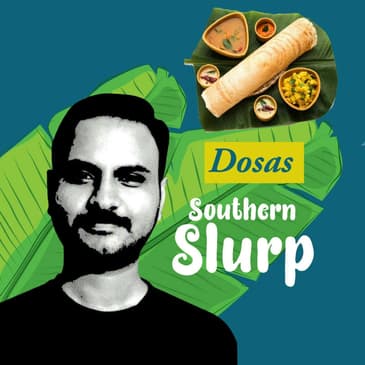
[00:01:10] Welcome to a crispy, fragrant and flavorful episode of Southern Slurp.
[00:01:24] One that's properly Tamil and I'm talking Sangam Eira 2000 year old recipe but is also definitely global.
[00:01:32] What goes around comes around, but with the dosa the batter goes round and round the hot plate
[00:01:38] and no matter who you are you'll definitely come around to its taste, texture and the almost ritualistic accompaniments.
[00:01:46] Before we dig in, we have a full blown menu of delectable episodes on Apple podcasts, Google podcasts, Spotify, Aawas, Geosarbon or wherever you get your podcasts from.
[00:01:57] This episode is going to make you hungry and now you know where to go.
[00:02:17] The people of the world can be divided into two categories, those who love the soft, thick dosa and those who will give their all for that perfect crisp, absolutely circular disc that crumbles at your touch.
[00:02:31] Which tastes better? Well that's no question at all since it depends entirely on one's personality, memories and nostalgia.
[00:02:39] The right question is which came first?
[00:02:50] Before we attempt to answer that, allow me to indulge you with the recipe for that perfect crisp dosa.
[00:02:58] Perfect dosa has to be round and crispy and with a little bit of either ghee or till oil.
[00:03:09] Asha Lata, my neighbour and good friend is an expert in tamarind rice and in the dosai.
[00:03:15] We do have an episode on tamarind rice and its tangy history so do remember to check it out.
[00:03:21] The dosa for Asha Lata must be crisp, way further if not paper thin and should almost melt in your mouth after a couple of choose.
[00:03:30] Here's how she achieves said consistency, taste and texture.
[00:03:34] I try to use ayantava but when you want a little bit of crisp then you use the non stick so that you use less of oil.
[00:03:43] I do indulge in oil when I make dosas because that makes the taste.
[00:03:48] About 5-6 hours I soak my urad dal and rice. There are 3 cups of idly rice.
[00:03:55] I make purely with idly rice only.
[00:03:57] One cup of whole black gram dal.
[00:04:00] I do have a wet grinder so I grind in that.
[00:04:03] I've grown up outside India so my mom used to do it in a mixy only.
[00:04:07] She used to make super soft dosas and crispy dosas also.
[00:04:12] So we grind the urad dal first let it become into a smooth batter.
[00:04:17] Rice can be little green not too smooth also.
[00:04:21] I soak a spoon of methi.
[00:04:23] Sometimes I put a handful of beaten rice that is poha.
[00:04:27] It makes it soft also and crispy also.
[00:04:31] For fermentation sometimes when it grinds in the night I leave it overnight but about 3-4 hours is ok because in hot weather you don't want it to be sour.
[00:04:41] So you leave it not too long in hot weather like chennai hot weather is very hot so it's ok to leave it for 3 hours.
[00:04:56] So what makes the dosa a dosa?
[00:04:59] Its name?
[00:05:00] Well its dosai in tamar, dosa in telugu and malayalam, dosai in Kannada
[00:05:07] And of course dosai in all other languages.
[00:05:10] The dosa by any other name is still an intrinsically tamar with recipe.
[00:05:15] The word dosaka in Sanskrit is actually derived from the tamar with dosai which finds mention in Sangam literature from earlier than the first century.
[00:05:25] It has been written about across the ages, the recipe is hinted at and eulogized in poems although not nearly as much as the pungal.
[00:05:34] And we do have an episode on that as well.
[00:05:37] There are a lot of recipes that involve batter being shaped into a thin or plump disk and fried over a pan.
[00:05:44] You have the apam for example, or the adai which is thick yellow brown and is eaten with avial a thick coconut milk based vegetables too.
[00:05:55] What makes the dosa a dosa as we know it today is the rice and lentil based batter and the overnight fermentation.
[00:06:04] Among the ancient tamar, the dosa was a purely rice based dish in which the batter is shallow fried in a pan.
[00:06:12] A recipe that resembles this 2000 year old dish is the illan dosai.
[00:06:23] It is pure white, silken soft in texture and as thin as a silk hankerchief.
[00:06:29] It is extremely hard to master even for expert cooks.
[00:06:38] Something my mother excelled in which I am yet to get right is illan dosai.
[00:06:42] Using watery dosa batter you make a perfect drum that's hard to get even with a compass.
[00:06:48] Close the lid and then remove from frame within 10 or 20 seconds.
[00:06:52] Even if you stack 30 or 40 of these illan dosais, it could be thinner than any lunch.
[00:06:57] Even removing one from the staff without tear on takes finesse.
[00:07:04] After all these years I still don't want to accept defeat.
[00:07:10] Rewati Aachi is the Julia child of Tamil cuisine and has been cooking for the camera for over three decades.
[00:07:19] The story of the dosai is a beautiful metaphor for how recipes tend to get refined over time.
[00:07:28] From a ruff and tumble experiment to an ubikitas, pour heat and eat recipe to find a flourishes to more complicated processing.
[00:07:43] The illan dosai as a recipe is simple and is basically thin salted rice batter.
[00:07:48] But over time it grew whiter, thinner, silkier and demanded more expertise.
[00:07:55] The recipe and the ingredients too underwent additions and changes.
[00:08:09] Let's head to 12th century Karnataka, working Somaishwara 3 composed the Manasol Lasa.
[00:08:14] A compendium of all things that delight the mind, food of course was given prime prominence.
[00:08:26] In it he describes the dosaka, the sanskritized version of the Tamil dosai and gives out what was then a popular recipe.
[00:08:35] Batter made from urad dal, chickpea and green pea was fried in clarified butter, ghee for Indians over a hot tawa.
[00:08:44] The ingredients in the modern dosa are different but this type of dish is still in boog in Karnataka and Andhra.
[00:08:51] The Andhras have somehow retained the ancient recipe of frying in a broken pot.
[00:08:56] In fact their version of the dosa called the atu is derived from the atika which means a broken mud pot.
[00:09:04] The Telugu's even have a festival atle dade in honor of this recipe.
[00:09:09] The dosa existed parallely in Telugu homes with the atlu.
[00:09:14] This we know from poet Shrinata's verses from the 15th century.
[00:09:18] He calls the dosas dosi alu and also mentions the atlu separately.
[00:09:23] The crispy fried rice and urad dal based dosa that the world loves today was popularized by the utpi restaurants that began in Maishuru
[00:09:31] and then travelled to Delhi in the 1930s.
[00:09:35] And then there was no looking back.
[00:09:46] Ratna ka feincha in 1948, modern restaurant in Madurai in the early 50s and of course the impossibly swift rise of saranabhavans from the 80s to the 90s have all made the dosa global.
[00:09:58] Each of these chains have brought in a little something to their version of the dosas.
[00:10:04] The masala, a spicy mashed potato mix introduced by Udupi.
[00:10:09] The unlimited sambar combination that remains Ratna ka feincha is USP and the classy interiors in high quality ingredients that once took saranabhavans to heady heights.
[00:10:19] But you know the dosas that are made in Tamil homes are in crisp and brown.
[00:10:24] They're soft, thick and far from crispy.
[00:10:26] This is the version that is popular at roadside dosa stalls and at homes.
[00:10:31] In that sense it is similar to the atlu of the telegos.
[00:10:43] The primary difference between a dosa and atu is the ingredients will be the same.
[00:10:50] However it is in the process of making.
[00:10:53] Dosa will be very crispy and thin and atu will be little thick.
[00:10:58] And atu size also varies from dosa.
[00:11:02] Dosa will be a big one, big round flat shaped one and atu we will generally pour in a small size.
[00:11:09] Hey this is Padmum inakshi and I work as a journalist with BBC.
[00:11:23] We go way back and are generational acquaintances and family friends.
[00:11:28] I know Vikram since his early childhood and I still remember his wedding in Madurai.
[00:11:35] So I have got a chance to visit my nakshi temple on the pretext of attending his wedding.
[00:11:41] She is a journalist by profession but a compendium of Telugu culture, history and aesthetics by nature.
[00:11:48] At our place dosas are regular thing and atu we use to make only during atlu tatti.
[00:11:56] Atlu tatti is a women only festival where women of the home, even the little kids, girls and their neighbors,
[00:12:04] and even friends will be invited to participate in the festival.
[00:12:10] And in the evening the festival will be celebrated.
[00:12:13] Men of the home do not have any role to play in this festival.
[00:12:19] My recipe for atu is one portion of urad dal, two portions of rice.
[00:12:24] Soak it well overnight and then the next day morning grind it and you have to keep the batter for 4-5 hours outside of the fridge.
[00:12:34] And then the batter will be ready to pour a tol and they will be delicious.
[00:12:40] The best combination for atu with any chutney, coconut chutney, tomato, coriander or the least ginger chutney.
[00:13:04] That brings our episode to a spicy end.
[00:13:12] Do remember to drink lots of water, a few minutes after you gauze on any variety of dosa.
[00:13:18] It will do you good. You could also wash it down with some filter coffee.
[00:13:22] That's my go to for everything and I do have an episode on that as well.
[00:13:26] Do check out more recipes and episodes and content on Apple podcasts, Google podcasts, Spotify and GeoSabin.
[00:13:34] And as always thank you for listening.