
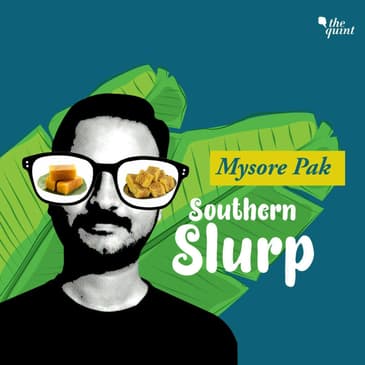

This is Vikram, and you're listening to Southern Slurp. Herein shall you find recipes, histories and mysteries from the many kitchens of South India. We have a large, wonderful tasting menu of episodes; some sweet, some spicy and all of them equally filling. Check them out on Apple Podcasts, Google Podcasts, Spotify and Jio Saavn.
Learn more about your ad choices. Visit megaphone.fm/adchoices
[00:00:00] Swap the Quint Spot. The war zones are laid out and the camps are split into the crumbly hard side to the right. The Mysore Pak should be medium-liquid speed, which would stay in the mouth for a bit before it melts.
[00:00:36] And the soft melt in the mouth side to the left. Soft a mess will park for me anytime. When you bite into this, you realise that it's slowly going away and melting into something velvety, something very glazy and that's very very sensual.
[00:00:55] And you also realise that there's a full scale explosion happening in your mouth when all the flavours of roasted basin and ghee and sugar everything is blending coming together so beautifully that it really really get addicted to it. Welcome to the Great Mysore Pak Desert Battle.
[00:01:30] This is Vikram and you're listening to Southern Slurp. Here in Shalufine recipes, histories and mysteries from the many kitchens of South India. We have a large wonderful tasting menu of episodes, some sweet, some spicy and all of them equally filling.
[00:01:50] Check them out on Apple Podcasts, Google Podcasts, Spotify and Geosubben. Back now to the delectable Mysore Pak. For those unfamiliar with South Indian sweets, the Mysore Pak is a confection, a dessert that's made of
[00:02:10] a flar, ghee and sugar. It has two variants. The traditional method results in a cake, slab, or square peas that is porous and hard. Class with two tightly in your fingers and it breaks apart. It is fragrant thanks to the ghee and the roasted gram flour.
[00:02:29] Take a bite and you will feel it crumbling into tiny pieces and melting away. The texture is truly beautiful. The more recent method results in a soft cake that is half golden and half brown.
[00:02:54] The moment you sink your teeth in, it melts onto the tongue and into the mouth. If made properly, it leaves hardly any residue in the mouth, allowing you to go for another piece and another.
[00:03:09] Wash it down with some coffee. After a bite of some savory snack and you're good to go. India has a long and rather wonderful history of sweets. In fact, India has the sugar daddy of the world.
[00:03:27] I mean, it was here that sugar was first processed and turned into an industry. The English and Persian words for sugar, candy and canned are derivatives of the Sanskrit Khanda.
[00:03:46] We'll sprinkle the history of sugar across the episode and the story of how the Mysore Pak came to be. For now, though, let's listen to Nyanam City's stories from half a century ago of the Mysore Pak. For water into it and drink it up like juice.
[00:04:29] Nyanam City lives in Nanganallur in Chennai and she's been making the Mysore Pak from when she was 18 years old. She's related to my in-laws in some way but our bond is much closer, thanks to mutual love for food. She loves to cook, I love to eat.
[00:04:45] I'm not sure if you're feeling it or not, but I'm not sure if you're feeling it or not. Nyanam City's pushing 70 now and according to her own admission, her Mysore Pak has never failed.
[00:04:55] If it does look like it is failed, it basically meant it would turn out harder than expected. Then I immediately cover up the hot Mysore Pak with a large plate. The vapor, good condons and make it go soft. So my Mysore Pak has never failed.
[00:05:10] She is undeniably an expert in the sweet. The Mysore Pak isn't just any sweet that start next to a mountain of other safaries and forgotten. The groom in those days will stay only for three days and one of the days Mysore Pak would definitely be made.
[00:05:26] It was rich dish meant to honor the guests. So for them to think, plan and then gather all of the ingredients necessary for it to take a full four days. So any of them are going to go on.
[00:05:38] You could get it out to go or join it after that we could see it made only next day. We're not going to get the part done. With all of the ingredients readily available today, making the Mysore Pak at home in the kitchen isn't physically difficult.
[00:05:57] But the process is all about timing. Mysore Pak is normally in front of me. For Mysore Pak I use one and a half-part sugar and one-part ground flour and 200 grams of ghee.
[00:06:13] This in carefully as Nyanam Chiti reveals the exact texture, timing and method of stirring or not stirring. It's a curry even though it's already hot.
[00:06:31] After making sugar syrup by reducing it to half at the ground flour and then we can go about our work and keep stirring it intermittently. When it makes bigings to froth you can stir it add a little of the ghee, wait and repeat.
[00:06:44] It takes a maximum of 30-35 minutes to make the Mysore Pak even in this low process. Stir it the first time with ghee and then the second time again when it froths. The third time it'll rise in brownish froth.
[00:07:02] That's when you pour it on to a tray greased with ghee. It'll puff up and slowly settle down. 10 minutes later when you slice it the Mysore Pak will be super. My grandchildren always love to eat my warm Mysore Pak.
[00:07:29] If you do try it at home let me know how it goes. Anyway, Nyanam Chiti reveals something equally interesting while giving out the recipe. Mysore Pak here in the danyu. I don't remember the Mysore Pak being there.
[00:07:40] Ladhu was there but I don't remember the Mysore Pak from 70 or 80 years ago. My assumption that the Mysore Pak was an ancient Indian sweet crumble. Just like a freshly made warm Mysore Pak that I bite into. My family has legend-release sweet teeth and an interesting food.
[00:08:01] So, they're not having any memory of the Mysore Pak from earlier than 60 years ago. So, it's well next to impossible. The only logical explanation therefore is that it is a recent invention.
[00:08:14] As recent as the early 20th century, here's the universally accepted story of how the Mysore Pak came to be. The year is 1930. George V is the Emperor of India. But so far as the state of Mysore is concerned, Krishna Rajavadaya is the Maharaja.
[00:08:40] While Mohandas Karamchengandi embarks on a march in protest of the Salt Tax, there is feasting in the dining hall of the Maharaja. The royal chef Kakasuramanda bowed realizes in the middle of the feast
[00:08:53] as the Maharaja tastes the rice and tamarind gravy that the desert section of the Thali is missing. He rushes to the kitchen to concoct a novel confection using sugar, water, and gram flour fried in clarified butter.
[00:09:12] The chef experiments and pulls out the thick golden viscous concoction onto a flat mold. Once cooled, he brings the slice of the desert to the king. The Maharaja immediately accostes the chef and asks him the name of this novel delicacy.
[00:09:28] For one to for name and time and imagination, Mandapas said Mysore Upakka. Guru Sweets is one of the most famous Mysore Pak stores in Mysore. According to the owners who claim to be descendants of Kakasuramanda, the Maharaja ordered Kakasuram to set up shops outside the palace,
[00:09:53] so the people too made taste the delicacy. Now this last bit sounds oddly self-serving, but I let it fly. Guru Sweets Mysore Pak is pretty good after all. It is true that the Mysore Upakka was born in the kitchen of the Mysore Palace, between 1840 and 1930.
[00:10:19] But I wonder how the texture of the original Mysore Pak would have been, because it isn't something that can be prepared in a hurry like they say in the story. The process just doesn't allow it.
[00:10:31] It takes at least 40 minutes of simmering for the Mysore Pak mixture to attain the right consistency. And then it needs to be poured onto the cooling tray, allowed to cool for at least half an hour and then cut. That's when you get the crumbly buttery texture.
[00:10:47] Unless of course, the original, the very first Mysore Pak was actually hot and soft, and it was then developed into the hard crumbly variety we all recognize today. It was after hundreds of trials that it came to him finally in a moment.
[00:11:05] You could say that my father spit it as a mineral watered the Mysore Pak. That is emmurely. The emmd of Sri Krishna's sweets, a chain of restaurants and sweet stores spread across the country.
[00:11:17] Muralese the son of N.K. Mahadevun, who started selling pure ghee sweets from his home in 1948, and then expanded onto the first retail store in 72. By then after over 100 trials he had already invented the soft Mysore Pak, one that melts in the mouth,
[00:11:36] one that's not crumbly, but soft and which doesn't stick to your palate despite the texture. I'm a firsted tray, put it up all the first day and it sold out immediately, sold it the second day and that's when he said, I trusted the people and they saved me,
[00:11:52] the rest as they say is history. Here's an interesting segue. Why did the cook in Maharashtra Vadeh Arskichan, called it Mysore Pakar, well, Pakar means confection in chased Canada. In Sanskrit, the word Kandapaka means cooking or syrup. Sugar syrup in Tamil is called Pakar and Pakamun Telugu.
[00:12:21] Since the Mysore Pak is basically thick in sugar syrup, mixed with gram flour roasted in ghee, and because it was born in the Mysore Palace, Mysore Pakar, that's a pakar reduction. Anyway, India's stressed pachyuga is legendary.
[00:12:49] Each shoe is the common word for sugar and it finds mention in the Rig Veda from over 4,000 years ago. By the time of the Buddhist sutras, 2,000 years ago, Goudha, Jaggery of Sugar, had lost its exotic nature and was the sweetener of choice in kitchens at home
[00:13:05] and also in rituals. It is from Goudha or Goudh in Hindi that Sharkarah was derived. Sugar. Chana Kameshens, Matsyan Dika, Sugar Kandy. By 7th century AD, the industry had fully developed and all of the products of sugar came right from under-fined brown sugar
[00:13:23] to pure white sugar crystals were in use. The point I'm making is that the thousands of years of evolution of India's sweet tooth actually culminated in the birth of the Mysore Pakar. It has universal appeal, a global market and a fan in every house
[00:13:47] and it's fully dacy from the ingredients up. So go get yourself a box and tell me I'm right. Until next time, do check out more episodes of Southern Slurps on Apple Podcasts, Google Podcasts, Spotify and Geosarvan. And as always, thank you for listening.