
Why Ocean Infrastructure Is Inevitable | Systems Thinking, Sustainability, and the Future of Cities
Ocean infrastructure is no longer a futuristic concept—it is an inevitable response to the limitations of land-based systems and the growing demand for sustainable, scalable solutions. As global challenges around waste management, water scarcity, food security, and energy demand intensify, the shift from siloed problem-solving to integrated systems thinking is becoming essential.
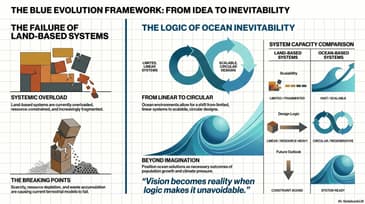
Today, most infrastructure is designed within fragmented systems. Urban planning, waste systems, agriculture, and energy production operate independently, leading to inefficiencies, rising costs, and environmental degradation. Land is finite, overutilized, and increasingly unable to support the growing needs of expanding populations and climate pressures. This is where ocean infrastructure emerges as a strategic solution space.
The oceans offer vast, underutilized environments capable of supporting circular economy models and integrated resource systems. Unlike traditional land-based infrastructure, ocean-based systems can be designed to connect waste, water, food, and energy into a single, regenerative ecosystem. This approach enables resource optimization, environmental sustainability, and long-term resilience.
For example, waste-to-energy systems can convert organic and non-organic waste into usable energy, reducing landfill dependence and pollution. Plastic reuse technologies can transform ocean and coastal plastic waste into construction materials for floating or modular infrastructure. Water purification and recycling systems can ensure continuous access to clean water, addressing one of the most critical global challenges. At the same time, ocean agriculture, including seaweed and algae cultivation, provides scalable and sustainable food production that does not rely on limited land resources. Integrated with renewable energy sources such as solar, wave, and bioenergy, ocean infrastructure becomes a powerful model of circular, self-sustaining development.
From a strategic and economic perspective, ocean infrastructure aligns with global priorities such as ESG (Environmental, Social, and Governance), climate resilience, sustainable development goals (SDGs), and green growth strategies. Governments, corporations, and global organizations are increasingly investing in climate innovation, blue economy initiatives, and sustainable infrastructure, making ocean-based systems not just viable but necessary.
The inevitability of ocean infrastructure is driven by three key forces:
- Constraint – Land-based systems are reaching capacity, with increasing inefficiencies and environmental strain.
- Opportunity – Oceans provide scalable, flexible, and integrated environments for building next-generation systems.
- Demand – Rising population, climate challenges, and resource scarcity require new models of infrastructure that are sustainable and regenerative.
This shift also represents a transformation in leadership and professional thinking. The future belongs to those who move beyond execution and develop the ability to design interconnected systems, communicate strategic value, and create impact at scale. Ocean infrastructure is not just an engineering or environmental concept—it is a systems-level solution that integrates multiple global challenges into one cohesive model.
In conclusion, ocean infrastructure is inevitable because it addresses the fundamental flaw in current systems: fragmentation. By leveraging the oceans as a solution space, we can transition from linear, resource-intensive models to circular, integrated ecosystems that drive sustainability, efficiency, and long-term impact. The question is no longer whether we will build in the oceans—but how soon we will recognize their role in shaping the future of infrastructure and human development.