
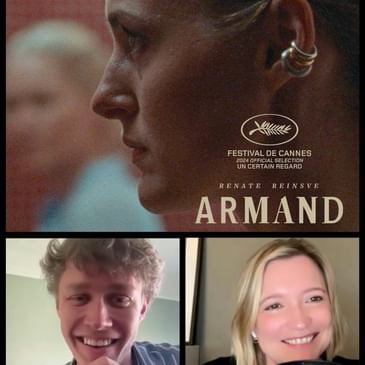
Guest writer/director Halfdan Ullmann Tøndel talks to Christina about his fascinating first feature 'Armand', winner of the Cannes' Camera d'Or 2024. They talk about his ambitious and risky drama that revolves around a meeting between parents and school staff regarding an incident between two kids. On how he built the tension in the script, being inspired by '12 Angry Men' & Spielberg, what movies his grandfather Ingmar Bergman showed him, the brilliant Renate Reinsve and the 7 minute scene that required she take a 5 day break after filming.
Learn more about your ad choices. Visit megaphone.fm/adchoices
[00:00:00] . Shopify grows your business no matter how far or big you grow.
[00:00:06] Shopify is the global commerce platform that helps you sell at every stage of your business.
[00:00:12] Whether you're selling your fan's next favorite shirt or an exclusive piece of podcast
[00:00:17] merch, Shopify helps you sell everywhere.
[00:00:21] Shopify powers 10% of all e-commerce in the U.S.
[00:00:26] . You can find the company's
[00:00:31] services across all countries.
[00:00:34] Plus, Shopify's award-winning help is there to support your success every step of the
[00:00:40] way.
[00:00:42] Because businesses that grow grow with Shopify.
[00:00:45] Sign up for a $1 per month trial period at Shopify.com slash income.
[00:00:52] All lowercase.
[00:00:53] Go to Shopify.com slash income now to grow your business no matter what stage you're
[00:01:01] in.
[00:01:02] This is Pop Culture Confidential and I'm Christina Jörling Biru.
[00:01:21] Hey everyone, thanks for joining me.
[00:01:24] My guest, writer-director Halvdan Ullman Töndel made a splash at the Cannes Film
[00:01:30] Festival a couple weeks ago winning the Camera Door Prize for his first feature film
[00:01:35] Armand.
[00:01:37] The grandson of Ingmar Bergman and Liv Ullman has made a tense, mature and fascinating first
[00:01:44] feature that had me on the edge of my seat.
[00:01:48] The film revolves around a meeting at a school the day before summer vacation.
[00:01:53] A single mother, Elizabeth, played brilliantly by Renate Renzwe who we know from Joakim
[00:01:59] Trier's The Worst Person in the World and another set of parents are called to
[00:02:04] to discuss an incident involving their six-year-olds, a shocking accusation directed at Elizabeth's
[00:02:11] son.
[00:02:12] The kids are never seen in the film.
[00:02:14] The school staff includes a young, well-meaning teacher, the school principal Jarl who
[00:02:20] mostly wants to avoid any conflict and cover his back and a school administrator who
[00:02:25] keeps getting nosebleeds and interrupting the meeting.
[00:02:29] Ullman Töndel escalates the tension and awkwardness of the meeting to great heights.
[00:02:35] Was it a kids' game?
[00:02:36] Is it serious?
[00:02:38] All these grey areas, what are the real issues with the parents?
[00:02:42] Ullman Töndel and I had such an interesting conversation about his movie including how
[00:02:48] he built the suspense and awkwardness from the script level.
[00:02:53] We talked about inspirations like Twelve Angry Men, Jaws and Jenna Rollins and
[00:02:58] what about the influence of his grandfather Ingmar Bergman?
[00:03:01] We also talked about the brilliant performance by Renate Rensvej who has a seven-minute
[00:03:06] scene of uncontrollable laughing that required a five-day break for her to recover from.
[00:03:13] Halfton, thank you so much for joining me.
[00:03:16] Congratulations on your film and all your success at CAM.
[00:03:20] Thank you so much.
[00:03:22] So I was really blown away by your film.
[00:03:25] I think it's really a secure first feature.
[00:03:29] Just half a dozen actors, one location, but you can cut the tension with a knife.
[00:03:34] Who's telling the truth?
[00:03:35] Who's not?
[00:03:36] All this new information is introduced.
[00:03:38] It feels really simple, but it's so complicated in script and tone.
[00:03:43] So I'm so happy to talk to you about it, sort of understand how you did this.
[00:03:47] First of all, I want to ask you why is the school setting such a perfect like microcosm
[00:03:53] of our society?
[00:03:55] That's a good question.
[00:03:56] I really felt within these walls of the school, you can really contain so much different emotions
[00:04:04] and feelings.
[00:04:05] And partly it's because you have like the parents and everything kids means for parents.
[00:04:12] It's their whole life for many parents at least.
[00:04:15] And then you also have like the school system which represent the public and like
[00:04:22] And then you also have these other parents in this film, which kind of is like a Greek choir.
[00:04:28] So I could like have all these elements that quite dynamically or organically became
[00:04:37] like this allegory of society.
[00:04:40] And what gave you the idea to begin with?
[00:04:43] It started really with Renate Reinsvets character, Elizabeth, because I had this
[00:04:49] character in my body and in my mind.
[00:04:53] But I didn't know in which like film I was to place her in.
[00:04:59] But then I heard this story about these two kids on a camping trip and something
[00:05:04] like similar happened between those two kids.
[00:05:07] And that was just like the story I was told lasted for 25 seconds.
[00:05:11] But I was so intrigued by how much I was able to imagine about these kids and their
[00:05:18] parents based on that little piece of information.
[00:05:21] And that really became like the premise of the story.
[00:05:25] And I also worked in a primary school for three, four years.
[00:05:28] So, of course, I've used a lot of my experience from that period in this film.
[00:05:34] It's something particularly tense when you're dealing with kids, especially young
[00:05:39] kids like the six year olds.
[00:05:41] Yes, totally. And I think it was also very interesting when I did the research
[00:05:47] because I was told that playing doctor is something you do in kindergarten.
[00:05:53] And that's natural in kindergarten.
[00:05:55] But when you go to school, it's not allowed anymore.
[00:05:58] And like in Norway, at least you go to kindergarten until May when you are six
[00:06:04] years old and then two months later you're in a school.
[00:06:07] And they have no idea on that shift.
[00:06:10] They know they go to school, but they don't know it's not allowed to
[00:06:15] playing doctor anymore.
[00:06:16] So I think that was the whole film kind of explored these boundaries in society
[00:06:21] and these gray areas.
[00:06:22] And I think that was like the perfect example because it could be very innocent,
[00:06:27] but it could also be very, very serious.
[00:06:31] When you were working with these gray areas, which is done so well in the
[00:06:35] film when you were on sort of on the script level and because we get
[00:06:39] introduced to new things all the time.
[00:06:41] Parents have had a relationship before.
[00:06:43] It's a small community, so it's almost sort of claustrophobic in that sense.
[00:06:47] How did you work on the script deciding what to introduce when?
[00:06:51] Yeah, it's like two levels on this because part of the film is also
[00:07:01] to take the viewer away from the case, because that is also what I feel
[00:07:08] we do in our society.
[00:07:09] You know, we talk about the case, but then the case suddenly starts to be
[00:07:14] about everything else and we kind of lose focus on what really matters.
[00:07:20] And that's like a really intentional satirical thing in this script.
[00:07:26] I felt I also had to do it right.
[00:07:30] So I watched 12 Angry Men like 100 times and tried to analyze at what
[00:07:36] point every piece of information arrived.
[00:07:40] And I was quite inspired by that.
[00:07:42] I have tried to read script books, but I can't do it.
[00:07:46] I mean, that's the best of the best.
[00:07:47] So that's a good choice if you're going into that.
[00:07:50] Right.
[00:07:51] And it's also a lot about sort of past trauma of the adult character.
[00:07:55] You don't tell us everything, but you tell us enough to understand
[00:07:59] that things have gone on, including the father that's passed away,
[00:08:03] that you realize that there may be other things going on that perhaps is being
[00:08:08] projected onto the children somehow.
[00:08:10] Yes, I really love that.
[00:08:13] The team, if you can call it that, you know how we project our own
[00:08:18] like traumas and feelings onto our children and also like this concept of
[00:08:23] traumas moving in generations, you know, that, you know, it's almost,
[00:08:30] it almost becomes part of your legacy kind of, which is quite interesting.
[00:08:35] And it's very like mystic.
[00:08:38] And you know, and that is what I want to like try to take in this movie.
[00:08:45] Yeah.
[00:08:45] And it makes it very strong that we don't actually see the children.
[00:08:49] So we're actually seeing the ones that are projecting onto them.
[00:08:53] Yeah.
[00:08:54] And that's also a really big part of the film.
[00:08:57] Like I started to say in the beginning, you know, I was intrigued how much I was
[00:09:01] able to imagine about the kids that I didn't know.
[00:09:04] I didn't know how they looked based on that little piece of information.
[00:09:08] And for me, like making a film where the audience also could like use their
[00:09:14] fantasy to make their own portraits of these kids was really part of the story.
[00:09:26] And I was thinking one thing, cause when I was reading some research about you, I
[00:09:55] understand that you saw Jaws and that made an impact.
[00:09:59] Is that true?
[00:09:59] Like when you were quite young?
[00:10:01] Oh, yes.
[00:10:03] Yeah.
[00:10:04] Jaws is one of my favorite films, but it hasn't been part of this movie.
[00:10:09] But well, actually what I was thinking was that I was thinking very much
[00:10:12] about the mayor and he's sort of the American representation of the
[00:10:18] Scandinavian principle here.
[00:10:20] Yes.
[00:10:21] Yeah.
[00:10:22] Yeah.
[00:10:23] When you say it like that, maybe, maybe there has been some inspiration.
[00:10:27] I mean, just the fact that the principle here is like, he's so,
[00:10:31] he just wants the summer to start.
[00:10:33] He, when he doesn't want any sort of fighting to go on.
[00:10:36] And of course the mayor and Jaws, he has more of a commercial
[00:10:39] interest in making money, but there's something so slimy and snively
[00:10:43] about these two that when I read that thing about Jaws, I immediately
[00:10:47] thought, wow, he's making the Scandinavian version of.
[00:10:50] Yes.
[00:10:51] Yes.
[00:10:51] I didn't actually think about the mayor and Jaws when I wrote the
[00:10:55] principle here because the principle here was like based on some research
[00:11:00] we did, and also of course, like the, the Scandinavian way of handling
[00:11:06] conflicts, you know, we are so afraid of being honest and direct.
[00:11:10] So we are, are moving around the edges the whole time.
[00:11:13] But when you say it, maybe, maybe the mayor and Jaws, I,
[00:11:17] you know, it's, it's great.
[00:11:20] Great comparison.
[00:11:21] Yeah, but it's a great, I hadn't thought about it.
[00:11:24] Moving on to the actors.
[00:11:25] I want to talk about Renate of course, but I have to just shout out
[00:11:29] Ellen Dorrit-Pettersson.
[00:11:32] I thought she was amazing because it's quite a difficult role.
[00:11:35] You don't like her very much.
[00:11:37] I mean, she's very hard and you don't really understand her motivations,
[00:11:42] but in the actress's portrayal of it, she really gives it a.
[00:11:46] Yeah.
[00:11:47] I'm so glad you're saying that.
[00:11:49] Ellen is first of all, she's one of the, one of the best and most
[00:11:55] like famous actors in Norway.
[00:11:57] She, she has been in Joachim Trier's films, Eskild Fogt's films.
[00:12:01] She is, she's absolutely like a monumental figure in Norway.
[00:12:08] I was so like happy to work with her and she can say so much,
[00:12:11] like you said about, you know, just by being, being.
[00:12:16] We had a lot of pre-production like meetings about this character
[00:12:20] because she is difficult, you know?
[00:12:22] And, and like the key word we ended up with with this character was shame.
[00:12:27] She is like so conflicted with shame the whole time.
[00:12:31] She doesn't want to inflict a lot of pain on Elizabeth, but she can't stop
[00:12:37] doing it because she has so much pain in herself, you know, with all that
[00:12:41] has happened.
[00:12:42] And, and the way Ellen does this, it's not likable, but I'm so glad you're
[00:12:48] seeing the nuances in her.
[00:12:51] I think it's a super difficult role to play and I totally agree with you
[00:12:56] that she's doing it very good.
[00:12:59] Yeah.
[00:13:00] But I have to of course talk Renate Rensvej.
[00:13:02] She plays Elizabeth.
[00:13:04] I've been comparing her to sort of Meryl Streep and even your grandmother.
[00:13:08] But then I came to think it's very much sort of Jenna Rollins in, in
[00:13:12] woman under the influence.
[00:13:14] Have you seen the Cassavetes?
[00:13:15] I mean, it's something about that at the same time it's, it's beautiful,
[00:13:20] but awkward and you're sort of hoping, please don't lose it.
[00:13:23] Please don't, don't lose it.
[00:13:25] If you could take us to the filming day of that, those 10 minutes when
[00:13:32] basically the camera is on her and she has this laugh attack where we as
[00:13:37] viewers don't understand, is it real?
[00:13:40] Is it not real?
[00:13:41] Is she going to cry?
[00:13:42] Is how is it to film that for you and how did you direct her there?
[00:13:47] First of all, I would just, I'm very happy you mentioned the woman
[00:13:50] under the influence.
[00:13:51] Of course I was very inspired by Jenna Rollins in that film.
[00:13:55] But yeah, that day, it was a crazy, it was a crazy day.
[00:14:02] It was one of the few scenes me and Renate didn't discuss so much
[00:14:06] in, in pre-production because.
[00:14:10] Oh really?
[00:14:10] Yeah.
[00:14:11] Because it was really just one line in the script saying she laughs
[00:14:15] a lot and then she started to cry.
[00:14:18] And then Renate asked me like, what does a lot means?
[00:14:22] And I said about seven minutes.
[00:14:26] And she said, it's impossible to do it.
[00:14:28] And I said, I think you can do it.
[00:14:30] And she was just like, okay, challenge accepted.
[00:14:33] So she really prepared for that scene on her own.
[00:14:37] And I gave her the trust to do it because I couldn't make her laugh.
[00:14:41] It was just like, she had to find what was making her laugh.
[00:14:45] And then this, and then on the day it was, I pushed it quite far.
[00:14:52] I, we did a lot of takes.
[00:14:54] It was never difficult for her to laugh.
[00:14:57] It was like amazing to witness how she had found this route within herself
[00:15:02] that when, when the nurse was saying these kinds of words, she had
[00:15:06] to find it so she could laugh naturally.
[00:15:09] Which was amazing.
[00:15:10] But we also knew that she, she kind of had to lose it.
[00:15:15] You know, for real in the beginning of the day, it was quite
[00:15:19] contained and it was quite like controlled, but then she was just
[00:15:23] laughing and laughing and laughing take after take, and then she really
[00:15:26] started to, you know, lose it for real.
[00:15:30] And, and we knew that had to be the case.
[00:15:33] So we also like planned for five days of a break for her after the scene.
[00:15:39] And in the end of the day, she was like exhausted, but we had, but we
[00:15:45] had done something really special, which we felt.
[00:15:49] Yeah.
[00:15:49] I mean, Renate is just brilliant.
[00:15:52] Yeah, she is.
[00:15:53] I have no words about how great it is to work with her.
[00:15:57] And like the way she, she's also so brave, you know, because attacking
[00:16:02] a scene like this is it's very scary.
[00:16:05] And the only thing I said to her was like, I can catch you when you,
[00:16:10] when you are done, I will be there when you're done.
[00:16:13] But otherwise it was like, she had to just lose it.
[00:16:21] Now we've talked about all these other incredible movies that may be
[00:16:26] inspirations for you, but I have to admit that bringing out tension in
[00:16:30] performances with your actors and filming the way you film their faces.
[00:16:34] I can't help to think about Ingmar Bergman.
[00:16:38] And are you inspired at all consciously?
[00:16:41] Do you feel okay with that comparison?
[00:16:43] I'm not inspired consciously.
[00:16:45] I'm really not.
[00:16:46] I have like one shot in a movie, which is, which is like a greeting
[00:16:52] to him from one of his, but that is that I am.
[00:16:56] I was more inspired by like how Spielberg and Harkovsky and some of these like
[00:17:02] great filmmakers constructed their shots.
[00:17:08] And that's why it probably feel a little bit vintage, you know,
[00:17:12] how the film is shot.
[00:17:14] And of course, since I'm the grandchild of Ingmar Bergman,
[00:17:16] you can also make that comparison.
[00:17:18] And like, and he was inspired by a lot of those great,
[00:17:24] like all the closeups and all the faces.
[00:17:26] It's, I love closeups and faces, but it was really also like an
[00:17:30] economical question because we had 22 days doing this.
[00:17:33] So we couldn't like have a lot of master shots.
[00:17:36] We had to like find a way, conceptual way to solve,
[00:17:40] solve the fact that we'd only had 22 days for this really ambitious film,
[00:17:43] you know?
[00:17:45] And of course the comparison will be made.
[00:17:46] I can't do anything about it.
[00:17:48] And the only thing is like, he made 53 films and I made one.
[00:17:53] So we can also, we can.
[00:17:55] You're on your way.
[00:17:57] I'm on my way.
[00:17:59] I mean, I know that he had his movie theater there and how much on Forø.
[00:18:03] Did you, were you part of that ritual?
[00:18:05] Did he show you other people's movies and talk about them?
[00:18:09] Yes.
[00:18:09] So every summer I was at Forø while he was still alive.
[00:18:14] And, you know, we had like this tradition every time he had birthday.
[00:18:19] We watched a film in the cinema and then we watched Modern Times by Charlie Chaplin
[00:18:24] and also this like Norwegian Ivo Caprino puppet show as a pre movie.
[00:18:34] Every time he showed you the puppet show?
[00:18:36] Every time he showed me Vestlefrik med Fela, which is called.
[00:18:40] And every time I watched Chaplin either Circus or Modern Times.
[00:18:46] And did he have something to say about why he was showing you those every time?
[00:18:50] No, no, no.
[00:18:52] I think he, you know, he loved Chaplin.
[00:18:54] He think it was really funny and it is, you know, so.
[00:19:00] And it was not like he was not a big fan of birthday.
[00:19:03] So it was like just this was his way of like meeting.
[00:19:08] What about Liv, who is of course brilliant actress and director, of course, and Lin,
[00:19:13] who your mother's one of the best authors coming out of Scandinavia.
[00:19:18] How have they influenced or been part of your journey?
[00:19:22] No, they have not apart from being, you know, my family and I have been influenced
[00:19:28] by my family in a way, you know, like every kid gets influenced by their family
[00:19:36] and for better or worse, you know.
[00:19:38] So but I'm not like I have not involved my mother or grandmother in the script
[00:19:43] or like in the because of the legacy, which I'm very proud of.
[00:19:49] But it has also been like important for me to just like do this thing,
[00:19:54] you know, for myself.
[00:19:56] Of course.
[00:19:59] Your grandfather looms large.
[00:20:00] What can I say?
[00:20:01] And your family were good and bad.
[00:20:03] But it's a really exciting moment for Norway.
[00:20:07] Yourself, Trier, Borgli, Makta, the big American and productions from
[00:20:13] Succession to Mission Impossible.
[00:20:15] I just there's a focus on Norway that's really interesting now.
[00:20:18] What is the secret sauce for the moment?
[00:20:21] It's a good question.
[00:20:22] I still feel we are like in the beginning of something.
[00:20:26] And also like I have to mention like Thea Vistendal, which is a which is
[00:20:30] Oh, yes.
[00:20:30] Handling the Undead, which premiered at Sundance.
[00:20:34] And she also made like a super brave and daring movie.
[00:20:42] I don't know what it is, but it's I feel that we kind of started to think globally,
[00:20:47] maybe I don't I don't know.
[00:20:49] I don't have a good answer for it.
[00:20:51] Of course, Joakim has been like this front figure,
[00:20:55] which has been important.
[00:20:57] Christophe Borgli has moved more out and now makes films in America.
[00:21:03] But no, I think there's something about this new generation also.
[00:21:08] I think so too.
[00:21:09] And what about you?
[00:21:10] What do you want to do next?
[00:21:12] Yeah, I have like started to think about something and I know what it will be.
[00:21:16] And it will also be with Renate and it will be worth a little bit, you know,
[00:21:21] expands a little bit more, but with the same like playfulness and
[00:21:26] things like that, then it will be great.
[00:21:30] It will be very great.
[00:21:32] I hope.
[00:21:32] But yes, I'm really excited by that by that project.
[00:21:37] And you're writing it as well?
[00:21:38] Yes, but it's inspired by a book.
[00:21:42] Thank you so much for taking your time with me.
[00:21:44] Thank you so much for inviting me.
[00:21:46] Thank you so much to Halftan Ullman Tøndel.
[00:21:51] Don't miss Armand when it hits your local movie theater or your festival.
[00:21:57] It's really, really worth the watch.
[00:21:59] I can't wait to see what he will do next.
[00:22:01] And thank you so much for listening to Pop Culture Confidential.
[00:22:04] You can follow us wherever you get your podcasts.
[00:22:08] Pop Culture Confidential is a part of the Evergreen Podcast Network.
[00:22:12] See you next time.