
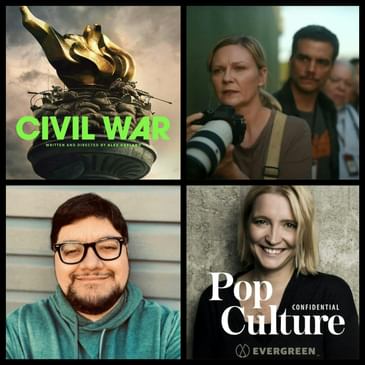

Ryan McQuade (AwardsWatch.com) joins Christina to discuss one of 2024s most anticipated, and possibly divisive, films Alex Garland's 'Civil War'. The first trailer left us with a lot of questions and certain expectations but the film turned out to be something else completely. Christina and Ryan discuss the film, the discourse, Alex Garland, the incredible performances and much more.
Spoilers around the 36 minute mark!
Learn more about your ad choices. Visit megaphone.fm/adchoices
[00:00:00] This is Pop Culture Confidential and I'm Christina Jirling-Beru.
[00:00:14] Hey everyone, welcome to the show!
[00:00:17] Writer-director Alex Garland's new film Civil War was divisive even before its premiere.
[00:00:24] The first trailer, a few months back, left some asking if the movie was exploiting tensions and anxieties in an election year.
[00:00:33] Would it be thoughtful, incendiary? Will it be good?
[00:00:37] Civil War stars Kirsten Dunst, Wagner Mora, Kaylee Spaney and Stephen McKinley Henderson
[00:00:44] as a group of war correspondents travelling from New York City to DC
[00:00:49] as an escalating civil war rages through the US.
[00:00:53] The film is a huge deal for A24. It's their most expensive venture yet with a $55 million budget as well as their widest release yet.
[00:01:04] It's almost always interesting when a film stirs up discussions and emotions, so this of course merited a review and a conversation.
[00:01:13] Well, my guests and I have seen it and we're here to tell the tale.
[00:01:17] Executive editor of Awards Watch, friend of the show, Ryan McQuade, welcome back!
[00:01:22] Thank you, Christina, for having me on. What a wonderful, almost scary intro.
[00:01:28] Kind of like this movie. What a scary idea.
[00:01:31] To quote the terrifying Jesse Plemons in the film. What kind of American are you, Ryan?
[00:01:36] I have thoughts on Jesse Plemons. Good Lord.
[00:01:41] I guess the kind of American that would be like you're saying they're worried about a movie, about a civil war in the middle of the election and our most divided time here in America.
[00:01:53] But here we are.
[00:01:56] So we're going to talk about and discuss the film, but towards the end I have some particular scenes I want to talk to you about, Ryan.
[00:02:05] Listeners, I'm going to let you know then that there will be some real spoilers in that section just so you know.
[00:02:12] First of all, Ryan, I was saying at the top here that the trailer left people with questions.
[00:02:19] After seeing that trailer, what did you expect?
[00:02:23] Okay. I think the trailer. We're just talking about the trailer right before we talk about our thoughts.
[00:02:31] I think when the trailer is one of the most eye rolling,
[00:02:38] disgusting trailers I've seen in a long time.
[00:02:45] Because it's doing exactly the kind of fear mongering and Jenna of people to get them to a movie theater that I don't like.
[00:02:58] I also feel like when we talk about the film, it's a massive manipulation of the audience and expectations.
[00:03:06] Which is not to get on the side tangent.
[00:03:11] You know that lawsuit that happened a couple years ago when someone sued the filmmakers of the movie yesterday because Anadah Armas wasn't in the film?
[00:03:20] I feel like this would be the better case if this went to court of a massive manipulation of the expectations of what a film is versus what the film actually is.
[00:03:32] And I think that, I think times are very fragile.
[00:03:38] I know that every political pundit tries to give us either like the dark days are coming or they try to give us a glimmer of hope.
[00:03:51] I think that we're kind of in the middle where it's like we have some hope, but it's very, very slim.
[00:03:57] I think the reality, sadly of November at least the people I've talked to is starting to selling in on potentially another Donald Trump presidency.
[00:04:08] Whether he's in the office or in jail is to be seen.
[00:04:13] And so his group, if you're just looking at it through a political prism, his group, the Trump base seems to want to have one of these kind of events.
[00:04:28] You have the insurrection of January 6th.
[00:04:32] You have Trump talking about being a dictator for a day.
[00:04:37] Those are the signs and hints of not just from dictators in the Middle East or Putin or even just in South America and countries there.
[00:04:50] That's how it started.
[00:04:51] That's how their democracy sort of fell apart.
[00:04:54] And so I think that I know that movies aren't harmful or can't be blamed for certain things because like, you know, people want to blame when I was a kid.
[00:05:07] Quentin Tarantino in the matrix for violence and films or people want to say certain things about sex and movies and we've talked about that before.
[00:05:17] I do think though, politics might be the one line where it could get a little dicey.
[00:05:25] But just off the trailer, I was not looking forward to it.
[00:05:29] If you've seen Alex Garland's previous film Men, which is the most pretentious piece of shit.
[00:05:34] I've seen in the last 20 years.
[00:05:37] Not my cup of tea.
[00:05:40] As Spike Lee would say.
[00:05:42] And so I was, I was like, oh my God, the guy that made annihilation and ex machina and wrote some very other great films in his filmography.
[00:05:51] I was like, Oh, is he one a hack?
[00:05:55] And two, do I need to go back and watch those and question whether those were actually good in the first place.
[00:06:02] And as some, it's somebody that does a podcast about going down director's filmography is I was not able to do that before this film.
[00:06:09] But it almost was like leading up to an exercise I almost wanted to do.
[00:06:14] I was not going to watch men, but I was writing 28 days later, which of course has parallels to this one.
[00:06:21] Exactly, exactly.
[00:06:22] But those are, those are based in genre.
[00:06:26] And this is almost based in realistic fiction.
[00:06:31] It's there's no global zombie attack.
[00:06:36] It's just human beings, which are just as scary, I guess, and zombies.
[00:06:40] But yeah, that trailer, I don't know what you thought, Christina, but I, I despised it.
[00:06:49] I felt the same way.
[00:06:51] I found that first trailer to be manipulative and the it left me with certain expectations.
[00:06:58] But after seeing the film itself, I found it to be something very different.
[00:07:05] It surprised me in so many ways, particularly the fact that this movie is mostly about the fundamentals of journalism,
[00:07:14] journalistic ethics and more had me thinking about films like the Year of Living Dangerously or Salvador or something like that in this political landscape,
[00:07:29] this fictionalized version of what could happen in the United States.
[00:07:34] But what was so interesting and fascinating is that the politics are intentionally vague.
[00:07:40] So the sides are difficult.
[00:07:43] You can't really grasp what side is doing what the point of the movie is more division and that the inability for us to come together to empathize and everyone pulling in different directions is more the point of the movie than the actual politics,
[00:08:03] which was what was so manipulative with the trailer.
[00:08:06] And I have to wonder whether Alex Garland himself was pleased with that trailer.
[00:08:12] Yeah, I, I don't know if he less we don't have to harp on it anymore, but that's a question I have when there's no that's no that's a good question.
[00:08:21] How did you feel about the movie?
[00:08:23] I don't know how you watched it, but I was lucky that they did a screening.
[00:08:31] I was at South by Southwest and that was where the world premiere was on.
[00:08:35] And this screened it separately, like 30 minutes after the premiere at the Paramount Theater for a whole section of journalists and feel like every journal movie journalist that was set up by Southwest got the invite
[00:08:51] to go to the IMAX screening in Austin and watch it there.
[00:08:57] And I wasn't the only one in attendance.
[00:09:01] There was a ton of people in the industry.
[00:09:04] I know that a certain duo that won Best Picture a couple years ago were in the audience and and there were and so actors and everybody it felt like the screening to kind of be in.
[00:09:20] And I haven't seen it yet and garland introduced the film and was kind of just a few words, but it wasn't really anything.
[00:09:27] And we were all sitting again, Christina talking about expectations.
[00:09:30] We're all sitting in our seats going, why did we do this?
[00:09:34] Because there were critics around me people around me we're all sitting like, oh shit like you know what it wouldn't you know did we waste our night here going to this movie you know that you know like, I don't know if it's going to be any good.
[00:09:47] And I have to say it was it's one of the biggest genuine surprises I've had in a while.
[00:09:55] I really found it to be like you a very interesting look and subversion of obviously every expectation we had going into it.
[00:10:07] And I think that really isn't about the sort of political divide the sides are clearly drawn.
[00:10:14] And I know that they released a poster with the different territories and we can talk about that in a little bit of how realistic and unrealistic some of those territories may be based off American politics California and Texas California and Texas together.
[00:10:29] Okay.
[00:10:31] But as the Western forces. Okay, sure.
[00:10:36] But I found it to be really interesting not just about, I think the state of journalism inside a war state inside, you know, inside, you know, political unrest.
[00:10:54] But the idea of what an image can say from a from a photo journalistic perspective of the dangers of getting said image, and that it is maybe the most interesting way of presenting the idea of a pictures worth a thousand words that I've seen in a while.
[00:11:18] I think the movie is perfect. I think there's, you know, some structural aspects that that I would I would kind of change.
[00:11:27] It's not it's not perfect. No, I'm curious about the ending from your perspective like the last five minutes of that movie.
[00:11:35] I was on I fully was invested by the end of that movie, but the last like, I want to say, we'll get into a half scenes. I was I'm still thinking about it and I think that honestly, what you said that's the point.
[00:11:48] The point of this movie is to is to think and to have conversations not just about where our media and where our journalists are portraying something or anything during an election, a genocide.
[00:12:08] Just something maybe local, because, you know, there's everything that these journalists do in this movie, they're not doing some frivolous story.
[00:12:19] They're actually taking their job seriously.
[00:12:22] And wouldn't that be kind of like a nice change of pace?
[00:12:27] Like I was watching John Stuart last night, and they started off the show talking about the fucking eclipse and making fun of the fact that the news media is covering an eclipse.
[00:12:41] Meanwhile, we have a tough decision as as going on in this country.
[00:12:49] We have the ongoing battles in the Ukraine and in Gaza.
[00:12:54] We have an administration that is not doing really doing the bare minimum.
[00:12:59] And we're all worried about what the fucking sky looks like.
[00:13:03] And, like, this is our ongoing cycle of things.
[00:13:08] And I feel kind of Garland's talking about that in this movie of that, like, we are still quote unquote, kind of living in normally in our world in this movie.
[00:13:21] But yet there's like, there's the scene of like the small town of like where the girls just like we completely just don't even think about the civil war.
[00:13:30] That's so true. They mentioned it several times in the movie, both of the female photographers say to each other, my parents are in Colorado.
[00:13:38] They pretend this isn't happening.
[00:13:40] But let's start. Let's do first, I want to ask you, you don't get to know the full story of what has actually happened in America.
[00:13:49] What is your take? What you were mentioning the Western Front.
[00:13:53] The president is in a third term.
[00:13:55] So there's some fascist stuff going on there.
[00:13:58] I mean, it feels as if we're I'm not, I don't get into much hyperbole as you know, Christina.
[00:14:07] But I think you have to with a movie like this, right?
[00:14:10] You have to go and stretch your belief to sort of also to he he kind of paints it with the broad brush to allow the audience, I think, to be able to.
[00:14:19] Inject their own fear into it.
[00:14:23] It's a little bit of not to the same extent and definitely not to the overall quality.
[00:14:30] It's a little bit of what Jonathan Glazer does in the zone of interest is what Garland does with his.
[00:14:36] His his touch here of allowing enough of a of a canvas for not only him to inject his thoughts and and move his story into the places that he needs to go, but allow the audience to place their sets of fears and anxieties that have gone that can be inflicted on on serious places and ideas like this.
[00:15:00] So I think that.
[00:15:03] That America.
[00:15:06] Who is the real central character of this movie is is in an, you know, an authoritarian.
[00:15:15] On the rise dictatorship.
[00:15:18] And this is the last ditch effort to prevent that and it's honestly the way the film portrays it.
[00:15:26] It's a not very short lived one because if you realistically know like California and Texas working together to stop.
[00:15:36] Whether it would be Donald Trump or, you know, Joe Biden or whoever is in charge and most and it would definitely be fucking Trump.
[00:15:48] Or somebody like him.
[00:15:50] It makes sense from, if you know about, you know, the resources that both of those states can provide the, you know, obviously.
[00:15:59] There's tons of military bases in both states.
[00:16:03] So they have the, you know, the resources, the warfare to contend.
[00:16:12] And the economies to be able to withstand something like that.
[00:16:15] So it makes sense on paper.
[00:16:17] It's politically speaking, it's silly.
[00:16:19] You know what I mean?
[00:16:20] Because you would mean to like have Gavin Newsom and Greg Abbott work together.
[00:16:23] That's not going to happen in anybody's lifetime.
[00:16:26] But isn't the reason for that just so that we won't immediately think red states, blue states.
[00:16:32] I think so.
[00:16:33] He wants to keep it as you were.
[00:16:35] It is a fantasy saying this is not the point.
[00:16:38] You're injecting your own fears and the point is that the divisiveness that we've come has just become so much that it doesn't really matter what side who said you don't really understand who's on particularly what side.
[00:16:53] That's not the point that everyone sort of lost the real issues that what's going on and that's what's happening.
[00:17:01] Well, you know this from covering journalism for so many years.
[00:17:06] Is is that when these dictatorships, these, you know, these heads of state become all powerful.
[00:17:17] It's not just their enemies that fear them.
[00:17:20] They're friends.
[00:17:21] Their allies fear them because any false move.
[00:17:25] Any wrong step.
[00:17:27] Any, you know, just statement that is not completely 100% towing the line can lead to a bag over your head and put in a black site.
[00:17:41] And so I feel like that's why you can put your own like, like I'm saying, you could put the Abbot in the news something in your head but then you also have to realize like, you have to know about dictatorships a little bit.
[00:17:55] You have to know about how those places are in a state of, of just awkwardness as countries because there's like you think of some somewhere like Russia where there are hundreds.
[00:18:12] There's millions of people living there and they're going through their life and they're making their own way in the world and everything.
[00:18:19] But yet there is this, if you look at it from even if you take the microscope and you zoom out rather than zoom in, if you take it out, you realize they're in one of the most politically unstable places in dangerous places in the world.
[00:18:37] And yet people can still survive.
[00:18:39] So that's why I think that Garland.
[00:18:42] He actually researches it pretty well.
[00:18:45] I know everyone's just going to bash him because he's like, that's not going to make sense because of that state and that's it but you're right Christina.
[00:18:51] And I totally agree with you.
[00:18:52] The point is to take away the fact that at this point in America, there are no more parties.
[00:18:59] There is no red and blue anymore.
[00:19:01] There is, do you believe the crazy shit that is being served to you by someone that is going to innately harm you and make you have to just blue pill it?
[00:19:13] It's very matrixy actually when you think about it.
[00:19:15] It's like, do you buy into the machine or do you buy into the real, real world and freedom?
[00:19:22] And so, and that's where these journalists get to kind of go between the lines.
[00:19:29] And that's an interesting thing.
[00:19:31] You don't really, I mean they clearly are not in support because they're at a massive threat in their profession by the presidency of President Nick Offerman in this movie, which is also very jarring because you know,
[00:19:50] Yeah it's very sure.
[00:19:52] And then you're like, what the, no come on.
[00:19:54] Like put like a different face there.
[00:19:56] Not Nick Offerman, sweet man.
[00:19:58] He's like picking strawberries on the last of us.
[00:20:01] Yeah, exactly.
[00:20:03] But no I think that the way the world is set up is very, I think it actually would be what happened if we had a modern civil war where we would have places in states that say that's not in my business.
[00:20:17] And then there would be ones that be like, no we have to do something.
[00:20:21] And then there would, and yeah I mean unfortunately it would be like Washington DC would be ground zero from martial law and it would almost feel like a,
[00:20:34] I wouldn't, I'm not going to go this far but it would feel very much like how to get into Washington DC would be almost like getting into North Korea if you had some sort of,
[00:20:44] if you had a real run of it because that would be the ground base for anybody at that point if they were running a dictatorship.
[00:20:58] The world building that he's done here is really interesting because it keeps you guessing and it keeps you just asking questions in a way that I was not prepared for because I thought all those questions were going to be served to me on that trailer platter we were talking about.
[00:21:14] But here's not.
[00:21:16] The movie starts with a some kind of really violent situation where the police and there's a group of people both very desperate, you know we need water for our children the police are holding them back and and and protesters and this is where we meet several of these
[00:21:33] journalists.
[00:21:34] Kirsten Dunst who I have to say is absolutely magnificent in this movie she don't do you agree.
[00:21:41] I think I think it's one of her best roles in years. I think it, I think it's so fully layered and yeah it's incredibly beautiful work by one of our great actresses that we have today.
[00:21:55] Lee who is supposedly sort of an iconic female photojournalist whose namesake is the real Lee Miller. We understand and we see really horrific things that she's taken pictures of through the years where she's kept completely neutral,
[00:22:13] she's been graphing some of the most horrific acts of war you can imagine and in Christian Dunst face in her movements in her body language in her eyes she just seems completely not void of emotion that's the wrong word.
[00:22:29] I felt 7000 walls to be able to handle this and to keep this ethics in her head of I can't take a side I can't go in I can't do anything about the situation I just have to take a picture of it.
[00:22:43] I just have to send it back and as she voices in the film her goal has always been to sort of show her country, the US. This is what we shouldn't be getting into. And now she's in the midst of it actually happening in her home territory and she's partnered with a
[00:23:01] American born reporter I guess Joel played by one of our who's also really great in the film and he's more of that one I think we've seen in several films the adrenaline kick reporter who's like get me to the scene and and tell me about the two other ones.
[00:23:20] Well yeah I mean they sort of in the beginning of the film, they, there's a car bombing and involves those people that you're talking about that are looking for food and water reminded me a lot of.
[00:23:35] I don't remember any a lot of like a hurricane situation or weirdly enough that we can't bring all of our past politics and I was sitting there I was like oh this is like that time when Trump went to Puerto Rico.
[00:23:53] And those people there were hundreds of thousands of people like needing the supplies and he's just like tossing little pieces of toilet paper and shit to you know and you're just like it's it's the bare minimum.
[00:24:06] You know I mean, and it really is the bare minimum but these people they need the bare minimum to survive and in because the US dollars completely tanked the Canadian dollars more powerful we see like Lee later when they're trying to fill up a take a gas and
[00:24:21] they say that this she has Canadian money and it's you know, which is kind of wild when you if you've ever been to Canada and know the difference between it's like for an American it's like 25% off it's like a wonderful sale to go to Canada.
[00:24:36] And now it's like holy shit like our dollar doesn't mean anything, which also if our dollar didn't mean anything then it would also not be good for allies in the World Bank and everything but that's that's that also just talks to a little bit about also when you're
[00:24:52] thinking about how our country is falling apart how that impacts the rest of the world is it's truly fascinating but yeah I mean Lee and Lee and Joel are essentially their their photograph in this and the bombing happens and.
[00:25:09] And he wants to get to Washington or he wants to interview the president because he feels that present doesn't have a long time left.
[00:25:17] No, he sees the writing on the wall based off of the Western forces kind of colliding with the Florida territories and essentially everybody is everybody is weirdly unified in the idea of getting rid of the president.
[00:25:31] And they're moving quickly in getting rid of the, I guess United States forces these traders.
[00:25:41] And Lee saves this girl. Jesse played by Kaley Spaney who is essentially a super fan but also wants to get into this line of field with them and and leaves very hesitant on the idea of this because.
[00:25:59] And I think that this is sort of the mastery of Dunce's performance it's like it's it she knows that what this life can be on somebody's just psyche and what you have to have and it's not a side show.
[00:26:17] It's not a hobby.
[00:26:19] It's it's real and it's raw and it's visceral.
[00:26:23] And I think that she's trying to prevent Jesse from seeing that side because once you it's one thing to live it's another thing then to have to be able to see it from the lens and from the perspective of.
[00:26:40] That you're not just doing it for yourself you're doing it then for everybody else.
[00:26:43] But she also sees herself in her.
[00:26:46] The regrets. Yeah.
[00:26:48] Yeah, but she but I think she sees a lot of the regrets of if somebody had tried to pull me into this I would stay the far fuck away from it as possible.
[00:26:56] And and she kind of says that.
[00:27:00] But Joel, who is just kind of like the hey come on man you know we're gonna you know I will teach you the ropes.
[00:27:07] And she's not very happy about that but I think that the great thing is when this movie kind of slows down and there are moments between Spain in Dunst.
[00:27:17] Which I was like, if you're Sophia Coppola watching this you got to have like a tear in your eye in an IMAX screening scene your two girls up on the screen.
[00:27:25] I was part of this.
[00:27:28] Those are my girls to you know those are my my actresses dammit and and they're killing it and they're absolutely they work absolutely incredible together and they're also alongside Sammy who is a veteran reporter.
[00:27:41] Who's kind of like who's kind of like their counterpart friends slash also a guy that has beat them to the punch before and goes along with them played by Stephen McKinley Henderson who is phenomenal in this movie.
[00:27:56] And one of the great character actors that we have working today period.
[00:28:00] Obviously, Joel describes his character of Joel describes a character of Sammy is someone a journalist who writes for what's left of the New York Times.
[00:28:10] Exactly.
[00:28:11] Yeah, and so and so yeah he's he's he's writing it from his perspective but they're both they both all kind of come together because they they feel that if they can tackle this beast together that it would be beneficial to the both of them.
[00:28:28] And I think that there's a great scene.
[00:28:30] It's in the trailer it's manipulative in the trailer but but it works in the film of just Sammy talking to Joel about the questions and how they will get stopped.
[00:28:41] Essentially with these answers and you know and he kind of basically says, you're only really going to get one before they bag in tagging get you out of there.
[00:28:53] So you better make a good and you better hope that he answers it because your whole thing is writing on that.
[00:29:00] And this whole trip was writing on it and I think then this movie ends up becoming a road trip movie weirdly enough through the battered and bruised remains of America, which a trip that would take what three hours from New York to Washington takes.
[00:29:15] Yeah, complete life.
[00:29:17] I'm going to get into some particular scenes.
[00:29:20] I'll wait a little bit of that for the spoiler section.
[00:29:23] I want to ask you first in general about the filmmaking.
[00:29:26] This movie takes place really in broad daylight which I found even more effective considering what we're seeing.
[00:29:34] What did you feel about the cinematography the editing his use of music for example.
[00:29:41] His use of music.
[00:29:43] Okay, I have to tell you a funny story really quick about it is leading into this movie.
[00:29:51] We were sitting in the in the IMAX and so the lovely reps or whoever curated the playlist before this movie.
[00:30:04] I feel like they were part of the marketing of the trailer because every song was like CCR.
[00:30:12] You know, it was John Fogarty.
[00:30:14] It was Bruce Springsteen born in the USA.
[00:30:16] It was it was you know, you know war what's it good for absolutely you know it was like every song that had the idea you know there was that too.
[00:30:30] It was like it was like a fourth of July barbecue.
[00:30:35] It was like Surrey play a patriotic playlist right.
[00:30:41] We must have had a plan with this they must have wanted us all to be completely confused.
[00:30:48] And so any needle drop that he did in the movie was was subdued by the context of what I had before.
[00:30:57] I don't.
[00:30:58] I mean like I think like, I'm really just Christina were friends.
[00:31:04] I can tell you this really goddamn tired of directors just putting the slow version of a really good song by a cover artist in a fucking movie.
[00:31:14] I'm like really tired of it.
[00:31:16] And this is no this is no different.
[00:31:19] There's a scene.
[00:31:20] Yeah, there's a scene towards the end.
[00:31:23] I don't know if you can get into really spoilers about it, but it you'll know it when you hear it and you just like, OK, yeah.
[00:31:31] But the imagery.
[00:31:33] That's a sequence actually at night and that imagery is beautiful with the sort of fire and everything that's going on around it.
[00:31:39] But yes, I think that I always think horror movies are real interesting when they're in the daylight rather than they're at night.
[00:31:46] I feel like nights just like the cheap aesthetic and we just assume.
[00:31:50] I'm scared of shithead of people in broad daylight.
[00:31:52] I think that that's even more more effective filmmaking.
[00:31:55] And I think that a lot of this movie is done like that.
[00:31:58] I think like a lot of this movie is a horror movie for American audiences to watch or maybe any audience that is feeling a little bit like,
[00:32:06] Oh, our democracy might be gone really, really soon.
[00:32:10] You know what I mean?
[00:32:11] So I think that the cinematography is absolutely beautiful.
[00:32:17] And you know, Rob Hardy, I believe is his D.P. on this film and and was worked with him on most of the films.
[00:32:26] Right?
[00:32:27] Yeah, he worked on him with X Machina Annihilation.
[00:32:29] He also did my favorite Mission Impossible movie fall out.
[00:32:34] So like he has got a beautiful sense of visual language.
[00:32:40] And I think that I think that the movie is really, I think to buy into the premise of the movie,
[00:32:46] you have to have a really beautiful way in which you're looking in shooting America.
[00:32:52] You can't make a movie about photojournalism and have it look ugly.
[00:32:57] So like you just can't do that.
[00:32:59] And I think that it looks pretty good for the way they use in them in the middle of some of the most violent and really horrific scenes when they sort of use the images.
[00:33:10] From the cameras.
[00:33:11] Yes, quick and you see the either Kayleigh Spain is black and white.
[00:33:15] She does more artsy black and white work and the other.
[00:33:18] And you see just the image isolated of some soldier screaming, which you can't really see during the violent action of the actual film, but isolated into this photography, which they use that a quite a lot.
[00:33:32] I thought was quite a brilliant move and elevated the pain and sort of horror of those scenes.
[00:33:39] And then you also you just opposed the beautiful, you know, just photography with Jake Roberts very good editing in those sequences of kind of cutting back to the what's happening live and what is being shot on the lens.
[00:33:55] And then the ability to of Garland to say I'm going to kind of cut off the score or any music in moments of violence or in moments of tension and the sound work in this movie Christina is incredible, especially like the last act of the film.
[00:34:11] In particular is really, really good.
[00:34:13] But there's like moments when you know they're following a group of soldiers of sort of resistance soldiers against them, you know, Western Front soldiers, I guess you call them Western territories.
[00:34:26] I don't remember what the hell those people are.
[00:34:29] But anyway, the good guys quote unquote versus the United States.
[00:34:33] And yeah, that whole sequence there kind of sets you up and it also sets I think really Jesse up to understand fully the ramifications of, you know, being slow on the trigger of something being caught in the way being in a completely different sort of mindset than then what she thought this was going to be the way Lee is very much intently on her after that.
[00:34:59] And I think that is is is a is a testament because of this really intense sequence that I think a lot in that moment is through is supposed to put us through Jesse's perspective of what's the lesson of a oh she gets a big fucking lesson in that thing and I think it's it's
[00:35:18] the idea of, of you wanted to be thrown into the fire this is what we deal with. It's not us sitting in a hotel bar with you in New York City wasting our like dream tickets or whatever.
[00:35:29] You know I mean it's, it is us in the field, putting our lives on the line, alongside the people who are really actually putting their lives on the line.
[00:35:40] And that's, I mean like, if anyone and through an American history because ever seen what it is like for a photo journalism to be on the scene to take those photos during war or during battles.
[00:35:51] It's not, it's not a glamorous position it's very hard work. It is it's the most it's very dangerous to because most times they're not armed.
[00:35:59] You know I mean they're they're entrusting their life, literally to somebody else.
[00:36:04] And in its in so it's and they're in the way. Yeah they're in the way and people are pulling up their best but then back up and stand here and the whole thing is like when he grabs her when the soldier grabs her back.
[00:36:18] Yeah or Joel does it too I think as well it's like they do it multiple times in that scene because she's so antsy right to do it and it's like yeah you do that and you're going to get a bullet to the head essentially because there's a sniper out there for God's sakes.
[00:36:31] I mean.
[00:37:01] Well let's get I'm gonna towards the end I want to ask you sort of about what you think the debate is going to be after people have seen the movie as opposed to the debate but first let's do some major stuff.
[00:37:12] And possibly get some free stuff for doing so we can't thank you enough for the support now back to the show.
[00:37:19] Well let's get I'm gonna towards the end I want to ask you sort of about what you think the debate is going to be after people have seen the movie as opposed to the debate but first let's do some major spoilers here listeners because there's a couple scenes I want to ask you about and if you have any scenes you particularly want to talk to me about.
[00:37:37] Well there's one.
[00:37:38] Let's talk about the Jesse Plemons scene.
[00:37:41] That's the one I want to talk about.
[00:37:43] Major spoiler.
[00:37:44] So Jesse Plemps of course 50% of my favorite couple Hollywood couple married to Kirsten Dunst he is an absolutely terrifying figure that the our little road trip group of journalists.
[00:38:00] There's this whole thing that has happened where Jesse gets into another car and they follow that card it ends up that Jesse Plemons and his compatriots have taken Jesse and the other guy and it's a horrific scene where they're standing in front of basically a dump truck filled with bodies.
[00:38:19] And they approach Jesse Plemons to save them or to get them out of this situation and that's when he starts asking that question that I had to be at the top what kind of American are you and it's just a really horrific scene.
[00:38:33] What does Jesse Plemons character in his really weird red heart sunglasses and violence tendencies represent do you think.
[00:38:44] I think it represents maybe mostly the fears that we thought that this movie was going to be.
[00:38:51] And he does it in a very isolating terrifying way.
[00:38:55] He doesn't give you this throughout the film which I think is great Alex Garland that is.
[00:39:00] I think he gives you a taste how bitter well he's he set it up where.
[00:39:05] You know there's that scene where in the small town and yes there are people on top of the rooftops trying to save their little piece of paradise while they still haven't.
[00:39:13] But then there are going to be people that are going to take this way too seriously that are never also going to let this go regardless of that this war at the end and what happens to the president.
[00:39:26] There will be people throughout our history that will not let the Civil War go much like people have not let go of the what 200 year old Civil War that we've had now where there's reenactments where there's statues where there's.
[00:39:43] The Confederate flag and the and the arguments of that it's part of now their heritage their birthright their history and we can't ignore it.
[00:39:52] Even though it's not right even though it was treasonous even though they lost and so and what do people do they then justify any of their actions by saying that well you know that you know I can I can do this I can be this way I can act this way because we're in a time of civil unrest.
[00:40:12] And I think that clearly they're not abiding to.
[00:40:16] Any military standards or they're kind of going by their own code this is totally rogue yeah yeah and so this is this is essentially what happens when you allow a platform for divisive thoughts to be put into the consciousness of an individual.
[00:40:36] And so I found that to be really fascinating and I think plemins.
[00:40:41] I think this is the scene of the year so far Christina because plemins is like a dancing on a wire you don't know what he's going to do the tension is that I think pretty much the highest it gets in this movie maybe the second highest.
[00:40:59] And he's just knocking it out of the park.
[00:41:02] It's a one scene scene Turner he looked so much like Philip C. Moore Hoffman to me when I was watching this and the parallels of like being a generational quiet actor made so much sense and.
[00:41:18] You know reading about how Duns was even terrified of her own husband while he was doing the scene.
[00:41:25] And it's like it's like the polar opposite of their work in the power of the dog where they're a very tender loving couple and.
[00:41:32] And yet this is this is this is a madman.
[00:41:36] And I think that I think it's really great stuff.
[00:41:39] Yeah, if the trailer is so manipulated why do you think we don't feel that the scene is.
[00:41:45] Because I think well one we've seen like an hour of the film beforehand.
[00:41:49] You understand the context of the tone I think that.
[00:41:54] I think that it's not once again presenting itself as.
[00:42:00] I mean it is presenting it though in the way in which the film presents its.
[00:42:08] Divisive radicalism it's the really the only time we get to see radicalism in the film really.
[00:42:16] Where we're watching a guy saying like.
[00:42:20] Who I feel kind of knows that his time is ending a little bit too like you can feel like I this is the only power I have left is to kill these journalists.
[00:42:32] And I think that the reason why I didn't feel that it was I think it was necessary to you know necessary within the pot of the film I think that.
[00:42:41] You then get a grasp of.
[00:42:44] Of what sort of the states that are deemed okay which are not.
[00:42:50] I believe it's like Colorado and Minnesota.
[00:42:52] At this point I don't remember exactly but we've seen several different reactions we've heard about people who they just forget they don't even want to think about that there's a word happening then we have that little town they go through which is basically pretending it's not happening their stores are open there's a little old lady walking her dog.
[00:43:11] We've met soldiers who are this way journalists who are that way and the scene is begins with Jesse.
[00:43:19] Just fun and games jumping into another car she's like having a good time and it just makes it so jarring where this is where she ends up like all that is over kid you can't do that anymore and it really becomes the worst possible outcome of this situation.
[00:43:40] But isn't it an interesting Christian and just position you talked about the use of daylight and how and how we talked about how it's very present and it's terrifying.
[00:43:52] And then when they're at the shelter from their stop on the road in the middle of night and a place that you know is is an abandoned like football stadium soccer stadium.
[00:44:03] That's the place where they're at most peace where they're not whether the safest is at night but in the daytime right and they're able when you are able to be free when you are able to open the little children running around yeah.
[00:44:19] Like that's when you're at peace but in the daytime when people can see you and look into your eyes that's when you're most that's when they're most terrified I find that to be really a great just a position and a reason why I've seen like this works is because.
[00:44:36] We've seen them we've seen them in comfort and you would think to yourself well then just stay there you know I mean like just just don't like don't don't go out into this but yet yet it is the it is obviously the cost of doing something like this and in you have to.
[00:44:57] I think elevate the stakes a little bit but I think that yeah it's.
[00:45:02] It's a it's a it's a rough scene because because yeah.
[00:45:07] Because it is the most on on the nose I guess you could say about it but I don't but of course people have gotten already like up in arms about and you know and and everything and it's like.
[00:45:20] It's purposeful I think it makes sense for the way in which the story.
[00:45:25] Trajects and yeah I mean it also is to tell you that this is not a fun world and this was not going to be a fun ride like there's consequences to.
[00:45:35] At every turn I mean there's the I think if I don't if you don't mind the scene at the winter wonderland.
[00:45:41] Oh they're driving through and there's a obviously a sniper or this is the horror movie aesthetic yet you.
[00:45:50] Soldiers two soldiers on the ground right like and there's a guy who is like I guess.
[00:45:57] Again one of these fanatics that owns a crap ton of guns in a mansion sitting on top of you know in a fucking hill on a driveway and he's shooting anybody that's coming nearby and.
[00:46:11] It's it's a hell of a again the sound work the way in the way in which it's it's it's dropped you know any scores drop to build tension.
[00:46:23] Yes those the scenes of violence are really.
[00:46:28] They take your breath away and these little details one of the soldiers who is trying to get the sniper he has painted nails and colored hair and it's not like the.
[00:46:40] Soldier so you that you would expect you know all these questions you have keep you painted nails the glasses yeah I mean everyone's kind of.
[00:46:52] Everyone's kind of weirdly created their own version of what a soldier is what what they're what is their purpose behind this I mean that's the thing.
[00:47:00] It's also like I thought the stereotypical this is what soldiers look like this is that's why we don't really know if they're sides or who are these people who are fighting now.
[00:47:10] Let's talk about the end to they've gotten to DC and this is where the real we see the combat.
[00:47:18] Yeah we are yeah we see them actually first arriving to where all the soldiers have sort of a base and then everyone says we're leaving we're leaving this is being done now.
[00:47:30] We're going to Washington and it's basically a combat situation in the streets of DC you had some issues with the end as do I actually so I think the combat the warfare.
[00:47:45] Again that aspect of the film absolutely breathtaking I mean for a 24 to have to commend them really for allowing Garland to kind of go to this to let him have this rain you know to be able to make a movie like this is kind of back to back years they've given their.
[00:48:07] No directors or directors that they trust some some big bigger budgets like they did this with Ari Aster last year with Bose afraid didn't really care about the consequences are not of of a three hour anxiety inducing film.
[00:48:24] And then they don't really care about this one like they're they're just releasing these movies that they think are necessary and so I kind of commend them for that.
[00:48:31] But when we get into the White House is where I have an issue.
[00:48:38] I don't know how you felt but the way in which least characters sort of handled.
[00:48:43] And how it's kind of Jesse's fault for Lee having to sacrifice yourself because we get killed by.
[00:48:52] By bullets from the private secret service and in saving Jesse but then the sort of final finality of killing the president and.
[00:49:07] In the photo and everything they're like that last five minutes I'm curious Christina what you thought about it for me I'm still wrestling with the idea of that if that's if it works.
[00:49:18] It kind of feels like it goes against a lot of what we have been watching.
[00:49:25] Which is really great stuff and it kind of then deteriorates a little bit of.
[00:49:30] You know because it's so on the nose.
[00:49:35] Both of those those scenes and it leaves you I left me at least with a little bit of a sour taste in my mouth but still liking the overall experience a lot but I don't know what you thought specifically about the ending because I felt that it could have been.
[00:49:52] It could have been better and it didn't work.
[00:49:56] In terms of the two of Lee and Jesse I thought.
[00:50:02] They sort of went out of character we learned certain things about them and also what Jesse had been through and all of a sudden she's just renegade she's doing all these stupid things and it was too close to what she had just seen and what she had just witnessed for her not to be more careful to sure want to really document this situation but then.
[00:50:25] There should have been things that she should have learned at this point and scene was missing between them.
[00:50:31] Yeah, to establish that you know and may yeah sure the fact that Kirsten Dunst character has a first panic attack we see right outside of the that maybe was it just felt like they very quickly went out of character and very quickly it felt rushed how Lee died in a way that just to get the point.
[00:50:55] Across that of course Jesse would take the picture of her dying that was the whole point he wanted to get to since they had been talking about that earlier.
[00:51:06] She had asked would you take the picture of me getting shot and you understand that Lee says of course I will.
[00:51:14] And it wasn't as emotional as several of the other deaths even if the deaths were really quick and violent and I don't have a answer for you how.
[00:51:25] What the president should have said or how that it just the whole movie was so much more interesting and thought out then I thought it would be coming in with all these questions left for us to answer rather than answered by the film.
[00:51:44] So when that the last thing the president says and when that shot it just felt like the movie was better than the ending.
[00:51:51] It felt like.
[00:51:54] I like the idea of the forces coming in there alongside these journalists clearly they're all allies with each other.
[00:52:04] But the I like the idea of essentially like the journalists are trying to get to the president before the Western forces sort of like come in there and want to kill him because like they are they're like no this guy is going to pay for what he did.
[00:52:19] And I like the idea of essentially being like well they're no different than probably the president.
[00:52:24] That's that's not something that's new but it is also in this movie it's it's showing the the the the complicated like you know morality that even our heroes have and that these journalists have kind of face.
[00:52:40] So I like that angle in that perspective.
[00:52:44] I just feel like it's then tossed for a very conventional ending of well I got my quote.
[00:52:53] They got their guy we took the photo and that's history and that's not I think what the film was trying to say we're not trying to do a history lesson here or like a you know cautionary real.
[00:53:08] Tale about you know what is the real truth.
[00:53:14] I think we're there should have been even more of a struggle between Joe like when Stephen McKinley Henderson's character Sammy passes they're all in complete shambles they're not really like that with Lee.
[00:53:28] No that's the thing it's just like and it's very like it's very I mean I felt like a moment where I this is how I feel and I'm not sure.
[00:53:37] I'm not trying to rewrite a script but I feel like Joel would have slapped that damn camera out of her hand and say you're not taking that photo of either one of them the president or or or or or Lee and there would have been a moment between the two of them like you cause this.
[00:53:56] I actually think that that would have been the better scene it's like she's about to take it he's like you cause this and make her live through it to then because of the mistakes like that Lee has she it's haunted her.
[00:54:08] This would be the mistake that that haunts Jesse.
[00:54:11] She takes that photo of the president but it's very reluctantly her hands are kind of shaking like I think that that would have been a hell of a lot better it's all done so stone face and on the nose.
[00:54:22] It doesn't ruin the movie and most of that experience but it but it is one that's kind of like damn it if you would have landed this it would have been like really really good.
[00:54:33] Well for me it's one of those times I would have loved an open ended.
[00:54:38] Yeah an open ending also to what have just been like yeah or you know what they get into the Oval Office and we cut it.
[00:54:45] Yeah I mean before he's not there and or maybe it's just what have kind of been cool too is if it was just audio rather than like see like we're talking about what the and then we end with the photo or something like I don't know.
[00:55:01] Like we don't act we just hear we don't see it so we have to then we then have to project which is again another thing that we as an audience that is going to read and see these photos has to do in the first place.
[00:55:12] So there's some more interesting ways he could have gone about it for sure.
[00:55:16] But it but yeah I think it's I have the questions of what I mean obviously what's next what happens now I mean because what if they the actions that they've done have they then essentially have they brought democracy back or are they I mean democracy was started you know in this country based off of blood and war in and in death.
[00:55:42] So I mean that's interesting because we don't know if there's another leader out there ready to take the reins we don't know anything about that it's just that that's why it could have been even more open ended what happened.
[00:55:57] Is the status quo going to go back to where it was or are we in such damage as a country or in this film and is the country so much divided in torn apart and tethered from from the events of this president.
[00:56:15] Can it be rebirthed can we go back to America I don't think we can when you've gone this far in the modern age but he's not interested in that he's not interested in that kind of thing.
[00:56:27] He's not interested in a movie though he lays enough hints for you to if you want that movie it's kind of in here but that's not interesting that's not what he's he's making a movie about journalism right you know so.
[00:56:42] But what we know about the status quo is that people will be divided.
[00:56:46] What do you think the new divisive discussion is going to be about this the film I mean what's your prediction.
[00:56:55] I think people I've already seen it because I've already seen people put up their reactions online.
[00:57:01] I've seen a lot of one and a half some of the two stars would have also loved to see a lot of that when men came out people but you gave it a pass.
[00:57:09] I think this is a far more interesting and complex movie and I think I think it's a movie where you I mean I've liked it more as we've talked about it Christina because it's a movie that.
[00:57:18] Provokes discussion and that's interesting like I think that that for me that gets a two and a half star pass already because it's an interesting enough movie to have a conversation in a dialogue even more so that if that conversation veers into more of what's going on now because we need to be politically and socially conscious.
[00:57:41] We can't just go online like and retweet an article we actually have to live in the muck a little bit of it and examine the various ways in which our system is being oppressed but also how it's effect on people and how people will respond to it.
[00:58:00] And I think from a cultural from a critical standpoint there's going to be a lot of people that are going to want to call this pretentious which I can I can understand that they're going to call it you know they're going to ask Garland to retire which you know he's already kind of like I'm just going to take a step back for a little bit which is fine.
[00:58:19] He's not retiring he's taking a little step back from the director chair but I mean it'll be divided because I think that that's kind of the point.
[00:58:26] And I think if we all universally liked a movie called Civil War that I would not have that on my bingo card.
[00:58:34] I mean like I would not sit here go like wow we all like that one huh kind of shocked.
[00:58:40] It was the war Alex Garland Civil War is what brought America together.
[00:58:46] Yeah.
[00:58:47] No but I mean like the night I was at I was at my premiere there were conversations there and people were conflicted and I think that that made for the most fascinating conversations about it like it doesn't have to.
[00:59:01] I don't think it has to work for you in order for you to do like I kind of like that there's negative reactions.
[00:59:06] I think the sort of vapid like it's trash get you know move on with your life.
[00:59:12] That's not interesting so if you do that.
[00:59:15] I mean I don't think you really maybe you need to watch it again maybe you need to like examine whether you should do film criticism or any kind of commentary but because that's just not how I would I would process a movie like this I would I would come on the show and I would talk to Christina about it or I would do it on our show and I would talk about it.
[00:59:33] I think there's various different avenues but I think there's going to be different opinions because I also think to politically speaking we're so divided that a movie like this would be divisive in terms of did you bring your politics into this or did you allow essentially an outsider's perspective to come in here and examine.
[00:59:56] Not just our country but anybody that's going through this this is not he's using us because we're the biggest example of for audiences to grasp you know these sort of themes and everything.
[01:00:10] I mean he has a great that he is he was talking about I heard him in several interviews about this could have been anywhere in England this could have been England this could have been yeah the United Kingdom this could have been.
[01:00:22] This could have been in France you know I mean this could have been again in South America it could have been in you know the far in the Middle East it could have been anywhere you know but he chose this our country because we have the resources where if there was going to be another side right if there was going to be a faction that you know they could put up an interesting enough fight.
[01:00:48] And of course he's playing with with the political divide that is that's happened in the States and I also think that there's going to be another group of people who feel that who wanted this to be more of just an action movie.
[01:01:04] Yeah that yeah they don't want the journalism war thing it's a 24 movie you know what I mean like come on.
[01:01:14] I go back to the original question and ask you this because this is something that I am worried about because I'm just worried about things in general.
[01:01:22] Do you feel do you feel like a movie like this regardless of if people see it or not there could be some sort of reaction negative or not negative but a violent reaction to it like that I think that that's something.
[01:01:37] I mean remember when Joker came out not to bring up Joker and I remember police having to scan like you know to want people like you're going into a football stadium or something like check purses and things people were terrified and I don't think because I don't think that we're at that level but I hope that we don't get to that point right where we're where somebody takes this and.
[01:02:07] Which is a movie that doesn't really go into a blueprint of how a civil war would start but then feeds that.
[01:02:16] That those thoughts that are already out there by certain individuals look I mean we've seen so much now.
[01:02:22] That I would never say never to anything people taking the wrong message from pretty much anything that happens today.
[01:02:30] I mean that's sort of the state of our situation but I have to say to answer your question and when the trailer came out that thought.
[01:02:39] That struck my mind that that would be after seeing it if people actually see it I'm not as worried because just because it is more vague than it is a blueprint as you call it we don't actually know the politics here.
[01:02:57] What we really know is that people have been turned against each other for all kinds of different reasons and this is what happens when people turn against each other that that's what we know so I'm less worried about that the movie will sort of be hijacked by a certain group in order to use it for their politics.
[01:03:17] Yeah I'm hoping there's not a copycat.
[01:03:23] Does that make sense like because like what like Jesse Plemons or no I'm talking about like artistically a copycat now like somebody sees this movie or you know what I mean and they're like it didn't go far enough and they make it make another one.
[01:03:43] Like I don't want I don't need to see the Civil War universe or more like or I don't need a deep impact to this Armageddon.
[01:03:53] You know I don't need like I don't need like I don't need the ying to the yang on this one like I did this is just fine the way it is I just you know because I feel like those are already out there.
[01:04:06] Yeah those are already out there but I do feel like there will be.
[01:04:10] I don't know I just kind of want.
[01:04:12] I mean, hopefully no pun intended a civil discussion between everybody about this it won't be.
[01:04:21] But I mean also to I think that people might be genuinely surprised that it's not as visceral as that trailer and I think so to both you and I were not that's that's what I'm hearing.
[01:04:35] The few people I know that have seen it at this point.
[01:04:38] More people probably seen it when this show is out but it's going to be definitely I think it's gonna surprise people what it actually is.
[01:04:48] I mean even for Kirsten Dunst Press tour has had to I think she's felt several of those types of questions.
[01:04:56] Yeah I think that it's.
[01:04:59] I think that she's been out the whole cast even Garland to they've been put through this sort of really hard thing of being of having to like answer questions about the state of of America and it's like you're not asking them world questions about the fucking film that they made.
[01:05:20] It's like you didn't see it.
[01:05:22] Like you know and.
[01:05:23] But promise me if you or I get a chance to talk to Garland.
[01:05:27] Can we ask him about that trailer.
[01:05:30] And I mean I think I think it is a I think that that is a fascinating question to ask him about the subversion of expectation and.
[01:05:41] Maybe what's the point a 24 you know.
[01:05:45] Yeah is the point to just get him into the theater to see that like I think that that is a.
[01:05:49] I think that's a better question than like hey do you think that this could actually happen which is probably what they've answered like 900 times already you know.
[01:05:58] But no I yeah if if I did talk to Garland which I don't know if I will because it's he seems like a little bit of an like a just a really intimidating kind of guy and he's just always.
[01:06:12] It's like or also just to like I don't know if I want to talk about this all the time you know what I mean.
[01:06:20] But I don't know if the opportunity presents itself yeah you should totally ask him that Christian.
[01:06:26] But it is a risk they took a risk or they did a miscalculation or some trailer producer was like yeah.
[01:06:35] I mean you mentioned this also to I think that this is a fascinating thing and I'm in I talked about it a little bit as well.
[01:06:42] A 24 is the last two years they have allowed their mostly known or big brand directors to make a big statement but was afraid to not make a ton of money at the box office but they didn't care about that.
[01:06:59] This movie will probably do OK like it won't I don't think it'll like make $100 million or anything but maybe a bombs I don't know.
[01:07:10] I'm not I'm not a box office prognosticator but I mean I do think that that's an interesting thing going forward is like the studio that sees essentially like that they can recoup their money through
[01:07:28] more of their audience friendly material but yet they're making something provocative and you know discussion based and so yeah again as much as I don't think that their marketing department did a good job for this movie.
[01:07:44] I have to commend them for greenlighting it because this also is a very sorry.
[01:07:50] It is a little bit bold for you to take a risk like this and make it but yeah I'm glad that I'm essentially saying thank God for a 24 can't wait for all the.
[01:08:05] And then finally do you see Oscar for me Christian Dense would could definitely be.
[01:08:12] I would love her to just because I mean like Christian Dense is like one of the great actresses of the 21st century.
[01:08:20] I mean it's I'm at a complete disadvantage because I'm like in the middle of a Sophia Coppola movie series over director watch.
[01:08:29] So I'm like really invested in her as an actress right now.
[01:08:34] But I would love her to get in there.
[01:08:38] I mean I would love Stephen McKinley Henderson.
[01:08:41] I know that like they don't nominate one scene actors anymore but Plymouth is incredible as well too.
[01:08:49] I think it's very well shot.
[01:08:52] I think the sound work actually could really get in like that's it's the it's really really great sound work.
[01:09:00] And maybe editing too because it's it's a it's a editing but it's so far away.
[01:09:05] I mean like.
[01:09:06] Yeah sort of depends on if it if it depends on if still or if it just dies out withers.
[01:09:12] Well honestly it depends on how the industry kind of takes it because like honestly it really doesn't.
[01:09:18] I don't think the people give a shit like the Oscars don't care about like what some critic with 200 followers has to say about this movie like they care if they like it you know I mean because there's a ton of people online that don't like.
[01:09:33] I mean they don't name a movie that they didn't like over the last couple years that the Academy like loved you know so yeah I would I would say that it depends it depends on two of like what 824 has.
[01:09:46] I know that they always have like 900 movies.
[01:09:48] They're the studio though when they send the screeners you get like like a like a stack.
[01:09:53] You know but but yeah I would I think sound the sound nomination would be it would be really good because it's because again it's it's very visceral that sound especially like any gunshot going off in this movie is it's again it kind of jolts you those are the jump scares.
[01:10:15] Right Christina those are the jump scares of the bullets yeah so.
[01:10:19] Ryan this is so interesting and now I'm really looking forward to seeing what happens if everyone else if we happen to be in sync or just everyone's good.
[01:10:31] I like that everyone's all over the board with it and I think that those are the more interesting we need more movies like this.
[01:10:38] I mean either way what you think about whatever just the fact that I think people will be talking about it they're going to have questions it's not in a movie that gave you all the answers you have to think for yourself and discuss them with people that you want to discuss them with and just that we need more of that.
[01:10:57] Yeah I totally agree it's kind of like that video that James Gray talked about where you need movies these these mid level movies that maybe they don't make a lot of money for that for that studio but.
[01:11:10] They find an audience and they provoke discussion and they you know they allow an artist to explore a territory that they haven't done before and so I'm all for those I'm all for this even like even though Alex Garland was completely on thin ice.
[01:11:27] After men and in this trailer was like fuck this guy is I'm done with him.
[01:11:34] He's he's he's back in moderately good graces like he's he's he's I wouldn't say he's back to like annihilation next mock in the territory for me but.
[01:11:44] I appreciate what he did.
[01:11:46] And it's nice to talk to you about this than it is about the real thing coming up in November.
[01:11:52] So I know I'm just a entertainment journalist but good God yeah I don't I never talk about politics but and but and I know that you do on the show and you you've had some great.
[01:12:07] It's already here.
[01:12:09] More about how we're covering it in our popular culture.
[01:12:13] Well yes this is an interesting example but it's but again like I think a discussion like this is very vital because.
[01:12:20] You know covering this however the best way you can is the way in which we can get people out there to to vote and you can't you know the only way.
[01:12:33] The bad people win is if we all get complicit in the idea that the bad people are going to win so as much as I'm when it comes to politics I'm a bit of a skeptic and I'm a bit of a.
[01:12:44] A Debbie Downer when it comes to Christina knows this about me I'm a bit of a Debbie downer because I just you know people I have to put my faith in people.
[01:12:55] I still hope that I'm wrong.
[01:12:59] I always like to be hopeful that I'm wrong about that.
[01:13:02] My Oscar predictions I like to be 100% right but my political opinions I like to be completely wrong and that means that maybe good things happened so.
[01:13:12] Well on that note Ryan thanks so much again tell everyone where they can read your stuff and.
[01:13:18] Yeah watch watch a watch watch dot com that's where all the written stuff in the podcast director watch watch watch podcast go.
[01:13:27] Which I was just on directors was yes Christina was just on our loss in translation episode please go and listen to that and the rest of that series.
[01:13:35] It's been it's been it was a fun episode and we're going to we're going to have her on again for someone down the road.
[01:13:43] And and yeah just go find me on Twitter Instagram letterbox I ran McQuade 77 and Christina thank you once again for having me on my friend.
[01:13:53] Thank you so much my friend talk to you soon.
[01:13:55] Thanks so much to Ryan McQuade for joining me pop culture confidential is a part of the Evergreen podcast network subscribe wherever you get your podcasts see you next time.
[01:14:08] I'm Allison Holland host of the Kennedy dynasty podcast equipped with a microphone and a long term fascination of the Kennedy family.
[01:14:15] I am joined by an incredible cast of experts friends and guests to take you on a fun relaxed yet informative journey through history and pop culture from book references to fashion to philanthropy to our modern expectations of the presidency itself.
[01:14:29] You'll see that there is so much more to Kennedy than just JFK or conspiracy theories.
[01:14:34] Join me for the Kennedy dynasty podcast.