
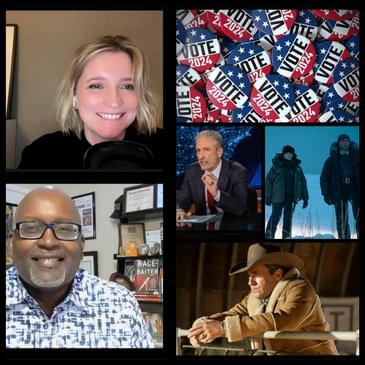

NPR's TV critic & media analyst Eric Deggans joins Christina to talk about how the 2024 US election cycle is reflected in our popular culture. On the return of Jon Stewart. How are the late night talk shows meeting this political moment? What issues are TV creators exploring in shows like True Detective & Fargo as well as in the documentary series space.
Follow Eric Deggans on X @deggans
Learn more about your ad choices. Visit megaphone.fm/adchoices
[00:00:00] This is Pop Culture Confidential, and I'm Christina Yearling-Biru.
[00:00:30] What themes of the moment are TV creators with shows like True Detective and Fargo Exploring?
[00:00:36] I have one of the best with me here to help us navigate these big questions.
[00:00:41] Eric DeGins, NPR's TV critic and media analyst, and author of Racebader, How Media Wheels Dangerous
[00:00:49] Words to Divide a Nation.
[00:00:51] Just a note, Eric and I talk about the run-up to NBC's controversial decision to hire former
[00:00:58] Republican National Committee Chair, Rana McDaniel, as a contributor.
[00:01:03] Just a few hours after our conversation, NBC reversed its decision to hire McDaniel.
[00:01:10] Let's dive in.
[00:01:12] Eric, welcome back.
[00:01:14] Thank you so much for joining me for this.
[00:01:16] You always come to me with the small questions.
[00:01:19] I appreciate that.
[00:01:21] You need to solve the bigger issues.
[00:01:23] We're going to talk about the minor, small problems affecting media and society today.
[00:01:31] I'm here for it.
[00:01:32] I'm here for it.
[00:01:33] I want to start here as of course there's a Trump and Biden rematch.
[00:01:39] Someone who's also back is John Stewart.
[00:01:41] He's back behind the Daily Show desk after more than eight years away.
[00:01:46] He's committed to host Mondays as well as produce the show during the selection cycle.
[00:01:51] He's been back a few weeks now.
[00:01:52] Eric, how is he doing?
[00:01:54] So far it seems to have worked out really well.
[00:01:58] One of the things that I've talked about is that I did a piece on Rewood Jr. former Daily
[00:02:08] Show correspondent when he was still on the show and I hung out with him a little bit
[00:02:11] when he was actually guest hosting the show.
[00:02:14] So leading up to that, I looked at the ratings for all the people who had guest hosted before
[00:02:18] he did it.
[00:02:20] He did it around April, early April of last year and then it had guest hosts since January
[00:02:26] of that year.
[00:02:29] The guest host who got the biggest ratings was actually Al Franken.
[00:02:34] My theory about that is that Al Franken's fans were older and they were still watching
[00:02:41] the show on cable television.
[00:02:44] I think one of the big problems that the Daily Show has had, every late night show has
[00:02:50] this problem but the Daily Show in particular because under Trevor Noah they had focused
[00:02:55] the show on younger viewers and younger viewers have stopped watching cable television.
[00:03:01] They've stopped watching traditional television broadcast and cable.
[00:03:04] They watch everything via streaming.
[00:03:07] So people were watching the Daily Show on YouTube.
[00:03:09] They were watching the Daily Show on TikTok.
[00:03:12] And we're watching it on all these platforms that don't translate into Nielsen ratings,
[00:03:16] which is where the show makes its money.
[00:03:18] What's great about Judge Stewart's return is that he still has a lot of traditional television
[00:03:25] watching fans.
[00:03:27] So that is super charged the show's ratings and it's had a halo effect where the different
[00:03:35] correspondents host the show Tuesday through Thursday and those higher ratings carry forward
[00:03:42] into when they're hosting.
[00:03:44] They're not as high as when John hosts but they're higher than they were when they just
[00:03:50] had guest hosts.
[00:03:51] And I think that's part of the reason John has convinced traditional TV watchers to start
[00:03:57] watching the Daily Show again.
[00:03:59] So not only do they have really good numbers online but they have really good numbers in
[00:04:04] traditional television.
[00:04:07] And he's come back with something to say.
[00:04:10] His first monologue or his first, I don't know, segment was about the debate over Biden's
[00:04:18] age versus Trump's age.
[00:04:21] And I thought it was very savvy and picking that subject because it was a subject where
[00:04:26] it was it was valid to criticize Biden for the way his team is communicated about his
[00:04:33] age and for the fact that he is at an advanced age.
[00:04:38] And you can see it in how he moves through the world.
[00:04:44] But also reminding the viewers, you know, Trump is only a few years younger.
[00:04:51] He's had a lot of public moments where he seems to also have trouble connecting his thoughts
[00:04:57] and trouble talking and trouble reasoning about things.
[00:05:02] And of course, he has all of his problems, all his legal problems, all the fines, all
[00:05:11] the judgments against him.
[00:05:13] He's been found civilly liable for sexually assaulting a woman, all these things.
[00:05:20] But there are some criticisms about how Biden has handled the age issue.
[00:05:26] And so by choosing that topic, he came forward with something where he could credibly kind
[00:05:32] of make fun of Democrats and Republicans, make fun of Biden and Trump, deliver this sort
[00:05:38] of telling analysis.
[00:05:40] And something that he knew probably would anger liberals who were ready to embrace him
[00:05:45] when he came back.
[00:05:47] But it was controversial enough.
[00:05:49] I mean, you know, Christina, you know this now.
[00:05:53] He sells controversy produces engagement, which produces page views, which produces
[00:05:59] audience.
[00:06:01] And so he needed to come back with something that wouldn't just be preaching to the choir.
[00:06:07] And that presentation was absolutely that.
[00:06:12] And then he's gone on to articulate some really interesting ideas, including just this
[00:06:17] past Monday where he talked about Donald Trump's latest legal issues and took on this idea
[00:06:25] that his fraud in New York was a victimless crime and debunking that idea.
[00:06:31] So it was, you know, I think he's had a really great run so far.
[00:06:35] I think the only fly in the ointment for the Daily Show is that he may be proving week after
[00:06:40] week that the only person who can really host the Daily Show and have produced significant
[00:06:46] ratings is John Stewart.
[00:06:49] And what happens when we pass the election, when he's supposed to stop hosting, what's
[00:06:57] going to happen to this show?
[00:06:59] And you know, I did an interview with Dolce Sloan who was a correspondent on the show
[00:07:03] and I sort of asked her about, you know, what's it like now that John is back.
[00:07:11] And you know, her reply, you know she was joking but she was also a little serious
[00:07:15] when she said, you know, well now people know we won't get canceled.
[00:07:19] And so I think, you know, John obviously loves the Daily Show and obviously feels a connection
[00:07:27] and loyalty to the people who work there.
[00:07:29] So I think he realizes that if he steps away from the show and they don't have another
[00:07:34] host, Sotletly Chosen, it could be a serious problem.
[00:07:39] So it'll be interesting.
[00:07:41] I mean, that's a decision in the distance for them.
[00:07:45] And it's hard to know what to do.
[00:07:47] You know, everybody's been so focused on seeing what this new iteration of the show is
[00:07:53] going to be like and how it's performing but you know they don't have to find permanent
[00:07:59] hosts.
[00:08:00] Right.
[00:08:01] Right.
[00:08:02] You were mentioning the others, Colbert, Seth Meyers, the Jimmy's and I'd like to mention
[00:08:06] SNL there as well.
[00:08:07] Do you see a difference in how they're sort of comedy, how they're covering this is
[00:08:12] opposed to 2000?
[00:08:14] Well, SNL I think it's a different beast than the other programs you mentioned not just
[00:08:19] because it's a very different program but also because SNL is in a very different place.
[00:08:26] It's very much in a sort of rebuilding mode.
[00:08:29] You know, they have a bunch of new people.
[00:08:32] They have a gigantic cast and they have not figured out how they want to talk about the
[00:08:38] modern political moment.
[00:08:41] And so you get a lot of shows where there's a lot of okay stuff but nothing that really
[00:08:47] penetrates.
[00:08:48] I mean, one of the things that SNL used to do really well was come up with a way of
[00:08:55] making fun of a politician that became that politician's image.
[00:09:01] So you know, like Tina Fey was doing in all these.
[00:09:05] Well, I would say going all the way back to when Chevy Chase made fun of Gerald Ford and
[00:09:10] you know, Dana Carvey's impersonation of George H. W. Bush, Will Ferrell's impersonation
[00:09:18] of George W. Bush, Tina Fey's impersonation of Sarah Payland.
[00:09:22] You know, they all managed to crystallize things that we always suspected about these
[00:09:28] politicians and really make fun of them.
[00:09:32] And I think even though they currently have a performer who does a great Donald Trump,
[00:09:41] we've already seen Donald Trump's hypocrisies and foibles and weirdness encapsulated in
[00:09:47] great impersonations from several other people including Alok Baldwin and Darrell Hammon.
[00:09:53] So they have a great Trump which is wonderful but that's nothing new.
[00:09:58] Right.
[00:09:59] And they haven't really figured out, you know, they don't have a great Joe Biden.
[00:10:04] They don't, you know, they've had a succession of people play him and they haven't never found
[00:10:08] anything that really sticks with the public.
[00:10:11] And so, you know, part of their challenge, I mean it's weird to bring it down to impressions
[00:10:16] but once they find someone who can crystallize a take on one of the biggest politicians
[00:10:22] of the moment, that helps focus their comedy and then all of a sudden you get these great
[00:10:26] sketches that lampoon where we are and they just have not figured that out yet.
[00:10:34] And so I think it's meant that their political comedy has kind of felt aimless.
[00:10:40] And so they just haven't produced anything that's really insensitive or kind of resonates.
[00:10:46] And the only thing that's resonating now is the controversy over some of their hosts including
[00:10:51] Shane Gillis.
[00:10:53] With the other shows, they've all kind of leaned into politics to one extent or another
[00:11:00] and they're all threatened by the decline in traditional viewing.
[00:11:05] How do these increasingly middle-aged white male late-night hosts speak to an increasingly
[00:11:14] diverse youthful audience that is watching them on platforms where the network does not
[00:11:21] own nearly the amount of profit that they would earn on those viewers if they actually
[00:11:27] watch them on their TV networks where they are based.
[00:11:33] And it's just a problem that just keeps getting worse and there's not much that they can
[00:11:38] really do about it.
[00:11:40] Before we get into some drama shows I want to talk to you about, I wanted to ask about
[00:11:44] something that happened yesterday or few days ago and that's NBC's hiring of Ronan
[00:11:49] McDaniel who was the former chairman of the Republican National Committee and this has caused
[00:11:56] a lot of consternation.
[00:11:58] Talk a little bit about why.
[00:12:00] Sure.
[00:12:01] So, yeah, Ronan McDaniel was hired by NBC to be an analyst, an expert I guess.
[00:12:13] There's been some reporting Dylan Byers, the reporter who writes for Putt claims that
[00:12:18] she's being paid $300,000 for this.
[00:12:22] And the issue for a lot of journalists that work at NBC News is that she's hired by
[00:12:29] a news organization but when she was the head of the RNC, she had helped support Donald
[00:12:37] Trump's efforts to overturn the election that Jabbayden won fairly and seems to have
[00:12:47] been involved with the effort to get a bunch of fake electors to show up and claim that
[00:12:54] they were the people who should be voting in the electoral college so that they could swing
[00:13:00] the vote for Donald Trump.
[00:13:03] So, to have someone who seems to have been involved in a plot to overturn a free and
[00:13:10] unfair election and who has in the past supported Donald Trump's lies about the 2020 election
[00:13:17] not being valid to have that person be hired by a news organization and pay to significant
[00:13:22] sum at a time when other people are getting laid off.
[00:13:27] Just seemed like a really terrible idea to a lot of people who worked at NBC News and
[00:13:36] particularly at MSNBC because the head of MSNBC has come out and said that they will not book her on their shows.
[00:13:48] It's freed up the talent that work at MSNBC to be quite vocal about how they felt hiring her was a bad idea.
[00:13:57] So, Joe Scarborough and Nico Rizinski and Jen Socky and Rachel Maddow in particular spent
[00:14:05] more than 20 minutes on her show this past Monday criticizing the idea, calling it a mistake and saying
[00:14:16] that she hoped that the leadership at NBC News would reconsider once they had time to think
[00:14:21] and realize that it was a terrible idea.
[00:14:24] And so, it's interesting.
[00:14:27] I can't recall the time when someone was hired.
[00:14:31] I mean, they've been controversial hires where people from politics have tried to cross over into news.
[00:14:37] But people had sort of gotten used to the idea that folks whose time as a political operative
[00:14:44] had kind of ended would then get these cushy jobs where they would be political analysts for a news outlet.
[00:14:51] And generally their job is to not only talk a little bit about politics from an insider's perspective
[00:14:59] but part of their job is to also give the news organization a deeper connection inside the party
[00:15:04] where that person had been working. So, if somebody like Donna Brazil gets hired by CNN as an expert
[00:15:11] part of her job is to sort of help them reach out to other Democrats and get a sense of what's
[00:15:16] happening. You know she can sit in on news meetings and sort of say well you know here's what's
[00:15:21] happening on the surface. But you know I know these people I know how they think
[00:15:24] and this is probably what's going on and maybe I can call around a little bit and find out what's
[00:15:28] happening. And do you think this was the idea that the leadership may have had in this higher?
[00:15:34] Why don't know exactly what they would have asked her to do but generally that is what
[00:15:39] those kinds of analysts are expected to do. They're not just hired to be on camera.
[00:15:45] They're not paid that amount of money just to go on during panel shows and say what they think.
[00:15:50] Part of their job is also to help the news outlet figure out what's happening behind the scenes
[00:15:56] and help them figure out how to report on stories and get a sense.
[00:16:02] You know in a sense, Ronald McDaniel might have been the most prominent kind of free agent
[00:16:10] person who was close to Donald Trump at one time. She might not necessarily be that close with him
[00:16:15] now. I mean he did you know have her forced out of the RNC but at one time she was particularly
[00:16:22] close to him and I'm sure they were thinking here's a way to get somebody working in NBC News who
[00:16:26] knows all these people, who knows how they think and can help us figure out how to reach research
[00:16:31] stories. But the big problem that they have is that she has a long track record of saying and
[00:16:39] doing things that are not particularly in line with NBC News journalism ethics. And it's one thing
[00:16:47] the hire somebody who was a political operative and they did their job as a political operative.
[00:16:53] And now they've decided to kind of leave that world in there working for you as an analyst.
[00:16:58] And it's but that's different than hiring somebody who may have been involved with subverting an
[00:17:04] election, particularly when you know the core of a traditional news outlet is to uphold the
[00:17:12] institutions of democracy. And particularly when you know Trump and Trump world has been very focused
[00:17:19] on trying to invalidate the power of traditional news organizations because they don't like the way
[00:17:25] traditional news organizations hold them to account and report independently on what they do.
[00:17:30] And so to take someone from that world and hand them a bunch of money and say come work for us
[00:17:36] you know their credibility isn't great. And it damages the credibility of the larger news
[00:17:44] organization and you know a lot of journalists there were worried about that. And part of the dilemma
[00:17:50] you could see Meet the Press reportedly had booked Toronto, McDaniel long before it was known
[00:17:59] as she was going to be working at NBC News but her appearance on Meet the Press came right after
[00:18:05] news broke that she had been higher. And so then Kristen Wilker the host of Meet the Press had to
[00:18:10] grill her on all her past opinions and try to get her to say okay you believe Joe Biden was
[00:18:17] fairly elected president and you know did you participate in you know the effort to overturn
[00:18:23] the election? And you know all of it had to sort of try to rehabilitate her image by grilling her
[00:18:31] on all these questionable things that she had been involved with. And you know ideally if you
[00:18:36] hire somebody and you pay them more than a quarter million dollar salary you don't have to
[00:18:41] you know sort of vet them or inoculate them from criticism by having a contentious interview
[00:18:47] with them the first time they appear on your platforms after their hiring has been announced.
[00:18:55] The fact that they had to do all that tells you how you know the damage her credibility was
[00:19:03] even going into this agreement and that made people scratch their heads you know why at a time
[00:19:07] when so many great journalists, Pulitzer winning journalists are losing jobs or taking pay cuts or
[00:19:14] you know seeing their roles dial size. Why are you handing this much money to someone who isn't
[00:19:19] a journalist and who has you know really questionable credibility?
[00:19:26] I'm Ken Harbaugh host of Warriors in their own words, a podcast that presents the unvarnished
[00:19:31] unsanitized truth of what we have asked of those who defend this nation. As a country we need these
[00:19:37] stories more than ever, stories from Americans who have borne the battle including 30-year-old
[00:19:43] remastered interviews with veterans from World War One recounting their time in the trenches of
[00:19:48] Europe and with veterans from World War Two, Korea, Vietnam and from our most recent conflicts in
[00:19:54] Iraq, Afghanistan and other battlefields Americans may never have heard of. Hear their stories by
[00:20:00] listening to Warriors in their own words wherever you find podcasts. Just one more question about
[00:20:08] the talk shows of the more comedian aspects of this juicy in their material and the jimmies
[00:20:16] and the cold bears. How they're actually tackling this election. After January I think that's
[00:20:22] lots of things happen this time if there's been a change in how they want to approach the landscape
[00:20:28] in general. I mean you know my sense is that you know they do what they do what they do what they do
[00:20:35] and it's all about meeting the moment and trying to talk about what's happening and you know
[00:20:40] in the background is the sense among liberals at least that democracy is on the ballot and that
[00:20:50] you know because of what Trump has said he will do if he gets elected president again there's
[00:20:56] real concern about the independence of the Justice Department about freedom of the press, about
[00:21:05] free and fair elections, whether he would ever voluntarily leave power again if he's actually
[00:21:11] elected president. And so that's in the background of I think everything that they're joking about
[00:21:16] in a way that it wasn't when Trump was actually president because I think even then people
[00:21:25] couldn't people might joke about how he would never leave but they couldn't really imagine the
[00:21:30] lengths that he would go to to not relinquish power and I don't think anybody you know well I wouldn't
[00:21:38] say anybody but I don't think amongst the late-night hosts that they seriously thought for example
[00:21:42] that he would inspire a crowd to attack the Capitol until it happened. So so you know everybody I
[00:21:50] think kind of it's about the stakes you know we can constantly hear journalism ethicists talk about how
[00:21:57] you know journalists covering the election should talk about the stakes of the election
[00:22:01] and not horse race journalism who's ahead and who's not. And I think the late-night hosts have also
[00:22:08] shifted to talking about the stakes of this election in a way that's a little more intense than
[00:22:14] maybe they had before but it's just about meeting the moment, it's just about talking about you.
[00:22:18] Yeah that's my feeling too. Let's turn to drama of course you know drama productions film and TV
[00:22:24] have a long production cycle so it's not something happening out but I'm still interested in hearing
[00:22:28] air because you always have such great theories about different things is what we're seeing right now
[00:22:34] what people are watching be it three body problem on Netflix or the regime. I was thinking about
[00:22:39] Fargo the other day this last season if you can see anything that's sort of in the air of the moment
[00:22:45] of the issues we're dealing with. Well again you know sort of dealing with authoritarianism and
[00:22:52] and dealing with tribalism. I think those things have kind of been in the air since
[00:22:59] Trump was president. You know his election I think prompted a lot of artists to take a look
[00:23:07] at how authoritarian styles of governing become popular in democracies. And what do you do when
[00:23:17] an authoritarian kind of gains power like how do you if you're somebody who believes in democracy
[00:23:25] how do you react and I think you know a lot of the several were two set dramas that we've seen
[00:23:34] recently. I'm blanking on the name of the one that was recently.
[00:23:38] Masters of the air? No no masters of the air is is Apple TV plus and that's different that's
[00:23:44] about warfare. But I'm thinking more about the new look on Apple TV plus. I'm thinking about
[00:23:52] the zone of interest to film that was recently an Oscar contender and won an Oscar and I'm thinking
[00:23:58] all the light we see is that right right yeah on Netflix. You know those shows are all about
[00:24:05] you know you have this brutal authoritarian power that is in your environment and that is dangerous
[00:24:12] and how do you negotiate that? How do you oppose it if you're opposing it or how do you survive it
[00:24:19] you know what does it mean? How do you know what does it do to to your to the world? What does it
[00:24:27] do to society to have this thing going on? And so you know we've seen a lot I think of
[00:24:33] TV shows kind of grapple with that even the regime is kind of about that. So I'm critic who wrote
[00:24:40] that you know it's a comedy about what might happen if Trump gets elected again and you know you
[00:24:48] could certainly look at that and say you know that's probably why they thought this comedy was
[00:24:54] appropriate to try and tackle in this moment because there are all these people who see authoritarian
[00:25:02] tendencies and think well here's a guy who'll come in and make everything work and it makes you
[00:25:07] sort of understand one of the things that I think is sometimes hard for Americans to understand
[00:25:14] is that authoritarian's rule in some places because a lot of the people who live there want them
[00:25:21] in power they they agree with their views on issues or they agree with their views enough
[00:25:27] that they're willing to have them in power because there's a sense that they bring order
[00:25:32] and and so the way that authoritarian's take power is by creating chaos where they are based
[00:25:40] and then presenting themselves as the only solution to that chaos and we've seen it in a lot of
[00:25:46] different places and it's happening in America now and so of course artists will
[00:25:53] find a way to talk about those themes and in other fictional fictionalized works and that so we
[00:25:59] seen some of that you know that's that's been and even Dune is like cautionary tale sort of yeah
[00:26:05] but but that message in Dune won't really emerge unless they do the third film
[00:26:12] the the the second film is it is kind of different it doesn't really you you have this foreboding
[00:26:21] sense that elevating the the lead character is a mistake but but isn't that where we've been
[00:26:28] this foreboding sense well but in the case of of Trump we we know we know what he's capable of
[00:26:37] because he was president already and a case of Paula Trady's nothing to get too thick in in
[00:26:42] the weeds um we like that he just has these visions and and and he's and he's a reluctant
[00:26:51] authoritarian and a bizarre way you know he he understands the cost of being elevated
[00:26:58] and and but he's in a world where he he wants his revenge and the chaos is real so you know it's
[00:27:06] I think it's it's a slightly different situation but I mean I understand why it makes sense that
[00:27:11] that again that movie would come forward but um but I don't think we'll get the cautionary
[00:27:16] tale about authoritarianism until if they if they get to make they probably get to make it they
[00:27:20] will it's been a success i'm pretty sure yeah yeah as many he says well you know but you never
[00:27:25] you mean I tell you you never know i mean euphoria you know there's a lot of doubt that there's
[00:27:30] going to be a third season the next show it's pretty successful so so uh see you never know but um
[00:27:37] but that's that's one thing that we're that we're seeing a lot of that i think is is really interesting
[00:27:43] the other thing that i've been really interested in is seeing how indigenous culture has played a
[00:27:49] pivotal role and a lot of interesting shows that we've seen recently including true detective
[00:27:54] night country echo on disney plus um it's it's uh you know it helped reinvent true detective
[00:28:04] from an anthology series that was very much about the male gaze and about how men feel about things
[00:28:10] to making it a female centered show that and and and and and a show centered on indigenous culture
[00:28:18] and and it was very much about how women and about how uh indigenous people see things
[00:28:23] and and um and it reinvented uh the genre and and it's proof of something that i've been saying
[00:28:31] uh for quite a long time almost since i started covering television in 1997 which is that by adding
[00:28:40] diversity you create better product it's not just about i'm always being an an advocate of inclusion
[00:28:49] because um it makes journalism more accurate and it makes scripted and fictional works uh more
[00:28:58] expansive it expands the possibilities and it expands your your ability to surprise audiences
[00:29:05] because you don't go into a movie or tv show knowing who the hero is knowing who the villain is knowing
[00:29:11] how the story's gonna play out because you you might be seeing it through the eyes of a different culture
[00:29:17] you know you watch true detective night country some things happen during it and you're not sure if
[00:29:22] they're actually happening if they're happening because people are hallucinating or because they
[00:29:26] have mental illnesses or if they're happening because the spirit world is reaching into the actual
[00:29:31] world and and having an impact on people and the show itself doesn't really resolve those questions
[00:29:39] you have to watch it and kind of decide for yourself what you think is happening um and that's a
[00:29:45] really exciting thing to present to audiences who are so sophisticated now that they can watch five
[00:29:51] minutes of a police procedural and tell you who the the criminal is uh unless the the show unless
[00:30:00] the story that's in that procedural is so bizarre and twisted that no one could guess it and then
[00:30:06] that's that's sort of the the point of it yet the amount of shit that is alopeas and the rest of
[00:30:14] the creators on um true detective had to take because of all the issues with that being female
[00:30:22] dominated show and everything was really sad to see well what was sad was that the
[00:30:27] nick pizalato the guy who had uh the original show um became uh you know an instigator of this stuff
[00:30:36] and he you know um looking at his IMDB page there's a sense that he hasn't really done anything since
[00:30:44] the first season of true detective that's been nearly as successful and rather than he still
[00:30:50] listed as an executive producer on the show and rather than sit back and enjoy the way that
[00:30:56] someone clearly paid close attention to the first season of true detective created a show that in
[00:31:02] some ways was a homage that in some ways was a mirror image then in some ways was in conversation
[00:31:09] with that first season rather than sit back and enjoy that see that uh so many critics and viewers
[00:31:16] seem to like it and say you know good on you you you did a good job taking something that
[00:31:22] that i started and taking it to a different place rather than doing that being generous
[00:31:29] implying on social media that he didn't like the changes that were made that had cheap in the show
[00:31:34] and and and giving all those you know trolls out there who just wanted to tear down
[00:31:42] uh a female centered show giving them the justification to kind of go after isalopeas the new
[00:31:48] showrunner and and go after the cast it was just so sad to watch it was just wanting to watch
[00:31:57] and so surprising because you know there's plenty of situations in show business where people
[00:32:02] just keep their mouth shut and they get their check and even if they're kind of bother what
[00:32:06] happened about what happens they understand that um the polite thing to do is to just sit back
[00:32:12] and let it happen and uh and enjoy the fact that you still get a a piece of the success of the show
[00:32:20] um so i don't know you know that whole thing was very distasteful and and you know i i got just
[00:32:26] a sliver of that because um you know i posted and commented a few times i did an episode of
[00:32:34] the impure podcast pop culture happy hour will recryticize pizalato for what he was doing
[00:32:40] and and that started an online conversation on my x-lash twitter page that brought a lot of vitriol
[00:32:46] my way and so i just got a sense of a sliver of what they must have been enduring and uh it was
[00:32:53] just really sad because you know you could tell in the first two episodes of the show that it was
[00:32:58] really a triumph of a reinvention and that jody foster was knocking out of parking kelly race the
[00:33:05] um you know women who then um played the indigenous character was just uh matching jody foster you
[00:33:14] know i mean being able to hold the screen with a talent as experienced and as boundless as jody
[00:33:20] foster is no mean feat and and she did a great job holding those scenes with her and and giving
[00:33:28] back as good as she got and you could tell the two of them there was a chemistry there and it was
[00:33:33] and that's important you know because that's you know that's at the heart of true detective is two
[00:33:38] different uh two very different police officers pursuing the same case and their differences
[00:33:45] producing this chemistry that becomes uh very watchable every that's the consistency even though
[00:33:53] every episode of true detective has been sent in very different circumstances that's always been
[00:33:57] the constant and they've really managed an amazing job in putting these two people together inside
[00:34:03] this really unique interesting story and to have all of that kind of get impugned by the guy who
[00:34:09] can figure out how to make a fourth season that was um you know uh nearly as captivating was was
[00:34:15] was really uh disappointed and i want to mention to your point of great shows event reservation dogs
[00:34:22] which i thought was amazing in terms of your name and of course killers of the flower moon um what
[00:34:27] about the topic of disinformation and fake news and things like that which of course has been a
[00:34:32] topic for like have you been seeing that in any drama oh and any dramas misinformation disinformation
[00:34:38] that's a good question i mean i'm sure it's being dealt with then sort of like the procedural shows
[00:34:44] let's try to think of a larger series and as i was mentioning at the top i thought this season of
[00:34:50] Fargo was really tackling um some of the issues of the moment yeah toxic masculinity and the cold
[00:34:57] like devotion that some people have to super conservative figures yeah absolutely um yeah i can't
[00:35:04] think of right now off the top of my head i can't think of a major tv project that is centered on
[00:35:10] disinformation in the way that you know uh toxic masculinity is a big part of what Fargo's talking about
[00:35:16] her um you know the power of uh you know womanhood is at the center of true detective i'm sure
[00:35:26] a there's probably some projects out there that i'm just not thinking of and b i'm sure some people
[00:35:30] are working on it um you know misinformation and disinformation can be elements of stories
[00:35:37] you know in the regime for example you know you see how she has control of the media and um
[00:35:43] and so i think we've seen that kind of thing where you know at misinformation to disinformation
[00:35:49] was a part of succession's story for example you know because that family controlled um a right
[00:35:55] leaning uh cable news network and we saw how they um you know covered a contingent selection
[00:36:03] and it offered a lot of cautionary tales about what might happen in our own contingent selection
[00:36:09] that's coming up uh but i can't think of a show where that is the center and i think that might be
[00:36:15] i think it might be because it's you know it might be hard to to really make um an entire movie or
[00:36:24] an entire tv show about that subject and it's much easier to make the film of the tv show about
[00:36:31] the result of the misinformation rather than the actual misinformation itself blockbuster tv show
[00:36:38] that is centered on misinformation and disinformation and i and i know i you know i don't say that
[00:36:42] trying to joke because i think you're right it's a major theme and and i and i noted i think about
[00:36:47] i'm surprised that there hasn't been uh one that i can remember um you know maybe we'll think of it
[00:36:53] we'll probably think of it when the interview's over we will and then we'll have to go ahead
[00:36:58] and be like we were such an idiot we forgot you know what's interesting to me i think i see this
[00:37:03] happening much more in the um non-fiction documentary space where um documentarians are going back
[00:37:12] and looking at things that we enjoyed 20 years ago and pointing out all the toxic and terrible
[00:37:18] things that we kind of glossed over back then and we saw it happen of course with archaea and
[00:37:26] surviving archaea and we saw it happen with Britney Spears and most recently we saw it happen
[00:37:32] with Nickelodeon with the docuseries quiet on set where they went back and talked about a period
[00:37:38] about 20 years ago when Nickelodeon was the king of kids tv and the main showrunner who helped them
[00:37:48] maintain that status was somebody who had a lot of allegations of toxic behavior behind the scenes
[00:37:55] and then you know separately there was an issue with Drake Bell the star of one of their shows
[00:38:01] who who said that he was sexually assaulted by a dialogue coach repeatedly um and and that person
[00:38:10] was prosecuted the the dialogue coach was prosecuted in serve time in jail but the identity of
[00:38:16] the person that he molested was never was not revealed in court and and Drake Bell came forward
[00:38:22] publicly to say he was that person in this docuseries so you know that's kind of where we are now
[00:38:29] with some of this stuff is that the docuseries are really looking back at politicians and politics
[00:38:36] and pop culture from 20 years ago and saying hey you know we may have thought this stuff was okay but now
[00:38:42] that we've been through the Me Too movement now that we have much more diversity in um in all of film
[00:38:53] and Hollywood and we have different people who can look at this stuff and get film projects made
[00:38:58] and TV projects made let's look at these things with a different lens so even there's a recent
[00:39:04] documentary about this festival called Freak Nick that would be amazing if you've heard of it
[00:39:09] nope so I went to college um in through the 80s um and in the 80s and early 90s in particular
[00:39:19] there was this festival that was originally organized by historically black colleges in Atlanta
[00:39:25] during spring break um that was supposed to be you know um there's always this ritual in college
[00:39:31] you get time off uh for spring break in the middle of a semester and people go party they go to
[00:39:38] Florida or they go you know the Caribbean or something you know black college students were looking
[00:39:44] for a place to go that they could call their own and so this festival called Freak Nick got created
[00:39:50] and that was where black college students went and it started with historically black colleges when
[00:39:55] they first started it but then it became this huge festival where you know if you were a black kid
[00:40:00] in college you always hearing about man you gotta go to Freak Nick you gotta go to Freak Nick
[00:40:04] and it became a street festival that just took over Atlanta and you would have people party in
[00:40:11] and cars you know you would have um women and men you know kind of hitting on each other and you
[00:40:18] would have you know um the uh rap artist especially in Atlanta started to realize hey these are the
[00:40:24] people who are listening to our music so they would give out Freak Assets so that's how outcast for
[00:40:29] example um you know we first started to spread word about what they were doing and and you could tell
[00:40:35] people would really like a sampler because uh they would hand it out and then it would become popular
[00:40:41] and then suddenly you'd have these big traffic jams and everybody would be bumping the same song
[00:40:46] because everybody thought it was cool it was just this huge communal event that um the featured black
[00:40:52] culture but then it started out of control and there were very public events where women were
[00:40:57] sexually assaulted and uh and then the police had to crack down and particularly when in Lanna got
[00:41:03] the the Olympics they decided to make it really hard to have uh Freak Nick in Atlanta
[00:41:10] and the whole thing kind of fell apart there's a documentary out now about that
[00:41:15] and and and looking back on it again you know you're looking back about 30 years in this case
[00:41:23] and and you see things with a little different eye when you're an adult and you see where everything
[00:41:27] has gone and you know you understand how women were objectified during that whole process and
[00:41:33] and uh you know as fun as it could be how tough it could be for a city to just have this flood of young
[00:41:41] botquist to send on it and and and do things their way you know um so you know I see this happening
[00:41:52] in the docu-series space right now and and it's really interesting and and and i can't wait to see
[00:41:58] what other things documentarians are going to have us re-examine because they really deserve it
[00:42:04] it's it's a fertile grant and you know with quite on set for example um we need it's a message that
[00:42:11] we need to pay attention to how children uh young performers are being treated right now
[00:42:17] and uh it's something that even though we talk a lot about child actors who grew up and then
[00:42:23] have dysfunctional adult lives we don't spend a lot of time looking out for the current children
[00:42:29] performers we will look at these people who used to be child stars and we will document their
[00:42:35] every failing as an adult but we won't look at what the young performers right now uh are going
[00:42:41] through and whether they're being taken care of and i hope that quite on set you know inspires
[00:42:46] that kind of thing inspires people to really take a look at them and make sure in the same way that
[00:42:51] surviving our kelly uh eventually inspired uh legal charges against our kelly and um and the
[00:42:57] Britney Spears documentary inspired this drive to free her from the conservatorship she was in
[00:43:03] i hope so too um there's gonna be a lot to look back on from these years that we're talking about
[00:43:08] now Eric we'll see what what happens in popular culture it's always so interesting to talk to you
[00:43:13] and get your perspective thank you so much for joining me again
[00:43:17] thank you for having me thank you so much to Eric deganes you can follow his work read his reviews
[00:43:24] listen to interviews at npr.org and you can follow him on x formally twitter at deganes and thank
[00:43:33] you so much for listening subscribe to pop culture confidential wherever you get your podcasts
[00:43:39] see you next time
[00:43:40] i'm a grown up me too yep me too but you know these days being a grown up can really suck
[00:43:47] luckily we're grownups who grew up in the coolest generation we had video arcades and also some
[00:43:52] of the best tv movies ever made we live the origin of awesome consumer electronics the list goes on
[00:43:57] and on yep generation x exactly and we're gen x grown up every week the gen x grownup podcast
[00:44:04] explores media tech toys games and more from both yesterday and today through the eyes of
[00:44:10] generation xers who absolutely love that stuff you can find us on itunes or wherever we get your
[00:44:15] podcasts or find us on our website gen x grownup dot com all right i think that was good enough
[00:44:22] i hope so man i'm tired who listens to a promo in a podcast and then goes and listen to a different
[00:44:27] podcast i've never done it