
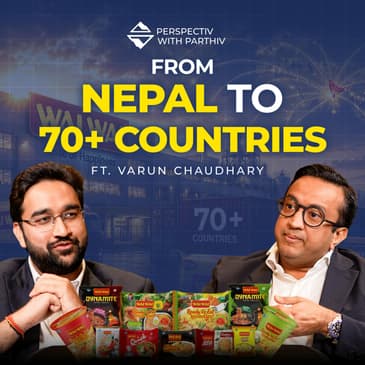

In this episode of Perspectiv with Parthiv, Varun Chaudhary, Managing Director of CG Corp Global (the company behind Wai Wai Noodles), shares how a boarding school snack became a global FMCG brand present in over 70 countries.
Varun talks about competing with Maggi without matching its advertising budgets, maintaining the iconic ₹5 price point for over two decades, and how quick commerce is reshaping consumer behaviour across India.
The conversation also explores family businesses, scaling across volatile markets, managing 200+ companies, discipline in entrepreneurship, and CG Corp’s future IPO ambitions in India.
All of this, and much more, in episode 6 of Perspectiv with Parthiv.
Chapters:
00:00 – Introduction
02:51 – Varun Chaudhary's Family roots: Migration from Rajasthan to Nepal
07:02 – Diversification strategy for CG Corp
10:07 – Varun Chaudhary's early career in Dubai
16:22 – The origin story of Wai Wai
20:55 – Wai Wai competing with Maggi in India
23:20 – India’s instant noodle consumption opportunity
27:24 – The ₹5 FMCG pricing phenomenon
33:22 – CG Corp IPO plans & India’s capital markets
36:10 – Nepal political unrest & personal losses
40:25 – Why India excites global entrepreneurs
45:24 – Varun Chaudhary's advice for young entrepreneurs
47:24 – The truth about third-generation businesses
[00:00:00] The story of Wai Wai is also so unique that it's actually the boarding school kids through word of mouth, it became a brand that it is today. People from Nepal who left, they carried Wai Wai to their respective countries, be it in Europe, be it America, be it Canada. It's the brand created by the people. You have 261 brands in 202 companies across 50 countries. Does that sound right? Absolutely, you got the data right. I think diversification of risk, diversification of verticals, diversification of geography has also hit us.
[00:00:29] If one region is getting affected, you have the other region to compensate or help your value out. So this strategy has worked beautifully for us. In a world of contracts, people I think are losing value of word. As they say, when we say something, when we speak something, we deliver or we don't speak at all. You know, you come from a country, Nepal, which very recently had a massive political upheaval.
[00:00:56] I think some 200 people stormed into my house and they vandalized, stole and put the house on fire. Our showrooms were burnt down, our factories were burnt down. Very sad movie. Maggie has a big brand recall. You know, having this conversation with you, you seem quite unbothered about it when I'm comparing it against Wai Wai. Why? So one is, you know, competition keeps us alive. When you are so confident of the acceptability of this product, I'm like, bring it on.
[00:01:25] Hello and welcome to Perspective with Parkha. This is a conversation series where we explore the ideas, values and turning points behind the leaders shaping India's business landscape. My guest today carries a story that is about the weight of inheritance and the courage it takes to move beyond it. A story with Indian origins, foundation in Nepal and a global ambition, which in many ways tells you everything about the person.
[00:01:53] Today we have with us Mr. Varun Chaudhuri, Managing Director of CG Corp Global, one of South Asia's most diversified conglomerates and a multinational with interest spanning FMCG, hospitality, finance, real estate, cement, auto, with operations in more than 50 countries. What genuinely interests me about Varun is the question of how a leader navigates between legacy and ambition.
[00:02:18] When to honour what is built and when to have the conviction to break away from it. Please welcome Mr. Varun Chaudhuri. Thank you so much for being on the show. Thank you, Parthas. So your family has had roots in India and went to Nepal, built such a large enterprise.
[00:02:44] Can you walk us through those early moments with your grandfather and with your father making such a wonderful enterprise? About 150 years back, my great-grandfather moved to Nepal. And that time what had happened was that the royal family of Nepal had invited, I think it was 8 to 10 Marwadi families from India to come and set up business in Nepal. And you know, Marwadis were and are known for their strong business acumen.
[00:03:12] That's also how the migration to Calcutta happened at that period of time. You know, Marwadi is from Rajasthan when economic opportunities opened under the British rule with Bengal and Calcutta being the capital. A lot of people moved there and set up business. So that's why Calcutta is such a vibrant Marwadi ecosystem. And I'm sure it must be around the same time. So there's a place in Shekhawati area. So it's actually that 27 square kilometer area where all the Marwadis have migrated all over the world.
[00:03:42] That whole Churi Ajitgarh, Junjunu, Ratangarh, Mukhangarh, Sujandharh. That was India's great migration. That was India's great migration. Exactly. I think that's stopped now. We are third generation. We've been in Nepal now. So that's how we actually got there.
[00:03:58] My grandfather, he was the one, you know, who used to go to all the royal courtyards to sell your textiles or sell saris with my great grandfather. So he had that entrepreneurial skill where he sort of, you know, built up the textiles, you know, and got into a few other industries, built the first ever departmental store. And when my dad was 18, my grandfather had a heart attack.
[00:04:27] My dad was all ready to go to Bombay to do a CA. And at the age of 18, when, you know, your father has a heart attack, he had to leave everything. He had to leave his aspirations and get to work. So he took over the reins of the company at the age of 18. And what he's built, we'll come more to it. But all I can say is that he is one in a billion for me. And I treat him like my God. That's so wonderful to hear.
[00:04:53] And, you know, people have heard of CJ Corp, the most popular business being YY, but it has a lot of businesses. You are across auto, cement, financial services. I think there's a whole host of 20 industries. About 15, 20 industries. First of all, what are the industries you're in? So let's start with the FMCG, which definitely covers YY. YY, by the way, we do three and a half billion packets a year.
[00:05:21] And that's almost about three to four percent of the total world production. So that's strong. Three to four percent of the world instant-nodal production? Instant-nodal production, exactly. Okay, wow. Okay, so YY is the only brand which is basically, which has made it big in terms of the only multinational out of Nepal. In foods itself, we do the entire range, be it snacks, be it beverages, be it wafers, be it chips.
[00:05:49] Recently, we've just done a JV with Bikhaji. So we're getting into the entire Indian ethnic snacks as well. So, you know, the, I mean, life doesn't stop. Then we have our financial services where we own the largest bank in Nepal. We have a bank in Sri Lanka. We're also into insurance, into financial services, into money remittance. Third is hospitality. That's where we have a common sort of spot, which is Taj, I-H-C-L.
[00:06:14] We've shared a relationship with them for about almost more than 25 years, having properties, I think, almost 13 to 14 properties with them, ranging from the famous ones in Maldives, Sri Lanka, Nepal, now in Bhutan. We also have our relationship with Marriott, where we have the Fern series by Marriott. We are into real estate in Nepal, India, and Dubai, now getting into Sri Lanka, getting into Serbia.
[00:06:43] So, you know, that's another growing vertical for us. We're into telecom, education, electric vehicles. If you look at any business school, you know, philosophy, they say go deep in one sector instead of diversifying into so many. So what is it that has worked for you that has made you successful in so many different industries? Because we are so diversified. Instead of focusing in one, you're focusing in so many Audi managers.
[00:07:06] I think diversification of risk, diversification of verticals, diversification of geography has also helped us. You know, we are present in so many countries. You see, if one region is getting affected, you have the other region to compensate or help you or bail you out. Yeah. So this strategy has worked beautifully for us.
[00:07:34] So from the data I have, you have 261 brands in 202 companies across 50 countries. Does that sound right? Absolutely. But it also sounds insane. No, it is. And... 261 brands, 202 companies in 50 countries. Yeah, but look at the amount of verticals we have, no? But that's a huge volume of business, even despite the fact you probably need an army of brothers to handle it. Or no? No, we are three-man army. Three-man army.
[00:08:02] But our team below is very strong. Like our team, every category, every product, every vertical has its own COs, regional COs. And our monitoring and tracking system is extremely good. And what would the group business volume be like across these different... Vertical Go is a private limited company? It is. It is. And we're not even... Only our bank is listed in Nepal. Otherwise, it's a very privately held company.
[00:08:34] Well, Forbes valued us at 2 billion early this year. So how does one manage so many different businesses? So my father's also lucky that he's got three boys. And luckily, he's got three disciplined boys. You know, so our education started when we were sent to boarding school at the age of six. We thought our parents were quite heartless that, you know, at the age of six, when we barely know to Prashatid, we are sent to boarding school.
[00:09:01] But we didn't realize that our training actually started so early to be independent, to be disciplined. And for some reason, all three of us, our fraternity has been very, very strong. I consider Dubai as my B school. Right after I see the boards, when everybody went for holidays, I decided to go to Dubai because my parents were coming there. So, you know, I just said, that's fine. I'll just join you for a couple of days and that's my break.
[00:09:29] But when I landed in Dubai at the age of 18, not knowing that this is where my actual career is going to start. So I landed in Dubai. I said, you know what? If there's any place in this world I want to live is Dubai. So that three days holidays turned into a two weeks holidays where we ended up, you know, making a significant investment. And my dad said, this is your first step into the world of business. So I went to States for two years. But, you know, I had to come back.
[00:10:02] So I used to do my work from nine to six and six to ten. I used to do my college. So your brothers, you know, even your father started his career when he was 18 and so did you. You know, for someone that comes with the privilege that you do, in a sense, I've seen many people in India, including me, use that, you know, three, four years of post-school life to study abroad, go to a good university, learn from the experiences there, enjoy a little bit. But you chose to work.
[00:10:32] Why would you do that? No, it's simple. Like I told you, you know, when I landed in Dubai, I said, this is where I want to be. You know, I didn't want to miss that. Would I say bubble or would I say the excitement or would I say that early growth phase of Dubai? You know, we could see that Dubai is going to take off. And when I went there in 2004, that was the time to take off. So, you know, I didn't want to miss that journey. So, maybe it could be my far-sightedness. It could be my vision. But, you know, I wanted to be a part of that journey.
[00:11:00] So, from 2004 to about 2006, I was in the States. But I came back to Dubai in 2006. So, you were rushing through your education. I was rushing me. I took a transfer from an American university in America to a local university in Dubai. And I did my education and I did my work as well. And I learned the most in Dubai.
[00:11:25] You know, when we used to come for summer vacation, we used to be actually doing internships in one of the verticals of our group. So, we used to come back. Either we used to be sitting in a delivery truck of a YY or, you know, one of those other companies delivering YY to dealers, retailers and stuff. Or I used to be interning in my bank.
[00:11:47] So, every vacation we were, you know, built in such a way that you were trained to jump into the business at the age of 18. So, and intrinsically speaking as well, if you ask me, you know, I could have stayed on in America. Saying that, you know, I need to finish my undergrad, I need to finish my master's.
[00:12:10] But it's in us, it's in our DNA that you want to leave everything, you want to do something and make them up for yourself. So, that hunger was within as well. You know, you work with two elder brothers. History has taught us, it doesn't usually work. What was the secret sauce that has allowed you to do that for now more than 20 years? And where do you see this going forward?
[00:12:40] Such a beautiful question. We've seen that, you know, like the one that I asked you, it's sort of, you know, confines to my, the global theory of what we were talking about. But, you know, since we went to boarding school at the age of six, that unity and that understanding is there.
[00:13:02] But what is even more sort of clear to us is that the way my father has, you know, distributed each vertical to each son. There is no overlapping. You know, we could work with each other, like let's say where we do.
[00:13:24] Now, if I'm doing a real estate and if it has a hotel component, I ask my middle brother to come and, you know, help me with it. So that's a beautiful, beautiful, you know, framework which is created. And also because the, you know, he's, he's here. He's here to literally work with the three of us together in a very fair manner. And we just believe in his working style and we have a good working sort of understanding amongst the three of us.
[00:13:54] And my eldest brother Nirvana, I truly believe that he is playing such a good role with a big heart in terms of, you know, putting the whole family intact. So there's no brotherly competitiveness? No, competitiveness is there, but in our own field. I mean, even if it's not, even if it's amongst us, but it's a good laughing competition, you know.
[00:14:16] Can you say the magic for this lies with your father's way of handling this or is it amongst the brothers that is, that everything is clean and sorted? No, so, you know, definitely he plays that role because there could be times when, you know, there could be a certain friction, but he sort of steps in. But that friction also, you know, teaches us deeper values. That why was the friction there when it could have been sort of sorted out?
[00:14:45] But you see, we're such a happy family. And each of us bring in a certain set of a skill set on the table. So, holistically speaking, as a whole speaking, the three of us can probably propel this group to such a new level, which we are treading on, where my father actually is proud of.
[00:15:11] I believe also when you were in dune school, you had, you know, you were very fond of YY, one of the products. That was a currency in school, no? That's the only thing that used to be passed around. Absolutely. So, and also because it was so loved and the story of YY is also so unique that it's actually the boarding school kids through word of mouth, it became a brand that it is today. I mean, we've never spent money, you know, significant money in ATL.
[00:15:41] And the way YY has grown, you've seen the story. It's such a case study, actually. You know, I think one of the universities has actually done a case study on the rights of YY. And in school especially, literally, I remember I used to be called as a YY kid or Chao Chao. You know, the Chao Chao was the Nepali name for YY. So, you know, these two, I used to have these funny names. Yeah. So, YY became a cult. Okay.
[00:16:07] And that actually had a big impact on my entire school journey as well. But what's the origin of YY? How did that company, how did that product come to you? And, you know, what was the inception of it? So, you know, my father used to go to Japan a lot. Because he used to buy a lot of textiles from Japan. And then we did the, we brought in Suzuki to Nepal, my father back in the day. So, you know, whenever he used to come back to Nepal, he used to come via Thailand. Because I don't think so.
[00:16:34] Back then there was a direct ride from Nepal to Tokyo or Osaka. He used to come via Bangkok. So, whenever he used to be back, he used to see on the carousal that, you know, people, whenever they're returning from Thailand, they see this particular YY carton floating every time he comes back. So, you wonder that why would anyone, you know, and so many people just carry a box of YY repetitively, you know what I mean?
[00:17:02] So, he decided to reach out to the company to have a technical collaboration in Nepal. That's how the journey started in Nepal. Until the whole thing had a spillover effect. India was the natural neighbor. So, you know, the entire northeast became a big market for us. We ended up setting the first plant in 2007 in Sikkim.
[00:17:27] Then the whole phenomena came of people leaving Nepal and going abroad for foreign work or employment. So, people from Nepal who left, they carried YY to their respective countries, be it in Europe, be it America, be it Canada, be it Middle East. So, you know, it's the brand created by the people. It's the brand created by college-going kids, by school-going kids. I remember, you know, when I was in school, YY was very, very popular.
[00:17:56] You know, that used to be probably in the bag of every other student. And because it's a snack that you can also have it dry, you know. It's not only, you know, you cook and people, apart from them bringing cooked YY in the tiffin, many of them, and I would say majority of them, you should just bring the packets and snatch it open, crush it, put the masala in and have it as a dry snack.
[00:18:19] And how did that concept, because I don't know whether, was that part of the plan to make YY also a dry noodle or a dry product? Or it became an invention of the school students or the consumers? No, so it was, that's the unique selling point of YY, right? And it automatically became a hit because in school, now you tell me something, where will you find a stove or an incinerator? You know, I remember in school, it's funny, right?
[00:18:47] We used to have those one and a half liter Pepsi or Coca bottle. We used to cut it from the beach. We used to make a can out of it. We used to take compass, put the water in the water, right? If you wanted to really, but you know, Nobody or everybody didn't have that. But that's very high on air for you. Very, you know, and so what people really used to do was they used to pop open a pack of YY. So it became the most convenient snack.
[00:19:17] Now, people in India back then, they were not exposed to YY because of all of Maggie Harate. Right? The moment the whole introduction started happening from people coming from Nepal and introducing to guys like you and me introducing to the whole school. So it became so strong that demand creation started happening overnight.
[00:19:43] In the earlier days of my school, a friend of mine used to get cartons full of YY from Siliguri. I didn't get it. I think in the early... It was in order, right? Just in the 2000s, early 2000s. So he had a cousin living in Siliguri in Bengal. And he used to send cartons of YY to him. And that was our source of getting access to it. And later, obviously, we started getting YY. It's a thousand. Early 2000s, maybe late 90s. I'm not sure exactly when.
[00:20:12] But there was a period where Siliguri came from. The cult of YY is spread all over the world. We're in 70 countries now. 70 countries? 70 countries. And we manufacture India, Nepal, Kazakhstan, Bangladesh, Serbia, now Egypt. So we are really all over. And you have to set up hyper-local plants there? Or do you export out of Nepal or India? So we export. Now what we do is that, let's say if it's Serbia, we export Europe out of Serbia. If it's Kazakhstan, Central Asia.
[00:20:41] If it's India, India is so big. Like, Bangladesh was a lot. How many plants do you have in India? So India, we have 13 plants in seven locations. Wow. And it's so emotional. You know, when I talk about YY, it's so emotional for us. Well, you know, you speak about YY as a brand where you didn't spend much on ATL. And, you know, it was a brand that was developed by word of mouth, by consumers, with a large concentration being in the Northeast and maybe parts of the East. You know, your biggest competitor, I would assume, is Maggie.
[00:21:11] You know, which has a national presence, is nationally known everywhere. Yeah, two times more than us. Spends a lot on marketing. A lot. Why would you not take up that strategy? And how would you compete with a brand like Magli? No, so we have a set, you know, tailor-made market as well. So we are definitely growing in the markets where we are very, very strong.
[00:21:33] And similarly, those markets where we are not, after we had Aishman, you know, was a very dear friend of mine. He was the brand ambassador. That also, you know, sort of helped us distribute and become stronger in the areas where he's got a good recall. So, North, West, we really grew.
[00:21:58] After the coming in of Ecom and Quickcom, I think this is going to be the biggest explosion of distribution. So, and you have already seen that for your product? We've seen that because the way we've grown in Ecom, it's not, it's a double growth. And when you say Ecom, you talk about the Quickcommerce, like the Linkit and Zetto, Swiggy. Yeah.
[00:22:25] My question is that, is there a certain advantage you have gained out of Quickcommerce over Maggi compared to the traditional distribution channel? No, well, even Maggi is there. Everybody is there. And it's just that when you type noodles, you order from, like, so, you know, when you type noodles, at least that thing, you get an option. So, that automatic, you know, need of wanting to try.
[00:22:53] Ki haan, hamne suna hai hai hai, lekin mila nahi kahi. You know what I mean? And like what you said that you used to order from Sidi Gudi when you were in Calcutta. So, even now, you know, there are so many places where because the demand also is so high that, you know, kahi kahi kahi mila mushkil rata hai. So, Ecom mein, or Quickcom mein, they're able to see the packet and they order it. And, you know, we've seen that growth happening.
[00:23:19] And when we speak about a bit macroeconomically, the per capita instant global consumption in India is still lower than the Asian markets like Indonesia. Even Nepal. Or China or even Nepal. Do you see that trend changing? Or is it going to, this is the general consumption pattern? We are maxed out on it. We have just started. Nepal is, I think, 57 packets per capita.
[00:23:48] India is, I think, 506. Oh. So, do you see the, when you do the ratio analysis. But is it 57 also very high? It is because you see the amount of consumption that happens in Nepal. You know, how many times I eat five a day? How many times do you eat five? At least have daily, at least, after me, chalo, char paan bar to mere ho ra ta hai. Really? Yeah. But is that only because it's your brand or do you like? No, no, no, no, no. I love, I love Y. So, do you see the gap? Yeah.
[00:24:17] We are talking about 1.4 billion people here. And we are talking about convenience. We've seen the rise, the way people don't have time these days. Why do you think the whole Quickcom, the whole universe in Quickcom is growing so bad? That today, what will all be done? And is YY or InstaNoodles only a student or young adult-led demand?
[00:24:44] Or is it also transitioning into older population, which is true in countries like China, Indonesia, Thailand? No, it's transitioning definitely into old population as well. And you'll be surprised. Yesterday, this marketing company came to me to make a presentation. And they told me that, sir, have you ever tried laughing? What the hell is laughing?
[00:25:12] Sir, it's a dish which has wai-wai filling. Aisha. It's like a rice wrap with wai-wai filling and spicy. And, sir, it's a super hit. Now, imagine, I didn't listen to that. And that, by the way, has become a vogue. This laughing you get everywhere, I don't know. So, you see the invention which people themselves are trying. It's not only confined to a certain age gap.
[00:25:41] Meaning, even the older lot who are working in all these corporate offices, it's their favorite snack. So, I would say in different forms, definitely, wai-wai is tried out by the many. But obviously, you know, the younger lot, it's their favorite snack. Maggie has a big brand recall. A very strong one. And, you know, having this conversation with you, you seem quite unbothered about it.
[00:26:09] You know, when I'm comparing it against wai-wai. Why? When you have a competitor, which is a household name. You know, wai-wai is also, but not as compared to Maggie. But you seem completely unbothered by the fact that Maggie is better known. No, so one is, you know, competition keeps us alive. And I know that my product is distinct.
[00:26:34] I know that wai-wai clearly differentiates from Maggie in many ways. So, when you're so confident of this product, when you are so confident of the acceptability of this product, I'm like, bring it on. So, India is a very interesting market. And what I have seen is in the last 20 years, you know, since, you know, with me being a consumer,
[00:26:57] maybe 25 years since me being a consumer, I have bought a packet of noodles for 5 rupees, 10 rupees, a packet of chips for 5 rupees, 10 rupees. And to date, there are also packets of the same value available. A 20-25 year period is immense. Obviously, the volumes have shrunk. But why does that 5 rupee, 10 rupees still hold value 25 years later?
[00:27:23] You see, that's the phenomena of the noodle industry. If a competitor increases the price, what if the second one doesn't? So, it's a typical Pala Eiji example as well. Abhi bhi moh biscuit pauchara pahi mei, I think 5 rupees kaai. I think that's the largest selling biscuit. Similarly in noodles as well.
[00:27:52] But what has happened is that the volume has grown. So, it's become a volume gain. So, you know, I agree with the fact that it's not limited to noodles. It's across FMCG. And my question is, why is it so centric in that industry? Because it's not a 5-year period. It's not a 10-year period. 20-25 year period when I'm seeing the same product, you know, irrespective of the change in volume, having that price point of, I don't think so. Anything that I bought 20-25 years back, if I buy it today, will have the same price tag.
[00:28:22] Why does that 5-rupee, 10-rupee, despite, see, per capita income. So, your cost price, your inputs have gone up. Everything has gone up. Everything has gone up. Your manpower cost has gone up. Your inputs have gone up. Infrastructure cost has gone up. Everything has gone up. I mean, if you just, by sheer measuring inflation, that price would have been probably more than two, three times, you know, speaking today. So, why does this golden price of, the way people call it, the golden price of 5-rupees and the golden price of 10-rupees, why does it work?
[00:28:52] You see, this is going to stay on forever. Forever. Forever. I don't think so, you know, you'll be able to replace the 5-rupees market because the 5-rupees market is a lot in the rural areas as well. You know, your price is changing in urban, suburban, you know, the tier 2, tier 3 cities, you know, as we are sort of progressing. But that 5-rupees market is, I mean, irreplaceable and Yeah. Yeah.
[00:29:24] And is there a time that you remember, especially in your FMCG vertical, a defining moment which made, which is, you know, benefiting you even today? Let me talk about my early years in Dubai. Like I told you, you know, Dubai was at upswing. Yeah. Till the Lehman Brothers crisis happened. So, till the crash happened and the economic meltdown. Yeah. Sort of took place. Markets crashed. Overnight.
[00:29:53] And Dubai too was severely impacted. But you see, what I learned during that time was survival of the fittest. We all know that back then, people were not able to sort of service the debt or, you know, were not able to service their installments. You know, they used to literally, they left their cars at the airport and everybody ran away. But you know what? We stayed on. We stayed on in Dubai. We finished all our projects.
[00:30:19] We made sure that whatever we had promised, we delivered. So, you know, those three, four years which it took me to sort of put the whole system back on track. That was the biggest defining moment of my life. But you know, this kind of perseverance doesn't just come. You know, you spoke about your father. You called him a god-like figure in your life.
[00:30:45] There must be some key value systems or lessons that he would have imparted to you and your brothers, you know, in order to ensure this kind of a perseverance and survival of the fittest attitude that you spoke about. So, number one, as they say, it's very important to the world. So, we value that a lot.
[00:31:11] We value when we say something, when we speak something, we deliver or we don't speak at all. Third thing which he's taught us and which is... You know, I must, just to add to that point and I must say that I think that's very critical. You know, in a world of contracts, people I think are losing value of word. And I feel that is very... I mean, I think that's regressive in nature. Earlier, when you didn't have contracts, the word used to matter.
[00:31:41] My point is, contracts are only for worst-case scenarios. The word should still matter. It should matter even more. And I think that that is quite commendable that, you know, institutions and I have seen institutions that not only on the word that they say, but also on the word that is perceived to be theirs. Like, you know, one of the greatest organizations in India is the Tata Group. There are many things that people assume them to say to you, despite them not saying to you.
[00:32:09] To be transparent, to be fair, to be trustworthy, to deliver to the expectations and even beyond it. You know, many a times they might not mention those things, but that is a trust that we attribute to them. That's a quality we attribute to them. And even though it's not a verbal commitment or a contractual commitment, it's a commitment that that organization lives by. And we see the success that they have found in the many businesses they are in because of these attributes. And I think that the value of word comes also from that.
[00:32:38] No, no, for sure. And you know, we've had that partnership with them for more than 25 years and we've learned a lot from them. And I think that the value system is something where, I mean, you know it. So the learning we've got from our partners as well has been phenomenal. One or two cases here and there, you know, with other partners elsewhere, you know, fine. But you know, we've at the end of the day, you know, you don't solve it.
[00:33:07] I think at the end of the day, it's communication at the end of the day. Otherwise, you'll be spending most of your money in paying lawyers to sort out your problem. But I think that it's better to, you know, whenever there's an issue, just sit across and sort it out. But we've been lucky so far. You know, that's a very large enterprise. And why have you not looked at public markets? No, so we will, for one reason or the other, But you're open to it? No, we are not just open. We are working towards it. And the Indian markets? Yes.
[00:33:36] So let's say we will be listing not the group as a whole, but different companies. And I've been saying this. It's a matter of time that we just, why, why? And why? Because I see that the Indian capital market is good. The multiples you can command here. I don't think so you can get this kind of multiple anywhere in the world.
[00:34:01] And the confidence that I have in the leadership of India, which you also sort of reinforce, that makes a lot of difference. So hats off to the leadership of this country. But you know, this is a debate I've often had that, you know, you've spread yourself so wide. Do you think that has come at the cost of going deeper in any of these sectors? Yeah.
[00:34:31] So, you know, we've also started to focus a lot in our core competencies, which primarily is your FMCG, hospitality, financial services. Now real estate is becoming quite a diversified portfolio for us. Telecom, we're looking at various opportunities. So, you know, we are really confining ourselves to these sort of...
[00:34:55] So you're trying to concentrate more value into it so that it becomes more, you know, ready from public market point of view? And also value creation can happen in all these areas. And obviously, you know, we are working a lot on a lot of M&As. And by the way, you know, one of the verticals which I handle, I forgot to tell you, was we are the largest cement player in Nepal. So, you know, that's another common thing which once you had and, you know, we're in cement as well.
[00:35:24] So I'm happy about that. Coming to my M&A, we're looking at acquiring a FMCG company and a retail company. In Europe. And in the next four or five years, what kind of investment outlet are you looking at as a group or maybe sector specific and even would be very interested to know what's happening in India for you? Well, investment outlet, it'll be too early for me to say anything because we literally look at, you know, on an angry basis. India, like I said, the next biggest milestone for me is the IPO.
[00:35:54] Yeah. And let's just, you know, focus on that. Things will probably explode in such a good way post IPO, I feel. So we're just working towards the IPO at the moment. You know, you come from a country, Nepal, which very recently had a massive political upheaval. The governments were overthrown.
[00:36:19] Your house was on the news, unfortunately being vandalized by many of the protesters. You know, you were sitting in India. How did that? No, I was sitting in Nepal actually. You were sitting in Nepal at that point of time. So how did that, how did you, what was the experience for you? Unexpected.
[00:36:41] Unexpected in the sense that they, I think some 200 people stormed into my house and they vandalized, stole and put the house on fire. They put the house on fire? Our showrooms were burnt down. Our factories were burnt down. Our ATMs were burned down. Our factory, our office was vandalized. I think we lost about 50 odd cars. We lost all the cars at our home. Very sad moment.
[00:37:10] You know, when I think of this, just imagine the memories you have in that house. Just imagine the things, the valuables, the priceless things you have in that house which you've, you know, in the form of letters, in the form of, you know, old pictures, which you've not even photographs, in the form of your clothes, you know, all these, a lot of, so many.
[00:37:38] I mean, burning, your house getting burnt down means you're... Probably the worst thing that can happen to anyone. I think there's so much emotional damage. There is so much to it, like, and you can't even repair or recover it. It's gone. But as they say, you know, life has to go on. It's time to rewrite history. We had that.
[00:38:03] We had the Gen Z who sort of literally took charge. Why did it happen? Like, in your experience, you've been a... The writing, the writing was also on the wall. Nepal literally had some 25 governments in 35 years.
[00:38:24] And when you see literally three parties or three families sort of, you know, just taking chairs based on their permutation combination, frustration is bound to step in. You know, it's so irritating that you're working on a particular project and you've reached that stage of approval and suddenly the government collapses.
[00:38:54] So how many times one can fall and rise? And Gen Z especially, you know, they rely a lot on social media, their phone, so to speak. When you put a ban on social media, you know that you're headed, heading for a disaster. And that was the tip of the iceberg.
[00:39:22] So what does the country look like now? Well, we have a 35-year-old prime minister with a clear two-third, virtually two-third majority. I think they are pressing the right buttons. So they are speaking the people's needs? They are addressing the people's needs? Yeah, they are addressing the people's needs. They have clearly charted out their 100-point agenda. The day the finance minister took over, he abolished some of the most archaic laws.
[00:39:49] So by and large, it's in a process of, let's say, Shuddhi Karan bolte hai. So they're in the process of cleaning up everything. And I was one of the first few people who actually came and gave an interview saying that, you know, we welcome this government.
[00:40:14] And we'll be so happy to work with them to do our part of the private sector contribution for the growth of better and a new Nepal. You've lived in India for a while now. What is it about the India market that excites you? And where do you see the potential of India going forward? Look at the growth of India, the way it's happening. I feel that it's such a vibrant place to work. And, you know, as they say, it's not about what you have.
[00:40:44] It's about who you know, which means if you're well-networked here, the opportunities where you can actually tap into your natural acumen is huge. So I think this country gives you a lot. So what is that one thing that India does better than the rest of the world? And then I'm going to ask you the question opposite also. What's that one thing that the world does better than India?
[00:41:10] So if you see India, what India gives you is that size, that scale. It allows you to think big. You know, you are in your neighborhood in South Asia.
[00:41:32] And you know that if you're here, whatever you do, if you do it right, you are bound to become a solid player. You know, you might, you would have worked in many states in India. Is there any particular state that you've had the best experience, you know, working either with the government or working with the people in those? No, we have had wonderful relationships with every single state.
[00:41:56] It's so enriching when every single chief minister and let's say people down below are so enterprising in a sense that they're always there that, you know, if there's any issue, please let us know. Yeah. So, you know, when you have that sort of a competitive competitiveness amongst the states in India, that changes everything.
[00:42:22] Let's say just to give an example, considering that YY is, we've got our largest presence in Northeast and especially in Assam. And our largest market also is Northeast. Look at honorable CM Himatwishw Sharma. What a phenomenal person. Look at his energy. You know, look at his vision. Look at how enterprising he is. So, I really, you know, enjoy learning so much from him.
[00:42:52] And the way he's taken Assam to a whole new level. You've been to Assam. You know it for yourself. The development that's happening there. You know, I really feel good to be a part of that development. And I really feel happy when YY is loved so much in that part of the world.
[00:43:15] So, you know, having run so many companies and so many verticals at the same time for you, there must be something that you're irrationally particular about. That, you know, that you ensure when you're running these companies. Oh, when I see losses. You don't like that. No? Sleepless nights. And on top of that father, only you. No, but, you know, there must be something in your, when you're managing as a manager of your businesses or as an owner of the businesses.
[00:43:44] Is there a certain metric or certain function that you're particularly, that you're very particular about? No, so. Or having it under your own control? No, you know, we all are very cost conscious people. My word is by intrinsically speaking, we don't need to tell each other. The reason why I think why people are successful is because they are cost conscious.
[00:44:13] So that's one thing which I am as well. If you had to start over, what is that one business that you would build? One business? Yeah, one business. You know the answer, aren't there? Why, why? Why? If you had to start over, amongst the entire portfolio, you would only do YY. It's emotions. You know, I'm in love with that brand. What is that one core philosophy?
[00:44:41] You know, you've expanded a lot of these businesses, particularly YY, across so many countries. What is that one business philosophy that allows you this global scaling methodology? We are dynamic in terms of our operability. You know, we've seen the civil war in Nepal. We've seen the ULFA in Northeast.
[00:45:08] We've seen LTT in Sri Lanka when they were bombing everything. So if you've survived all this, yet you've grown, it means you know how to find opportunities in chaotic environment. What is that one piece of advice that you would give young entrepreneurs looking to start their own business? My biggest advice would be study deep what you're getting into.
[00:45:38] Superficiality has no place in business ecosystem. You know, take such a deep dive till you're not convinced about a particular business. You're part of a very large group, a very renowned group. But what is Varun Chaudhari's legacy going to be? What I'm going to be known for? That's something actually you should be telling me.
[00:46:04] You know, but if you ask me, what I've done really for the group is, and this is something which my father tells me all the time, is I'm a very people's person. So what I've built, which is priceless, are my relationships. That's very true. I can vouch for it. You know, you're a person that is very hard to forget, very affectionate. And I do it dil se.
[00:46:34] And you do it dil se. And I think that is very important because, you know, you have that, you know, demeanor to really cultivate very valuable friendships. Right. And I think that really helps, you know. Networking helps. And I don't do it with any agenda. Let's say, I like you. You're my younger brother. So, you know, we have that natural relationship which automatically grows in. Yeah. So, that's done from my end. Yeah.
[00:47:03] But from my end, it's going to start. It's very unconventional. You've given me the liberty. Well, I'm taking the liberty. Perspective with Parthiv comes to an end. Now, perspective with Varun starts. So, let's make it fun. You see, I've loved this conversation. And so have I. No, also because, you know, we didn't even realize the time that was gone by.
[00:47:28] You know, in India, there's a saying that the first generation makes it, the second generation maintains it, and the third generation breaks it. And we both come from the third generation. Yeah. So, what do you have to say about that in order to take such a brilliant legacy set forth by your family? I think, you know, it's a saying that has often been quoted.
[00:47:59] I don't necessarily agree with it. And despite, you know, maybe me being in that position allows me to disagree. Because I feel that legacy is a privilege that people need to acknowledge and respect. And that is the only way it continues in generations in a multiform manner.
[00:48:19] If you take the privilege for granted, which maybe statistically people have and says, okay, there was an inventor, there was a creator, and then there was a destroyer. Right? But if you look at it from that point of view, and you don't have the ability or you don't have the mindset to either reinvent and to recreate or to build more, it will inevitably fall into that basket. Because the ones that created never really had anything.
[00:48:48] The ones that invented never found the glory in enjoying that. And hence, it ends up trickling down to the third generation, which says that maybe, you know, they had the privilege, they had everything. They were not able to either sustain it or grow it. So I don't think so in today's world, anything is sustainable. You can't have a sustaining strategy. You need to have a growing, reinventing and scaling strategy.
[00:49:11] And I think once you have that mindset, I don't think so this statement holds true for those people. And I don't think so holds true for you. And I hope in the future to come, it won't hold true for me either. Absolutely. Brilliant answer. That's exactly what I was expecting. And let me end this conversation. Ladies and gentlemen, I started my conversation by saying that Parthiv is one of the nicest human beings I know.
[00:49:40] And they show that he started the time he sort of takes out in bringing in the right kind of people, not just for his learning, but also for learning for each of us. This is something which is so unique and peculiar in terms of the quality podcast that you do. And that's the reason, you know, I chose. And I'm glad we had such a good round of conversation. And I hope that, you know, there will be season two. Thank you so much.