
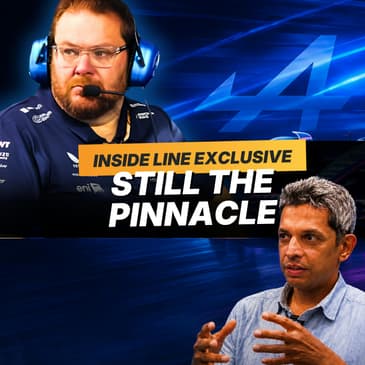

Most Formula One teams tout their engineering prowess, but few truly reveal what makes F1 the pinnacle of motorsport innovation. Dave Greenwood, Racing Director at Alpine F1 Team, pulls back the curtain on what it really takes to stay ahead in this high-stakes game. From the relentless pursuit of marginal gains to the groundbreaking engineering challenges of energy management in 2026’s cars, he shares insights that’ll leave you questioning whether F1’s technological arms race has reached its peak — or just begun. In this episode, you’ll discover: - How Alpine’s approach to driver development is shaping the future of racing stars like Kush Maini, and what it takes for young talent to break into F1. - Why Formula One remains the most complex and high-tech motorsport on the planet — with 11 teams creating cars from scratch in 11 different locations. - The secret to balancing data-driven decisions with instinct and experience, especially in the critical moments of race weekends. - How rule changes and technological innovations are pushing engineers to their limits, and what that means for the sport’s evolution. - The broader impact of F1’s global footprint — from India’s rising talent to the potential return of the Indian Grand Prix. - With over two decades in motorsport, Greenwood offers a rare perspective on what it takes to engineer victory at the highest level. - Whether you’re a racing fanatic, an aspiring engineer, or a curious newcomer, this episode reveals the unsung science behind every thrilling lap and record-breaking season. - Perfect for anyone passionate about cutting-edge technology, driver psychology, and the future of racing. Chapters:- 00:00 - Introducing Dave Greenwood and the Alpine conversation 02:21 - Why motorsport engineering led him to F1 05:04 - Why Formula One is the toughest engineering test 08:26 - How simulators changed driver development 10:37 - What Alpine values in Kush Maini 15:00 - Pace vs results in junior formulas 19:06 - Similarities between Kush Maini and Kimi Räikkönen 23:43 - The pathway for Indian drivers to reach F1 26:52 - Thoughts on a possible Indian Grand Prix return Tune in to get inspired by the relentless pursuit of performance, and learn why F1’s innovation cycle is more intense — and more exciting — than ever before. 📢 F1 journalists & bloggers — if you quote this interview, please credit: Inside Line F1 Podcast. Sharing is caring. So is attribution. 🧡 Don’t forget to like, comment with your thoughts, and subscribe for more exclusive F1 interviews and breakdowns! Follow Us: X: https://x.com/insidelinef1pod Instagram: https://www.instagram.com/insidelinef1pod/ Spotify: https://open.spotify.com/show/3P2RsaP89xP1xvG7twj8pd Apple Podcasts: https://podcasts.apple.com/us/podcast/inside-line-f1-podcast/id632531804 Follow our hosts: ► Soumil Arora: https://www.instagram.com/iamsoumilarora/ ► Kunal Shah: https://www.twitter.com/kunalashah
Learn more about your ad choices. Visit megaphone.fm/adchoices
[00:00:00] Hi, I'm Dave Greenwood. I'm the racing director at Alpine F1 Team. In terms of background, I've been in Motorsport now for over 20 years. I've had a wide range of experience both in Formula 1 and Endurance Racing. I've had some success, notably in this team, in the 2005-2006 World Championships. I've also worked in the WEC and had success there very well at Le Mans.
[00:00:28] That's fantastic. But if we can just get to the start of your journey, you know, before you became a racing director, before you were a part of Team Endstone winning 2005 and 2006 and the world titles, you were just someone who loved cars. And if we can go back to that one moment you realized that Formula 1 was what you wanted to do with your life. Was there a specific race or a car or a personality that made you feel like, that's it, I want to work in Formula 1?
[00:00:55] Yeah, I think in terms of the sort of draw to Formula 1, teenage years were spent watching races and in races with my family. And then really through education, at a certain point in your life, you have to make some career choices. Took the route of mechanical engineering. Very lucky that at the time I was sponsored through university by a company called Tom Walkinshaw Racing. They had the Arrows F1 team back in the late 90s.
[00:01:25] And really my sort of draw into Formula 1 was that kind of career path and that experience I've had as a late teenager working, you know, at the factory in Leithfield, which is not too far away from where we are now. And, you know, at the same time completing my studies and that really kind of, you know, accelerated my ambition to be in Formula 1. That's lovely. Orange Arrows F1 and Jos Verstappen Racing in that car. Those were the memories I, you know, suddenly had a flashback from.
[00:01:55] And for the new audiences of Formula 1, what exactly is the role of a racing director? Can you just break it down? Yeah, I mean, we kind of split our sort of, if you like, Formula 1 technical operations into three. We call it basically design, build and operate. So we have the technical direction side of aerodynamicist, designers, vehicle performance engineers under their design element.
[00:02:22] The operate is the, if you like, the part that I encompass, which is to go to the racetrack and operate the car with the drivers, basically. And so effectively, I look after everything that is a car or a driver and all of the sort of engineers, logistics, mechanics, all of the stuff that go with that part of the operation, basically. That's a very interesting job to have, I must say.
[00:02:47] And talking specifically of, you know, 2026 and drivers have been extremely vocal that they want changes in the rules and so on. When we look at it from an engineering point of view, which is, you know, eventually what Formula 1 is, it's got the, yes, it's got 22 best drivers in the world. It's probably got 20,000 best engineers in the world working across all the teams, if I may do a rough math. Does Formula 1 still pose the biggest engineering challenge in motorsport?
[00:03:16] I believe so, yes. Basically, because it's one of the only few forms of motorsport left where there is actual genuine competition between the teams to design and build the car themselves. You know, unfortunately, a lot of routes of motorsport now have gone to sort of spec cars. And really only Formula 1 owners are sort of the top class of work are now left where people actually design the car from scratch.
[00:03:40] It always amazes me that 11 teams in 11 different places produce cars from raw components and materials and designs in people's heads. And we go racing them on tracks and sometimes there are fractions of a second between them. And so I think as a good example of how, you know, high tech engineering is and but ultimately it all brings together as a sport and what counts is the stopwatch. Wonderful. And what is hence the biggest engineering challenge of this generation of cars?
[00:04:09] And I'll tell you what, there is an over indexation on how battery management and the software that manages energy deployment is a big challenge. But is there more to these cars that's also an engineering challenge or is it just about let's just get the best engineers running the battery side of the business? I think the conversation at the minute is a lot about this element of the energy management that you described.
[00:04:33] But I would count at the minute that that really is the big topic at the minute because that is where the focus is at the minute to optimize things because that's the newest thing. It's the biggest change. But I think if we have this conversation in 12 months time, it won't be all about batteries and energy management. It will be around other things that have come along. And that's the big thing with the sport and with Formula One is, you know, we have these rule set changes that bring challenges.
[00:05:00] We then have a period where people learn very quickly and Formula One teams do learn very quickly. And then we get to a process where really it's the marginal and incremental gains again, which become the differences between the teams. And I'm sure that in less than a year's time, the talk of the energy management will be just part of the normal talk around everything. Tyres, set up, energy management. They'll be part of the big, bigger conversation around the differences in performance between the cars.
[00:05:28] I hope that's the case. And I hope that drivers remain the biggest differentiator apart from, you know, all the engineering differences that will come as well. And if I can hence segue into talking about one of your junior drivers who I've actually known as a baby, Kushmany. Okay. And how he's sort of, you know, developed within the Alpine ecosystem. In the case of Alpine, given that, you know, we have now young drivers who grew up with simulators are surrounded by data.
[00:05:56] How different is it to work with this generation of drivers versus say, you know, the previous era where you relied more on instinct because just the sheer, you know, amount of data available was not as sufficient or as enough compared to today's work. I think with all of these drivers, as these new engineering tools come online, such as simulators, as you described, they become more and more of the tool set that we use with the drivers to extract the performance from the car.
[00:06:25] I mean, really, a lot of the simulator push came around from the fact that testing reduced. And what that meant is that we do much more of our tests in the virtual world. But the one thing that we still rely on heavily is as drivers and drivers need to give good feedback on these tools and get used to driving these tools in the same way they drive the race car.
[00:06:47] So really, I think, although the, if you like, the amount of data, the amount of simulation has increased, the driver is still a core part of what we do. And I believe the instinct still is one of the core factors as well. You, of course, use all the data, but there's also a driver's instinct and engineer's instinct that you still rely on. Yeah, absolutely.
[00:07:07] And when, you know, we get to the racetrack and if you like, we get to those points where we've done all the work with the pre-event simulation, the simulator work, even the simulator during the event. And really, when it comes down to those last few decisions and steps before going into qualifying of what to do finally with the car to optimise it, it really does come down to a conversation between the driver and the race engineer and the performance engineer.
[00:07:32] And so those last sort of decisions on how to, if you like, take the compromises of each set up change, but decide that overall they will be better for performance. That does still come down to a conversation and a decision between that small group. And going deeper into Kush, you know, he's the biggest connection India has to Formula One right now. Even though he's a step away, he's still the closest any Indian has been to a Formula One seat in almost over a decade.
[00:08:01] Internally in Alpine, how do you assess where Kush Maini stands today and how does he fit in the long-term plans? I mean, you've got to remember he's been part of our academy since October, I think 2023, so the end of that season. And, you know, he's been racing Formula Two, one of the junior series for the last few years. I think, you know, Kush has had some good success in those junior formulas and that, you know, couple of wins, podiums.
[00:08:28] And that is very important to us because ultimately you need to have that, you know, level of, if you like, skill and experience in order to help us when he comes and helps us with the simulator program and with the testing program that we do with him. And really those things, you know, go together. You know, the simulator is obviously the simulator of the current car. So we use Kush to help us on the development of that outside of the time that the race drivers are around.
[00:08:57] You can't have race drivers here every day. So, you know, Kush being around and being available to run the simulator at various times is very important to us and a big part of our program. And the testing program we do with the previous cars helps him to be relevant to that. So it gives him the experience of a Formula One car and, you know, the differences to the performance envelope of the F2 car to make the simulator work more real and more relevant to him, basically.
[00:09:23] And when it comes to F2 and F1, and I was there at the junior driver test last year after Abu Dhabi. In fact, I was covering Kush's first test in Austria in 2024 for Fancode. So, you know, I've been a part of that journey. And one thing what I've realized when I've discussed Kush with various members of Alpine and now you today is that Kush is showing real pace in Formula One machinery.
[00:09:49] And, you know, with all the caveats included, he was a tenth of Pierre in Abu Dhabi at the young driver's test. But in Formula Two, he's, you know, had inconsistent results. And it's not always been because of him. There's a lot of conversation about, you know, how his equipment hasn't been there. But how does Alpine separate noise from the signal? Okay. When assessing someone like Kush and his capabilities?
[00:10:15] I think most of that boils down to, you know, the fact that he's been with us for a while now. He works with the engineers in the simulator. He works with the engineers when he goes testing. Really, you know, Kush is a big part of our development program and our testing program. Outside of, you know, the race weekend. And really, the work that Kush does for us is all about kind of working with those engineers to look at solutions that can make the car go quicker.
[00:10:44] And what we're looking for in that is the feedback and the feedback aligning to what the data's telling us. So I think where Kush is doing an exceptionally good job at the minute, as does a lot of our other junior drivers who complement that program with Kush, is basically to, you know, give us the confidence that they drive the car. They give us the feedback. The car was in the simulator. And ultimately, that matches with our expectations from our other simulations and from the data that we see.
[00:11:14] And then we use them to help us, guide us on a lot of the compromises. Often, you can find a solution that is quicker in one area, but slower in another. But really, what we need the use of the driver for is to help us understand if that overall, that compromise is one that's positive still. And really, you know, the work that Kush does, he's given us confidence that his feedback is good. And since you mentioned data and the very fact that there are so many engineering more tools available.
[00:11:42] And given that, you know, discrepancy where he's quick in Formula One, F2 is where a lot of struggles happen. What do you look for, you know, in the data or in the person that actually lets you say, you know what, that's not the driver. It's actually the car that's not there for him in Formula Two. I mean, I wouldn't like to specifically comment on F2 with the teams that he works with. I'm genuinely not close enough to them.
[00:12:09] We have people who work in an academy that, you know, work alongside those teams and try to give some guidance and some help around what specifically the driver needs and can be helped with. But ultimately, as I mentioned earlier on, F2 is a single make formula and those teams have got to do their job to get the best out of that car. I think when Cush comes and, as you said, mentioned he was, you know, very close to Pierre in the test that we did in Abu Dhabi last year.
[00:12:38] Completely there was a difference in the program. You know, there was a difference in terms of what tyres were being tested and all of these things. And ultimately, I think what you've got to look, though, is it's more about, you know, what we're looking for, Cush, is to drive the car at representative pace and speed. And we see that because in testing, we see that, you know, the lap times are representative, as you mentioned, close to Pierre, etc.
[00:13:03] But ultimately, I think you've also got to recognise that it is testing and not racing or qualifying. But at the minute, that is where we're looking for Cush to perform. Being honest, I think it would be a different matter if we put Cush in qualifying versus Pierre, but that's not where things are right now. But the big thing that we need is that, you know, Cush is running at that representative speed and pace and he is able to do that. And therefore, we know the results. We're getting a valid. Absolutely. Love to see Pierre and Cush in qualifying one day soon.
[00:13:33] Seems like a distant future right now. And I say it in a positive way. I mean, I've known Cush since he was like six years old. What does Alpine need to see in Cush in 2026 to prove that he's actually moving closer to, you know, that dream qualifying shootout between Pierre Gasly and Cush Meide? I think, you know, you've got to realise that there are unfortunately only 22 seats in Formula One right now. And, you know, it's a tough, tough world.
[00:14:01] There are a lot of people looking at those drives, etc. So I think the big thing with us and Cush right now is, you know, to continue the good work that he's doing and continue the work that he's doing with the simulator. Continue the testing work he's going to do this year. He's got, I think, four more days of testing with us this year. He's done five days previous with us. You know, for us, it's all about working on the programme that we've got for him.
[00:14:29] Ultimately, you know, he has his competition element with F2. I'm sure that, you know, Cush is looking to have a good season there and try and, you know, improve on the results he's had so far. So I think with Cush, really, it's about continuing that work in F2. You know, he's clearly had success. He needs to now maintain that level of success over, you know, subsequent races and start stringing these things together. This may be a very leading question.
[00:14:56] But, you know, you can first laugh after I ask the question. But you've worked with a variety of drivers, including former world champion Kimi Raikkonen. Any similarities between their talent, between their instincts, between their humour, any personality, anything that you'd probably draw a comparison? I mean, it's a difficult question because, you know, I know Cush, but I don't know Cush like a race engineer. You know, Cush is part of our academy and I regularly see him and we see him at events.
[00:15:26] He was, as we said, with us in Abu Dhabi. But I'm not super, super close with Cush, being honest, as the race engineer kind of relationship is. I think if I had to say something from what I've seen so far, I think it's probably work ethic. You know, Cush is definitely always looking to have that extra time in any one of the, you know, activities that he's doing for us. And that's a really good thing to see. I think it was a misnomer of a lot of people with Kimi on work ethic.
[00:15:55] He was actually much, much more sort of into doing the things he needed to do and maintaining a high level of readiness at all times on various aspects of what he did. And, you know, I think he might have come across this sort of laid back approach, but that certainly wasn't the case. The minute we arrived at a racing track, it was pretty full on with Kimi to make sure everything was covered and he understood everything and he knew everything that was going to be happening. And he knew everything that had happened in between the last race and the race we were doing.
[00:16:24] So, yeah, it was a very strong work ethic and we do see that in Cush as well. Thank you. That's a very helpful answer as well. And if I can move on, just one last question on drivers and their psyche, because you work with drivers at different stages in their Formula One journey. So there's Pierre, who's rebuilt himself after, you know, Red Bull. Cola Pinto proved himself at Williams, but then lost a seat. Jack Doohan was their legendary name.
[00:16:52] And, you know, now there is Cush chasing his shot. How do you help someone who's constantly measuring themselves against their peers? How do you tell them that they are good enough, but they still need to go beat someone else when it comes to lap times? You know, unfortunately, we do live by the stopwatch. It's the way we are.
[00:17:13] But I think that whilst that's the sort of the end measure of all of these things, I think there's lots of things along the way that, you know, drivers need to do and, you know, take a different approach to in order to get that final result that they want.
[00:17:29] And I think that's probably one of the most interesting things I find around working with various different drivers at various different levels is, you know, that ability to talk to them, have an honest conversation, you know, get into the details of what they're struggling with and why they're struggling. You know, is it the people around them? Is it do we need to have a different approach in the meetings? Do we need to structure the way we do the analysis differently? Do we need to approach the way we do the simulation differently?
[00:17:57] I think lots of times you've got to kind of tailor each method of how we do things to each driver. And that's quite, you know, an interesting thing to do. We do get sometimes a little bit formulaic as Formula One teams. And we tend to always try and do things in the same way every side. But that doesn't often always work. And very much that comes into play when it's the people that are involved that you need to tailor things slightly differently.
[00:18:23] So I think overall, you know, the way that you may need to work with an experienced driver to a very young driver is different. There's no two ways about it. And you obviously put more emphasis on the sort of driver coaching side with the younger guys than you do with the older. But equally, that doesn't mean to say that we forget all those things just because someone's been around or had good results in the past. Unfortunately, you know, you still need to cover all of these basics all the time.
[00:18:52] And if I can take you back to the basics, you know, there are lots of young drivers in India who reach out to me asking, how can they be on the radar of Formula One team driver development programs? You know, they could be karting in Bangalore. They could be doing it in Bombay, driving Formula Four or in the Indian Racing League. What's the realistic pathway on to getting on to Alpine's radar? Yeah, I mean, that's difficult when geography is involved.
[00:19:20] And unfortunately, you know, you're a little way away from Europe. And rightly or wrongly, we are quite a European-based, what's the right word? We look for our talent, unfortunately, in probably too narrow a sphere. But I think that's why you get people like Kush that come over to Europe and spend their time in those European junior formulas
[00:19:43] and karting to expose themselves across in terms of the teams that you mentioned in their junior programs. It doesn't mean to say I think it's right. I think, you know, often we do perhaps need to look more out of our sort of local sphere that we look at. And, you know, the fact that Formula One is becoming more and more global, we're visiting more and more countries and continents, means that there's more chance for us to see these talents when we're in those countries, when they're, you know, supporting races that we're running.
[00:20:13] I believe what I asked you about drivers also stands true for engineers because there are even more budding engineers. Like, how do I work for a Formula One team? And I suspect, again, for them as well, it would be to get to the, you know, universities in the United Kingdom that sort of feed into your programs. Yeah, I mean, again, we kind of know that that has been the route for people to come, you know, come to some of the universities in the UK that do have close links with the teams.
[00:20:41] But I would say still generally the biggest thing to do, regardless of where you are in your education and where you are located currently studying, is to just do anything that can bring more experience to yourself apart from your studies. You know, whether it's, you know, working with teams in junior formula, working at circuits, it's just being around motorsport and the sort of ecosystem that's there, and some practical knowledge and practical experience.
[00:21:08] It's certainly helped me in my career early on to have that link of not just studies, but also, you know, having the practical experience around cars. And definitely that's the thing that sets everybody apart when we get the CVs from people, is whether they've done something just a bit more than the studies, and whether they've been involved in motorsports at a grassroots level, definitely makes the CV look a little bit more interesting. Thank you, Dave.
[00:21:39] I will make sure that, you know, Alpine is flooded with applications from Indian engineers as well. A big thanks and quick word just before you go. There's a lot of chatter on the Indian Grand Prix coming back. How important is it for, you know, Alpine as a team? Because Renault is, of course, one of the major shareholders to race in a country where there's also significant business interest. Yeah, I've seen the chatter in recent days as well. And honestly, I have fond memories personally of coming to that track.
[00:22:08] I think it's a great track, you know, in a great country. You know, I wish India all its success if it's trying to go that route. But in terms of the markets that we operate in, I think everyone is always looking to go to those places where, you know, if you like, perhaps the sport is a bit underrepresented. So great to see all of these stories around these places wanting to become part of the sport. And that, you know, that will be a great way for the future
[00:22:38] if that comes about. Perfect. Thank you, Dave. On behalf of me, Fancor and 80 million fans in India, we'll get the message out to them. Have a lovely day ahead. No problem. Thank you very much.