
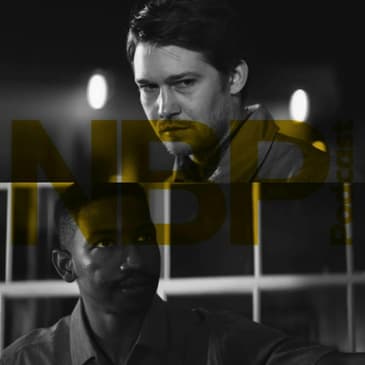
"Kinds Of Kindness" had its world premiere at the 2024 Cannes Film Festival, where it received positive reviews for Academy Award-nominee Yorgos Lanthimos' writing, direction, and the performances from the cast (including Jesse Plemons, who won the Best Actor prize at Cannes for his work in the film). Stars Joe Alwyn, Mamoudou Athie, and Lanthimos were all kind enough to spend some time talking with me about the anthology film, which you can listen to below. Please be aware of spoilers and be sure to check out the film, which is now playing in theaters from Searchlight Pictures. Thank you, and enjoy!
Check out more on NextBestPicture.com
Please subscribe on...
SoundCloud - https://soundcloud.com/nextbestpicturepodcast
Apple Podcasts - https://itunes.apple.com/us/podcast/negs-best-film-podcast/id1087678387?mt=2
Spotify - https://open.spotify.com/show/7IMIzpYehTqeUa1d9EC4jT
YouTube - https://www.youtube.com/channel/UCWA7KiotcWmHiYYy6wJqwOw
And be sure to help support us on Patreon for as little as $1 a month at https://www.patreon.com/NextBestPicture
Learn more about your ad choices. Visit megaphone.fm/adchoices
[00:00:00] Shopify grows your business no matter how far or big you grow. Shopify is the global commerce platform that helps you sell at every stage of your business. Whether you're selling your fans next favorite shirt, or an exclusive piece of podcast merch, Shopify helps you sell everywhere.
[00:00:20] Shopify powers 10% of all e-commerce in the US. Allbirds, Rothies, Brooklinen, and millions of other entrepreneurs of every size across 175 countries. Plus, Shopify's award-winning help is there to support your success every step of the way. Because businesses that grow, grow with Shopify.
[00:00:46] Sign up for a $1 per month trial period at shopify.com slash income, all lowercase. Go to shopify.com slash income. Now to grow your business, no matter what stage you're in. You are listening to the Next Best Picture Podcast.
[00:01:09] And these are my interviews with the director and writer for Kinds of Kindness, Yorgos Lanthimos, and two of the film's stars, Joe Alwyn and Mamadou Abdi. This is it. The moment of truth. Burgos. Hi. Back again so soon. Lovely seeing you again.
[00:01:25] And I got to say, I'm quite pleased with the outcome here. I saw Kinds of Kindness at the Cannes Film Festival at its world premiere. What a blast. What a time.
[00:01:34] It was, in many ways, what people were saying was a bit of like a return to form almost. Not to say that anything had necessarily changed so much over the last couple of years. You're still you. But it was great to reunite with your writing partner again.
[00:01:48] And I think that's what's so great about this podcast. But it was great to reunite with your writing partner again and get some more of the type of style that some of your earlier work really reminded us of.
[00:02:01] And so congratulations on the reception of the film, first and foremost. Winner of the Best Actor Prize at Cannes. How are you feeling? First of all, just coming off of everything from Poor Things and now straight into this. Are you like in need of a break?
[00:02:14] How are you doing right now? Yeah, I mean, I will eventually take a break. I was starting to feel like I needed. And, you know, every time that I finish something, I never can stay still for too much.
[00:02:29] There's always something in my mind and I'm like, oh, I'm wasting time. Why am I not doing that? Which is how Kinds of Kindness came to be that quickly right after Poor Things because we ended up shooting it during VFX post-production of Poor Things.
[00:02:47] I just felt that I wasn't doing enough following VFX. And since we had just finished this other script, I thought it was a good idea to go and shoot it.
[00:02:58] Well, I got to say three separate stories, all of them dealing with seeking love, adoration and the limits that they will go to in order to get it. What limits? Made me question what would I do for that?
[00:03:16] And I'm curious to know for you personally, what is the craziest thing you've ever done for the love and adoration from somebody else? I mean, I don't know. Probably crazy things that I don't even want to remember.
[00:03:30] But I mean, yeah, that's the whole point of creating those kind of situations in order to observe and take things to extremes and see how each individual person that sees that feels.
[00:03:52] As you say, put yourself in their places and try and imagine how it would be for you or what your judgment is on other people's decisions, life decisions. I think it's a very interesting arena to observe. I think so too.
[00:04:14] The limits of human behavior especially are quite fascinating to say the least. Because these are three separate stories, did you shoot them basically one at a time or were they all out of order during the shooting schedule? No, we shoot them one at a time.
[00:04:29] Well, first of all, there's the practicality because the same actors are playing a different character in each story. They needed to slightly change their appearances, cut their hair or dye them or whatever that may be.
[00:04:43] So that kind of guided us to filming the three stories one after the other, which is in any case very beneficial for every other aspect of filmmaking. Like the actors can follow what it is that they're doing.
[00:04:59] I can understand more how the filming is progressing and I think it's beneficial for everyone to be filming things in sequence as much as it is possible. Absolutely. Your friend, Yorgos Stephanakos plays RMF in this movie and the title RMF is included in all three of the stories.
[00:05:25] Is that just an in-joke between you and him? How did that all come to be? Well, that's quite a long story actually because when we started writing, we started writing the one story. So RMF was that part of that story the way he still is.
[00:05:46] And then when we decided that we want to make a film with a different form and structure and include more than one stories,
[00:05:55] we didn't want the characters to be in all of the stories, but we wanted like one of them to be the point of reference in its three stories. So we chose him.
[00:06:12] I mean, I didn't know at the time necessarily that he was going to be the one who would play RMF, but I guess soon after we wrote it, I thought of him.
[00:06:23] He was in Poor Things too and we had a great time doing that and the same here. It was just figuring out the structure, figuring out the one character that wasn't going to be one of the main characters.
[00:06:40] But at the same time, he was kind of pivotal in all three stories, but he wouldn't appear so much in every story. The initials that were always part of the first story became something recurring in the story.
[00:06:58] So it just made sense from a structural point of view to use it that way. And then, you know, he's just an incredible presence to have, you know, as the man that appears in all three stories.
[00:07:12] Sure. Sweet Dreams Are Made Of This has become the anthem for this movie. I'll never forget the anticipation of being in that can audience. We started clapping on beat during the opening credits because we were so excited to watch the film.
[00:07:27] How did you settle on that song? Was there any kind of thematic connection to the lyrics or was it just something that came to you? A bit of everything. I decided relatively late in the process to include a song in the beginning of the film,
[00:07:44] which is the one that kind of establishes RMF as, you know, the man in the car. So I just started listening to music and I, you know, I took into consideration, you know, his age as well.
[00:08:00] Like he's from a different generation. I started listening to old music, old music that had affected me when I was younger. And, you know, all these incredible iconic songs. And then, of course, you know, you do listen to the lyrics as well. And that is important.
[00:08:17] So that you use something that is not terribly inconsistent with what the film is. But at the same time, you don't necessarily want something that's expositional or trying to explain anything about the film.
[00:08:35] So it just felt that it hits all the right. It hits the right balance of everything that we wanted to achieve. And it's an iconic song, of course, and very, you know, dear to me as in I'm guessing millions of people that grew up listening to it.
[00:08:57] And I have to ask, too. Who was your dog trainer? Because the way you've animals and various films that you've done over the years, have you always worked with the same people for that? Because there's one section in this movie where I mean, it was great.
[00:09:14] I loved what you did there with the dogs. Can you just tell me a little bit about that? Yeah, no, it was no, it was someone local.
[00:09:20] I guess you have to work with people in every place that you go to because you have to source dogs as well. But it was a very intense experience.
[00:09:32] We actually kind of shot most of it as a pre-shoot just the day before we started shooting the rest of the film. So it felt like the best way to start this film, like filming all these dogs doing all these strange things.
[00:09:51] Yeah, it was just great. I mean, we came up with whatever it is that we wanted to do. And then he would go and test it with the dogs. There was specific dogs that could do specific things. Certain dogs didn't like water, certain dogs didn't like beds.
[00:10:10] There's the shower thing. It was just a matter of casting the right dog for each part. In the end it was relatively straightforward when he chose basically the right dogs for the parts and trained them to do it. It was relatively straightforward when we were filming it.
[00:10:31] There was a couple of scenes that needed a little bit of help with VFX because the dogs wouldn't do exactly what was necessary for the illusion. But it was all shot practically and then some of it was put together.
[00:10:49] And as I wrap up here, I want to ask before I go, I'm just curious, is there any one of the three stories that speaks most to you on a personal level? Not really, because it was a very careful selection of ideas that we had, myself and Efthymis.
[00:11:08] And we always work in a way that we add to each other's ideas. So by the end of it, it just becomes very personal for both of us, whatever the story ends up becoming.
[00:11:23] So yeah, I thought that they were all equally important to us and that's why we chose to include them in one film. Otherwise we wouldn't. We'd just keep trying to find another story that would feel the same.
[00:11:38] That would feel that it has the same importance to us as the other. Well, whether you're working with Efthymis or if you're working with Tony, there's only one Yorgos Lanthimos.
[00:11:47] And sir, I can speak for everyone when I say we are so happy to have you doing what you do because nobody else is doing it like you. So thank you for this and thank you for your time here today. Thank you. Take care.
[00:12:21] Joe, Mamadou, I'm so, so, so happy to be talking to you guys about this fucked up, amazing film. Hope you both are doing great. I want to first start off by asking, this is not your first time jumping into the Yorgos Lanthimos pool.
[00:12:36] You guys have both worked with him. No, wait, I'm sorry. Yes, you are correct. One of you has. So for you, Athi, it was actually your first time. Keep speaking into existence, my friend. No, no, no, no, no. It's all good. Hey, listen, hopefully more to come here.
[00:12:49] That's what I'm saying. So I want to ask you as a newcomer, what was it like essentially with all these other actors who had worked with him before?
[00:12:58] What was it like just like getting into that style, that rhythm and embracing that unique weirdness that is all over his filmography? Well, they bullied me a lot and they beat me. No, it was chill. It was really easy going.
[00:13:13] Yorgos, I believe there's something in the writing that lends itself. You just it's very there's a freedom on set. He doesn't we don't talk about the character or the script or intentions and things like that.
[00:13:31] That's he leaves that up to you. But there's some the script is so specific. The language feels so specific. It kind of lends itself to what it whatever you see.
[00:13:44] You know, I don't think anyone's pulling faces or or trying to, you know, make anything spectacular for the sake of it. It's you want to do the thing you want to do it as fully as possible, but you want to do it as simply as possible as well.
[00:13:59] And I think I think that's probably also what this is me surmising here, what attracts Yorgos to who he works with. Joe's like, yeah, definitely. I'm just here, Joe. It was so funny.
[00:14:13] I'm watching the first story. I'm at Cannes and I swear to God, I didn't even think I saw you on the first story. You're the appraisal guy. I realized this on a second viewing.
[00:14:23] And then, Afi, you also pop in briefly, but it feels like you guys each have one story in particular for you. It's the second story. And for you, Alwin, in story number three, where the roles are definitely a little bit larger, I would say, than the other two.
[00:14:40] Right. So it's my understanding that these were shot not out of order. So what was it like essentially for those ones where you had to come in, just do like one scene? And that was essentially like it for the day.
[00:14:52] Did you like have like a period of time in between where you just weren't working? Were on call. Were you able to take over projects in between? How did it work from a production standpoint? You've watched them in unforgettable adventures, love affairs and tragedies.
[00:15:08] Now it's time to hear their own remarkable stories from the makers of Death of a Rockstar and Death of a Sports Star. This is Death of a Film Star. Starring Heath Ledger, Marilyn Monroe, Chadwick Boseman, Robin Williams, Carrie Fisher and Bruce Lee.
[00:15:34] Search for Death of a Film Star in your podcast app. You've seen them tell stories. Now it's time to tell theirs. From a production standpoint, I personally, well we shot in New Orleans, but because there was time to bounce around. Bounced around.
[00:16:01] But also really had a great time there. I loved shooting there actually. Would love to spend more time there. And it's interesting like with those, Mahmoud was saying this earlier, when you are popping in for a story and doing just one day.
[00:16:18] On any project it might be. In some ways that's more nerve wracking than saying the third story or the second story when you have more to do. Because you want to get it right and you want to fit into what is already fitting like a pre-existing world. Sure.
[00:16:39] I mean I loved shooting there. They shot it in order which for me or for us I think made less of a difference. But for someone like Jesse obviously who is front and center of every story, every scene.
[00:16:54] I can imagine that was hugely helpful not to jump between the three. So yeah we were lucky or it was lucky to be structured that way. Sure. Absolutely.
[00:17:06] In terms of the themes of the movie itself, I'm curious to know what is the craziest thing you all have ever done in the sake of obtaining love from somebody else? Oh the things you do for love. I don't know. Kind of boring.
[00:17:27] So it is what it is and if you're not into it, you're not into it. You know what I mean? Todd. I'm trying to think. Are they really getting love though in the film? I don't know if they are. You're not asking us personally? Oh yeah.
[00:17:46] He's switching it. Pivot. I can't think of anything in particular so crazy that I did in pursuit of love. I don't know. But this is what then separates our world from the worlds that your ghost creates in that case I suppose.
[00:18:05] Nobody is doing the things that his characters are doing. Nope. It's still going. I'll tell you later. I got nothing for you. That's totally fine. That's totally fair. What was your favorite day on set? Favorite day on set.
[00:18:26] I mean personally, I did really enjoy filming the one scene that I had in the second story. Yes. He gets shot in the hand. The character gets his hand blown off and then Jesse is trying to lick his hand or heal his hand.
[00:18:41] Whatever he's trying to do. Eat his hand? I don't know. He's trying to heal. He's trying to put him away. He's trying to heal him. That was fun because you don't do that every day. You don't do that every day.
[00:18:54] And I liked that one. It was very funny. Jesse kept apologizing after each take. During the take. I liked it. Sorry. I'm sorry. It's written in the script. That's true. I just thought it was him saying sorry.
[00:19:13] I actually really loved that scene as well. I thought it was hilarious when I read it, when I saw it and when we shot it. Every iteration of development was so funny to me. To this day apparently. My favorite scene? I don't know.
[00:19:33] I enjoyed any chance to have just a simple conversation. I love the conversations I had with Jesse at the dinner table. Also, I did love that scene a lot. Yeah, those are the ones that come to mind.
[00:19:57] I loved working with the police chief who wasn't an actor by trade by the way. There was a lot of interesting moments. Yeah, definitely. You never know what you're going to get in a Lanthimos film. Especially here where he's reunited with Ephemis.
[00:20:15] The writing is harkening back to some of his earlier work in a lot of ways. It's just this unpredictability. For you guys, I imagine when you're getting the screenplay and reading through each page, you're probably thinking, I don't know where this is going.
[00:20:31] I don't know what these characters are talking about. When they reveal it, it must be completely eye-opening, shocking, funny. As we've mentioned before. I want to ask the two of you, what was probably the moment, spoilers allowed,
[00:20:44] what was the moment in the film that excited you the most when you read it on the page? Excited? In a gruesome way, I suppose one of the big points that jump out is in the second story. Is she really going to chop off her fingers?
[00:21:05] Is she really going to cut off her liver? Is she really going to feed it to me? Yikes. Didn't see that one coming. You said anything, you'll do anything. I was like, oh my god. Brutal. I still go back to the hand-licking scene. It really wasn't my favorite.
[00:21:26] I was like, what is happening? I read that and I was laughing so hard. So, in talking about Lanthimos' style, I've seen him work now across his entire filmography, pushing characters into situations that are just stretching the boundaries of what the audience may be comfortable with.
[00:21:49] How does it feel for you as actors being asked to play a scene or have a moment where you're just like, wait, what? What are we doing? This is so dark and messed up.
[00:22:01] I'm just curious to know, is that something that you find invigorating as an actor, being pushed out of your comfort zone in that regard? Just see if you could tell me a little bit about the way Lanthimos works. That would be great. Yeah, I find it exciting.
[00:22:17] I like that he is so untethered to reality. There's reality there, but it's stretched and it's warped. Some of the scenes are obviously dark or just crazy or larger than life.
[00:22:36] I think what surprised me, or I guess I've had an experience of it before, but actually on set though, it's a very light atmosphere. There's not a lot of heaviness, there's not any darkness. Even though he's asking people to go into dark corners, he keeps things very light.
[00:23:00] There's quite a small crew as well, I was thinking, and he tries to keep it as minimal as possible. Just by nature, the fact that it's three films and a group switching roles between each one, there's an inherent playfulness to that. It's like a theatre troupe.
[00:23:19] Even though there is wackiness and surreal, strange material, you actually feel liberated by that, but grounded by the atmosphere that he creates and that everyone creates. Yeah. He agrees. Very well put.
[00:23:39] Did you guys always know which characters you would be playing from the get-go, or did you read not knowing who you would be playing? I read for Emily. Right! I saw that tape, I was like, I don't know.
[00:23:53] No, I got it with the script, these are the roles we'll be playing, it was as simple as that. So he had you guys in mind from the start?
[00:24:03] Yeah, I guess. I don't know at what point it was all put together, but when he reached out, he said, will you take a read? And these are the three characters. I think both of us said before, it was going to be a yes before even reading it.
[00:24:16] If we can all just acknowledge that you guys did a great job and everyone else did a fantastic job as well, is there another character in any story that you selfishly wish you could have taken a stab at? We're just talking about this.
[00:24:28] I would love to, I would love to, because we might do a remake, right? Take it a bit away. I'd love to play Raymond, that would have been dope. And I'll be the Robert to his Raymond. That would be crazy. What a strange, that would be so strange.
[00:24:44] It feels right. So I'm sure you guys get this question a lot, but I don't personally know the answer, so going to ask it anyway. Which one is your favorite of the three?
[00:24:54] I like the third one the most. I was saying it feels the most hopeful, but Joe, you really, you're right. You're like, it's also the most colorful and I was like, oh. I think it is, right? You were 100% correct on that. Yeah.
[00:25:12] Yeah. It feels, you suddenly feel like you're going to a different space. Yes. I mean, I love them all. I really liked the first one as well. Yeah. It's hard. I'm going to say the first one, but I love them all. I really do.
[00:25:29] Yeah. And this film had its world premiere at the Cannes Film Festival. I understand, I'm pretty sure you both were there, if I remember correctly. Did you guys get a chance to experience it with the crowd live? Yeah. Yeah. Yeah.
[00:25:44] We'd seen it once before, but just the two of us. I don't know if you guys had the same thing happen, but in our screening, the audience started the screening by clapping. Yeah. Yeah. Yeah. That's exactly right. Yeah. Yeah. I think we're at the same screening.
[00:25:56] Yeah. Okay. Perfect then. Yes. Because the atmosphere was so fantastic. Everyone was so, so excited.
[00:26:02] I'm curious to know because of that excitement, that anticipation of just what a Yorgos Lanthimos film means to people nowadays, would you say he's the type of filmmaker that no matter what the project is, it's just an instant yes? To go and see it, sorry?
[00:26:18] No, to just be a part of it. Oh yeah. I mean, even before I saw Poor Things, it was an instant yes for me in this. The guy is the real deal.
[00:26:30] There's not a lot of people you can say that about. I mean, there are people you can say that about, but it's not like the town is littered with them.
[00:26:38] It's like there's very specific people that can maintain a level of excellence and integrity and also continue to get their movies made.
[00:26:48] It's unfortunately rare, but when it happens with somebody, you just want to be a part of their movies because you know you're going to either elevate to the level that's being demanded or you're going to learn something or hopefully a combination of those things and get to work with people like Joe and the rest of this cast.
[00:27:07] It's like a literal dream come true. And you described the atmosphere on set as being a tremendous amount of fun earlier and keeping light.
[00:27:18] I want to know before we wrap up here for a story that is so messed up, well three stories that are so messed up, I'm curious to know for you guys when you walk away from the experience of Kinds of Kindness, what is the big takeaway?
[00:27:34] From either just what you took away from the material or the experience itself? The experience itself, just holding on to that sense of play when you go and do something I think and having fun doing it.
[00:27:49] And I think I felt that on his set so much and that's something to hold on to. And then from watching it, I like that everyone is going to get something different from it and I like that it's not complete until each person has that reaction.
[00:28:04] And I also like that it's thought provoking and complicated and not obvious as to what it's about if it has to be about anything. It's kind of a felt experience as lots of his films are. And I really like seeing those kinds of films.
[00:28:18] Yep, well I can definitely say that for a fact. Conversation starter for sure. Both of you, thank you so much for your time here today. Really, really appreciate it and I loved this movie. I can't wait for others to see it and love it as well.
[00:28:33] Oh, thank you. We really appreciate your feedback and your support, which you can also lend on over at Patreon. For $1 minimum a month, you'll get some exclusive podcast content from us. Thank you all so much for listening as always and we will see you all next time.
[00:29:56] Hello and welcome to Novel Conversations, a podcast about the world's greatest stories. I'm your host, Frank Lovallo, and for each episode of Novel Conversations, I talk to two readers about one book. And together we summarize the story for you.
[00:30:14] We introduce you to the characters, we tell you what happens to them, and we read from the book along the way. So if you love hearing a good story, you're in the right place. Our ninth season is coming this fall.
[00:30:24] Tune in to hear from some of the all-time great authors. Charles Dickens, Jules Verne, F. Scott Fitzgerald, and more. Subscribe to Novel Conversations wherever you listen to podcasts.