
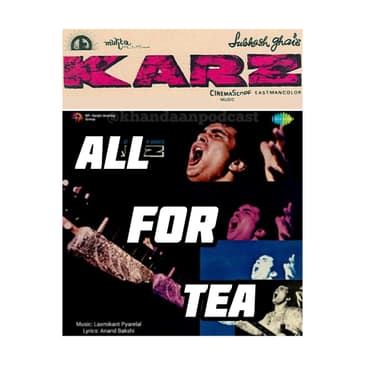

Welcome to the first 80s Dhamaka! episode of Khandaan: A Bollywood Podcast.
We kick things off with Subhash Ghai’s KARZ (1980), an iconic reincarnation drama starring Rishi Kapoor, Simi Garewal, Tina Munim, Raj Kiran and Premnath.
Join us as Asim watches the movie for the first time while Sujoy and Amrita compare their memories of this film to what it looks like today.
A big Shoutout to our friend Dj Shai Guy for the 80's Dhamaka Theme song. You can check out more of Shai's work here
💖 Join Our Patreon & Get Exclusive Perks! 💖
Love Bollywood? Support Khandaan: A Bollywood Podcast on Patreon and unlock amazing benefits:
🎬 Early Access & Ad-Free Episodes – Be the first to hear our 80’s Dhamaka series without interruptions!
💃 A Bollywood-Loving Community – Connect with fellow fans who share your passion!
📺 Bonus & Video Content – Get exclusive behind-the-scenes clips, extended discussions, and more!
🗳️ Vote in Polls & Pick Movies – Help decide which films and shows we cover next!
✨ Join now and be part of the ultimate Bollywood experience! 🎧 Link in bio!
🌟 Support the Podcast:
Enjoyed this episode? Don’t forget to leave us a review and a 5-star rating on Apple Podcasts. Your support helps us reach more Bollywood fans and keeps us inspired to bring you the best content!
We are now on Blue Sky!
Follow us on Socials:
- Amrita, Sujoy, Asim
- YouTube, Facebook, Instagram, Tik Tok
- Sujoy's Instagram
- Amrita's YouTube Book Channel- Amrita By The Book
You can listen to Khandaan- A Bollywood Podcast episodes on the following apps:
[00:00:00] Dhamaka Dhamaka Dhamaka Dhamaka Dhamaka My name is Blackhand Where you stand, you start from the line of line You've always loved someone from someone
[00:00:24] Hi and welcome to Khandaan Podcast where we are doing our Dhamaka 80s series. I'm joined with my lovely co-host Amrita and Sujoy. Hey Amrita, hey Sujoy. Hey everybody. Hello. We are kicking off our long awaited 80s Dhamaka series. We're very excited. How excited are you Sujoy? Ah, my legs are falling ten feet in my legs. This whole podcast will be in Khanda Khan dialogues.
[00:00:52] Absolutely. Otherwise, what's the point? This is our secret way to say Khanda Khan is the best. Amrita, how do you feel about, you know, our 80s series? We've been waiting for a long time for this one. Yeah, I'm a lot more excited than I sound, to be honest. So, we've basically locked in our picks. We have 15 movies. I think it's probably maybe going, this whole series is going to be 15, 16 episodes.
[00:01:19] We're not sure how the format is going to be. As usual, we haven't prepared as well as we hope to. But we have picked our movies. 10 have been picked by us and five have been picked by our Patreon. This series can only be happening by the support of our lovely Patreon community. So, join Patreon, help us grow the podcast. Let us, you know, allow us to do more of this content. So, we'll add a link in the show notes. You can, you know, subscribe for $1 and be part of our lovely community.
[00:01:48] So, join man, which are the final 15 picks that we have? So, we had a lot of soul searching and lots of debates and arguments and throwing of utensils in the kitchen to finally arrive at the final 15. The top 10 that we selected are Kars, Kalia, Arth, Namakhalal, Merijang, New Delhi Times, Khunbari Mang, Tezab, Chalbaz and Tridev.
[00:02:14] This is what a wild bunch of movies, man. For people who are not aware of these, you are in for a ride. And then the Patreon picks are also like a wild bunch. Mr. India, Umrao Jan, Ram Lakhon, Nagina and Sagar. What do you think, Avrita? What do you think of those 15 picks?
[00:02:38] I think it's a solid list, but I think like Umrao Jan is one of those movies that people think they want to hear about. But it is honestly like the moment like Aasim was just like, yo, we've got to have Umrao Jan in there. And I was just like, oh, he's going to regret it. You're going to solidly regret him. For one thing, I'm perfectly certain that Aasim has never seen Umrao Jan. Have you watched him? Of course I've never seen Umrao Jan.
[00:03:05] I just want you to remember that you are the one that were like dead certain that we should be discussing Umrao Jan. Because you have no one but yourself to blame when we watch this movie. I think this is a good way to actually intro this. Why did we pick those 15 movies, right? I mean, I wanted a breakdown of a lot of different characters, a lot of different actors in there.
[00:03:33] And kind of like the main people that were kind of around in the 80s. We want to cover all of them. And we also didn't want to always go with the obvious picks. We wanted to avoid them. Or maybe we've already discussed them too many times. And also we wanted to add some, you know, artsy movies. You know, I think there's New Delhi Times and stuff and Arth in there. And I also wanted some, you know, female driven movies in there.
[00:04:00] So that's why I was like, you know, like Umrao Jan is like Pakistan of the 80s. That's what I'm thinking was. And I'll also say there's a lot of movies on this list that I've not watched. I've not watched a lot of them. And actually I had somebody comment. I think Sophia Q, who has a lovely TikTok channel. She was commenting about Ijazat, how I have not seen this movie. And it's just that, you know, I've told this many, many times.
[00:04:29] People take a shot now, you know, the ones that take it. I grew up in Belgium. We used to get VHS cassettes, whatever random, you know, Jafar uncle used to give us. And we used to watch those. And a lot of times were the biggest releases. That was either Amitabh because everybody enjoyed them or Anil Kapoor. And these art movies never reached those shores. And then when the satellite channel started, I was almost kind of phasing out of Bollywood at that time.
[00:04:57] It was kind of like the end of the 80s and the early 90s. And then the Khans really piqued my interest again. But there was a span where I didn't have access to these movies. And I had no interest in it anymore. So I kind of missed a lot. And then going back, they weren't always available on DVD or stuff like that. So I just kind of missed it. And then I never got around to it. And a lot of times it's now discussing with Sujoy and Amrita, like this movie is so much fun.
[00:05:27] And how have you not seen them? And, you know, getting shamed by so many people online. Then I go back and watch them. And I was like, hey, that's actually a good movie. I should have watched it earlier. So that's my justification about it. It's interesting that you mentioned or you name check Parkiza. Because that is another film that I think a lot of people are just like, oh yeah, Parkiza. And you actually, like it is not really borne out by the movie itself.
[00:05:54] Like it is, there are certainly things in like Umrao Jaan, as there were things in Parkiza that are worthy of comment. And there is a reason why people study it in film. But as a Hindi film watcher, oh, Aasem, you are going to have a special time. Yeah. Amazing. Amazing.
[00:06:24] But our first episode, this episode is Kars. And I thought, again, Kars, a movie I have not seen. This is the first time I'm watching Kars. Like, you know, shock and awe. But I also felt there was no better movie to kick off the 80s series, I think. I think, Sujo, you might be the biggest Kars fan if I'm like, I think Kars... Among Us Three? Or just... Of all the world? After Subhash Gaya and Rishikahur, it's you?
[00:06:53] I mean, I grew up watching Kars all the time because it was always on TV, as far as I can remember. Like, either the songs were on or the movie was on. It's omnipresent. Like, Lakshmi Kant's Piyar Alal soundtrack and the clips of Sir Judah and that whole Kalima scene and Simi Karewal putting on the wig.
[00:07:13] Like, every single bit of Kars, even before TikTok existed, the short-form content summarized version of Kars has been living in my head, you know, rent-free in one form or another. And I don't know if that's a blessing or a curse. But also, like, Bollywood cannot get enough of Kars.
[00:07:36] It has, you know, always drawn inspiration from it, different elements of it, the reincarnation arc, the various remakes in various languages, and obviously, Himesh Rashamya's version as well. So, yeah. Farah Khan. Farah Khan, obviously. Yeah, yeah. Amrita, Kars, for you, where does it kind of stand? Like, where, like, you love it, I assume, or? Yeah, yeah, yeah.
[00:08:06] I love Kars. It's funny because, again, this is, like, one of those films that I don't remember having watched from, like, A to Z. Like, I can't remember having just sat down and chronologically watched it. Like, I think this was probably, this might even have been the first time. I don't know. But as Sujoy says, you couldn't escape Kars if you grew up in the 80s and 90s India. It was always playing somewhere.
[00:08:32] And you sort of almost absorbed it in the background subconsciously as you were living your life. There's so much in this movie that I just remember, you know.
[00:08:47] The music is a huge part of it because, you know, like, there's that theory that says that the music that you hear before your 14th birthday or something is the one that, like, really seeps into your psyche and you can never forget. And Kars was definitely part of that soundtrack for me. And it's a very simple movie with very big emotions.
[00:09:15] And it's a good time. Like, you know. And also, for me, it makes really good sense for us to begin this series with Kars because it came out in 1980. So it's literally the start of the decade. And I don't think this is an 80s movie, but I don't also think that this is a 70s movie. It's very much a movie specifically of that transition period from the 70s to the 80s.
[00:09:43] It has that scale of a 70s movie. And it has that weirdly chamber quality of the 80s movies, you know. Like, I think that is something that I'm interested to basically examine as we go through the list of movies in the series. This was not the first. Was it the first reincarnation revenge drama or not? No, no.
[00:10:13] Which ones are there before this? Madhu Madhi has been there. Yeah. Madhu Madhi is a big one. Yeah. I mean, but it wasn't like there's been a movie, but it wasn't like an established genre. Like, now I feel it's an established genre. Like, from Karan Arjun to, you know, Shantiyom, you'll get so many of these.
[00:10:34] But what I find interesting and different in this version of the reincarnation story is that Ravi Verma gets reincarnated into Monty. But these are two different actors altogether, which I don't think has happened before. Like, every time there's a reincarnation story, there is a direct connect because it's played by the same actor and you know it's a reincarnation. This time you don't.
[00:11:01] And until you get to, you know, the story when it's doing the exposition. Maybe that was the reason why this movie wasn't a big hit because people expected a reincarnation. Which is so shocking to me. Like, wait, do we want to talk about this right now? Yes, because I'm shocked. Like, what? This movie wasn't a big hit? No. No. It came out literally one week before Kurbani, Faroze Khan's Kurbani, which I don't know if you've seen, Asen.
[00:11:30] But it had a very sexy Zeenat Aman in it. And, of course, it was Faroze Khan, so it was just bad shit. And everybody was just like, it was like the huge hit of that year. And it literally just wiped the flow of Atkar's when it came out. And, you know, like, Subhashka has been very bitter about it for years. Yeah. I had no clue. I did not know.
[00:11:59] I thought this was just a massive, like, game-changing, you know, kind of hit. But I'm really shocked when you're telling me this. But also, that also speaks like box office numbers at the end. Yeah. Don't matter shit. Yeah. In the, you know, the legacy of a movie. Because I think Kars now is a more favorite movie of people than Kurbani would, I would say. Yeah, it definitely has more cultural relevance in any shape or form, right? Yeah. Interesting. Okay.
[00:12:28] So, hit us up with a summary, Amrita, for the people like me who hadn't seen Kars. What is Kars about? Okay. So, the movie begins with this mopey dude called Ravi, who's just won a family property dispute in the courts. And he marries his girlfriend, Karmini, who then immediately proceeds to murder him. Cut to 20 years later, there is this very famous pop star called Monty.
[00:12:54] And Monty has these debilitating flashbacks of a life or like visions that he doesn't understand. And he is advised to go to Ooty to get some rest because he's a big like money-making machine. And when he arrives in Ooty, it's, so Ooty is right down the road from Kunul, which is where like the first dude, Ravi, was from.
[00:13:21] And Monty suddenly starts recognizing landmarks. He starts recognizing all sorts of things and realizes that he is actually Ravi who has been reincarnated to get justice for his murder and to save his family, which is his, you know, his Vidwama and his Lachad Behin.
[00:13:46] So, it's a very, very strong Bollywood trope movie is what it is. I mean, this is where the Bollywood trope began in a way, you know, in this epicenter. Yeah, that's really what I'm interested in when I was watching it is that, you know, I'm asking, you know, has there been a revenge reincarnation story? But yes, there has been. But this is where trope started, it feels. And that's why it's so surprising when you tell me this movie wasn't even a hit.
[00:14:16] Like, yeah, I'm just, I'm still under the shock. I have first one question that I had immediately when I was watching this movie is, is Skars part of the Mere Naam Joker cinematic universe? Is it part of the MNJCU? What makes you think that? No, why would you, yeah, why would you think that? No, it's not. What makes you think that? Oh, did I just mess this joke up completely by not recognizing the actress? Is that not her? Yeah, it is her.
[00:14:45] At the train station. Yeah, that's what Monty finally gets her girl, like, so many years later. What? What? That's a reach. That's a reach. Let's move on. Let's move on. I felt like Subhash Gai has also started the trope of cinematic universes and also of revenge stories. His power doesn't range this far. So yeah, let's talk about Subhash Gai as a director. Because I think even when we go through our 15 movies, a lot of them are Subhash Gai movies. Oh yeah.
[00:15:15] Right? So is there any director that is more of the 80s than Subhash Gai? I would not be able to find another one. I think, like, he is the 80s for me. And I think always he was... Even when I remember his movies coming out, it was like, he makes big movies. He makes... He's the... What was his name? The showman, right? And then also this thing where he shows up in the movies as a little cameo.
[00:15:43] It just made him, like, a bigger director than anybody else. Like, this bravado in filmmaking, in the persona that he was. Like, always wearing a hat, always talking, like, weirdly about his movies. Yeah, Subhash Gai was a thing, yeah? Yeah. In a pre-YouTube era where you can only get access to these filmmakers via the Leheret tapes,
[00:16:11] it's that, you know, the fraction of information that you get and you build an image of the director in your head and also sort of draw the parallel with the movies that he makes. Subhash Gai always was the larger-than-life 80s director in my head. And he always remained that because when he then moved on to the 90s, his aesthetics just fall apart. You know, it just dated so quickly.
[00:16:39] And then, obviously, he couldn't carry into the 2000s. But as an 80s guy, he was solid, man. His bunch of movies, if you pull up his filmography, it's nuts. His collaboration with Anil Kapoor, Jackie Shroff. Yeah, it was nuts. Even a movie like Saudhagar, which is like Dilip Kumar and Raj Kumar and two new people. Saudhagar was a big deal when it came out.
[00:17:09] Yeah. Yeah, I mean, he was up till the 2000s, right? Like Tal came out in 1999 and then Yade was in 2001. It was completely dated. Like within a year, like just it all came from coming down. And I think, you know, one of the things that he's a hallmark was the music, right? Even when you talk about Saudhagar, when you talk about Kars,
[00:17:34] the music has always been such a big part of his movies. And then also just the language. And it's just we're living in such an interesting times where I feel Indian cinema now wants to make Subhash Ghai movies again. Like at the end, that's what we want now. Like we've had the artsy period and the rom-com period and the small independent movie.
[00:18:02] And now we want to go back to big bombastic action driven movies with a great soundtrack and big stars. And hopefully get more stars together, which essentially is a Subhash Ghai movie, right? Like, is it not? I don't know if like, so Subhash Ghai is definitely one of the people that I strongly associate with the 80s. But for me, it's also the Mahesh Bhatt decade.
[00:18:32] Like, he didn't make like the big movies like, you know, like Guy did. Like, you know, Guy obviously made like the big blockbuster movies. But you, if you look at say Mahesh Bhatt's filmography in the same era, these are also some of like the most influential movies of those years. And it went on to be a huge influence in the kind of movies that were made in the 90s.
[00:19:02] Whereas Subhash Ghai is almost a cul-de-sac when it comes to Hindi cinema. But I will say that Guy was perhaps the last of the showman directors. I think this is like what Bansali aspires to be, but doesn't have the personality to be, you know, like Guy definitely was taking a page out of Raj Kapoor. You know, like that's the kind of director he wanted to be.
[00:19:32] He wanted to be flamboyant. He wanted to be the heart of the Hindi film industry. He wanted to be the grandpapa of everybody. So if you see all the Lahani footage of like, you know, the holy parties that he used to have, you know.
[00:19:49] Weirdly enough, I think like a lot of the Bollywood directors who sort of, you know, the Bollywood directors who were sort of power centers in and of themselves. They sort of exercise that power through parties that they would like invite. So, you know, there were like Raj Kapoor parties.
[00:20:14] There's like, you know, like Diwali parties at like so-and-so's house or like whatever. And these are the kind of things that you don't really get to see in Bollywood of today. Like, you know, you maybe get to see like the pap wall outside Manish Malhotra's house at Diwali or something, which is not the same as say, you know, that footage of Shah Rukh and Gauri, for example, dancing at Holi at Subhashkaist.
[00:20:42] Like right after they got married, like that kind of like very intimate setting where people are just like coming together, fraternizing in the real sense of the word. Like that kind of a milieu was basically something that only someone like Subhashka could have done.
[00:21:03] And I think that went away with the whole corporatization of Bollywood, which has its bad. I mean, it's a bad thing and also it's a good thing, you know, like it definitely cleaned up the industry in a lot of ways because Guy himself is like quite a sleazy character. You know, like you can't be that kind of a person without being a little bit sleazy. And Guy was like very sleazy. So, yeah.
[00:21:35] What are the tropes of a Subhash Gai movie for you guys? Like music we've discussed, right? But for me, a larger than live villain is the second trope that, you know, Subhash Gai villain has. It's like we have the Kukas, we have Sarjaun from Ramlakhan and then we also have Sarjuda here, which I didn't know that there was a clear link between Sarjaun and Sarjuda. So, I was like, what the hell is going on here?
[00:22:07] The tropes of a Subhash Gai movie are basically the tropes of a masala movie, which is basically invented by Manmohan Desai. So, anything that you are talking about, these are all inventions of Manmohan Desai, you know, like the over-the-top villain with like a weird name that is instantly memorable.
[00:22:26] The climax song where like everyone comes together and there's like a big production, like all of these things, you know, like the innocent girl who's also capable of throwing a punch, like all of those things. Like it's very, it's very Manmohan Desai. Yeah. But the other thing I also found was also the heroine launch, like that was a big thing for Subhash Gai too, right?
[00:22:55] And again, it's a trope we've seen. So, I mean, you have the Yash Chopra actress, right? Like, and then you also had, like, and he's launched, like, or he, let's say he takes credit for the launch of a lot of actresses, be it Madhuri, be it, you know. Minakshi. Minakshi. Mahima Chaudhuri. Manisha Kaurala. Manisha Kaurala. Yeah. Yeah.
[00:23:20] Even like when, when he was making Kisna, one of his last movies, there was this whole thing that I'm going to search a girl out and I'm going to launch her and all of this thing. It didn't go well, obviously, for Kisna, but there was this whole idea of the myth of Subhash Gai launching an actress. And I think with Kisna, he was playing that. And I think here, I don't know if Tina Munim in this one was already, I think she was already an established actress, right? I'm assuming. Yeah, she was. Yeah.
[00:23:50] She had already done, like, Devanand movies and stuff. Right, right, right. Yeah, she's the Devanand discovery. Right, right, right. Right. But yeah, those were the kind of the things that I was kind of picking up on watching Subhash Gai. Although, even if, like, even when we go to Madhuri, right, she had been launched, right? But he does present them in a way that they really become kind of a focal point of the movie itself. And I'm not sure. I mean, maybe Devanand did that too.
[00:24:17] I'm not aware of his movies, but I feel like just the money he spends on them, the clothes, the way they're shot, he really presents them really, very well. And I feel for a lot of actresses, being a Subhash Gai heroine meant that. Definitely. Like, that was a huge deal. You know, the fact that he renamed them to an M name, you know, it was like if their names weren't actually with an M.
[00:24:47] So, like, all of those things, you know, like, it meant something. The same as it meant something to be a Yash Shobra heroine, a Raj Kapoor heroine. Like I said, like, Subhash Gai was definitely modeled on, like, the directors that came before him. Hmm. So, let's get into the plot of Kars a little bit. It starts with Raj Kiran, right? I've never been able to watch Raj Kiran in movies.
[00:25:17] Like, I have a really tough time. Why? I don't know. He just has one of those, like, 70s, 80s, like, faces that I want to slap. I don't know what it is. I think I'm going to get down my ceiling in my head. You want him to try? I'm going to try to survive against the Kalima temple. Multiple times. Not once, like, multiple times. Yeah, I was watching it and I was like, yeah, Raj Kiran has no game. Like, at all.
[00:25:44] There's always an ulterior motive behind dating Raj Kiran. And I was watching, because in my mind, I had, obviously, Om Shanti Om in my head, right? Like, I just thought, like, you know, he comes back and he wants to. And I also had Karan Arjun in my head, you know? Like, this big tragedy has happened. And, you know, the gods are so angry.
[00:26:10] Or they want revenge that they send back, you know, a reincarnation. But here, I was like, I mean, it's not that big. It's not big. It's that big of a deal. Like, all this for a tea estate? Like, I was like, why is Sarjuda, like, is he like the approved vendor of PG Tips or something like that? Did he get the contract? Like, why does he want this tea estate this bad? It was interesting to see that.
[00:26:38] I was like, yeah, I don't know if the gods would be this angry to send Rishi Kapoor to extract revenge. Because Raj Kiran got scammed here, you know? All this for tea. Yeah, all this for a cup of tea, yeah? What do you guys think of the whole Simi Garewal Raj Kiran setup of the movie?
[00:27:04] I mean, from the get-go, it's very clear that Simi Garewal is evil. Because the opening frame is she lights up a cigarette, you know? This is not the best. You know? And then the bhai that, you know, takes care of all the business and she's just the glamorous face. And then we get introduced to Sarjuda and his gang. And Mac Mohan gets to say more than two lines in this movie, which is...
[00:27:33] I think he's got the most lines of his career in this movie, I suppose, which I'm really happy for him. So Mac Mohan, for the people that don't know, Sarjuda doesn't talk. He clinks his long manicured nails on his glass. And Mac Mohan's job is to translate this Sarjuda Morskot. So I was just thinking, like, does he get sent to a seminar every three months to update the Sarjuda Morskot language? Like, how does that work?
[00:28:02] What is the life of Mac Mohan in this job? Yeah. But yeah, it is a good one because Mac Mohan does get to talk more than two lines, which is probably the best thing he's ever done, you know? Yeah. I was very surprised, though, that it's never, ever explained why Simi Garewal is a bad girl. Or, like, it's coded cinematically, right? Because she's smoking while having pigtails, which is the world's worst, you know, worst thing you can do as a woman.
[00:28:34] But they never really get into why she wants the money, what she's going to do with it, why Sarjuda has a hold of her. All of that is never really explained. It's just shorthand for these are bad people. Right? And there's also a point where they describe the power dynamic between the two. And Sarjuda is like,
[00:29:00] Don't think because the mahal is named after you that you will turn on Sarjuda. And you see that that's the hierarchy that is there. But again, like, it's not never explained why Kamini cannot do that. Yeah. And also, like, once she takes hold of the tea state, that's, like, she doesn't do anything with it. She's like, you get all that money and you're still stuck in ooti on a tea state?
[00:29:30] Like, what do you do with it? Like, what do you do with it? You're still leading a boring life. It's not like she's, like, full-on doing ayashi and having young lovers come over. And, like, no, she's just, like, living like a widow in this tea state surrounded by, you know, servants. And that's it. So, I don't even know what the end game was for Sivikarewale. I think maybe the Prahan incident sort of put brakes on that.
[00:29:57] Like, she might have planned bigger things. But now she's living in the fear of her secret being out because Prahan is there. Right. Prahan is there for sure. Prahan is definitely there. Abhita, what do you think of Prahan in this movie? Kabira. Kabira. I mean, yeah, this is, like, that weird era in Prahan's career, right? Where he's not the bad guy anymore.
[00:30:23] But he's playing, like, what, you know, he probably considers to be textured characters or whatever. Flexible girls. Yeah. But it is funny that, like, you know, isn't he supposed to be, like, Tina's... Dad's friend. Oh, okay. Yeah, yeah. Yeah. Because the dad dies. I thought for some reason... Yeah, okay. I, for some reason, like, I thought he was, like, her brother. And I was just like, what?
[00:30:54] No, no. Yeah. We'll get there. About the age difference, we will get there. Yes. Yes. But, yeah, I mean, I always like Prahan. Who doesn't like Prahan? Yeah. Watching also Prahan is, like... Because we've had... We've watched a few Prahan movies. Like, we just had Caravan in here. And he's, like, such a joy to listen to. Like, not even the acting. I was just like...
[00:31:23] It's, like, his command of dialogue delivery and all of, like, the language is so amazing. Like, you forget, like, sometimes when you're watching Bollywood now. Yeah. And, like, how skilled these people were in, like, you know, elocution and Urdu and Hindi and stuff like that. That all of those skill sets are pretty much gone now, you know? Just, like, nobody in Hindi film industry can say Barkhurdar like Prahan does, you know? Just that one word. Barkhurdar.
[00:31:54] It's so satisfying. Yeah. And he also has this weird kooka kind of get-up, right? Like, the weird beard. He's, like, half Muslim, half Hindu. Yeah, it's ambiguous. That's why he's called Kabeer, you know? Yeah. Plus, he's doing this poetic line. But he's also a badass. You know, it's all of these combinations. It's quite an interesting and very weird kooky character that Prahan is playing.
[00:32:22] And then, yeah, I mean, his straight relationship is then with Tina Munuim, right? Like, the girl he saves. And he also kills Kamini's brother by throwing, like, one very thin butter knife at his chest. Yeah. Like, Tina Munuim. Now, Tina Ambani. Let's be careful. She is the wife of a bajillionaire. Before we say anything. I don't know.
[00:32:53] Is Anil bankrupt or not? Yeah. Exactly. She's, like, the safest Ambani, I think. He's the one we can insult? Yes. Who's gonna take charge of that? Like, who's gonna... Amrita Khan, she's still in India. We have, like, some semblance of distance here. No, but... What was she in the 80s? Like, how big of a star? Because for me, she seemed, like, massive growing up. Like, I saw her...
[00:33:22] She felt, like, everywhere. And then she just completely disappeared. I remember... I used to call her... Like, I was really tiny. Like, I remember I used to call her Rajesh Khanna's girlfriend as a kid. Because she was, like, in all of his movies, right? No, she actually was. She was actually... Right. Yeah, go ahead, Amrita. No, she actually was Rajesh Khanna's girlfriend. Yeah. I clocked that at year six. I was six years old.
[00:33:48] I had no access to gossip language, magazines and things like that. But I already clocked that watching it then. But she's, like... I mean, Rajesh Khanna's dating history is, like, really, really murky, right? So, I don't think we're doing even... Are we doing a Rajesh Khanna movie? No, right? No. We're not. We're not. We're not.
[00:34:23] We're not. We're not. Yeah. Yeah. Let's get back to Tina. So, like, looking at her filmography, I think the most successful she was was when she was paired with Rishi Kapoor. So, she had Bade Dilwala with Rishi Kapoor. She had Ye Wada Raha, which is a massive, massive hit. But then she had Kars, obviously. But I think she did a few others that were not that big. But these three were the biggest ones. She's beautiful.
[00:34:53] Like, she's amazing to look in. Like, in this, like, she's really, really pretty. But she's also... A school girl? 14 in this movie? Sola. Sola, yeah. 16. Yeah, but he's... Yeah. And Rishi Kapoor is, like, 30. I think he's... There's not even that much of a difference between Simi Garewal and Rishi Kapoor's age while they're shooting this, isn't it?
[00:35:23] I think I calculated it. It wasn't that... It was, like, four or five years or something like that, if I'm not mistaken. But, yeah, she's supposed to be 16. And they really focus on it because she's not only in high school, dressed in a school uniform. But she's also very coded as a baby. Like, as a baby. Like, you know, it's this whole idea when she's sitting with Rishi Kapoor in the tree and stuff like that.
[00:35:51] She's like, oh, I'm such an innocent girl. I shouldn't do this and I shouldn't do that. My friends are saying, boys are like this. And it's so weird watching and knowing that this guy is, like, 30, right? Like, whatever. He's supposed to be younger in the movies. He does not look younger at all. They apparently say... There's somebody who asks him, how old are you? Monty's character. And he says, yeah, 21, 22. I was like, that is the shadiest answer to give when somebody asks you.
[00:36:20] How old are you? Because you're dating my daughter. And you give, like, an approximation of an age. It's not a good look at all. Clearly the guy is, like, 40. But I calculated Rishi Kapoor was 28 at 1980. Yeah. Yeah. But how old was Simigar? She wasn't that much older, man. Yeah. But yeah, Amrita, what do you think of Tina Munim?
[00:36:48] As an actress, as a presence? Favorite, I have to say. Like, I don't know. She's just there, mostly. Guys, I have a joke. Yes. Still not. Simigar Eval's Wikipedia page has no date of birth. She's literally living the life of Kamini. Like, we don't know. We don't know. I think it's on IMDb her date of birth is there.
[00:37:17] Yeah, she's tried her best to remove it. I bet, like, you know, she has an assistant who, like, goes on Wikipedia every day to check. 47. 1947. So, five years. Five years. Yeah, five years difference. Yeah, that's what I'm saying. Like, it's not that big of a difference. Between these two. So, are you justifying Mera Nam Joker then? Awesome. That was my initial joke. Would you guys kill? That's what I was going for.
[00:37:45] But yeah, Amrita, thina manim? Not my favorite. Like, yeah, that's basically it. You don't even waste too much band with talking about it. No. Okay. Let's get into the Rishi Kapoor of it all then. Yes. Yeah. I've never been a fan of Rishi Kapoor. That's probably one of the reasons I've not watched Kars. I was an Amitabh guy, right? I was an Amitabh guy and then I became an Anil Kapoor guy.
[00:38:12] And there were a lot of these actors that if they were kind of in the similar vein, I would like them. Like, I like Jackie Shroff a lot. I like Sadie Deval and all that. But Rishi Kapoor was always so different. He was a soft boy. He was a soft boy. He was a soft boy. And also, what annoyed me even then is that there was this idea of a chocolate hero. Remember that term, chocolate hero? I don't think we use it anymore, right? Do we? No.
[00:38:40] But there was this term of a chocolate hero, which probably is like a soft boy or making romantic movies and playing younger than himself, right? Like a Ralph Machu kind of guy, I guess. But I just never thought he looked like a chocolate boy. I think he didn't. Like a chocolate hero. I thought he was always like out of shape. An uncle? Yeah. Out of shape. Badly dressed.
[00:39:07] His movies weren't really something that interested me. And like always people were like, Rishi's so amazing in dancing and songs. And I just couldn't see it. I do see it in Kars, though. I do see that he's great in the Kars songs, for real. But that was my impression of him back when I was kind of growing up and watching movies, right? Now, obviously, I'm looking back at them and kind of my opinion has slightly changed.
[00:39:36] But that's why I missed a lot of these Rishi Kapoor movies. But, I mean, he's great in Kars, right? And I think he also looks great a few times. Like there's this shot where he's wearing this long black overcoat with a turtleneck. And he looks... I was like, I don't think Rishi Kapoor has ever looked this good. Like this is like the best look for him. I mean, he's still in his 20s here, you know.
[00:40:03] But because his image is sort of the Chandni look stayed forever afterwards, right? The sweater and dancing, but not dancing. And trying to romance younger heroines. Like he acted against Manisha Kodala and Juhi Chawla. And that was kind of the dusk of his romantic hero career.
[00:40:28] And I think that did a disservice to his earlier days when he was romancing heroines that were his age appropriate. You know, like Tina Munim in this case. Or Neetu Singh, his wife. None of these women are appropriate to his age, by the way. That is also true. All very, very young girls. So nothing changed basically for Rishi Kapoor. He was always acting against women that were...
[00:40:54] But I guess it was a powerful course. It still is. Like, what am I saying? It still is, you know. Like, it still is. Nothing has changed. Abrita, what do you feel about Rishi Kapoor? I think he's great in this role. I think there are like certain... I think like in the 90s, he just like fell off a cliff. Yeah. But in like...
[00:41:19] I don't think it's possible for us to really truly appreciate what a big star. Rishi was. Like, it was the star sun launch. Like, we don't do that anymore. You know, in our days of like Nepo kid hate campaigns. And it was like... Obviously, I wasn't alive when he made his debut. But I've heard my mom talk about it. You know, completely unprompted.
[00:41:45] Like, that entire generation of women will like talk about like what it was like when Bobby came out. And everybody just fell in love with him. Yeah. And he really was the enfant terrible of like Bollywood for a solid decade. And I don't think he was... And he's like very much like a natural actor.
[00:42:09] Like, I was looking at interviews where they were talking to him about, you know, the way that he handles instruments. Because he's done a lot of these movies where he's playing a rock star or whatever. Yeah. And they were talking about that. And he was like, listen, I don't know how to play a single instrument. I've never played anything in my life. But he's like very... And I think like this is the difference between someone like Rishi Kapoor and say someone like Ranveer Singh or even Ranveer Kapoor for that matter.
[00:42:39] Where that generation or this generation of actors, if you tell them that, okay, so you need to be this character. They'll be like, well, okay, I'm going to go where I'm going to become that character, blah, blah, blah. And Rishi Kapoor just belongs to that generation of actors who are just like, well, I'm just going to act it. And he's good at it, you know, where he's like, it's my job to make you believe that I can play an instrument. And you do.
[00:43:06] Like for years and years and years, I honestly thought that he could play the guitar. Because he's just so good at doing the guitar in this film. And also like he's playing the violin in Dardai Dil. And like there's so many piano songs of Rishi Kapoor. Like the piano song has been like one of the big tropes in Bollywood music, right?
[00:43:30] In the 50s, we had like a lot of actors, you know, professing love over a piano song. Dilip Kumar has done it. All the actors have done it. But there's something about how Rishi Kapoor does it. You can believe that he's a musician. It almost reminds me of Shah Rukh, to be honest. Like I feel Shah Rukh has that same quality where obviously Shah Rukh cannot play any instrument for shit. But he really makes you believe it like that he can do the piano, he can do the violin.
[00:44:00] And yeah, it is. And I know that Kars was probably a big movie for Shah Rukh, right? Otherwise, Om Shanti Om was not going to be there, right? Like, so yeah, I think it's really... And it's like, I forget whose autobiography. I think it was like maybe Shashi Kapoor was talking about in like an interview of his or something.
[00:44:23] But he says that when Rishi Kapoor was small and he would kick him off or something and, you know, he'd start crying. In the middle of crying, and he was probably like around like what, five, six years old. In the middle of crying, he would run away to the bathroom to just look at himself in the mirror to see how his face looked when he cried.
[00:44:46] And he was like, he was just like, that's the kind of innate ability, like acting, you know, like, like Jukav, basically, like that you can't, that you can't foster in a person. Like somebody, some people are just like born with that. And Rishi was very much born with it. So he's like very much a natural actor. He's very much, but he's also, again, like a lot of our greats, so to speak.
[00:45:14] He's also incredibly difficult. There are like so many stories. Well into, you know, his old age. I mean, I think he got worse the older he got. But even as a young man, he, there's just all these stories of how terrible he was. We all forget that Rishi Kapoor's Twitter account was a thing. Yeah. He used to have his Friday night drinks and Twitter session, you know, he used to shit on everybody in the industry. And we used to know uncle has had a few.
[00:45:47] I'm sure that's not even been deleted. Like, I'm sure people can still find it, right? Yeah. So what also surprised me in this movie, it's basically that Kars is set up in two parts, right? The second part is the revenge story where he goes back to Uti and he's like, you know, I'll get into that quickly later on. But the first part of this movie is basically a contract dispute. That's the whole thing. Like he won't, he's been, which is a really weird setup. I didn't expect it.
[00:46:17] It's the half of the movie. He's this, he's not a pop star. I think he's a lounge singer, right? Like in a hotel. And the person that found him as a kid is the owner of the hotel chains or the hotel. He's basically adopted this kid and he forces him to sing and he can't sing for anybody else, right? Yeah. And I think there's also some ego squabble where he says like, I am the star maker.
[00:46:46] Without me, he is nothing. And Rishi Kapoor gets invited to a party somewhere else. And then he gets tricked by Iftikhar to sing a song. And his adoptive father comes in and he's so pissed off that he's just basically, you know, the fight is, there's a fight between them. And I did not expect that this was going to be the first part of Kars. I did not expect this at all.
[00:47:14] But we do get some bangers out of it because of that. And the one thing that also I thought this was, I'm sure this had existed before. Amrita, you'll probably know this. But the credits of the movie where the credits are part of the props of the, you know, I'd never seen it this way. I was like, wow, this is such a cool way. Like in Paisa Ye Paisa, right? The first song that is introduced.
[00:47:45] Like this is probably the first time when written credits are shown as part of the song itself. It's very cool. Yeah. It's really cool. And it just shows that how much of a vision of the camera setup Subhaj guy had, right? To do this this way. Because obviously now we can just superimpose credits or we have so many ways to do it. Back in the day, you couldn't, right?
[00:48:07] So basically it's all like props where you have glass and they've stuck on or painted on the names produced by this, you know, camera work by that. And then the camera moves within the song behind that screen. And I was like, this is such an inventive way. I'd never seen it. Maybe Amrita, you can correct me. Maybe this already existed somewhere. But for me, this was quite innovative to see it this way. Yeah, I don't think I've seen it either. Yeah.
[00:48:34] The right person to answer that question for you, though, would have been like Beth. Because she like, you know, like really pays attention to innovative title credits. I'll DM Beth and see if she has an earlier version of this. Yeah. What do you guys think of the first half of the movie? Were there anything that stood out for you? Anything that you want to kind of point out?
[00:49:01] Like when the first half happens, I'm like, there's one song after another coming up, right? And I'm like, there won't be enough songs for the second half of this movie. What are we going to survive on? But obviously the climax song in the high school is going to happen in the last bit where we get the recap of the Poonar Janam and everybody and pointing towards Simi Karewal, the chief guest. Which is always a great Bollywood trope to have.
[00:49:29] But yeah, the first half is pretty much like living the movie through the songs and every song just, you know, is a masterpiece. I know they are kind of inspired or sampled from different inspirations. Like Shri Khan Parallel have lifted bits and pieces. But even then, so like I totally live for Om Shanti Om. That track, like it's the arrangement, the production of it. And obviously the...
[00:49:59] After all these years, I realized that Rishi Kapoor, that spinning disc is actually a vinyl because he arrives on the needle. I was like, wow. After all these years, I realized just that it's an HMV vinyl, supposedly, you know. There's even a shot where he's literally, he falls. Like you could see he jumps off the vinyl and he has no balance. And they left it in the movie. I was like, wow, they really love that prop, right?
[00:50:29] And it comes a few times in a few different songs. And I think also it's like, it's one song immediately after the other, right? There's no break between Om Shanti Om and Paisa E Paisa, right? No, no. Paisa E Paisa starts the movie. Comes first. Yeah. And then you have Om Shanti Om later. There is a break. And in the party song, don't they do two songs one after the other? That's also in between. Because that happens where Iftikhar is...
[00:51:00] Right. No, because I was thinking that like, why? There's two songs one after the other. I was like, there's no break here. But like you, I was thinking like, we're going to run out of songs here. But yeah, maybe I misremembered this. Yeah, it's really cool. And I was just like, I was thinking of Om Shanti Om when I was... The movie, like Farah Khan movie when I was watching it. And I was like, wow, it's so inventive of Farah to inter-verse her movie with this. Like, it's such a cool way to do it.
[00:51:26] I was just like, yeah, I was watching Kars and thinking of Farah Khan. I was like, you should leave too. Lot of Farah, lot of. Yeah. We miss her. We miss her. Yeah. What do you think of the whole adoptive... Because there's a moment where he's really like aching for his mother's love, right? And both of them, the Obero's don't give a shit about him. Absolutely not. And also like, when he tries to call him daddy and he was like, don't call me that in front of people or something like that.
[00:51:56] To that effect. Yeah. Which, yeah, don't do that. Like, this conversation has happened a lot of times, Monty. Yeah. If people don't want to be called daddy, don't call them daddy. It's the opposite of the podcast. Don't call me daddy. Oh, damn. But yeah.
[00:52:21] And I also find it funny because he has this whole relationship with his friend. Jalal Agha. Jalal Agha. Jalal Agha. Is that who? Jalal Agha? Yeah. The actor. Yeah. Who's also the Mehbubha Mehbubha guy, right? Yeah. Yeah. Which I had to IMDB and I was like, what are you? I didn't see. Because, yeah, he annoyed me from the moment I saw him. Why? He was the Panparag guy. What's the Panparag guy?
[00:52:51] Oh, it's a very Indian thing. I'll explain it for a half hour. What do you mean? Like, you can't just like... We have a lot of non-Indian listeners. Tell me about the Panparag guy. There used to be this... Pan masala thing. Yeah. So, like, the things that everyone, you know, like, gets mad at, like, Akshay and Shahrukh and Ajay for promoting.
[00:53:19] The original was by Jalal Agha. And Shami Kapoor. And Shami Kapoor. Baratiyon ka swagat. Pan parak se kheringe. Yeah, exactly. So, this was a big, big ad campaign that ran for years and years. Yeah. And then Jalal Agha and Shami Kapoor are samdhis. And, like, Jalal Agha is like, oh, no, like, you know, like, what will happen? And, like, you know, like, do you guys want dowry and everything?
[00:53:49] This is, by the way, the 80s. Everyone's like, ha, ha, dowry toh chahiye yoga. And then, and Shami Kapoor is like, nahi, hame kuch nahi chahiye. Bas, aap baratiyon ka swagat paan parag se kharin. And then, paan parag. And there's, like, one giant, like, thali. And apparently, like, that's how you greet baratis in the 80s. It's like, basically, oh, ambassador, you really spoil us.
[00:54:18] In India, it's paan parag. So, this was a series of ads or something like that. Yeah. It ran for decades altogether. Yeah. We only had those. It was the same ad. It just, yes. Because I remember the one ad where there's this old guy running to catch the bus. And the old, younger guy is like, and he looks at the old guy. And he's like, oh, how come you're still fit? And then there's some, like, what was that? And he doesn't smoke? No, no, he wasn't smoking.
[00:54:47] It was, like, some energy pill that you guys have in India. That's the one, yeah. That ad, I remember. Like, yeah. Anyway, ads aside. And, yeah. So, the second half of the movie, then, is basically this elaborate seduction plan that Rishi Kapoor has put in the place. Let me break down the elements of Monty's seduction plan. So, here are the elements.
[00:55:17] First, he creeps out on her like he's a, you know, obsessed sexual rapist. Where he's, like, looking at her all sweaty. He's like, I want her, I want her. So, that's the first part. Then, he sends her a mirror with I Love You written in it. Then, he sends a rapist who's also like a karate cyclops kind of thing that's happening.
[00:55:45] Then, he sits in front of her in the lounge and plays guitar for her for, like, 20 minutes while the camera spins around them. Then, there's a part where there's a dancing skeleton happening in a jeep. It's like, you know, where were bar mitzvahs? Spooky scary. And then, there's the one thing that was a dancing skeleton.
[00:56:13] Which is the most obvious song. The song has no subtlety at all. Because the whole thing that was a dancing skeleton. And then, he points at her. That was the dancing skeleton. That killed me. Get her. And then, she unraveled. So, that's the basic five-point seduction plan that Monty had created, basically.
[00:56:39] What I find really interesting in the second half of the movie, and with all of the points that I've laid out, is that Tina Munim is not involved with any of this. Like, they don't tell her. They don't inform her. They don't tell her, I'm going to seduce this older lady that's kind of your adoptive mom. She's just completely disappeared. And they just go out. Although, the funny part is, Tina Munim's uncle, Praan, he's really involved in this plan. Yeah.
[00:57:09] It's such a weird way to do this. They lied to her, saying, we need money for your wedding fund, basically. And that's why we're trying to scam Mim Sab. Oh, do they? Yeah, they do that. At one point, Tina Munim gets jealous because Monty is dating the Mim Sab. And she was like, why the heck? You don't love me anymore? And then Praan tries to classify her. By saying, oh, he's going to buy you some lollipop from Mim Sab money. So, yeah.
[00:57:36] I feel there's a lollipop. Basically that. But Amrita, what do you feel? How is Simi Garival presented in this as a character, right? Because there's definitely this idea of vanity. Like, appealing to her vanity of wanting to remain young and then punishing her with that, right? Yeah.
[00:58:04] Because there's that scene where she's hiding her white hair. Gray hair. With like a black wig. And then one of the servants comes in and he starts laughing and cackling about, oh my God. You know, what's the expression? Ghodi something lal lagam? Yeah. Budhi ghodi lal lagam. Yeah. By the way, the servant is the ugliest servant ever in the history of servants.
[00:58:34] That will not stop men, Sujoy. That will not stop men to make fun of Simi Garival. Which, yeah. It's... What do you feel about that? Like, there's this definitely weird undertone here, right? There is. But it's also like really fascinating because I don't think... Like, I don't remember having watched a character like Kamini in Hindi cinema before this movie. You know, like the...
[00:59:01] There have been like age gap movies. Even age gap movies starring Rishi Kapoor. I mean, there's a really interesting movie with Shashi Kapoor, Rishi Kapoor and Raki, for instance. And Nitu Kapoor as well in it. But there is something about this film and the way that Kamini is portrayed because it has to do a lot with Simi Garival herself.
[00:59:30] Who is possibly the most elegant woman who has ever acted in Indian cinema. And she's, I think, like one of the very like few actresses of her era who came with her own sensibility of style. And was able to preserve that throughout her career. Which is not an easy feat in Bollywood where the director usually decides, you know, like what the heroine is going to wear, etc.
[01:00:00] And in this one, like she really was like, you know, like a Rani Saiba. Like she was just the furs, the feathers, you know, like the, you know, the hair. I can only imagine what it must be like if she'd been a real person. And you were in like tiny little hunur. And then suddenly there was this woman in like boa feathers like just walking around. So, yeah.
[01:00:24] And then the idea that like her biggest, you know, like it's not so much that her husband has come back to life. But that she must see him in his youth or his soul. It like is preserved in like its pristine beauty of youth. Whereas she has now become an old hag. Like that's an interesting psychological turn for the movie to take.
[01:00:51] And that's the kind of thing that makes Subhash Ghai a good director in my opinion. Like it's not so much the fact that, you know, the little eccentricities that one talks about when one talks about Subhash Ghai. It's the fact that he will frequently include something that is just slightly offbeat. Something unexpected.
[01:01:17] And something that hints at some sort of like psychosexual sort of narrative that is very unexpected for a movie of the kind that probably existed for them. So, yeah. I really like Kamini as a character. Kamini the Kamini. I mean, you mentioned psychosexual. But I also felt it was interesting. Obviously, these are the time we are living in, right? Like the time these movies were made in.
[01:01:47] But there was also no sexual element to Monty and Kamini's relationship, right? Where that would be the obvious thing to go for. Especially, you know, she's a rich woman. She doesn't need to get married. There is no love there necessarily, right? She just has a young playboy with her. But that's not what Kamini wants. Kamini wants love, right? I don't know. There's one point where Rishi Kapoor's character Monty specifically says,
[01:02:16] I just want to be with you. I don't want sex or physical relationship with you. I don't want your money. I just want your company in a way. And I don't know why explicitly that was mentioned. And perhaps not to paint Kamini as the sexual being or being of desire. I don't know. Yeah. I just thought it was kind of an interesting play. Because again, yeah, Rishi Kapoor is saying that.
[01:02:46] But we never know what Kamini wants out of this, right? A lot of Subhash Ghai's filmography is sort of modeled on Hitchcock. That's why he does the little cameo things as well, for instance. And Hitchcock has like a big, you know, like one of the things that when you talk about when you say Hitchcockian is about the frigid blonde. And I've always felt like Kamini is like one of those characters, you know,
[01:03:15] this woman who's just gorgeous and every man wants her, but she is completely repelled by the thought of having sex with any of the men that, you know, that want her. And therefore she finds the idea of this beautiful man who doesn't want anything from her except to worship her as a goddess. And she finds herself to be more attractive and not just to her vanity,
[01:03:44] but also to like what she wants out of life. I found, I don't know how reliable it is, but in the IMDb trivia section, I found like a bit where they added how it was very difficult to cast for Kamini because it's obviously a female character with negative shades. And Simi Garewald did not want to do the villain's role,
[01:04:09] but Subhashga insisted her, you know, that he would pay her like handsomely. And she was worried that it would harm her career. But like, if you look back at her career, she hasn't necessarily done bigger roles after Curse in a way. But what she wanted was to add a more sympathetic telling of Kamini's character to justify her motives, but we never necessarily got to see that.
[01:04:40] So, yeah, I don't actually know too much of Simi Garewald's work, to be honest. I know her almost more from her talk show, which was also a very kind of like path-breaking thing that she'd created, right? At that time. It's like the pre-Coffee with Karan thing. But yeah, I don't know a lot of her work, to be honest. So, I don't, yeah. I mean, she was great in this though, but I think, yeah.
[01:05:09] She had like really big connections with the Gandhi family, the Rajiv Gandhi family. And she did a documentary on Rajiv Gandhi. And she also, I think, produced a Channel 4 documentary on the life of Raj Kapoor. So, that was before Rendezvous became a thing on Star Plus, like after Satellite TV came into it. But she's been actively involved in these big media pieces rather than,
[01:05:35] I don't know, I also remember her because of these rather than her film career. Yeah, yeah. Yeah, I mean, I think anything else you want to talk about? What's your favorite song? And why is Mein Sola Baraski not good? I mean, it's just like, it feels odd that Mein Sola Baraski song, right?
[01:06:02] Like, it's just, I mean, A, I don't think it's a good song necessarily compared to all of the others there. I love it. You love it? That's your favorite one? No, that's not my favorite one. I think my favorite is still Om Shanti Om. Yep, yep. It's funny because he's, there's this idea, because the idea of reincarnation is in this movie. And they really talk about the religious element of it, right? And he's clearly saying, I am not a non-religious person.
[01:06:31] But he's also sang Om Shanti Om as the biggest song and started. So I was like, that's kind of an interesting... Also, like the whole, Maa Ke Dood Ka Karst Ada Karna Hai Or Chukana Hai. That's a wailing of the mother to Goddess Kali in a way. And obviously the image of Goddess Kali is kind of present. And that's where Rabbi Verma's life goes away. So yeah, it has a very strong religious imagery in a way. Yeah. Yeah.
[01:07:01] But what's your favorite song, Aasem? I think it's Dardedil. Which is weird because all the songs of Monty are sung by Kishore Kumar, except for Dardedil, which is Mohamed Rafi. It's when he breaks the contract, he goes into Mohamed Rafi mode. Yeah, yeah. But it's just like, because you have all Kishore songs, right? And they're very like peppy and energetic. But when Rafi comes, his voice is so full.
[01:07:30] He has such a full range, vocal range. It just overwhelms you. And it's just... I'm not saying... I mean, I'm not like saying Rafi is better than Kishore Kumar. I'm not going to wade into that conversation at all. But it's just like... Be careful, Aasem. Yeah, exactly. How much apology will you have to ask for? Plus, he's a Muslim. I had that angle in there too. He's Pakistani. But no, it's just...
[01:08:00] Visually, it hits you. And also just like... I like the song itself. I like it. Because all of the Om Shanti Om and all of this is like a big stage kind of production going on. And this is just him with a guitar. And the violin. Yeah, and it almost feels charming in that moment. Speaking of sets and all the art direction, Dardai Dil has a trick up its sleeve. There is a bit where he says, Parda giraya apne and the parda giros.
[01:08:29] In the background. It's such a... Oh! Iqdam. The Paisa Vasul scene. Yeah. I really like it. It's just like... I think it's just because of the change, the vocal change and the way it's set up. I thought that was like... And I mean, even me that doesn't know the movie, I know all of these songs. And I was like, oh yeah, obviously. I don't know when they were... That's the other thing. I didn't know when they were going to happen in the movie. So when Dardai Dil drops, I was like, oh my god, this is now?
[01:08:58] And I thought that was really cool. So it's kind of these things that really worked for me. Amrita, yours is Om Shanti Om, you said? Actually, it's Aik Hasina Thi. But Om Shanti Om is a close second. But yeah, like it's just... It's just iconic. Like I'll just find myself humming these songs. You know, like just out of the blue. My brain will just be like, let's just sing. You know,
[01:09:28] I'll say it again, I'll be happy with you. I'll be happy with you. Like that. It's just like... And I was thinking as I was watching this movie again about how much we lost when Kishore Kumar died. Because the way that Kishore sings, like I don't think anyone before him or after him has ever been able to do it. Because the man is full on acting. Yeah.
[01:09:55] You know, like you don't have to even watch the film to like get the pathos of the song. Like you can just live the song just by listening to him sing it. And I was actually listening to a tribute band on YouTube doing like a bunch of Kishore Kumar songs. And it was so terrible. It wasn't terrible because of the way that they were singing it. They were all like perfectly in tune. And they were like, you know, doing like a good job singing it.
[01:10:23] But the thing is like all of them just fell absolutely flat without Kishore Kumar emoting those songs. And I know there was like a period in the 70s when he fell out with Amitabh Bachchan apparently. And he refused to sing any Amitabh Bachchan songs. And Amitabh actually went and apologized. And was just like, I'm really sorry for pissing you off. Please sing for me again.
[01:10:48] Because it was such a huge like loss to the way that the songs came out. But having said that, I mean, of course, like Rafi is my favorite. Like he's my, I think we've had this conversation before, Asim, where I was just talking about like how much I love Rafi. And the way that, and Rafi's like voice is like unmatched in my opinion. So yeah, great.
[01:11:12] This is the album though that I think of as the quintessential LP album. Like the Lakshmi Kanthi Aral album. And like Sujoy, like I know that there are definitely little plagiarisms here and there. And I don't give a shit. Yeah, me neither. This is the Lakshmi Kanthi Aral album to me.
[01:11:32] For me, when Om Shanti Om starts, the song, I get like, because how rich this soundtrack is, right? That particular song in particular, my direct reference is then to the beginning of Om Shanti Om, the film. Then you go into the studio and Shah Rukh is there with Farah Khan dancing.
[01:12:07] Yeah, my heart is full when Om Shanti Om, you know, starts. And it's such an iconic way to shoot a song, the whole silver dress and Monty written on the back. The audience is cheering. It's like, it's what disco dancer wants to be when he grows up, you know? It's kind of that. It's so good. It's so good. Yeah, yeah.
[01:12:33] I think with Kishore is clearly when he's singing, you know that he changed the game. Like, more than anybody. Like, love Rafi and all, but he seems to be more of a classical singer. Then Kishore, you know that things were not the same anymore after this. And he has that kind of power, right? Like, let's say A.R. Rahman or something like that. He has contemporaries, but like the way he changed the game, it's never going to be the same again. And I think Kishore has that.
[01:13:02] I'd like to add one more thing in the bucket of love and respect for Mohamed Rafi though, which I saw in a Sonu Nigam sort of interview when he's obviously the disciple of Mohamed Rafi. And he's, in a way for me, carried on that legacy in a way that, you know, the love for Rafi lives through Sonu Nigam in some ways for me. And he said like, playback singing was never the same again after Mohamed Rafi arrived.
[01:13:29] Because before him, it was the KL Saigals and whoever sang before him, like Talat Mahmood and all of that. But they had a particular style of filmy singing. But Mohamed Rafi like sort of invented playback singing in Bollywood, in modern day Bollywood of how to emote, how he sings classical music from Madhuban Me Radhika to Aisahan Tera Hoga Much Par, which is a completely romantic way of singing. How you enunciate, how you emote through words
[01:13:57] was never the same again after Mohamed Rafi arrived on the scene. Like he like discovered, invented that whole genre of playback singing. And obviously Kishore Kumar came after that, in a way. Any random things you noticed watching Kars after so many years? Anything that you want to still point out?
[01:14:24] I've forgotten that stupid expression on Tina Munim's face. Which one? The slightly like mouth open, eyebrows raised expression that she has when she's like, she's trying to be like innocent. And she basically gives like, I had a lobotomy instead. You really don't like her. I've some random bits.
[01:14:51] In A Kasinathi, where Ravi Verma's bust is, you know, sort of unveiled as a tribute to like the T-Estate, whatever Malik. And it's made out of plaster of Paris. It's also placed in this really weird spot. Like I didn't remember that it was like basically in the middle of the auditorium and with its back to the stage. So it's like, what kind of placement is this?
[01:15:19] And then within the song, they are trying to make a point for Kamini to go apeshit, right? So they sort of do the random switching between Ravi Verma and Monty, where Tina Munim is just being tossed from left to right. And Ravi Verma switches from Monty to him. And it's just nuts. Poor Tina.
[01:15:44] Like another trope that we all discovered is that in a climax fight, everybody comes together. And this also happens here where it's pretty much the Priyadarshan curse, right? Everything happens altogether. One last trivia is that the songs of this film inspired several movie titles. Paisa Ye Paisa is a movie. Main Sola Varas Ki, Ek Hasina Thi, Aashik Banae Aapne, and obviously Om Shanti Om. Wow.
[01:16:12] Yeah, that's why I was so shocked that this movie flopped. Like it's such an influence for so many things. Two random notes that I had, because we've not really talked a lot about the Ma and the Behend, right? That whole part that he recognizes her and he knows who she is and stuff like that. They're really living in squalor, you know, at that point. But the funny part is where he comes in.
[01:16:40] They don't know this guy, Monty, right? They're in a village, a small village. And I don't think these village people know who this pop singer is. And the Ma is going like, you know, it's my beta and stuff like that. And he's like, I'm here. I'm going to take care of it. And everybody's like, no, the son will come. The son will do it. And they all just leave this old lady that they've known all of their life. I was like, wow, this is just amazing. You just come in with a high neck and people are just going to make room for you in this little village. Like the son will come. The son will come.
[01:17:08] And the other thing that I also found really weird. This movie has a lot of art. Have you focused on the art in this movie? No. All of the art is very boob focused. Like all of it. And they really, there's no art whatsoever except this one painting where there's like a lady breastfeeding a babe. And there's like three, four other shots. And the movie really like cuts to those shots. And it's like so weird.
[01:17:38] Like why? It's like this, you know, 70s, 80s art in there. It's very Raj Kapoor of Subhash Gai to do that. Let's just put it there. Yeah. Maybe it is again one of those Raj Kapoor influences. But I was like, how did they get away with this in the 80s? Like you wouldn't even be able to do this now. There is no way the censor would pass these kind of paintings in the background. Like what is happening here? But yeah.
[01:18:06] Amrita, any random things that you still had about Kars? I mean, this entire movie is like a collection of like really random things. Like when Rishi Kapoor has had his little meltdown. And that entire like medical test thing that happens. And you're just like, this is medical malpractice at least. You know, like what is happening?
[01:18:34] They put on the clockwork orange helmet on his head. And it makes like pee-pee-boo-boo noises also. I would go crazy. I would start babbling about past lives if they put that on my head, you know. Yeah. But yeah. I think that's it for Kars. I think like, Sujo, any final words? Watch it for the music.
[01:19:01] And if you want to get reminded of how movies used to be in the 80s, I think this is a good way to start. Yeah. Because this will ease you in, in a way. Yeah. And I think what Amrita was also saying, it is a very kind of transactional movie, right? Between the 70s and the 80s, where it has certain portions of what the 70s still had and what the 80s will become.
[01:19:27] And I think that was really clear to me that it's really like, you know, 80s, like the start of a new decade and things will be changing from here. I don't know how much they change in the next movie that we are going to discuss in 80s Dhamaqa series, which is Kalia. How much of a change that has happened since Kars into Kalia, but we will discuss that on our next episode. Exactly. Exactly. I want to keep my Kalia talking points for the Kalia episode.
[01:19:56] Amrita, final words on Kars? It's a classic. It truly is. And I'm so glad that we chose this to kickstart our 80s series. Yeah. I'm really glad I finally watched it. Although I feel it's interesting because you watch a movie that's kind of the basis for so many other movies. And it's weird because you feel you've seen it in a better version already, right? You've seen, and I still think Om Shanti Om is better than Kars. I'm not going to change my opinion on that.
[01:20:26] But it makes you also want to re-watch Om Shanti Om. The moment Kars was done, I was like, I think I want to watch Om Shanti Om again now. Or, you know, Karan Arjun and so many others. But I'm so happy I watched Kars, you know, after so many years. And I think this was kind of the perfect opportunity, the perfect time for me to watch it, where I don't necessarily have all of the biases about Rishi Kapoor and stuff like that from back in the day.
[01:20:53] I think also because now he's passed away, you can, you almost soften about certain people, right? When they're not around anymore. Because when he was alive, the Twitter Rishi Kapoor was very much in my face, you know? That's the one I remember. And all of the stories from Ranbir and stuff like that. So all of that kind of melds away. But yeah, Kars is really, really good. I think also it was a pretty decent print we watched on YouTube. So it's available.
[01:21:22] And if you haven't watched it or you haven't watched it in a while, I think even some of our listeners were like, oh, we want to re-watch the movies while we do the series. So I think everybody that has watched Kars has really appreciated it, I think. And if you have or if you haven't, drop us an email at upowtesting at gmail.com. We won't be reading the emails during the series, but we will probably collect them and then do a post-Dhamaka series episode
[01:21:51] and then kind of go through your thoughts. So you have a bit of time. You have a bit of time to revisit the movie. Get your thoughts together. Drop us an email at upowtesting at gmail.com. If you want to have a more interactive experience of talking with us, join Patreon where we're live. We talk and we have conversations. And there's all other lovely people that love Khandan, love movies that are having a conversation going. So that's a great way to join us and to support us. You get the episodes quicker. You get them ad-free.
[01:22:21] And, you know, it's a good way to support our work. Sushay, where can people find you online? You can find me on Twitter, Blue Sky and Instagram at 9E3K. And you can also follow Khandan Podcast on all our socials. I love the way that it's frozen also. Yeah. Is he coming back? Yeah. Suja, you froze. Ah, okay. You there? Yeah, yeah, yeah. I've already recorded my bit though. So I don't know. Just say it again in case.
[01:22:50] You can follow me on Twitter, Instagram, TikTok, Blue Sky at 9E3K. And you can follow Khandan Podcast on all our socials at Khandan Podcast. And as Asim said, you can join our Patreon at patreon.com slash Khandan Podcast. Amrita, where can people find you online? You can find me on Blue Sky and still on Twitter at AmritaIQ. I'm at Asim Burni on all of those social medias that you mentioned. And we're looking forward to doing this series.
[01:23:19] We're looking forward to talking about Kalia next episode. Thank you for listening. And yeah, that's it. Khandan Podcast from the Epiglottis. Papa, are you podcasting again?