

🎧 BONUS ON PATREON: This week we're also reacting to the completely bonkers trailer for Yash's Toxic. Is it spectacular maximalist action, Manosphere: The Movie, or are Asim and Sujoy simply too old for this shit?
Watch the full video reaction exclusively on Khandaan Patreon
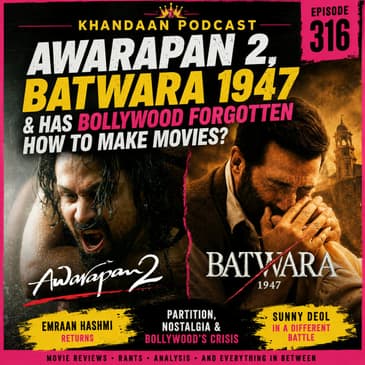
Asim and Sujoy catch up on the latest releases, starting with Awarapan 2 and the enduring appeal of Emraan Hashmi before turning to Rajkumar Santoshi's Batwara 1947 and its surprisingly nuanced take on Partition.
Then they attempt to survive David Dhawan's Hai Jawani Toh Ishq Hona Hai, which raises the bigger question of whether Bollywood has forgotten how to make mainstream comedy. Plus: Varun Dhawan's identity crisis, Asim's inexplicable rage at Manish Paul, and why Maa Vaapas Aunga turned out to be one of the most moving films Asim has seen recently.
Timestamps:
02:30 — Awarapan 2
12:11 — Batwara 1947
23:36 — Hai Jawani Toh Ishq Hona Hai
33:38 — Maa Wapas Aunga
39:07 — Cocktail 2 & what's next
40:21 — Toxic on Patreon
💬 Join the conversation:
Do you think Awarapan 2 earns its nostalgia? Has Sunny Deol's recent filmography hurt Batwara 1947? And when was the last genuinely great mainstream Bollywood comedy?
🎧 Support Khandaan and get exclusive episodes and bonus content:
Khandaan Patreon
📺 Watch our video episodes:
Khandaan Podcast on YouTube
#Awarapan2 #EmraanHashmi #Batwara1947 #SunnyDeol #VarunDhawan #Bollywood #KhandaanPodcast
[00:00:15] Hi, this is Asim, this is Sujoy, this is Amritha, and you're listening to Khandaan, a Bollywood Podcast about the three main Khans of the Hindi film industry, Aamir, Salman, and Shahrukh. Hi, you're listening to Khandaan, a Bollywood Podcast regular feed. Thank you so much for your support over the years. We now have a Patreon channel with bonus content and exclusive merch for those of you who would like to support us.
[00:00:39] Every dollar goes towards creating more and better content. Visit us at patreon.com slash Khandaan Podcast. Hi and welcome to a new episode of Khandaan Podcast. My name is Asim Burnie and I'm joined with my lovely co-host Sujoy. Hey Sujoy. Hey everybody, it's only me this time. Yes, it's only you so you get the lovely co-host. It's all for you. Normally you have to split the lovely between you and Amritha but this time it's all for you man. Yeah, all I need is love.
[00:01:11] How are things man? Going okay, I think. I don't know. There's so many things to complain so let's not for a change and look at the positive side of things. We've got so many movies coming up, so many movies to watch and yeah, we're here to talk about it. Yeah, I mean I was off for 10-12 days so I kind of missed the big releases and by the time I could go watch them they were already out of theaters.
[00:01:38] The thing is like and this is going to be sometimes I wonder if this is going to be a problem going forward is that the UK Bollywood distribution system seems to be completely screwed in the last two years. Yeah, there's no rhyme or reason when movies are being shown which movies are being shown and it's having an effect on which movies we can cover on on Khandaan.
[00:01:59] Yeah, also like there's a lot of Tamil, Telugu, Kannada, Malayalam releases happening and they are sometimes taking center stage and like the for example, Avarappan is only getting in its second week of release getting a screen at the O2 and that's also like 9.50pm and who's gonna watch it? Yeah, man. I'm old. I have to get my you know, 9 hours of sleep or 10 hours of sleep in the week and I can't do it you know. Yeah.
[00:02:28] And it's a shame because I think like there's been a few of these tweets where oh, we should give credit to bads of Bollywood about how they've hyped up Imran Hashmi and that's led to the success of Avarappan. And I want my credit. I want my credit. I have been hyping Avarappan. I don't even know 10 years, 15 years and like I even got you to watch it which is very hard to do.
[00:02:58] And you liked it which is one of my biggest accomplishment as this podcast. It's not the millions of listeners. The love that we get is Sujoy watching Avarappan and actually enjoying it. Yeah, absolutely. And then the irony of it is that I watch Avarappan 2 and you did not. Yeah. So tell me what is how was Avarappan 2 so I can live vicariously through it?
[00:03:23] Right. It's very much a nostalgia bait kind of a movie. It's very much fan service in that, you know, it's trying to replicate the success of the of the original. It's continuing the story of Shivam Pandit and his yearning, his loss, his tragedy. He's dealing with the grief of the loss of his lover and he's still living in that.
[00:03:45] But it's a continuation of a story from him being this love who has lost and then finding a new purpose in life in bringing up a smaller, an orphan that he finds. And then he names her Alia and then she gets into trouble and he has to deal with that and, you know, try to save her and rescue her.
[00:04:09] And the mission here is I'm not going to lose Alia again, you know. So that that's the whole story of Avarappan 2. It goes to all lengths of, you know, oh, this this is too far fetched. You know, the Interpol gets in, you know, involved and he becomes an undercover gangster and all of that. And it's too far fetched for me. They should have kept it a bit more realistic in a way. Also, like the villain character. So there are two main villains here.
[00:04:38] One sort of takes a backseat as this larger looming character who doesn't necessarily play much, which is played by Shabana Azmi. She plays Nafisa, the big ganglord of Bangkok. And then the second one is, I can't remember, but he's played by, I think, Wamika Gabi's brother, who is, let me. Is his name Gabi Gabi? Gabi Gabi, single, single, as you would say.
[00:05:13] Gabi Gabi Gabi. The villain in the first one with a different shade altogether.
[00:05:43] Obviously, we are not looking the same sort of villain being repeated here, but he's very much like our game kill there. Whoever, you know, gets to reassemble a gun first will be will stay alive and whatever. And then you look at him and he's like five foot two and he's lanky. And he is trying so hard to be the evil guy. But yet there is nothing.
[00:06:10] I don't believe in the evil of this Zorabar guy. And also, every time he does something really evil, the background goes, the BGM score goes, Zorabar! Zorabar! It's really unintentionally hilarious. Very vijusha! Very much like that. Speaking of which, obviously, they have a callback of the soundtrack, which was such a big hit from the original.
[00:06:38] So they use it to great extent here. To phir aho, you know, literally starts off the movie with to phir aho. And then Tera Mera Rishta Purana is also sort of, it echoes what happens in the first movie where here there is a very, very cool shot. I don't want to spoil it for you. But it's Twitter already spoiled it for me. And I hate Twitter for it. Yeah. It's a very cool shot.
[00:07:05] And the song really makes sense to come at that point. It builds up, builds up. And then they hit you with that. It's really, really cool. It's like when the Rocky theme song comes into Creed at just the right moment. You know, that's what I was thinking of when I saw The Little Kip. I was like, ah, this is really cool. So Avarapun came out in 2007. This is almost 19, 20 years later. It's coming out, the sequel.
[00:07:31] I thought, I don't know for what reason, like Imran Hashmi was much older than he was in my head. But he's not that old compared to the Khans or whatever, you know. And he's looking really good in this. Like he's got six packs and they really showcase like he's hot and happening and muscles and lean and all of that. But the action sequences don't work for the most part, apart from two sequences.
[00:07:58] Like there's a lot of inconsistency, like how I'm saying inconsistency, you know. There's a lot of that. Like the quality dips and then picks up and then it cannot... Sustain the momentum. Yeah, it cannot decide what kind of a movie it wants to be. But there are really two awesome, cool action sequences.
[00:08:22] One in the climax itself where they are in this junkyard sort of a warehouse with all the steel containers. And the lights go dim and Imran Hashmi goes around shooting guns. And so there's holes in the container. So the lights coming out, coming from outside. That's really cool. And then they have a oner in that and it's really well done. And but like if you look at the rest of the movie, like so you saved all of that just for this, you know, it kind of feels like that.
[00:08:52] But yeah, like Shabana Azmi should have been the main villain. I think she really choose scenery. And I really thought like they sort of hedged their bets on the wrong guy to become the villain. So that's why this movie didn't really blossom as it should have, I thought. Like I really enjoyed my time. But then it becomes like, yeah, they could have done this. They could have done that.
[00:09:17] It really either needed a good rewrite or a good recasting at some point to make it a bit more. It was funny because I was listening to the soundtrack because I couldn't watch the movie. So I was driving a lot in the last few weeks. I was listening to the soundtrack and I was getting that same feeling of the soundtrack itself. That the best part is the recall of the first Awarapan. And everything that's new falls slightly short, unfortunately.
[00:09:46] And I think that's probably the vibe we're getting from the movie itself. Because Awarapan is also a very vibe based movie just generally, right? And I don't know. The two original songs, though, one of them really feels like a sort of spin-off from the Sayara title track. It's very, very similar. It's very much going to the Mohitsuri verse. But still not being able to bring that.
[00:10:12] I know it's a disservice to the makers of this movie to call that, you know, comparing that to Sayara. But there is another track called Lado, which is when he's like very fondly remembering this little girl. And it's a really, really good track. I think if you have watched the movie, I think it even grows more on you. It's sung by Zubin Notriyal. And he's done a really good job. I really, really like that song.
[00:10:43] Where did I go? What's happening? Yeah, it's a shame. I won't be able to necessarily watch it in theaters. I'll try. But it's going to be a tough one for me. So it's probably going to be on streaming. But I'm really happy, though, that it's doing the numbers. Out of the two releases, there's Independence Day. Like, happy Independence Day to you, Asim. I'm related. But out of the two movies, two Bollywood movies that have been released this Independence Day weekend,
[00:11:12] this is the one that has picked numbers. You know, it's resonating with audiences. I don't know if they are really buying into the whole Imran Hashmi, Ek Taraf, and all that industry hype from Bats of Bollywood or Awa Rapunz nostalgia or I don't know. I'm happy that it's making bucks. Yes. Imran Hashmi, he is one of those guys that he was a contender, but he didn't like...
[00:11:41] I mean, we've loved his stuff. And I think a lot of people just love Imran Hashmi, but he never became like a Yash Raj hero. Like, you know what I mean? And that's a Dharma hero. So he has this underdog quality to him, although he is a complete Nepo baby like so many. But I do think that there's partly nostalgia to it, partly this idea of he's one of us because he's an underdog and everybody feels like an underdog.
[00:12:06] And then just, you know, when Imran Hashmi came along, you had kind of a dangerous movie. Like he was playing dangerous roles and the music was always good and that has a good factor. So I think the whole package there is, of Imran is there. But I just don't think now the music is as good anymore. Or even Vishesh film has those movies that they used to make back in the day. And the original was directed by Mohit Suri, wasn't it?
[00:12:36] The original one? Yeah. And this one isn't? This one isn't, no. Yeah. So I think also there's like just the lack of skill. I mean, I like Mohit Suri movies. I know a lot of people kind of like, you know, dis on him and he's not, you know. But I enjoy them for what they are, except for Egg Villain 2, I think. But anyway, you were talking about the second movie that also came out. But yeah, Batwara 1947. You also got a chance to watch that, right? Yeah, I did. Which again, we're Tuesday. Yesterday I was checking if it's still playing.
[00:13:06] It was already out of theaters, which is insane. That never happens. But how was Batwara? Yeah, sadly, this is like, I don't know. It's not finding its audience. It's not made the numbers. And it's pretty much being declared a flop at this moment. But the business aside, like there were some expectations going in. I had my reservations being, it being a Sunnydale movie released on Independence Day.
[00:13:34] So I knew what the pitch was going to be. But it also has the contradiction of being an Aamir Khan production and also directed by Rajkumar Santoshi. A lot of those have been done before. And so I didn't know where this movie would land in that sort of permutation combination Venn diagram of it all.
[00:13:57] And it exactly lands in a very confused land because it's trying to tell a very delicate story of, you know, this, which I found interesting because a lot of partition movies that have been shown in Bollywood is all about migrants from the other side of the border coming to India, right? This is the opposite of that.
[00:14:45] And she's in their house. And she's a Hindu and she's Mai, played by Shabana Azmi. And then obviously nefarious forces around the colony in Lahore, you know, coming into play to basically throw her out of her own house. And all of that then proceeds into how this family comes into terms and they grow as well into loving her.
[00:15:13] And it's their character growth, you know, going through being Indian and having this really rooted family and then finding people turn against them. Then, you know, because of the events of partition, how they become hateful and then finding love in a way. It's that very, it's all the drama that you need. But obviously, because it's a Sunny Devil movie, there has to be a lot of high-pitched shouting. There's got to be people being pummeled.
[00:15:43] There's has to be an over-the-top villain, which like Abhimanyu Singh, he speaks really terrible, filmy Punjabi. Yeah, it's all over the place. And even though like the climax really lands, the climax is so really well handled. But to reach there, it has been like the movie had totally beaten me down by then.
[00:16:11] And sadly, like I was quite excited to see Priti Zinta on screen after such a long time. And she does not get to play much. Like there's, there could have been scenes that could have been taken away from Sunny Devil. And her character could have, you know, taken that up. But she is only written as the token Muslim wife who's talking about her shohar and, you know,
[00:16:36] and all of that, like literally lines like that, you know. Yeah, I think it's quite a badly made movie, sadly. Which is, which makes me sad because it's a Rajkumar Santoshi movie, you know. It was interesting because we were, I had this feeling that, you know, and I think I was watching an interview with Rajkumar Santoshi on Bhartu Raj Rangan's channel, which I'm really enjoying. I haven't finished the whole thing.
[00:17:06] But I just like those kind of interviews about directors that are not, you know, have had a career and have made movies that I've absolutely adored, right? From Damani to Ghatak to Ghyayal and everything. And that's obviously our favorite. But he was saying that it was very hard to get this movie made because Sunny Devil's character was playing a Muslim.
[00:17:31] And that has, that just has less appeal for producers. But I also felt that in a post-Dhurander world, it also just has less appeal to audiences. Like the only thing they almost want is, you know, Pakistan mein ghar mein ghuske maarengi. That's what they want to see. I wouldn't say everybody, 100%, not everybody. But there's a subsection that is very vocal and very loud. That that's what they want to see.
[00:17:57] Like even just this portrayal of any sort of positive mention of Pakistan or Pakistanis is just not something that they can, they can't digest it even, right? And I think that's also partly why the audience hasn't turned out. And I also, like, I also believe 50%, this is the fault of Sunny Devil and the kind of movies he has been making, you know? I, who love Ghatak, who loves Damini,
[00:18:24] who loves his collaborations with Rajkumar Santoshi, I was wary about how this movie would be made. And I was not excited where I could have been like, you know, like, oh, he's gonna like, you know, take on Katia, Pakistani Katia again, and I'm gonna be there, you know? And I just didn't have it because he has had a track record of making so many violently anti-Pakistani movies, you know? And that just like sours the whole experience for me.
[00:18:53] And I don't care how many interviews he does about saying, you know, India maa hai, toh Pakistan khala hai ya maasi hai. I don't know which word that he used. It just seems fake when you, you know, awaz kahan tak jayegi lahor tak, you know? Like, you're not gonna swindle me, right? So it's kind of those both things. And I honestly feel Rajkumar Santoshi is probably like that older class of filmmaker that doesn't want to make these adhatiya dar kind of movies.
[00:19:23] But he has to, like Yash Raj did, they have to kind of bend to the will of it. And I just didn't have the faith that they would be, you know, like the Pakistani side would still be portrayed in a certain way. And I was not, it just didn't need to my excitement to go watch this movie. And virtually. Like, to be fair, it's still very much true to the actual play, which I can't remember the exact name.
[00:19:51] It's called Jis Lahor Na Vekia O Jamiai Nahi. It's written by Asghar Wajahat, who also gets writing credit on the movie. So it's a very graceful portrayal of Pakistan, except for the communal parts, which I think they have shown, you know, communal people are everywhere on both sides.
[00:20:16] It's a very, it's not a very biased view, I would say. And probably that's why people are not loving it, when they are expecting Sanidevol to not be that, you know. And that's the curse of Sanidevol, because he's cornered himself into playing this spokesman, you know. Yeah, yeah. And yes, that's my thing. So again, I'm like, I think in a few movies,
[00:20:44] I think like even Ikkis and I think even Border 2, a lot of people say that, you know, it is even-handed or it's not as one-sided as it needs to be. But it's also just the marketing and how the movie is being perceived. And also the, you cannot, like people will always say, oh, judge it on its own, but it's part of an ecosphere. It's part of, you know, the kind of movies that are being made, the kind of movies these actors are making. And obviously there's going to be a bit of a hesitation from audiences now,
[00:21:12] because we've been burnt so many times, right? Yeah. So I think that's also kind of, so it's appealing in a way to nobody, you know. It's not appealing to people like me, and it's also not appealing to the Dharundar crowd. So it's kind of like in the middle and then the wins are for Imran Hashmi. Which is a shame because the way this movie ends, there is, yeah, I don't want to spoil, but it's done some,
[00:21:39] I don't know if it's directly a lifting a particular scene from the play and how it ends, but it's done very, very powerfully and emotionally. You get the heights of a Rajkumar Santoshi melodrama in that scene. And you see why this was made to begin with. It's very much spreading the message of love and to be kind and all of those. But in a post-Dharundar world, we have to acknowledge that that world does not exist anymore in a way,
[00:22:09] which is such a sad thing to say. Yeah. In the interview, he was also saying that he, the director of the play was writing the screenplay with him for the movie. And they did adapt quite a few things because they had this larger canvas. Yeah. And they wanted to make it from a play to a movie. So I was still like, till yesterday, like I said, I was actually looking for timings to go watch the movie. And unfortunately now I've missed it. And I'll have to watch it on streaming because I do not want to miss Rajkumar Santoshi. You know,
[00:22:38] I think he's amazing. One last thing that I would like to add, but like, I don't want to diss on anyone, but I have to this time around because it was so badly done. Karan Deol, this is his second movie. His character had the most complex arc that could have been done so well in the hands of a really capable actor. And he really fails. Fails. Like, he's so bad.
[00:23:07] He's like, utterly bad. He's like, Fardeen Khan in Premagan bad. Like, this is so funny that Amrita picked up on that from the trailer. That's the first thing she said, right? And yeah, she always has the, you know, the pulse of these things. So yeah, it's unfortunate. So I think his career is probably done. I think this is the third movie, no? Second movie? Third movie. I'm not sure. Second movie. One last thing that I would like to mention about Bhatwara 1947.
[00:23:37] The soundtrack is amazing. Just go listen to the soundtrack by A.R. Rahman. Rahman. It's lyrics written by Javed Akhtar. Yeah. Yeah. There's a song called Tabasum by Sonu Nigam. Amazing. There's another song which is a bhajan. Sangh by Anuradha Podwal. It's called Kahan Chale Gae Ho Ram. It comes at a very crucial point in the movie. And it's picture as in Shavana Azmi. She acts the heck out of it. And yeah, it's really, really well done.
[00:24:07] Nice. Nice. I want to watch it when it comes out on streaming. What did come out on streaming and we got a chance to watch is I think we both failed to complete the viewing of this movie, right? We tried. I came in with a lot of goodwill. I'll be honest. We do. Always. We show up for Varun Dhawan. Just for Varun Dhawan, right? Yeah. And a friend of the podcast,
[00:24:37] he had already done a short review about how bad it is. But then I had removed that video, his foreshadowing of what was to come. You know, I'd completely lost memory of it. And then it showed up somehow. And then we both tried to watch and I survived 20 minutes of this movie. I'm an hour in. So I didn't get further along. So clearly my love for Varun is bigger than your love for Varun Dhawan.
[00:25:07] But it's unrequited love and it's an abusive relationship at this point, unfortunately. Very much so. What's also very interesting about this movie is because it stars with Varun Dhawan, you have Murnal Thakur and you also have Pooja Hedge, right? So... It's over the hedge for you, Asim. Yeah. The thing is, both of these actresses are in Bollywood,
[00:25:36] but they're really, really successful in South cinema, right? Telugu Tamil and stuff like that. And that's the point I watched The Coit not too long ago. And I think I was making this point that how... The difference how Bollywood is portraying these actresses and how the South is portraying these actresses and how much Bollywood is failing them. Not just that it's the type of movie that's being made. Obviously the movies that I've seen like Murnal in The Coit, I've seen her in Hai Nana.
[00:26:07] Amazing roles and they look beautiful in those roles. Pooja Hedge, she's like a item number... Pooja Hedge. I'm going to Pooja Hedge. Pooja Hedge. She has amazing items. Like every song she's in is like a massive hit in the South, right? And here she just is a random Instagram hot girl. That's the only way she's being portrayed in it. So none of the skills, none of the styling really works for them.
[00:26:37] And it's such a failure. It's such a shame that you have these actresses that are doing great work and they want to work in Hindi cinema. They want to work in Bollywood. And the roles, the type of movie is just not there. And also just basic things like styling, how they're being, you know, the clothes that they're wearing, the way they're lit is just not up to mark, you know? It's crazy to me that the difference. I mean, that's like a secondary concern when it comes to this movie for me.
[00:27:05] Because this is a David Dhawan movie making a movie with his son, Varun Dhawan, who is the hero of this movie. His last movie. His legacy. Yeah. And it's so sad to see that when you watch this movie, the only realization that I have is I think people have forgotten how to make movies. Like the comedy does not land. The writing does not land. Everything feels like a 20-minute real chunk, you know, joined together in some way.
[00:27:35] There's a setup and a sort of punchline in every 20 seconds. And then Manish Paul comes in and he does his bit. And it's all that continuously. And you cannot make movies like that. It's not like a Kapil Sharma show. You know, when comedy is so easily accessible on TV, what does it mean to make a comedy movie for the big screen? I think that art is lost.
[00:28:02] And because of writers like Farhad Samji, I would totally throw the blame at them for writing movies for TikTok. This is clearly a movie made for TikTok or Instagram Reels or short form, which is trying to be sold on as a big screen experience because they have the budget, they have the locations. And yeah, none of those beautiful shots look expensive. Everything looks like a,
[00:28:32] you know, a studio background in the, and it just like, and we used to have that. Even Coolie No. 1 was made for cheap, but that- The first one. Yeah. Yeah. The first one, the Gawinda one. But yeah, it just feels like such a betrayal of the Bollywood comedy experience. Like, who is going to want to watch this on TV? Yeah. I mean, I love Meitera Hero, right? Yeah.
[00:29:02] And when Varun came into that, everybody was like, oh my God, he's like the perfect combination of Gawinda with Salman, right? But now, in this movie, he still has that Gawinda with Salman thing, but he's not as funny as Gawinda and he's not as, he doesn't have the star power that Salman has. So he's like, kind of like falling in the middle and he just seems very insecure about what he's feeling. Yeah. And also like, that was a charming thing
[00:29:32] when he was starting out. Yeah. So many years into his career, if he's still coming out as the Gawinda with Salman caricature, then that's a failure on him as an actor to find his own identity, right? And if he's trying to just do that routine, it's not going to work. And there's a specific way, like there was a sequence in this movie where he takes off his shirt and he's like, you know, flexing his muscles, talking about his six pack.
[00:30:01] And it just hit me, like how many times have we seen Salman take off his shirt and how many times has he actually flexed his muscle and talked about his six pack himself? I don't think he's ever done that. No. Right. It's always like a reaction to him or, you know, that kind of thing. It almost has a purpose why he's taking off his shirt. And here it doesn't. And it's like, it just feels arrogant and cocky with no reason. And then the basic storyline
[00:30:31] of it is he's, he's initially married to Muranar and she's a career woman. Apparently, suddenly she drops in front of the divorce proceeding that she's a CEO of a company. She says, I'm a CEO of a company. They don't say which company. They never, you never see her in an office. You never see her actually work. She's just a CEO of a company. He's a wedding photographer or something like that. And he has, they got married and he absolutely wants a baby. And he's like, and there's this comedy sequence
[00:31:01] of every time he's trying and he, she brings out a condom and then that's, oh, I can't do it with a, you know, that kind of thing. And it's like, wow, this is really stuck in a completely different era of, yeah, I mean, she doesn't want it. She doesn't want it, right? Like, I don't understand what the problem is. Like, why is this, you know, and then they end up divorcing and while they're in this trial separation, he meets up Pooja Haigre and that's like the, the, the David, the one trope of one man being stuck with two, two beautiful women.
[00:31:31] this poor guy, he can't decide. Yeah, you know, so, I mean, just convert to Islam, marry them both, problem solve, you know, like, this is not a big problem. In the era of everybody in like open relationships and whatever else some of our younger friends tell me that people are into, this is not an issue anymore, you know? So, yeah, it's, I got to the point where she comes back and she reveals that she's pregnant and I don't know
[00:32:01] if I have the heart to finish this movie, although I like all of the, the performers in here. the, the magic is just not there anymore. You like all the performers including Manish Paul? Man, Sujoy. I don't, I was trying to end this on a positive note that you take it back and you know, like it's, I don't think, I don't know what it is. Like, I,
[00:32:32] you have an active on-screen allergy to Manish Paul. It's a hate. I, I hate him so much. I think he personifies everything I hate in a man. Like this arrogant, loud, cockiness based on no talent. Like, I don't find him funny. I don't find him charming. I don't feel he feels, like he, like, I think he's like, he's supposed to be the best friend and he's supposed to be then taking a second receipt.
[00:33:01] But he absolutely wants to be the primary driver of the comedy and he just has no star power for me. Like, as a, like, I don't watch his TV show. I don't watch what he does. So for me, he's, I've just seen him in movies and for me, like, this guy would never be a hero. Like, this guy would never be a, if he had a movie starring him, I would never go watch it. Like, he just doesn't have it, you know? So, yeah, he really, really annoys me. Like,
[00:33:30] and none of it is funny. Like, there's a sequence where he's speaking with Kubra Seth, who's the therapist. And he's like, you have to get these people together. And none of it is funny. He's staring, like, it's miscast. Like, I don't know. Yeah, it's, and there's a whole track where Varun is also thinking about his high school teachers. And there's no reason for that to be, and it's also, again, not funny. So,
[00:34:00] they do add, like, you know, yeah, comedic actors in those, like, roles and stuff like that. But, none of it really works. It's, it's complete mismatch. And it's an unfortunate thing that also, like, this comedy genius of David Dhawan has to finish his career with this kind of movie. You know, it's, it's kind of sad. Yeah. What a comedy with tragedy. One more movie I watched, finally,
[00:34:29] because it hit Netflix, is May Wapas Aunga. And you, you'd already watched it, right? Yeah. You, I think you've already given your thoughts on a previous podcast. I absolutely love this movie. I absolutely love this movie. It, I cried at the end. Like, it was so touching. Like, especially when you are talking about, you know, Batwara and Dharunders of the world. It is such a, um, sensitive and, you know, a loving portrayal
[00:34:58] of the loss of people and refugees and things like that. I do feel it has a, a lot of threads going through it. You know, it does have that, um, you know, Aaj Kal Ka Piyaar is not the same as old Logo Ka Piyaar, you know, that kind of thing, which I think, I agree with the criticism that, um, I blame capitalism, man. It has nothing to do with anything else that people are swiping left or right or they don't have any commitment. It's just capitalism. We cannot afford a home and we don't have, you know,
[00:35:28] jobs that can, you know, sustain us. And I think that's a bigger problem than people just can't find love, you know. Um, but, uh, and, but I think Imtiazadi keeps harping on that. I think it's, the whole track of Diljeet's comedy is horror, horrifyingly bad. It's horrifyingly bad. Um, I just find like Imtiazali does not understand how the world works when it comes to jobs. Like, you know, when we met
[00:35:58] this Aditya character is launching an unlimited time, talk time, SIM card or something, a calling card and he does not know anything about the telecom industry and everybody is just okay with that. And it's the same here. Like, he does not understand the world of stand-up comedy. He's watched some stand-up comedy and he thinks Diljeet has to do it because it's cool and it's the most horrible stand-up comedy that you have ever seen. And I've seen some terrible ones. Although, that's the other thing I was thinking. Maybe it is an actual
[00:36:27] portrayal of Indian stand-up comedy which generally is terrible. Maybe that's what it's supposed to be. Um, I don't know. It, it just seemed very, uh, it, that whole track was kind of like, um, weird and bad for me. And I also felt like there was no conclusion to the Diljeet story at the end of the day. You know, they have this, at the end, they have this, uh, kya kamal hai song which is making this larger point about refugees. But then, what, what it, what, what happens with his girlfriend? Like,
[00:36:56] you know, like, it doesn't matter. You know, so, which, which seems to be his search to find, you know, what love means for him and the kind of love he wants. But also, there's, well, there was this whole, so this thing about him trying to build this renewable energy thing, you know, like, what the hell? Yeah, yeah, that's what I mean. It just has a bit, too many of these threads going through it. Yeah. Um, but, when you, like, but the emotionality of, you know, um, that,
[00:37:26] also the poetry was bad. Like, he waited like 70 years to drop this poem to, you know, um, to his girlfriend and the poem was actually quite bad. There were a lot of these things, but the, the, the overall movie I had, like, you know, it's, it's such a touching, loving thing and just the sensitivity of the portrayal of partition and the horror of it. But I thought, you know, um, the younger, uh, actors, you know, what's his name? Raina,
[00:37:56] uh, Vidang Raina. Vidang Raina and, I'm blanking on the other, Sharwari. I thought they, that track was just beautiful and amazing, you know, and, um, also just the horror of partition, you know, actually seeing those women, um, you know, uh, committing suicide is, these are stories we've heard so many times, but seeing the horror of it and the burden placed on the elders of, um, you know, the elder women of, uh,
[00:38:27] of these, uh, families, you know, is so big. I was just like, horrific, horrific to see. Um, so, I absolutely love this movie. Like it, and also soundtack is really good too. Um, yeah, I, I really loved, and I'm, I'm glad that with the, I don't know if enough people went to watch, um, it in theaters. I think it was a moderate success, right? If I'm not mistaken. Um, but I think with, um,
[00:38:56] this is the perfect kind of movie to get a bigger audience through Netflix. And I think that's kind of cool too, you know? Um, I, I did find it funny that, that, um, that actor that's playing the, uh, the, the Pakistani that's very violent. He was the same from Dhurandar, wasn't he? Hmm. You know, the one who I mean? No.
[00:39:25] Wasn't he playing the best friend of, uh, the guy in Dhurandar? Mm. No, I think so. I just like thought it was weird that he was specializing, specializing in the guy playing Afzal, I think. Um, yeah. How, how actors find certain niches, you know? Hateful guy, Pakistan. Yeah, hateful Pakistani. We've got this guy. He specializes in it. Um, yeah,
[00:39:54] so that was our thoughts on May Wapas Aunga. I, I also think, cocktail two dropped on Netflix too. So I'm going to try and watch that for our next episode. Cause I'm keen to watch this. Um, uh, but I don't know if you've seen cocktail two. No, I haven't. I don't know if I'll, I haven't seen the original cocktail either. Wow. Yeah. Uh, is it streaming anywhere? I don't know. I have no clue. I never thought it was that great cocktail to be honest. Like it was, well, people claim it to be, you know, the,
[00:40:25] the, the, the breakthrough role for Deepika, right? Yeah. Yeah. Yeah. Yeah. Yeah. That is an interesting thing. And, and for me to watch and find out, I guess, but I don't know if I'll find it. And if I, I don't know if I'm interested enough to watch cocktail two either. Yeah. Yeah. No, I, I will try to catch that one. So, um, and then, uh, we're also going to be doing our English Babu Desi Meme review very soon on your request. So yeah,
[00:40:51] I must be shaking in her boots to come back to that. Yeah, exactly. Like she's probably like, I just want to stay here on my holiday. I don't want to do the English Babu Desi Meme. I don't want to go home. I'll come home. Yeah. Um, okay. We're doing one more thing for Patreon, which is going to be the trailer reaction to toxic, which you haven't seen yet. And we got a few requests. I can get fresh, fresh reactions. Yeah.
[00:41:19] So I'm really keen to see what your reaction is because I have seen it and it's like four minutes long. So it's going to be cool. Uh, so that's going to be on Patreon. Um, but, uh, this is it for this episode. Drop us an email at you podcasting at gmail.com. Let us leave us a comment also on Instagram. We're going to be doing a reader email episode very soon. We're going to be reading your questions, your comments, your thoughts. So any that you have drop us, uh, either on the podcast, uh, per email,
[00:41:47] I mean in the comment section or, uh, join our Patreon. That's also a good way. So you're aware. Can people find you online? You can find me on Instagram at nine E three K. And, uh, yeah, as Asim said, check us out on Patreon at patreon.com slash handan podcast. And all our video content is on YouTube at handan podcast. Great. And we'll be back next week with a new episode.
[00:42:16] Because I'm good as them. Girl, you're my time to get your love