
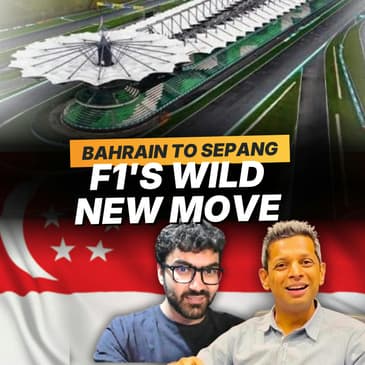

Formula 1 just invented a wild new business model: a Grand Prix can keep its name, its money, and its calendar slot - even if the race itself moves to another country. This episode unpacks the surreal "Bahrain Grand Prix in Malaysia" concept and why it could become the most important workaround in modern F1. Soumil and Kunal turn a strange one-off into a bigger conversation about war risk, revenue loss, sponsorship power, and what happens when a host nation can't safely stage a race. They explain why F1's calendar is under pressure, how much money is at stake, and why this situation may shape where races happen next. You'll discover: - Why Bahrain is effectively paying to host a race in Malaysia - How F1's revenue drops when fewer races are run, including the impact on teams and broadcasters - What "surrogacy" means in the context of Grand Prix hosting - How circuit upgrades, safety standards, and logistics factor into moving a race - Why this could open the door for India, South Korea, Fuji, Portimao, and other circuits to return The conversation also gets into the business logic behind the deal: who keeps the ticket revenue, who benefits from tourism, and why Malaysia may gain more than Bahrain on paper. Along the way, Soumil and Kunal compare this situation to historic "borrowed" Grands Prix like San Marino and Luxembourg, while also debating whether this is smart diplomacy, a branding masterstroke, or an admission of vulnerability. If you care about Formula One's future, calendar politics, and the money behind the sport, this is essential listening. It is part economics, part motorsport strategy, and part "wait, they can do that?" - and by the end, you'll never look at a Grand Prix name the same way again. Timestamps 00:00 - Opening the strange idea of Bahrain in Malaysia 00:48 - Kunal calls it Formula One surrogacy 01:31 - Swapping national identities across Grand Prix names 02:32 - Pushing the concept further with other countries and circuits 03:31 - Why India or other nations could theoretically do the same 05:00 - The geopolitical conflict driving race relocation 06:53 - Revenue pressure from a reduced F1 calendar 08:13 - Why Gulf states spend so much on Formula One 09:34 - Broadcaster obligations and why F1 wants enough races 10:31 - Bahrain Grand Prix in Malaysia as a surrogacy deal 11:35 - Who pays for the race and who controls the fee 12:31 - Sepang upgrades and FIA re-homologation costs 13:00 - What Malaysia gets from hosting the race 14:19 - What Bahrain gains by staying on the calendar 15:27 - Why the move may look like a warning, not advertising 16:32 - Kunal challenges the logic from a Bahraini perspective 17:33 - How this opens the door to future “named elsewhere” races 18:16 - Old examples: Luxembourg GP and San Marino GP 19:58 - Insurance, travel, and diplomatic issues in relocating races 20:57 - Why Malaysia is a strong motorsport country 21:45 - Why India still cannot easily host a relocated race 22:14 - Circuit upgrades and unresolved tax, visa, and logistics issues 23:11 - Why 2030 could be a turning point for India 24:24 - Best value F1 destinations for fans 25:48 - Other motorsport series fans can follow in Asia 26:53 - Could Imola become the season finale? 28:36 - How this could become a new Formula One business model 29:59 - Would India be better building up before hosting F1? 30:35 - Quick debate: Kimi title versus Ferrari constructors title 31:17 - Ticket pricing jokes and closing banter 31:53 - Next week’s topics: F1 2026 governance and FIFA commercialization #F1 #F1Podcast #bahraingp #malaysiangp #sepang
Learn more about your ad choices. Visit megaphone.fm/adchoices