
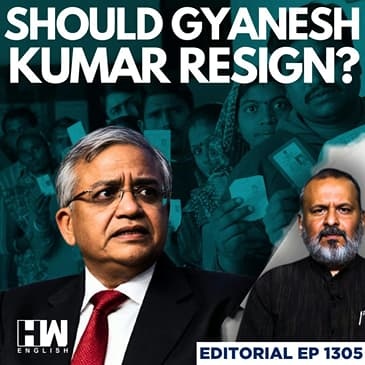
Is the Election Commission of India creating a two-tier democracy?
In this episode of Editorial, Sujit Nair analyzes the controversy surrounding the Election Commission's "Mark VIP" feature in the BLO app. Does providing preferential treatment to MPs, MLAs, and celebrities violate Article 14 and Article 15 of the Indian Constitution?
From missing names on voter rolls to questions about ECI autonomy, Sujit Nair breaks down why the election process is the ultimate frontier of Indian democracy.
Learn more about your ad choices. Visit megaphone.fm/adchoices
[00:00:00] has the right to vote if he is about 18 years old and he is a citizen of this country. The Constitution gives me that right. Gyanesh Kumar cannot take it away from me. And stop, I mean we should stop fooling ourselves and fooling the nation. This goes, election goes, election process is messed with, election process is interfered with. If election process is manipulated by the powerful party, end of story, India ceases to be democracy.
[00:00:35] Namaskar! Welcome to another episode of Editorial. Few days before, I had spoken to you about a possibility of VIP voting culture that is creeping into our society, that's creeping into our country. Today, there is more evidence of VIP voters. This is actually very, very disturbing. This is very disturbing.
[00:01:04] But before I get into all that, I want you to hear this. Today, Chinavayog wants to be a person to be a person. I want you to hear this. It's a person to be a person. You have to hear this. It's a person to be a person. I want you to hear it.
[00:01:39] And every day, for every editorial, we should hear this once. Chattan, Chattan, rock of Gibraltar, we will stand with the voters. This is what our election commissioner said. And you know why I wanted to hear this? Because imagine what has happened. Just yesterday, we spoke about 97 voters, eligible voters being deprived of their right to be in the voting roles.
[00:02:08] They are not, their names are not in the voters list. 97 eligible voters. You know what that means? What that means is it's actually going against the constitution of our country. Our constitution says that the election to the house of the people and to the legislative assembly of every state shall be on the basis of adult suffrage.
[00:02:31] That is to say that every person who is a citizen of India and who is not less than 18 years of age on such date as may be fixed on the behalf by or under any law by the appropriate legislature and is not otherwise disqualified under the constitution of any law made by the appropriate legislature on the ground of non-residence,
[00:02:58] unsoundness of mind, unsoundness of mind, crime or corrupt or illegal practices shall be entitled to be registered as a voter at any such elections. Any person who is not a criminal, who is not unsound of mind and who is otherwise said that this person cannot vote has the right to vote if he's above 18 years old and he's a citizen of this country. The constitution gives me that right. The constitution gives me that right. Gyanesh Kumar cannot take it away from me.
[00:03:28] Gyanesh Kumar cannot take it away from me. No government can take it away from me. Let that be very clear. You need to understand your constitution. You need to understand the rights that has been given to you in your constitution. 97 people, their names are not in the register. 97, 90 lakh odd people in West Bengal didn't have their names in the voting list. This is what's happened.
[00:03:56] Do you understand how grave this is? When you say that the constitution is being changed or the constitution is not being heard, the constitution is not being followed here. And that's the gravity of the situation here. Let me give you one more example. And that's the topic that we have in hand today. You see, article 14 of our constitution, article 14 of our constitution says that equality before law,
[00:04:20] the state shall not deny to any person equality before law and equal protection of law within the territory of India. Article 15 says prohibition of discrimination on grounds of religion, race, caste, sex or place of birth. Article 15 states that the state shall not discriminate against any citizen on grounds only of religion, race, caste, sex, place of birth or any of them.
[00:04:50] Long and short is what 14 and 15, article 14 and 15 tells you is that you cannot be discriminated. We are all citizens of this country, equal citizens of this country. Everything in this country is equal. Every right that possibly Narendra Modi has, I have. Every right that any person in this country has, I have. And every right I have, every person in this country has.
[00:05:17] This is exactly what article 14 and 15 tells you in our constitution. Article 326 tells us that we have the right to vote. If you are above the age of 18, these are the two rights that have been taken away from us. Or that is being taken away from us unless and until somebody intervenes and something is done about it. Let me talk about being equal.
[00:05:40] You see, two days back I had done an editorial where I spoke about is there VIP culture creeping into our elections and how dangerous that is. Today, more evidence. There is an article in Hindustan Times which talks about Mark VIP election commissions adds fresh feature in the app for official amid SIR. Now, the app itself has Mark VIP.
[00:06:10] So there are non important people like us and then there are VIP citizens are bifurcated. Let's be very clear. The election commission has bifurcated citizens, whatever the need is, whatever their justification is. Then there are some things you can't do. There are some things you shouldn't do. And that has been done. The election commission, according to these reports, have bifurcated citizens, very important people and possibly not important people.
[00:06:39] We belong to the not important category. I too, I'm supposed to go on the 28th of September with my, with my papers to prove that I'm a citizen of this country. I am also supposed to stand in that line and do that and I will do it. That's my job. I am a citizen. I have no choice. But if I was a very important person, I won't have to do it. I won't have to do it because the state will ensure that all of that is done. People will come to my house.
[00:07:07] People come to their house, not because they are sick, not because they are old, not because they are disabled. Because they are very important people. And you know who are the definition of very important people? That also I'll tell you. Very important people are, are people who are MPs, MLAs, MLCs, holders of declared offices and personalities from the field of art, culture, journalism and sports as well as members of the judiciary and public service.
[00:07:36] EROs are directed to ensure that these electors appear in the draft role so that that necessary documents can be collected during the period of claims and objections. These are the, these are the VIPs, MLAs, MPs, journalists, celebrities, film actors. These are the VIPs. So they are, they will, they will, they will not have to stand in queue. The system will ensure that they will, they will be incorporated. Let me give you, give you some more details on this.
[00:08:07] The mark VIP feature wasn't included in the BLO app in 2025. When SIR was held in West Bengal, it was introduced more than a month ago. It helped the BLO to mark the person as VIP during verification. This was said to Hindustan times by a member of the BLO association in West Bengal. He was requesting anonymity. So this name was not mentioned in Hindustan times.
[00:08:35] Hindustan times went on to quote that to be sure the provision to mark some voters as VIP has existed in the EC rules and manuals even since 2018. In Delhi, for example, the list of VIP electors is about 3000 strong. This again was said by an official in Delhi CEO's office. And again, he too requested anonymity. I can understand why people are scared to talk in this country.
[00:09:04] Now people are very scared to talk anyways. Rules say that VIP voters can be automatically added to the draft role, but they are not immune to claims and objection notices, which might explain why many prominent people got the notices. They have to be added on the draft role, but they are not immune to claims and notices. And if there are notices like I mentioned last time and we spoke about Amarty said, the BLO will go to his house.
[00:09:33] The officials will go to his house to correct it. The officials will go to his house to assist his whatever the discrepancies are, whatever document needs to be collected. For the rest of us, we have to go and present our own documents. The feature marking VIP is like consolidation exercise, said the Hindustan Times.
[00:09:53] Once a BLO marks an elector as VIP with an asterisk after visiting the residence of a voter, it is vetted by AERO and the ERO and subsequently by the office of the Chief Electoral Officer, Delhi. This is what the procedure is. This is what being said by a senior official from Delhi district. Again, the official obviously didn't want to be named. This is the status.
[00:10:20] So while you may not get special line, you will not they will not obviously make it obvious by making people move out for you at least as of today, at least as of today. But the fact remains that your name more or less will be ensured in the voters list because you are a VIP. Where does this VIP culture come from? Who gave this permission? Who gave this government or EC the permission to create VIPs and non VIPs amongst voters?
[00:10:48] What gave them the right to change the Constitution literally because they are acting against the Constitution? What gave them the right to act against the Constitution? Another aspect that I wanted to discuss with you is the response of Bharatiya Janata Party. Surprisingly, the response of Bharatiya Janata Party. I quite didn't understand as to why Bharatiya Janata Party is defending the Election Commission of India because end of the day, Election Commission of India is supposed to be an autonomous body.
[00:11:17] And I can still understand that the government of India is trying to defend the election commission of India, but Bharatiya Janata Party. Okay, let me let me draw your attention to the press conference that Samit Batra had yesterday in which he had spoken about dissent. He had spoken about how how dynamic how how how robust our democracy was, because you know, we had dissent people would differ from each other.
[00:11:43] People would talk about it people. I mean, it's it's all about democracy. He said here. Yeah, it's all about democracy. Bye, bye, bye.
[00:12:06] I've, I'm, every Tribe of China between three election commissioners what we gather from media.
[00:12:24] What we gather from media.
[00:13:01] I would say that today all the opposition parties have fallen into the trap. The trap where they said that the election commissioner and this government was a dictatorial government. Rather, I would say that this is pure democracy. The question is, differ sab thik hai? Differ, having difference of opinion is always fine. But has those difference of opinion being addressed? Have they been addressed?
[00:13:31] Is there an answer from the CEC, Chief Election Commission saying that Mr. Election Commissioner, your this particular point is valid or this particular point is rubbish. I don't agree to you or I agree to you. Is there a communication? Secondly, when two election commissioners are agreeing to something, the question according to the rule book, it is a law. That is how it should be. Have those been corrected? Are there documentation there?
[00:13:56] You see, even when the election commission gave a clarification, what did that clarification exactly mean? Except for the fact that they are literally saying and we are so used to it, sab changasi, it's all unanimous, every decision is taken unanimously and all of that. Has there been any clarification? Saying that, listen, you know, this letter we did receive, but this is what the decision for that was. Or this is how we resolved it. Was there any communication that way?
[00:14:25] If not, then what dissent are you talking about? And what democracy are you talking about? This is not democracy. This is somebody saying that, listen, you are not listening to me. And the other guy says, okay, teek hai. Thank God that it was reported in Indian Express. Otherwise, it would have gone under the carpet. End of story. Nothing would have happened. I mean, let's not get carried away like this. And stop. I mean, we should stop fooling ourselves and fooling the nation. Achso, point number two. Dissent? Look at the party. Who is talking about dissent? And allowing dissent?
[00:14:55] Normally, if you dissent, if it was descending against Bharatiya Janata Party, it would have been ED and IT raid by now. People would have gone behind bars and languished behind bars. These are serious questions. These are very, very serious questions. And these questions needs answers. Chattan ke thada khaday hai, uske thada khaday hai, iske thada khaday hai. All these talks we hear. But the reality is absolutely different to what is being told to us.
[00:15:22] And the fact remains that the reason I am continuously doing editorials on election commission is because that's the last frontier. This goes. Election goes. Election process is messed with. Election process is interfered with. If election process is manipulated by the powerful party, end of story, India ceases to be democracy. This is the last frontier. This is the last frontier. Nobody seems to be helping.
[00:15:52] And the Supreme Court has not intervened. Nobody seems to be helping. The fact is, we need to be mindful. If we are drowning, at least let us know that we are drowning. At least let us be aware, mindful of the fact that our democracy is drowning. And by the looks of it, it is. I say this with a lot of pain. I live in this democracy. I live in this democracy. And I was proud of this democracy.
[00:16:15] And I am seeing, step by step, this democracy being harmed, hurt, broken. So, this needs fixing. And this needs fixing fast. Till I see you next time. That's tomorrow at 10. Namaskar.