
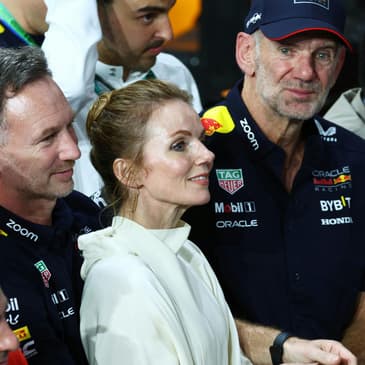
The Adrian Newey bombshell has finally dropped...on Red Bull Racing and all of Formula 1. But what Newey does next is more of interest, of course.
F1 TV's lead voice and commentator Alex Jacques is our special guest on this episode of the Inside Line F1 Podcast.
"What a problem to have for someone who has won 200 Grands Prix," said Alex Jacques, the guest on this episode of the Inside Line F1 Podcast. Soumil Arora and Jacques discussed with a lot of confidence that Maranello is where Newey will be headed to next...to work for Ferrari. "A great addition to his already fabled CV!" concluded Jacques.
In this "voices of F1" episode series, which is also a bonus episode before the 2024 Miami Grand Prix, Soumil and Alex spoke about Carlos Sainz's options, including Audi, Kimi Antonelli to Mercedes, Wolff-Hamilton and lots more.
Tune in!
(Season 2024, Episode 19)
Follow our hosts on Twitter: Soumil Arora and Alex Jacques
Image courtesy: Red Bull Content Pool
Learn more about your ad choices. Visit megaphone.fm/adchoices
[00:00:02] Before we begin, I wanted to give a huge shout out to the folks at Amazon Music for partnering with us on this episode of the Inside Line F1 Podcast.
[00:00:10] But more on this later, right then, let's get right into today's episode.
[00:00:35] Welcome ladies and gentlemen to another episode of the Inside Line F1 Podcast and this time we are back with the voices of Formula One.
[00:00:42] Now largely when we have done this series, we've had commentators who have worked on Formula One in the past,
[00:00:48] journalists who have been in the paroch, but I'm so glad that we literally have the voice of F1 TV on our podcast here this time out.
[00:00:55] Ladies and gentlemen, we've got Alex Jakes on the show and I'm so glad Alex that we get to speak to you about Formula One.
[00:01:02] Because normally we just tend to hear you talk about the sport and describe the action.
[00:01:07] Today we can hear a lot more about your opinions as well. So I'm glad that you've made up the time to come on the show today.
[00:01:12] Thank you so much for having me. I'm not sure anyone needs to hear more of my voice, but that's what we've got in store for the next few minutes either way.
[00:01:20] Thank you for having me. It's great to be here.
[00:01:22] Thank you. Thank you so much. And Alex, the one thing I've really been looking forward to ask you for all this while is a lot about Formula One and how you got your journey beginning early on.
[00:01:35] A lot of us know you through Formula Three and Formula Two and then that big F1 break came in, which is where we feel a little bit extra connected to you because we've seen you come in from that ladder.
[00:01:44] But for you personally, right? When did that call come in and what was it like?
[00:01:48] Because for all of us, that's one moment that we really felt, wow, Alex is accommodating on Formula One. This is something we've been waiting for for a while.
[00:01:56] It came in stages. It's quite an interesting one.
[00:02:00] So I'd done Formula Three and Formula Two and it's four runners in the championship, GP3 and GP2 since 2015.
[00:02:11] And there have been various different things, have been various different tests behind the scenes as early as 2016.
[00:02:21] And then that morphed into the pit lane channel, which was this cult classic, if you like, side channel, which was just a very small group of us working on this different way to do F1 with three boxes instead of one.
[00:02:39] So a couple of onboard cameras.
[00:02:42] But in between, there was a phone call out of the blue.
[00:02:48] No pre-chats about it at all or anything like that to say, hey, would you like to come and commentate for Channel Four?
[00:02:57] The great Ben Edwards is stepping back. He's reducing his workload.
[00:03:01] Would you like to come and would you like to come and commentate on Formula One for Channel Four?
[00:03:06] I was in the UK, the free to air broadcaster.
[00:03:10] That's network television.
[00:03:12] And in all honesty, it's what I'd been dreaming of for since I was a kid.
[00:03:17] So that was an amazing phone call to get.
[00:03:19] And it's every bit as cliched.
[00:03:23] You hang up from that call and you're like, wow, I've just been asked to be a Formula One commentator on network TV.
[00:03:31] That is unbelievable.
[00:03:34] I was going home, I was visiting my parents.
[00:03:36] One of the lovely things about it is I was visiting my mum for her birthday and I was able to go and I was able to go to say them.
[00:03:43] I just got a call from Channel Four and they want me to take over as lead F1 commentator.
[00:03:48] And that's a really lovely thing to have with them because obviously they've watched me grow up with this dream of doing it.
[00:03:55] And then there was an opportunity to combine that incredible prestigious role with what we'd started with the Pitlane channel.
[00:04:03] And that's where we are today.
[00:04:05] A wonderful combination of things whereby Formula One TV's streaming service, which is available in so many different countries around the world.
[00:04:14] That is the live broadcast and then still getting to be part of that amazing award winning Channel Four team.
[00:04:20] Yeah, but to answer your very good question in a short sentence, it was awesome getting that phone call.
[00:04:28] It's every bit as wonderful as you think it would be when someone's like, hey, do you want to do your dream job?
[00:04:33] Do you want to do this thing that you've been working on for a really long time?
[00:04:36] Yeah, it was great.
[00:04:37] But how did that dream begin, Alex?
[00:04:39] Because for me on that journey for commentating, I just used to imitate all the commentators like Crofty or in the past we had Ben Edwards as well on Channel Four.
[00:04:48] I used to just mimic their voices and be like, hey, that's what I want to do.
[00:04:51] Was it somewhat similar for you as well?
[00:04:53] What's up in Murray Walker in your time though?
[00:04:55] Yeah, I think.
[00:04:57] Yeah, it was Murray Walker when I was a kid.
[00:05:00] And I loved the way that he could explain it in a way that carried a massive network audience of some races.
[00:05:09] Ten million people plus, which for a UK audience is big.
[00:05:15] Okay, bear with me.
[00:05:16] But so that was a big deal when I started watching.
[00:05:22] And then that's what I wanted to try and carry on as well.
[00:05:25] That's what I wanted to try and that's why I wanted to do the job.
[00:05:30] When you start the very early stages, you can't help but do an impression of the people that have come before.
[00:05:38] But it obviously has to morph very quickly into your own voice.
[00:05:43] Otherwise, you will be found out.
[00:05:45] There is no way that you can borrow after the first few months because if you were to do that, what would the point of the job be?
[00:05:56] You can never be a good tribute act.
[00:06:01] You can only be a, you know, if you use someone's phraseology or you look at someone's methodology of doing it and you try to do an impression, eventually you've got to find your own path.
[00:06:13] Eventually, you've got to critically look at what works for you.
[00:06:17] And that is what the great names that you mentioned.
[00:06:20] Let's talk about Crofty and Ben Edwards there.
[00:06:22] That's what they've done.
[00:06:24] They've both used the commentators that would have inspired them as a starting point.
[00:06:30] And then they've had wonderful careers bringing their own voice, their own flavor to the broadcast.
[00:06:37] But one thing that you've done quite well, which is something that not a lot of modern commentators do, is embrace the pause.
[00:06:44] And I love that about your work that you're really all right with giving it a second to breathe.
[00:06:48] And that's where it really feels like you're stitching it along as it goes and it makes it so much fun to listen to.
[00:06:53] Is that something you intentionally do? Has it been part of your style from the very beginning?
[00:06:57] Yeah, it's something that I intend to do because listeners to F1 TV will know that I get quite carried away.
[00:07:05] It's my favorite sport.
[00:07:07] It's always been my favorite sport.
[00:07:09] It's the thing I love the most out there.
[00:07:10] And I'm a big sports fan.
[00:07:12] I'm not just a motor racing fan.
[00:07:14] I love almost everything when it comes to competitive elite sport.
[00:07:19] But yeah, the power of the pause.
[00:07:21] Something really working on certainly consciously in the last couple of years because I'm very lucky to commentate most weeks with David Coulthard and Jolyne Palmer, who are just at the very top of their game.
[00:07:37] Wonderful insights.
[00:07:39] You know, DC's been there.
[00:07:40] He's won 13 Grand Prix.
[00:07:42] On his day, he beat Michael, Micah and Fernando.
[00:07:45] He's very self-deprecating about it, but that gives you a real authority and gravitas to your analysis.
[00:07:51] And then we have Jolyne most weeks week in week out there who has an unbelievable reading of a Grand Prix and has the contemporary experience of these power units as well.
[00:08:04] And though it means that you get quite a you get a lot of talking, you get a lot if it is all three of us, you get a lot of talking.
[00:08:13] So it's quite important to add those pauses in just to give the audience a chance to maybe catch their breath.
[00:08:19] And if you know, if you think about you've got to chuck those pauses in because if you get a thrilling race, you don't want to hit the audience over the head with the with the noise that might be required.
[00:08:30] If there's overtake for the lead followed by overtake for the lead followed by overtake for the lead, then you get an excited and trying to convey the excitement there.
[00:08:39] But also you've got to try and you know, I want the audience to be able to hear the crunch when Valtteri Bottas' engine goes.
[00:08:47] I want the I want to hear that gearbox fail.
[00:08:51] That's part of it. So yeah, putting pauses in has become more and more conscious as we've gone along.
[00:08:56] Hang on. But you mentioned something there capturing the excitement.
[00:08:59] Normally you're normally you're the best one on the panel to do that.
[00:09:02] But there was one particular time that I remember where you were outclassed by a multiple time Grand Prix winner.
[00:09:08] You remember Mark Webber is famous.
[00:09:10] Oh, right next to you.
[00:09:11] Baku 21.
[00:09:12] You were there at that moment and I was amazed at how you kept your composure because anyone else like we all did, we just broke.
[00:09:19] Firstly, being amazed at how Hamilton missed his breaking marker and then listening to Mark Webber scream like a baby girl.
[00:09:25] That must have been some moment for you.
[00:09:27] What was mad about that is I didn't know who'd done it because that was effectively a race start with two laps to go.
[00:09:35] Right?
[00:09:36] That's a race start with two laps to go.
[00:09:38] You can't take your eyes off the screen.
[00:09:41] You've got to look.
[00:09:42] I mean, that is the hardest thing to do.
[00:09:45] And I've been very fortunate to commentate on a lot of sports.
[00:09:48] The hardest thing there is, I think, in sports commentary is the opening lap of a Grand Prix.
[00:09:53] So if you twin that with the fact that there are two laps to go, you know, Hamilton's got to jump off the line.
[00:10:00] He's going to win the race.
[00:10:02] Inexplicably sales on buy it turn one and then the stream comes in and I don't have time to turn my head and go, who has done that?
[00:10:12] But what's amazing about it is that we didn't even think about it.
[00:10:17] We packed up. We packed up.
[00:10:18] You go back to the production office like everyone's like, well, that was a Grand Prix, wasn't it?
[00:10:22] That was really something.
[00:10:24] And then we went to the hotel bar afterwards and we're all having a chat.
[00:10:28] And then obviously the race goes out because it was Channel four at that time.
[00:10:32] It was Billy Munger.
[00:10:33] It's Mark Webber and we're all there just talking about the race and we're just sort of decompressing after after a hard day's work.
[00:10:39] And then someone's gone getting a lot of social media chat about this screen.
[00:10:43] And I was like, oh, yeah, who did scream kind of thing?
[00:10:47] And it was one of those where we didn't think about it until afterwards.
[00:10:50] But that's how plugged in you are to the race start.
[00:10:53] And it's become a I love every single time that Bakun comes around now that always resists head on online and the clips.
[00:11:01] And what was great about that, that's just Mark's reaction to a big moment that very decisive as it turned out in 2021.
[00:11:10] So, yeah, that was a really, really fun moment.
[00:11:15] But we didn't we didn't really clock what had happened until about an hour afterwards.
[00:11:20] That's crazy.
[00:11:21] I mean, what a story that must have been.
[00:11:23] And then the clips went viral.
[00:11:25] But it's I find it amazing how it's not just Mark Webber you've got a good pairing with them.
[00:11:30] So many great racing drivers who you do have a good pair with like Webber,
[00:11:34] Pete Coulthard, Julian Palmer, as you mentioned, Alex Brundle, Davide Valsechi from the past as well.
[00:11:40] These are incredibly different characters and ones that have a lot of energy on screen.
[00:11:46] How do you OK, should I put you on the spot first?
[00:11:49] Should I go for the easier question first, Alex?
[00:11:51] You ask anything you like.
[00:11:52] You know what's coming next now that I've said that.
[00:11:54] Go on, you ask.
[00:11:56] Firstly, how do you how do you manage their energies?
[00:12:01] Because while DC can be a lot more, let's say, pinpoint, a lot more direct,
[00:12:05] someone like Davide would be a lot more energetic, a lot more flamboyant with his old style.
[00:12:09] And you need someone to balance everything out, right?
[00:12:12] Because obviously you don't want the commentary to be only one side of the need.
[00:12:15] Someone to match the energies.
[00:12:16] So is it something that you really consciously have to work on or just be natural and carry on and see how it comes?
[00:12:21] Because ultimately it all sounds pretty good with either of them.
[00:12:24] So I think that there's a few things in that.
[00:12:28] Davide is the only co-commentator whose energy I've found impossible to match, but no one alive could.
[00:12:35] He was a great reminder of how it should feel, that it should be joyful,
[00:12:42] that it should be intense, that it should be passionate.
[00:12:46] And I just tried to I just tried to match his energy.
[00:12:51] So that's certainly the most energetic commentary I've ever done.
[00:12:54] It's obviously developed as I've been this my 10th season of doing a single seater motor racing commentary,
[00:13:00] starting with the second and third tiers.
[00:13:03] And you do eventually go right.
[00:13:05] There's a score out of 100.
[00:13:08] And I'm going to provide this and my co-commentator is going to provide that.
[00:13:12] And you make sure that it basically adds up to 100.
[00:13:15] So you would and and commentating with Davide was about 120.
[00:13:20] So now you try to you try to match it a lot more.
[00:13:24] The other thing is to say that I do have a background in producing.
[00:13:30] So I think I understand what the co-commentator might need each time.
[00:13:37] And each co-commentator has their wonderful strengths.
[00:13:41] So you want to bring those strengths out and you want to make sure that you don't ever lean across their strengths as a so I let Jolyon basically take control of the majority of the here and now race reading.
[00:13:56] I wouldn't maybe refer to the past as much from David because I know David's going to cover off an anecdote that's relevant to the battle for the lead.
[00:14:04] So you play to your co-commentator strengths.
[00:14:07] The other thing to say, and it's an obvious point, is that I've been spot rotten with the people that I've had alongside me in the commentary box.
[00:14:14] Like you've mentioned some of the very best broadcasters out there.
[00:14:19] And fundamentally, I think the through line for all of them is that they're hugely experienced.
[00:14:26] They are great verbal communicators, but ultimately they want you to have a good time watching at home.
[00:14:32] They want they want to do grand prix commentary with a smile on their face.
[00:14:37] And I think that that through line has has been why I've had such a lot of fun and hopefully it's been a fun broadcast for everyone watching with the commentary parents.
[00:14:48] No, it certainly has. It certainly has. But now it's the time to put you on the spot.
[00:14:53] Who do you think you work best with? I'm not asking you to choose between any one of them.
[00:14:56] That would be the tougher question.
[00:14:58] But who do you when did you feel you sounded the best or which better in your view felt the most natural or the most comfortable, at least from your perspective?
[00:15:05] You know, I still have to see all of these people, right?
[00:15:13] I'm going to be boring.
[00:15:15] Told you, warned you before.
[00:15:17] To be honest, I don't think I don't think there's a definitive answer.
[00:15:20] I mean, I'm always the commentary is always changing.
[00:15:24] It has to always change because you're always trying to improve it.
[00:15:27] I would say I owe a lot to Davide because he came in and changed the work I was doing.
[00:15:36] I come from a BBC local radio background and a sports agency background and a newspaper background.
[00:15:41] And his effervescent commentary made that made me get a little bit louder, a little bit more expressive than maybe I've been before.
[00:15:50] So I owe him a lot.
[00:15:52] I have a wonderful working relationship with Alex Brundle.
[00:15:56] He's just it just so happens that we go on air sometimes.
[00:15:59] But the conversations and the enthusiasm for single seaters and Formula Two is about the same.
[00:16:05] I think DC and Jolion are absolutely phenomenal.
[00:16:09] But then you've got, you know, next week I'm commentating with James Hinchcliffe, who does a completely standing broadcaster, has a has a real ability to call the action as well.
[00:16:20] So has some chops as a lead.
[00:16:23] And and that provides a really dynamic commentary.
[00:16:26] So that is a long winded way of saying I can't choose, but I've been very lucky.
[00:16:31] Actually, that makes me wonder what's the vibe actually like in the F1 TV studios?
[00:16:36] Because you've got so many great racing brains in there and you're all constantly working on trying to find out the next big thing that you can cover.
[00:16:43] The next big story or the next big tech development with someone like Sam Collins up there as well.
[00:16:48] That must be such a such a great workplace to be a part of.
[00:16:52] Yeah. Can I can I just say on that on that?
[00:16:54] I mean, I know they're my colleagues, but I have to say the one thing that I love about F1 TV and Channel 4 is the working environment of the offices behind the scenes matches the quality that you hear on air.
[00:17:09] And it makes it a real joy to go to work.
[00:17:12] There's a real collaboration that I know from people, you know, speaking to like old US producers that in days of old, you would have people who would maybe hoard the information and would and would maybe sit on something until you get live on air and then go.
[00:17:31] Oh, I've actually just learned this myself.
[00:17:33] The nice thing about both of the productions that I'm lucky enough to be part of is that when someone learns something, it's on the table so that you get those great racing brains can go.
[00:17:44] What about this? And then you move the narrative on and I'd say that serving the viewer.
[00:17:50] I'd say that the approach and it doesn't happen by accident.
[00:17:53] And, you know, the producers, both channels are responsible for that setting the standard and making sure that everyone works together.
[00:18:00] But I think my colleagues are naturally disposed to having a big team effort.
[00:18:06] And I think the way that that works behind the scenes because as you say, there's a lot of racing brains.
[00:18:10] There's a lot of opinions that go around.
[00:18:13] But there's no like, you know, DC never pulls rank.
[00:18:17] DC never goes well come and have a conversation with me when you won 13 races.
[00:18:22] You know, there's none of that. It's a wonderful collaboration behind the scenes.
[00:18:27] And some of the conversations are just plain daft like some of the some of the wacky suggestions.
[00:18:33] You know, it's also a lot of fun along the journey as well, which is quite important.
[00:18:38] Like, it's the best job in the world, but it's still a job.
[00:18:40] You've still got an outcome. You've still got to take the information and present it to the viewer.
[00:18:44] So, yeah, the production offices are a lot of fun and I'm grateful for that.
[00:18:48] But this year, a lot of the information that needs to be processed and digested before conveying to all the people has been happening off the track, believe it or not.
[00:18:56] I mean, as much as the racing on track has been phenomenal, there's so much drama behind the scenes.
[00:19:01] And I'd love to know what you personally make up make of it because on the screen we only hear what's happening about the race.
[00:19:08] But we've never quite heard your take on on the off the track stuff as much, which brings me firstly to Adrian Newey.
[00:19:16] And that's been the big story lately about him potentially reading Red Bull.
[00:19:20] The rumors. Well, the sources are more reliable than all the other ones that we normally tend to see.
[00:19:25] But do you believe it? First, do you buy the fact that he could be on his way out for the reasons that you just said there?
[00:19:32] Reporting. So there's Auto Motor and Sports. They are gold standard journalists.
[00:19:38] And if it had come from other sources, you take it from a pinch of salt and then the BBC independently verified it as well.
[00:19:47] So I absolutely believe it if those are those three that I've just mentioned across those two those two brands are outstanding journalists, methodical journalists.
[00:19:59] And they wouldn't report it if they hadn't completely sourced it within an inch of its life.
[00:20:04] So you're right. And it's a little bit by design as well that I don't always give my opinions on the news cycle when it comes to Formula One, because ultimately my job there is to tell you about the race.
[00:20:20] You know, we have great reporters. We have great presenters. We have great pundits. Everyone's got their own role.
[00:20:25] And I do sometimes, you know, you do have to take a back seat. That said, if the greatest car designer of all time is on the market, what a story.
[00:20:35] And at the time that we're recording this, there's there's uncertainty of whether it's going to be an expiry and sale around the world or whether another Formula One team can tempt him.
[00:20:50] And everyone knows what that means. Adrian knew he would write his resources in the right management.
[00:20:58] Never. He's never failed. Has he? He's every single time he's been given the right resources and the right management.
[00:21:04] He has come up with unbelievable car designs. He has a ludicrous track record. And if you can get him, pay any money you like.
[00:21:12] Like what is the point of going motor racing? If you have a chance to get the greatest car designer of all time, it doesn't matter how much it's going to cost.
[00:21:20] It just matters that you can prize him across. And if Ferrari or Mercedes or anyone else were able to do that, a complete game changer.
[00:21:30] But as this moment, I believe that he's going to leave at the expiry of his contract and not before, but unclear of where he's going.
[00:21:39] But what a decision he has to make himself, right? I mean, almost unlimited amounts of money at Aston Martin.
[00:21:46] The ability to speak English, the ability to stay where he's staying and work with Fernando Lanzar versus the lure of Ferrari.
[00:21:53] I mean, talk about putting a man in a tough spot. What a lovely problem to have.
[00:21:57] You know, what a luxury problem to have. It turns out that over 200 Grand Prix victories will buy a man such a problem.
[00:22:06] I think for him, it's got to be. What else has he got to do for himself?
[00:22:13] So he's been described in the past as the most competitive person that Frank Williams had ever met.
[00:22:20] Well, I mean, instead of the Frank Williams was in Formula One for so many decades, that is quite a claim.
[00:22:28] So where does that competitive nature go? I would say he's taken the upstart state of the art facilities and taken a billionaire team to the top.
[00:22:46] The last thing that is missing from Adrian Nui's CV is working out of Maranello.
[00:22:53] And when you've got Charles Leclerc, Lewis Hamilton and the history of Ferrari, it's the only thing that his fabled career is missing.
[00:23:03] I imagine it would be with Ferrari. Man, they're assembling some dream team, right?
[00:23:11] I mean, Fred Vassar at the helm, Leclerc driving, Hamilton now coming in and contributing not just on the track, but in terms of branding as well.
[00:23:20] I wouldn't say we're already seeing the results with the HP partnership, but it all helps out a little bit just with the goodwill of the company and everything.
[00:23:27] But this gets me wondering about Mercedes more than Ferrari because now I find them in a weird spot, right?
[00:23:33] Because your Alfa driver has left or at least in the last couple of years he wasn't quite because both the drivers were working in the same direction.
[00:23:41] But that just makes me wonder if you're Mercedes, it must be such a hard spot, no?
[00:23:45] Because do you want to go and get that number one driver of the so-called number one driver or do you bank on George and get someone of a similar level?
[00:23:54] If not, if not lower. I mean, that must be such a crazy problem to have for Toto. The profile of a driver as well.
[00:24:00] Yeah, there was a great article written by wonderful journalist David Walsh, who's been with the Sunday Times for a really long time.
[00:24:09] He's a magnificent print journalist and he did a really great profile on him a number of years ago.
[00:24:18] And they were discussing it was at an American university and they were discussing Toto Wolf and his legacy.
[00:24:26] And it stayed with me ever since I read it.
[00:24:28] One of the students in the class said Wolf has never had to build up from a point of failure.
[00:24:36] He's never had to renew a team and until he has to renew the team, it is hard to place him in the.
[00:24:45] It's hard to physically place where he stands in Formula One management history.
[00:24:50] And I always thought that was interesting because at the time that it was written, Mercedes were continuing to win Constructors Championships.
[00:24:56] And this is part of it. This is massively part of it for Toto Wolf.
[00:25:01] He's got a desire to run Andrea Kimi Antonelli because he was so stung to lose out on Max Verstappen and got outflanked by Red Bull being able to put him straight into Formula One.
[00:25:14] So Toto is trying to avenge the one that got away.
[00:25:20] He's got a chance to potentially sign current Verstappen and he's got a chance to potentially sign future Verstappen.
[00:25:28] He's within the stable. But, you know, do you need to rush him into Formula One?
[00:25:34] All of these questions hanging in the air for Toto Wolf and they're defining questions.
[00:25:39] They're defining questions because the response to the rough patch and by Mercedes' standards, they are in a rough patch.
[00:25:47] The response to it is as important as winning all those Constructors Championships in a row and all those Drivers Championships in a row.
[00:25:54] Because they're trying to return the dynasty to the front of the field.
[00:25:58] And if they can capture Max Verstappen, it is extraordinary.
[00:26:03] It is an incredible thing to be able to lure him in and say, we've got a great engine for 2026.
[00:26:11] You might have to have a tough time in 2025, but you will only add to your legend if you can come here and make this a winning team again.
[00:26:21] If they can do that and they can sign him, it is the smile on Toto Wolf's face will be a mile wide.
[00:26:29] But on that, I'm now just wondering what sort of a rather what would convince Mercedes to put Kimi in that car for next year?
[00:26:41] A good F2 season for sure, but it's got to be more than that, right? Is he mentally ready for it?
[00:26:46] Is he physically ready for it? From what you've seen so far in Formula 2, do you think he's got it?
[00:26:51] It is hard to judge with what we've seen in Formula 2 so far because of the way that the season starts with an outlier with Bahrain.
[00:26:59] There's not much data when it comes to Melbourne.
[00:27:02] Once you get into the European round, suddenly there's nowhere to hide.
[00:27:06] You simply have to perform or otherwise you're going to be in trouble.
[00:27:10] I think they'll learn as much from Formula 2 as they will from the testing.
[00:27:14] They're doing the private testing that they can do with.
[00:27:17] They started with the 2021 car, but they can use a ground effect car as well.
[00:27:22] I know that version of the Mercedes caused a lot of trouble with the paupers thing,
[00:27:26] but they're going to have to surely at some stage run in with that car so that he's got an idea of it.
[00:27:32] And then they'll be able to get team personnel looking across the data and seeing what you can do and seeing whether there are signs like Red Bull saw with the staff and him being a generational talent.
[00:27:42] And then if they see those signs, I think they'll have no hesitation with promoting him.
[00:27:48] But the staff complicates that obviously because if they can lure the world champion to Mercedes to replace Lewis Hamilton,
[00:27:55] then they're going to have to place him with another team.
[00:27:59] But if Mercedes have been where Ferrari were this year,
[00:28:06] you'd be worried about putting a young precocious talent in a car that needs week in week out to make Q3 that needs to try and be within half a second of George Russell.
[00:28:19] That would be a hugely tough ask at the moment.
[00:28:23] At the moment that's not where Mercedes are and if you're asking him to do an Oscar piastry, can you get close?
[00:28:29] Can you out qualifying a couple of times established teammate?
[00:28:32] Can you out qualify in the top five?
[00:28:34] Yeah, I think Andrea Kimianz and Eddie Cadapso that you do that.
[00:28:37] And so the team slightly being on the back foot is probably makes it more likely to get promoted straight to that team if Verstappen says no.
[00:28:47] But they're making big overtures to try and get him to join the team.
[00:28:51] But from your experience of seeing younger drivers climb up the ranks so closely, particularly,
[00:28:56] do you what would it be that would convince them on that deeper level?
[00:29:01] Like hey, this guy has got like Leclerc coming up for Ferrari.
[00:29:04] Are there any mindset traits or any behavior patterns that you feel are shared across these drivers who have made those big moves earlier on?
[00:29:12] Yeah, I think there's an unflappable nature when the pressure is on.
[00:29:16] It's it's a bit of a cliche, but I can think of pinpoint moments for Charlotte Claire, George Russell, Lando Norris.
[00:29:24] Obviously you go back and you look at Max Verstappen's European Formula Three campaign.
[00:29:31] You can you can see it.
[00:29:33] I mean, Charlotte Claire, obviously when he sadly lost his father and then on that weekend was able to compartmentalize that that real tragedy
[00:29:44] and then go and blitz the field in Baku.
[00:29:47] He won both races over the line, got a weird penalty because of the nature of the second sector in Baku.
[00:29:53] But that was that was unbelievably impressive.
[00:29:56] And everyone at Ferrari paid attention to that.
[00:29:59] There is someone who can compartmentalize the job that they have to do.
[00:30:04] And there's always a there's always a moment like that where a driver might be on the back foot.
[00:30:09] They've got to do deal with an external factor to the motor racing paddock.
[00:30:13] And then if they can deliver on those days, that's the through line that I see with all the drivers that have made it through not just made it to F1, but stayed in F1 and eventually been promoted to the big teams as a result.
[00:30:26] And let's hope with Kimi, we do see a lot of that in Formula Two this year.
[00:30:29] Long season ahead and there will be more chances.
[00:30:32] But in terms of interesting driver moves and interesting changes across the grid, this probably won't be the only one because now that we have Nico Hülkenberg in that Sauber seat,
[00:30:43] it opens up the door a little bit for that second seat as well, because now there's a little more confusion about who that could be.
[00:30:49] Obviously Audi, Ayn Carlos signs very clearly.
[00:30:52] But I first they want to know what you make of that entire move because signing Hülkenberg.
[00:30:57] Now the rumour wasn't quite very excited about it before it happened, which says a lot because normally these sort of moves would be announced or rather hyped up quite a fair bit.
[00:31:06] So it's clearly at least from a media standpoint, little left field, but very sensible, very logical.
[00:31:11] Yeah, I think Andreas Seidel really believes in Hülkenberg's core talent as a driver and believes that he's a brilliant baseline to have.
[00:31:24] What you don't want when you're a manufacturer coming in like Audi will is a sneaky suspicion that if you had some in the car, you might be a lot further up the road.
[00:31:34] And they know that and the pendulum has swung towards experience in recent times in Formula One.
[00:31:40] They know that Hülkenberg is consistently very, very solid.
[00:31:46] If he hadn't had the anti stall off the line in Japan, there's a chance that he could have scored four points finishes.
[00:31:56] I mean, three is already very impressive.
[00:31:58] So he's in a really good place.
[00:32:03] And he's a great baseline driver.
[00:32:05] So he's not going to make the big headlines that some of the other moves could do if they came off.
[00:32:13] But for a team principal to have a driver that they trust there is the most important thing because the scrutiny on Audi as soon as they are Audi will be enormous.
[00:32:23] And you need drivers that you know are going to be able to deliver.
[00:32:27] And ultimately, that's why they've gone to Hülkenberg.
[00:32:31] But do you feel it says a lot about their ambition that they've banked their hopes and trust on Hülkenberg instead of, let's say, going all out on a star name like Fernando Alonso?
[00:32:41] Because I mean, theoretically, he was also on the market, not directly because obviously we haven't heard any reports or anything like that.
[00:32:47] But do you think it says a lot about where they feel they'll be initially?
[00:32:51] Yes. I mean, with the best will in the world, it's going to be a multi-year project for Audi and they're going to have to take great advantage of 2026.
[00:33:00] But yeah, it says that they're going to have to build their way through the midfield.
[00:33:05] And that is a excellent benchmark to have in Hülkenberg who's proven with the smallest team on the grid that he can get them regularly to Q3 and score points when points are available.
[00:33:20] Now there are some drivers in the midfield at the moment who can't always convert those points.
[00:33:24] And that's going to be that's going to be very, very important to keep the pressure off because when you're a works entry, you've got to deliver a form of success.
[00:33:36] It's going to be progress, hasn't it?
[00:33:38] It's on the way through that journey.
[00:33:40] It's got to be progress, even if progress is turning a 12th into a 10th, 10th into an 8th.
[00:33:46] The board have to see progress and Hülkenberg is the sort of driver that can take that pressure off.
[00:33:51] What do you think gets the second one, Alex?
[00:33:53] We're internally on the podcast.
[00:33:54] All three of us have been having such a big debate about it.
[00:33:57] Okay, we know that Audi are pushing for Carlos Sainz and we know it might or might not happen.
[00:34:03] But from your reading, would they be interested in someone like Bottas Ajo?
[00:34:07] Is there a road at the end for Jo as well because the performances have been hot and cold to say the least.
[00:34:14] But with the factory entry coming in, surely that they would expect a lot more than that, right?
[00:34:19] I think they're banking on Carlos Sainz taking their offer.
[00:34:22] I think they expect Carlos to say yes.
[00:34:25] The problem is Carlos's age, so he'll be very encouraged by the likes of Hülkenberg being in really good form at the age he is, Alonso extending his contract.
[00:34:36] But Sainz is also a cerebral driver.
[00:34:39] He will know that he's in great form.
[00:34:42] Does he want to spend that great form going to a long term project where he might not have a race winning car until his mid 30s?
[00:34:50] That is what he's weighing up.
[00:34:53] You know, there's been a cheeky rumor here and there from Hal but Marco that they can't match Audi's offer, which is exactly the sort of nonsense that we've come to enjoy from Red Bull's advisor.
[00:35:08] He loves stirring the pot, especially when he's got cards in the game, hasn't he?
[00:35:13] They would dearly, you know, they're talking to Sainz.
[00:35:18] They're talking to Checo.
[00:35:21] It would be to have a chance to drive that Red Bull in its current form.
[00:35:27] Very appealing for 2025 and 2026.
[00:35:31] I know we've got a regulation change, but the regulation change thing, I think, is a little bit, you know, talked up.
[00:35:37] Because of what happened with Braun in 2009, if you look at the last two versions of the regulation change, we have had Ferrari take a step forward.
[00:35:46] Then it's, you know, Mercedes have been winning races, Red Bull have been winning races, Ferrari has been winning races.
[00:35:51] It's not been a complete sea change.
[00:35:53] So Red Bull will still be going to be competitive in that 2026 mode.
[00:35:58] I guess the Adrian Newey story would influence that thinking.
[00:36:03] Ultimately, I think Carlos Sainz will sign for Audi and he will go, I'm going to be the driver there.
[00:36:10] I don't think he wants to be a number two.
[00:36:13] And realistically, if you're wandering into Red Bull, you would start off as the number two to Max Verstappen, whether you like it or not.
[00:36:21] This is his team. He's got the furniture everywhere.
[00:36:23] He wants it.
[00:36:24] And, you know, he's got an amazing relationship with with GP, he's engineer.
[00:36:29] So I don't sense a huge amount of enthusiasm from the Formula One grid to wander into that lion's den and being Max Verstappen's teammate,
[00:36:38] as we've seen from Gasly, from Albin to fantastically talented drivers.
[00:36:43] And now Sergio Perez is a six time Grand Prix winner.
[00:36:46] It's phenomenally difficult.
[00:36:48] So I think ultimately Sainz will end up at Audi.
[00:36:51] But let's not forget Red Bull also have a decision to make at the end.
[00:36:55] And Helmut Marko has indeed expressed his interest in Carlos Sainz, although nothing concrete has happened there.
[00:37:01] You think they're waiting on Carlos to make their decision or are they really firm about it?
[00:37:07] Because from my reading of Helmut Marko's comments, I get a feeling they are looking beyond Sergio.
[00:37:12] But again, Helmut Marko bluffs a lot as well, so we could never know with that thing.
[00:37:16] I think the information that we've got today, I think fundamentally there won't be a change there.
[00:37:22] The question mark coming into this year for Sergio was could he sort the qualifying out and could he regularly get on the podium?
[00:37:30] That was a problem at the end of last year.
[00:37:32] It's not a problem at the start of this year.
[00:37:34] So he seems to have a much greater understanding of how to manipulate the car over one lap.
[00:37:39] And he's lining up on the front row alongside Max Verstappen.
[00:37:43] That's what they need Sergio to do.
[00:37:46] And there's a big argument to say if it ain't broke, don't fix it.
[00:37:52] And I think that is ultimately what will happen.
[00:37:55] I think Sergio will get a one year extension.
[00:37:57] Let's wait and see.
[00:37:58] But how heartening is it for you, Alex, personally, to see someone like Sergio back up there after what has been such a horrible 2023?
[00:38:07] The gaps and Suzuka, they might have been so encouraging that hey, we are favorite driver.
[00:38:13] Not a favorite one, but a driver let's say we have a lot of space for in our heart is finally doing his best.
[00:38:19] And that's such a good human story.
[00:38:21] You just want to see the best drivers in the world on the front foot.
[00:38:24] It's that simple.
[00:38:26] You don't want to see any driver in tough form, whether it be Sergio Perez, whether it be Daniel Ricciardo.
[00:38:31] You just want to see these drivers who have provided so many brilliant moments.
[00:38:36] You know, think how hard Sergio worked to get back into a front running team after it didn't quite work out at McLaren years and years of totally unlikely podiums being, you know, always on an audacious strategy and pulling it off.
[00:38:53] And yeah, really nice to see a driver back on the front foot and showing us what he can do again.
[00:38:59] Alex, I'd really love to get your perspective on what's happening at McLaren as well with the drivers.
[00:39:03] And I personally have been very confused about the way things have been going this year.
[00:39:09] With Piazzari will come to him.
[00:39:11] But a lot of thoughts in my head have been going about Lando Norris and how well he can drive or rather how well people rate him because at the end of the day, right, there have been many chances given to Lando.
[00:39:22] Now, the many chances where he's put himself in the right place to be in there.
[00:39:25] But moments like qualifying in Qatar last year where eventually it didn't work out and Oscar Piazzari got the ball and eventually got the win in the sprint.
[00:39:33] Things like the qualifying in Abu Dhabi last time, the sprint start that we had in China.
[00:39:37] Do you see a recurring trend here?
[00:39:40] I certainly feel that in those key moments something is going amiss with Lando and maybe that's what's limiting him to get the best out of himself.
[00:39:48] But do you see a similar reading of scenarios or you feel that he's just on his way to get there quite like Max in 2019?
[00:39:54] Yeah, I would say in the latter camp when it comes to Lando, I think he's a phenomenally talented driver.
[00:40:03] It was obviously a regrettable moment into turn one for the sprint in Shanghai.
[00:40:08] And obviously if you gave him that moment back instantly, he would do it differently.
[00:40:14] But yeah, on Lando.
[00:40:16] Where do you think he's got to grow as a driver particularly?
[00:40:19] The thing about Lando Norris is that the sharp end battling has been very limited for him.
[00:40:25] So you're going to get the odd mistake here and there.
[00:40:29] He should already be a Grand Prix winner.
[00:40:31] I mean, he was a Russian rain cloud away from being a Grand Prix winner in 2021.
[00:40:36] And he was very unfortunate with that.
[00:40:39] I actually think that that Chinese Grand Prix result was massively encouraging because that was a weekend where driver and team didn't know one really knew where the setup was because of the rain on the Friday.
[00:40:53] And he thought he'd fall back and he managed to execute a brilliant performance and finish second.
[00:41:00] The key thing for Lando is the first time the conceivable opportunity comes along to win a Grand Prix.
[00:41:08] I think he had a half chance to win in Austin last year, but I still think it was very unlikely if you look at the gaps at the end.
[00:41:15] There will be a day I think probably towards the end of this season, maybe a wet race.
[00:41:21] There'll be an opportunity for him to convert a win.
[00:41:25] And when that comes along, it's just vital that he gets it done early because then that pressure melt away.
[00:41:32] Then those questions disappear and then he can focus on doing the day job.
[00:41:36] But there was a he's not had many opportunities to convert for that win.
[00:41:41] And I think on the evidence of what we saw the last time at a Grand Prix Sunday, that was an outstanding drive and a driver going in the right direction.
[00:41:48] And I'm glad that McLaren are also making the progress bit by bit to get him there eventually.
[00:41:54] But that also raises so many questions about Oscar Piastri where this season, of course, it's not been the easiest start for him.
[00:42:03] It's somewhat plateaued a little bit in the last year Grand Prix and he's come out and said tyre wear has been a bit of an issue.
[00:42:10] How do you rate him, Alex? Do you like what he's been doing so far?
[00:42:13] Where do you see that next big step coming for him particularly?
[00:42:16] So this is this is the season where you get into Formula One, you get chucked into the deep end and everyone asks you in the paddock, your team question marks over you.
[00:42:28] Yeah, sure. You've won the Formula Three championship and the Formula Two championship.
[00:42:31] Can you swim in the deep end?
[00:42:34] And he answered that emphatically. He won a sprint.
[00:42:37] He outqualified Lando a couple of times.
[00:42:40] He got the second McLaren to be competitive again.
[00:42:44] That was his rookie rookie task list.
[00:42:48] If you like his task list now for the second year is to understand how to build race pace tyre management.
[00:42:57] And so the second year, whilst it looks like he's in big arrears to Lando Norris, the work he does now has to impress the team.
[00:43:08] The work he has done at the start of the year might not be as headlining, but it's the building blocks that you put in now and how to build a stint all the way through,
[00:43:17] which will mean that those are the foundations of the amazing form that he'll be hoping for next year.
[00:43:25] So this is a year with a lot of homework.
[00:43:27] This is a year with a lot of study, and this is a year where he might finish sixth or seventh or eighth when Lando is threatening the podium.
[00:43:36] But if you don't get this year right, you will pay for it a really long time.
[00:43:41] Let's look at Jenson Button's second season.
[00:43:44] Amazing breakthrough with Williams in 2000.
[00:43:48] And in 2001, suddenly he was with a team that didn't allow him to have those foundations and he chased it all the way back until he was eventually able to be a race winner.
[00:44:00] You've got to get that second season right.
[00:44:03] It might not be as spectacular as we've been used to in his junior career.
[00:44:07] It might be off Lando.
[00:44:09] That's not the task.
[00:44:11] If the team sees in a way that they're happy with, they will be satisfied with his season.
[00:44:17] And I've spoken to Andrea Stella about this after Japan.
[00:44:20] They're really happy with how he's approaching races compared to his rookie season.
[00:44:25] And if there's no better person to actually come out there and say that if it's got Stella's approval,
[00:44:31] that's pretty much the ultimate person you need to be listening to.
[00:44:34] But the piastry in Lando was still somewhat easier to read than George Russell in the last few years, isn't it?
[00:44:40] Because with Russell, we all expected that fast championship winning car to come in the moment he came to Mercedes.
[00:44:47] And that's where things literally dipped.
[00:44:49] And I know that Mercedes have been very experimental with their setups, with their car.
[00:44:53] And that's been cited as a reason why Lewis hasn't been doing very well.
[00:44:57] But that's also convoluted the entire performance discussion around George Russell.
[00:45:01] And even though we do see them trying lots of things and eventually failing sometimes working out,
[00:45:07] it's really begged to question in my mind, which is just how good has George Russell been?
[00:45:11] Because we really haven't been able to have a direct comparison.
[00:45:15] And by the expression that I can see on your face, clearly it's a question that you find to be extremely difficult as well, just as I do.
[00:45:21] Yeah, I would say with George, I think it's an entirely fair thing to say.
[00:45:25] It's a really strange situation for him at the moment because he's been the lead Mercedes in all the races this year.
[00:45:35] And he's qualified Lewis Hamilton for one.
[00:45:40] You know, he's doing the job with the equipment that he's got underneath him.
[00:45:45] But yes, I think it will have played on his mind a few times that he's turned up and the team are having a dip after eight consecutive Constructors Championships of the World.
[00:45:57] The one thing I could say for George is the point that I raised for Lando.
[00:46:02] George has had one clear opportunity to win a Grand Prix and he took it in Brazil 2022.
[00:46:10] You've got to take that chance.
[00:46:13] He did take that chance and you can only drive what's underneath you.
[00:46:19] That day, he was in a straight fight with one of the greatest drivers who's ever lived.
[00:46:23] He beat him to the win.
[00:46:25] And he's you know, that's that's Mercedes top moment in the last few years.
[00:46:31] So he's done it and he's converted his chance, but he will be desperate for a competitive car.
[00:46:40] The whole sort of you remember when we had the situation where it was the worst car that Lewis had had in years and it was the best car that George Russell had ever driven because he'd come from a Williams team.
[00:46:51] That era is gone. He now he now knows that what he's got underneath him.
[00:46:56] He's played the team game.
[00:46:59] He knows that, you know, Mercedes are trying to find a very fast teammate for him.
[00:47:05] But that's what happens when you drive through a brand and a team like that.
[00:47:10] But I think you're right. And I think a lot of people will be going that we know is quick.
[00:47:14] We know he's a Grand Prix winner. We know he's a second is a third tier champion in a second tier champion.
[00:47:19] What we need is Mercedes to get that car back to the front of the field so that we can get an answer to that question.
[00:47:27] Otherwise, you'll have to spend the time trying to bail himself out and missing out on parts of qualifying.
[00:47:35] And that's not what he went to Mercedes to do.
[00:47:39] Must be such a big hit to your own self-esteem as well, right?
[00:47:42] If you don't have a benchmark to compare yourself with, like podiums and wins,
[00:47:46] and you're just constantly working on developing a car in your critical years in Formula One,
[00:47:50] it must be a weird place for him to be in to imagine, am I progressing? Am I doing better? Am I improving as a driver?
[00:47:56] Wow, what a spot.
[00:47:58] But one last thing to ask Alex before we can conclude the episode for today is your journey and your connection with these younger drivers.
[00:48:07] And as a commentator, when you're growing up the ranks, there are a few drivers that grow along with you as well,
[00:48:13] because you start your journey at the same time as they do.
[00:48:16] And there are so many drivers you see grow in front of you.
[00:48:19] Are there any particular ones that you've seen in your own journey?
[00:48:22] And if you had a certain bias or a certain special spot in your heart for them particularly?
[00:48:27] I think, you know, you try to, you try to, you know, we're, we're Formula Two and Formula Three,
[00:48:35] we're a glass half full kind of commentary box.
[00:48:37] We try to take into account that the unfinished article.
[00:48:42] And I was always really clear that when I got that role, that's how I was going to do it.
[00:48:47] And it's up to other commentators, the approach that they take.
[00:48:50] But that was mine.
[00:48:51] I think whenever you see a driver make their way through, I mean, if you go back to the last Grand Prix, Joe Guarnou,
[00:48:58] I just, you know, I've known him through him racing in the second tier and just a phenomenally nice guy
[00:49:09] who put his entire life into that moment that we saw in front of the grandstand at the end of the Grand Prix.
[00:49:16] And I think you have to remember, and the nice thing about your question there is that this is a journey,
[00:49:21] you know, these guys and girls have been giving their weekends and their weeks and their families.
[00:49:29] And it takes so many people to get a driver to Formula One that they've been doing that long before we even heard their name as a hot shot in Formula Three.
[00:49:40] So, you know, the fact that he went from Shanghai to Sheffield basically sacrificed his childhood and went all in,
[00:49:47] left his country behind, went all in to get on the European karting scene and then get to the European tree.
[00:49:53] I think anyone who makes it through, I mean, I've always found the drivers to be incredibly easy to work with at that level.
[00:50:01] They're all open. They're all a bit wide eyed.
[00:50:05] Some of them feel the pressure more than others.
[00:50:08] And it's been outstanding to be able to, you know, call these moments of these drivers succeeding in the third tier and the second tier and, you know,
[00:50:20] then getting wins in Formula One, Charles Leclerc, getting pole positions, Lando Norris, getting wins if you're George Russell.
[00:50:29] You know, the moment that we saw with Joe Guarnou, that sprint win for Oscar Piastri.
[00:50:34] There's no one who particularly stands out.
[00:50:37] I mean, I always found in my second year, I loved how open and raw Pierre Gasly was.
[00:50:44] And Gasly went through this weird thing where he hadn't won a race in over a thousand days and he never let it get him down.
[00:50:52] He was always up-dead. He was always polite.
[00:50:55] He was always fun.
[00:50:56] And I always found in him because I was thinking, man, if I had not won in a thousand days, I would be the most difficult person to deal with.
[00:51:05] And then he obviously had that breakthrough, went through the toughness of not immediately getting to Formula One, didn't let his head drop,
[00:51:14] went to Japan, proved himself there, got his Formula One chance and then obviously took that win in the Italian Grand Prix.
[00:51:25] So that was a special moment.
[00:51:28] But yeah, it's not about the commentator, but it's lovely watching the journey through and anyone who makes it and anyone who converts it into being a winner or a podium finisher.
[00:51:42] That's just the best thing to see.
[00:51:44] And yeah, it's been a really privileged chair to sit in, even though I commentate most of the time standing up.
[00:51:52] But that's the easiest way to describe it.
[00:51:54] Oh, wait, wait, wait.
[00:51:56] I know I said that was the last one, but an even better one has popped up in my head.
[00:52:00] This is going to be a tough one.
[00:52:01] But with you having commentated with so many great drivers, right?
[00:52:05] Davide Valsetti comes up to mind.
[00:52:07] A great Formula Two driver never got the chance in F1.
[00:52:10] We're seeing so many similar things happen now with Philippe Drugovic as well.
[00:52:16] Calamaio has now moved away to America, same as Lungard and Armstrong and the likes.
[00:52:22] So many great Formula Two drivers who you have seen the incredible moments of haven't gotten a chance at Formula One.
[00:52:28] Who would you say has to be the best of them all in terms of just pure driving?
[00:52:33] The best driver that didn't make it.
[00:52:35] It's got to be a few.
[00:52:37] There's a lot.
[00:52:39] I always thought that I always thought that Oliver Rowland had enormous raw talent and had gone through some really tough circumstances.
[00:52:50] And that if he'd yeah, if things had worked out differently for him, he might have been able to be a regular fixture in Formula One.
[00:52:57] I think Teo Portsia is a victim of his own success in that he may be overperformed in three, which got him to two maybe a year earlier than was best for him.
[00:53:14] I mean, you've got to remember, he's still so young and in anyone's conversation for seats.
[00:53:19] And I don't really know why, because he's he's ticked every box that you could ask of him.
[00:53:23] And he's a wonderfully engaging chap and just just a great, you know, would be such a fan favorite if he could make it in the driver that I always think back to though.
[00:53:33] And I know he's had a great career since and he doesn't seem, you know, like he regrets it at all.
[00:53:40] But I do think Stoffel van Dorn, yes, he made Formula One.
[00:53:43] But I think he he had a long Formula One career ahead of him and it just wrong place, wrong time for a driver who I think had wells deep well of talent that should have seen him in Formula One for many years.
[00:53:58] He's always the one who I'm like, ah, that is a clear situation if it had been different, he could have stuck around for a number of years.
[00:54:07] But, yeah, probably, probably Teo if he doesn't get the chance.
[00:54:11] But I hope someone switches. He's got a great chance in an Indy car in recent weeks.
[00:54:16] But yeah, you know, what's annoying about a question like that?
[00:54:21] I will then come off this podcast and go, oh, I forgot.
[00:54:25] I forgot. I haven't gotten this person.
[00:54:28] So, yeah, that's the best answer I can come up with at the moment.
[00:54:31] Probably Teo Corgeer by a nose.
[00:54:34] But I hope someone puts that right and puts him into Formula One.
[00:54:37] Fingers crossed, fingers crossed for that.
[00:54:39] But now, man, I don't want to end Alex.
[00:54:42] It's been so awesome listening to you.
[00:54:45] It's such a it's been such a phenomenal hour that I really don't want this to end.
[00:54:50] But I suppose we'll have to.
[00:54:52] But OK, one more question. That's it.
[00:54:54] Kushmene, are you impressed with what you've seen of him?
[00:54:56] I mean, we back in India are loving his work.
[00:54:58] His resilience is something that's really stood out.
[00:55:00] You like what you're seeing of him so far?
[00:55:02] Yeah, a lot. A lot.
[00:55:03] We were talking about second season of Oscar Piastri earlier on.
[00:55:08] I really like the way he started things off at the start of the year.
[00:55:13] Technical infringement robbed him of pole position and then
[00:55:16] here in the back of the grid for both races, that's weekend deleted.
[00:55:19] But that pace was great in Bahrain.
[00:55:22] I even like last year when he was
[00:55:26] making moves at 10 11 in Melbourne on his on his way to the
[00:55:29] which is glimpses that he was getting more right than he was getting wrong.
[00:55:34] And then he's just turned up with great pace this year.
[00:55:38] It's how he can he get a run going now?
[00:55:41] Can he get a run going in this European season?
[00:55:44] Because this is not the season that many expected.
[00:55:48] It's way more open than I thought it would be.
[00:55:52] I expected him to win races at the start of the year.
[00:55:56] I thought it was going to be an interesting dynamic, but I thought he
[00:55:59] I thought he'd be one of our race winners at the start of the year.
[00:56:02] He's got a chance to do more than that.
[00:56:04] He's got a chance to really force himself into the into the big places
[00:56:08] of the championships. He's got a great team.
[00:56:10] That's a proven team there seems to have that connection with them.
[00:56:15] But can you get that win in the can you get that winner?
[00:56:18] Can you get that winner in Malta?
[00:56:19] Can you get it in Malta?
[00:56:21] And then you've and then suddenly you've got a springboard for the rest of your season.
[00:56:26] If you can do that, I really think he started well.
[00:56:31] Really strong feature race result in Jeddah.
[00:56:35] Yeah, I think there's I think there's proper promise there.
[00:56:38] It's great to great to hear that.
[00:56:40] And hopefully there is just a lot more.
[00:56:42] But seriously, Alex, thank you.
[00:56:44] Thank you so much for your time to come on the podcast and narrate these stories just so beautifully.
[00:56:49] And I hope we can get to do this sometime later on as well.
[00:56:52] But at least we get to hear you once more when Formula One gets back in for Miami and Imola ahead as well.
[00:56:58] But thank you, Alex.
[00:56:59] Thank you for having me. Great questions.
[00:57:01] And I'm glad we could finally talk after after trying to put this together for so many years.
[00:57:07] Thank you so much for tuning into this episode of the Inside Line F1 podcast.
[00:57:32] Before we end it, I just wanted to say a huge thank you to Amazon Music once again for partnering with us on this episode of the podcast.