
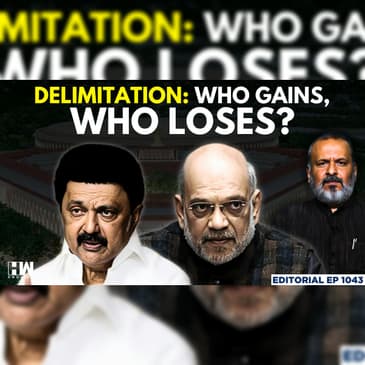

In this episode of Editorial, Mr. Sujit Nair discusses the political row over delimitation. Tamil Nadu Chief Minister MK Stalin has criticized the BJP-led central government over the issue. CM Stalin is concerned that delimitation could reduce Tamil Nadu’s parliamentary representation due to its lower population growth compared to northern states. He and other South Indian leaders fear this could weaken South India's influence in national politics.
Learn more about your ad choices. Visit megaphone.fm/adchoices
[00:00:00] Namaskar! Welcome to another episode of editorial. Today's editorial is very interesting. Today's editorial I am sure will be informative. And today's editorial we will look at the entire process of delimitation from a South India perspective. Now the question that I ask tonight is why is South India so upset about delimitation? Why is South India calling it foul?
[00:00:30] Especially Tamil Nadu, Chief Minister MK Stalin. Why is he saying it's unfair to us? Let's discuss this. Let's get right into the show. Now before I begin, I have done an entire explanation on delimitation, processes, how, when, what other countries do, all of that.
[00:00:55] I have done an elaborate editorial. I am going to put that link up in the description. Please do watch it. Please do watch it with this particular editorial so that you get an in-depth understanding of what delimitation is. So that's one. Now for this editorial sake, I am going to just run you through what delimitation is and what are the problems. And then we will get into the real crux.
[00:01:25] So that's the topic at hand, which is basically why is South India peeved or why is South India not too happy with delimitation. So that's the story today.
[00:01:38] For starters, delimitation is very simple. Delimitation is a constitutional mandate. Why do we have delimitation? Because delimitation as the people grow, you need to have representation, more representation. So delimitation basically says that after every census, you need to understand the growth of the population. And based on that growth, you need to recalibrate the representation in the parliament. So that is delimitation.
[00:02:07] So population grows, representation grows. Now delimitation has happened four times. Four times. One in 1952 based on 1951 census, 1963 based on 1961 census, 1973 based on 1971 census, 2002 based on 2001 census.
[00:02:29] Now 2002 delimitation had some internal gigs, but the total number of seats remained the same because Mrs. Indira Gandhi during the emergency in 1974 had said that now we will not have delimitation till 2000. Now Atal B.R. Iwajpai, when he took over, he pushed this delimitation date to 2026.
[00:02:53] He says it will be based on 2011 census, which means that 2029 parliament assembly as in parliament elections, we will see the new calibrated parliament. The number of seats will be distributed or calibrated there. So delimitation we will see in the 2029 election. This is as far as delimitation is concerned. Now let us get into the actual crux of the problem.
[00:03:24] We said delimitation is going to be based on the population. North population is growing faster. South population is not growing as much as what north is. So what could happen? So what could happen? Stalin says that if delimitation is going to be on population census, it will deprive and reduce the representation of South Indian states.
[00:03:52] There is a fear in the minds of people of Tamil Nadu that our voices will be undermined, which is what I told you. North population, but the population of North is growing and our population is not growing in that same speed. Our fertility is not, rate is not as high as North fertility rate. So we will suffer. We will, our voices will be undermined. We will not be heard in the parliament, in the temple of democracy of India. So then what happens?
[00:04:20] We will be deprived of our rights. Correct. Correct. This is what Stalin and a lot of leaders, by the way, from South fields and a lot of people also from South fields that. Now to answer this question, Mr. Amit Shah said that, listen, you know what?
[00:04:42] We will not, that is South Indian states, we will ensure, he said, we will ensure that South Indian states would not lose even a single seat. Amit Shah said, this is my word. South India will not lose a single seat. But yet, Stalin is not happy. Why? Let me try and explain to you why.
[00:05:09] And that's why I said, we will look at the entire process from a South India perspective. Now, I spoke to you about four delimitations. 1952, 1963, 1973, 2002. I also told you 1973 actually. The number of seats, total number of seats has not increased from 545. It remains 545. Even today, it is 545, which we have discussed. So that part of it is taken care of. Now, let us get into 1952 polls.
[00:05:38] That is after the first delimitation. Wherein, Kurg had won, Hyderabad had 25, Madras had 75, Mysore had 11, Travancore had 12. And there was 489 total parliament seats. And South India had 124. Now, the percentage of seats that South had in the parliament was close to 25.35%. 25.35%.
[00:06:05] Now, let us go to 1967 polls, which was based on 1963 delimitation. 1967 polls, India had 522 seats. So, from 489 seats, it increased to 522 seats. Now, in 522 seats, South of India had 126 seats.
[00:06:34] So, technically, technically speaking, from 1952 of 124, South India got two more seats. That is 126. Like, Amishya said that he may not necessarily reduce the South India seats. But the problem here was in 1952, South had a representation of 25.35%.
[00:06:59] Whereas, in 1967, South representation in the parliament of India reduced to 24.13. Almost 1% reduction. So, number of seats grew. But percentage, voice share reduced by 1%. So, let us go to 1977. 1977, like I said, the seats increased.
[00:07:24] That is, the parliament seats increased from 522 to 545. Two seats were reserved seats. So, 543 but 545 total. And South India increased from 126 to 130. 126 to 130. But, the percentage went down further to 23.85%.
[00:07:51] From 24.13%, it further went down to 23.85%. Number of seats grew. 26 to 130. But, the percentage went down. Same is the case with 2004 polls. 130, 545, percentage 23.85%. 2024 polls, same.
[00:08:18] 545, 130 seats for South and therefore percentage 23.85%. Like I told you, after 1977, there has been no changes. Since 1977, we were 545. From 1977 till 2024, we are 545 in the parliament. Now, the worry that South India has is like Mr. Amishya said, he may not reduce the number.
[00:08:47] For all you know, a few numbers may increase. By whatever methodology, whatever tools, however you calculate it may be. Chances are, if you go purely by fertility, I don't think that is going to happen. But, if you use some other methodology, you use some other techniques. Lot of countries use lot of techniques. Like I told you, my editorial, please do see it. I have taken you through a lot of other countries and the methods they use. So, a lot of countries use methods.
[00:09:14] So, there is a chance that we could increase the number of South India seats. From 130 to whatever. There is a chance. There is definitely a chance that 130 may not come down either. Like what Mr. Amishya promised. But, the chances are that the percentage of South Indian representation in the parliament of India could come down.
[00:09:39] Which means that the voice share of South India in the Indian parliament will come down. Which means that yes, yes, South India will be deprived of their right of putting up their demands, their needs, their representation in the temple of democracy. That's the parliament. So, this is where Stalin is coming from.
[00:10:06] So, this is why I think there is a valid point that he is saying. And, Amishya didn't say anything wrong when he said that I will assure you that not even one particular seat will come down. But, that assurance may not necessarily translate into the fact that therefore your voice share in the parliament would come down. It may not translate. That's the crux of the problem. Now, there is a political angle to it.
[00:10:35] Let us come to the political angle. You see, it is the South Indian states where the Bharatiya Janata party has not been able to make a mark. And still, by the looks of it, with all that is happening in Tamil Nadu, with all that is happening in Kerala, with all that is happening in Andhra Pradesh, in Telingara, etc.
[00:11:02] Even now, Bharatiya Janata party is not looking very, very confident or very, or at least in a commanding position in any of these states. So, somewhere around the line, it will be, and Karnataka, of course. I forget to mention Karnataka. Even Karnataka, though Bharatiya Janata party has been coming in and coming out. They have made their government once, twice.
[00:11:30] But, the point is, even in Karnataka, now it is Congress government. So, most of the South Indian states, Bharatiya Janata party has still not got the grip. So, there are two options in front of Bharatiya Janata party. Option number one is, work harder on South Indian states and get into the South Indian states, try to win seats in South of India.
[00:11:56] Or, in a way, the way Stalin feels, make South India irrelevant as far as national politics is concerned. If South of India is made irrelevant, if their number of seats or their voice share in the center is not relevant enough to determine who is going to be the Prime Minister of this country, then, two, it is advantage Bharatiya Janata party.
[00:12:24] Because, states that are really going to benefit out of delimitations like Uttar Pradesh, Bihar and all of that, are dominated by Bharatiya Janata party. So, with or without South states, Bharatiya Janata party or the government then, even Bharatiya Janata party or whoever, the government can be decided with or without South Indian states. Chances are, it can be decided with or without South Indian states.
[00:12:52] Because, as the percentage of South Indian MPs goes down, this is the probability of South India, determining who is the next Prime Minister of India, also decreases. This is the story that Stalin is trying to put up. And, this is the core reason why it is imperative.
[00:13:17] It is imperative that there has to be a methodology, there has to be a methodology, which ensures that somewhere down the line, South is given the confidence that they too are part of the larger picture. They too have a say in the central leadership. That's the last point I wanted to make.
[00:13:39] Before I end, before I end, you see, I am worried about the census itself. You see, census, delimitation, these are processes to make our democracy robust. So, that representation is correct. Like I told you, people are represented, sects are represented, genders are represented,
[00:14:09] cars are represented, religion is represented. That's why you have census. That's why you have delimitation. Now, if you see, census was conducted in 1961 and the polls happened in 1952. The census was conducted in 1961, polls were conducted in 1967. Census were conducted in 1971, polls were conducted in 1977. Census was conducted in 2001, polls were conducted in 2004.
[00:14:39] Now, that census and this poll may not have had much of difference based on the census because the numbers remained the same at 545. That being said, there is a process that takes place between the census and the polls. Now, let us look at our situation currently. The last census conducted was in 2011, post which a census was supposed to be conducted in 2021. Didn't happen. Didn't happen.
[00:15:07] The reason was COVID, which is fair. But then, 2022 it didn't happen. But then, 2023 it didn't happen. 2024 it didn't happen. And now, 2025. 2025. The reason I doubt whether this census will happen in 2025 is because according to Nirmala Sitaraman's budget, there is no money allocated. No decent money allocated for a full-fledged census in India.
[00:15:35] So, I want to believe based on the budget that the census may not happen in 2025. Which means possibly the census will happen in 2026 for a 2029 elections. Now, if the census starts in 2026, will we be able to do a proper counting of 140 crore people, caste, creed, gender, etc.
[00:16:03] Will we be able to do that physically? So, I am kind of not very sure whether the work that we can do between 2026 to 2029 and 2029, mind you, being a general election year, whether we will be able to do our job fair and square. Whether we will be able to do a job that is absolutely, unambiguously, absolutely authentic. I don't know whether we will be able to do that job. That's my first worry.
[00:16:33] Mind you, the census becomes important for two reasons. The census becomes important because A, you are talking about delimitation. B, you have already passed the women's reservation bill. The women's reservation bill will be implemented in 2029. How are you going to decide the reservation of 33% seats in India? On what basis? On what data?
[00:17:00] So, will all of this, that is, the delimitation process and the women's reservation bill, will all of this become part of a political strategy which possibly helps one party or the other? Is that how it could turn out to be? Which is what is worrying? And which is something that you need to actually think about?
[00:17:24] So, this is why possibly the South is nervous about the delimitation and you decide whether is that worry reasonable or not. Till I see you next time. That's tomorrow at 10. Namaskar.