
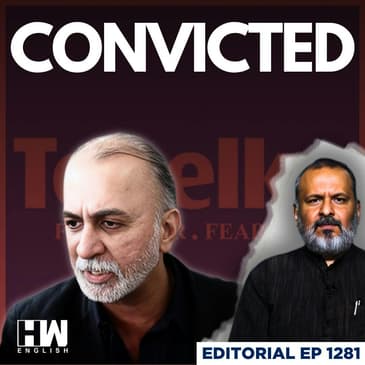

In this episode of Editorial, HW News Managing Editor Sujit Nair speaks on Tehelka founder Tarun Tejpal's conviction by Bombay HC for rape and sexual harassment. Mr. Nair takes you through the Bombay HC's judgment and makes a suggestion of how the government could - legally - help victims of sexual harassment
Learn more about your ad choices. Visit megaphone.fm/adchoices
[00:00:00] Tarun Tejpal Getting away by saying that I am politically victimized and all is absolutely ridiculous. He has committed this crime. There is no doubt about it, at least in the minds of the High Court. Isn't it important for our country to save our girl children? Especially like I said when it comes to influential people. Because influential people have money, wherewithals.
[00:00:27] They can get away like Tarun Tejpal almost got away. Namaskar, welcome to another episode of Editorial. The former Editor-in-Chief of Tehelka, Tarun Tejpal, has been convicted of rape and sexual assault by Bombay High Court.
[00:00:54] He has been sentenced to 10 years of rigorous imprisonment. Rigorous imprisonment. Now, there are a couple of questions that I would like to raise on this particular entire episode, but let us go systematically.
[00:01:14] I am going to read a lot today because you know these are court judgments and so on and so forth. So I don't want to be wrong. So I am going to read a lot today in front of you and will present this in three perspectives. The first perspective is that of Tarun Tejpal.
[00:01:30] Tarun Tejpal, the moment he was convicted, the moment he was sentenced, he said that you see I am 62 years old. I am father of two daughters. I have a wife and I am a political victim. My lawyer has also asked me to urge the court to show leniency. This is what Tarun Tejpal said.
[00:01:51] Tarun Tejpal, the moment he realized or he remembered that he was a father of two daughters. He realized that he has a wife and he says, listen, you know what? This is I am victimized. I am victimized. In fact, he went on to compare himself with Sharjil Imam and Umar Khalid and all of that. Now, how much of this what he said is justified? Let us discuss that during our conclusion. But this is what he said.
[00:02:20] Now, let us go back to 2014. I mean, let's go through the way the session court saw this entire proceeding, saw this entire trial. The session court made a statement. The session court observed that while the prosecutrix claimed to be in shock and trauma after exiting the lift on 7th November 2013,
[00:02:43] the footage showed her composer to be normal. The court noted that she has been smiling and requested the accused to join her for a photograph on the final day of the festival, which is viewed as a conduct inconsistent with that of a victim of a recent sexual assault. So the court here I thought had
[00:03:06] something in mind as to this is how a sexual assault victim should be acting. And the court, the session court felt that nay nay baba, this victim did act the way typically the stereotyped image of a sexual victim had to be. She was kind of okay. She was her composer was fine. She invited the Tejpal to for a group photography and all of that. But the question then is, is there something called a typical way
[00:03:36] that a sexual assault survivor has to behave? Is there a typical stereotypical way? That is a question that not just me, but even the high court asked the session's court. In fact, the session courts went on to say that drawing on the katena of Supreme Court precedence, the court ruled that while a conviction of
[00:03:59] rape can be based on a solitary testimony of a victim, that testimony must be unassailable, consistent from the initial statement of the trial and free from material prevarication. According to Justice Joshi, the prosecutor's testimony was not of sterling quality. So the judge, Justice Joshi felt that nay is not
[00:04:21] sterling quality because she felt that the way the survivor behaved was not typical to the way a typical or whatever a stereotypical rape survivor should behave. This is a very important point. Now, let's go to the high court and what the high court said. The high court saw it very differently.
[00:04:45] The high court also found misapplication of core legal principles by the session court. On the outset, the court wrapped the session court centering its analysis on the prosecutrix moral character, personal life and post incident conduct rather than the evidence against the accused. The court said exactly what we just said. The court said, what the how the are you basing the entire crime
[00:05:12] has happened or not? Or is a person guilty or not based on how the survivor behaved after the crime took place? Is that how it is even done? This is what the high court said. The high court went on to say that what struck most was the court's noticeable silence during the PW1 cross examination by the defense. We find it surprising
[00:05:36] that the court allowed the defense to use the time to harass and humiliate her. It appears that the court overlooked that the victim having already faced trauma might feel too ashamed, nervous or confused to respond clearly when questions repeatedly in an unfamiliar environment. You see, the court and so rightfully so, the court said, listen, you know what, this is a survivor. And what the session court allowed is the
[00:06:03] survivor to be asked more questions, humiliated more, interrogated more, almost humiliating the survivor. And obviously, it is not necessary that, you know, that survivor behaves in a typical format. In such an environment, the survivor may break. A lot of actions of her may look very different. But is that the reason to give a judgment to equate a person who has almost confessed to the fact that he
[00:06:33] has done what he has? I'll take you further. We bear in mind, the court said that a sexual assault must be proven beyond reasonable doubt in any case. And there is no presumption that the victim will always tell the truth. However, the standard of proof expected in such case must take into account that such crimes are generally committed on the sly and the direct evidence from a person other than the
[00:07:00] victim is rarely available. This is what the court said, the court actually went on to say that the appreciation of evidence by the trial court is not only unreasonable, but perverse. So very clearly, the high court was very, very clear about this. Okay, listen, the trial court flawed. The trial court flawed. You were looking more at the survivor rather than looking at the perpetrator. You were looking at how
[00:07:28] the survivor behaved rather than looking at what the perpetrator did. And one more thing, let me tell you, one more thing, let me tell you before I come to our conclusion of this particular case. And also, we need to be very mindful of the fact that on November 18th, a detailed email narrating the event was sent by the survivor to the managing director of the Helga, Shomach Chaudhary, demanding an inquiry and an apology.
[00:07:56] Following this, Tejpal, the perpetrator Tarun Tejpal wrote to the victim, hear this very carefully, Tarun Tejpal wrote to the victim that I apologize unconditionally for the shameful lapse of judgment that led me to attempt a sexual liaison with you on two occasions, November 7th and November 8th, 2013. Despite your clear reluctance that you did not want such attention from me. This is a almost a
[00:08:26] confession mail that he sent to the survivor saying that he has done it. So look at it. The session court viewed and acquitted him because the session court thought that the survivor didn't behave the way they typically envisaged or the way they typically expected a survivor to behave. And this and the session court didn't even look at this mail, take this mail into
[00:08:52] consideration where this the the perpetrator is saying that listen, you know what I did it. I'm sorry, I apologize. And the High Court was scathing, absolutely scathing. Now the last point. You see, Tarun Tejpal getting away by saying that I am politically victimized and all is is is absolutely ridiculous is absolutely ridiculous. He has committed this crime. There is no doubt about it, at least in the
[00:09:21] minds of the High Court. He has committed this crime. He is convicted by the High Court, which means he has committed this crime. And this crime is not that any political party asked him to go and commit. Or it is not that his CCTV footage which they claim they have has been doctored or it is not that his mail has been doctored. Nothing of that sort has happened, which means he has committed the crime. So now putting everything into a political party and calling it a political victimization and all I think these are
[00:09:50] excuses and these excuses won't stick to him. Comparing himself with Omar Khalid and all is absolutely, absolutely unjustified. He has to face his demands. He has to face the court and the courts will finally decide. He has gone to Supreme Court. The court will decide what his fate is. But then to say that it is political victimization and all I think it's absolutely, absolutely unjustified. Now that's point one.
[00:10:15] My second point. The way Solicitor General Tushar Mehta argued this case in front of the High Court was striking. It was commendable the way the government deployed its best resource for this particular case to ensure that this acquittal is challenged, to ensure that the guilty is punished. I thought it was
[00:10:38] commendable. But then my question is, shouldn't this procedure be standardized? Especially when sexual assaults, rapes involves big people, politicians, influential people, businessmen, stars, movie stars, journalists. Shouldn't the government take the same stance when it comes to the wrestlers?
[00:11:02] Shouldn't that be the stance for the government there also? Like I said, isn't it important for our country to save our girl children? Especially like I said, when it comes to influential people. Because influential people have money, wherewithals. They can get away like Tarun Tejpal almost got away.
[00:11:26] So why this discrimination? And why can't we standardize this? Why can't the government stand with every rape survivor in whatever form? I'm not saying therefore send Attorney General's to for for every rape survivor. That is not possible. I understand that. I would wish it happens. But I know it is not practically possible. But at least like I said, influential cases, cases which involves
[00:11:52] influential perpetrators? Would that be too much to ask? And shouldn't the government be committed to that? That's the point I will end my editorial with. Think about it. Write down your comments in the comments box below. And till I meet you next time. That's tomorrow at 10. Namaskar.