
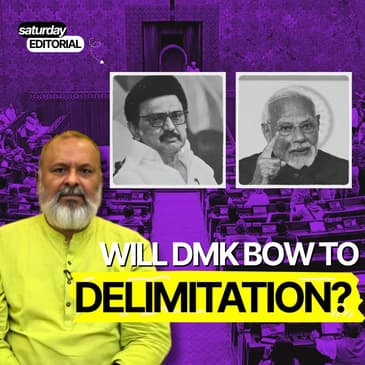

Tamil Nadu vs Delimitation: Will DMK Fight or Support the Bill?
Learn more about your ad choices. Visit megaphone.fm/adchoices
[00:00:00] Namaskar The million dollar question today is Will DMK Support the Delimitation Bill? The DMK has consistently maintained that it is not opposed to increasing the Lok Sabha seats. Its objection is to delimitation exercise based on latest population figures. You see, the concern is very straightforward.
[00:00:26] Tamil Nadu implemented population control policies with discipline over several decades. If parliamentary seats are redistributed primarily on the basis of current population, states with faster population growth would gain a larger share of seats, while Tamil Nadu's relative representation in parliament would decline. Many in the state see this as being penalized for successfully implementing a national policy.
[00:00:54] And this is not just a Tamil Nadu concern. Across the south, there is a broader regional anxiety about how delimitation could alter the balance of political power. Andhra Pradesh, Telangana and Kerala have also expressed concern about protecting the political weight of the states that have successfully controlled population growth.
[00:01:17] The DMK is therefore tapping into a much wider southern sentiment rather than fighting their battles alone. For Tamil Nadu, this is about far more than numbers. A smaller relative share in parliament means weaker voice in national decision making and potentially less influence over issues that directly affect the state's interest.
[00:01:43] The DMK has indicated that it could consider supporting a revised arrangement only if meaningful safeguards are incorporated. I repeat, only if meaningful safeguards are incorporated. This includes retaining the existing population freeze based on the 1971 census. I have spoken about this in my previous editorial.
[00:02:08] So please do have a look at my previous editorial where I have mentioned in detail about the freeze based on the 1971 census. Number one. Number two. Increasing seats without altering the relative shares of states or providing a statutory guarantee that Tamil Nadu's parliamentary weight will not diminish. These demands are consistent with the position Tamil Nadu has articulated earlier on.
[00:02:35] There is an important constitutional dimension to this debate. The government has introduced a constitutional amendment bill alongside the delimitation bill. A constitutional amendment bill requires a special majority in parliament including two thirds of the members present and voting. I repeat, two thirds of the members present and voting.
[00:03:05] With ratification by at least half the state where the constitution requires such ratification. That makes every vote and every parliamentary strategy significant. This is why the DMK's position matters. If the party supports the bill in its current form or even stages a walkout that effectively allows the government to secure the required number,
[00:03:33] many voters in Tamil Nadu may see a little difference between voting for the bill and enabling it. Enabling it? How? Enabling it by walking out. That could carry a political cost. It could also blur the distinction between DMK and AIDMK. If both parties are ultimately seen as facilitating the legislation.
[00:03:59] At the same time, Vijay's TVK and the Congress would have an opportunity to position themselves as the uncompromising defenders of Tamil Nadu interest. I just have one thing to say.
[00:04:14] And I think it is a very important thing for the future of the Tamil people, the Tamil language and the state of Tamil Nadu. There is an attempt by the BJP to do delimitation.
[00:04:40] Delimitation is designed to disenfranchise, to take away power from the people of Tamil Nadu. This is a BJP conspiracy. There was a historical character in Tamil Nadu called Attapan.
[00:05:04] Attapan is basically symbolic of the betrayal of the people of Tamil Nadu. Anybody who supports delimitation is betraying Tamil Nadu, is betraying the future of Tamil Nadu, is allowing the RSS and BJP to attack the people of Tamil Nadu and the future of Tamil Nadu and is a Attapan.
[00:05:32] Attapan is a 21st century Attapan. No Tamil person should support delimitation. Every single Tamil person should oppose delimitation. Every single Tamil national party should defeat delimitation in the house. So the real question is not simply whether DMK supports delimitation.
[00:05:57] The real question is whether DMK can secure constitutional and political safeguards for Tamil Nadu before it does. Because for the DMK, this is no longer just a constitutional debate. It's a political test. Can it protect Tamil Nadu's interest while engaging with national politics? Now there is a very interesting factor. The interesting factor is there is a connection between the FCRA Bill and the delimitation Bill. And I'll try and explain to you how.
[00:06:26] You see the connection is that FCRA Bill, if it is tabled and if it is passed. Because FCRA Bill is not constitutional amendment bill. So it can be passed with 50% votes. And BJP has 50% approval in the parliament. The point is if FCRA Bill is put up and passed, then that may hurt DMK and few other members. DMK will not be happy about it. So therefore somewhere down the line, FCRA to my mind is withheld by BJP.
[00:06:56] It's because they don't want to kind of hasten FCRA Bill, put it up and then kind of cheese off a DMK. So that is the connection between these two bills.