
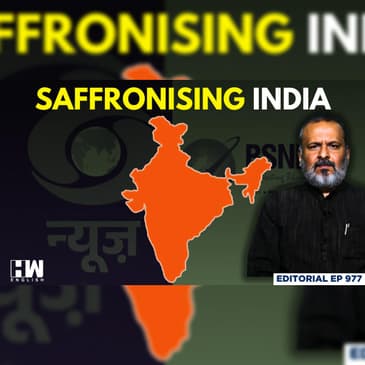
In this episode of The Editorial, Mr. Sujit Nair discusses the saffronisation of our country. He delves into color psychology and explains how colors impact our minds. Mr. Nair also examines how the BJP is using saffron to influence public perception and how their government is incorporating saffron into public assets. This saffronisation, he argues, is helping the BJP align the public mind with their brand.
Learn more about your ad choices. Visit megaphone.fm/adchoices
[00:00:00] Namaskar and welcome to another episode of editorial. Now BSNL logo color has been changed to saffron and green. A few months ago, Doordarshan color was changed from red to saffron. A few months ago, Vande Bharat train color was changed with a lot of saffron.
[00:00:32] So we have a lot of saffron around. Indian cricket team now has saffron in their men in blue uniform. Let's talk about saffron, let's talk about why saffron and let's talk about why not saffron. Let's get right into the show.
[00:00:55] You know, this is a good topic. I like this topic because this deals more with advertising and communication. So my favorite topic. So let me give you some gyan.
[00:01:12] You see, there is something called as color psychology. You know what is color psychology? Color psychology research says that color impacts the way you see the world. Color impacts the way you see the world.
[00:01:30] Color impacts the way you see the world.
[00:01:30] So if I want to make an impact on you in a certain form, if I know the color that I can use to make that impact, then the chances are your mind will be impacted by the way I want you to be impacted.
[00:01:45] I have a lot of impact. I'll tell you what I mean by that.
[00:01:49] You see, the moment you go into a room which has got a lot of multicolor, multicolor things around you, the chances are you will automatically feel happy.
[00:02:04] This is normal. This is normal. You automatically feel happy because that color has impacted you.
[00:02:11] You go to a room which is completely white. It's completely white. You will feel a lot of serenity. You will feel very, very clean inside. You feel very spiritual inside. The entire place is white.
[00:02:26] That's the way it is. Black has its own impact. Red has its own impact. So on and so forth.
[00:02:32] Now, whenever there is an impact on your mind, a brand or a brand strategist will always use it.
[00:02:41] Whatever impacts your mind is what a brand strategist uses. Correct? So that we can convert your mind.
[00:02:48] So, if you see Coke. Coke use red everywhere they can. Wherever they can, they emphasize the color red.
[00:03:04] Red and white is normally the combination but red is the color of Coke.
[00:03:09] So, wherever there is a presence of Coke or wherever Coke wants their presence to be felt, that place will be red. Be rest assured.
[00:03:21] Wherever Starbucks wants their presence to be felt, you will find a lot of green and white.
[00:03:30] A lot of green and white.
[00:03:31] So, what really happens is you create, like I told you, certain impact on your consumer's mind with your brand color.
[00:03:40] Now,
[00:03:42] This is the impact.
[00:03:44] Now, what happens when you use your brand color for years together, decades together, possibly some brands have been using it for centuries?
[00:03:53] What happens when you start owning that color?
[00:03:55] So, when you see red, no?
[00:03:58] When you see red, a lot of people who are exposed to Coke will think of Coke first.
[00:04:05] Which is what we call as T-O-M, top of mind.
[00:04:09] Patak say it, the first brand that comes to your mind is Coke.
[00:04:14] Here you are.
[00:04:15] Why?
[00:04:15] Color Dika red.
[00:04:17] It's like a trigger point.
[00:04:19] It's like a social behavioral trigger point.
[00:04:26] Red means Coca-Cola.
[00:04:29] So, that's how it is.
[00:04:33] Now, you know, have you ever thought why countries need flag?
[00:04:41] And why are they colors for country's flag?
[00:04:45] So, for an Indian, you personally may like blue as your favorite color.
[00:04:50] I may like black as my favorite color.
[00:04:52] Somebody else may like red as their favorite color.
[00:04:55] But end of the day, as a country and as countrymen, when we see saffron, white and green,
[00:05:03] there's a certain amount of emotions that gets triggered in us.
[00:05:07] That gets triggered in us.
[00:05:09] This is what I call the color psychology.
[00:05:12] So, that color, that tricolor triggers an impact on our mind.
[00:05:19] Okay?
[00:05:20] So, now I have spoken to you about color, impact, etc., etc., etc.
[00:05:25] Now, let us come to the saffronization.
[00:05:31] You see, Bharatiya Janata Party has been speaking about Hindutva.
[00:05:37] The Rath Yatra, you know about L.K. Advani and then you know about Mr. Narendra Modi,
[00:05:43] who took it to a next level.
[00:05:45] And from then on, India has been very openly and very emphatically Hindutva.
[00:05:57] So, Hindutva somehow in Bharatiya Janata Party's mind is represented by saffron.
[00:06:05] Now, Hindutva, if you ask a lot of Hindu pundits, they may not agree to it.
[00:06:09] A lot of Hindu pundits will say that Hindutva is represented by red.
[00:06:13] A lot of Hindu pundits will say that Hindutva is represented by white.
[00:06:16] Well, that is another story.
[00:06:19] But the fact remains that according to a lot of Bharatiya Janata Party and their affiliates
[00:06:25] and sang and all of that, Hindutva equals saffron.
[00:06:29] So, whenever they want to talk about Hindutva and battinge to cutting and all that,
[00:06:35] when they have, you will find a lot of saffron, saffron, saffron, saffron, saffron,
[00:06:38] which means what?
[00:06:40] They are linking Hindutva to saffron.
[00:06:42] Very clear?
[00:06:43] Now, I may not have to give you more explanation to say that at least in the recent past,
[00:06:53] the color saffron has been clearly, clearly, clearly associated with Hindutva.
[00:06:58] This is right.
[00:07:01] So, let's keep that fact number one.
[00:07:04] Number two is, therefore, saffron is a color that Bharatiya Janata Party has associated with itself also.
[00:07:13] So, mind you, if you see the Bharatiya Janata Party flag, no?
[00:07:18] If you see the Bharatiya Janata Party flag, there is green also in Bharatiya Janata Party flag.
[00:07:22] But have you ever seen the color green in their rally?
[00:07:26] You have never seen the color green in their rally because their rally is saffron.
[00:07:30] If it is a saffron, if it is a saffron rally, you can conclude it is a Bharatiya Janata Party rally.
[00:07:36] That is nationally.
[00:07:37] Of course, you have parties like Shiva Sanna in Maharashtra that uses the same color.
[00:07:43] But nationally, you can conclude that if the rally is saffron, that means it's a Bharatiya Janata Party rally.
[00:07:49] So, in some form, the green has not been given prominence in Bharatiya Janata Party.
[00:07:55] The saffron has.
[00:07:56] This, are we in agreement to this?
[00:08:01] So, what I have concluded till now, and if you agree to me, please write down, is a Hinduism is associated with saffron.
[00:08:10] At least, that is what Bharatiya Janata Party feels.
[00:08:12] Hinduism equals saffron.
[00:08:14] And saffron equals Bharatiya Janata Party.
[00:08:17] Itana established ho gaya?
[00:08:19] Itana established ho gaya?
[00:08:20] Okay.
[00:08:21] Now, let me go to my third part of the presentation.
[00:08:25] My third part of the presentation is now, if I am having a brand that gives me direct top of mind recall,
[00:08:34] then I will use that color at every point where I can trigger your top of mind.
[00:08:41] So, the next time you see a train, you will see a saffron train.
[00:08:44] The next time you see a bench in that railway station, you will see a saffron railway,
[00:08:48] your saffron bench.
[00:08:49] Next time you see BSNL, when you are going to make a phone call or whatever, when you see BSNL,
[00:08:54] oh, you will see saffron.
[00:08:55] Next time when you watch Doordarshan, you will see saffron.
[00:08:57] Next time you watch, maybe you go to a restaurant, you will see saffron.
[00:09:00] When you eat a burger, you will see saffron.
[00:09:03] When you go and pay your taxes, you will feel saffron.
[00:09:08] When you go to a hospital, you will see saffron.
[00:09:10] And then what happens?
[00:09:13] Then what happens?
[00:09:16] Saffron becomes a part of your life.
[00:09:21] Saffron becomes a part of your life and saffron becomes a part of your character.
[00:09:28] And when saffron becomes a part of your character, automatically brand Bharatiya Janata Party,
[00:09:37] which is directly associated with saffron, becomes a part of your life, becomes a part
[00:09:42] of your character.
[00:09:44] Ah, now you will ask me, how can you jump to this logic?
[00:09:49] I will try and tell you what I mean by that.
[00:09:52] You know, this is not the first time.
[00:09:53] Bharatiya Janata Party is copying another party.
[00:09:55] Actually, let me tell you that.
[00:09:57] It is not Bharatiya Janata Party's original idea.
[00:10:00] Original idea is another idea.
[00:10:02] Do you know, there is a party called Communist Party?
[00:10:06] See, Communist Party, everything they do is lal.
[00:10:11] So when they greet each other, they say lal salam.
[00:10:14] When there is a death, when there is a whatever, whatever, whatever, whatever, whatever,
[00:10:18] they will use the word red.
[00:10:21] Red.
[00:10:21] When it is a Communist Party rally, you will see only red.
[00:10:27] Red, red, red, red, red, and red.
[00:10:32] Everything about them is red, including their uniform, which is red, shirt or whatever they
[00:10:37] wear.
[00:10:38] The, the, you know, the garlanding they do, the garlanding they do, that too is red.
[00:10:43] Red.
[00:10:43] So, Communist Party of India or India or wherever, Communist Party globally actually, has been
[00:10:48] using this color red and color red emphatically, emphatically.
[00:10:54] So you think of red, especially in states where Communist still exists in whatever form,
[00:11:00] Kerala included.
[00:11:02] You see red, you know it's a communist area.
[00:11:05] You see red flag, you know it's a communist area.
[00:11:07] You see, you see red walls, you know it's a communist area.
[00:11:10] You see red benches, you know it's a communist area.
[00:11:13] You see red buildings, you know it's a communist area.
[00:11:15] Red, you can assume, you're a communist area.
[00:11:17] Top of mind recall, communist.
[00:11:21] So it is, BJP is not the first party to do it.
[00:11:25] But what BJP is doing it, it is in a larger scale.
[00:11:30] In a larger scale.
[00:11:31] So, technically speaking, this concept of social engineering and all, that people talk,
[00:11:37] no, that it is not very complicated.
[00:11:39] This is part of social engineering.
[00:11:43] This is part of social engineering.
[00:11:46] You associate with orange.
[00:11:49] You associate with Hinduism.
[00:11:52] Therefore, you associate with BJP.
[00:11:54] Straight equation.
[00:11:56] I associate with Tiranga.
[00:11:58] I associate with my country.
[00:12:01] And therefore, I am a patriotic Indian.
[00:12:05] Straight association.
[00:12:08] Correct?
[00:12:09] So, this is the similarities.
[00:12:11] Okay.
[00:12:12] Chalo.
[00:12:13] Now, last part of my editorial.
[00:12:16] A lot of you may ask,
[00:12:19] What is your problem?
[00:12:22] There is a problem.
[00:12:24] There is a problem.
[00:12:26] You know, the problem is,
[00:12:27] I hear a lot from,
[00:12:30] especially people of,
[00:12:31] people from Bharatiya Janata Party,
[00:12:33] like that R.N. Dravi who said,
[00:12:35] Arre, Tamil Nadu is being isolated.
[00:12:37] Or they are trying to isolate Tamil Nadu.
[00:12:39] Oh, Tamil Nadu is trying to be different.
[00:12:41] You see,
[00:12:42] or Tamil Nadu,
[00:12:43] by, you know,
[00:12:44] by calling themselves Dravidians and whatever,
[00:12:45] they are trying to be different,
[00:12:47] and so on and so forth.
[00:12:49] You see,
[00:12:50] the point is,
[00:12:51] if you are going to,
[00:12:54] do this exclusive strategy,
[00:12:57] instead of doing inclusive strategy in India,
[00:13:01] what you are actually going to do,
[00:13:03] is you are going to push sections of people away from you,
[00:13:09] by creating groups,
[00:13:11] by making national properties,
[00:13:14] national corporations,
[00:13:16] national assets,
[00:13:19] into groups,
[00:13:20] into saffron,
[00:13:22] by saffronizing national assets,
[00:13:24] what you are doing,
[00:13:25] is you are killing the concept of inclusivity.
[00:13:30] A group of people,
[00:13:32] a certain community,
[00:13:33] is going to feel excluded,
[00:13:35] saying that,
[00:13:39] and the moment,
[00:13:44] as a state,
[00:13:45] as a country,
[00:13:46] we create this concept that,
[00:13:49] what are you doing?
[00:13:55] what are you doing?
[00:13:58] It is not the others.
[00:14:00] It is possibly,
[00:14:03] the administration themselves,
[00:14:05] who are dividing people,
[00:14:06] who are dividing,
[00:14:08] the country.
[00:14:11] it is division of minds,
[00:14:14] it is division of camaraderie,
[00:14:15] it is division of,
[00:14:17] our,
[00:14:19] concept,
[00:14:20] of being,
[00:14:22] the,
[00:14:24] in our diversity.
[00:14:25] It is dividing that share concept.
[00:14:27] And that,
[00:14:28] is why,
[00:14:29] I object to saffronizing.
[00:14:32] While as an advertising person,
[00:14:33] I would say,
[00:14:34] okay fine,
[00:14:34] you are selling your brand,
[00:14:36] you are creating top of mind recall,
[00:14:37] all that is lovely.
[00:14:40] You know,
[00:14:40] but as an advertising man,
[00:14:42] I am also trying to tell you,
[00:14:43] this is the danger,
[00:14:44] that you are creating.
[00:14:46] You are dividing.
[00:14:48] It is not fair.
[00:14:50] It is not good.
[00:14:53] Your political party may benefit,
[00:14:55] but India will not benefit.
[00:14:56] India will lose.
[00:15:00] This concept of nationalism,
[00:15:02] no,
[00:15:02] this concept of nationalism,
[00:15:04] is very,
[00:15:05] very,
[00:15:06] exclusive.
[00:15:08] This concept of nationalism,
[00:15:10] is not inclusive.
[00:15:11] This concept of nationalism,
[00:15:12] is exclusive,
[00:15:13] is because,
[00:15:13] it is only for people,
[00:15:15] who believe in certain ideology,
[00:15:16] and who believe in certain political party.
[00:15:19] It is not good for Indians.
[00:15:23] And that's,
[00:15:24] the point,
[00:15:25] I wanted to make.
[00:15:27] And before I end,
[00:15:28] for those who may ask,
[00:15:31] and put in their comments,
[00:15:32] and please do write comments,
[00:15:33] and please do like the video,
[00:15:35] so that lot of,
[00:15:36] lot more people can see this.
[00:15:38] You see,
[00:15:38] a lot of people who may ask,
[00:15:40] in the Indian flag,
[00:15:41] no?
[00:15:41] So why can't we use saffron?
[00:15:44] Very logical question.
[00:15:45] That too,
[00:15:46] let me answer,
[00:15:46] before I bid you,
[00:15:47] good night today.
[00:15:49] You see,
[00:15:50] saffron is part of our Indian flag,
[00:15:52] but then,
[00:15:53] so is green.
[00:15:55] How many green brands,
[00:15:57] green corporations,
[00:16:00] green trains,
[00:16:01] do we have?
[00:16:04] Ask yourself,
[00:16:06] and possibly,
[00:16:06] you'll get,
[00:16:08] what I'm trying to tell you.
[00:16:09] Till I see you next time.
[00:16:11] That's tomorrow at 10.
[00:16:12] Namaskar.
[00:16:14] Stay ahead,
[00:16:15] with our cutting edge news app.
[00:16:18] Instantly access the latest shots,
[00:16:20] in just one minute,
[00:16:20] and breaking news,
[00:16:21] in just 50 words.
[00:16:23] Download now,
[00:16:24] for a smarter,
[00:16:25] faster news experience.