
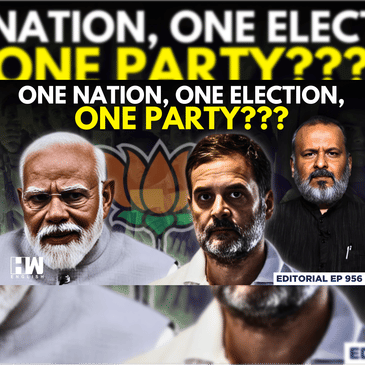
In this episode of Editorial, Mr. Sujit Nair takes an in-depth look at the concept of ‘One Nation, One Election’. He not only explores the potential advantages and disadvantages of this proposal but also provides a detailed analysis of its implications for India's democratic process. Additionally, Mr. Nair traces the history of elections in India, highlighting key moments and developments that have shaped the nation's electoral system.
Learn more about your ad choices. Visit megaphone.fm/adchoices
[00:00:00] Namaskar, Welcome to another episode of Editorial. One Nation, One Election is what Mr. Narendra
[00:00:08] Modi says he wants.
[00:00:11] Q Rathneka different elections when the country is won? This is what he asks. Let us understand
[00:00:18] this concept of one nation, one election. Let us understand this concept of whether
[00:00:24] it is going to be helpful for us as citizens of this country or not. Let us understand
[00:00:29] that. Let us kind of clinically study it and then you decide whether it is good for us
[00:00:35] or not. Let us get right to the show.
[00:00:42] First starters, the first thing what we need to understand is India used to practice one
[00:00:49] nation, one election. Our first general election happened in 1951 and ended in 1952.
[00:01:01] So, you know a lot of people who say that Sardar Vallabhbhai Patel was supposed to be the
[00:01:06] Prime Minister and then Gandhi got him out and made Nairu Prime Minister and all that.
[00:01:12] You see, Sardar Vallabhbhai Patel passed away in 1950 and our first general election
[00:01:17] was in 1951-52 and that election saw Pandit Javaharlal Nairu as our first Prime Minister.
[00:01:28] Anyway, okay. So the first Prime Minister, Pandit Javaharlal Nairu 1951-52 from 1951-52
[00:01:38] to 1967 that is the fourth Lok Sabha we saw one nation, one election.
[00:01:49] Okay, while I say that let me also add that you see as early as July 1959, July 1959, Prime
[00:02:00] Minister Javaharlal Nairu wanted to dismiss the Kerala State government headed by EMS
[00:02:06] Nambudri Patel. He wanted to dismiss the first ever elected communist government by the way,
[00:02:11] that was the first ever elected communist government in the world. He wanted to dismiss
[00:02:15] that in 1959 but that being said technically speaking let us simplify matters like we normally do.
[00:02:22] Till 1967 India saw one nation, one election. 1967 ke baat that is 1968-1969 we saw some
[00:02:35] assemblies being dissolved, state assemblies being dissolved and therefore there were
[00:02:40] the concept of one nation, one election got completely decoupled.
[00:02:49] Now there is also an instance, there is also an instance in December of 1970 where the then
[00:02:56] Prime Minister Mrs. Indira Gandhi had called for dissolution of the parliament in 1970 and called
[00:03:04] for a premature election in 1971, the election which was supposed to happen in 1972. She called
[00:03:12] for a premature election in 1971 and this absolutely decoupled the central election,
[00:03:23] Lok Sabha election with the assembly elections. This is the story. So long and short till 67
[00:03:30] it was all happening one nation, one election after 67-68-69 onwards the elections
[00:03:38] got decoupled. So you had assembly elections separately, you had central elections, Lok Sabha
[00:03:43] elections separately, TKNA okay. I also spoke to you about right in 1959 when Pandit Javala
[00:03:52] Nehru wanted to sack the communist government of Kerala and all of that. So this is history.
[00:03:57] Now Narendra Modi since 2014, since 2014 was always advocating this concept of one nation,
[00:04:07] one election.
[00:04:50] Now let us understand some advantages and disadvantages of one nation, one election.
[00:04:59] Because one nation, one election you can in one shot say that no, no it is bad for the country or
[00:05:05] good for the country. I think that is not the way one should view it. If you have to do a SWAT
[00:05:11] analysis. So let me look both, let us look at the strength and weaknesses of having one nation,
[00:05:16] one election and like I told you later on you can decide what is right and what is wrong.
[00:05:21] You see when you have multiple elections almost one or two or three elections per year,
[00:05:27] year after year. So the attention of the government gets diverted all the five years in elections,
[00:05:35] bad that is bad. Secondly every year election,
[00:05:42] lot of money you see if you do it all together the expenses comes down drastically
[00:05:50] but every year you set up your whatever EVM machine you set up your infrastructure
[00:05:56] you set up your government officers you pay them you get them there travel stay food infrastructure
[00:06:04] etc, etc, etc. It goes from the tax payers money. So a lot of money can be saved if the election
[00:06:11] is done in one shot. Thirdly political corruption or every election what do you think happens?
[00:06:22] Humongous amount of corruption do you think they actually spend the candidates actually spend
[00:06:26] the kind of money that election commission year marks is that what they do you think? So a huge
[00:06:32] amount of money is spent on elections huge amount of money and there is huge amount of corruption
[00:06:38] that happens during elections this can be curbed one shot may khatam ho jayega this can be curbed.
[00:06:44] So corruption is another issue. The fourth issue is you see the entire voting process
[00:06:52] the voting process can be simplified. Voting process can be simplified because you have state
[00:06:59] elections you have central elections. Now I will tell you how this one nation one election happens.
[00:07:08] One nation one election money you have two phases. Phase one is where you have the Lok Sabha
[00:07:14] election and the assembly elections together and phase two is when you have panchayat election
[00:07:19] municipality election within 100 days of the of your state stroke central election. So this is how
[00:07:26] in two phases you have one nation one election. So aek salme sab ho ye ho jayega and the fact
[00:07:33] remains that you have all the elections that happens simultaneously. This is what one state
[00:07:39] one election means. So the fact remains that it simplifies the process of election in totality.
[00:07:46] Now this is one end of the story. Now the next is what are the disadvantage of having
[00:07:55] one nation one election? What are the disadvantage? You see the first disadvantage is I vote for one
[00:08:04] particular political party and that political party starts thinking that they are non biological
[00:08:13] for instance. I mean I'm just giving you an example non biological they think they are God
[00:08:17] they think that everything is now under their control they are the supreme controller of this
[00:08:23] country. How do I teach him a lesson? How do I go back and tell this government a government who
[00:08:29] may not even listen to you how do you go back and tell the government no no no no what you
[00:08:33] are doing is wrong the way I have is to ensure that when my state election comes vote against
[00:08:38] him. Vote against that government that is the way I will show that government the central government
[00:08:43] that you were wrong your your governance in the center is not right that's the way I can show
[00:08:47] that's the advantage of having elections every year or possibly state elections different to
[00:08:53] the central election biggest advantage biggest advantage. The second advantage is a lot of
[00:09:03] political parties especially political parties that works the presidential style of election
[00:09:10] wherein you have one supreme leader who you present as a supreme leader as the ultimate
[00:09:15] leader once upon a time we had Indira Gandhi now of course we have our good prime minister Mr.
[00:09:21] Narendra Modi supreme leaders. See for these supreme leaders it is it is very easy to
[00:09:31] conduct all elections together you know why because I will tell you a consumer psych in this
[00:09:38] a consumer psych a consumer psych is that if you are buying a Sony television chances are
[00:09:45] the adapter that you will buy for that television will also be Sony. Multiple brands are not
[00:09:53] very easy for a consumer as consumer preference so there is a chance that if you are voting
[00:10:00] for congress or you are voting for Bharatiya Janata party for your national election or for your
[00:10:06] Lok Sabha election the chances are the next button that you press in your EVM machine
[00:10:11] for assembly election will also be congress or Bharatiya Janata party. It is very rare
[00:10:18] that you will press congress for Lok Sabha election and then go back same day same time
[00:10:25] and press Bharatiya Janata party for your assembly election it is it is not that easy it is rare
[00:10:35] from a consumer preference point of view it is rare. Ha! If you give gap if you give gap that
[00:10:44] means I today I press congress and I vote for congress and after one year one and half years
[00:10:50] if I have to vote for my state election I will then like I told you remember I
[00:10:53] congregant do well no so I am going to vote for BJP that happens but simultaneously
[00:10:59] it is very difficult that I have two minds and I you know
[00:11:03] Ha! Hota nahi hai in more often than not Ha! Hota nahi hai and especially in markets
[00:11:07] where the political understanding is not very entrenched in depth that is the point.
[00:11:16] So these people more often than not like I told you prefers one nation one election so that
[00:11:22] Modi wave and he captures everything in that wave. Tomorrow if there is Rahul Gandhi wave then Rahul
[00:11:29] Gandhi will capture everything in that wave. If there is a Arvind Kejival wave then he will
[00:11:33] capture everything if the Mamata Banji so that wave with that popularity they capture everything
[00:11:39] that is why some people some people who think they have that kind of popularity prefers one
[00:11:47] nation one election. Now the last thing I want to talk about
[00:11:54] the last thing is in fact most second last thing I want to talk about before I tell you the details
[00:11:58] of how actually this can be achieved this one nation one election can be achieved. The
[00:12:02] second last thing that I want to talk about is I wonder why is our government pushing for one
[00:12:09] nation one election by one election which is the Lok Sabha election they do it in seven
[00:12:15] phases and eight phases one general election that they have to do seven phases so then why add another
[00:12:23] Lok Sabha why add another assembly election phase why add load to the already loaded election
[00:12:31] commission because election commission is loaded that is why I mean loaded more work loaded of
[00:12:35] course election commission has got a lot of workload that is why they bifurcate the
[00:12:39] election in seven phases and eight phases and all of that otherwise they would have finished
[00:12:43] it in one or two phases but no they have in the seven phases and eight phases and all of that
[00:12:48] no if there it is so overloading you are also asking them to handle assembly election so
[00:12:55] will it actually help or harm the system that is a question I want to ask the government because
[00:13:01] that is what we have been seeing all this while so that question also needs to be answered now
[00:13:06] this is the pro and cons of one nation one election the last point which I want to make is
[00:13:17] the process in which you can do which is very important for my viewers to know the process
[00:13:22] in which you can make this entire one nation one election work is by amending the representation
[00:13:27] of people's act 1951 process one process two the bill must be passed in the parliament with
[00:13:35] two third majority that I am sure you know for that to become an act process three
[00:13:40] 50 percent of the state must pass the bill 50 percent of the state in India must pass the bill
[00:13:47] and process four five articles of the constitution must be amended which are those five articles
[00:13:53] the five articles are article 83 duration of the house of parliament article 85
[00:13:58] dissolution of Lok Sabha by the president article 172 duration of the state legislature article 174
[00:14:06] dissolution of the state legislature and article 356 imposition of presidents rule in states so
[00:14:13] you have to amend these five articles and you have to ensure that 50 percent of the states
[00:14:19] pass the bill pass the bill and create make this into an act and of course you yourself the
[00:14:24] the assembly the the Lok Sabha as to pass get the bill passed and amend the people representation
[00:14:31] act of 1951 amend that act and pass a new act only then pass a new bill so that it can be an
[00:14:38] act only then can this happen this is the long and short of one nation one election my last
[00:14:47] point my last point is it is always better that people have a choice to punish the government
[00:14:57] that they voted for if the government does not perform and the best form of punishment is to
[00:15:03] ensure that you are there in the center you remain in the center because we voted for you
[00:15:09] but I will show you that you are not doing well through my state election that is the best
[00:15:16] way for a common citizen a common voter whose vote today also doesn't matter
[00:15:22] whose vote today also doesn't matter because he may vote for some particular party that some
[00:15:27] particular party may tie up with another party and the that but the party may tie up with the
[00:15:31] fourth party and all the three put together would form a fifth party and then they form
[00:15:36] our government so my vote is that's the value of my vote today under this circumstances I would
[00:15:43] at least like to know and understand and be aware of that if the central government doesn't perform
[00:15:53] the way I wanted the central government to perform for which I gave the central government vote
[00:15:58] I have my assembly elections to teach them a lesson to tell them that listen you know what
[00:16:04] you're not doing well that right I will have this one point this one factor I think overrides
[00:16:12] every other factor in my mind this is my opinion please form your own and please let me also know
[00:16:19] there's one factor in my mind overrides all the other factors that to me would be true
[00:16:26] democracy till I see you next time let's tomorrow at 10
[00:16:30] namaskar
[00:16:32] stay ahead with our cutting edge news app
[00:16:35] instantly access the latest shorts in just one minute and breaking news in just 50 words
[00:16:41] download now for a smarter faster news experience