
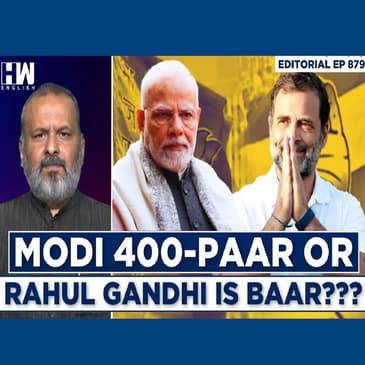
In this episode of ‘Editorial’, Mr. Sujit Nair discusses about the upcoming Lok Sabha Elections and compares the opinion polls and surveys of the earlier Lok Sabha elections of 2004, 2014 and 2019. Mr. Nair derives certain conclusions after discussing elections of the past and discusses about whether the opposition INDIA Alliance. India is preparing for the commencement of the Lok Sabha elections, which will be conducted in seven phases starting from April 19. The first phase of voting will take place on April 19, while the final phase is scheduled for June 1. Notable states participating in the first phase include Assam, Bihar, Madhya Pradesh, Maharashtra, Rajasthan, Tamil Nadu, and Uttarakhand.
Learn more about your ad choices. Visit megaphone.fm/adchoices
[00:00:02] Hello and welcome to HW Editorial with me Sujit Nair. Here you can listen to my views, my analysis. Follow this podcast to stay updated. At HW News, we have been delivering news that matters to you.
[00:00:17] Our goal is to present you with information that stimulates conversations around topic of larger public importance that often gets lost in prime time shows. Namaskar. Welcome to another episode of Editorial. Up ki baar 400 paar or up ki baar India Alliance Sarkar.
[00:00:52] What exactly are we looking at in the near future? This is my topic for today. Before I start my editorial, let me tell you something. Only go ahead with this editorial if you are really interested in politics and you have an enthusiasm for politics like me.
[00:01:13] Only go ahead with this editorial because let me tell you all the numbers that I am going to throw at you, all the analysis that I am going to give you, these are analysis that actually makes very little sense.
[00:01:27] It makes very little sense is because the actual decision, bulk of the actual voters happened in the last 10 days, 7 days, 8 days, 6 days, 4 days of the actual voting at times right outside the booth. That is when the actual decision happens. So a lot of times things have changed.
[00:01:46] A lot of times, a lot of polls will say, they ko, I told you this number and it's called, see most of it are fluke.
[00:01:56] There is a direction like I always say there is a direction that pollsters can give us but that is no actual prediction or no actual analysis and all that. But what is interesting is to know, to understand numbers, to crunch numbers, to analyze figures,
[00:02:14] it gives you some kind of an understanding of how politics is working in our country, which is a fantastic understanding, which is a good thing to learn. Good thing to learn is because we know how our countrymen are thinking.
[00:02:26] Good things to learn is because we know what triggers, what are the trigger points, political trigger points in our country, what makes a person go and vote for a particular party, all this we get to learn and that's very interesting and that's why I said
[00:02:40] if you are an enthusiast, if you are a political enthusiast, continue with this editorial, otherwise I think you can watch something else actually. So that's the point I want to make, let's get right into the show. So now let us talk about some figures.
[00:03:00] See everybody is talking about 2024 figures, pre-poll, post-poll, that-poll, everybody is talking about 2024 figures and what 2024 figures holds for you. Now, a lot of people are also talking about why do they choose the prime minister, why is the prime minister the most popular face,
[00:03:22] who is the most popular face and all of this. This forms a narrative and that narrative is normally presented to you. Now what we will try and do is we will try and look at our elections right from 2004.
[00:03:37] Let us look at numbers 2004, numbers 2014, numbers 2019 and what numbers are predicting 2024. So a fair amount of idea will be found that where does this number take us, that's the first thing we will do. Then the next thing we will talk about is this popularity game.
[00:03:57] Who is popular? Why is this particular person, why is Narendra Modi more popular than Rahu Gati? We will get this popularity game. Then one thing that I want to really talk to you about are the trigger points, the trigger points of Indian politics.
[00:04:13] There has been trigger points which have actually changed the course of elections. Thung, it went topsy-turvy. It has started from 2004. Let us talk about those change, those trigger points. These are the three points I would like to share with you today. Let us get right into the show.
[00:04:32] So like I told you, if we were to start from 2004, the figures that were spoken about in 2004 were as follows. NDTV, AC Nielsen spoke about NDA getting 230 seats to 250 seats. Congress getting 190 seats to 295 seats. Others getting 100 seats to 120 seats.
[00:04:58] So NDA was shown as the single largest group in the parliament. It was widely understood that NDA alliance with others would form the government. At least they will attempt to. Of course, otherwise a lot of people spoke about 2004 being a hung parliament.
[00:05:19] Now the reality we know, the reality UPA got 208 which was not predicted. NDA got 181 which was lesser than what was predicted and left front and others got 59. This is what the actual story was. Congress got 145, BJB got 138. So Congress was the single largest party in 2004.
[00:05:42] So the prediction all went wrong. But more than prediction, prediction normally goes wrong. More than prediction, the direction went wrong. The direction of the research went wrong. So that's what 2004 is now. Let us come to 2014 and the game begins.
[00:05:59] 2014 NDA was supposed to get and I am going to take one research this time. I am going to take the mood of the nation by India today. I am going to take that one research so that we will get some kind of consistency.
[00:06:13] So we will follow that research through and through so that some kind of consistency on what we talk and then we will form our own opinion. Believe me, it is an interesting exercise. NDA according to mood of the nation in 2014 was supposed to get 217 to 237 seats.
[00:06:31] They actually got 336. Others were supposed to get 205 to 225. They actually got 148. UPA was supposed to get anything between 91 to 111. They ended up getting only 59 seats. So this was the difference of the numbers that was predicted. But one thing, direction was right.
[00:06:55] Now BJP was supposed to get anything between 192 to 212. They got 282. Congress was supposed to get 79 to 99. They got mere 44. Like I said again, numbers, haywire but direction was correct. Let us go next. Next is let us talk about 2019. The game comes closer now.
[00:07:19] 2019 NDA was supposed to get 237 seats. They got 353 seats. Again, number completely haywire. Others were supposed to get 140. Got 98. Numbers haywire. UPA was supposed to get 166. Got 91. Numbers haywire. But this time around even direction haywire because it was widely predicted that we will see a hung parliament in 2019.
[00:07:49] Hung parliament in 2019 and then something happened that was called Balakot and things changed. Now, did things change because of that? Not. We will come to that. That is the trigger point that I was talking to you about. But let us come to that.
[00:08:05] Let us hold on. Let us come to that. Let us get to 2024. What are people talking about in 2024? In 2024, some people are not only talking about 240470. They are talking about 600 and 700.
[00:08:17] Back in Nepal, Pakistan, Sri Lanka, all seats, incidentally according to them, according to a lot of people is going to BJP. But that being left set aside. Let us talk about 2024. What mood of the nation says?
[00:08:31] 2024, mood of the nation says that NDA could get anything. Not anything. In fact, the figure is 1. NDA could get 335. Mood of the nation says India Alliance could get 166. Mood of the nation says others could get 42.
[00:08:46] This is what the mood of the nation says. Now, one has to see how much of this is the direction going to be right, is the number going to be right?
[00:08:52] Okay. Now, let us go further. You see, the next thing I want to talk about is in 2019, the biggest problem that the incumbent government faced was unemployment.
[00:09:08] The first one was the number one problem. And you know what was the number one achievement later on that really made a difference? What really made a difference other than Modi's popularity as it is called? What really made a difference was Balakot, 16%.
[00:09:22] Difference was made by Balakot airstrikes. The nation went and voted for a Bharatiya Janata Party left, right and center. What was predicted? 237. What they got was 353. That is NDA. And what was predicted for Bharatiya Janata Party was 202. They got 303.
[00:09:44] So, things changed. Things changed drastically. Balakot was that trigger point. That one trigger point that changed the direction of the entire elections.
[00:09:56] From what could be a hung parliament that lot of research says to something where Bharatiya Janata Party won and won massively. Absolutely one sided. That is the point.
[00:10:11] Now, 2024. 2024, the status is very simple. Not very different. You know what is the biggest problem? The biggest problem is still unemployment. That has not changed. Unemployment remains our biggest problem. But you know what is the biggest strength of the government?
[00:10:31] Again, the leadership and all what they say that will keep it aside. The biggest strength of this government according to CSDS research is 22%.
[00:10:42] That is the consecration of Ram Temple. So, the trigger point is consecration of Ram Temple. Earlier on the trigger point was Balakot. Now the trigger point is the consecration of Ram Temple.
[00:10:54] Earlier on Balakot happened very close to the election. Now Ram Temple happened much before the election. It happened in January. So, enough time for Bharatiya Janata Party to establish to stay claim on that to actually make that into a great direction strength.
[00:11:19] Their USP, their consumer offer or whatever called voter offer and it stuck. It stuck. Ram Temple consecration stuck. So, the story remains the same. First, the problem unemployment taken over by Balakot strike.
[00:11:37] 2024 problems still unemployment but taken over by consecration of Ram Mandir. Now we got that trigger point. Now let us look at what that trigger point did. What that trigger point did. In fact, let me before that before I get into that.
[00:11:54] Let me also show you a same. Like I said, we will go by the mood of the nation service and we will go so that there is consistency.
[00:12:00] The mood of the nation said that one of the reasons why this was done in August which is post poll. They said what is the top reason for victory of Modi led NDA in this election.
[00:12:11] The strongest was of course 35% strong leader image of Narendra Modi. 16% was Balakot airstrike like I said achievements of the government 11% massive spent on advertising 8%, 7% was BJP campaign. So, the point is this thing about strong leadership and all is that's very volatile. That's very volatile that changes.
[00:12:34] And the fact that Balakot had a huge impact on creating the strong leadership aura on the Prime Minister Narendra Modi that great leader and all that. All that was thanks to Balakot.
[00:12:48] So, I will not see that as in isolation. I will see Balakot as the number one trigger point. And that's what I wanted to share with you. After that let me also go to now the popularity game. Now, let's talk about popularity. In 2019 this is before Balakot.
[00:13:11] In 2019 the popularity of Narendra Modi was 46% and Raul Gandhi was quite close 34%. The popularity 2024 seems to be quite widened where Narendra Modi sits at 55%, Raul Gandhi is at 14%.
[00:13:33] Mind you 2019 the popularity is before Balakot 2024 popularity is after Ram Mandir. Like I told you unlike Balakot last time Ram Mandir happened in January so they had enough time to build up.
[00:13:48] That got enough time to build up while a lot of us said that you know the popularity peaked very early before the elections. The fact also remains that before because the popularity peaked and the opposition didn't do anything to combat that popularity much.
[00:14:05] The fact remains that Narendra Modi's popularity has been soaring high. This is where the popularity between these two leaders stand. So my conclusion with all these figures will be as follows. You see currently the H is definitely with the Bharatiya Janata party no doubt.
[00:14:29] No doubt and one may believe it one may not believe it that too let me tell you one believes it because you know it is we believe we start believing in the ecosystem that we are in.
[00:14:39] So if you are in a left ecosystem then you start believing in the left propaganda that comes to you. If you are in the right ecosystem then you believe in the right propaganda that comes to you.
[00:14:50] The moment you put these propagandas together the moment you start watching these together keeping them side by side you will understand where it stands because the truth is somewhere in the middle.
[00:14:59] The truth is neither with the left or with the right completely. So these are the figures. These figures show that there is an edge that Bharatiya Janata party has but does that mean that it is all over for the India Alliance?
[00:15:14] Absolutely not. The opposition has to remember that there is this huge concept called the trigger point. 2019 it changed fates for NDA. It changed the direction of the election. 2024 it has built up the entire 2024 election for the NDA so trigger point is what made a difference.
[00:15:38] If the opposition can use that trigger point if the opposition comes about with a great offer with a great voter offer even now the opposition can this time use that trigger point to do that.
[00:15:51] There is still that chance to come up with that big idea. That big idea that big offer that can trigger the consumers that can trigger the voters in this case.
[00:16:08] That big idea can still be bought about. That big idea which will make that last mile voter to change his preference. The opportunity still stands. So the match is still very open.
[00:16:23] This is what I will conclude with. The rest is for you to decide write down. Write down what you feel. Write down what you think. Write down what is your opinion. Write down how you analyze these numbers because obviously I am sure you have your own opinion on this.
[00:16:41] Please write down in the comment box all your opinions and do remember to share and subscribe to our channel till I see you next time. That's tomorrow at 10. Namaskar.
[00:16:52] Stay ahead with our cutting edge news app. Instantly access the latest shorts in just one minute and breaking news in just 50 words. Download now for a smarter faster news experience. Be assured you will love it too.