
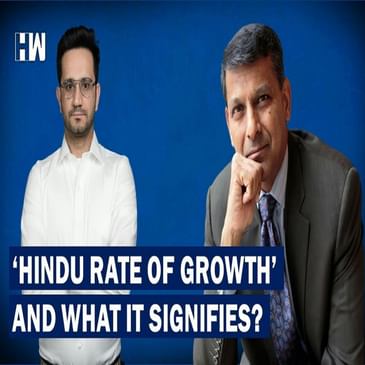

I discuss why Raghuram Rajan is pessimistic about India's future GDP growth rate, noting that the private sector is unwilling to invest and the RBI is still hiking rates. He believes that the government needs to encourage corporate India to invest more and that the Production Linked Incentive (PLI) scheme for the manufacturing sector needs improvement. The video also touches on criticism of the government and the challenges India faces in achieving higher growth rates. I also explain a reference made by him to “Hindu rate of growth” & what it signifies
Learn more about your ad choices. Visit megaphone.fm/adchoices
[00:00:05] There's a recession expected in America and Europe. China has witnessed its slowest growth rate in decades due to draconian lockdowns. Inflation is still persistently high in Latin America. There's no particular good news about Canada or Australia either. And even Japan just narrowly avoided a recession recently.
[00:00:24] Among all this, India was supposedly the bright spot. At least until last quarter. But if the latest figures, NRXRBI Governor Raghuram Rajanath to be believed, the bright spot just got a whole lot dimmer. And these very same words were echoed by our very own Chief Economic Advisor,
[00:00:42] V. Ananta Nageshwara as well. So join me for today's video where I explain to you how India's GDP has nosedived in the latest quarter, the concern expressed by Raghuram Rajan and his hard-hitting questions addressed to SEBI and the government about the Adani issue.
[00:00:59] And guys, if you enjoy such videos, please be sure to hit that like and subscribe button for more such financial content. Mr. Raghuram Rajan has always been opinionated and critical of the BJP-led NDA government at the centre.
[00:01:12] And maybe that's a good thing because few others in India can be critical. Just look at the latest income tax surveys on BBC offices after they release a documentary showing our Prime Minister in bad light. Of course, we do have exceptions like Subramaniam Swami
[00:01:28] who despite officially being with the BJP is somehow openly critical of them on some issues. I find that an anomaly. But I digress. Raghuram Rajan hit the hammer on the head recently when he brought up the topic of our latest GDP growth figures.
[00:01:44] Everyone thought India was a bright spot in an otherwise gloomy world economy. And to be honest, our GDP growth in the second quarter, which was the July-August-September period of 2022, was a healthy 6.3%. So it was expected to continue on the same lines.
[00:02:03] But lo and behold, in quarter three, which is the October-November-December period of 2022, our GDP growth rate dropped to a mere 4.4%. This prompted Mr. Rajan to use the phrase Hindu growth rate in reference to our economy.
[00:02:20] Now before I move forward, let me just be clear that this is not a derogatory term by any stretch of imagination. But it does have a cultural reference. Let me explain. The term Hindu growth rate was coined in 1978 by economist Raj Krishna,
[00:02:36] who was a teacher at the Delhi School of Economics. Basically, India had a very poor GDP growth rate which range from 3.5% to 4% from the 1950s to the 1980s. And it continued irrespective of change in governments, wars and other crises.
[00:02:53] This made Raj Krishna think of it as an inherently cultural phenomenon and hence he came up with the name. But the growth rate during that era could be attributed to socialist policies, state control and license raj, which was eliminated in 1991 when we opened up our economy.
[00:03:12] Now I certainly don't think that a sequential slowdown in growth rates warrant a comparison to the era where our GDP growth was literally stagnant for decades. But Mr. Rajan is concerned that this slowdown will continue. Let's see what observations he had to make.
[00:03:29] In an interview with the Press Trust of India, Dr. Aguram Rajan noted that the private sector in India is unwilling to invest. The RBI is still hiking interest rates and global growth is still likely to slow still further later this year.
[00:03:44] This concoction leads him to a rather pessimistic view of the Indian economy in the near future. And he says that overall in the coming financial year, beginning from 1st April, we would be lucky if we hit a 5% growth rate.
[00:03:56] An important thing to remember here is that the government recently revised upwards the GDP growth numbers of last year. So this creates a higher base against which this year's GDP growth seems lower. Dr. Rajan said that optimists in the
[00:04:12] government will use this upward revision of last year's GDP to justify the low growth rate this year. But guys, the point he brought up about private sector not investing in India is actually India's Achilles heel along with consumption, which is another big problem.
[00:04:28] Private investment has been languishing big time in India and the private sector has been making all kinds of excuses for not investing like they want their capacity utilizations to go beyond 80% before they start making fresh investments. The government is bending over backwards to accommodate them to invest,
[00:04:45] such as slashing corporate income tax rates from 30% to 22% and many more measures. In fact, Nirmala Sitaraman last year was rather annoyed when she publicly stated that she was aghast at the unwillingness of corporate India to invest more. The simple fact is the government
[00:05:02] is focusing a lot on infrastructure with an allocation of more than 10 trillion rupees also being made towards it in the latest budget. But they need support from the private sector as well for India's growth engine to kickstart. So Dr. Rajan was pointing out to this fact.
[00:05:21] But I guess he meant it in a sense that the government is getting something wrong and they are unable to encourage corporate India to invest more. Mr. Rajan also had another complaint. This one's about our manufacturing sector, specifically about our production linked incentive or PLI scheme. This scheme
[00:05:39] has been touted as a victory, a very efficient way of stealing China's manufacturing business away from them. Basically, the Indian government is giving massive subsidies and incentives. You can view it as a sort of cashback scheme to big companies that manufacture their products in India.
[00:05:58] A lot of jobs are expected to be generated from this and the government views this as its flagship job generating scheme. Dr. Rajan however has a different view. He critiqued a sensible evaluation would be to ask how many jobs are being created
[00:06:15] at what price per job. Because after all the government is giving away tens of thousands of crores as incentives. He further went on to say that government spokespersons point to the rise in cell phone exports as evidence that the scheme is working. But if we are subsidizing every
[00:06:32] cell phone being exported then obviously exports will show a rosy picture. The key question he says is how much value is added from India? It turns out very little so far, he concluded. He also said we need more evidence before celebrating the success of the PLI scheme.
[00:06:50] Another very pertinent point Mr. Rajan brought up is that of services and question wise in the government concentrating on that equally. After all, most major economies in the world are largely service economies. Therefore, India can be a large economy without being a major manufacturing
[00:07:09] hub. Mr. Rajan rightly pointed out that India needs to work on both manufacturing as well as services to create jobs and both these need schooling and skilling. While all what I've mentioned above were just Mr. Rajan voicing his opinion and maybe taking indirect digs at the
[00:07:27] government, he also directly questioned the government and Sebi on the Adani issue. He asked why has Sebi not got to the bottom of the issue raised by the Hindenburg group and even sought to know if they need help from investigative agencies.
[00:07:42] Most specifically, Mr. Rajan wanted to know why Sebi hasn't taken investigative action against four Mauritius based funds that have reportedly parked 90% of their $6.9 billion in Adani group stocks. It's widely thought that these four funds, Ilara, Cresta, Albula and APMS are all shell
[00:08:03] companies controlled by the Adani group and used to manipulate the price of his group stocks as per his convenience. Mr. Rajan also said that non-transparent links between the government and the Adani
[00:08:14] group is not allowing regulators to do their job. So there you have it, whether you agree with him or no, his views do hold a lot of weight and mind you, there are few very noteworthy voices
[00:08:26] that don't agree with his viewpoint. For example, the International Monetary Fund or the IMF says India will be the world's fastest growing large economy and along with China will account for half of global economic growth in 2023. Yet another veteran, Bank of Baroda's chief economist
[00:08:44] Madan Sabnavis said that Raghuram Rajan's view only takes into account quarterly growth and that too in uncertain times. He prefers to look at full year's growth instead. But be that as it may, Mr. Rajan is one of the most credible voices from the opposition camp
[00:09:00] and even though he is not formally with the Congress or aligned with any other political party, there have been theories about his name even being fielded as a face of the Prime Ministeral candidate in next year's general election. Again, these are all theories.
[00:09:15] But whatever said and done, like I've mentioned before, when Mr. Rajan talks, people just stand up and listen, even if it's members from the BJP camp. Thank you.