
If you like what you saw - follow me on Instagram @mr.talkstock and on YouTube @mr.talkstock7282 for more such content as well as short videos, memes & collaborations.
The video discusses the history of Air India, how JRD Tata founded the airline, & how the government took it over under the garb of nationalization, only to return it to Ratan Tata after struggling to run it. We also discuss the decline of Air India under government control, with overpaid and over-perked employees, inefficient management, and crippling debt. Also covered is how the Modi government capitalized on a PR victory when Air India announced the biggest order of planes ever in the world.
Learn more about your ad choices. Visit megaphone.fm/adchoices
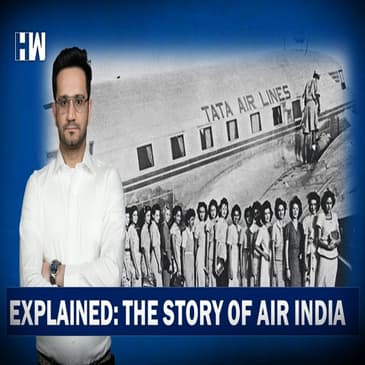
[00:00:05] The story of Air India is about how JRD Tata founded an airline because of his passion for flying Only to have the government forcefully take it over under the garb of nationalization And how another government returned it to Ratan Tata after struggling to run the airline for 68 years
[00:00:23] And since the concept of sale and leaseback is such a big thing in the airline industry You could look at it like the government in 1953 Nationalized Air India and paid JRD Tata 2.8 crores for it Then ran it into the ground with politics and bureaucracy
[00:00:39] Racked up massive losses towards the end and then sold it back to the Tatas in 2021 for 18,000 crores In a reversal of process named privatization But I say thank god it's with the Tatas again
[00:00:52] So join me for today's video where I take you through a brief history of Air India under JRD Tata And how its eventual garb apsi back to the group decades later Not only saves the government thousands of crores in losses every year
[00:01:06] But also allows the Modi government to flaunt the biggest privatization in India's history And allowed them to capitalize on a PR victory when Air India announced the biggest order of planes ever in the world
[00:01:18] And guys, if you like such videos, please be sure to hit that like and subscribe button for more such financial content Air India over the years has disintegrated into an airline of the employees for the employees and by the employees Who are overpaid and over perked
[00:01:36] Including but not limited to flying allowances for pilots who don't fly at all And free international air tickets for themselves and their families But you could say that's the case with most public sector companies
[00:01:49] The government sort of views them as a vote bank which would create a big noise if they weren't taken care of Beyond what value they actually bring to the organization Just look at the case of BSNL and MTNL Five employees doing the job of one efficient person
[00:02:05] But it wasn't always like this Back in the day when JRD Tata founded and ran the airline It's said when he traveled himself He would walk down the aisles to see if passengers were content
[00:02:16] If a tray of food went out with a cold main course or even if a fork had a twisted prong He would give the cabin team hell Is this kind of dedication and personal touch that made the airline special
[00:02:30] Air India was nationalized by the Jawaharlal Nehru led congress government back in 1953 The government already had 49 percent stake in it But bought the remaining 51 percent from the Tatas and the public paying 2.8 crores to JRD Tata for his share
[00:02:46] Not only Air India, they nationalized a total of nine airlines Their logic was simple Too many small airlines would not have the capital to operate large fleets And so they consolidated all of them into two large carriers backed by the government
[00:03:02] The glory days of Air India actually began after it was nationalized Since JRD Tata shared a good relationship with the ruling party back then He stayed on as Air India's chairperson and ran the airline It said no minister or civil servant could tell him what to do
[00:03:18] And his passion and dedication was such that he worked free of cost Despite critics within the Tata group complaining that he devoted too much time to Air India A company that Tatas had no stake in
[00:03:31] It was the first airline in Asia to fly the Boeing 707 and went big on the Boeing 747 before other carriers did Air India's reputation for its in-flight service and marketing I'm talking about the Maharaja mascot all came during the period when it was owned by the government
[00:03:48] In fact, the brand was held in such high regard that other Asian airlines followed its model and a few even asked for its help Things went bad in 1977 once Moraji Desai was elected prime minister
[00:04:01] He disliked JRD Tata and all that he stood for and decided to sack him from his post It was then that the airline was handed over to politicians and bureaucrats after which it began to decline Running an airline is always a tough job like automobiles and telecom
[00:04:18] Airline 2 is a very competitive sector. Let me give you an example If you were flying from Mumbai to Delhi, you'd probably go to your favorite travel booking website and check for all flights on their route
[00:04:29] If a list of 10 options flashed before your eyes without thinking you choose the cheapest one Even if it's a few hundred rupees less expensive Very rarely will we think about the service, food or management of the airline At least for short distances because it's pretty much standardized
[00:04:48] That's why it's very difficult for airlines to make a profit consistently over a long period of time No wonder then even big names like jet airways and kingfisher airlines went bankrupt The only Indian airline that's consistently done well over the last few years has been indigo airlines
[00:05:06] And is a benchmark and sector leader Air India over the last couple of decades clearly doesn't fit the bill of a well-run efficient business It's badly executed merger with Indian Airlines in 2007 crippled its effectiveness
[00:05:21] The competition from airlines in the Gulf region such as Emirates and Qatar airways robbed many passengers away from air India And most importantly huge loans taken to buy aircrafts led it into a debt trap
[00:05:35] So much so that it had a debt of more than 62,000 crores as of august 31st 2021 The yearly interest outgo was such a heavy burden which was being funded by taxpayer money And the government towards the end became pretty desperate to sell the airline
[00:05:50] The Tata group paid a total of 18,000 crores out of which 2,700 crores went to the government While it agreed to take over 15,300 crores in debt of the airline The remaining 46,000 crore odd was transferred to a special entity which also received some land holdings and other assets from air India
[00:06:10] That weren't transferred to the Tatas Which it will sell and settle as much debt as it can With this payment the Tata group gets control of three entities Full service carrier air India its low cost division air India express
[00:06:24] And its ground handling and cargo service wing AI SATS The Tata group already operates to other airlines Vistara, which is in joint venture with Singapore Airlines and air Asia India But both have yet to make money
[00:06:39] While the purchase of air India will give them access to valuable flying rights and landing slots It's quite tempting to think what synergies they can benefit from if they merge all their resources Which is pretty much what they plan to do
[00:06:53] So now that the Maharaja of the skies is back with the Tatas They're planning some really big things with it and it's pretty evident from their latest move Air India just a few days ago in a rather surprising move announced the world's biggest ever purchase order of aircrafts
[00:07:08] In a single sitting they placed an order for 470 planes in total 250 with European Plane maker Airbus and the remaining 220 aircrafts with its American rival Boeing The total value of the deal is 70 billion dollars Now the thing to remember here is this deal has major implications not just economically
[00:07:29] But also in terms of geopolitics and this can be seen from its variety. Let me explain Airbus from which Tata placed an order of 250 aircrafts is based in Netherlands But has German French Spanish and British ownership
[00:07:43] The deal was announced by prime minister Modi and french president Emmanuel Macron It was welcomed by British prime minister Rishi Sonak Since airbus engines will be likely built in united kingdom President Joe Biden announced a press statement to announce the 220 plane order from Boeing
[00:08:01] Saying it would create a million jobs in America in 44 different states So it was a clear PR win for our government and is expected to give India an upper hand in its free trade agreement negotiations with European Union
[00:08:15] It will also force the US to be more cooperative with India in trade talks and on market access What I found interesting was that this order of 470 planes by air India Just managed to overtake the previous biggest order for aircrafts by just 10
[00:08:31] American Airlines placed an order of 460 planes in 2011 Guess we really wanted the tag of biggest order ever If low-cost airlines want to be efficient They try to minimize the number of configurations they fly
[00:08:46] But this order by air India has at least five different models and is spread out between two different companies They have a combination of wide body and narrow body planes and have signed deals with three different engine manufacturers CFM international GE and Rolls Royce
[00:09:02] This variety reflects air India's recent convoluted strategy and bad planning This order has to cater to its existing various routes airports and passengers as well as plan for the future So managing all these different configurations while improving service is indeed going to be a challenging task
[00:09:22] And let me tell you one more thing the last time air India made a big order of planes was in 2007 following its merger with Indian Airlines And that order was responsible for its unsustainable levels of debt Which finally drove the company close to bankruptcy
[00:09:37] But that aside, this is a pretty brave move which indicates to me the Tata group indeed has a strategic plan for air India's revival I'd also like to give credit where it's due Darendra Modi has been the most reformist prime minister India had since P.V. Narasimha Rao
[00:09:54] It takes a brave government to uproot a culture that's been entrenched for years One of giving luxuries to employees or public sector companies with taxpayer money Air India has definitely been the most contentious privatization till date But I hope there are more to follow
[00:10:13] Waiting in the wings in Bharat Petroleum or BPCL, which they tried to but failed I think it'll get done in the near future Then of course, there's LIC another organization That is off the agents for the agents and by the agents
[00:10:30] And while the disinvestment process has begun and the government did sell a 3.5 percent stake in LIC, YN, IPO and 2022 It needs to be privatized where the government holds less than 50 percent stake in it for it to be run efficiently
[00:10:46] Then there's Indian oil, HPCL, MTNL, BSNL and a bunch of public sector banks But one at a time let's not get ahead of ourselves Because like many leaders including Narendra Modi has reiterated The government has no business to do business Its job is that of an administrator
[00:11:08] Thank you