
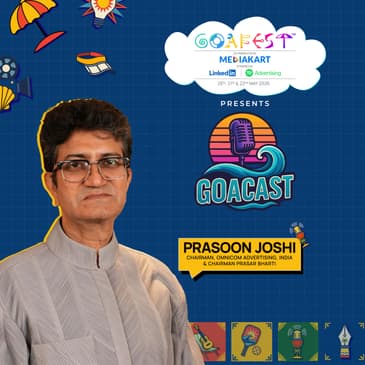
He wrote Maa. He created Thanda Matlab Coca-Cola. He holds the Padma Shri. And yet - Prasoon Joshi says he never ran after a single title he holds.
In this deeply personal GoaCast 2026 conversation with host Jenisha Shah, Prasoon opens up about his roots in Uttarakhand, the grandmother who went from illiterate widow to school principal, and the river-and-stone philosophy that has shaped everything he has ever created.
Key highlights:
- The river and stone philosophy - and what it means to be "chiselled by failures"
- Why his grandmother's story is the greatest lesson in resilience he's ever known
- The ancient Indian theory of Vani - Para, Pashyanti, Madhyama, Vaikhari
- "हम सबके पास कहानियां हैं" - why every person's story is unparalleled
- Authenticity vs. transparency - and why brands get this wrong
- What "felt truth" (अनुभूत सत्य) really means in storytelling
- AI, creativity, and what the next generation of creators must prepare for
- The one piece of advice Suresh Malik gave him that changed everything
A rare, intimate conversation with one of India's most celebrated creative minds.
Guest: Prasoon Joshi | Chairman, Omnicom Advertising India | Chairman, Prasar Bharati | Padma Shri
Host: Jenisha Shah
Show: GoaCast - Official Goa Fest 2026 Podcast
#PrasoonJoshi #GoaCast #GoaFest2026 #IndianAdvertising #Poetry #Authenticity #Creativity #Storytelling #JenishaShah #PrasarBharati #OmnicomIndia
[00:00:00] Rakesh Bedi & How does it feel to have so many awards, accolades? Does it put that pressure on you to always deliver performance? Prasoon Joshi & People think that, Oh, where do you want to reach? I don't want to reach anywhere. There is no destination. Prasoon Joshi & In today's world also, it's so important to not just be authentic but transparent. Prasoon Joshi & We all have a story behind you. Believe me, you and me are unparalleled. Prasoon Joshi & You or Me or Me like you is another one. Prasoon Joshi & What comes first? Emotion, thought or the word?
[00:00:29] If your energy system is that you're drawing things from deep inside, there is going to be certain truth in it. We have more storytellers in the audience today. Everybody has a story to tell. I think creativity will not suffer. Creator will suffer. Today's youngsters have immense amount of confidence and today's India is not looking for validation. They're looking for relevance.
[00:00:58] Hi, I'm Janisha and I'm hosting Goa Cast, which is GoaFest's official podcast. And today we have with us a very special guest who doesn't need an introduction because the moment you see him, you'll know. But he is one of the sharpest minds India has seen in terms of lyricist, advertising, content, poetry, everything that you can think of where creativity is first from every breath of his.
[00:01:28] Hi, sir. Welcome. Pleasure. How do you feel? I feel good. Being in GoaFest has been ages. In fact, I'm one of the architects of this festival. And we used to have two different festivals. One is a club and one is three years of I. And that time, God bless Biyush.
[00:01:50] He was there and we all got together and decided that it should be one place and it should be out of Bombay, out of Mumbai. And that became GoaFest. And since then, one has been coming here. And it is always a pleasure to meet friends, meet colleagues, meet younger people whom I always take sessions with and sort of do share my thoughts with.
[00:02:19] So, in that sense, we keep threatening each other that we meet each other in our cities. But we never. And here, at least, we get some time to spend with each other in the industry. Away from home. So, you end up spending all the time with everyone. Amazing. How does it feel to have so many awards, accolades as advertising campaigns that you won awards for? You won the Padmashri. You won for lyrics. You won for other national awards. Like, so many awards.
[00:02:47] Does it put that pressure on you to always now deliver performance? Or now that you're not? No. The pressure, there's no pressure in me. People think that, oh, where do we want to reach? I don't want to reach anywhere. There's no destination. For someone who's at the top? I don't know. What is the top?
[00:03:13] You see, as far as you feel, you're engaged. As far as, I always liked the rivers. I was brought up next to the Gaga in Uttarakhand. I like the flowing water. And I want to stay flowing water. And as far as your life is allowing you to do that. Learn new things. Do new things.
[00:03:43] Or, I'm fine. Success in positions are byproduct. Believe me, I have never hunkered after single title which I held in my life. A CEO's title which I held. A chairman's title I held. Or chief creative officer's title I held. Or even a Padma Award you're talking about. I never ran after anything.
[00:04:10] I feel this is not what I feel satisfied with. I feel satisfied with doing something which I didn't do before. Or feel that, yes, I wrote well. This was good. Or feel disappointed. Why did I let this go? Yeah.
[00:04:42] And, well, that's been working till now. Let's see. There's this very interesting opening to a speech also you gave when you got the Hall of Fame Award. About the river and stone philosophy. Do you want to tell the rest of them also what it is? You know. It's beautiful. So, I, since I feel, you know, sometimes even saying yourself made sound condescending.
[00:05:11] Because, yes, I don't have anybody in film industry or advertising in the corporate world. I'm simple teachers, you know, child, son. And, well, I can say himself made. But, now I've started feeling conscious about saying yourself made. Because you're not self made. You're actually product of a lot of people. Yeah.
[00:05:36] Your ideas are little bit of your mom, little bit of your dad, little bit of that friend of yours, little bit of that aunt, little bit of that village you went to. It's actually, so nobody's self made. Yeah. Yeah. Yeah. Yeah. Yeah. Some people get extra leverage because their ancestors came to a city.
[00:06:05] I come from Uttarakhand, smaller towns. Some people would have probably been living in Mumbai or New York and they're probably the beginning is. But I think when I said the simile of the stones you see at the river banks, especially in the mountains, you see those are chiseled stones. It looks like, it looks like, it looks like someone has been tormented. It's a big disappointment.
[00:06:35] It's a big disappointment. Who has been tormented? Who has been tormented? They have tormented. Rolling stones are tormented. They are tormented. They are tormented. They are tormented. What's the problem? You think it has become a road to the river. How did it become so perfectly? They ate so many thieves that they are looking at you to do things like that. So I think I'm only a thief.
[00:07:07] Any experience in life which has left still till today, you feel that mark etched because of that experience. I have great childhood experiences and that's why my similes will always come from nature and I will write that You are the wind from the sky You are the wind and the weather
[00:07:36] These two things are spread out If you stay there you feel that the wind is going to be on the sky and you go to the sky and you see people have time You have to see one or two, five The other thing is the wind So I feel I was very fortunate that I was brought up in nature
[00:08:02] and my biggest memory is my grandmother My grandmother, my nani, my mother's mother She was, she came from a village lost her husband at the age of 19 around 19 and she had my mother and she was illiterate She retired as the principal of a school
[00:08:30] So someone who is illiterate at the age of 19 can understand the kind of resilience she would have and when I look at the women from Uttarakhand they have exceptional resilience
[00:08:55] What mountains and nature does to you Nature makes you tough but nature doesn't bluff So a river which you are out of the earth will be from the start to the end It is not that you make a river I was different I had a river But if you stay in the river then people are changing
[00:09:23] You must change You may be safe somebody says I am a man in a lady nature nature nature which is a way of a muskill at muskill so it's straightforward tough people but not
[00:09:49] manipulative but that is what I cherish as a child and I've learned and my first instinct is to trust my instinct is to be resilient take the challenge manipulation is something tough to deal with as this entire journey that you have had I know I'm sure when you are letting your creative juices flow and
[00:10:13] writing lyrics what comes first emotion thought or the word in India this is Indian thinking this is called vacary
[00:10:38] vacary is the last product is the paletina madhima madhima kya hai? jise aapne bola nahi lekin aapne manne bola jise aap koji gaana sunje wo mujha aata hai andar aapke chalne lega okay but you are not pronouncing it that is madhima
[00:11:03] uske pehle hota hai parashanti the yogic eye intuition then I know what you're going to say or what is going to so that is a parashanti and usse bhi pehle hota hai parakh that is very much seed of everything which where the energy system is emanating from so aapki
[00:11:28] aapki wani mein agar wo poora link hai from the unexpressed from the eternal energy source aapki wani mein ek tariki and I'm not trying to say believer non-believer whoever you are if your energy system is that that you're drawing things from deep inside there is going to be certain
[00:11:52] truth in it yeah it's going to connect as any that modern sort of psychology has not explained it the kalyung collective subconscious in a sense is going to be also explaining the same thing but for
[00:12:16] me brought up here and everybody is unique I'm not saying this is the thumb rule to communication non-speaking but I know whenever you are connected to with the source and you say something it does connect precisely goes there because it's something which is eternal you've already said something which
[00:12:42] and sometime you have not said anything usse maun ki bhasha kertai that is the sound of silence that also communicates a lot in all of whatever you've written especially the song ma because I really connect with it also there is a deeper level of understanding jo samne wala bol raha ho aap pehle se hi
[00:13:07] samad chukyo and you've understood what it is that is going to drive that emotion when they hear it how is it that you find that level of relatability with everything very good question and it the answer of this I actually got while writing this song that is ameepar yeah if you the ones your audience who
[00:13:34] are familiar with how scripts are written in India and especially because we use songs and generally we describe what kind of song will come there say separation song to be added now separation song to in the name of the song by the song that you can write and then that is the song that you have written
[00:14:01] in the song that is the song that is the song that you can write in the song that you have written in the song but when and I was taking time I'm a used to ask me verse sonji you have never said that I'm doing I'm thinking I said, how do I uniquely express this situation, this emotion, this child is being left.
[00:14:33] And one thing which has always worked for me is Anubhut Satya, first hand truth, your own experience, which makes you the most vulnerable, has the possibility of connecting. This is through my experience of writing I realized.
[00:14:54] So I went back to my childhood and I realized there was a time my mother was supposed to go for a training program and I was very young, I'd never lived without her. And what happened to me at that time? And then I wrote these lines, that I never speak, but I'm afraid of my mother.
[00:15:22] And I don't see the same, but I'm afraid of your mother. You all know, it's not her mother. So it came from a very felt unknown fear which I had felt that time. I tapped into that. And then I put it forward.
[00:16:03] And I said, I think this is true. And it was a time, I thought, I thought, I came from a very young man. So it came from a very young man. I thought, I thought, it was my mother. I thought, I thought, I thought, I am not giving my eyes, but I am not giving my heart. You all know everything. So, there is a series of thought processes.
[00:16:31] And I was not sure, I have told myself that it is not my truth. That it's only my truth, it's not going to connect with people. Maybe other people don't feel that, like that. But the amount of love I got because of this. So many emails still come to me on this particular song.
[00:16:59] I hear sometimes Shankar Mahadevan calls me from US. Prasunji, I am not going to be on stage. People were crying wherever it is performed. It's probably everybody's truth. What you felt is your truth. And you found that in multiple different ways, not just with lyrics for songs, but even in advertising.
[00:17:25] With McCain, obviously you worked on multiple different campaigns and different advertising plays. At this time, how do you think there's a connect between, I know writing is writing. It's the core of what you do. You are doing it for years. But what is it in advertising that has made you attracted towards it? At a time when maybe advertising was not even a popular career. See, I don't distinguish. I came into this profession as a storyteller. I tell stories.
[00:17:54] I think you and me are sitting here right now. If you ever share comes here, you will come in the room. You don't distinguish your people from me and my friends. They can eat anyone. It's not that they will eat after the national award. We are all narratives for each other.
[00:18:24] Otherwise, what are we? So when I look at a product, product is nothing but a dabba without a narrative. The moment you put a narrative to it, it becomes a brand. And what is that narrative? It's a story. Then that's the reason when a brand gets hurt. If someone's factory is torn, or it becomes a problem, it will not be so difficult.
[00:18:55] But if it's a brand reputational damage, it will be very difficult. Because you have hurt narrative. And I have dealt with brands in crisis. I have dealt with coke when they went through the pesticide crisis here. And I had to do a huge amount of damage control campaigns. Dealt with Nestle when the Maggie crisis happened.
[00:19:25] In fact, Suresh Narayan and me had a long chat on one of the Tenevijer channels about how with poetry I tried to solve it. With transparency, we try to communicate with our people. So when the narratives get impacted, and that is the reason I feel the narrative and the storytelling is what I do. Whether you put me in cinema, you put me in even today's conversation.
[00:19:55] I feel it's a story. It will be a story. The way you are asking me questions, and answering you, this is a question. So, it has excited me when I was writing various ads for Thanda Matlab Coca-Cola and I thought that, let me tell the story of somebody, you know, we come from UP, lived in UP, and where, you know, people dunk mangoes. They used to.
[00:20:26] They used to put it in the well for keeping it cold, cool. And when you took it out, it used to sound, those non-refrigeration days. So, why not put coke bottles there? Use, keep, you know, sort of. And I did those ads and then series of them. Lot of avatars of, yeah. They were all short stories. I enjoyed writing them, those, you know, story telling.
[00:20:54] Or Happy Dent where I thought of a world which is all, you know, teeth become bulbs. Yeah. And all employed bulbs, you know, and the chief bulb is the hero of the film who is getting late for his work. So, there's stories, short stories you tell. Or just now I did the DeToll ad where you saw a little child looking for the mother. You were just talking about it today morning. So, for me, these are short stories.
[00:21:25] Yes, the canvas you get in advertising is much more defined than what you get in otherwise in art or even cinema. But it has its own sort of joy. And it requires practice. It requires sharp understanding of the brand's, you know, core and also understanding of consumer. But so does even films.
[00:21:54] So, films do require understanding of your target audience. And you defined yourself as a storyteller. I am a storyteller. What makes a great story? Do you? Authenticity. People have a lot of time for authentic storytelling. You see, a lot of influencers are doing very mundane stories.
[00:22:23] Like how the mother cooks food. And people are interested in it. Because they find it authentic. Yeah. So, I feel authenticity in storytelling is very important. We all have a story. We all have. Believe me, you and me are unparalleled. You are not like someone else, or me like someone else.
[00:22:51] You have a set of experiences. And I have a set of experiences. They are different. We are the same home. In the universal consciousness. But as stories, we have very different nuggets of stories in our life. Yeah. And if you start authentically getting inspired from there, you will have great stories. Whether in advertising or films.
[00:23:19] And people will have time for those stories. Because that's something which is an anubhut sattya, or felt truth. Which is not lafazi. Or just wordplay. In today's world also, it's so important to not just be authentic, but transparent about everything. Because the advertising world today, and you have described it also once, there was a lot of distance created between an ad and the consumer.
[00:23:47] Which was also not show business, just a different reality. Yeah. Today, how do we bridge that gap to become more authentic, while you are on the pursuit of it? Especially for a brand. In today's world, see, first of all, we talk a lot about attention span, distraction. Yeah. We'll have to realize that the Friday show over film release, used to be a big deal. Yeah.
[00:24:16] We'll have to accept that the people who waited for a whole week for this new film, didn't have too many avenues of entertainment. I'll draw parallel. I'll give you an example that a mother calls her son, and says, he works in office, and she says, he's coming soon to the house,
[00:24:46] and he's making a place for your favorite food. He'll come soon to the house soon, and he'll enjoy it, and he'll enjoy it. It's fun to come. If you call him today, he ate so many snacks. He had a big pie, a slice of pizza, and this, that, and another. And by the time he's reached home, he has got indigestion.
[00:25:15] So he tells her mother, Fridge me, Same thing is happening with content. By the time, he thought, I will watch this film. But by the time, he reaches that point that he doesn't have patience left for watching 3 hour film. Because he's been snacking on content. Little bit of WhatsApp images, little bit of this, little bit of YouTube,
[00:25:43] little bit of this person, that chat, this group, that group. He is exhausted. Now he's got more of a content indigestion than anything left. So, very difficult to communicate with someone like that. When the Durudarshan era was there, and the ads used to be, it's, ads itself, they were short stories and people used to find them entertaining.
[00:26:12] People used to just wait. There was a time when people used to watch Krishidarshan also, that they all look at it. Because the moving picture was a novelty, there was less to entertain. Today, well, I'm telling you, today you have, I've jokingly tell it to my friends in the cinema industry, and even in advertising that we have more storytellers than audience today.
[00:26:43] Everybody has a story to tell. In fact, I think that, I go to literature festivals and I'm about to recite my poem. The guy is not sitting there to listen to my poem. He's actually sitting there to recite his, and he's saying, When will the audience session be? And when will the mic be? And the moment comes is, Before I ask a question, sir, I have to recite something. So everybody today is making short films,
[00:27:13] can shoot, is, can also, it's a democratization, I really like it. I think it's great. And it poses a challenge in front of all of us, who took the audience for granted. That, fine, I mean, you will come and we will give you that. Today, that's not the case. If you ask the news fraternity, they are facing the same thing that,
[00:27:39] you know, people are not coming to the channels or news or the papers or newspapers. Because everybody is broadcaster. If something has happened, somebody has broadcasted that already on, on a, on a WhatsApp, and you've got, already got a footage of it. So that's the new reality, which we are living in. And to be able to communicate in that,
[00:28:09] you will have to constantly keep inventing. So on one hand, I tell my clients that, be authentic. Don't lose focus on, or grip on emotions with your, with your consumer. At the same time, keep reinventing yourself in terms of, how do you communicate? But don't forget, why do you communicate?
[00:28:37] And with so many stories, there's so much information coming your way, so much content being circulated. How do you still stay relevant with everything that you do? You have written some amazing lines, some amazing songs, which have stayed true, even today, maybe 10 years later. Content today, when so much is being produced, there's something new and viral, every second day. How do you stay relevant years together later? See, years together is,
[00:29:07] is not in your control. I think, certain things which become classic. Everybody wants to make things, create things which will last. Yeah. But not everybody is so fortunate that, you will create something which will, you know, live on. And be referred to. Every writer would love to be a Shakespeare, or a Kalidas, or a Ghalib.
[00:29:36] But I don't think, you know, but, keep doing. Stay genuine. Stay authentic. Don't be in a denial that, oh, I will not make short videos, I will not pick 50 seconds, 15 seconds, a lot of poetry, you know. Let's even go back to oral tradition time. This, very country, our own country has,
[00:30:05] we think that, short form of poetry writing was only in Japan, which called Haiku. Not true. Doha's, here, in India, Doha's were very popular. Why were Doha's like that? You, you see, I can take the entire session on that, where I'll tell you how small things are shared through Doha's.
[00:30:34] Kabir's Doha. Kabir's Doha, Raheem's Doha, it means, there are couplets which are telling you wisdom. Life lessons. Life lessons. Raheeman, Dekh Badeen, Laghuna, Deje Dari, Jahaan kama, Aya sui, Kaha kare talwari. The language is the first. Yeah. Khi, chote ko, bade aadmi ko dekhke, chote ko kabhi, chote ni saamajna chahiye,
[00:31:03] because wherever you are the work of a man, what will be done? The work of a man will do. So, we know how to do pithi writing. Today, people will be challenged to write something as precise and as chiseled and as pithi and this is what? If I recite it, how many 5 seconds, 7 seconds? And it has fabulous wisdom shared.
[00:31:32] And it's not only that boring or wisdom stuff was there. A lot of entertaining stuff was done. So, let's not feel that this is something which we can't do. We think that this one person performing and everybody else listening ye purani chiz thi. Ab toh sabhi lage ho hai hai.
[00:32:01] It has become more participative. aapko lagta hai ki nahi chiz hai? Nahi. Go to the tribal culture. Tribal people don't have condescension in performance. That I perform, you listen. Yeah. They have, we will perform together. two people were dancing, then they dragged the other guy also. What is happening in the social media world today? Competition. See, so,
[00:32:31] we have seen in some way things jumbled up, technologies will come. Let's not get overwhelmed with it. I am not denying that AI is unprecedented. We haven't seen anything like AI before in the human civilization. It has democratized a lot of things. And I love it.
[00:33:02] It has democratized intelligence. where internet had democratized information. It has democratized intelligence. So, the fact that somebody knew more than you or knows more than you or is good, that is not any more relevant. Everybody knows the same. Sab ke paas utna hi access hai. which gives fantastic opportunity for us
[00:33:31] to see where we will apply our mind. Now, if people are talking about creativity and they are saying that you know, what will happen to creativity and I think yes, creativity will not suffer. Creator will suffer. And suffer bhi kya hai? Rewiring of the mind will have to be done. The creator, the kind of satisfaction you get through you know,
[00:34:01] through the process. That process is truncated. So, jo aapko paint kane mein aapke hato mein rang lag jata tha usko fir ap dhote tha uska ik jo joy tha wo aapko ne melega. What you will you will get is five options and you will have to choose to create those five options maybe you haven't played a role.
[00:34:31] but to identify yourself with one you will have to commit to one and that might become the role of the creator. So, yes, people like us who are maybe but the new generation which will come which will only see this world empowered by AI would not lament that. I would because I come from that. I still look for you know over an iPad
[00:35:00] I prefer a Kindle scribe to write on because it has the sound of kitch kitch of the ink like that. because I am romantic about that time pen and paper and kagas so I like that. Not my daughter's generation they have always typed for them the ink kushbu and kagas kish kish doesn't mean anything. For them that's a
[00:35:31] different you know so life changes things change creativity always will be there humans have whenever cavemen also had cave art so it's not that people don't you know create or it's a
[00:36:01] forms change things nothing dies believe me India believes in a circular civilization it keeps circulating nothing dies just takes different form it aaj aapko joe dikkha hai kal kuch aur tarihse dikha ka if you deep down go jese man hai aapko abhi vani ke liye bola ki you go deep
[00:36:31] down the way i'm speaking i'm speaking in english or in hindi i could have chosen tamil or could have chosen french to speak but uske peech aap jayenge where it is unexpressed where it is in unexpressed form and where it's emanating from so that's why they say i have spiritually connected with you what does it mean yeah
[00:37:01] what does spiritual connection means means we might be speaking different languages he might be dressed up differently but abhi kuch aisa hai at a human level wo connection ho gaya yeah and then two people don't have to talk agar apka woh connection ho jayega aap kisi kisath be aap kisi kisath baith chal ti hai
[00:37:31] agar aap bhaut bada baada raha hai hai to ap bhaut bezuban bhi ho sakte hai bhaut kuch kuch kuch nai kuch kuch nai because your discomfort with silence sometime makes you talk of wisdom especially to me and my generation so anything you say is it directly hits the spot in the right place like
[00:38:01] you said but that is extremely insightful and that brings me to the next segment which is a little bit of a fun segment it's a game called flip the card so each card of here has a question so you can pick out we can do four or five cards you can pick out a card and then answer the question piece of advice I will give to my juniors first of all there is no juniors in creative world there is no juniors yeah only
[00:38:31] maybe you have more years and experience but sometimes the best ideas come from the freshest of the people who just joined so there are no juniors for me there shouldn't be any juniors but for them I would love them to think I am a senior I tell you why practicing your craft is very important
[00:39:01] learning from somebody else's experience is also very important I have been trained in the classical music generation where teacher was very important because he tells you a lot of things which so I give advice to juniors that first of people don't you know don't hide
[00:39:31] your your authentic side try and find that authentic you all your life you should just try and believe that you are unique there is a unique you created unparalleled nobody else can say what you can say and nobody else can create things which you can just that you have to strike that
[00:40:01] chord and find that authentic you because you one you are one piece you are one piece of the piece more nuggets of wisdom what still generally excites you about this industry well I think story telling still the story telling excites me also the fresh talent the new
[00:40:30] I think why people keep saying the new generation is in fact I talk to newborn children also and I talk to
[00:41:03] newborn children also I sit with my daughter who is a young girl, she's 20 and for hours we talk and I am talking to a friend because I never treated her. I don't try to pretend in front of her.
[00:41:31] What happened? And this is my advice to the parents actually. They have started trying too hard to be relevant to their children. They are saying we want to be your friends. You know what they are missing? Your children are not missing friends, they have enough friends. They are missing their parents. They say, man, that was my father. He didn't have a father. He said, I don't need a father. He's like, I have a father.
[00:42:01] Where is that father? I need him. He is looking for his father. You don't want to be friends. My friend, you have something else. You have a father. And I think they will get sorted. They are distracted. They have got too much. They have a problem of plenty. But they will sort them out. Eventually. It will all work out.
[00:42:28] So that excites me about the industry. Them excites me about the industry. What's something brands get wrong about Indian audience specifically? I think today, I would say, every era has a different truth.
[00:42:46] Today's India is not obsessed only with aspirational brand. There is aspiration there. I think relevance is very, very important. And that is a sign of a very confident India.
[00:43:10] There was a time we were very conscious of our own identity, our own languages, the way we ate, the way we lived, the way we behaved. I think today, the comfort of our India, that's where we get it wrong. I think there is a hugely confident India. Today's youngsters are more confident. Today, when I take sessions with, you know, certain questions which they ask,
[00:43:39] probably I wouldn't have had guts to ask. Well, I tell you, I was with a film star. And I will not name. And there is a young boy who came. And all of us, including him, thought, like, selfie. He had come to his height. And he said to his friend or girlfriend,
[00:44:08] I said to him, I'm with him. But I don't see anything. You have confidence in us. We are going to work. If a film star is coming, which will not go to his height? That means, the aspiration is there. I can also be. And you think that I am not a long time. I am so much. I am so much. So, today's youngsters have immense amount of confidence.
[00:44:38] And today's India is not looking for validation. They are looking for relevance. Puts me into thought every time you say something. What's the piece of advice that actually worked for you? Yeah. I remember in advertising, Suresh Malik. The legendary Suresh Malik. God bless him.
[00:45:03] As I said, I was very fortunate that I got great teachers, masters. Suresh Malik is the one who was responsible for Mele Sur Bera Tumara. That entire thing. That time. Raag Desh. Lot of things he used to do around music. And I was very lucky that he treated me like his son. And taught me every little thing. And what he told me is that,
[00:45:32] That you are singing, that you understand music. You know, that is your... Why do you try to talk like others? Sing it. Sing it aloud. Like I have started singing poetry and singing. I owe it to him. He told me, Please understand everybody can't sing. You are blessed. You can sing and think. So do it. And I started doing my client meetings.
[00:46:01] And my clients will... Sometime buy the idea. I'll say, yeah, because... You want people to imagine how it will look. You want them to... You know, we compose it. But when you hum something, I have realized the power of music and poetry that... You know, it kills cynicism. When you write a song, it will end cynicism. It will end cynicism. Same thing, If you try to say it in dialogue,
[00:46:32] It might logically... Get cynicism. Why are you saying it? What are you saying? But, If you say it so difficult, You can say it. This is the song. I taught Suresh Milk. Would you like singing, Doh Lain? Of any of your songs? No, I don't like singing. So, that's why I taught you. Because I used songs As I used them, I used songs which were popular.
[00:47:01] People used to sing this song But I used to sing it here and I used to sing it. Why do I sing it? The song is the song. And I used to sing it now. I used to sing it. I used to sing it. I used to sing it. I used to sing it. popular but this song which I was telling Niti Mohan a while back I said
[00:47:27] that this is one of the songs which Bombay Jayashree is a singer who sang outstanding singer from Chennai she sang this Shankar composed it and it's about basically positive you know it's very poetic so
[00:47:53] Kholyake muskura le tu, dard ko sharmane de Kholyake muskura le tu, dard ko sharmane de Boodoo ko dharti par saaz ek bajane de
[00:48:20] Hawa'e keh rahi hai, ája jhulhe zara Gaghan ke gaal ko chal, ja ke chulhe zara Kholyake muskura le tu, dard ko sharmane de
[00:48:46] Jhil ek adat hai, tujh me hi to raiti hai Jhil ek adat hai, tujh me hi to raiti hai Or nadi shararat hai, tere sang baiti hai Jhil ek adat hai, tujh me hi to raiti hai Or nadi shararat hai, tere sang baiti hai Utar gham ke mozeh, utar gham ke mozeh
[00:49:13] Zami ko gun gunane de, kankarou ko talwau meh gudgudhi bachane de Hawa'e keh rahi hai, ája jhulhe zara Gaghan ke gaal ko chal, ja ke chulhe zara I feel that people undistimate younger generation
[00:49:43] Mere jo thode se serious gaane hai Wo younger generation, jo pakar ke laate hai Like o rung raise gaate hai People think o rung raise to bada philosophical gaana hai, o love ka But bhaut gaate hai O rung raise, I never thought will become so popular And they sing it So, yeh joh
[00:50:12] Hai na ki bachyou ko Aap vishwaas kiji, positive raiye hai Aap jo fayasla karate hai, wohi aapko dikhai dita hai Ghar se aap subay uthiye Aap jo fayasla karate hai, kye aaj Aaj, mai, smiles dhekho ga. To aapko smiles dhekhae ga. Aap yeh fayasla karake dhekhae ga. Kye, mai taklif se dhukh dhekho ga.
[00:50:41] Aap, chidh chidh hai loog dhekho ga. Aap, chidh chidh hai loog bhi aapko rung raise da Chal ka, chal ka, chal chal chal chal
[00:51:13] Mai zariya, tu zariya. These eyes cry, cry, cry, cry, cry Cry so much that these eyes clean up And they clean up, the whole world will look clean and dhula dhula Kya ki, aapke vantage point se dikhta hai duniya Aapka jaisa man hota hai, waisa hi aapko duniya dikhai dooti hai. To work on the fact of what I want to see.
[00:51:42] We have all decided that youngsters are short stand attention span Bhoot kuch dekhre hai, great advertising nahi banpae ki. Aapne khudi you told me that that all is worked very well. Why has it worked? Younger generation don't like their, they do like.
[00:52:04] They like khun chala, they like you know, yes they also like mastiki paadchala, they also like you know rap music which is happening or or. But it's a, it's a, it's a wrong assumption that the young people don't have taste. They're very taste. They have. They have. We have to believe in them. Unki haath thodi chodh deynge aap. Unka haath to hummara bhi haath kisi na pakda tha na. Yeah.
[00:52:34] To hummye bhi to pakda na padega, jenga generation daat. When you're doing any work do you know ki e successful huyega nahi hoyega? Uh, nahi. Successful means you're saying that hit ho ga ja nahi. Yeah. Hit I don't know. But I know that it is good or not. Hmm. That I know because you, you, you answerable to yourself. Yeah. Thank you so much sir.
[00:52:58] There's a lot to learn for everyone but we've had an amazing experience and I'm sure anyone watching will also really enjoy it. Pleasure. Great.