
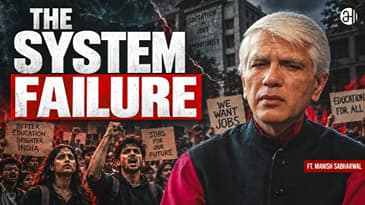

India doesn't have a jobs problem. It has a wages problem.
That reframe from Manish Sabharwal sets up one of our sharpest conversations on why India keeps producing record numbers of graduates who still feel stuck - and what a young person should actually do about it.
Roshan Cariappa sits down with Manish Sabharwal - co-founder of TeamLease and Ashoka University - to ask questions that are useful at any age: government job, private job, or building your own thing? And in a world where AI can do the "quick and dirty" first draft, what keeps a human relevant?
They get into India's 200-year-old education crisis, why our exams reward memory over judgement, why education became "the filling of a bucket" instead of "the lighting of a fire," and why your first job has almost nothing to do with where you end up. Manish makes the case that a skilled electrician now out-earns many salespeople, that "unemployment is a luxury good," that bravery is the one virtue you can't fake - and that the people who pull ahead are the ones who treat learning as a lifelong habit, not a one-time degree.
📚 CHAPTERS
(00:00) — The Questions This Conversation Answers
(01:19) — Are the Student Protests a Warning Sign?
(01:42) — India's 200-Year-Old Education Crisis
(05:18) — Medical Seats: Scarcity by Design
(07:13) — Should the Government Run Education?
(10:17) — When a Degree Stops Meaning Anything
(12:41) — What Questions Are Worth Asking?
(15:34) — The Three Intelligences AI Can't Replace
(20:29) — Why Outrage Is a Poor Fuel for Change
(24:14) — Student Activism: Get Stronger First
(28:52) — The Social Contract That Was Never Real
(30:21) — How Manish Would Redesign Education
(33:00) — "A Wages Problem, Not a Jobs Problem"
(36:17) — Why the Next 20 Years Belong to India
(40:31) — Everyone Wants a Bank Job. Plumbers Earn More.
(41:38) — "Unemployment Is a Luxury Good"
(44:43) — Bravery: The Virtue You Can't Fake
(48:38) — Is AI Killing the Entry-Level Job?
(54:43) — You Can't Outsource Your Own Destiny
(01:00:46) — The Doom and Victimhood Narrative
(01:03:05) — How Parenting Quietly Changed
(01:08:41) — Advice to an Anxious 21-Year-Old
👤 ABOUT MANISH SABHARWAL
Manish Sabharwal is the co-founder of TeamLease Services, one of India's largest staffing and skilling companies, and a co-founder of Ashoka University. A long-time columnist and former independent director on the board of the Reserve Bank of India, he is the author of Made in India. He has spent over two decades working on India's jobs, skilling and education reform.
🇮🇳 ABOUT BHARATVAARTA
Long-form conversations on India's politics, policy, economy, technology and culture — beyond the headlines.
🌐 https://www.bharatvaarta.in
✖️ https://x.com/bharatvaarta
📷 @bharatvaarta
[00:00:00] Historians warn against a disease called presentism. The historian broader warned against fireflies and froth, you know. India has been in education crisis for the last 200 years. While we're graduating record number of people every year, right, and this, again, there aren't, there simply isn't enough jobs. But there are enough jobs, there's just not enough wages. Education is not the filling of a bucket, it's the lighting of a fire in its highest form, right, as poet Yeats used to say.
[00:00:28] But in India, it became the filling of a bucket, right, and all our board exams are basically about measuring memory. AI is making that entry-level job almost redundant. AI is going to give that quick and dirty version rather than offering the hungry, hardworking, sincere types a shot at, you know, making something of themselves. You know, my boss used to say, you can ask the priest if you can smoke when you pray or pray when you smoke.
[00:00:54] I think the three intelligences I would love my kids to learn would be conversational intelligence, political intelligence, and serendipity intelligence. Thank you so much for being on Bharatvaarta again, sir. Always a pleasure speaking with you. Thank you for having me.
[00:01:19] So, just in a matter of a few months, we have seen these couple of protests from students across the nation. First, we had the NEET exam protests and today, I mean, now we have the IIT Bombay controversy as well. Should we read this as isolated incidents or is there some broader significance to this? Is there an underlying cause to the resentment that you're seeing? Thank you. You know, historians warn against a disease called presentism, the belief that today's circumstances are so special or so unique.
[00:01:50] Historian Brodel warned against fireflies and froth, you know. India has been in education crisis for the last 200 years, right? For the first sort of 150 years, it was under the British because they obviously had decided that a certain kind of education would keep us as a colony. So, that was and that manifested itself in various ways. But obviously, life expectancy was 31 when the British left. But now the British left a long time ago, right?
[00:02:19] And I think the most embarrassing number about India is that only 45% of our kids are left in government schools. See, only 5% of kids in Japan go to private school. Only 10% of kids in UK go to private school. Only 15% of kids in the US go to private school. If anything should be at free and at quality, it should be K-12 education, right?
[00:02:43] And while the creation of IITs, IAMs, AIMs has been masterful in higher education, it is a scandal on the neglect of primary education that happened after independence, right? It just seems like a blind spot in policymaking. And the 1948 Radha Krishnan Report, the 1968 Kothari Committee Report, the 1986 New Education Policy just did not focus on primary education.
[00:03:12] And if you think about prepare, repair and upgrade as a continuum, you know, you can't teach people in six months what they should have learned in 12 years. So, repair doesn't really work. I also think that just there are many changes happening in the world of global education, but the Indian context is very important because India's transition is not happening from farms to factories. It's happening from farm to services, right?
[00:03:38] China's happened from farm to factories and that's why their sort of transition of education and skills was a little different from India. So, I would say that India has been in an education crisis for a long time. It feels like a slow burn, but we pay the price, right? Why do we make 50% of the world's medicines but only get 6% of the world's revenues? Why did China account for one third of new drugs licensed when we are the world's drugs manufacturer?
[00:04:08] Why did DeepSeq come out of China when India exported more software than Saudi Arabia did oil a few years ago? So, I think we may look at education as infrastructure of opportunity, which I do, but also it is the font of innovation. You know, whether it is the school system or the skill system or the college and university system, I think we have a huge education crisis because we're not moving from volume to value in pharma or in many other businesses.
[00:04:37] So, I think these are not isolated incidents. I think we should recognize that education really needs a radical rethink in the way we thought industrial policy or industrial licensing in 1991, right? It's important to recognize 1991, but I don't... I've stopped doing the puja of 1991 because it is 35 years later. China and India had the same per capita income and now China is five times more than us.
[00:05:06] I don't want to live in China, but they have moved 400 million people from farm to non-farm employment. And one of the reasons is the education system. Right. Yeah, you're right in the sense that we did focus on higher education almost at the cost of primary education and so on. But even on the higher education side, right? I mean, you look at the number of medical seats available, for instance, right? I mean, is there like an artificial scarcity that's kind of built up in this?
[00:05:36] And why is the case, right? Why can't we deregulate on the medical education side of things? Because the licensing, Raj, in education has not held, right? But we've moved from, let's say, MCI to now NMC and still it hasn't made too much of a difference. Well, yeah, but we still haven't given up a mindset of prohibited till permitted. We haven't given up the mindset of drunk driving as an argument against cancer. So I think there are lots of civil service mentalities.
[00:06:06] I'm not sure the government should be regulating education as deeply as it does. It should be accreditating institutions. But the sophistication is obvious in a randomized control trial in Iran between engineering education and medical education, right? We went from 2 lakhs 25 years ago in engineering seats to almost 18 lakhs and then came back to 11 lakhs and have gone up to 15 lakhs, right?
[00:06:33] And the crappy engineering colleges in Tamil Nadu, Andhra and Kannatka, which have become the supply chain of the IT services industry, because over time consumers, parents and kids and staff have chosen which engineering colleges are better than others, right? So I think the market is and consumers are not that dumb and we're not infants the way education regulation tends to treat us.
[00:06:58] So in engineering education, we expanded quantity, which led to quality. But in medical education, we decided that controlling quantity would lead to quality and we have actually ended up with neither. Right. But let me try to steelman the other case, right? Which is that education is perhaps one of the biggest expenses for a family, a household and key to moving up, right? I mean, social mobility and so on.
[00:07:25] So shouldn't the government decide on certain norms and standards for, you know, how colleges are run, how degrees are handed out, and just make it more valuable for the person to invest time and effort and money into getting this degree and education from a particular college? See, it's very hard to measure what matters in education, right? Knowledge no longer matters as much as it did.
[00:07:53] But all our assessments, education is not the filling of a bucket, it's the lighting of a fire in its highest form, right? As poet Yeats used to say. But in India, it became the filling of a bucket, right? And all our board exams are basically about measuring memory. But in a world of AI where technical problems are no longer as important as wicked problems. See, technical problems are where the players stay the same, the rules stay the same, and the goals stay the same.
[00:08:23] Wicked problems are where it is your job to change the rules, to change the goals, and to change this, right? And so, Jung used to talk about thinking, feeling, sensing, and intuition. But we only define education as thinking, right? I think the future of education is educating intuition. Now, how do you assess intuition? How do you assess judgment? How do you assess imagination?
[00:08:50] So, while I agree with the need for consumer protection in education, but consumer protection confuses university buildings with building universities, right? You specify input norms, but you don't measure what matters, right? Because measuring that is hard. So, I'm not absolutely for one saying that there should be a poorness for age for universities or schools from boards.
[00:09:16] But I think the current regulatory over-prescription on input norms creates an adverse selection among education entrepreneurs. Because you can't be a first-generation entrepreneur. See, my father was in the police. How was I able to start both my companies? He didn't have the money to give me. It was venture capital, right? But in education, venture capital can't come because you can't take external investors. It's a trust. The structures prescribed are so difficult.
[00:09:44] In any way, the capital prescribed because of land and building. India has mispriced land so early in our development that setting up a school for a teacher or a principal is impossible. So, who sets up schools? Politicians, landlords or criminals, right? Because they have... So, the adverse selection among education entrepreneurs comes from a good place of saying we need to protect consumers.
[00:10:10] But we have neither delivered cost nor quantity nor quality. Education has also come to mean the acquisition of a degree at this point, right? And of course, I mean, it's a bit rich for us to talk about it given the per capita where we are right now and so on, right? I mean, obviously, survival is the core for us. But still, I mean, should it mean something else? Because, you know, if you look at Goodhart's Law, for example, right? I mean, classic case where, you know, the measure has become a target and so, I mean, it's kind of become redundant right now.
[00:10:40] So, you have everyone with all kinds of degrees, but it really doesn't translate too much in a practical sense. But that's not a uniquely Indian phenomenon, right? 60% of taxi drivers in Korea now have a college degree. 33% of Walmart checkout clerks have a college degree. 15% of high-end security guards in India have a college degree. So, college isn't what it used to be. But Michael Spence, you know, got his Nobel Prize for the signaling value of higher education.
[00:11:10] Right? My wife went to Harvard. I went to Wharton. These are good places to be at, but they're better places to be from, right? The fundamental value is being from IIT or IIM. It's not being at IIT or IIM. At least, I don't think so. So, I think we have to strike a balance between how do you deliver. Traditional universities deliver signaling value. You can deliver signaling value two ways. By tight exit gates and wide open, tight entry gates and wide open exit gates like the IITs and IIMs. Right.
[00:11:38] Or like the chartered accountant exam, which has wide open entry gate and tight exit gates. Only 2-3% of the people fast it. Vocational training in India and many universities have had wide open entry gates and wide open exit gates, which is why we have not created the signaling value. But I think you ask a more important question about is education for living? Is it for citizenship? Or is it for earning? And I think it's got to be a combination of all three, right?
[00:12:06] I mean, a country without any educated citizens, I think the politics will be very different. Obviously, we see that in many parts of the world. An education which does not make you a holistic human being is also problematic. Life is not the solving of a sum. It is the painting of a picture. We don't live in an economy. We live in a society. Too many engineers think that we live in an life is the solving of a sum. But I wish they would think about liberal arts.
[00:12:36] You know, it's not always about how to solve a problem, but it is also deciding which problem to solve is maybe the more important question. What questions are worth asking? What questions are worth asking? And then learning for earning is important, right? In a country like India, where, you know, upper capita income is 128th in the world right now. We may be fourth in total GDP. So we can't expect always parents to have the resources to give their kids the rent.
[00:13:03] I have learned in Team Lease that the two most important decisions a child in India makes are to choose your parents wisely and your PIN code wisely, right? Now, how do you break that opening balance tyranny? You break it through employment system, which is growing and giving you good jobs through an education system, which recognizes that your opening balance is important, but it's not going to decide your closing balance.
[00:13:27] If you're willing to work hard, if you're willing to sort of I love asking music maestros or sports coaches, what matters more to make a champion or a maestro, right? Is it Talim, is it Fitrat or is it Riaz, right? Talim is the education, Fitrat is your nature and Riaz is your hard work, right?
[00:13:50] I think for me, Team Lease has reminded me about the profound question about the role of education in sort of as social mobility, right? And that is the question which you were asking originally. And I think it's if we don't fix our social mobility, we don't really deliver on our ambition as a country. So we delivered mass democracy.
[00:14:15] We created the world's largest democracy on the infertile soil of one of the world's most hierarchical societies. But why didn't we deliver mass prosperity? You know, surely those were the two objectives in our minds. Perhaps there may be other objectives, but at least in my mind, I am disappointed. And I think mass prosperity was not decided because our education system has not kept up with many of the innovations that have happened in many other parts of the world.
[00:14:42] And unfortunately for us, the world of work, the world of education is changing so rapidly. You know, we define education or the world defined education as the three R's of reading, writing and arithmetic. But it's the fourth R of relationships which now matters even more, right? Soft skills are not taught, they are caught. So if I was to think about how does humans have an unfair advantage at being human, right? How do we compete with AI?
[00:15:09] I think the three intelligences I would love my kids to learn would be conversational intelligence, political intelligence and serendipity intelligence, right? Conversational intelligence, it doesn't matter what you say. It matters how you say it, when you say it, in front of whom you say it and where you say it, right? You ask the, you can, you know, my boss used to say, you can ask the priest if you can smoke when you pray or pray when you smoke and you'll have entirely different responses to that. Yes, absolutely.
[00:15:35] I was on the, you know, RBI board and I remember one of my colleagues, Dilip Sangvi, whom I respect a lot, he's the creator of San Pharma. He said, Manish, you're a very smart guy. You want to be more effective as a board member? I said, yes, sir. He says, why don't you be a therapist instead of an oncologist, right? He said, why don't you learn to listen a little more, be a little kama rather than tell them this is the logic and that's right. So I think conversational intelligence is something that I wish our schools could teach.
[00:16:02] Political intelligence, you know, the ability to get along with people who don't like you, get along with people whom you don't like. The ability to build coalitions, the ability to build alliances, you know, influence without authority. I remember Dr. Kastu Irangan when we were on the Karnataka Knowledge Commission, he also said the same thing to me. He said, you want to be more effective? I said, absolutely, sir. He said, why don't you raise something three board meetings before you insist on it? You raise something and you insist on it. He said, raise it.
[00:16:30] First meeting, they'll say not doable, not desirable. Second meeting, they'll say, okay, doable, desirable, but not doable. Third meeting, they'll say, oh, you're saying, oh, you're not going to do this again. So I think that political intelligence is going to be key, the ability to work in teams because finally, you know, lone wolves are never as effective as a pack of wolves. But serendipity intelligence, you know, the ability to increase your luck. Richard Wiseman's research suggests that people who smile more are more lucky.
[00:16:59] Obviously, people who work hard are more lucky, but people who hang out with cognitively diverse people are more lucky. So I think we're in the process outside the Indian context itself, in a global context of defining what are the kind of intelligences that will matter in a world of AI. And I don't think our traditional universities anywhere in the world teach serendipity, political and conversational intelligence, right? And the concepts they may teach you.
[00:17:29] But I think that the world of work is going to demand as much higher standards than it did in the past, right? And unfortunately for us, this has huge political implications because inequality is really going to rise, right? I mean, I still haven't made up my mind on whether AI will bring low-skilled people to the median or it will make superstars uncatchable. See, if it brings low-skilled people to the median, it'll be a gift to humanity because productivity will go up.
[00:17:57] But I think it'll make superstars uncatchable, which reinforces an existing trend of knowledge. See, a good electrician, a good plumber, a good barbender is five times better than a bad one. But a good software programmer is 100 times better than a bad software programmer. A good investment manager is 200 times better than a bad investment manager. A good CEO is 500 times better than a bad CEO. So knowledge businesses anyway have inequality built into them.
[00:18:25] Now, if you equip the good knowledge workers with AI, I mean, essentially pyramids will become Eiffel Towers, right? Because senior people will be able to do so much more with so little this thing. So my sense is I think we have to be very mindful of what's going on in the world of education outside India. Before defending the status quo in India, we need a massive dose of deregulation in Indian education. We need all three.
[00:18:55] You know, the objectives of any of my favorite book about education is John Gardner who says, can we be equal and excellent? As a democracy, we want to be equal. We want to give everybody opportunities. But if we want to come up with innovation, we also need to be excellent. You know, we shouldn't look down on MIT and Harvard and Stanford. I mean, MIT was created by World War II or won America World War II. Stanford pretty much won the Cold War for America by this way.
[00:19:22] And obviously seeded so much of their technology leadership today. So I think we underrate the value of human capital in per capita GDP, in power. You know, it's been very difficult, the U.S. trade negotiation. They keep changing the negotiator. They keep saying, I don't care if India does a deal with us. Everything you agree to, see it will come on the floor. The only thing that the U.S. trade negotiation reminds us is that we have to make ourselves stronger.
[00:19:52] You know, and the biggest source of strength will be human capital. So I think a massive sort of rethink of how our school skill and university system works is way overdue. I don't think the current University Grants Commission, the way it is set up as a regulator, is the appropriate institutional format to encourage the creation of world-beating universities,
[00:20:19] to increase capacity in schools, and to just ensure that we do all, we recognize cognitively diverse learners. In that sense, were you a bit disappointed with the kind of remarks that you heard over the last few months? I mean, there might be a selection bias in terms of who they put in front of the camera and, you know, what sound bites they choose to show and so on. But it's not even the coarseness of the language.
[00:20:46] But there was a certain aesthetic that was really terrible. I mean, in the sense, just plain decency, you know, of the type of language being spoken, the tone, tenor and everything. Right. I mean, and that can't be something that they picked up yesterday. Right. I mean, that should be something that, you know, don't you think that an education is supposed to like help someone parse some of these things and figure out like what to say and what not to say and so on? Oh, I don't think so.
[00:21:14] That's why I think conversational intelligence is a key skill that we don't have. See, first of all, I'm not sure educated people are necessarily better human beings than non-educated people. Over a long period of time, I know lots of wise people who didn't have the opportunity to go to college or the kind of schools that I went to, but their judgment is better than mine. So I first of all want to recognize that there are many ways to get an education, which
[00:21:40] is different than our traditional view in the last 30, 40 years. But I think I was absolutely disappointed because I think education reform is important, but I think outrage is a poor fuel for change. I think calling people names, I think screaming and shouting is not the way change societies change. You must fight the battle for ideas. You must decide whether you are trying to be successful or you're trying to be right.
[00:22:10] Try to be successful, right? And successful, you have to have political intelligence to build the coalitions. You know, make yourself powerful. Build power. We talked about this last time. Think about power structures. Think about how power is generated. Think about how power is grown. And think about how power can be welded. All of us as Indian citizens have a lot of power. But we have to work with others. We have to be patient.
[00:22:37] We have to fight the battle for ideas over long periods of time. We have to create coalitions. We have to do advocacy. I'm not sure shutting down things. I mean, if Gandhiji was around, I would really argue with him on whether civil disobedience is the right thing in a democracy. It was the right thing when you were filing a colonial power. But I think a democracy, Gandhiji gave us, has a lot of other tools to fight for change.
[00:23:03] So my view of change is that you must work with the system, inside the system, from outside the system. But I'm not sure that... I think outrage is a poor fuel for change, if not channelized, into fighting the battle for ideas, into understanding how power is exercised, and building coalitions and partnerships and alliances with people who may not, you may not like, but want the same thing.
[00:23:30] So I think fighting in packs is a better way to change society than the lone wolf view of the world. And thinking about power rather than sort of believing that there is going to be a world without power. I think the sweet spot for my theory of change is idealism without illusions. I think you idealists often sort of look down upon people who sort of talk about glide
[00:23:58] paths, who talk about coalitions, who talk about coalitions as people who compromise or as people with lower ambition. Actually, idealism without illusions has higher ambition than idealism. Right. You wrote this wonderful article when the Ashoka University protests happened on student activism. And I think that bears reading for everyone on how the system we inherit. Right. I mean, it's an amanat and it's not a jagir. Right.
[00:24:28] In that context, I want to talk about student activism in itself. Right. I mean, how much interest and even responsibility should students take to change the circumstances around them? Right. I mean, is it the job of a student to sort of like invest in themselves, become more capable in the three or four years that they are in college? Or should they also concern themselves with everything that's happening around the world and let their voices be heard, even if it's imperfect? Right. Right.
[00:24:58] And without full understanding. So what is that balance? My view of is that I am older, wiser and more dangerous because I have chosen to build my knowledge. I have read a book a week for 42 years. I have chosen to build my networks. I don't hang out with people from business school. I know a lot of people who didn't go to business school. That makes me more cognitively diverse.
[00:25:22] But most importantly, I think my favorite poet, Ramdhari Singh Dinkar, Sahishama Shobati Us Bujang Ko Jis Ke Paas Garal Ho, right? Only snakes with venom can be kind, benevolent and generous. I think students should be politically aware. But I think they should be idealists without illusions. We work in a democracy. It has tools. That democracy obviously can be hijacked by vested interests.
[00:25:49] But then you become a vested interest for your view of the world, right? In Anik Antabad, which was Gandhiji's multi-sidedness of truth, where you stand on an issue depends on where you sit, right? And so why don't you go sit in some place where you exercise the power to change the system? So my view is that education, especially school and college, is to make yourself stronger, is to make yourself aware. It is not just about knowledge.
[00:26:17] Now, I'm not saying student activism is not something that should not happen. But I think student activism is about educating yourself about the issues of society. And then you make yourself strong, you educate yourself, you create your networks, and then you go out and change the country in the ways that you want to do it. But I think education is about making yourself stronger. I think that life is long, life is a marathon.
[00:26:45] I think, in fact, the 25 years of learning, 25 years of earning, and 25 years of giving is not a model that I agree with anymore. When I was young, I was told I should learn for 25 years, then earn for 25 years and give from 25 years. I have reversed that option. I gave up my earning much earlier in terms of my executive role. I continue to do lifelong learning.
[00:27:12] I am giving in much ways, much earlier than I'm before 75 years old. So I think that students must recognize that the universe does respond to your power. The universe does respond to making yourself stronger. The universe is not conspiring against everybody. You know, this victim mentality is very often not useful in my mind. I think when something goes wrong, there are some people in the world who say,
[00:27:41] whose fault was it? And I've been telling you that this will happen for 20 years. The people I find most interesting are what can we do about it today? And so I think people should spend their education making themselves stronger so that they can make the world better. They don't need to make the world better when they're 12 years old or 16 years old or 18 years old. They should make themselves aware and craft their interests on what they're interested in. They should explore science.
[00:28:11] They should explore humanities. They should explore math. They should explore all kinds of things. But the more cognitively diverse you are, the more interdisciplinary you are, the harder it is to get a good education. Right? I think mongrels will rule the world. In a world of AI, you know, mongrels will be people who are comfortable with math and English. They are comfortable with liberal arts and engineering. They are comfortable with political science and sociology. So, but if you want to learn all that,
[00:28:41] it's going to take a lot of time and a lot of work in your education. So I would focus on education, make yourself stronger, and at the exit gate of your education, go change the world. Right. But is there also a cause for concern, considering that, you know, this social contract that we had, almost implicit, no, explicit social contract that we had, that, you know, get a degree, get married, you know, build a family, so on and so forth. That seems to be collapsing, right? I mean, in the sense... But that was never true,
[00:29:11] other than for the last 30, 40 years. Oh, yeah, I mean... Well, that's a sampling error. I mean, it's again back to my view of history, right? Of presentism, you know, that's... But wasn't that valid for at least about three generations? No, no, not at all. Not at all. That's a sampling error. It was valid for my brother's generation and my generation. Yes, yes, because you chose your parents wisely. And so did I. I think we tend to... If there's one concept I would like my kids to learn,
[00:29:39] it is don't think in stories, think in statistics, right? So when you think probability is a very important thing to learn. And I think human beings just don't think in terms of probability or statistics. We think in terms of stories, you know. And stories are... All stories are true. Every anecdote is true. But is that anecdote scalable, replicable, generalizable, and representative? It's an important interrogation I would urge you to do.
[00:30:08] I don't think that this social mobility... And even in America, if you were black or you were a woman, it's not clear there was that much social mobility in the golden age that Trump thinks... But doesn't it improve the odds of success that... I mean... Education. At that point of time... Education still does improve the odds of success. I am... We are not in a post-education world yet. But the cost of education had ballooned. The cost of education... The forms of education had gone wrong. We have to fix that.
[00:30:35] But I think education, which is the distance from where you started, is always going to be a ladder for social mobility. Now, will a pure degree be the pathway to that? Will we move to... If I was to design an education system or a skill system, there would be five design principles I would use today. It would be learning while learning. Right? Because people who don't have can't go. Right? So I think India will be the first country where employed learners cross full-time learners.
[00:31:05] I think it would be learning with modularity. A three-month certificate is an opening balance for a one-year diploma, is an opening balance for a three-year degree, and you have multiple on-ramps and off-ramps. You stack it. You stack it. It would be learning by doing. Because soft skills are not taught, they are caught. You need to figure out how to get things done rather than study in this thing. You need learning with a multimodal delivery. An online classroom should be pedagogically equal to an on-site classroom,
[00:31:33] should be equal to an on-campus classroom, should be equal to an on-job classroom. And the fifth one would be learning with signaling value, which is not social signaling value, which is what Michael Spence got his Nobel Prize for, but employability signaling value. And that apprenticeships give you that, right? In some sense. So I think that education will have to be reimagined for a world where you can rent as much IQ as you want. But actually education will have to become about educating intuition.
[00:32:03] Education, educating sensing, educating feeling, rather than purely educating thinking. So I think educating thinking was okay for an industrial revolution without AI. In a place where the industrial revolution has happened, manufacturing is much less labor intensive than it used to be, robotics, automation. And so now in a post-industrial society where there will still be people working in manufacturing,
[00:32:30] but it'll never be the 40-45% peak of labor force that Britain had in World War II, 45% of labor force of wagon factories, that's never going to come back, right? So I think we need to think about reimagining education for the new world. Life is a river. It's not a pond, right? So while education was okay for the industrial revolution, there was a certain kind of education. But we may still be stuck in measuring our assessments are still industrial revolution kind of assessments.
[00:32:59] But we're doing all of this or we're having to do all of this while we're graduating record number of people every year, right? And this, again, there simply isn't enough jobs to sort of... Well, there are enough jobs. There's just not enough wages. That's the argument. Well, that's an important point. I don't think unemployment is the problem. So I think that India has a wages problem. It doesn't have a jobs problem. Everybody who wants a job has a job. They just don't have the wages they want,
[00:33:29] the wages they need, or the wages that they thought they would get after their education. So let me push back slightly on that. So which is that one, I mean, wages have stagnated, right? I mean, whether it is an entry-level engineer or other forms of employed work... No, but for superstars, it hasn't. Well, but superstars are outliers, right? So that's what my point to you originally was,
[00:33:54] that maybe inequality in wages is a child of the knowledge economy, which makes this a public finance problem. Let's see, I'm making two, three leaps here. I genuinely believe that technology, automation, AI is increasing inequality in productivity. That will reflect in inequality of wages. In a plumber, a bar vendor, it's four times better. In a...
[00:34:24] It's 400 times more. So if there's 400 times more, the guy who's 400 times better is going to get much higher wages than even if you are a software programmer. So within software programmers also, there is a substantial standard deviation now among people who get paid. Yes, entry-level people don't get paid that much, but the good ones accelerate very quickly in one year, two years, three years. And unfortunately, the good ones accelerate so much more and almost the bottom is sort of the Eiffel Tower
[00:34:52] that I was talking about, right? The people in the thin part of the Eiffel Tower are getting paid are equal to 20 people at the bottom of the Eiffel Tower or 40 people. So I think there is a broader change in the world of work, which is increasing inequality in wages, right? But I think India has a first-order problem. This is a second-order problem. We have a licensed Raj in education. We have very poor government schools. We have a skill system not fully in sync with the world of work.
[00:35:21] And we have massive capacity constraints in our education system. And why don't we have more top 100 universities? Singwa University, I don't want to live in China, but it was destroyed by Mao in 1978. Today, it has almost 80,000 students and 26,000 PhDs. It is one of the reasons of China's renewal. Where is our Singwa University? I mean, I'm one of the co-founders at Ashoka University.
[00:35:50] I'm very proud of what the university has accomplished and where it is going. I think it has the best chance to be among the top 100 universities in the world. But we have 5,000 students. You know, we have to really, India's population scale has to really raise our ambition also has to be population scale from the private sector. And the government's capacity also has to be population scale capacity. But what I'm trying to get at is
[00:36:18] there is a transitionary problem right now here. There's a transitionary problem in every generation. There was a transitionary problem in the Industrial Revolution. There was a problem. I just don't believe, I believe presentism is a form of narcissism, right? It's just a belief that today's circumstances are so special. But isn't the scale and the complexity of the challenges like way bigger right now? Because as I said... But on many aspects, I mean, people are not dying of hunger.
[00:36:47] Life expectancy is continuing to increase. Violence is continuing to come down. So, I mean, is India worse today? If you read the newspapers today, you'll think India is in a terrible condition politically. But in the 1950s, the Communist Party had declared war on the Indian state. In the 1960s, we ran out of food. In the 1970s, we had emergency. In 1980s, we had Blue Star. In 1990s, we had Kashmir. I'm not sure that today's circumstances
[00:37:15] are that soul-destroying and where I did. See, I have also, I must caveat my... You know, I have... I believe that the next 20 years for us is India's time. Primarily because the West has run out of petrol. And China is a very... It's a country whom I don't... Again, I don't want to live there, but I respect for their moving 400 million. But their demographics are very difficult.
[00:37:45] Their debt situation of 400% debt to GDP is very difficult. So, obviously, it has challenged my... China as a country. I thought autocracies or dictatorships couldn't deliver mass prosperity, but that damn thing is delivering innovation also, right? I thought, well, dictatorships can't deliver mass prosperity, but, you know, now if they deliver innovation and mass prosperity, then we would be idiots, right? Because... So... But I think they are... Their demographics and debt are real drags
[00:38:15] on their real potential. I think Trump is not the chef. He is the waiter. You know, America is asking for immigration to be shut down. The three geniuses of America were stealing the best people in the world. Public spending on science and globalization of supply chains. I think Japan, the sale of adult diapers has cost baby diapers. In Europe, they are 7% of the world's population, but they have 50% of the world's social spending.
[00:38:45] So I think India, just given our demographics and given our past mistakes, we are coming off a small base. So while these frontier problems of AI and other things, India is very far from the frontier problem. 45%... What is the nightmare of America? 45% of their labor force will generate 14% of GDP because of AI. But what are we going to say? We are already there. 45% of our labor force in agriculture only generates 14% of GDP.
[00:39:14] It's self-exploitation. So I think we have a real chance in the next 20 years to overcome some of the opening balance challenges that we had from colonialism, from the 1955 Awadi resolution, and from the 1991 reforms, not including education. I think that was a big blind spot. We have spent the last 35 years without radical changes to our school, skill, and college system.
[00:39:43] And that really has to become reality if we want to do it. Now, let me caveat that I have also decided that optimists will never get as much respect as pessimists because pessimists sound like they're protecting you and optimists sound like I'm selling you something. But I genuinely believe this, that given the state of the world, see, life is a beauty contest. You don't have to be, look like Aishwarya Raya, Malin Soman. You just have to be less ugly than the others, right?
[00:40:12] So AI is affecting everybody in the world equally. We have many sort of advantages. We have many disadvantages. My net calculation of the next 20, 25 years is that it'll be much better than the last 25 or 50 years for India. Right. But I speak of this transitionary generation of folks, right? I mean, who are, let's say graduating now, have to enter the workforce. I think, you know, there is a slight mismatch
[00:40:41] or rather large mismatch in expectations, right? Because you're, and it's reflected in the kind of... Yeah, but there was a mismatch in skills. There was a mismatch in... Of course. In many mismatches, right? Of course, of course. Because you see a large number of these folks, for example, applying to some banking jobs, then some PSU, government jobs and so on. Like crazy numbers of people applying to very limited sort of jobs, right? And at the same time, I mean, in a city, for example, in Bangalore, there's a huge dearth of people who are skilled, right? I mean, technicians, like mechanics,
[00:41:12] plumbers, carpenters, but it'll almost be sacrilege to, you know, ask our youth to explore these avenues, right? Well, I'm not sure it'll be sacrilege in the long run because plumbers and, plumbers and electricians make more wages than salespeople. They make a killing in Bangalore, right? I mean, like, and perhaps, I mean, you know, go back to the times of being tradesmen and craftsmen and, you know, those, think in that sense, right? But, yeah, I mean, you try explaining this to others. We'll work it out, right? So my sense is
[00:41:41] the only true information in any economy are votes and prices. Everything else is a model. See, I think the price of labor in relatively between these so-called white-collar professions and gray-collar professions and blue-collar professions, those were artificial partitions anyway, you know? So if you work with your hands and legs, your wage premium, and you have skills, your wage premium will more than compensate for that. Unfortunately, the social signaling value may not be there.
[00:42:10] So this is not a problem labor market or education can solve. This is a problem society has to think through. That's not, that's above the pay grade of people in education and labor markets. If people say that I would rather be unemployed than get some wages in a profession where I have to use my hands and legs, then that's up to them. First of all, unemployment is a luxury good. Only if you choose your parents wisely can you be unemployed. So to me, I don't have that much
[00:42:39] sympathy for engineers who are sitting at home and not taking a job because their parents are paying for them. You know, my parents told me to go and find a job. I found a job and I'm glad that they did that. They could have paid for me to sit at home and wait for a better job. They told me to take the best job I could get after SRCC, which was a real problem because I didn't have an MBA and I wanted to go to a business school who said, you get four years of work before an MBA. In India, the problem is no one will give you a job without work experience, but how do you get
[00:43:09] work experience without a job, right? But I went and found a job and I got four years of work experience and I went to Wharton. So beyond a point, my sympathy for people saying I'm not getting any job is very high. My sympathy for I'm not getting the job I like, I'm not getting the job commensurate with my experience, I have no sympathy for because most people's first job has nothing to do with what they do in the long run. They take the first job, they show that they are hardworking, they show they are intelligent,
[00:43:39] no employer can keep you down. So I would first of all advise people who are believed that they are not getting a return on their education to look inside rather than look outside and keep making noise like I have been making for 25 years that our employment, education, and employability ecosystem has too much regulatory cholesterol. India is not generating formal employers at the speed that it should. India does not have enough medical seats. All that can continue. See, we have to all operate at two levels.
[00:44:09] One is in our society engagement and the other is at the individual engagement. But I think if people are saying that they are not willing to take jobs because it is not, it pays enough but it's below their dignity, I don't really care for them. That's not, I don't think, I think they are getting bad advice is my advice to them. I think they are getting bad advice. Your first job has nothing to do with what you do in the long run. If you get a job, get in the workplace,
[00:44:39] show you work hard, show your skills, no employer can keep you down. I was embarrassed to say that I worked in sales after an engineering degree for a good amount of, I mean, my parents were too, I mean, so for a good year, couple of years, even after... Why were you embarrassed? I mean, because I had a technical degree and so on and whatnot. I mean, I spent all of three months in the refinery and I came back and I couldn't do more of that, right? I mean, I decided that that's not the life that I wanted. So I was fine with it but it's just that
[00:45:09] there was, my parents were the thoughts that this was the first engineer of the family and so on and so forth. So I kind of sort of sympathize with folks who might be in those circumstances but the other thing... But then they should do what you do. Which was great. I mean, on hindsight, everything worked out beautifully, right? So 18 years after that... No, it's not in hindsight. You know, I recently wrote a book called Made in India about Indian Pharma and the first three words in the book are Veerbhogiva Sundara
[00:45:39] which is the brave shall inherit the earth. Right? I think bravery is a very, very underrated virtue. You know, all the crap that I learned in MBA and first of all, bravery is very valuable because it's the only virtue you can't fake. So you can fake kindness, you can fake curiosity, you can fake empathy, you can fake bravery. But most importantly, bravery makes all of the other virtues more valuable. It is a meta-virtue. It makes... If you're curious, if you're kind, if you're hardworking, bravery will make
[00:46:08] the other virtues more valuable. So you're quitting that royal refinery and taking a sales job was bravery. And in some sense, it's not a skill that other people, brave people are not people in comic books or biographies that we read about kings. Bravery is your choices about education, your choices about employment, your choices about do you want a big job in a small company or a big job or a small job in a big company? Do you want to work for a multinational or do you want to work
[00:46:38] for an Indian company? Do you want to work for a small company or a big company? Do you want to work in manufacturing or services? All are the wrong questions. You should only work for a growth company. It doesn't matter whether it's small, big, multinational. You should work for a growth company. And so I think there's... While I'm not sure that we have the job apocalypse in India that America is starting to face. Because $10,000 is a lot of money depending on which side you're coming from. Right?
[00:47:08] America's problem is that the $30,000, $40,000, $50,000 job will disappear. But we still are far from the productivity frontier. So I would advise younger people who are coming out of college to really think about soft skills, to think about political intelligence, conversational intelligence, serendipity intelligence, to think about the opportunities that India offers. I think India should offer it faster, which is why I spend half my time on public policy. But hopefully
[00:47:38] we will get our act together on that. But to hold out for some perfect person is like holding out for the perfect spouse. Right? When I only got married at 31 and my wife told... And my mom told me when I was not getting married, I said, I'm looking for somebody perfect. She said, you know what the problem is? This guy who was looking for somebody perfect for 10 years and then he found the perfect girl. But she was looking for the perfect boy. And so nothing happened, right?
[00:48:08] Which is what many of your people who are engineers are holding out for. They're holding out for the perfect job. But then the employer is looking for the perfect employee. So I would say that life is messy, I'd say. But right now, if you're saying that India's problem is people who are qualified, who are not taking jobs on offer, which pay more because they believe they're an engineer and shouldn't do a sales job, I think they're getting the wrong advice. Right.
[00:48:38] For a long while, we, or rather, I mean, the colleges sort of outsourced this on-job training to the companies, right? So whether it's an engineer or whoever else, right? I mean, it was sort of an implicit understanding that, hey, I mean, I will funnel these folks towards you and then you will run them through a three-month or six-month program depending on, you know, the job opportunity or the company and the industry and they would get you quote-unquote job ready, right? But now, if you think about it, I mean, AI is making that
[00:49:07] entry-level job almost redundant because for a lot of us, the first job was, hey, we're going to hustle hard, we're going to give you a quick and dirty version of something, you're going to give me feedback and I'm going to iterate and learn and we're going to get there faster, right? But AI is going to give that quick and dirty version two at a time, right? folks who are hiring slightly mid to senior people now to do these jobs, right? And sort of lift that baseline a little bit rather than offering
[00:49:36] the hungry, hardworking, sincere types a shot at, you know, making something of themselves. See, first of all, we're very good at predicting which jobs will die, we're not very good at predicting which jobs will be born, right? If you go back, I spent some time looking at the newspapers and the journals when the Industrial Revolution came and people were exactly in the same mood, right? But the Industrial Revolution was not bad for employment. The Industrial Revolution was very good for employment. So the question
[00:50:05] for us here right now is that how are we going to figure out how to get our entry-level jobs to marinate in the same ecosystem as the education ecosystem? See, we have partitioned the worlds of education, employment, and employability too vertically and too strongly, right? Thinking and doing should never have been partitioned anyway, right? I mean, it is the essence
[00:50:35] of strategy actually is thinking and doing. My father, who was in the police, used to carry a plaque all through his career from Thucydides, who was a Greek general. He used to say any army that has too much of a gap between his thinkers and doers will have its fighting done by fools and his thinking done by cowards, right? Now, I think that is what has happened in the education system. We have people in academics sometimes who can be cowards and we have people who are doing things who are fools, right?
[00:51:05] See, if you have too much thinking and no doing, you do nothing. And if you have too much doing and no thinking, you do nothing great. So the intersection of thinking and doing should anyway have never been as partitioned, which is why I was happy with my four years of work ex before Wharton. Right? All my batch mates at Sriram College of Commerce, which you may have noticed this year had a 99.2% cutoff. Obviously, there were smart people who go there,
[00:51:34] but all of them went straight for their MBA straight after their BCom. And that was a mistake. First of all, a BCom is a mistake. It's the world's most useless degree, but I would go back and do something broader. But even if you did a BCom, I spent four and a half years or five years. My wife spent seven years before her MBA and she went to Harvard. I spent five and a half years. And that is the way that you, the notion that education is something you finish off on a trot. Right? And my parents were also middle class.
[00:52:03] He was in the police. They didn't understand at first why I wanted four, five years of work ex. They said, well, you finish your bachelor's, you go get your master's. Right? And then after my master's, I've sort of kept up a curated plan of lifelong learning. I think that you're going to have to develop lifelong learning plans. The upfront 10 plus 2 plus 3 plus is inappropriate. My parents had 35 year careers. I'll have a 45 year career.
[00:52:33] My kids will have 55 year careers. So this upfront 10 plus 2 plus 3 system is not going to work unless you learn how to read books, unless you learn how to develop relationships which improve your knowledge, unless you get into roles which improve your knowledge, unless you, you have, you'll have to figure out how you learn. Maybe somebody learned, I read my books, I learned my roles. The RBI board was the best political science classroom I've ever been in. I thought it would be a finance classroom but it ended up being a political science classroom. So I think
[00:53:02] this notion that learning, doing, apprenticeship are sequential, are not in parallel, you will finish your education and then you will join the world of work. I think that has been a sampling error because that was never true, right? through human history. And that's why I have to keep reminding myself some of the people I respect the most, whose judgment I respect, whose intuition I respect, whose ability to increase their luck I respect,
[00:53:32] did not go to the same top tier colleges. See, I chose my parents wisely, I went to a great business school, I went to a great undergrad college and I went to Mayo which is a great school. But some of the people who didn't get an opportunity to go to these schools are much smarter than me. So we have to be very careful with the signaling value of higher education being the primary value of higher education and recognizing that there are multiple ways to learn. So I am not as disappointed
[00:54:00] with the ivory tower crumbling as much as I should be because I went there. Because I have, between who I am, which is went to the ivory tower schools and what I do in Team Lees which has only hired 5% of the kids who came to us for a job is a recognition that the ivory tower may not be delivering for most people. It delivers for a small sliver of people and we guys sort of extrapolate our knowledge to the rest of the world.
[00:54:29] So I am not sure we are in an education apocalypse. I think we should be embarrassed with the level of education reforms we have done since 1991 and I hope we will change them in the next 25 years. Yeah, all of this again puts a lot of cognitive load on the individual because I think for a long time I mean I think we had sort of outsourced it to a collective I think that was a mistake. Yeah. I think outsourcing your destiny see
[00:54:58] is history are you in Tolstoy's camp or Will Durant's camp? You know Tolstoy used to say people are history's slaves and Carlisle used to say the history of the world is the biography of its leaders right? Or leaders are history slaves. So the social science view of history which is Tolstoy and Karl Marx sort of view circumstances as the only thing that matters. The literature view history which is Will Durant, Carlisle
[00:55:28] and many other people say that look people really matter. But the challenge is as you get older you recognize that luck and skill matter equally right? You know I know lots of lucky people who are completely unskilled I know lots of skilled people who are completely unlucky so actually Karl Marx whom I obviously hate but you know the only quote of his which I agree with he says we make our own luck but not in the circumstances of our choosing and I think that's the right reconciliation of the framing
[00:55:57] of the question that you put that we had outsourced it we always outsource circumstances we don't choose which generation we are born into we don't choose whether we are born when AI was invented or the steam machine was engine was invented or the agricultural hoe was invented or when PCs were invented there have been many discontinuals of technology I'm not sure that there has been any time in the last 100 years when technology has not continuously been making manufacturing
[00:56:27] less labor intensive than it used to be manufacturing has continuously become labor intensive software services unfortunately is very labor intensive but doesn't pay well good wages you know food services or hospitality and all these which are very labor intensive don't always pay the best so I think the notion that yes as individuals we will have to take more responsibility for our destiny which means for our education which means we will have to curate our lifelong learning
[00:56:57] plans is inevitable is it good or bad I don't know I think actually that's a debate is a waste of time because people who sort of want to get up and do things will not debate whether it's good or bad they just do what they can where they are with what they have and the world that they are born in in 2026 or the world that they graduate to in 2027 is a different world than 2020 or 1975 is it better or worse
[00:57:26] I'm never sure about that you know nostalgia is usually amnesia you know so it's you know there was no good old days it depended on whether you were a brahmin it depended on whether you were white depended on whether you were black it depended on whether you were a woman so I think there were no good old days for everybody there were good old days for certain people and sometimes the whining is the outgoing elite cribbing about the incoming elite see anytime there is change happening in society the elites are changing right and the outgoing
[00:57:55] elite has the mic and so they will say what happened in 1975 there was a golden age for education there was a golden age for degrees I'm not sure that was true there was a golden age so I think that the world is more complex it always has been complex the world is constantly changing it is constantly changing I do think that the biggest lesson from history is that we are not the waiter we are not the chef we make our own luck not in the circumstances of our choosing
[00:58:24] so you have to curate your personal learning plan I sit down and write the five pillars of my learning plan it is the books I read the people I meet the roles I play the experiences I have and the content I consume now you will have to decide that what do you want to do how do you make yourself more relevant I want to be relevant in public policy I want to be relevant in corporate governance I want to be relevant in mentoring
[00:58:53] young companies with their strategy I have to keep up my lifelong learning plan if I keep quoting some in search of excellence of Tom Peters which was written in 1978 all the companies were not doing well or finally didn't end up doing well no success is enduring so the personal lifelong learning plan if you're saying has become more important in 2026 than it was in 2000 I might agree slightly
[00:59:22] but only slightly I think lifelong learning is the characteristic of leaders who get ahead or people who get ahead and people stagnating or outsourcing their destiny to this is the nature of many most people outsourcing your destiny is not a medical condition it's a human condition so you shouldn't do that if you can resist it right yeah I mean I think it's a net positive
[00:59:52] if more people take responsibility for their lives right so even if it's forced by circumstance as it is right now yes but there are lots of people whose opening balance is very difficult and that's why the infrastructure of opportunity I think policy should play to two gods education and jobs everything else is downstream from that an education and a job changes lives in ways that no subsidy ever can
[01:00:21] so for public policy you should play to the education you should play to the gods of education and jobs and for individuals you have to take responsibility for your personal learning rather than believe by just getting a degree you're somehow entitled to a job which pays a certain salary I think that was never true maybe it's less true than it was even if that's true it's where we are do you worry about the victimhood narrative that's being created in some sense
[01:00:51] right I mean this doomer narrative that everything is going to hell I think social media does make us more narcissists right I think people consume right now I mean it's not very regulated in the sense that that's fine I'm not sure I think that train has left the station but it's also been true that people wrapped up in themselves make small packets all through history see narcissism is not a new concept it has existed for a long time are we saying we are more narcissists because of social media
[01:01:20] because of our phones I think the epidemic of loneliness in western countries is real you know people are the loneliness may be a bigger sort of mental health challenge than many other attributes of loneliness so I think yes I think that it's back to my personal learning program you know you have to it's not our abilities but our choices right as Dumbledore tells Harry Potter in Chamber of Secrets I think the media
[01:01:50] we choose to consume is your choice I mean the shrillness of the media the clickbait will obviously or dooms media doom scrolling is I mean as it is pessimist media will get more attention than optimist media man bites dog versus dog bite exactly so my sense is that we should not I think like I sometimes worry about mental health issues being larger than they used to be but were they much less in the past they were not
[01:02:20] diagnosed is social media leading to amplification these are questions will society is struggling with answering right now my sense is 50% of the population doesn't have mental health problems 5 or 7% have very serious mental health and they should receive medication but if we start approaching 50% 70% of the medical health problem it's like reservation 100% reservation they don't know if you approach 70% reservation then you might as well go to 100% right
[01:02:50] so my sense is that I think narcissism has gone up by a shade and maybe it is because of social media maybe it is because of prosperity maybe it is because of longevity maybe there's so many attributes parenting standards have kind of changed parenting itself has changed oh yes my wife from the school she used to have helicopter parents then she had drone parents now she has lawnmower parents so clearly parents
[01:03:19] I think my parents did me and her parents did her a good service by if there was no blood don't bother us I think I'm being facetious here but I think that life is a series of daring adventures the only thing I've learned from psychology is that life is a series of daring adventures from a secure base and parents provide a secure base but your hammock should not become a safety net your hammock
[01:03:49] should become a trampoline right and that is not what I think the excessive focus on safety security we're not going to be able to eliminate all risks in life in fact the objective should not be to eliminate all risks in life it should choose which risks choose which are fatal choose risks which are two-way doors rather than one-way doors choose the blessings of a skinned knee rather than an amputation there's a whole spectrum of risks that we need to take but I think
[01:04:19] narcissism is also manifesting itself in parenting styles choices I think I think you know with the Madhya Marg is always the right place to sort of go to right I mean we should not I'm not knocking the mental health challenge I'm not knocking narcissism but people should not my view also that maybe we're going a little bit overboard with the nanny state
[01:04:42] you know to treat citizens are not children and all employers are not criminals and you should not let citizens outsource their choices because it doesn't lead to good choices in the long run right so you know i am presenting a counter view so like we talked about anek antavad which is the multi-sidedness of truth in jainism i actually found something more wonderful called syad
[01:05:07] which is the doctrine of maybe right doctrine of maybe of maybe okay it's the doctrine of maybe right i believe that people should also give my chance to listen to i i may be a little conservative or maybe a little you know people say me maybe right wing but i'm not i think public debt um has been one of the biggest market failures there have been three market failures i would say in the world
[01:05:34] in the last 100 years one was mispricing carbon was mispricing care work and the other was mispricing public debt but we're refactoring the care work right now right we are refactoring care work but government spending has gone up in india 108 times since 1991 per capita income has only gone up eight times what is government spending it's back to that whole outsourcing destiny my mentality right i mean how are we being good ancestors because today's debt is tomorrow's
[01:06:02] inflation and tomorrow's taxes so i think it's important for us to recognize that the world is not worse than it was it's getting better in many ways it's changing constantly and some of the shrillness of you hear about it is usually the outgoing elite cribbing about the incoming elite there's always the elite is always changing but i would agree with where we started that we do have an education crisis which is a man-made public policy created crisis in schools we should
[01:06:32] go back to 70 75 percent of our kids in government schools not by forcing them but making our government schools good in skills we should really have a linkage with the world of work in much better ways and education must really recognize that it is education for living education for citizen and education for um earning but we can't only measure knowledge anymore knowledge has become
[01:06:56] commoditized in a world where google knows everything in a world where ai knows how to calculate everything then we humans have an unfair advantage in being human we know how to be political we know how to be conversational and i think we know how to improve our judgment and imagination so but education has not always prayed to the gods of intuition imagination judgment we have prayed to the god god of knowledge
[01:07:22] you know because knowledge is easier to measure so how do you assess i mean maybe assessment maybe the biggest reimagination in education in the next 20 years will be reimagining assessment because assessment decides curriculum and then curriculum decides how what you teach and how you teach it right so but today the education exams are like birbal's old story of looking for the
[01:07:46] key in the light even though he lost it in the darkness because you can't find it right because it's easier to measure knowledge you're measuring that so i think that it's a it's a wonderfully exciting time for people who are willing to change and look ahead for institutions it's a wonderfully exciting time for individuals who will take responsibility for their own learning and their own skills and they're
[01:08:13] curating their lifelong learning plans i think it's a wonderfully exciting time for india if we can take advantage of the demographic challenges and the debt challenges and just the political challenges i mean make america great is make america white again it's not make america great again and if they choose to be right america's genius who was stealing many indians who were very smart if those indians we would welcome them back i hope instead of um you know tolerating trump's intolerance they come back to india right
[01:08:43] um this has been a fascinating conversation in conclusion just a parting note from you um if you know what what advice would you have to an anxious let's say 20 21 year old who's about to graduate and has this world to look out to um any words of advice i would say pick your pick your best way you learn and consciously i chose 40 years ago that i learned by reading books and i've read a book a week
[01:09:12] for 40 years you some people might learn by watching videos some people might learn with conversations some people might learn through volunteering some people might run through roles experience some people might learn by being in classrooms i'm not sure i learned the best by being in classrooms i learned the best by being in conferences by being in debate with people you know i sometimes learn best in a two-chair conversation i have on my schedule i have at least two i have given myself a goal of two
[01:09:41] two-chair conversations every week it's a cute it's a curiosity conversation it's a conversation one-on-one with somebody who is above my pay grade and knows better than me and when that's been my way of learning so i think the biggest gift you could give yourself is self-awareness about how you learn you could everybody learns differently but if you learn how you learn and then just compound that
[01:10:06] over the next 30 40 years compounding is just as simple well compounding is hard yeah but i think compounding starts with being uh deciding what you want to compound on so compounding may be hard but i think self-awareness of how you learn is is the starting point of that because if you compound in an area which feels like a root canal every day you will stop at some point right i mean if you
[01:10:31] compound in area for me reading is not work it reading is joy and uh so my compounding has been almost organic right um and um i think that that was a partly opening balance my mother read a lot she always encouraged me to read but partly my choice when i recognized that i just stepped on the gas so i think the biggest gift you could give yourself as a 21 year old is be honest with
[01:10:56] yourself of what is the best way you learn and then start making sure that you do a little bit every day because how you spend your day is how you spend your life most people think oh i spend my quarter differently than how i spend my year i spend my year different than how i spend my decade i spend my decade and no how you spend your day is how you spend your life so you've got to do some learning every day now how you do it is up to you right thank you so much sir great it's a fantastic
[01:11:25] conversation thank you so much catch up and great to see you