
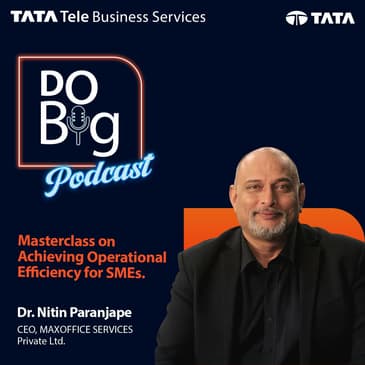

In this engaging episode, Dr. Nitin Paranjape dives into the transformative power of AI for SMEs. Discover how tools like Copilot are reshaping productivity, addressing misconceptions, and unlocking unique opportunities. Dr. Paranjape shares real-world success stories and a must-try growth hack to elevate your efficiency instantly. Tune in for a masterclass in efficiency.
[00:00:08] That brings me to a very interesting thing, right? A lot of us in the FOMO sense of the word tend to get into a lot of things. But is it that JNI is necessary for everyone or is there always a time that you reflect back and say, no, not required just because I have a sense of or a fear of missing out. I don't need to jump onto this band. Does that also happen?
[00:00:31] Dr. Yeah, currently a lot of this excitement about JNI is more of FOMO and less of direct, tangible, proven value. But it is not that. In substance, there is a lot of potential benefit, especially in my field where there is already inefficiency well-entrenched in the world because it has been there for decades and nobody is looking at it. It's grown exponentially.
[00:00:58] Dr. So now, even if you notice that I'm inefficient, how are you going to find the efficient method? Do you have a consultant sitting behind you every day? No. So now you can understand there is a potential of transforming efficiency. And in order to find the best way to get your job done, rather than you doing trial and error or paying someone for that, why not ask JNI? Because JNI has understood all options. That will at least suggest the best approach. Then you compare it with your process.
[00:01:27] If it's better adopted. So even purely from efficiency transformation point of view, with existing processes, it has value. And you mentioned using tools like Copilot, which do not use your data. What are the other advantages of using tools like Copilot over the options available to us?
[00:01:48] Sure. So typically what has happened is because there is hype about JNI, all business users want to do something in JNI, whether they like it or not, whether they understand. And that's okay. If something is new, people want to try it out. But because there is a risk of data leakage and all other privacy compliance issues, most IT people block it.
[00:02:10] And then what happens when someone is something is blocked, people are going to find workarounds. And that is even more dangerous. So the first thing IT has to do is not block all JNI. Keep the safe version of Copilot on and encourage people to use that. So they get exposed to the capabilities. And then they will come out with genuine effective use cases.
[00:02:32] That's the first step. Now, if you use Copilot, which is free version, it is safe and all that. And it has all the chat GPT capabilities, but it has one missing link to what is the missing link. Whatever data you have as a person, my company, I have my emails, I have my chats, I have my meetings, data, files, documents, presentations, those things that free version of Copilot doesn't understand.
[00:03:00] If I have to make it understand, I have to physically upload a file. How many files will I upload? I have created thousands of files, thousands of emails. It's not possible to do that. So if you have Microsoft 365 version of Copilot, which is the paid version, it has all the benefits of the free because it has chat GPT behind, but it automatically understands all your data. And that is a game changer. So if I ask you a question saying, I have a meeting, I can see the meeting in calendar.
[00:03:30] Now I want to prepare for the meeting. I can ask Copilot to help me prepare for the meeting. In the meeting, there is nothing, just a title. Some people are invited and few agenda items. That's it. But because Copilot has access to all my data, it can figure out what are the related files? What are the related meetings which happened earlier? What are the mail trails? And it will actually give me a list of things I should be doing to prepare better for the meeting.
[00:03:55] Now that is something which falls under the category useful, but it was impossible to do like this earlier. That's real empowerment. When we talk about smaller enterprises, right? There are different opportunities that smaller enterprises can leverage compared to the larger companies. Because larger companies have a lot more data available, all of that.
[00:04:18] What are those unique opportunities that SMEs can leverage with AI that maybe a large company may or may not be able to do? So first of all, Copilot, as the name suggests, is your assistant. So I'm not saying you only keep Copilot and remove all your manpower. That's not what I'm talking about. But that is a common misconception and wrong thought process which many decision makers have in mind.
[00:04:45] So one of the first things from SME point of view you have to understand is in SMEs, there are few leaders and lots of followers. So staff is more and decision making is concentrated with few people. And if you find something which saves time or eliminates some drudgery, the first natural thought is to reduce people. That's not the right thought. Why? Because those people who are already doing the work, maybe they were doing it inefficiently, but that's not their fault.
[00:05:14] Nobody told them there is a better way. So now that we are giving them efficient method, their time is released. Now those people are valuable because they have been trained in your organization. They understand your business. They know your customers. So rather than having a knee-jerk reaction of removing them, try to think how you can utilize that time which is released so that you can grow more with the same staff. Because finally everyone wants to grow, whether small or large business.
[00:05:42] And the desire to grow is much more vibrant in smaller businesses because they have higher competition, limited resources and all that. So this is the driver. Remove drudgery, invest that time in growth-oriented activities. That's the single most important mindset change leaders have to do.
[00:06:00] And one is a mindset change, but one other aspect of adoption of tech very often, whether it's AI or otherwise, is also concerns and misconceptions. I don't think this can happen or I don't know enough, etc.
[00:06:17] When you meet with organizations, what are those common misconceptions or concerns that you find repeatedly being mentioned to you when it comes to adopting AI tools? So one of the common ones is it's complex. And I wouldn't blame anyone because there is so much hype, so much confusion, so much jargon. So it is natural to think it is complex. So that's number one. It's not complex.
[00:06:44] Of course, initially there will be some teething trouble, but it is designed to be working with natural language. So in that sense, there is no barrier for entry. Second is cost. Now, obviously everyone is worried about cost, especially smaller the business, more cost conscious. Now, everyone talks about cost, but nobody talks about benefit because cost is accrued. You just pay. That's it. But the benefit needs to be extracted, which is a longer, more effort oriented process.
[00:07:12] So while talking about cost, you will evaluate the product at the time of evaluation. You should identify where the benefit is. You should have a method of quantifying the benefit in terms of time saving, intangible benefits, whatever it is. And then have the ability or a conversion matrix to convert that time saving into money. And then you compare the cost with benefit. That is important. Otherwise, people just say, oh, this one is cheaper, so I'll go for it.
[00:07:39] But maybe it is cheaper because it lacks certain things which would otherwise have been useful to you and given you exponential benefit. So don't just do cost comparison and feature comparison. Do benefit comparison as well. And the third thing is, like you said, adoption. Purchasing is easy. When it's a subscription, you forget about it. Many times we have subscriptions which we have forgotten about and they are still making money from you. You have not even opened that app for years. It happens all the time.
[00:08:07] So whatever in the evaluation phase you have identified as use cases, process improvements, benefits, those have to be implemented. And that is also the job of leaders. Because if you just say to learning and development and IT do it, everyone may not listen to them. It has to come from the top. So in order to adopt this, top management has to identify a group of people who will continuously learn.
[00:08:32] They should be given official permission to spend X amount of time every month to proactively learn, apply it to business context, convert it to standard operating procedures. And then the bosses will help implement those. Because these technologies are growing very fast. You purchased it today, it may have 200 features. In Copilot itself, more than 300 features were added in last year alone. Now many people who purchased it are not aware because they got trained on the day one.
[00:09:01] And now no training. That's literally like loss making proposition because there is more capability. You are not aware of it. It's literally like tearing money. So it's a long term process of effective adoption. So AI is clearly more than just a tool like you mentioned. It's an enabler of opportunities for SMEs to grow and to compete.
[00:09:23] But the single largest underlining thought is you have to continuously learn to be able to optimize the usage of tools. That's really what we're talking about. And that's amazing. For our final segment, we're going to jump into the Do Big Mantra. And here you will hear key takeaways and advice for SMEs ready to embrace technology and make bold strides for gold. Welcome to our third and final segment on this episode of the Do Big Podcast.
[00:09:53] Nitin, as we wrap up, what is the one key message or piece of advice you'd like to share with SMEs about embracing AI efficiency? And I know you've said a lot and they have so much to do. They can utilize it, embrace it, but they need to keep learning. You've said that. But what else can they do when they want to embrace AI and build efficiencies for their businesses?
[00:10:17] Generally, people know that AI is sort of a smart assistant who never takes leave, has knowledge of everything, all that. Generally, people know. And some amount of automation will happen. Now, that is just not even scratching the surface. And this happens even with large enterprises. I have seen it happening with largest and best of consultants, experts as well. What the real power of this, especially Copilot, Microsoft 365 Copilot I'm talking about and why I'll explain a little later.
[00:10:47] Copilot is an assistant? Yes. It's a sort of automation tool? Yes. But I'm actually going to read a list of different roles the same Copilot can play in your life, individually as well as as an organization, strategically. So because it's a long list, I'm going to read it.
[00:11:04] It can be a coach, a mentor, a career guide, analyst, creative assistant, decision support guide, investigator, sounding board, counselor, friend, devil's advocate, interviewer, critic, and the most important, cross-functional tutor. Because whoever you are, obviously, I'm assuming you are an expert in one, two, three, seven fields, let's say, best case scenario. But you cannot be best or expert in 20,000 fields. But to do your business, you need that knowledge.
[00:11:34] So if you don't have knowledge about something, you have to hire a consultant, subscribe to some service, all that Copilot can do. That's what I mean, cross-functional knowledge. So with all these roles, it's literally transformative. The sad part is most people are just exploring the first two, assistant and automation. The remaining long list, which is really empowering, is completely missed out. And the best part, why am I saying this can happen only with M365 Copilot?
[00:12:02] Technically, it can be any JNI. No, because Microsoft 365, while playing these roles, has full access to your data. So let's say you've got a mentor, you hired the best mentor in the world, in your industry, expert in your field, all that. But that person has not read all your mails, all your documents, all your meetings. So this is the real transformative power of M365 Copilot.
[00:12:29] Nitin, thank you so much for sharing such actionable and inspiring insights. Honestly, I don't think that any of us must have realized, I'm sure most of our listeners like me, are completely shocked at how much Copilot can do for them. I know as an entrepreneur, I'm going to call up, I'm going to ask you on another call to take me through the whole Copilot abilities and capabilities.
[00:12:52] But, you know, it is amazing to be able to get so much information in a conversation as short as this one. Your expertise and your passion for empowering MSMEs is amazing and it's truly contagious. I mean, I'm already hooked on to, I'm thinking, when can I start working with Copilot?
[00:13:11] And for our listeners, I'm sure they will remember this, that whether it's operational efficiency, AI, or your own do big mantra, the future of business is only as innovative as you dare to make it. With that, thank you so much, Nitin, for joining us. And thank you so much for sharing such wonderful insights about Microsoft 365.