
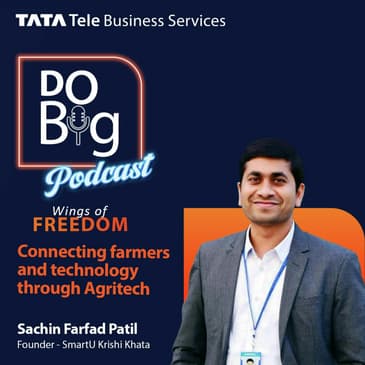

In this episode of Do Big Podcast, we dive into the future of agritech with Sachin Farfad Patil.
Sachin is transforming the way farmers manage their operations through the SmartU Krishi Khata platform, offering a streamlined approach to transactions, expense management, and real-time data analysis.
Discover how technology empowers farmers to evolve into successful farmpreneurs, driving productivity and sustainability. Learn from Sachin how digital tools are creating a new paradigm in Indian agriculture, blending traditional wisdom with modern advancements.
[00:00:09] Welcome to another thrilling episode of the Do Big Podcast. I am your host, Sheetal Choksi, and today we will delve into the dynamic world of farmpreneurs.
[00:00:21] Farmpreneurs is a concept which is at the intersection of agriculture and innovation. Farmpreneurship represents a groundbreaking movement where traditional farming meets cutting-edge methods.
[00:00:35] These visionary farmers are revolutionizing the agricultural sector by incorporating technology, embracing sustainable practices, and pioneering new unique business models.
[00:00:47] They're transforming traditional farming into a hub of opportunities, job creation, and community development.
[00:00:55] Joining us today to unpack this fascinating topic further is our special guest, Sachin Farfad Patil.
[00:01:02] He is the founder of SmartU Krishikata.
[00:01:06] Sachin has over 12 years of experience in IT services, education, startup, and the development sector.
[00:01:14] He founded SmartU Krishikata, an award-winning startup, in 2023.
[00:01:19] His goal is to create 5,000 jobs in rural India and become India's first Agritech unicorn.
[00:01:28] He is focused on helping and building the startup ecosystem in Vidarbha region and is a part of the Nagpur startups community.
[00:01:38] Welcome, Sachin, to the Do Big Podcast.
[00:01:40] And I am more than happy to jump in and learn so much more about what it means to be a farmpreneur.
[00:01:47] So welcome.
[00:01:48] Thanks a lot, Sheetal.
[00:01:49] Very happy to be a part of this podcast series and delve into the lives of the farmer, how technology is transforming the way farming is being done in the country.
[00:02:01] And share my thoughts about it.
[00:02:04] Very happy to be here.
[00:02:05] You know, while I have done what I think is the definition of a farmpreneur, Sachin, it would be great to understand from you what defines a farmpreneur today.
[00:02:15] Yeah, this is probably a point term or the extension of what is entrepreneur means, right?
[00:02:23] And there are multiple extension of the entrepreneur.
[00:02:26] Now we call the mamas who started business called mompreneurs, the couple who starts a couplepreneur.
[00:02:33] But that was not the idea behind this farmpreneur word.
[00:02:38] But our farmers in India or all across the world, they are doing into the same practice as any other businessman is, right?
[00:02:47] They are also kind of putting up some raw material, processing it, selling the finished wood or maybe providing services, right?
[00:02:54] But they call the farmers and others call entrepreneurs or businessmen, right?
[00:02:58] So we wanted to coin this term and give a different notion to it.
[00:03:02] And that's where this term farmpreneur came from.
[00:03:05] And what inspired you to get into this space and empower small and medium-sized farmers?
[00:03:12] So, Sita, this comes from a very personal story of mine.
[00:03:17] I come from a background of farming.
[00:03:21] My father is a farmer.
[00:03:22] I grew up going into farm, working into farm, seeing my father and my mother doing farm activities and stuff.
[00:03:31] That was our only income while growing up.
[00:03:36] And when I completed my bachelor's in computer and management education, I started working for MNCs, did my own startups.
[00:03:49] Also provided, like, I was involved in different passion projects and stuff.
[00:03:55] But whenever I used to go back my village and talk to my father again or maybe talk to my schoolmates again,
[00:04:02] what they are doing in farming.
[00:04:04] And their issues were very much different than what we talked on the day-to-day basis in sitting in ballrooms,
[00:04:10] in corporate offices or any other businesses we do.
[00:04:13] Here we talk about just our travel expenses sometimes shoot up like more than lakh rupees for one trip.
[00:04:20] And that is the whole year earning for the farmers.
[00:04:23] And that used to kind of strike me.
[00:04:25] Hey, I come from this community.
[00:04:27] I come from this background.
[00:04:29] I'm a son of a farmer.
[00:04:30] I kind of studied because of my parents' efforts and their vision.
[00:04:37] I was able to get the right education.
[00:04:39] Now it's my time to kind of contribute back to my community and what I can do for them.
[00:04:46] So I started dwelling into doing different activities or maybe talking to more people and stuff.
[00:04:51] And that's where we come across this particular idea of starting a product for the farmers,
[00:04:59] which can help them to kind of maintain their accounting, maintain the farm finances, operations,
[00:05:09] and kind of gain some insights which they can utilize in their regular farming activities.
[00:05:17] And eventually kind of enhance their profitability rate.
[00:05:23] So that was the idea, right?
[00:05:24] Because everybody is struggling with that, right?
[00:05:26] Finally, they want to make more money, right?
[00:05:29] For their livelihood and their regular things.
[00:05:32] So yeah, from there we started this.
[00:05:35] So, you know, it's very interesting because farmers in India specifically have many, many challenges, right?
[00:05:42] Everything from education to seed to soil to the works.
[00:05:46] I mean, you name it and every aspect of farming, there is a challenge.
[00:05:49] What made you choose finance as the place where you would want to provide solutions?
[00:05:59] Why finance as the solution?
[00:06:01] That's a very interesting question, Sheetal.
[00:06:04] And people don't think from this perspective, but you accept it or not.
[00:06:09] Finances or money is the core problem where everything falls around, right?
[00:06:15] And fortunately and unfortunately, even a government or the developmental organizations or other startups and enterprises,
[00:06:24] everybody has chosen the route to kind of do an intervention in the farming or agriculture other than the finances.
[00:06:32] So they provide better agriculture practices, better input probably, market linkages and so on and so forth things.
[00:06:40] But it is really not enough for the farmers because they are doing farming from ages and generations.
[00:06:49] Nobody can go back and really teach them farming, right?
[00:06:52] In fact, what they were used to do earlier, the organic farming and stuff.
[00:06:56] So we kind of change their habit and ask them to do a hybrid farming and the pesticide-based farming.
[00:07:00] Now we are again giving them GAN about, hey, let's do natural farming now, right?
[00:07:05] So they were anyways doing that, right?
[00:07:07] So we thought to go into the core issue of what these small and medium-sized farmers are facing day in, day out.
[00:07:18] Their problems are very basically worse.
[00:07:21] I am investing X amount of money.
[00:07:23] I am doing X, Y, Z efforts.
[00:07:25] The output which I should supposed to be getting is not enough.
[00:07:28] And that is not, I am not able to survive on the basis of that, right?
[00:07:34] And that's where you see a lot of farmers who say news comes into every now and then in newspaper or TV channels.
[00:07:42] There are protests by the farmers across country and stuff.
[00:07:46] The major issue is how they make the livelihood and their life better by doing farming, right?
[00:07:52] How they can make the farming profitability?
[00:07:53] Now, for businesses, whenever anybody do any small business or a bigger enterprise or a corporate level business,
[00:08:03] the first and foremost important tracking they does is the finances because that's what run their show, right?
[00:08:11] Run their businesses if the profitability is not there.
[00:08:14] But if you look at the farming, nobody maintains the accounting.
[00:08:17] And hence the problem is that they don't know how much they are investing, how much efforts it's going,
[00:08:22] how much profitability it is making, how to price their producers, whether the price is right or not.
[00:08:28] And that's where they get exploited and get very lesser prices.
[00:08:32] It doesn't make a lot of profit out of it or margins out of it and struggle for their livelihood.
[00:08:38] So that is where this idea came into providing them a tool to record and reflect on these farm finances
[00:08:46] so that they can take data-driven ongoing decisions about the farming,
[00:08:51] what is going to be better for enhancing their profit.
[00:08:54] So basic of any business, right?
[00:08:57] So that's why I said, first of all, these are not just the farmers, right?
[00:09:01] They are also equally a businessman or entrepreneur.
[00:09:03] They are into the similar kind of a work what we are doing or the businesses are doing
[00:09:09] or businessmen are doing day in, day out, right?
[00:09:11] So first is that.
[00:09:12] Then what the businessman does?
[00:09:13] Businessman records, even though he is going to office, he kind of put the traveling expenses there.
[00:09:19] If he's traveling outside or maybe giving dinner to team member or investor or any client,
[00:09:24] that's also expenses are covered in their accounting.
[00:09:28] But farmer doesn't do anything, right?
[00:09:30] So that's the first step of it, I guess.
[00:09:33] If you really uplift the life of the farmers in a country, that's the first step.
[00:09:38] We should teach them that you have to start accounting first.
[00:09:43] Although it may sound like it doesn't make profitable or not even a viable business,
[00:09:49] but first you understand, hey, it is not a viable business.
[00:09:52] What I can do then, right?
[00:09:53] How do I minimize the expenses?
[00:09:55] How do I sell my produces in my maximum price or better price?
[00:10:00] Or how do I do some additional work along with the farming so that I can make the life without
[00:10:04] good?
[00:10:05] So that's where this comes into picture to solving those challenges.
[00:10:09] So it's very interesting.
[00:10:10] You're using technology to help them solve this problem called business.
[00:10:13] One of the challenges that a lot of technologies face is the level of education of the person
[00:10:19] who's using the tool, right?
[00:10:22] Always a challenge, which is that how does your tool cut across the educational barrier
[00:10:31] of the farmer?
[00:10:33] Is it in languages?
[00:10:34] Is it easy to understand?
[00:10:36] How have you figured that piece out for the farmer?
[00:10:39] I guess that's the key.
[00:10:41] That's the key of doing.
[00:10:44] If you look at agri-tech as a market or a startup ecosystem, there are a lot of technology
[00:10:50] out there and very, very good innovative things, which is really helpful to the farmers.
[00:10:57] But the problem is the technology adoption in the farming community is very, very less.
[00:11:02] The reason is because nobody now, like in India, at least in this last two to three decades,
[00:11:11] I would say, from my generation, I saw the farming.
[00:11:16] Nobody is doing farming by choice.
[00:11:19] It is by chance because they don't have anything else to do or maybe not have that much education
[00:11:24] to kind of get the professional job or professional work and that's why they are doing farming.
[00:11:29] It means that there is an educational barrier or there is a literacy barrier in that.
[00:11:34] And when it has come to end technology, there is a technology barrier as well.
[00:11:39] So when we built this, we thought of kind of using different technology, high-end technology,
[00:11:46] starting from mobile application to web tools to so on and so forth.
[00:11:51] But then these were also problem statement, which I just spoke about was rolling around our idea board
[00:12:00] or story board, which we are planning.
[00:12:03] And then we thought, hey, there are three sets of problem here.
[00:12:07] One is if I have to break the technology barrier problem further, there are three sets of problem
[00:12:12] in the technology.
[00:12:13] One is they do not have a high-end mobile phones because their mobile phones are basic, right?
[00:12:18] And the reason they bought a smartphone, because there is no palyphonic or button phone available
[00:12:24] in the market and that's why they are on a smartphone.
[00:12:27] That's the reality.
[00:12:28] Neither they have that much money to buy the high-end smartphone.
[00:12:32] Second, their technosiveness or their digital literacy to use any tool or any mobile application
[00:12:39] is very less because of their educational background and the kind of communities or kind of areas they stay.
[00:12:46] Third is the internet stability.
[00:12:48] Even though we are talking about 5G, 6G and whatnot, still there is an issue of the internet in the rural areas.
[00:12:55] This is my own example.
[00:12:57] Whenever I go to my own village, if I had to pick up the call, I need to step out of my house
[00:13:03] to get that call, right?
[00:13:04] Maybe go on a terrace to pick up that call or serve the internet.
[00:13:07] And although my house, village is just 100 kilometers away from one of the top cities in India, Nakhur, right?
[00:13:16] And just besides the highway, still I face those problems, right?
[00:13:19] So now these were very, very important issues or challenges to solve when we are really asking farmers to come on some platform
[00:13:30] or give them some tool to kind of record and reflect or do a digitalization of their farming records was a challenge.
[00:13:37] And that's where we built our tool on WhatsApp.
[00:13:39] And that's kind of a groundbreaking for us or maybe helped us solve these barriers because
[00:13:49] A, it doesn't require any other mobile application to be installed because phones are already basic
[00:13:55] and WhatsApp is pre-installed in most of the phones or almost every phone in country.
[00:14:01] Second, user behavior.
[00:14:03] The digital literacy of the users, which is farmer in this case, is already set on WhatsApp
[00:14:08] because WhatsApp is the first application probably somebody would have started using after calling somebody, right?
[00:14:15] From the phone, right?
[00:14:16] That was the first application, right?
[00:14:17] So user behavior is also set.
[00:14:19] Third, WhatsApp runs on a low internet.
[00:14:23] So if you switch off your phone or maybe put it on the flight mode,
[00:14:27] if you are traveling and if you switch back your flight mode back,
[00:14:33] connect to an internet, you will get a first notification from the WhatsApp.
[00:14:36] That's because it runs on a low data and only the text travel.
[00:14:40] And that's where is the key for our solution to take the farmers and get a higher adoption rate.
[00:14:48] At this point of time, we are connected with 20 lakhs farmers from Maharashtra.
[00:14:54] On regular basis, 50,000 plus farmers are using our tool on WhatsApp.
[00:15:00] That's kind of an achievement within one year, which we have.
[00:15:04] And that really helped.
[00:15:07] Interesting.
[00:15:08] And when you...
[00:15:11] So it's still about the Waii Khata and it is still about the accounts and things like that.
[00:15:16] Can you kind of share one change?
[00:15:20] I'm not going to call it a success story,
[00:15:22] but can you share us the impact of having done something like that?
[00:15:27] Yeah.
[00:15:28] So first is, as I said, the step forward to kind of debugging something
[00:15:35] or maybe come up with something.
[00:15:37] Start recording that problem or start kind of narrating or articulating that problem.
[00:15:44] Everybody knows Indian farmers are in trouble.
[00:15:47] Right?
[00:15:48] That is no new.
[00:15:49] From generation and decades, everybody knows people are working towards government,
[00:15:54] development organizations, corporates.
[00:15:57] Everybody is trying their bit to solve this or maybe be making their problem.
[00:16:02] So first we had given them a tool to kind of record their problem.
[00:16:06] Right?
[00:16:07] Finances, accounting.
[00:16:08] Finances, accounting.
[00:16:09] And how does it really helping it giving in a mobile is if you look at the earlier
[00:16:15] or previous method of doing this accounting for the farmer,
[00:16:19] those who are keeping the accounting was on the Waii Khata or diary pen.
[00:16:22] Even after my...
[00:16:24] That's the story I usually tell that whenever I was young and going to the school,
[00:16:29] my father used to come back from the performing farming operations
[00:16:32] or selling his produces in agriculture market.
[00:16:36] And he used to write something on the backside of my notebook.
[00:16:38] Today after 20 years or 25 years, even he does the same
[00:16:42] or even my friends are doing the same.
[00:16:45] The reason is wherever these farmers are doing transaction related to the farming,
[00:16:51] those happens either in the ABMC market, agriculture producers market,
[00:16:55] maybe in the agriculture input shops or maybe
[00:17:01] and he doesn't have any office by the way.
[00:17:05] Like Azvi, he doesn't have any office table, chair and accountant
[00:17:08] or anybody in his office.
[00:17:09] He's a one-man army.
[00:17:11] None of these places he carries his diary pen with him.
[00:17:15] Hence, whenever he comes back, his priorities get changed
[00:17:18] and he forget to write those expenses.
[00:17:20] And hence, it is not recorded and he's not paying attention.
[00:17:22] And slow and steadily, it kind of fade away
[00:17:24] that many people use it and keep writing it.
[00:17:28] So the basic problem we are solving is that
[00:17:30] in all these places, you don't have diary pen
[00:17:32] but you can write it on mobile phone.
[00:17:35] So my tool works on mobile, WhatsApp,
[00:17:37] and I don't have to download additional app.
[00:17:40] That is number one.
[00:17:40] Number two, whenever they record,
[00:17:43] they get to know about different insights.
[00:17:46] For example, what is the cost of cultivation?
[00:17:49] What are the different heads they are spending money in?
[00:17:51] Were there just two spring or three spring required
[00:17:54] and he did four or five?
[00:17:56] He means excess expenses, right?
[00:17:59] All of these insights he gets, right?
[00:18:01] And now, whenever he's selling his produce sales,
[00:18:04] first, when he records the expenses,
[00:18:07] he kind of gets to know,
[00:18:07] okay, probably I'll make this much amount of money
[00:18:10] out of this selling these produce sales.
[00:18:12] Now my expense is already shooting them, right?
[00:18:14] So he keeps the control on that
[00:18:15] or maybe find things in the cheaper prices, right?
[00:18:18] Or maybe excess expenses he doesn't do.
[00:18:21] Second, benefit to the farmer
[00:18:23] whenever he's selling produces,
[00:18:25] if the market price is X amount
[00:18:28] and he knows that his expenses is not getting made,
[00:18:31] he kind of holds his selling decisions, right?
[00:18:33] Produces to him.
[00:18:34] And whenever he gets a little better prices,
[00:18:37] then only he shares
[00:18:39] because now he knows what is the cost of cultivation.
[00:18:41] So now, when to sell has become very easy for him.
[00:18:45] Otherwise, what happened?
[00:18:46] When the market was opened,
[00:18:48] he was sold.
[00:18:49] He didn't know what's happening in the market.
[00:18:52] He started thinking about the price.
[00:18:53] Now he started thinking.
[00:18:54] I'm not saying that he gets the right rate.
[00:18:56] He started thinking about the right rate.
[00:18:57] At least he started thinking about the market rate
[00:19:00] that's not the right rate for me.
[00:19:02] It's not the better price for me, right?
[00:19:04] That's what he started thinking.
[00:19:05] And because of this,
[00:19:07] what we had observed over the period of time,
[00:19:10] our users, farmer users,
[00:19:13] are able to reduce their overall cost by 20%
[00:19:16] just by tracking the expenses
[00:19:18] because they are not doing any excess things.
[00:19:20] Somewhere he needs two, three, four levers.
[00:19:22] Maybe he is contributing himself
[00:19:24] to save that cost and stuff, right?
[00:19:26] So that is one kind of insights
[00:19:28] or clear impact which is happening.
[00:19:30] Secondly, he will be able to get better prices
[00:19:32] or he will be able to sell his produces
[00:19:35] on a better price
[00:19:35] and that's why he is maximizing his profit as well.
[00:19:39] That's another impact you would say is happening.
[00:19:43] Third, he is also getting access
[00:19:46] to a lot of information
[00:19:47] and the advice which he requires
[00:19:49] to do the farming rate.
[00:19:51] The classic example is
[00:19:52] knowing the market rates,
[00:19:54] what's happening,
[00:19:55] what is the market rate
[00:19:57] in the nearby APMC rates rate.
[00:19:59] So we are disseminating these rates
[00:20:01] through this WhatsApp channel only
[00:20:02] or WhatsApp bot only.
[00:20:04] Now he knows that
[00:20:04] which rate is in the nearby market
[00:20:06] is going to be in the near market.
[00:20:07] He can't send it to the rate
[00:20:08] and how much he has paid.
[00:20:10] He also tells you that.
[00:20:10] So he can do the comparison.
[00:20:12] Not only that,
[00:20:13] we also help him
[00:20:14] comparing current market rate
[00:20:17] with the MSP rates
[00:20:18] given by the government.
[00:20:19] Right?
[00:20:20] And he gets that comparison
[00:20:21] whether it is lower than that
[00:20:22] or higher than that
[00:20:23] and all of that
[00:20:24] and because these rates
[00:20:26] have been introduced
[00:20:27] by the government
[00:20:28] to maintain the parity
[00:20:30] or maintain the zigzag
[00:20:32] in this agri-producers market rate.
[00:20:36] So third,
[00:20:37] we also help him
[00:20:38] with the crop advisory.
[00:20:40] Whenever he have any problem
[00:20:42] related to any pest
[00:20:44] or diseases in the farming,
[00:20:45] he can click that photograph,
[00:20:47] mention that problem to us
[00:20:48] and I have a team of agronomists
[00:20:51] at the back end,
[00:20:51] expert at the back end
[00:20:52] who answers these queries
[00:20:54] to the farmers
[00:20:55] and that's where
[00:20:56] he can reduce his cost
[00:20:57] or do a better treatment
[00:20:58] to his plants
[00:20:59] and enhance the quality as well
[00:21:00] and that's why we said
[00:21:01] that we are empowering farmers
[00:21:03] through SmartYu Grishikarta
[00:21:05] by providing them
[00:21:06] a tool on WhatsApp
[00:21:07] to enhance their quality
[00:21:09] and the profitability
[00:21:10] through expense tracking
[00:21:11] and profitability.
[00:21:12] That's our statement.
[00:21:13] Very interesting.
[00:21:14] I'm sure that,
[00:21:15] you know,
[00:21:15] when you started this off,
[00:21:17] there were things
[00:21:17] that you knew already.
[00:21:19] What were those
[00:21:20] interesting aha moments
[00:21:22] that happened for you
[00:21:23] when you started doing this work?
[00:21:25] So it's almost a year
[00:21:26] since you've been in the space.
[00:21:28] You know,
[00:21:29] I'm sure,
[00:21:30] I'm sure that
[00:21:31] there will be some instances
[00:21:32] which even caught you
[00:21:33] and your team by surprise.
[00:21:35] Share some of those
[00:21:36] interesting moments.
[00:21:38] When we started this,
[00:21:40] you know that
[00:21:41] as I mentioned earlier
[00:21:42] as well,
[00:21:44] farmers are not doing
[00:21:45] farming by choice, right?
[00:21:46] They are doing by chance
[00:21:48] and all the farmers
[00:21:49] in country,
[00:21:50] no farmer want their
[00:21:51] son or daughter
[00:21:52] to do farming again.
[00:21:54] He wants him
[00:21:56] to or her
[00:21:57] to do something else.
[00:21:58] Maybe get a corporate job
[00:22:00] or maybe a government job
[00:22:01] or do something else
[00:22:02] than the farming, right?
[00:22:03] So when me
[00:22:04] and my other founders,
[00:22:05] three of us
[00:22:06] are from the farming background.
[00:22:08] One of our founders
[00:22:09] from Mumbai,
[00:22:10] she's from the technology background.
[00:22:11] So whenever
[00:22:12] three of us started,
[00:22:13] our parents started
[00:22:14] kind of shouting
[00:22:15] on us,
[00:22:16] why are you doing this?
[00:22:17] Nobody is getting
[00:22:19] really making anything
[00:22:20] out of farming
[00:22:21] and you are coming back
[00:22:22] and doing this.
[00:22:22] You are doing earlier good, right?
[00:22:24] So keep on, carry on that.
[00:22:25] So there was not
[00:22:26] that much
[00:22:28] favorable situation
[00:22:29] for us to start this, right?
[00:22:31] And neither
[00:22:31] on the idea stage
[00:22:33] as well,
[00:22:33] it was looking like
[00:22:35] hey,
[00:22:35] farmers don't need
[00:22:36] to do any compliance work.
[00:22:37] Why they will
[00:22:38] maintain the accounting?
[00:22:39] What will happen
[00:22:40] out of that?
[00:22:41] It is really going to help.
[00:22:42] And these are still
[00:22:42] the blurry areas for us
[00:22:44] and still we are
[00:22:44] discovering different ways
[00:22:46] we can do.
[00:22:46] But deep down the line
[00:22:48] we understand that
[00:22:51] or we know that
[00:22:52] if they start
[00:22:53] maintaining accounting,
[00:22:54] they will be going
[00:22:56] to get benefited
[00:22:57] in a long run, right?
[00:22:58] So surprise
[00:22:59] moments for us
[00:23:01] when we saw
[00:23:02] farmers'
[00:23:03] adoption
[00:23:03] to this tool
[00:23:04] is very,
[00:23:06] very rapid
[00:23:07] and they are not
[00:23:08] even reluctant
[00:23:09] about it.
[00:23:10] So sometimes
[00:23:11] when I talk to
[00:23:12] like maybe
[00:23:14] people like us
[00:23:15] you
[00:23:16] or maybe
[00:23:16] some other
[00:23:17] journalist
[00:23:17] or maybe
[00:23:18] some startup guys
[00:23:19] or maybe
[00:23:20] investor
[00:23:20] they say
[00:23:21] that farmers
[00:23:22] use it
[00:23:22] and they don't
[00:23:23] have technology
[00:23:24] and all of that.
[00:23:25] To my surprise
[00:23:25] none of the farmers
[00:23:26] said this question
[00:23:27] to me.
[00:23:28] Till date
[00:23:29] he said
[00:23:30] he asked
[00:23:31] if you have
[00:23:31] 10 questions
[00:23:31] and he
[00:23:32] tried to understand
[00:23:33] and learn it, right?
[00:23:34] So there is
[00:23:35] a learning question
[00:23:35] or there is
[00:23:36] a learning desire
[00:23:38] in the farmers, right?
[00:23:39] That's what we saw.
[00:23:39] So the other
[00:23:41] example is
[00:23:42] when farmers
[00:23:42] start a journey
[00:23:43] with us
[00:23:44] we kind of
[00:23:44] does their
[00:23:45] registration
[00:23:45] to understand
[00:23:46] from which
[00:23:46] location he
[00:23:47] belongs
[00:23:47] so that we
[00:23:48] can give
[00:23:49] them a location
[00:23:50] based customized
[00:23:51] services
[00:23:52] and make
[00:23:53] this tool
[00:23:53] available
[00:23:54] in this
[00:23:55] native language
[00:23:55] stream, right?
[00:23:56] I guess you
[00:23:57] also asked
[00:23:57] this question
[00:23:58] in the earlier
[00:23:59] part, right?
[00:23:59] So it's
[00:24:00] in their
[00:24:00] native languages.
[00:24:02] Now we
[00:24:03] ask pin
[00:24:04] code in that
[00:24:04] particular
[00:24:05] to do
[00:24:05] onboarding
[00:24:06] and shorten
[00:24:06] the flow.
[00:24:07] We ask
[00:24:07] the pin
[00:24:07] code
[00:24:08] and we
[00:24:09] kind of
[00:24:09] did
[00:24:10] lot of
[00:24:10] workshop
[00:24:10] for the
[00:24:11] urban
[00:24:12] farmers
[00:24:13] versus
[00:24:13] ruler
[00:24:14] farmers
[00:24:14] and the
[00:24:15] different
[00:24:15] sets
[00:24:16] of
[00:24:39] technology
[00:24:39] adoption
[00:24:40] and the
[00:24:43] which is
[00:24:44] easy to
[00:24:44] use
[00:24:45] which is
[00:24:46] going to
[00:24:46] be useful
[00:24:46] for them
[00:24:47] adding the
[00:24:47] value in
[00:24:48] their lives
[00:24:48] and making
[00:24:49] some difference
[00:24:50] in their
[00:24:51] lives.
[00:24:51] They are
[00:24:52] eager to
[00:24:52] learn,
[00:24:53] they are
[00:24:53] eager to
[00:24:53] adapt and
[00:24:54] they will
[00:24:55] be definitely
[00:24:56] going to take
[00:24:56] the help
[00:24:57] out of that
[00:24:57] particular
[00:24:58] tool.
[00:24:59] So I was
[00:25:00] reading up
[00:25:01] on this
[00:25:02] space and
[00:25:03] it's quite
[00:25:04] interesting that
[00:25:04] the government
[00:25:05] has interventions
[00:25:06] but the
[00:25:07] government has
[00:25:07] no governance
[00:25:08] is what I
[00:25:09] read in one
[00:25:09] of the
[00:25:10] reports.
[00:25:10] They will
[00:25:11] tell you
[00:25:12] what to
[00:25:12] do but
[00:25:12] there is
[00:25:13] no
[00:25:13] governance
[00:25:13] on how
[00:25:14] it should
[00:25:14] be done
[00:25:15] etc.
[00:25:16] I just
[00:25:17] want to
[00:25:17] understand
[00:25:17] that as
[00:25:18] agri-tech
[00:25:19] becomes
[00:25:21] more
[00:25:23] prevalent
[00:25:23] in this
[00:25:24] country because
[00:25:24] the government
[00:25:25] is also
[00:25:25] pushing for
[00:25:27] agri-tech
[00:25:28] because they
[00:25:29] know that
[00:25:29] they can't
[00:25:29] do it so
[00:25:30] they are
[00:25:30] asking
[00:25:31] entrepreneurs
[00:25:31] such as
[00:25:32] yourselves
[00:25:32] to get
[00:25:33] into it.
[00:25:34] What
[00:25:35] shifts do
[00:25:36] you see
[00:25:36] coming when
[00:25:37] governance
[00:25:37] comes into
[00:25:38] play?
[00:25:39] Right now
[00:25:39] there is no
[00:25:39] governance in
[00:25:40] that sense
[00:25:41] but when
[00:25:42] governance
[00:25:43] comes in
[00:25:43] do you
[00:25:44] see
[00:25:45] challenges
[00:25:45] in the
[00:25:46] agri-tech
[00:25:46] or the
[00:25:47] farm
[00:25:47] front
[00:25:47] space?
[00:25:48] No,
[00:25:49] I guess
[00:25:49] it will
[00:25:51] definitely
[00:25:51] help
[00:25:52] big time
[00:25:53] to the
[00:25:53] agri-tech
[00:25:54] ecosystems
[00:25:55] as well
[00:25:56] as the
[00:25:56] agri-tech
[00:25:57] startup
[00:25:58] founders
[00:25:58] or startups
[00:25:59] and the
[00:26:01] farmers as
[00:26:02] well because
[00:26:03] scale of
[00:26:04] agriculture
[00:26:04] is very
[00:26:05] vast.
[00:26:06] The
[00:26:06] problems
[00:26:07] are very
[00:26:07] vast.
[00:26:08] You pick
[00:26:08] up any
[00:26:09] piece in
[00:26:09] the farming
[00:26:10] you can
[00:26:11] solve that
[00:26:11] problem.
[00:26:12] You can
[00:26:12] solve the
[00:26:13] forward
[00:26:14] integration,
[00:26:15] backward
[00:26:16] integration,
[00:26:16] input-output,
[00:26:18] precision
[00:26:18] farming,
[00:26:18] IoT, so
[00:26:20] on and so
[00:26:20] forth.
[00:26:20] You can
[00:26:21] pick up any
[00:26:21] piece and
[00:26:22] there is a
[00:26:23] startup idea
[00:26:24] in agri-tech
[00:26:25] too.
[00:26:25] There is a
[00:26:26] lot to be
[00:26:26] done.
[00:26:27] There is a
[00:26:27] huge vacuum
[00:26:29] in the
[00:26:30] agriculture
[00:26:31] space.
[00:26:31] Now,
[00:26:33] for the
[00:26:33] startups,
[00:26:34] they can
[00:26:34] really
[00:26:34] identify
[00:26:37] problems
[00:26:37] well.
[00:26:38] They can
[00:26:39] really come
[00:26:39] up with
[00:26:39] some
[00:26:40] innovative
[00:26:40] solution.
[00:26:41] But those
[00:26:42] solutions to
[00:26:42] scale,
[00:26:43] there is a
[00:26:44] support needed
[00:26:45] by the
[00:26:45] government and
[00:26:46] the other
[00:26:47] corporates as
[00:26:48] well to take
[00:26:49] it to the
[00:26:49] scale.
[00:26:49] Because almost
[00:26:50] we have
[00:26:50] 20 crore
[00:26:52] farmers in
[00:26:52] India and
[00:26:53] almost our
[00:26:54] one-third
[00:26:55] population is
[00:26:56] dependent on
[00:26:57] the agriculture
[00:26:57] rate.
[00:26:58] So,
[00:26:59] there is a
[00:27:00] huge
[00:27:00] quantum of
[00:27:01] this rate.
[00:27:02] If the
[00:27:02] governance
[00:27:03] comes in,
[00:27:03] government
[00:27:04] intervention
[00:27:04] comes in
[00:27:05] and they
[00:27:06] really do
[00:27:07] what they
[00:27:08] are supposed
[00:27:08] to do,
[00:27:09] it is
[00:27:09] going to
[00:27:10] help the
[00:27:11] agri-preneurs
[00:27:12] or the
[00:27:12] agriculture
[00:27:14] startups.
[00:27:16] And where
[00:27:17] do you see
[00:27:18] the future
[00:27:19] of farming
[00:27:20] in India?
[00:27:20] Because right
[00:27:21] now we
[00:27:21] have small
[00:27:22] parcels of
[00:27:22] land,
[00:27:23] we have
[00:27:23] all kinds
[00:27:23] of things,
[00:27:24] right?
[00:27:24] I am
[00:27:24] sure that
[00:27:25] the challenges
[00:27:25] of farmers
[00:27:26] in the
[00:27:27] Vidarbha
[00:27:27] region is
[00:27:28] different from
[00:27:29] the challenges
[00:27:29] of the
[00:27:30] farmers in
[00:27:30] another
[00:27:31] region,
[00:27:31] etc.
[00:27:32] So,
[00:27:32] where do
[00:27:33] you see
[00:27:34] the future
[00:27:35] of farming
[00:27:35] in India
[00:27:36] with technology
[00:27:37] adoption?
[00:27:38] I guess
[00:27:39] technology
[00:27:40] is the
[00:27:41] future for
[00:27:42] the agri-tech
[00:27:42] to make
[00:27:44] it better,
[00:27:45] make it
[00:27:46] profitable,
[00:27:47] make it
[00:27:47] do it on
[00:27:48] the scale.
[00:27:49] Is technology
[00:27:50] the way forward
[00:27:51] and technology
[00:27:52] has kind of
[00:27:53] proven
[00:27:54] its
[00:27:55] credentialing
[00:27:55] in many
[00:27:56] different
[00:27:57] areas such
[00:27:58] as education,
[00:28:01] transportation,
[00:28:02] general
[00:28:03] businesses,
[00:28:03] accounting
[00:28:04] practices
[00:28:04] everywhere,
[00:28:05] right?
[00:28:05] You might
[00:28:06] have seen
[00:28:07] long queues
[00:28:08] in front
[00:28:09] of railway
[00:28:10] ticketing
[00:28:10] windows 10-20
[00:28:12] years back
[00:28:13] and currently
[00:28:14] there is no
[00:28:15] one who
[00:28:15] goes to
[00:28:16] door windows,
[00:28:17] right?
[00:28:17] And that's
[00:28:18] happened because
[00:28:18] of the
[00:28:18] technology.
[00:28:19] Now you
[00:28:19] can book
[00:28:20] the tickets
[00:28:21] on fingertips
[00:28:22] and that's
[00:28:22] the kind
[00:28:23] of power
[00:28:23] technology has,
[00:28:24] right?
[00:28:24] it is a
[00:28:26] gift to
[00:28:26] the humanity,
[00:28:27] I guess.
[00:28:28] Technology is
[00:28:28] the gift
[00:28:29] to the
[00:28:30] humanity and
[00:28:30] that those
[00:28:32] fruits to
[00:28:33] be given
[00:28:34] or those
[00:28:35] seeds to
[00:28:36] be shown
[00:28:37] in the
[00:28:37] agriculture
[00:28:39] or the
[00:28:39] farming
[00:28:40] sector as
[00:28:41] well.
[00:28:42] And that
[00:28:42] is going to
[00:28:43] transform
[00:28:44] the agriculture
[00:28:45] as well and
[00:28:46] those days
[00:28:47] will come
[00:28:47] back that
[00:28:48] when we
[00:28:48] will say
[00:28:48] farming or
[00:28:50] agriculture
[00:28:50] agriculture is
[00:28:51] the first
[00:28:51] and then
[00:28:52] you do
[00:28:52] business or
[00:28:53] now free
[00:28:53] and then
[00:28:54] other stuff,
[00:28:55] right?
[00:28:55] That was
[00:28:56] first
[00:28:56] business
[00:29:00] and I
[00:29:01] saw something
[00:29:02] which I
[00:29:02] had heard
[00:29:03] from my
[00:29:04] grandmother
[00:29:05] long time.
[00:29:06] So those
[00:29:07] days will come
[00:29:08] because agriculture
[00:29:10] is the basic
[00:29:10] needs, right?
[00:29:11] Food is the
[00:29:11] basic need and
[00:29:12] you need to
[00:29:13] kind of focus.
[00:29:14] With the
[00:29:15] technology,
[00:29:15] I guess,
[00:29:16] these farmers
[00:29:17] will become
[00:29:18] more aware,
[00:29:19] more empowered
[00:29:20] and more
[00:29:22] connected to
[00:29:22] the world
[00:29:23] and the
[00:29:25] markets and
[00:29:26] hence they
[00:29:26] will start
[00:29:27] showing which
[00:29:29] gets sold
[00:29:29] in the market
[00:29:31] or which
[00:29:31] gets the
[00:29:32] better price
[00:29:32] in the market
[00:29:33] than doing
[00:29:33] anything and
[00:29:34] everything
[00:29:34] which is
[00:29:35] kind of
[00:29:36] they were
[00:29:36] doing
[00:29:37] traditionally.
[00:29:38] That's
[00:29:38] number one
[00:29:38] shift I
[00:29:40] can see
[00:29:41] is going
[00:29:41] to happen
[00:29:42] because of
[00:29:42] that.
[00:29:43] Because of
[00:29:44] the technology
[00:29:45] there will
[00:29:45] be a lot
[00:29:46] of pressure
[00:29:47] or a lot
[00:29:47] of I guess
[00:29:48] control over
[00:29:49] the demand
[00:29:49] and supply
[00:29:50] also of
[00:29:51] the agriculture
[00:29:52] commodities.
[00:29:53] Now farmer
[00:29:53] will understand
[00:29:54] I am not
[00:29:54] getting rates
[00:29:55] it means that
[00:29:56] I need to
[00:29:56] wait for
[00:29:57] till I get
[00:29:58] the better
[00:29:58] price rate
[00:29:59] than selling
[00:30:00] the producers
[00:30:01] right away
[00:30:02] when it is
[00:30:02] come out
[00:30:02] of the
[00:30:03] farm.
[00:30:04] And that
[00:30:04] way demand
[00:30:05] and supply
[00:30:06] will play
[00:30:06] his role
[00:30:07] and the
[00:30:07] prices
[00:30:08] will also
[00:30:09] at a certain
[00:30:10] level where
[00:30:11] it becomes
[00:30:12] reasonable
[00:30:12] for the
[00:30:13] sailors as
[00:30:14] well as
[00:30:14] the buyers
[00:30:14] in this
[00:30:15] area.
[00:30:17] Third
[00:30:17] as you
[00:30:18] said there
[00:30:19] is a
[00:30:19] fragmented
[00:30:19] farming
[00:30:20] happening
[00:30:20] or the
[00:30:21] nuclear
[00:30:21] farming
[00:30:22] happening
[00:30:22] in the
[00:30:22] country.
[00:30:23] That will
[00:30:24] also start
[00:30:25] happening
[00:30:25] in a
[00:30:26] consolidation.
[00:30:27] This is my
[00:30:27] father always
[00:30:28] tells that
[00:30:29] unless and
[00:30:30] until a group
[00:30:31] of people
[00:30:31] come together
[00:30:32] the group
[00:30:33] of farmers
[00:30:33] come together
[00:30:34] and think
[00:30:35] about producing
[00:30:37] one single
[00:30:38] produce,
[00:30:38] buy the
[00:30:39] inputs
[00:30:40] together,
[00:30:41] sell the
[00:30:41] producers
[00:30:42] together,
[00:30:43] then only
[00:30:44] they can
[00:30:44] optimize the
[00:30:45] cost.
[00:30:46] They can
[00:30:46] get a
[00:30:47] better price
[00:30:47] and they
[00:30:48] can get
[00:30:48] a better
[00:30:48] price.
[00:30:49] So these
[00:30:49] things also
[00:30:50] will start
[00:30:51] happening
[00:30:52] with the
[00:30:53] help of
[00:30:53] technology
[00:30:54] and it
[00:30:55] is going
[00:30:55] to be
[00:30:55] I guess
[00:30:56] big time
[00:30:58] help to
[00:30:59] farmers as
[00:31:01] well as to
[00:31:01] the farming
[00:31:02] allied businesses.
[00:31:03] So this
[00:31:04] technology is
[00:31:04] much needed
[00:31:06] to kind
[00:31:07] of enhance
[00:31:09] the farming
[00:31:10] and uplifting
[00:31:11] the farmers
[00:31:12] income and
[00:31:13] their lifestyle
[00:31:14] like this.
[00:31:14] Second main
[00:31:15] goal which
[00:31:16] we have is
[00:31:17] to providing
[00:31:17] insights to
[00:31:18] the farmer
[00:31:20] himself to
[00:31:21] made him
[00:31:22] farm in
[00:31:22] another so
[00:31:23] that he
[00:31:24] knows that
[00:31:25] this is the
[00:31:26] business he is
[00:31:26] doing and
[00:31:27] where he can
[00:31:27] cut short the
[00:31:28] expenses,
[00:31:29] where he can
[00:31:29] get a better
[00:31:29] price.
[00:31:30] Third,
[00:31:31] at the
[00:31:31] business side
[00:31:32] as well,
[00:31:32] we are going
[00:31:33] to help
[00:31:35] agriculture
[00:31:35] businesses,
[00:31:36] those who
[00:31:36] are in
[00:31:37] good
[00:31:37] organizations
[00:31:38] or seed
[00:31:38] farm
[00:31:39] mechanism
[00:31:39] organization.
[00:31:40] We also
[00:31:41] empower them
[00:31:42] with the
[00:31:42] right set
[00:31:43] of analytics
[00:31:43] or insights
[00:31:44] to reach
[00:31:45] out to the
[00:31:45] right set
[00:31:45] of farmers
[00:31:47] because
[00:31:47] nowadays if
[00:31:48] they wanted
[00:31:48] to market
[00:31:49] their seed
[00:31:51] fertilizer
[00:31:51] or agriculture
[00:31:52] they do not
[00:31:53] have a
[00:31:53] platform where
[00:31:54] they can
[00:31:56] reach to
[00:31:57] a specific
[00:31:57] set of
[00:31:58] farmers
[00:31:58] because
[00:31:59] the existing
[00:32:00] channels of
[00:32:02] marketing
[00:32:02] does not
[00:32:02] have any
[00:32:03] insight
[00:32:03] related to
[00:32:04] farming.
[00:32:04] Maybe
[00:32:05] you can
[00:32:06] take a
[00:32:06] high level
[00:32:07] gaze that
[00:32:07] keeps somebody
[00:32:08] is a farmer
[00:32:08] or not
[00:32:09] but you
[00:32:09] cannot decide
[00:32:10] whether
[00:32:11] somebody is
[00:32:11] a cotton
[00:32:12] farmer or
[00:32:13] a sugarcane
[00:32:13] farmer.
[00:32:14] Probably
[00:32:14] Google can
[00:32:15] tell you
[00:32:15] if somebody
[00:32:16] is a
[00:32:16] farmer or
[00:32:17] not but
[00:32:17] Google
[00:32:18] cannot
[00:32:18] tell you
[00:32:18] if somebody
[00:32:19] is a
[00:32:19] cotton
[00:32:20] farmer or
[00:32:21] a sugarcane
[00:32:21] farmer or
[00:32:22] holding 2 acres
[00:32:23] land or 20 acres
[00:32:24] land, have an
[00:32:24] irrigation facility
[00:32:25] or not.
[00:32:26] And all of
[00:32:27] these solutions
[00:32:27] are available in
[00:32:28] the market
[00:32:29] which agriculture
[00:32:30] businesses,
[00:32:31] agritech is
[00:32:31] providing or
[00:32:32] even the
[00:32:32] banking products
[00:32:34] are there.
[00:32:34] It is that
[00:32:35] are customizing
[00:32:37] the nature and
[00:32:38] for a specific
[00:32:39] set of farmers
[00:32:40] and that's where
[00:32:40] they keep on
[00:32:42] investing so much
[00:32:43] money in
[00:32:44] marketizing their
[00:32:45] product but
[00:32:46] doesn't get
[00:32:47] good ROI.
[00:32:48] And here we
[00:32:49] help these
[00:32:50] agriculture businesses
[00:32:51] to reach out to
[00:32:52] the right set of
[00:32:53] farmers.
[00:32:54] So yeah,
[00:32:55] that's how I
[00:32:56] think our
[00:32:56] aim or vision
[00:32:57] for the
[00:32:58] smart team
[00:32:59] whenever you
[00:33:01] will see any
[00:33:02] farmer putting
[00:33:03] up the price
[00:33:04] card or a
[00:33:05] rate card on
[00:33:06] the producers
[00:33:07] in the
[00:33:07] agriculture market
[00:33:08] that will be
[00:33:09] the kind of
[00:33:10] our vision
[00:33:11] coming through
[00:33:12] or our dream
[00:33:13] coming through.
[00:33:14] That's the
[00:33:14] vision as a
[00:33:15] founding team
[00:33:16] we have.
[00:33:16] We wanted to
[00:33:17] see farmers
[00:33:17] putting up the
[00:33:18] price time on
[00:33:19] their produces
[00:33:19] before selling
[00:33:20] it.
[00:33:20] Not the
[00:33:21] some merchant
[00:33:22] or somebody
[00:33:22] else is deciding
[00:33:23] the price for
[00:33:24] it.
[00:33:25] That's the
[00:33:26] larger guru
[00:33:27] we have.
[00:33:28] And my last
[00:33:28] question to you
[00:33:29] Sajjan because I
[00:33:30] can continue
[00:33:31] asking you
[00:33:31] questions but I
[00:33:32] do need to
[00:33:32] also kind of
[00:33:34] keep time in
[00:33:35] and what
[00:33:37] advice would
[00:33:38] you give other
[00:33:39] entrepreneurs who
[00:33:40] are looking to
[00:33:42] make a difference
[00:33:43] in the agri-tech
[00:33:44] industry?
[00:33:46] As I said
[00:33:47] earlier as
[00:33:48] well Shital
[00:33:49] agriculture and
[00:33:51] farming in
[00:33:52] India and
[00:33:52] across the
[00:33:53] world has a
[00:33:54] lot of
[00:33:55] vacuum.
[00:33:56] There are
[00:33:56] all set of
[00:33:57] problems
[00:33:58] statements
[00:33:59] available there
[00:34:00] or all set
[00:34:01] of problems
[00:34:02] these people
[00:34:03] are facing
[00:34:03] and they
[00:34:04] need our
[00:34:04] help.
[00:34:05] They need
[00:34:06] the help
[00:34:06] from the
[00:34:06] budding
[00:34:07] entrepreneur,
[00:34:07] they need
[00:34:08] help from
[00:34:08] the
[00:34:08] corporate
[00:34:09] government,
[00:34:09] everybody.
[00:34:11] And that's
[00:34:11] where the
[00:34:11] opportunity is.
[00:34:12] Wherever the
[00:34:13] problem is there,
[00:34:13] there is
[00:34:14] opportunity.
[00:34:15] We can innovate
[00:34:15] solutions, we
[00:34:16] can ideate or
[00:34:18] we can do
[00:34:19] all our
[00:34:19] business models
[00:34:20] accordingly and
[00:34:20] think about how
[00:34:21] we can really
[00:34:23] help farmers to
[00:34:25] uplift them.
[00:34:26] And there are
[00:34:27] no rocket science
[00:34:29] required or
[00:34:29] rocket science
[00:34:31] technology which
[00:34:32] is required.
[00:34:33] There are basic
[00:34:34] things which are
[00:34:34] being getting
[00:34:35] done in the
[00:34:36] enterprise solutions
[00:34:37] or maybe in the
[00:34:39] urban areas that
[00:34:40] just we need to
[00:34:41] find and go and
[00:34:42] replicate those in
[00:34:43] the rural area.
[00:34:45] and these people
[00:34:46] can really get
[00:34:47] benefited out of
[00:34:48] it if you really
[00:34:48] have a passion for
[00:34:52] it and if you
[00:34:52] really want to do
[00:34:53] it.
[00:34:53] But to do an
[00:34:55] agriculture related
[00:34:57] business or agritech
[00:34:58] startup, you need
[00:34:59] a passion and a
[00:35:00] very vast
[00:35:00] understanding of
[00:35:02] the agriculture
[00:35:03] domain, right?
[00:35:04] Because these
[00:35:05] businesses or
[00:35:07] startups are not
[00:35:08] going to make you
[00:35:09] a billion dollar
[00:35:10] company overnight.
[00:35:11] This is not an
[00:35:12] AI tool which
[00:35:13] people will start
[00:35:14] using the other
[00:35:14] day.
[00:35:15] and you will
[00:35:16] become suddenly
[00:35:17] will become the
[00:35:18] tech tycoon or
[00:35:19] maybe a business
[00:35:20] tycoon of the
[00:35:20] year and so
[00:35:21] it requires a
[00:35:24] lot of patience,
[00:35:25] lot of perseverance
[00:35:26] determination to
[00:35:27] kind of identify
[00:35:28] the problem,
[00:35:29] giving them a
[00:35:30] solution.
[00:35:31] Adoption rate is
[00:35:32] very low and
[00:35:33] there is a
[00:35:33] very high level
[00:35:35] trust deficit in
[00:35:36] the farming
[00:35:36] community to
[00:35:37] win that trust
[00:35:38] as well of the
[00:35:39] farmer rate.
[00:35:40] but if you want
[00:35:41] to do it,
[00:35:41] you will,
[00:35:43] if you really
[00:35:44] do it,
[00:35:44] you will
[00:35:44] probably will
[00:35:46] have a sound
[00:35:46] slip at the
[00:35:48] end of the
[00:35:48] day and
[00:35:49] you will have
[00:35:51] that sense of
[00:35:52] achievement that
[00:35:53] you impacted
[00:35:54] someone's life,
[00:35:55] right?
[00:35:55] And you really
[00:35:56] help and
[00:35:56] obviously you
[00:35:57] will be going
[00:35:58] to make the
[00:35:58] money also out
[00:35:59] of it,
[00:35:59] right?
[00:36:00] nobody is
[00:36:00] doing startups
[00:36:02] only for the
[00:36:03] charity rate,
[00:36:03] although there
[00:36:04] are social
[00:36:04] impact ventures
[00:36:06] and social
[00:36:06] entrepreneurs
[00:36:07] coming in,
[00:36:07] but you need
[00:36:08] a sustainability
[00:36:09] rate,
[00:36:09] right?
[00:36:09] So money
[00:36:10] will come
[00:36:11] alongside,
[00:36:12] but you
[00:36:12] need a
[00:36:13] passion and
[00:36:14] the determination
[00:36:15] to really solve
[00:36:16] the right set
[00:36:17] of farmers,
[00:36:17] right?
[00:36:18] And one more
[00:36:18] last advice I
[00:36:19] wanted to do,
[00:36:20] rather than
[00:36:21] just pushing
[00:36:23] what we want
[00:36:24] to provide to
[00:36:24] the farmer,
[00:36:25] understand what
[00:36:26] do they really
[00:36:27] need as a
[00:36:29] technology or
[00:36:30] as an
[00:36:31] intervention,
[00:36:32] right?
[00:36:32] A lot of
[00:36:33] these things
[00:36:33] which are
[00:36:33] happening
[00:36:34] nowadays all
[00:36:35] across country
[00:36:36] in the world
[00:36:37] are the push.
[00:36:38] They say that
[00:36:39] drone is
[00:36:40] important for
[00:36:41] the farming,
[00:36:41] right?
[00:36:42] Drones can
[00:36:43] spray and
[00:36:44] a lot of
[00:36:44] other things
[00:36:45] which are
[00:36:45] coming,
[00:36:45] right?
[00:36:46] But we
[00:36:46] really want
[00:36:47] to see whether
[00:36:48] the farmer
[00:36:48] needs it or
[00:36:49] not.
[00:36:49] What is his
[00:36:50] need,
[00:36:51] right?
[00:36:51] What is his
[00:36:51] first diehard
[00:36:52] challenge?
[00:36:53] If you really
[00:36:54] identify that,
[00:36:55] I guess there
[00:36:56] is a huge
[00:36:57] scope in this
[00:36:58] particular
[00:36:58] segment.
[00:37:00] Sartan,
[00:37:00] this was
[00:37:01] absolutely
[00:37:02] fascinating and
[00:37:03] illuminating and
[00:37:04] I'm sure that
[00:37:05] whoever listens
[00:37:05] to this episode
[00:37:06] is going to be
[00:37:08] very, very
[00:37:09] motivated.
[00:37:09] I don't know
[00:37:10] if they will
[00:37:10] become farm
[00:37:11] runners or
[00:37:11] not, but
[00:37:12] I'm sure it's
[00:37:13] very, very
[00:37:14] motivating to
[00:37:15] do something
[00:37:15] that makes a
[00:37:16] difference and
[00:37:17] creates an
[00:37:17] impact.
[00:37:18] For our
[00:37:19] listeners, if
[00:37:20] you decide to
[00:37:21] become a
[00:37:22] farm
[00:37:22] runner or you
[00:37:23] decide that
[00:37:23] you want to
[00:37:24] take your
[00:37:24] first step
[00:37:25] into this
[00:37:26] space, do
[00:37:27] write in to
[00:37:28] us with
[00:37:28] your questions
[00:37:29] and I'm
[00:37:29] sure we'll
[00:37:30] be happy to
[00:37:30] come back
[00:37:31] to you with
[00:37:31] answers.
[00:37:32] I'm sure that
[00:37:33] there will be a
[00:37:33] description and
[00:37:34] a link where
[00:37:35] you can write
[00:37:37] into us.
[00:37:38] And we hope
[00:37:39] that you enjoyed
[00:37:40] this conversation
[00:37:41] as much as
[00:37:42] I did.
[00:37:42] I learned a
[00:37:43] lot today.
[00:37:44] I'm a very,
[00:37:45] very urban
[00:37:45] girl.
[00:37:46] My first
[00:37:47] attempt at
[00:37:48] farming is to
[00:37:49] do some
[00:37:49] hydroponics in
[00:37:50] my house, but
[00:37:51] beyond that,
[00:37:52] I'm not a
[00:37:53] farmer and
[00:37:55] it's absolutely
[00:37:56] fascinating having
[00:37:57] this conversation
[00:37:58] with you.
[00:37:58] Thank you so
[00:37:59] much for your
[00:38:00] time and
[00:38:01] thank you for
[00:38:01] being a part of
[00:38:02] the Do Big
[00:38:02] podcast for us.
[00:38:03] Thank you.
[00:38:04] Thanks a lot
[00:38:04] for inviting me
[00:38:07] to the Do Big
[00:38:09] podcast and
[00:38:10] also thanks to
[00:38:11] Tata Techie
[00:38:12] Services for
[00:38:13] giving us this
[00:38:13] opportunity.
[00:38:15] Look forward to
[00:38:16] get more and
[00:38:17] more entrepreneurs
[00:38:18] coming and
[00:38:19] joining this
[00:38:20] space and help
[00:38:21] farmers in
[00:38:23] India.
[00:38:24] Thank you very
[00:38:24] much.
[00:38:25] Thank you.
[00:38:25] Thank you for
[00:38:27] tuning in to the
[00:38:27] Do Big
[00:38:28] podcast, a
[00:38:29] podcast that is
[00:38:30] dedicated to
[00:38:31] providing insights,
[00:38:32] strategies and
[00:38:33] success stories
[00:38:33] of smart digital
[00:38:35] solutions for
[00:38:35] SMEs.
[00:38:36] We believe that
[00:38:38] behind every
[00:38:39] successful business
[00:38:40] there's a strong
[00:38:41] foundation of
[00:38:41] reliable and
[00:38:42] secure technology
[00:38:43] via digital
[00:38:44] connectivity, cloud
[00:38:45] infra, cloud
[00:38:46] apps, collaboration
[00:38:47] tools or
[00:38:48] cybersecurity
[00:38:48] solutions.
[00:38:50] In a rapidly
[00:38:51] evolving digital
[00:38:52] world where
[00:38:52] technology is key
[00:38:53] to progress,
[00:38:54] Tata Tele
[00:38:55] Business Services
[00:38:56] stands at the
[00:38:57] forefront of digital
[00:38:58] transformation of
[00:38:59] SMEs.
[00:39:00] Tata Tele
[00:39:00] Business Services
[00:39:01] with their
[00:39:02] extensive experience
[00:39:03] and commitment to
[00:39:04] empowering businesses
[00:39:05] understands the
[00:39:06] unique needs of
[00:39:07] SMEs.
[00:39:08] Whether it's
[00:39:09] scalable connectivity,
[00:39:11] robust communication
[00:39:12] tools or tailored
[00:39:13] ICT solutions,
[00:39:15] Tata Tele
[00:39:15] Business Services is
[00:39:16] here to propel your
[00:39:17] business forward.
[00:39:19] Tata Tele
[00:39:20] Business Services is
[00:39:21] synonymous with
[00:39:22] innovation, reliability
[00:39:23] and transformative
[00:39:24] solutions.
[00:39:25] So, if you're ready
[00:39:27] to take your
[00:39:27] organization to new
[00:39:28] heights of success,
[00:39:30] we encourage you to
[00:39:31] explore the
[00:39:32] transformative
[00:39:32] possibilities that
[00:39:33] Tata Tele
[00:39:34] Business Services
[00:39:35] has to offer.
[00:39:36] Our contact details
[00:39:37] are in the
[00:39:38] description below.
[00:39:39] Remember, we're
[00:39:40] available in major
[00:39:41] podcast platforms,
[00:39:42] so if you enjoyed
[00:39:43] today's conversation,
[00:39:45] subscribe to our
[00:39:46] podcast for future
[00:39:47] episodes which we
[00:39:48] promise will be
[00:39:49] packed with equally
[00:39:50] valuable insights on
[00:39:51] questions entrepreneurs
[00:39:52] face as well.
[00:39:53] as they digitize and
[00:39:54] scale businesses with
[00:39:55] the help of technology.
[00:39:57] Don't forget to rate
[00:39:59] and review our podcast
[00:40:00] as well as share it
[00:40:01] with peers,
[00:40:01] colleagues and other
[00:40:02] entrepreneurs like
[00:40:03] yourself who will
[00:40:04] benefit from listening
[00:40:05] to it.
[00:40:06] Thank you for
[00:40:07] listening to us and
[00:40:08] until the next time,
[00:40:09] keep embracing
[00:40:10] technology and may
[00:40:11] your business thrive
[00:40:12] in the digital era.