
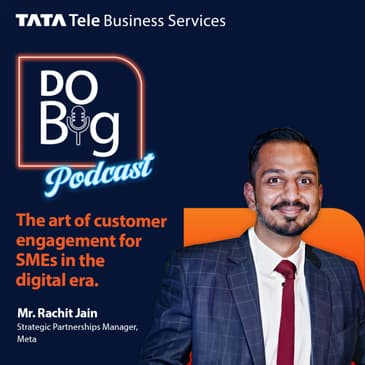

Welcome to another insightful episode of the Do Big Podcast. In this episode, we're joined by our guest, Rachit Jain, Strategic Partnerships Manager at Meta. Rachit takes us on a journey through the changing contours of customer engagement over the years and sheds light on how the WhatsApp Business platform is proving to be a game-changer for SMEs in this digital era.
Ready to boost your business using the WhatsApp Business Platform? Tune into our podcast now.
You can follow Rachit on-
LinkedIn- https://www.linkedin.com/in/rachitjain87/
Instagram - https://instagram.com/rachitjn
Follow us on LinkedIn- https://www.linkedin.com/company/ttbs
[00:00:00] Hello and welcome to another episode of the Do Big Podcast. I am your host Sheetal Choksi and today we're going to discuss the art of customer engagement for SMEs in the Digital Era. Well, the art or the science refers to the strategies and techniques employed to effectively
[00:00:28] connect and interact with customers in the modern digital landscape. In a sense, it's about utilizing digital platforms and technologies to engage with customers in meaningful ways that resonate with their needs and preferences. And to throw light on this subject today, we have with us
[00:00:49] Rachit Jain, the Global Strategic Partnerships Manager at Metta. With over 13 years of experience under his belt, Rachit specializes in crafting and nurturing intricate partnerships and ecosystem strategies for communication platform as a service, C-PASS as it is popularly called,
[00:01:08] and software as a service SaaS portfolios on a global sale. Rachit specializes in crafting and nurturing intricate partnerships and ecosystem strategies for communication platform as a service, C-PASS as it is popularly known, and software as a service SaaS portfolios on a global
[00:01:27] scale. His expertise lies in enhancing organizational competitiveness through the implementation of on-ground strategies, driving incremental revenue and executing joint marketing initiatives with tier one partnerships, global system integrators, GSIs, technology partners as well as service partners. In his role, Rachit thrives within a dynamic and collaborative
[00:01:53] environment adept at navigating the fast-paced evolution of technology. Rachit's overarching mission at Metta is to spearhead C-PASS partnerships and drive exponential growth while empowering individuals and organizations to connect, create and accomplish more in the digital realm. This in-compasses a variety of practices including leveraging social media,
[00:02:22] personalized marketing, customer relationship management tools, data analytics and user experience optimization to cultivate strong relationships, drive customer satisfaction and ultimately foster business growth. So welcome, Rachit and it's an absolute pleasure having you here today with us on the Dubic podcast where we focus on the needs and preferences
[00:02:46] of MSMEs in India and around the world. Rachit, before I jump into my first question with you, it'd be great to get to know you a little better so I know I've done an introduction
[00:02:56] but define yourself as a person tell our audience who you are what is it that you like to do what does a day off look like? So thank you Sheetal for having me and I'll try my level
[00:03:10] best to do justice to this podcast. So I am originally from Chandigarh, I've been working in Delhi for a little less than about eight years now. Primarily as you sort of mentioned largely done business development and partnership roles all throughout different organizations.
[00:03:28] I think what's really keeping me busy these days is this job that I'm doing full time because of this job, I happen to travel extensively and then happen to sort of meet all sort of customers and the partnerships that we've sort of been building
[00:03:43] from last two, three years from ground up right and then this honestly is sort of a very humbling and a rewarding experience. So this honestly sort of keeps me busy for sort of time
[00:03:54] when I'm not working I'm usually sort of spending time at home with my wife or with my friends eating out so very very fond of eating out make it a point that at least we try to
[00:04:07] three new places every week and I think a few other things that I extensively pursue which very few folks sort of know about me is that I am into photography at least I feel that I
[00:04:20] click good pictures so in case you want to maybe check it out I can let you know and then you can decide whether you want to include this or not include it but this is one thing
[00:04:30] that I've been doing for about seven eight years something that has grown a lot so I try and see and capture world from my perspective and then I'm a big big big space so I nerd out on
[00:04:42] what is really happening in space and you know what Elon Musk is doing and what SpaceX is doing what Jeff Bezos is doing with his own startup for all kids and stuff like that yeah so these are the
[00:04:52] things that sort of keep me busy yeah but other than that most of the time it is largely about So that's fantastic I know who to reach out to next time I'm in Delhi and I want to figure
[00:05:02] out where to eat so I'm going to reach out to you for that and have you booked your seat to the first trip or the second trip or whatever trip to space on SpaceX or I'm pretty confident that it's going
[00:05:15] to cost a lot it's sort of slogging the head but yeah that's on the chart something that I'd love to do someday but yeah for now I'm just sort of saving so part of your bucket list is it
[00:05:26] 100% yes let's top of the bucket list you know that's something that I want to do Okay fantastic so coming back to the you know our topic for today which is really the art of customer engagement in the digital era and who better than somebody from meta right
[00:05:44] so I just want to get a sense from you as to what's the state of customer engagement for MSMEs today how do you kind of define that for MSMEs in the digital era well I don't think there is
[00:05:59] there is an answer that sort of can do justice to this but the way I see this I think customer engagement has sort of evolved to become much more participatory and customized right so if
[00:06:10] you really look at a lot of these small and medium-sized enterprises today they're extensively using digital platforms like WhatsApp business API to connect with their customers right gain insights from what they need you know and then also going to an extent where they can offer tailored solutions
[00:06:28] right and and where we sort of come in in the whole places that the platform that we offer sort of helps them deliver all of this automate this and then also deliver this at scale respond
[00:06:41] to messages etc etc right one of the outcomes for this is that because of again platform like WhatsApp and a lot of other competing platforms these SMEs today are able to reach out to wider
[00:06:54] audience and engage with customers in real time that that is the most important thing that has sort of happened in last few years right so if you really look about customer engagement
[00:07:05] this wasn't the case maybe four five years back right so let's say if there was a D2C brand back then and if you wanted to buy something from that D2C brand the best that you could do back then was
[00:07:18] drop them an email call them on the phone hoping to see someone's going to pick up an answer and respond to your questions or send them an email and then wait for days and weeks right but all
[00:07:29] of that has changed people have become impatient they need answers instantaneously otherwise they move to a different brand and today a lot of these SMEs are able to do that actually you know what
[00:07:41] SMEs are also doing they're sort of just to ensure that they're able to you know which is what I sort of said initially that because it has become much more participatory and customized they're also now sending targeted messages to their prospective customers and the
[00:07:57] customers that have bought from them so not only they are working with a existing base to their you know return spent from these customers but also sort of targeting you know they're targeted
[00:08:09] messaging to a lot of this new prospective customers right and the best part is in both the cases they get an instant feedback that what is working and what is not working and I think in the
[00:08:20] long run what what is really going to happen is that because of this instant feedback and the fact that they're able to reach out to customers at scale etc these businesses these SMEs you know they'll be able to build stronger relationships with customers right and then
[00:08:35] also in the long run not only this will help them build loyalty but also sort of help increase the overall revenues and I think that happens to be the P0 for a lot of these SMEs this is
[00:08:49] this is what I think has happened in the last few years and this is how the customer engagement sort of has evolved you know if I were to sort of sum this up you're absolutely right digital's changed the way people are interacting but you know it's also
[00:09:03] changed the number of platforms that are available it's changed the the spaces in which you can have customers it's also kind of fragmented the customer right so some will be on one platform and some
[00:09:14] on another and is there therefore a way in which SMEs can kind of because budgets is always you know tight with SMEs so is there a way that platform choice can be done depending on what
[00:09:27] kind of business you're in is there a way in which you can optimize platform choice when you're looking at businesses so I wouldn't know the exact numbers for the other platform but I can definitely maybe give some insights about the WhatsApp business API
[00:09:44] so India amongst India is one of the priority markets for meta worldwide and majority of the user base for WhatsApp sits in India got a very active engaging community that exists on WhatsApp
[00:10:01] and people like you me you know we use this platform every day to not only talk to our parents you know friends etc but also to know businesses etc right in fact there was this
[00:10:14] recently the article that was published I remember reading I think about a week back on money controlling comic times where our VP said you know that they're what 65% participants like you and me who are interacted with businesses on WhatsApp or you or you know use
[00:10:32] WhatsApp to interact with businesses or every day if you look at a city like Delhi or a Bangalore you can now book tickets metro tickets right you can do core banking you can talk to brands for
[00:10:45] customer service you can buy tickets you can pay electricity bills you can do basically whatever you used to do on all other offline channels you can now do on WhatsApp and the reason
[00:10:55] why all of these brands are in base embracing a channel like WhatsApp is because of the user base in this active community so to answer your question I think if any brand is sort of looking
[00:11:06] to build loyalty and also ensure that they are able to build on the existing base which is whether I mean they are able to cross sell up sell etc I think WhatsApp is a great platform
[00:11:21] that they can look at to start some of these journeys and as in when they progress with these journeys and if they need a little more customization they can work with partners and
[00:11:32] these partners can help them build chatbots a lot of AI power agents etc etc which can you know address a very specific custom tailored use case but then you know the brands then
[00:11:43] can later decide what they want to sort of do in the long run but I think WhatsApp is a good starting point for a lot of these brands is how I would like to put it.
[00:11:53] Is that precisely why you have so much of the channels and the communities and all of those new features getting added on to WhatsApp which is enabling these businesses or how does that work? How do businesses leverage let's say for example a channel or a community or
[00:12:09] the features that you have on WhatsApp? Okay so WhatsApp has three different flavors right there is this app that sits on most of our you know phones right the phone that you use
[00:12:20] or the phone that I use and we use this app extensively to again that I mentioned before to talk to our friends and family right then there is an SMB app which is largely used by these small
[00:12:30] businesses and they use this app to not only sell their product but to also reach out to prospects in the form of you know by driving an outreach a paid outreach which they can do through a
[00:12:43] marketing message or they can run a click to WhatsApp ad which I'll talk to talk to about in a minute and an SME should definitely look at that and the third is the WhatsApp
[00:12:53] business API which is what I was talking about right so what a lot of businesses are doing today is ensuring that they have presence on WhatsApp business API and they you know when they've sort of implemented WhatsApp business API they're able to drive communication at scale
[00:13:08] which means if they have let's say a user base of 10 20 million they can instantaneously deliver messages targeted messages to these 10 20 million users right let's say if there is an upcoming sale so they can inform these users that there's an
[00:13:23] upcoming sale and then users can make an informed decision about it in case of an SMB app which is what I was talking about earlier and then by the way this is also available on our API but a
[00:13:34] lot of brands especially SMEs in India are doing is using a product called a click to WhatsApp ads so think of an ad that is shown on our family of app which is Instagram or Facebook and then when
[00:13:50] someone clicks on that ad they land a window within WhatsApp where they can interact through the brand so think of let's say a D2C brand that is based out of Mumbai showcasing their ad
[00:14:02] and let's say they're very proficient in selling clothes right to a very specific targeted audience and I'm that I'm part of that demographic and I see that ad I can now click that ad
[00:14:14] and they'll be taken to their WhatsApp handle and then I can talk to that brand which again sort of does two things one not it only reinforces that this brand is legit
[00:14:22] it helps you build a relationship if there are any questions the brand can answer there and then and then help me make a decision relevant decision but in the long run the brand can use this
[00:14:33] information or the fact that now I've spoken to them they can use my number to retarget a personalized offer so let's say I was interested in that piece of garment but I didn't purchase it
[00:14:44] for what's whatever reason a week down the line the brand thinks you know that rachet because we had a conversation with rachet and he was interested back then let's reach out to him
[00:14:54] in a form of a targeted marketing message and see if we can help him make that mind again so they can sell me a very targeted marketing message through a smb app or an api and then
[00:15:07] persuade me to make that decision right so this is how a lot of brands are using WhatsApp API and smb app and which is what I would sort of tell to a lot of these SMEs who are listening
[00:15:18] to this podcast is that not only you should have a presence on api but you should also look at leveraging api and the smb app to also run click to WhatsApp ads this will not only help you acquire
[00:15:31] users but also ensure that you're able to retarget to this space later okay and so when you're talking about retargeting and when you're talking about doing all of that through WhatsApp you know whether it's a api the business api or the other piece is it just about
[00:15:52] those kind of promotional conversations or can they go beyond the how can smes leverage these solutions to build a better connection rather than just a you know sales pitch if I may say that
[00:16:10] thank you for asking this right so there's a very very big misconception you know that the brands can only use this platform to send out promotional messages the answer is definitely no right if you look at a lot of other large brands for instance I mentioned earlier that
[00:16:27] people now in Delhi can pay their utility bills they can book metro tickets right people in Bangalore can do that people in Chennai can do the same right and then a lot of other different use cases right brands can have automated responses which means let's say if someone
[00:16:41] is talking to someone sees this ad on Facebook or Instagram and clicks that ad there could be an automated response right which then further captures let's say a few more things right so
[00:16:53] they could be an automated bot response that captures and you know by I click that message you know what kind of government I am interested in again going back to that example what color
[00:17:03] of government I'm looking at etc or you know they could have a very templatized you know response right so let's say you've got my number you know I've bought that piece of
[00:17:12] comment from you you can then because I'm curious and I've paid money my hard earned money to you to buy this piece of government you can use the same channel like WhatsApp to send me
[00:17:25] information about when is the shipping happening you know has the has a product been shipped who's going to be shipping this product when will this get delivered etc right so brands are not using this platform for just promotion but are also ensuring that they are building these other
[00:17:41] journeys that completes the entire customer life cycle so in marketing we've got a very common term right that what is that a brand doing to help customer make their decision right and then once the customer has made the decision how is the brand helping customer actually you know
[00:17:59] execute that decision and then once they've executed how are you sort of ensuring not only are you retaining the customer but also giving them a real-time feedback in terms of whether their product has been shipped who will deliver it etc and then how you're reengaging with the customer
[00:18:12] to ensure that you're able to do an upsell so brands are using building journeys across all these different stages of a customer life cycle right and and when I say brand I'm not at all talking about large brand I'm talking about the smallest or the smallest brand right
[00:18:26] so you won't believe in early January I was in Goa so my wife's birthday is in third week and I remember that I have to buy her something and I remember I was at a shack in Goa wondering
[00:18:40] what what is that I need to buy you know for her and I remember that she is looking to buy a bag that she can take to work that accommodates her laptop and then few other things that she
[00:18:51] likes to carry to work and I came across this brand and but I was resistant to make that purchase right because it's the first time I've heard about that brand but their bags were really really good
[00:19:02] so I went ahead and I saw this button on their website and I clicked on that button that took me to their whatsapp channel and then I started talking to that person on that whatsapp handle
[00:19:14] and that person guided me and I made that purchase and the bag got delivered and and all the updates after that whether the product has been delivered, the product has been packed etc
[00:19:25] all of that was delivered through that channel so it sort of reinforced what we're doing is the right thing and the brand is sort of loving it and then and it sort of also helped me make
[00:19:36] that decision if I can say that yeah so it's interesting because it's always a double-edged sword right this kind of communication that is available either the brand utilizes it really well or something falls through the cracks and the customer gets pretty upset it could be either
[00:19:55] of the two spaces yeah when it comes to you've shared the example of you know how a brand can kind of map the entire customer journey and walk the customer through that or hand hold the
[00:20:10] customer through that journey to make it a good experience but has it ever happened that you know somebody's actually had like a not so great journey on some offerings like these and what do you recommend businesses should do to ensure that they stay and keep the customer experience
[00:20:30] really really top notch and that things don't fall through the cracks are there some things that they should watch out for are there things they should put into their planning
[00:20:39] for these journeys so I think for a lot of brands right for a lot of SMEs one thing that I will suggest is that everyone should really really prioritize customer support and customer service right because happy customer will help you get 10 new customers organically right so as
[00:21:02] opposed to really spending that money on marketing and sending out promotions you know that no one's going to see it's better to pre-prioritize that spend to customer service right the fact
[00:21:15] that I spoke about that brand where I bought that bag from is a sort of in two senses a clear example of that right the only reason why I chose to give you that example and not maybe
[00:21:25] any other example is because it was really really delighted with how they treated me and the fact that they were there for the entire journey and they kept me informed in terms of where
[00:21:35] that bag is then it's going to get delivered etc etc right and by the way all of it was automated right so no one was really doing it no one was just sitting and sending these messages
[00:21:44] it was all automated right so I think customer service and support is a no-brainer I think then the other thing that a lot of SMEs should look at and I think that applies to all kind
[00:21:56] of companies not just SMEs this personalization is the key to success so if your messaging is very generic chances are that people are going to ignore that messaging and if your messaging is very personalized people are going to look forward to that messaging again channels platform like
[00:22:13] whatsapp business api helps you build a lot more personalization and build relationship with the customers so it's better if these brands can leverage or platform like whatsapp business api but your personalization is another area that a lot of these SMEs should focus so I think
[00:22:30] if I were to rate this customer service and then the second would be personalization and so that's when you are a D2C brand right yeah but what if you're a B2B brand how does
[00:22:41] that work with something like a whatsapp business api yeah that's a very good question right so let's look at an example for a brand that leverages whatsapp business api to send out
[00:22:57] all the employee communication on whatsapp so you and I come from a world that majority of the communication that we get from our employers is on emails right and then maybe an internal internet portal today a lot of these brands moms and pop shops soho's mid-size organizations
[00:23:18] they're leveraging platforms like whatsapp business api to for all sort of outreach to their employees right so for instance what a lot of brands now started doing is that they have started sending an outreach on whatsapp instead of sending them an email so that because the eyeballs are
[00:23:35] already there and they're using this to talk to their friends and family the employer also knows that they will see this message right another interesting thing which sort of happened with me this happened about three years three and a half years back I was approached by a head
[00:23:50] hunter and that head hunter referred for a partnership solution and went ahead and scheduled an interview everything with respect to interview right the zoom link on which you know my interview was scheduled the person I was supposed to be talking to all of it was shared to me
[00:24:09] by their official handle on whatsapp so I didn't have to scramble and look for all that on the emails you know you know there was this interview scheduled how do I find that email
[00:24:21] all of it in a chronicle order was there on whatsapp right so brands you know the way they are using whatsapp business api also sort of surprises us at times right but yeah these are just two
[00:24:32] examples that I could think of one is something that I've experienced personally but the other one is yes you know a lot of brands are doing it so now that you've said this that brands
[00:24:41] surprise us tell me one or two interesting ways that brands have used the whatsapp business api which is completely unexpected at your end and has now become kind of like a case study within
[00:24:52] your organization saying hey you can even do that we never thought of it so you've got a lot of examples right deli metro right you can buy tickets and you don't have to stand in a queue
[00:25:05] right and is something that's now being replicated across the country right banglore metro has done this chennai metro has done this let's talk about a you know pre whatsapp and a post whatsapp
[00:25:18] sort of scenario right so before whatsapp you know a person had to go to metro station stand in a queue spend like 10 15 minutes walk up to that machine and that guy who's standing
[00:25:29] next to that machine for some reason that guy shouldn't be there will say that he does not have chutka and you need to get that change and get that ticket right so that will
[00:25:39] lead to a lot of frustration right and i've spent like four five years in bombay even in bombay right you have these machines outside the stations right and there's a guy spelling tickets there right so
[00:25:50] imagine that flight of that person who's standing in a queue for 15 20 minutes is already running late and then you know it's right is that there is no way he can get that ticket right
[00:25:58] or the other way is that you get a smart card and then most of the folks end up losing that smart card because no one uses metro regularly right they will use this when they think you know
[00:26:08] there's a lot of traffic on the road so let's just take metro because that's comfortable right now this is before whatsapp after implementing whatsapp in this api imagine i'm sitting in my home
[00:26:20] i know that i have to go to gurgaon for work and i have to buy a ticket i can book the ticket at my home and go to metro station and board the train that is like i don't have to stand
[00:26:30] in the queue i don't have to do anything i just show my phone the qr code and that's it i've taken that metro journey and i do the same when you know i'm going back
[00:26:40] and imagine the amount of time that you can save the amount of quality time that you can you know this time that you said you can spend this time on so many other things right
[00:26:49] so this is one thing you know that uh i think a lot of metro organization in india they are sort of doing uh already and i think other interesting use case that i can think of at this stage
[00:27:03] is again a brand that is using whatsapp for seat tickets so imagine you booked a bus journey unless you're going to manali and you booked a volvo ticket and then you now want to book a
[00:27:18] seat right so who could have thought you can book or decide which seat you need to book you know on in the bus through whatsapp right now you can and this brand has basically built this
[00:27:29] entire ui leveraging one of the products that we rolled out uh within whatsapp uh at conversations relate last year which is whatsapp flows but imagine someone booking a bus ticket and deciding that i want to sit on let's say seat number 16 and then sharing all of this
[00:27:46] on whatsapp right so this is again very imaginative and very very intuitive something that people will use have you found that whatsapp pay has kind of made a big difference to all the business that is happening within the whatsapp piece or is it that there is
[00:28:06] you know you still have to integrate with other apis for payments and things like that so most of the brands to large brand that i spoke about right deli metro or this other brand
[00:28:17] uh you know where you can select the seat right or the fact that you can pay utility bills more most of them they're now started embracing payments payments is in fact another thing that we announced at conversations uh late last year so we're sort of partnering with
[00:28:35] few other large vendors and basically productizing the whole integration piece so that a lot of these SME brands a lot of these mid-size and large brands can quickly go live and sell their products and services through whatsapp so they don't have to have a separate purchase
[00:28:51] journey outside whatsapp but they can ask for payments and you know uh they can look at payment methods which is upi credit cards and banking all of that so it's really your aiding the
[00:29:03] most of the smb through their journey itself so while it's the customer journey that they are really working hard towards you're making sure that their journey from discovery to conclusion of sale is kind of being mapped by you so i could keep asking you questions but i'm
[00:29:19] going to ask you a little bit about the future and i just want to understand that what are those new advancements or developments that you're seeing which if smbs were aware today they could start thinking about it and capitalizing on these changes or adapting to these changes
[00:29:37] what are the big shifts that you are seeing coming in the next maybe a future for me is like six to six months to a year i'm not going into the distant future but in the next six months
[00:29:48] to a year what is the kind of shifts that you're seeing happening in context to whatsapp or in general in general uh you can always talk about the changes in whatsapp but i would also like to
[00:29:59] get a slightly larger perspective of what's going to change so dramatically that or what's going to change because everybody's talking about the pace of change being really rapid and everybody needs to adapt quickly to it so what are those things that will happen
[00:30:14] i think huge journal observations like trends you know that i've seen that is happening in the whole marketplace one thing that is highly sort of discussed and talked about is jnai so i am pretty confident that we will see some sort of application for jnai across the
[00:30:34] industry so when it comes to customer service when it comes to marketing when it comes to support when it comes to let's say upsell all of that right you will see some sort of influence
[00:30:48] we are coming in from jnai right so so think of let's say an ai bot doing customer service for you and that bot is so basically what is really happening is the think of a scenario where the
[00:31:02] SME no longer will have to invest in hiring an expensive resource training that resource but this jnai agent will be able to go through the entire frequently asked questions the entire question base that this organization wants this bot to be trained on and they'll be able to answer
[00:31:18] questions in real time to people like you and me right so i think that will happen for sure in fact if you see a lot of these d2c brands a lot of these large brands right a lot of there
[00:31:29] today responses are very ai generated right these are very machine these are very not natural responses right when you go through them you realize that these are not something that has been responded by humans i think we'll see a lot more of that generally so definitely there'll
[00:31:45] be some sort of influence from jnai i think other than that customer service will play a very very important role and which is why a lot of brands have started investing in ensuring they're able to build you know loyalty with their existing users and also then
[00:32:04] use this loyalty to drive and command premium right the only way you can build business in the long run if you have customers that are willing to pay you premium right and sort of
[00:32:16] helps you grow overall pat and stuff like that right so unless you have that you cannot really scale your business right and then what a lot of brands have realized that value it is it makes
[00:32:28] sense to sell a lot more of the respective services and products if they're not able to retain customers then they'll just keep losing on money and we'll just keep burning money and they'll not be able to really make their businesses profitable right so i think that
[00:32:43] there's another change that we will see in about six to eight months or maybe a little longer and i think a lot of brand have already sort of started focusing on that when you're talking about the art of customer engagement and like you said retention is very
[00:32:57] important and building loyalty is very important especially in today's day and age where loyalty seems to be dying from at least the customers end they have they're just spoiled for choices and
[00:33:07] therefore brands have to work harder at earning the loyalty of customers versus you know in the good old days i gave you the points and you became loyal because that's the way it was i think the
[00:33:20] power has changed today the power is more in the hands of the customer and therefore brands will have to work harder to earn loyalty what are the things that you would caution SMEs on
[00:33:31] saying that in this whole journey of retention and loyalty are there things to watch out for and are there things like or are there tech solutions that they should be optimizing to make sure that they retain their customers and keep earning their loyalty okay so i think
[00:33:50] answer your first question the things that they should not take for granted or should look out for think they cannot take their customers for granted i don't think we live in that era where they can just simply go about ignoring their customers because one bad review leads to
[00:34:10] one bad not only one bad experience but also churn natural churn across like different prospects etc right so definitely they cannot take customers for granted they need to ensure that they're driving a very relevant and a personalized messaging to their existing audience and also
[00:34:27] to the prospects that they're trying to onboard for their specific product service right this applies to b2b b2c both and i think to answer your second question right which is what kind of
[00:34:39] technology or a platform you know these organizations can look at to ensure that they're able to sort of deliver all of this whatsapp business api is definitely one platform along with the smb app
[00:34:50] depending upon if you are a small soh etc then you should look at a whatsapp whatsapp smb app but if you are a sizable business and you're looking right outreach at scale and then move
[00:35:02] customer service on whatsapp a lot of different use cases on whatsapp then you should definitely look at whatsapp business api what will help in the long run is that the more personalization that you build the more relationship that you build with your customers in the long run
[00:35:18] that will help you to be not only profitable but also will help you to grow your customer base and increase your overall revenues right so so i think that is how i look at it and and
[00:35:30] platform again like whatsapp can help you deliver that in the long run this is quite interesting because we started with saying the art of customer engagement but i feel like i'm ending on a note
[00:35:42] which says there's the science of customer engagement and the science is really a lot of technology to customer engagement this right but at the end of it really sort of boils down to the objective that you have right and then for someone whose objective is to grow revenue
[00:35:59] i think revenue is a byproduct of how you bring in customers how you retain customers how you engage with customers and then you know what do you ensure so that your customers
[00:36:09] are happy right so technology can enable all of this but then it really sort of boils on to how you handle the farmer right and which is why i sort of was emphasizing on the other two things
[00:36:20] great rachet it was absolutely wonderful having this conversation with you thank you for putting sense to the art and the science and the tech of customer engagement for us i'm sure all of the smbs are going to start if they've not already started on whatsapp business api they're
[00:36:35] they're going to definitely look at it after this conversation today and you know it's really amazing what and how things have changed in the last couple of years thanks to whatsapp and other such platforms on how small businesses have been able to find customers all over the
[00:36:53] country so thank you once again for this conversation an absolute pleasure we hope that we'll see you on the dubic podcast again soon yeah likewise thank you for having me i hope
[00:37:05] i did some justice through the questions that you had for me and and you know these are able to make a sense of how you know how they can leverage that from like whatsapp and maybe
[00:37:16] you know how they can go about building their businesses and growing that news absolutely great thank you very much thank you for tuning in to the dubic podcast a podcast that is dedicated to providing insights strategies and success stories of smart digital solutions
[00:37:34] for sms we believe that behind every successful business there's a strong foundation of reliable and secure technology via digital connectivity cloud infra cloud apps collaboration tools or cybersecurity solutions in a rapidly evolving digital world where technology is key to progress
[00:37:53] tata tele business services stands at the forefront of digital transformation of sms tata tele business services with their extensive experience and commitment to empowering businesses understands the unique needs of sms tata tele business services is here to propel your business forward tata tele business services is synonymous with
[00:38:13] innovation reliability and transformative solutions with a legacy spanning decades tata tele business services has been empowering businesses and they are the most important and most important in digital technology and technology development and technology development and technology development
[00:38:34] decades tata tele business services has been empowering businesses and transforming lives across the nation so if you're ready to take your organization to new heights of success we encourage you to explore the transformative possibilities that tata tele business services
[00:38:52] has to offer our contact details are in the description below remember we're available major podcast platforms so if you enjoyed today's conversation subscribe to our podcast for future episodes which we promise will be packed with equally valuable insights on questions
[00:39:08] entrepreneurs face as they digitize and scale businesses with the help of technology don't forget to rate and review our podcast as well as share it with peers colleagues and other entrepreneurs like yourself who will benefit from listening to it thank you for listening to us
[00:39:25] and until the next time keep embracing technology and may your business thrive in the digital air